
Surveillance colonoscopy after polypectomy how frequent Dr Chu


- Slides: 19
Surveillance colonoscopy after polypectomy – how frequent? Dr Chu Ming Leong Tuen Mun Hospital 1
Introduction Colorectal cancer is the second commonest cancer in Hong Kong, third commonest cancer killer (Hong Kong Cancer Registry 2006) Risk of colorectal cancer can be reduced by up to 90% after removal of adenomatous polyp (Winawer et al. NEJM 1993; 329: 1977 -1981) Frequency for follow-up colonoscopy after polypectomy has much impact on allocation of clinical resources 2
Aim To review on literature for evidence to give recommendations on surveillance interval after polypectomy for adenomas 3
Aim of surveillance To detect any missed polyp in index colonoscopy Tendency to develop new adenomas 4
Risk factors for recurrence of advanced adenoma Multiplicity (≥ 3 adenomas) Size (≥ 1 cm) Histological features (villous features, high grade dysplasia) Incomplete index colonoscopy Concurrent proximal and distal adenomas Parental history of CRC 5
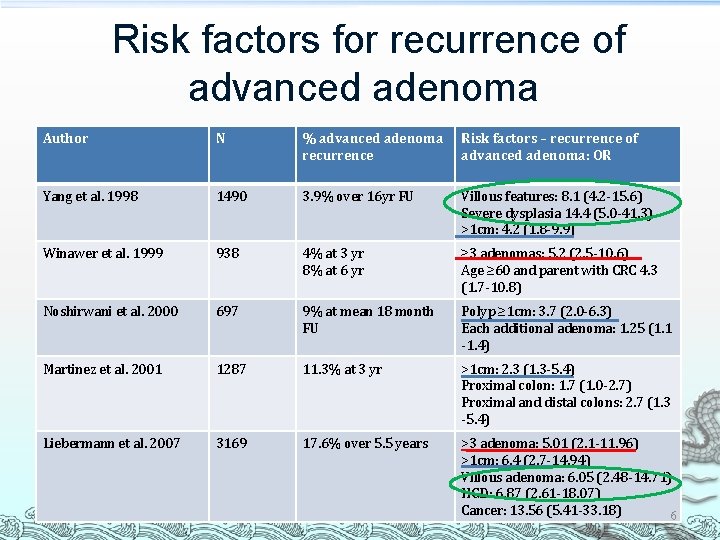
Risk factors for recurrence of advanced adenoma Author N % advanced adenoma recurrence Risk factors – recurrence of advanced adenoma: OR Yang et al. 1998 1490 3. 9% over 16 yr FU Villous features: 8. 1 (4. 2 -15. 6) Severe dysplasia 14. 4 (5. 0 -41. 3) >1 cm: 4. 2 (1. 8 -9. 9) Winawer et al. 1999 938 4% at 3 yr 8% at 6 yr ≥ 3 adenomas: 5. 2 (2. 5 -10. 6) Age ≥ 60 and parent with CRC 4. 3 (1. 7 -10. 8) Noshirwani et al. 2000 697 9% at mean 18 month FU Polyp ≥ 1 cm: 3. 7 (2. 0 -6. 3) Each additional adenoma: 1. 25 (1. 1 -1. 4) Martinez et al. 2001 1287 11. 3% at 3 yr >1 cm: 2. 3 (1. 3 -5. 4) Proximal colon: 1. 7 (1. 0 -2. 7) Proximal and distal colons: 2. 7 (1. 3 -5. 4) Liebermann et al. 2007 3169 17. 6% over 5. 5 years >3 adenoma: 5. 01 (2. 1 -11. 96) >1 cm: 6. 4 (2. 7 -14. 94) Villous adenoma: 6. 05 (2. 48 -14. 71) HGD: 6. 87 (2. 61 -18. 07) Cancer: 13. 56 (5. 41 -33. 18) 6
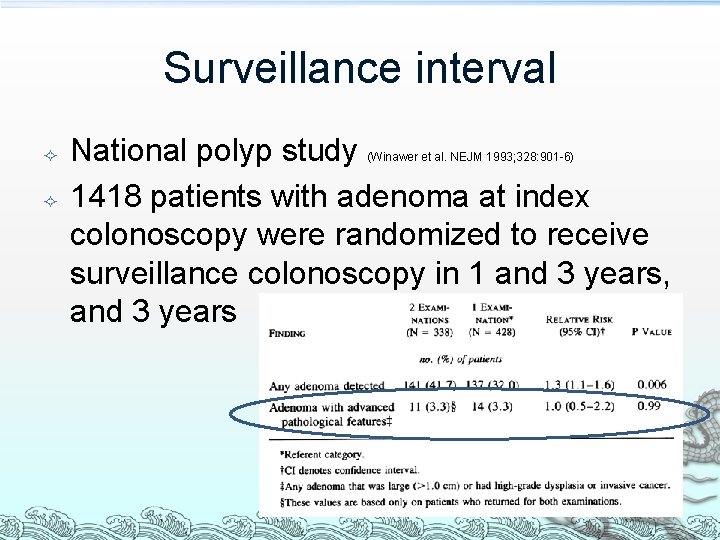
Surveillance interval National polyp study 1418 patients with adenoma at index colonoscopy were randomized to receive surveillance colonoscopy in 1 and 3 years, and 3 years (Winawer et al. NEJM 1993; 328: 901 -6) 7
Surveillance interval No statistically significant difference in number of high risk polyps detected with less frequent interval Advise for 3 -yearly surveillance 8
Risk stratification and Surveillance interval Atkin et al. NEJM 1992; 326: 658 -62 Cohort study of 1618 individuals with rectosigmoid adenomas (mainly detected with rigid sigmoidoscopy) with polypectomy No colonoscopy was done Average FU period was 14 years 9
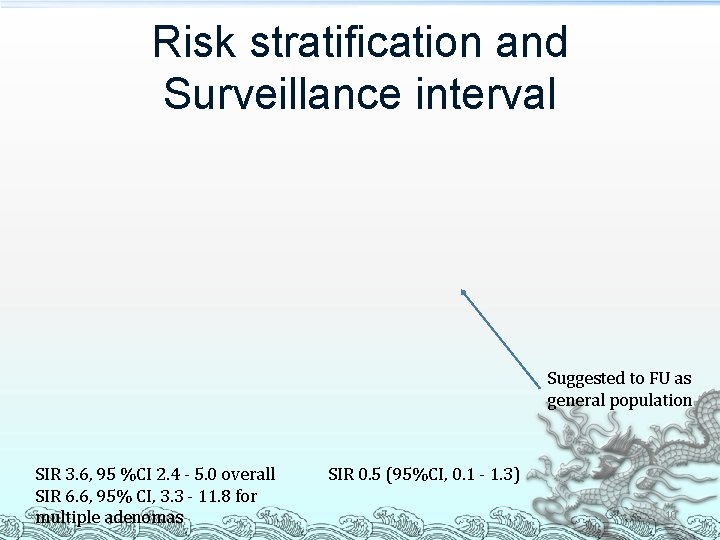
Risk stratification and Surveillance interval Suggested to FU as general population SIR 3. 6, 95 %CI 2. 4 - 5. 0 overall SIR 6. 6, 95% CI, 3. 3 - 11. 8 for multiple adenomas SIR 0. 5 (95%CI, 0. 1 - 1. 3) 10
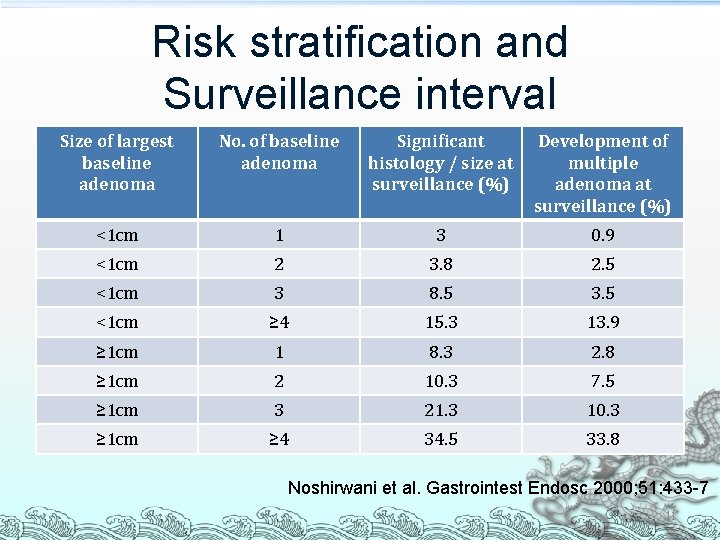
Risk stratification and Surveillance interval Size of largest baseline adenoma No. of baseline adenoma Significant histology / size at surveillance (%) Development of multiple adenoma at surveillance (%) <1 cm 1 3 0. 9 <1 cm 2 3. 8 2. 5 <1 cm 3 8. 5 3. 5 <1 cm ≥ 4 15. 3 13. 9 ≥ 1 cm 1 8. 3 2. 8 ≥ 1 cm 2 10. 3 7. 5 ≥ 1 cm 3 21. 3 10. 3 ≥ 1 cm ≥ 4 34. 5 33. 8 Noshirwani et al. Gastrointest Endosc 2000; 51: 433 -7 11
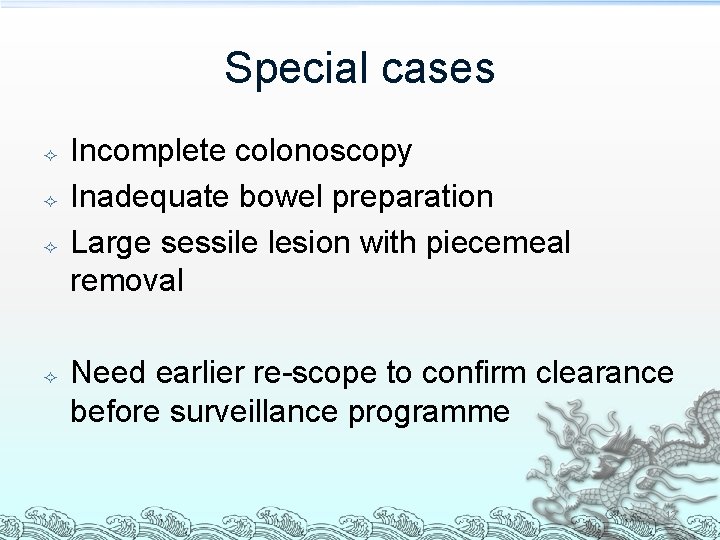
Special cases Incomplete colonoscopy Inadequate bowel preparation Large sessile lesion with piecemeal removal Need earlier re-scope to confirm clearance before surveillance programme 12
After first surveillance… No high level evidence for follow up programme after the first surveillance colonoscopy Recommendations from professional bodies according to expert opinion 13
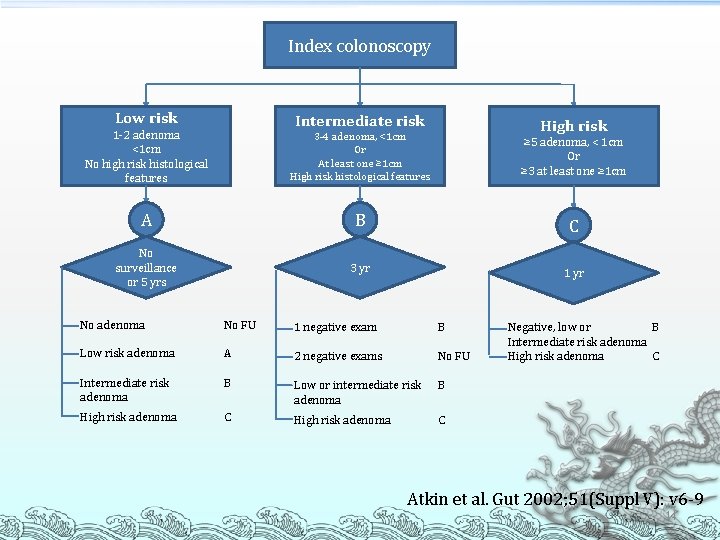
Index colonoscopy Low risk Intermediate risk High risk 1 -2 adenoma <1 cm No high risk histological features 3 -4 adenoma, <1 cm Or At least one ≥ 1 cm High risk histological features A B C No surveillance or 5 yrs 3 yr 1 yr ≥ 5 adenoma, < 1 cm Or ≥ 3 at least one ≥ 1 cm No adenoma No FU 1 negative exam B Low risk adenoma A 2 negative exams No FU Intermediate risk adenoma B Low or intermediate risk adenoma B High risk adenoma C Negative, low or B Intermediate risk adenoma High risk adenoma C Atkin et al. Gut 2002; 51(Suppl V): v 6 -9 14
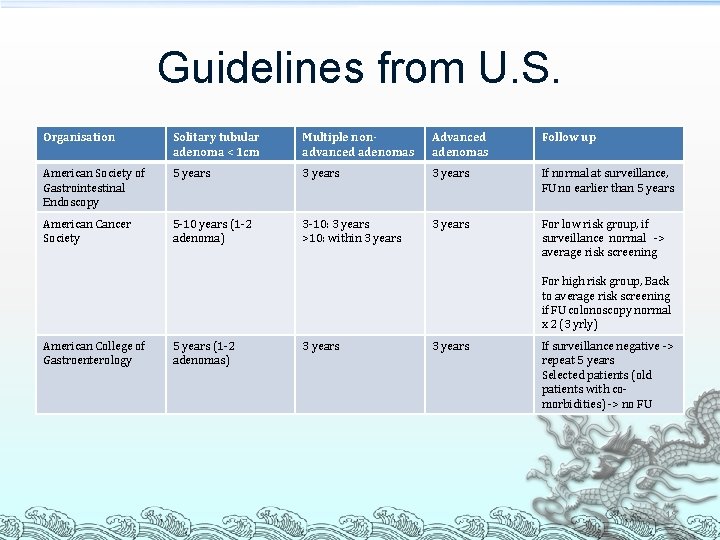
Guidelines from U. S. Organisation Solitary tubular adenoma < 1 cm Multiple nonadvanced adenomas Advanced adenomas Follow up American Society of Gastrointestinal Endoscopy 5 years 3 years If normal at surveillance, FU no earlier than 5 years American Cancer Society 5 -10 years (1 -2 adenoma) 3 -10: 3 years >10: within 3 years For low risk group, if surveillance normal -> average risk screening For high risk group, Back to average risk screening if FU colonoscopy normal x 2 (3 yrly) American College of Gastroenterology 5 years (1 -2 adenomas) 3 years If surveillance negative -> repeat 5 years Selected patients (old patients with comorbidities) -> no FU 15
Conclusion Optimal surveillance interval after polypectomy lacked conclusive evidence Current guidelines were mainly based on result of few studies, knowledge on adenoma-carcinoma sequence and expert opinion 16
Take home message Interval of surveillance is based on finding at index colonoscopy Risk stratification by ³ ³ ³ Number Size Histology 17
Questions? 18
Thank you 19