
SURREALISM 1924 45 SALVADOD DALI WHAT IS SURREALISM

- Slides: 11
SURREALISM (1924 -45) SALVADOD DALI
WHAT IS SURREALISM Surrealism is a cultural movement that began in the early 1920 s, and is best known for the visual artworks and writings of the group members. Surrealist works feature the element of surprise, unexpected juxtapositions and non sequitur; however, many Surrealist artists and writers[who? ] regard their work as an expression of the philosophical movement first and foremost, with the works being an artifact. Leader André Breton was explicit in his assertion that Surrealism was above all a revolutionary movement. Surrealism developed out of the Dada activities during World War I and the most important center of the movement was Paris. From the 1920 s onward, the movement spread around the globe, eventually affecting the visual arts, literature, film, and music of many countries and languages, as well as political thought and practice, philosophy, and social theory
Dali embraced all the science of painting as a way to study the psyche through subconscious images. He called this process the Paranoiac Critical Method. As any paranoiac, the artist should allow these images to reach the conscience, and then do what the paranoiac cannot do: Freeze them on canvas to give consciousness the opportunity to comprehend their meaning. Later on, he expanded the process into the Oniric-Critical Method, in which the artist pays attention to his dreams, freezing them through art, and analyzing them as well. As Freud said, "A dream that is not interpreted is like a letter that is not opened. "
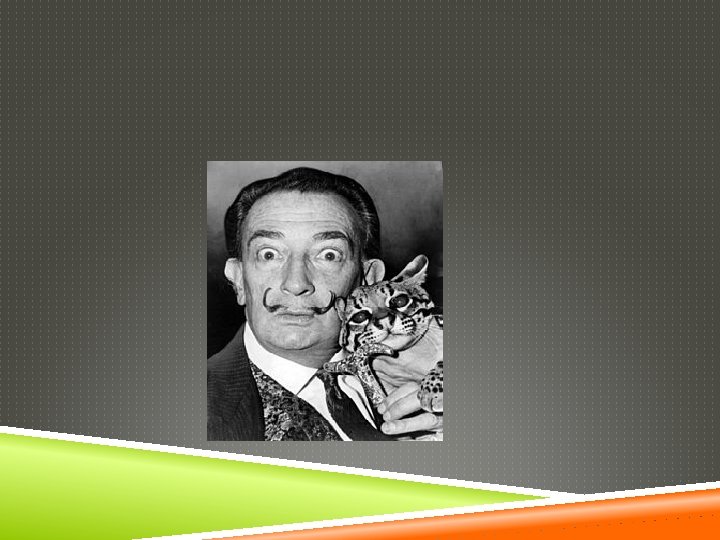
Dalí was a skilled draftsman, best known for the striking and bizarre images in his surrealist work. His painterly skills are often attributed to the influence of Renaissance masters. [2][3] His bestknown work, The Persistence of Memory, was completed in 1931. Dalí's expansive artistic repertoire includes film, sculpture, and photography, in collaboration with a range of artists in a variety of media.
SYMBOLISM IN HIS WORK alí employed extensive symbolism in his work. For instance, the hallmark "soft watches" that first appear in The Persistence of Memory suggest Einstein's theory that time is relative and not fixed. [26] The idea for clocks functioning symbolically in this way came to Dalí when he was staring at a runny piece of Camembert cheese on a hot day in August. [59] The elephant is also a recurring image in Dalí's works. It first appeared in his 1944 work Dream Caused by the Flight of a Bee Around a Pomegranate a Second Before Awakening. The elephants, inspired by Gian Lorenzo Bernini's sculpture base in Rome of an elephant carrying an ancient obelisk, [60] are portrayed "with long, multijointed, almost invisible legs of desire"[61] along with obelisks on their backs. Coupled with the image of their brittle legs, these encumbrances, noted for their phallic overtones, create a sense of phantom reality. "The elephant is a distortion in space", one analysis explains, "its spindly legs contrasting the idea of weightlessness with structure. "[61] "I am painting pictures which make me die for joy, I am creating with an absolute naturalness, without the slightest aesthetic concern, I am making things that inspire me with a profound emotion and I am trying to paint them honestly. " — Salvador Dalí, in Dawn Ades, Dalí and Surrealism. The egg is another common Dalíesque image. He connects the egg to the prenatal and intrauterine, thus using it to symbolize hope and love; [62] it appears in The Great Masturbator and The Metamorphosis of Narcissus also symbolized death and petrification. Various animals appear throughout his work as well: ants point to death, decay, and immense sexual desire; the snail is connected to the human head (he saw a snail on a bicycle outside Freud's house when he first met Sigmund Freud); and locusts are a symbol of waste and fear. [6
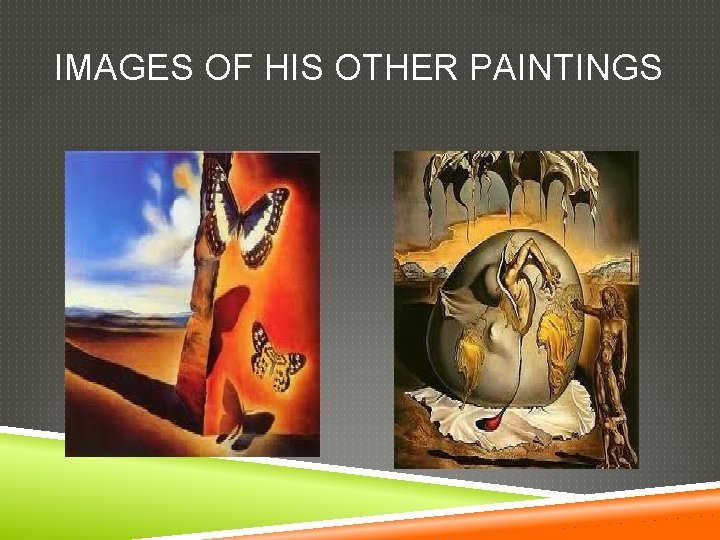
IMAGES OF HIS OTHER PAINTINGS
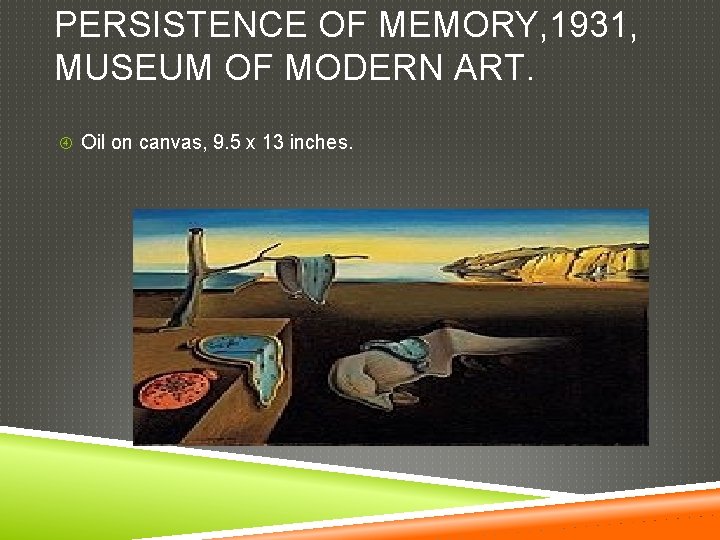
PERSISTENCE OF MEMORY, 1931, MUSEUM OF MODERN ART. Oil on canvas, 9. 5 x 13 inches.
The well-known surrealist piece introduced the image of the soft melting pocket watch. [2] It epitomizes Dalí's theory of "softness" and "hardness", which was central to his thinking at the time. As Dawn Ades wrote, "The soft watches are an unconscious symbol of the relativity of space and time, a Surrealist meditation on the collapse of our notions of a fixed cosmic order". [3] This interpretation suggests that Dalí was incorporating an understanding of the world introduced by Albert Einstein's Special Theory of Relativity. Asked by Ilya Prigogine whether this was in fact the case, Dalí replied that the soft watches were not inspired by theory of relativity, but by the surrealist perception of a Camembert cheese melting in the sun. [4]
Although fundamentally part of Dalí's Freudian phase, the imagery precedes his transition to his scientific phase by fourteen years, which occurred after the atomic bombings of Hiroshima and Nagasaki in 1945. It is possible to recognize a human figure in the middle of the composition, in the strange "monster" that Dalí used in several period pieces to represent himself – the abstract form becoming something of a self-portrait, reappearing frequently in his work. The orange clock at the bottom left of the painting is covered in ants. Dalí often used ants in his paintings as a symbol for death, as well as a symbol of female genitalia. The figure in the middle of the picture is symbolized as a "fading" creature, as which, when one often dreams, he or she cannot pin-point the exact form and composition of a creature. One can also see that the creature has one closed eye with several eyelashes; this also suggests that the creature is in a dream state. The iconography of this famous painting is that of a dream that Dalí had experienced. The clocks symbolize the passing of time that one experiences in a dream state. The Persistence of Memory employs "the exactitude of realist painting techniques“, to depict imagery more likely to be found in dreams than in waking consciousness.