
SURGICAL SITE INFECTION PREVENTION BUNDLE FOR CESAREAN DELIVERY
SURGICAL SITE INFECTION PREVENTION BUNDLE FOR CESAREAN DELIVERY AND ABDOMINAL HYSTERECTOMY AT AN URBAN TERTIARY CARE TEACHING HOSPITAL Presenting author: Dr. Catherine Callinan, Denver Health Medical Center, Catherine. Callinan@cuanschutz. edu Catherine Callinan, MD 1; Deborah Aragon, MPH 1; Bryan Knepper, MPH 1; Karen Ryall, Ph. D 2; Kent Heyborne, MD 1; Meredith Alston, MD 1; Stefka Fabbri, MD, MPH 1 1. 2. Denver Health Medical Center, Denver, CO Rocky Mountain Poison & Drug Safety (RMPDS). Denver, CO
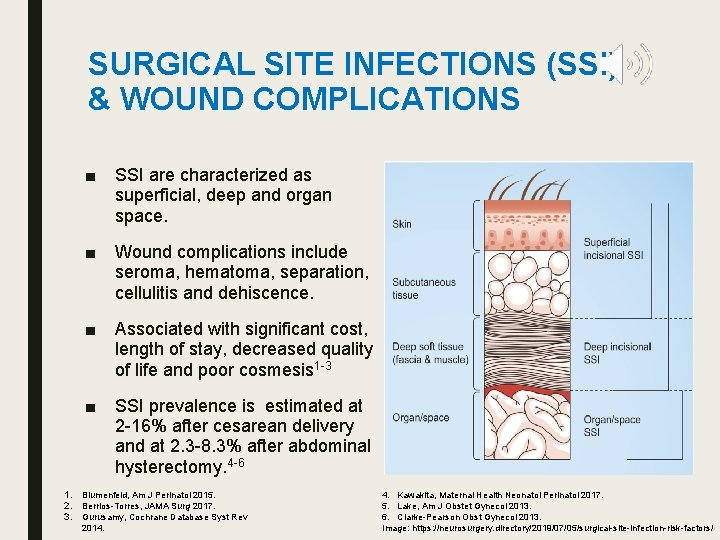
SURGICAL SITE INFECTIONS (SSI) & WOUND COMPLICATIONS 1. 2. 3. ■ SSI are characterized as superficial, deep and organ space. ■ Wound complications include seroma, hematoma, separation, cellulitis and dehiscence. ■ Associated with significant cost, length of stay, decreased quality of life and poor cosmesis 1 -3 ■ SSI prevalence is estimated at 2 -16% after cesarean delivery and at 2. 3 -8. 3% after abdominal hysterectomy. 4 -6 Blumenfeld, Am J Perinatol 2015. Berrios-Torres, JAMA Surg 2017. Gurusamy, Cochrane Database Syst Rev 2014. Kawakita, Maternal Health Neonatol Perinatol 2017. 5. Lake, Am J Obstet Gynecol 2013. 6. Clarke-Pearson Obst Gynecol 2013. Image: https: //neurosurgery. directory/2019/07/05/surgical-site-infection-risk-factors/
PREVENTION BUNDLE ■ A bundle is a selection of interventions either theorized or individually demonstrated to provide an impact on a desired outcome. ■ A number of studies have demonstrated benefit of SSI prevention bundles 1 -5 ■ ACOG and the Council on Patient Safety in Women’s Health Care recently published evidence-based practice guidelines 6 -7 1. 2. 3. 4. Andiman, Obstet Gynecol 2006. Bruce, Gynecol Oncol 2018. Harris, Am J Obstet Gynecol 2017. Johnson, Obstet Gynecol 2016. 5. 6. 7. Lippitt, Obstet Gynecol 2017. ACOG Practice Bulletin No. 195, 2018. ACOG. The Council on Patient Safety in Women’s Health Care. Patient Safety Bundle 2015.
STUDY OBJECTIVE Evaluate the impact of a SSI prevention bundle on the composite incidence of wound complications and surgical site infections after cesarean delivery and abdominal hysterectomy at a tertiary academic care center.
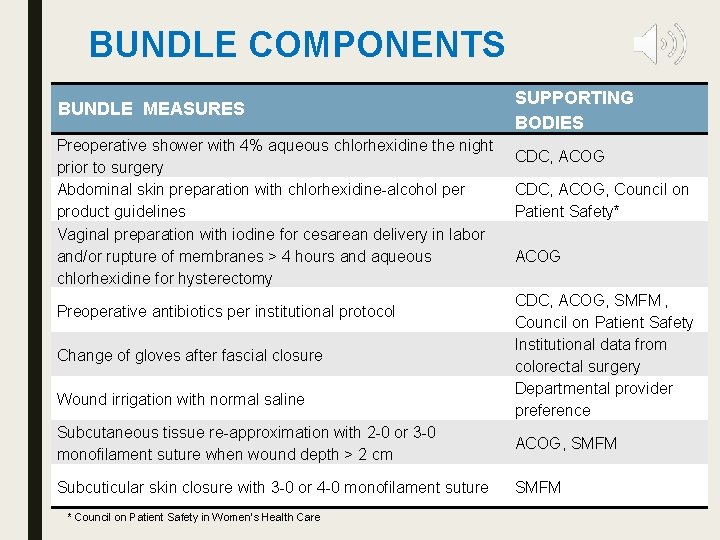
BUNDLE COMPONENTS BUNDLE MEASURES Preoperative shower with 4% aqueous chlorhexidine the night prior to surgery Abdominal skin preparation with chlorhexidine-alcohol per product guidelines Vaginal preparation with iodine for cesarean delivery in labor and/or rupture of membranes > 4 hours and aqueous chlorhexidine for hysterectomy Preoperative antibiotics per institutional protocol Change of gloves after fascial closure Wound irrigation with normal saline SUPPORTING BODIES CDC, ACOG, Council on Patient Safety* ACOG CDC, ACOG, SMFM , Council on Patient Safety Institutional data from colorectal surgery Departmental provider preference Subcutaneous tissue re-approximation with 2 -0 or 3 -0 monofilament suture when wound depth > 2 cm ACOG, SMFM Subcuticular skin closure with 3 -0 or 4 -0 monofilament suture SMFM * Council on Patient Safety in Women’s Health Care
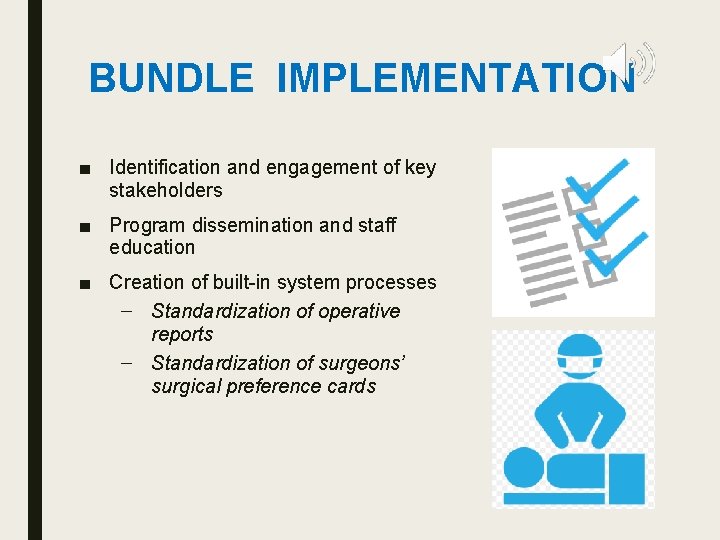
BUNDLE IMPLEMENTATION ■ Identification and engagement of key stakeholders ■ Program dissemination and staff education ■ Creation of built-in system processes – Standardization of operative reports – Standardization of surgeons’ surgical preference cards
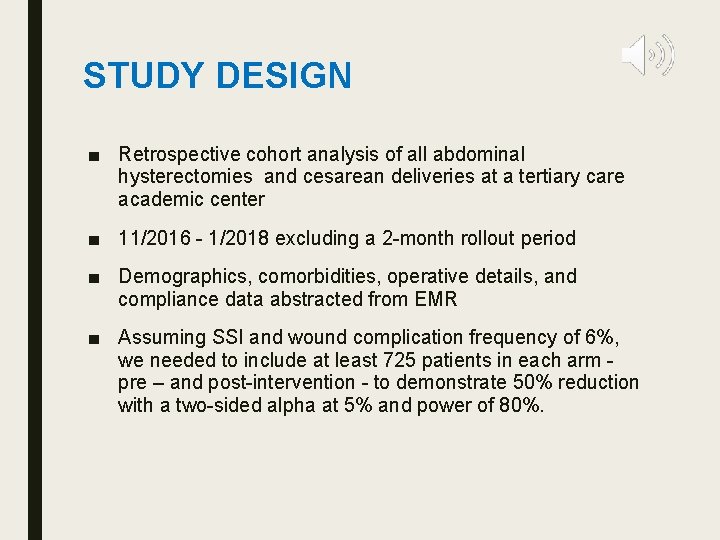
STUDY DESIGN ■ Retrospective cohort analysis of all abdominal hysterectomies and cesarean deliveries at a tertiary care academic center ■ 11/2016 - 1/2018 excluding a 2 -month rollout period ■ Demographics, comorbidities, operative details, and compliance data abstracted from EMR ■ Assuming SSI and wound complication frequency of 6%, we needed to include at least 725 patients in each arm - pre – and post-intervention - to demonstrate 50% reduction with a two-sided alpha at 5% and power of 80%.
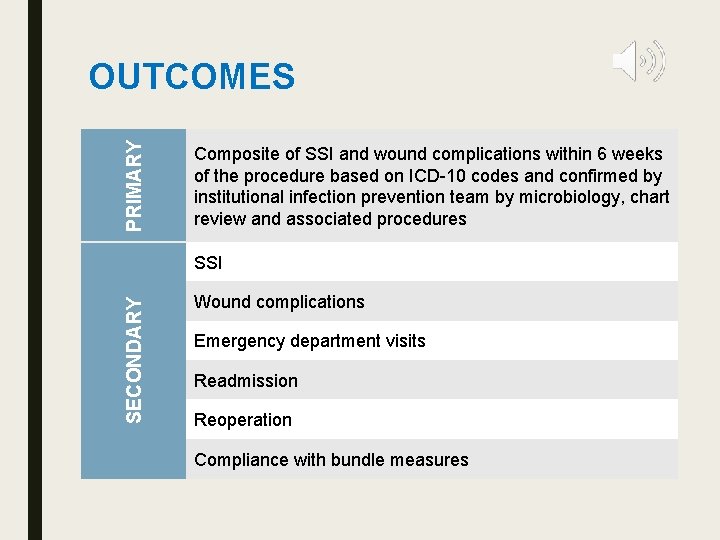
PRIMARY OUTCOMES Composite of SSI and wound complications within 6 weeks of the procedure based on ICD-10 codes and confirmed by institutional infection prevention team by microbiology, chart review and associated procedures SECONDARY SSI Wound complications Emergency department visits Readmission Reoperation Compliance with bundle measures
RESULTS ■ 807 cases were performed in the pre-bundle period - 38 abdominal hysterectomies and 769 cesarean deliveries. ■ 824 cases were performed in the post-bundle period - 44 abdominal hysterectomies and 781 cesarean deliveries. ■ Demographic characteristics were similar across the pre- and post-bundle cohorts. ■ Operative characteristics were similar in the pre-bundle and post-bundle periods with the exception of increased operative time and estimated blood loss.
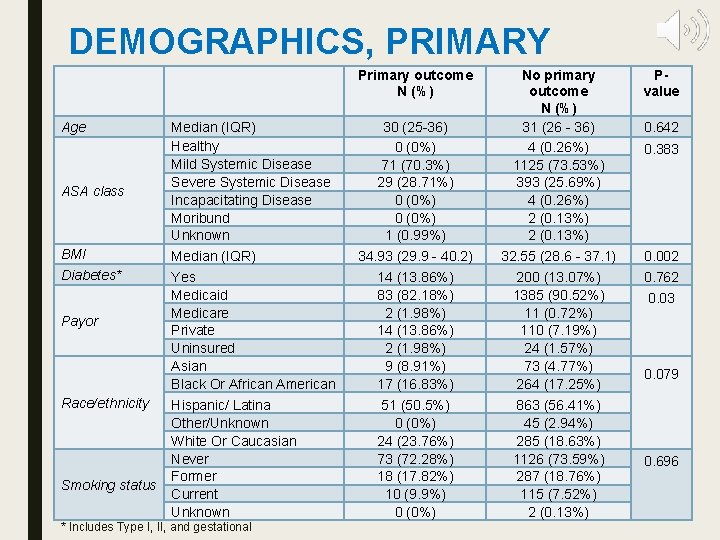
DEMOGRAPHICS, PRIMARY OUTCOME Primary outcome N (%) Age ASA class BMI Diabetes* Payor Race/ethnicity Smoking status Median (IQR) Healthy Mild Systemic Disease Severe Systemic Disease Incapacitating Disease Moribund Unknown Median (IQR) Yes Medicaid Medicare Private Uninsured Asian Black Or African American Hispanic/ Latina Other/Unknown White Or Caucasian Never Former Current Unknown * Includes Type I, II, and gestational 30 (25 -36) 0 (0%) 71 (70. 3%) 29 (28. 71%) 0 (0%) 1 (0. 99%) 34. 93 (29. 9 - 40. 2) 14 (13. 86%) 83 (82. 18%) 2 (1. 98%) 14 (13. 86%) 2 (1. 98%) 9 (8. 91%) 17 (16. 83%) No primary outcome N (%) 31 (26 - 36) 4 (0. 26%) 1125 (73. 53%) 393 (25. 69%) 4 (0. 26%) 2 (0. 13%) 32. 55 (28. 6 - 37. 1) 200 (13. 07%) 1385 (90. 52%) 11 (0. 72%) 110 (7. 19%) 24 (1. 57%) 73 (4. 77%) 264 (17. 25%) 51 (50. 5%) 0 (0%) 24 (23. 76%) 73 (72. 28%) 18 (17. 82%) 10 (9. 9%) 0 (0%) 863 (56. 41%) 45 (2. 94%) 285 (18. 63%) 1126 (73. 59%) 287 (18. 76%) 115 (7. 52%) 2 (0. 13%) Pvalue 0. 642 0. 383 0. 002 0. 762 0. 03 0. 079 0. 696
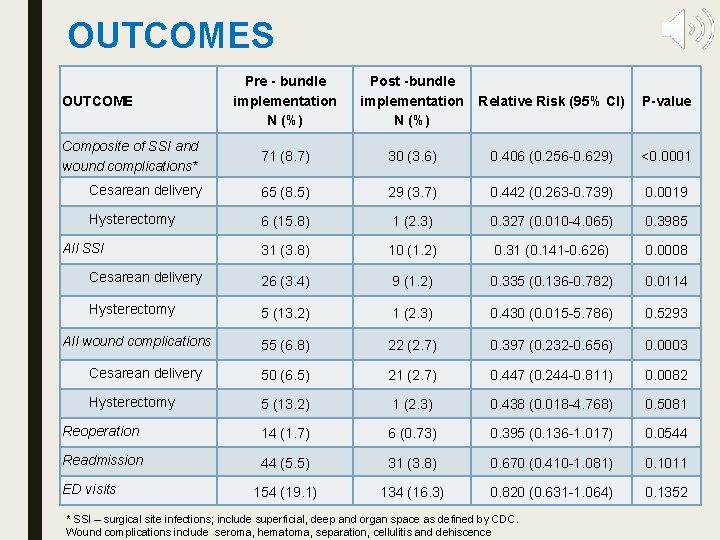
OUTCOMES Pre - bundle implementation N (%) Post -bundle implementation N (%) Relative Risk (95% CI) P-value Composite of SSI and wound complications* 71 (8. 7) 30 (3. 6) 0. 406 (0. 256 -0. 629) <0. 0001 Cesarean delivery 65 (8. 5) 29 (3. 7) 0. 442 (0. 263 -0. 739) 0. 0019 Hysterectomy 6 (15. 8) 1 (2. 3) 0. 327 (0. 010 -4. 065) 0. 3985 31 (3. 8) 10 (1. 2) 0. 31 (0. 141 -0. 626) 0. 0008 Cesarean delivery 26 (3. 4) 9 (1. 2) 0. 335 (0. 136 -0. 782) 0. 0114 Hysterectomy 5 (13. 2) 1 (2. 3) 0. 430 (0. 015 -5. 786) 0. 5293 55 (6. 8) 22 (2. 7) 0. 397 (0. 232 -0. 656) 0. 0003 Cesarean delivery 50 (6. 5) 21 (2. 7) 0. 447 (0. 244 -0. 811) 0. 0082 Hysterectomy 5 (13. 2) 1 (2. 3) 0. 438 (0. 018 -4. 768) 0. 5081 Reoperation 14 (1. 7) 6 (0. 73) 0. 395 (0. 136 -1. 017) 0. 0544 Readmission 44 (5. 5) 31 (3. 8) 0. 670 (0. 410 -1. 081) 0. 1011 154 (19. 1) 134 (16. 3) 0. 820 (0. 631 -1. 064) 0. 1352 OUTCOME All SSI All wound complications ED visits * SSI – surgical site infections; include superficial, deep and organ space as defined by CDC. Wound complications include seroma, hematoma, separation, cellulitis and dehiscence
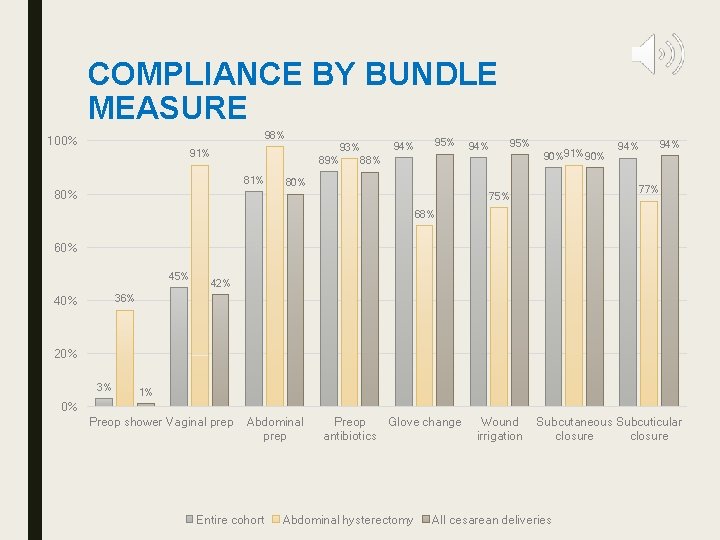
COMPLIANCE BY BUNDLE MEASURE 98% 100% 89% 81% 80% 95% 94% 93% 91% 95% 94% 88% 90% 91% 90% 80% 94% 77% 75% 68% 60% 45% 42% 36% 40% 20% 3% 1% 0% Preop shower Vaginal prep Abdominal prep Entire cohort Preop Glove change antibiotics Abdominal hysterectomy Wound irrigation Subcutaneous Subcuticular closure All cesarean deliveries
DISCUSSION ■ At our institution, SSI prevention bundle decreases the risk of surgical site infections and wound complications by 60% – There is significant reduction in both SSI and wound complications – The findings are driven primarily by observations in cesarean deliveries ■ The results of this study are similar to previously published studies of surgical site infection prevention bundles in cesarean delivery 1 -2 and hysterectomy 3. 1. Temming, Am J Obstet Gynecol, 2017 2. Carter, Obstet Gynecol 2017 3. Andiman, Obstet Gynecol 2018
LIMITATIONS AND STRENGTHS Limitations Strengths ■ Retrospective design ■ Large sample size ■ Compliance and documentation with bundle measures ■ Power analysis ■ Heterogeneity in patient and procedure ■ Loss to follow up ■ Logistic regression
CONCLUSION & ACKNOLEDGEMENTS This study adds to the growing body of literature supporting the use of surgical site infection prevention bundles in cesarean delivery and gynecologic surgery. THANK YOU TO: ■ SASGOG ■ Denver Health Medical Center Infection Prevention Team ■ Department of Obstetrics and Gynecology at Denver Health
- Slides: 15