
Surgical Management of Osteoarthritis of the Knee EvidenceBased

Surgical Management of Osteoarthritis of the Knee: Evidence-Based Clinical Practice Guideline Adopted by the American Academy of Orthopaedic Surgeons (AAOS) Board of Directors December 4, 2015

The American Academy of Orthopaedic Surgeons 2015 Clinical Practice Guideline on the Surgical Management of Osteoarthritis of the Knee Brian Mc. Grory, MD; Kristy Weber, MD; John A. Lynott, MD; Vinod Dasa, MD; Theodore Toan Le, John C. Richmond, MD; Charles Moore Davis, III, MD, Ph. D; Adolph Yates, Jr. , MD; Atul F. Kamath, MD; Gregory A. Brown, MD, Ph. D; Tad L. Gerlinger, MD; Sara Piva, PT, Ph. D; Thomas Vilanueva, DO; MBA, FACPE, SFHM; James Hebl, MD; David Jevsevar, MD, MBA; Kevin Shea, MD; Kevin J. Bozic, MD, MBA; James Keeney, MD. AAOS Staff: William O. Shaffer, MD; Deborah Cummins, Ph. D; Jayson N. Murray, MA; Patrick Donnelly, MA; Nilay Patel, MA; Kaitlyn Sevarino, MBA; Anne Woznica, MLIS, AHIP; Peter Shores, MPH; Erica Linskey; Ben Brenton, MSAE © 2019 American Academy of Orthopaedic Surgeons
WHAT IS A CLINICAL PRACTICE GUIDELINE? Clinical Practice Guideline A clinical practice guideline is a series of recommendations created to inform clinicians of best practices, based on best available evidence © 2019 American Academy of Orthopaedic Surgeons
GOALS AND RATIONALE OF A CLINICAL PRACTICE GUIDELINE § Improve treatment based on current best evidence § Guides qualified physicians through treatment decisions to improve quality and efficiency of care § Identify areas for future research CPG recommendations are not meant to be fixed protocols; patients’ needs, local resources, and clinician independent medical judgement must be considered for any specific procedure or treatment © 2019 American Academy of Orthopaedic Surgeons
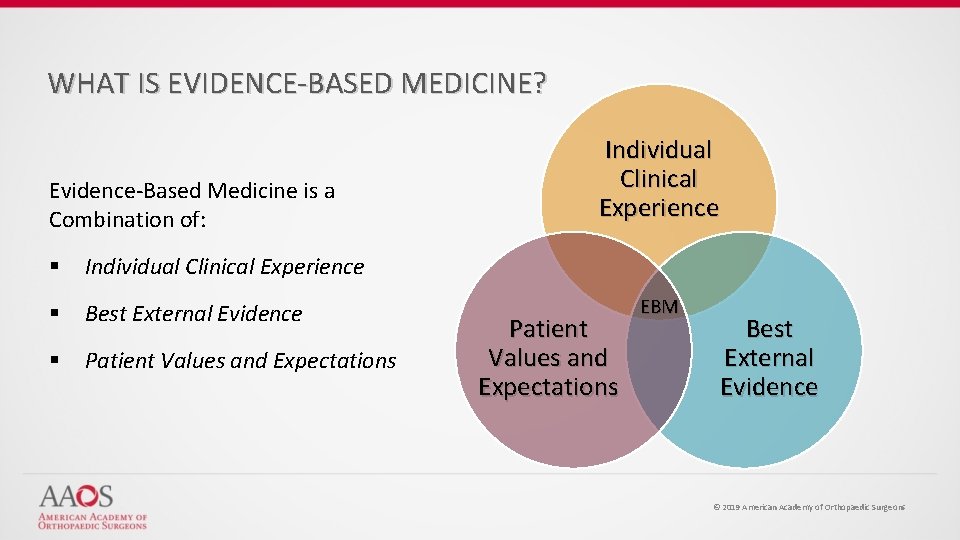
WHAT IS EVIDENCE-BASED MEDICINE? Evidence-Based Medicine is a Combination of: § Individual Clinical Experience § Best External Evidence § Patient Values and Expectations Individual Clinical Experience Patient Values and Expectations EBM Best External Evidence © 2019 American Academy of Orthopaedic Surgeons
WHAT IS EVIDENCE-BASED MEDICINE? Evidence-Based Medicine Evidence-based medicine is the conscientious, explicit, and judicious use of current best evidence from clinical care research in the management of individual patients Haynes, Sackett et al, 1996 Transferring evidence from research into practice Sacket et al, 1996, BMJ EBM: what it is and isn’t © 2019 American Academy of Orthopaedic Surgeons
IOM STANDARDS FOR DEVELOPING TRUSTWORTHY GUIDELINES § Establish Transparency § Management of Conflict of Interest § Guideline Development Group Composition § Clinical Practice Guideline-Systematic Review Intersection § Establish Evidence of Foundations for and Rating Strength of Recommendations § Articulation of Recommendations § External Review § Updating © 2019 American Academy of Orthopaedic Surgeons
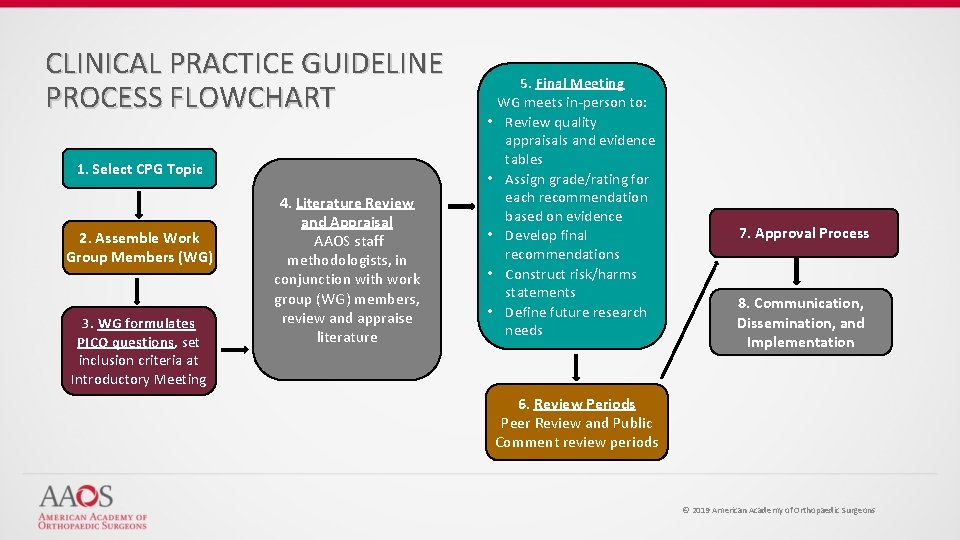
CLINICAL PRACTICE GUIDELINE PROCESS FLOWCHART 1. Select CPG Topic 2. Assemble Work Group Members (WG) 3. WG formulates PICO questions, set inclusion criteria at Introductory Meeting 4. Literature Review and Appraisal AAOS staff methodologists, in conjunction with work group (WG) members, review and appraise literature 5. Final Meeting WG meets in-person to: • Review quality appraisals and evidence tables • Assign grade/rating for each recommendation based on evidence • Develop final recommendations • Construct risk/harms statements • Define future research needs 7. Approval Process 8. Communication, Dissemination, and Implementation 6. Review Periods Peer Review and Public Comment review periods © 2019 American Academy of Orthopaedic Surgeons
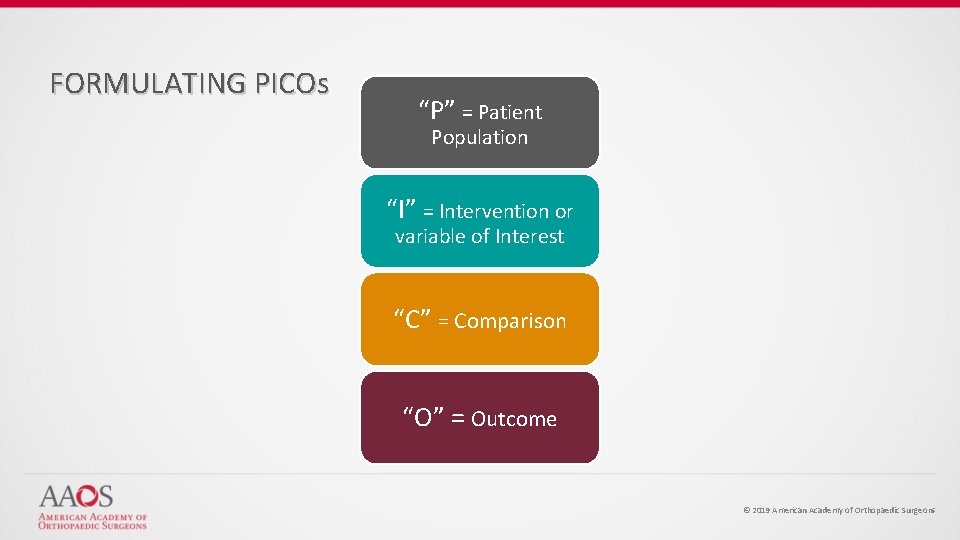
FORMULATING PICOs “P” = Patient Population “I” = Intervention or variable of Interest “C” = Comparison “O” = Outcome © 2019 American Academy of Orthopaedic Surgeons
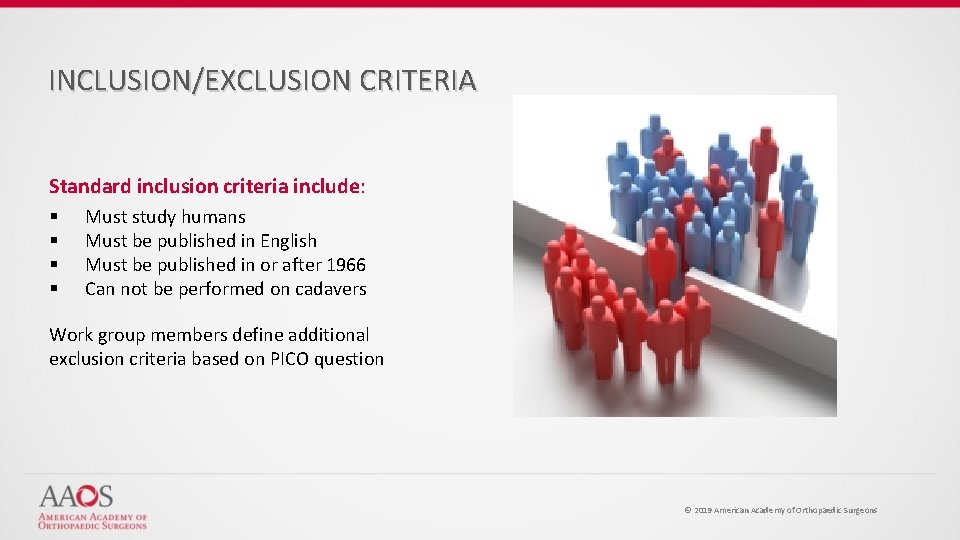
INCLUSION/EXCLUSION CRITERIA Standard inclusion criteria include: § § Must study humans Must be published in English Must be published in or after 1966 Can not be performed on cadavers Work group members define additional exclusion criteria based on PICO question © 2019 American Academy of Orthopaedic Surgeons
LITERATURE SEARCHES § Databases used: § Pub. Med § EMBASE (Excerpta Medica data. BASE) § CINAHL (Cumulative Index of Nursing and Allies Health Literature) § Cochrane Central Register of Controlled Trials § Search using key terms from work group’s PICO questions and inclusion criteria § Secondary manual search of the bibliographies of all retrieved publications for relevant citations § Recalled articles evaluated for inclusion based on the study selection criteria © 2019 American Academy of Orthopaedic Surgeons
BEST EVIDENCE SYNTHESIS § Include only highest quality evidence for any given outcome if available § If there are fewer than two occurrences of an outcome of this quality, the next lowest quality is considered until at least two occurrences have been acquired. © 2019 American Academy of Orthopaedic Surgeons
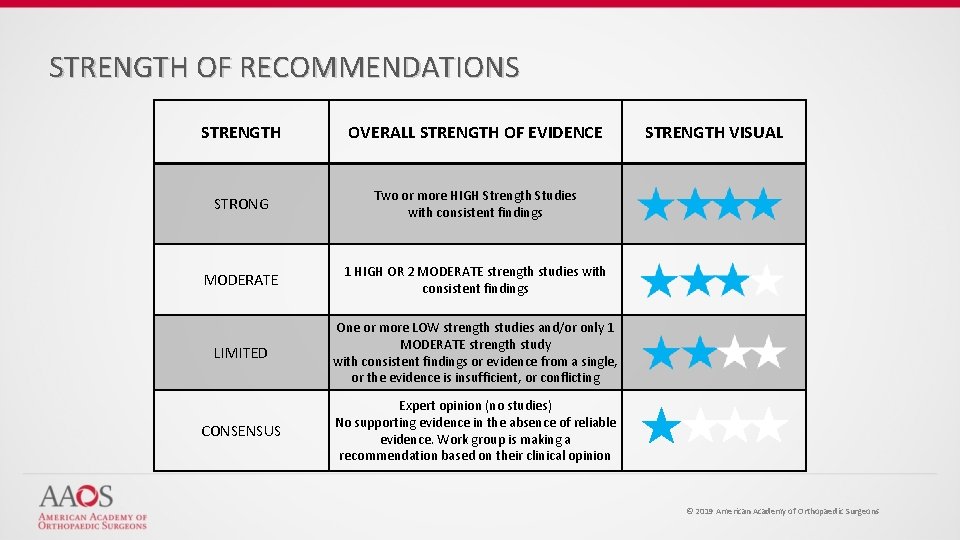
STRENGTH OF RECOMMENDATIONS STRENGTH OVERALL STRENGTH OF EVIDENCE STRONG Two or more HIGH Strength Studies with consistent findings MODERATE 1 HIGH OR 2 MODERATE strength studies with consistent findings LIMITED One or more LOW strength studies and/or only 1 MODERATE strength study with consistent findings or evidence from a single, or the evidence is insufficient, or conflicting CONSENSUS Expert opinion (no studies) No supporting evidence in the absence of reliable evidence. Work group is making a recommendation based on their clinical opinion STRENGTH VISUAL © 2019 American Academy of Orthopaedic Surgeons
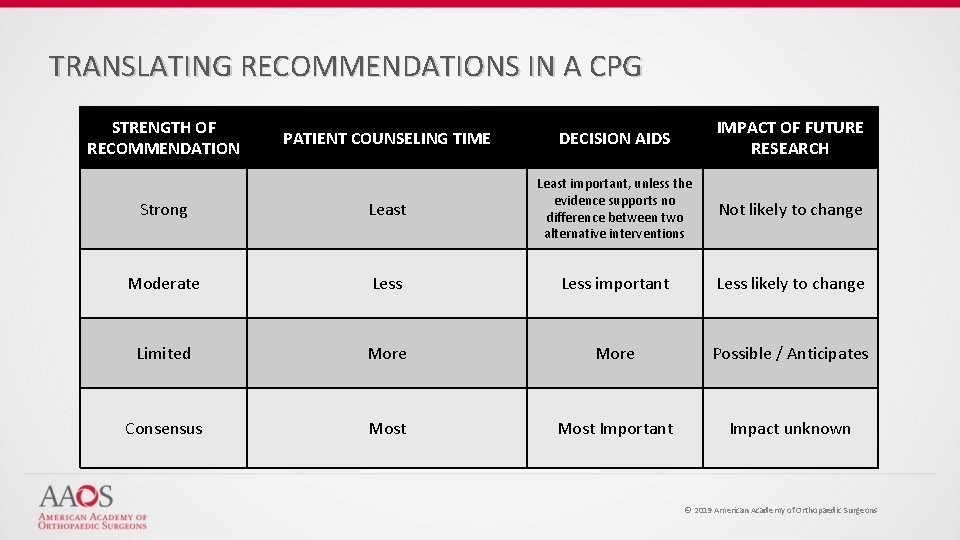
TRANSLATING RECOMMENDATIONS IN A CPG STRENGTH OF RECOMMENDATION PATIENT COUNSELING TIME DECISION AIDS IMPACT OF FUTURE RESEARCH Strong Least important, unless the evidence supports no difference between two alternative interventions Not likely to change Moderate Less important Less likely to change Limited More Possible / Anticipates Consensus Most Important Impact unknown © 2019 American Academy of Orthopaedic Surgeons

ASSESSING QUALITY OF EVIDENCE All included studies undergo a quality assessment Each study’s design is evaluated for risk of bias and receives a final quality grade, depending on the number of study design flaws Study quality tables are made available to the work group in the final data report and the final publication of the guideline/systematic review © 2019 American Academy of Orthopaedic Surgeons
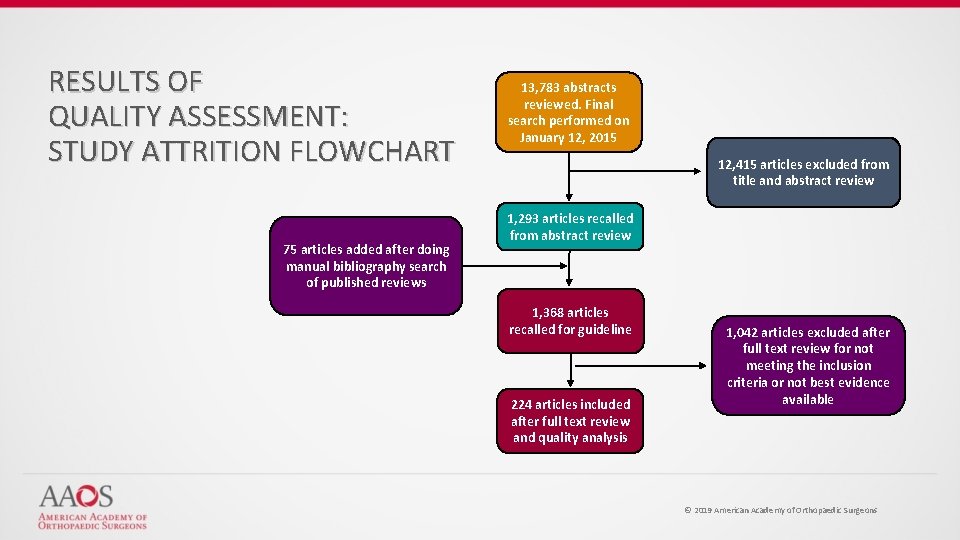
RESULTS OF QUALITY ASSESSMENT: STUDY ATTRITION FLOWCHART 75 articles added after doing manual bibliography search of published reviews 13, 783 abstracts reviewed. Final search performed on January 12, 2015 12, 415 articles excluded from title and abstract review 1, 293 articles recalled from abstract review 1, 368 articles recalled for guideline 224 articles included after full text review and quality analysis 1, 042 articles excluded after full text review for not meeting the inclusion criteria or not best evidence available © 2019 American Academy of Orthopaedic Surgeons
VOTING ON THE RECOMMENDATIONS Recommendations and recommendation strengths voted on by work group during final meeting Approved and adopted by simple majority (60%) when voting on every recommendation If disagreement, further discussion to whether the disagreement could be resolved © 2019 American Academy of Orthopaedic Surgeons
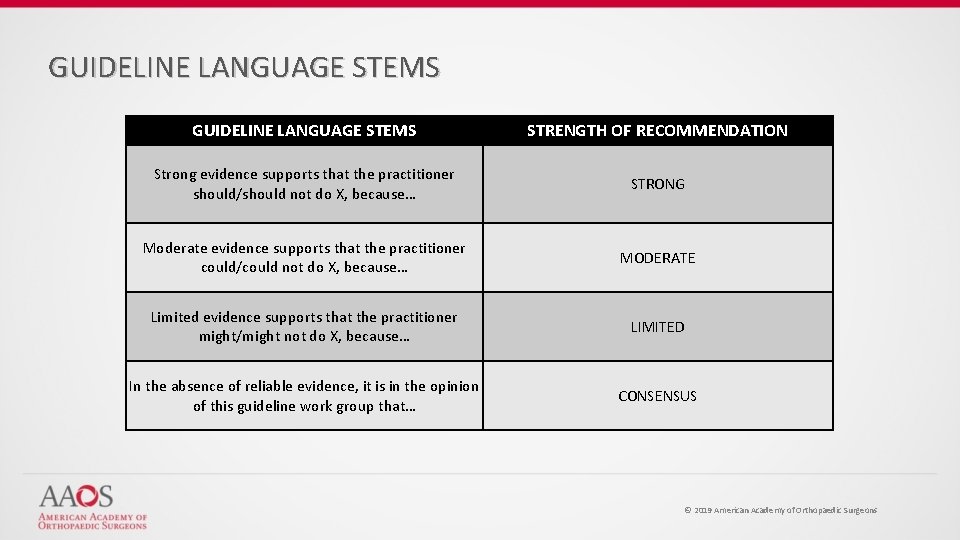
GUIDELINE LANGUAGE STEMS STRENGTH OF RECOMMENDATION Strong evidence supports that the practitioner should/should not do X, because… STRONG Moderate evidence supports that the practitioner could/could not do X, because… MODERATE Limited evidence supports that the practitioner might/might not do X, because… LIMITED In the absence of reliable evidence, it is in the opinion of this guideline work group that… CONSENSUS © 2019 American Academy of Orthopaedic Surgeons
PEER REVIEW § Guideline draft sent for peer review to external experts § Comments and draft of responses reviewed by work group members § Recommendation changes required a majority vote by work group § A detailed report of all resulting revisions is published with the guideline document © 2019 American Academy of Orthopaedic Surgeons
PUBLIC COMMENT Following peer review modifications, CPG undergoes public commentary period Comments are solicited from: • AAOS Board of Directors • AAOS Council on Research and Quality • AAOS Committee on Evidence-Based Quality and Value • AAOS Board of Councilors • AAOS Board of Specialty Societies • 200 commentators have the opportunity to provide input © 2019 American Academy of Orthopaedic Surgeons

FINAL MEETING The work group is charged with: § § Review of data summaries Final recommendation language Rationale and risk/harm construction Future research © 2019 American Academy of Orthopaedic Surgeons
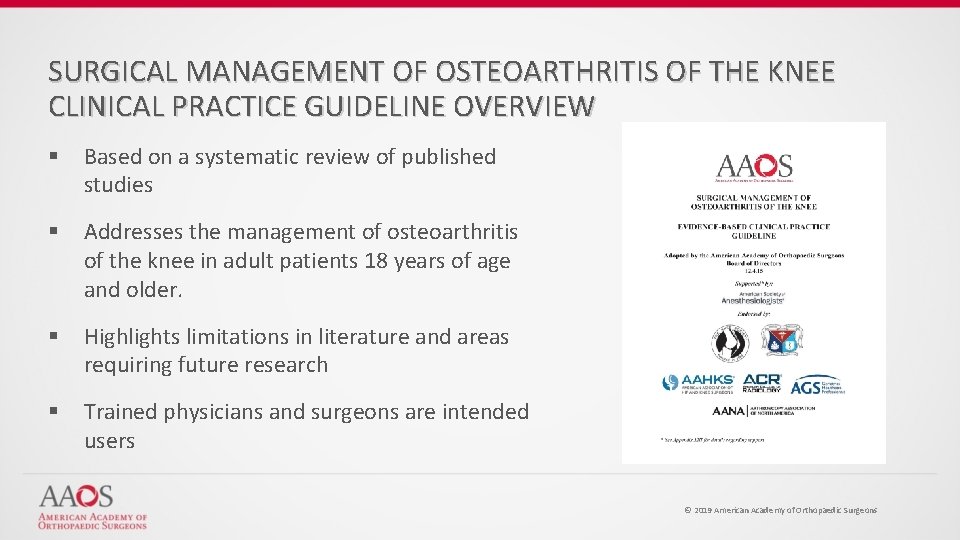
SURGICAL MANAGEMENT OF OSTEOARTHRITIS OF THE KNEE CLINICAL PRACTICE GUIDELINE OVERVIEW § Based on a systematic review of published studies § Addresses the management of osteoarthritis of the knee in adult patients 18 years of age and older. § Highlights limitations in literature and areas requiring future research § Trained physicians and surgeons are intended users © 2019 American Academy of Orthopaedic Surgeons
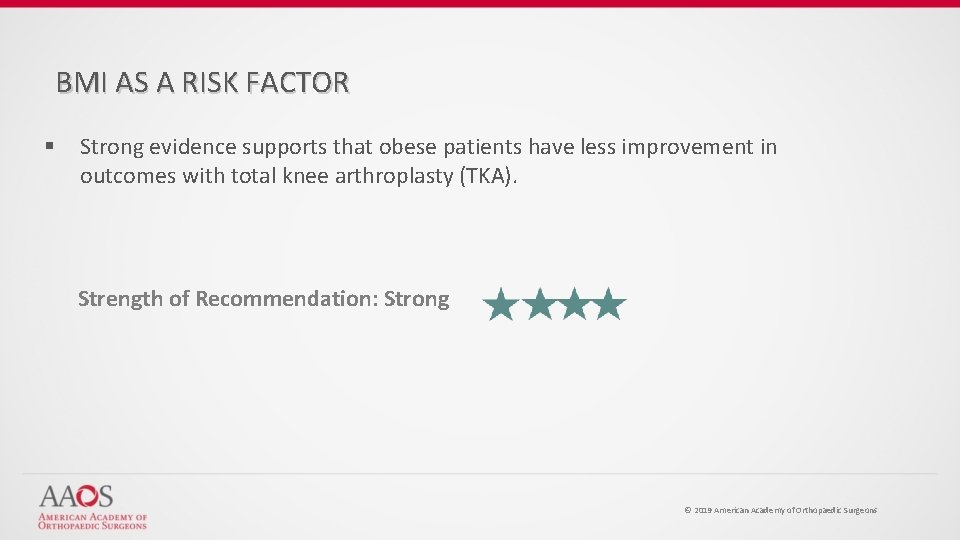
BMI AS A RISK FACTOR § Strong evidence supports that obese patients have less improvement in outcomes with total knee arthroplasty (TKA). Strength of Recommendation: Strong © 2019 American Academy of Orthopaedic Surgeons
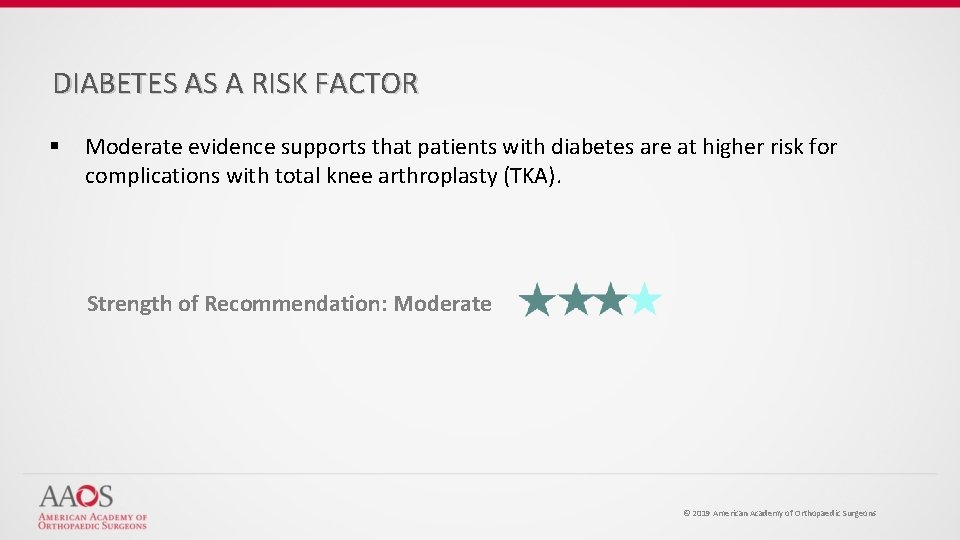
DIABETES AS A RISK FACTOR § Moderate evidence supports that patients with diabetes are at higher risk for complications with total knee arthroplasty (TKA). Strength of Recommendation: Moderate © 2019 American Academy of Orthopaedic Surgeons
CHRONIC PAIN AS A RISK FACTOR § Moderate evidence supports that patients with select chronic pain conditions have less improvement in patient reported outcomes with TKA. Strength of Recommendation: Moderate © 2019 American Academy of Orthopaedic Surgeons
DEPRESSION/ANXIETY AS A RISK FACTOR § Limited evidence supports that patients with depression and/or anxiety symptoms have less improvement in patient reported outcomes with total knee arthroplasty (TKA). Strength of Recommendation: Limited © 2019 American Academy of Orthopaedic Surgeons
CIRRHOSIS/HEPATITIS AS A RISK FACTOR § Limited evidence supports that patients with cirrhosis or hepatitis C are at higher risk for complications with total knee arthroplasty (TKA). Strength of Recommendation: Limited © 2019 American Academy of Orthopaedic Surgeons
PREOPERATIVE PHYSICAL THERAPY § Limited evidence supports that supervised exercise before total knee arthroplasty (TKA) might improve pain and physical function after surgery. Strength of Recommendation: Limited © 2019 American Academy of Orthopaedic Surgeons
DELAYED TOTAL KNEE ARTHROPLASTY § Moderate evidence supports that an eight month delay to total knee arthroplasty (TKA) does not worsen outcomes. Strength of Recommendation: Moderate © 2019 American Academy of Orthopaedic Surgeons
PERI-ARTICULAR LOCAL ANESTHETIC INFILTRATION § Strong evidence supports that the use of peri-articular local anesthetic infiltration in total knee arthroplasty (TKA) decreases pain and opioid use compared to placebo. Strength of Recommendation: Strong © 2019 American Academy of Orthopaedic Surgeons
PERIPHERAL NERVE BLOCKADE (PNB) § Strong evidence supports that peripheral nerve blockade for total knee arthroplasty (TKA) decreases postoperative pain and opioid requirements. Strength of Recommendation: Strong © 2019 American Academy of Orthopaedic Surgeons
NEURAXIAL ANESTHESIA • Moderate evidence supports that neuraxial anesthesia could be used in total knee arthroplasty (TKA) to improve select perioperative outcomes and complication rates compared to general anesthesia. Strength of Recommendation: Moderate © 2019 American Academy of Orthopaedic Surgeons
TOURNIQUET: BLOOD LOSS REDUCTION • Moderate evidence supports that the use of a tourniquet in total knee arthroplasty (TKA) decreases intraoperative blood loss. Strength of Recommendation: Moderate © 2019 American Academy of Orthopaedic Surgeons
TOURNIQUET: POSTOPERATIVE PAIN REDUCTION § Strong evidence supports that tourniquet use in total knee arthroplasty (TKA) increases short term post-operative pain. Strength of Recommendation: Strong © 2019 American Academy of Orthopaedic Surgeons
TOURNIQUET: POSTOPERATIVE FUNCTION § Limited evidence supports that tourniquet use in total knee arthroplasty (TKA) decreases short term post-operative function. Strength of Recommendation: Limited © 2019 American Academy of Orthopaedic Surgeons
TRANEXAMIC ACID § Strong evidence supports that, in patients with no known contraindications, treatment with tranexamic acid decreases postoperative blood loss and reduces the necessity of postoperative transfusions following total knee arthroplasty (TKA). Strength of Recommendation: Strong © 2019 American Academy of Orthopaedic Surgeons
ANTIBIOTIC CEMENT • Limited evidence does not support the routine use of antibiotics in the cement for primary total knee arthroplasty (TKA). Strength of Recommendation: Limited © 2019 American Academy of Orthopaedic Surgeons
CRUCIATE RETAINING ARTHROPLASTY § Strong evidence supports no difference in outcomes or complications between posterior stabilized and posterior cruciate retaining arthroplasty designs. Strength of Recommendation: Strong © 2019 American Academy of Orthopaedic Surgeons
POLYETHYLENE TIBIAL COMPONENTS § Strong evidence supports use of either all-polyethylene or modular tibial components in knee arthroplasty (KA) because of no difference in outcomes. Strength of Recommendation: Strong © 2019 American Academy of Orthopaedic Surgeons
PATELLAR RESURFACING: PAIN AND FUNCTION § Strong evidence supports no difference in pain or function with or without patellar resurfacing in total knee arthroplasty. Strength of Recommendation: Strong © 2019 American Academy of Orthopaedic Surgeons
PATELLAR RESURFACING: REOPERATIONS Moderate evidence supports that patellar resurfacing in total knee arthroplasty (TKA) could decrease cumulative reoperations after 5 years when compared to no patellar resurfacing in total knee arthroplasty (TKA). Strength of Recommendation: Moderate © 2019 American Academy of Orthopaedic Surgeons
CEMENTED TIBIAL COMPONENTS VERSUS CEMENTLESS TIBIAL COMPONENTS § Strong evidence supports the use of tibial component fixation that is cemented or cementless in total knee arthroplasty due to similar functional outcomes and rates of complications and reoperations. Strength of Recommendation: Strong © 2019 American Academy of Orthopaedic Surgeons
CEMENTED FEMORAL & TIBAL COMPONENTS VS CEMENTLESS FEMORAL AND TIBIAL COMPONENTS § Moderate evidence supports the use of either cemented femoral and tibial components or cementless femoral and tibial components in knee arthroplasty due to similar rates of complications and reoperations. © 2019 American Academy of Orthopaedic Surgeons
ALL CEMENTED COMPONENTS VERSUS HYBRID FIXATION (CEMENTLESS FEMORAL COMPONENT) § Moderate evidence supports the use of either cemented femoral and tibial components or cementless femoral and tibial components in knee arthroplasty due to similar rates of complications and reoperations. © 2019 American Academy of Orthopaedic Surgeons
ALL CEMENTLESS COMPONENTS VERSUS HYBRID FIXATION (CEMENTLESS FEMORAL COMPONENT) • Limited evidence supports the use of either all cementless components or hybrid fixation (cementless femur) in total knee arthroplasty due to similar rates of complications and reoperations. Strength of Recommendation: Limited © 2019 American Academy of Orthopaedic Surgeons
BILATERAL TKA • Limited evidence supports simultaneous bilateral total knee arthroplasty for patients aged 70 or younger or ASA status 1 -2, because there are no increased complications. Strength of Recommendation: Limited © 2019 American Academy of Orthopaedic Surgeons
UKA: REVISIONS § Moderate evidence supports that total knee arthroplasty (TKA) could be used to decrease revision surgery risk compared to unicompartmental knee arthroplasty (UKA) for medial compartment osteoarthritis. Strength of Recommendation: Moderate © 2019 American Academy of Orthopaedic Surgeons
UKA: DVT & MANIPULATION UNDER ANESTHESIA § Limited evidence supports that unicompartmental knee arthroplasty might be used to decrease the risk of deep vein thrombosis (DVT) and manipulation under anesthesia compared to total knee arthroplasty (TKA) for medial compartment osteoarthritis. Strength of Recommendation: Limited © 2019 American Academy of Orthopaedic Surgeons
UKA VERSUS OSTEOTOMY § Moderate evidence supports no difference between unicompartmental knee arthroplasty (UKA) or valgus-producing proximal tibial osteotomy in outcomes and complications in patients with medial compartment knee osteoarthritis. Strength of Recommendation: Moderate © 2019 American Academy of Orthopaedic Surgeons
PERI-ARTICULAR LOCAL ANESTHETIC INFILTRATION § Strong evidence supports that the use of peri-articular local anesthetic infiltration in total knee arthroplasty (TKA) decreases pain and opioid use compared to placebo. Strength of Recommendation: Strong © 2019 American Academy of Orthopaedic Surgeons
SURGICAL NAVIGATION § Strong evidence supports not using intraoperative navigation in total knee arthroplasty (TKA) because there is no difference in outcomes or complications. Strength of Recommendation: Strong © 2019 American Academy of Orthopaedic Surgeons
PATIENT SPECIFIC INSTRUMENTATION: PAIN AND FUNCTION § Strong evidence supports not using patient specific instrumentation compared to conventional instrumentation for total knee arthroplasty (TKA) because there is no difference in pain or functional outcomes. Strength of Recommendation: Strong © 2019 American Academy of Orthopaedic Surgeons
PATIENT SPECIFIC INSTRUMENTATION: TRANSFUSIONS AND COMPLICATIONS § Moderate evidence supports not using patient specific instrumentation compared to conventional instrumentation for total knee arthroplasty (TKA) because there is no difference in transfusions or complications. © 2019 American Academy of Orthopaedic Surgeons
DRAINS § Strong evidence supports not using a drain with total knee arthroplasty (TKA) because there is no difference in complications or outcomes. Strength of Recommendation: Strong © 2019 American Academy of Orthopaedic Surgeons
CRYOTHERAPY DEVICES § Moderate evidence supports that cryotherapy devices after knee arthroplasty (KA) do not improve outcomes. © 2019 American Academy of Orthopaedic Surgeons
CONTINUOUS PASSIVE MOTION (CPM) § Strong evidence supports that CPM after knee arthroplasty (KA) does not improve outcomes. © 2019 American Academy of Orthopaedic Surgeons
POSTOPERATIVE MOBILIZATION: LENGTH OF STAY § Strong evidence supports that rehabilitation started on the day of the total knee arthroplasty (TKA) reduces length of hospital stay. © 2019 American Academy of Orthopaedic Surgeons
POSTOPERATIVE MOBILIZATION: PAIN AND FUNCTION § Moderate evidence supports that rehabilitation started on day of total knee arthroplasty (TKA) compared to rehabilitation started on postop day 1 reduces pain and improves function. © 2019 American Academy of Orthopaedic Surgeons
EARLY STAGE SUPERVISED EXERCISE PROGRAM: FUNCTION § Moderate evidence supports that a supervised exercise program during the first two months after total knee arthroplasty (TKA) improves physical function. © 2019 American Academy of Orthopaedic Surgeons
EARLY STAGE SUPERVISED EXERCISE PROGRAM: PAIN § Limited evidence supports that a supervised exercise program during the first two months after total knee arthroplasty (TKA) decreases pain. Strength of Recommendation: Limited © 2019 American Academy of Orthopaedic Surgeons
LATE STAGE POSTOPERATIVE SUPERVISED EXERCISE PROGRAM: FUNCTION § Limited evidence supports that selected patients might be referred to an intensive supervised exercise program during late stage post total knee arthroplasty (TKA) to improve physical function. Strength of Recommendation: Limited © 2019 American Academy of Orthopaedic Surgeons
FUTURE RESEARCH – BMI, DIABETES, CHRONIC PAIN, CIRRHOSIS, HEPATITIS • Future research can be directed in several directions. One direction would be the evaluation of patient’s outcomes and risks after they have had successful treatment of their co-morbidity. Examples would include patients successfully status post gastric bypass surgery or those patients treated for, and who have eradication of, hepatitis C. • Sub-group analysis of various levels of involvement of the above co-morbidities has been difficult because of smaller cohorts or the use of administrative data sets with only a few nondiscriminating utilized codes. Future research could be addressed towards utilization of more complex registry data to better define the marginal increase in risk and less good outcomes for patients with less severe expression of various co-morbidities. It could also address the creation of better models of risk adjustment for performance measures in such sub-groups versus those with more severe expression of disease. Careful analysis of risk category may also be helpful to assess if one or more component of the risk factor contributes significantly or may act as a surrogate (e. g. malnutrition in obesity). © 2019 American Academy of Orthopaedic Surgeons
FUTURE RESEARCH – PREOPERATIVE PHYSICAL THERAPY § Further studies on rehabilitation pre-surgery should be aligned with exercise recommendations from national guidelines and use exercise programs sufficiently long to promote gradual progression and overload. Research could test the effect of pre surgical rehabilitation on cost and utilization of care after surgery. Future research could also test pre-operative rehabilitation on selected patient populations in whom TKA might be delayed due to co-existing morbidities such as obesity, diabetes, and musculoskeletal conditions associated to chronic pain. © 2019 American Academy of Orthopaedic Surgeons
FUTURE RESEARCH – PERI-ARTICULAR LOCAL ANESTHETIC INFILTRATION § Standardization of peri-articular infiltration (PAI) solutions and peripheral nerve block (PNB) protocols are needed before comparisons of PAI and PNB can be truly compared with each other and to neuraxial anesthesia such as epidural infusions. . The impact of periarticular injection for pain relief on day of surgery mobilization should also be further explored. © 2019 American Academy of Orthopaedic Surgeons
FUTURE RESEARCH – PERIPHERAL NERVE BLOCKADE (PNB) § Additional prospective studies are needed to evaluate the long-term (>24 -hour) analgesic benefits of peripheral nerve blockade; as well as their impact on functional outcomes. Future studies are also needed to compare peripheral nerve blockade to other modalities of perioperative analgesia (e. g. , periarticular injection, neuraxial anesthesia). Future studies comparing the effectiveness of a single perioperative peripheral nerve block versus continuous infusion should be performed for standard outcomes. In addition, research should be done to evaluate effectiveness of combination sciatic and femoral nerve blocks compared to other peripheral block methods. © 2019 American Academy of Orthopaedic Surgeons
FUTURE RESEARCH – NEURAXIAL ANESTHESIA § Additional comparative multicenter (high-quality) prospective studies evaluating the impact of intraoperative anesthetic technique on perioperative complications and outcomes are needed to further clarify if unique patient cohorts (e. g. , patients with cardiopulmonary disease, obstructive sleep apnea, obesity) may benefit from neuraxial anesthesia. Future studies comparing the effectiveness of neuraxial anesthesia with periarticular injections and/or peripheral nerve blockade should be performed. © 2019 American Academy of Orthopaedic Surgeons
FUTURE RESEARCH – TOURNIQUET BLOOD LOSS REDUCTION, PAIN REDUCTION, AND POSTOPERATIVE FUNCTION § Continued prospective multicenter randomized studies with and without use of a tourniquet may show difference if more detailed patient reported outcomes instruments are utilized. Studies that included gradation of use of tourniquet or select times during the operation when utilized may demonstrate when tourniquet may be most beneficial. The work group also supports more high quality studies that take into consideration tourniquet use in the context of modern blood conservation protocols such as the addition of tranexamic acid. © 2019 American Academy of Orthopaedic Surgeons
FUTURE RESEARCH –TRANEXAMIC ACID § The studies used to make this recommendation almost all have significant exclusion criteria, and this must be considered by the practitioner implementing the recommendation. The most common exclusion criteria were thromboembolic disorders, cerebrovascular conditions, and cardiovascular disorders. As tranexamic acid is renally excreted, its use must be modified or reconsidered in patients with poor renal function. Use of tranexamic acid in joint replacement surgery should be considered “off-label” as it is not explicitly FDA approved for this usage. FDA contraindications for its approved usages include: patients with acquired defective color vision, patients with subarachnoid hemorrhage, patients with active intravascular clotting, and in patients with hypersensitivity to tranexamic acid (accessdata. fda. gov). © 2019 American Academy of Orthopaedic Surgeons
FUTURE RESEARCH – ANTIBIOTIC CEMENT § adjusted, data from large registries could also be of value. These studies should focus on both routine use of antibiotics in the cement and use in high-risk patients. © 2019 American Academy of Orthopaedic Surgeons
FUTURE RESEARCH – CRUCIATE RETAINING ARTHROPLASTY § Continued comparative multicenter prospective studies between PCR and PS simultaneous or staged total knee arthroplasty may further clarify the cohort of patients (e. g. subgroups with high deformities) for whom PCR or PS designs would be more beneficial. © 2019 American Academy of Orthopaedic Surgeons
FUTURE RESEARCH – POLYETHYLENE TIBIAL COMPONENTS § Continued comparative studies between modern all-polyethylene and modular metalbacked devices in knee arthroplasty will help to further define the utility of these component types, including evolving component designs (e. g. modular and monolithic) and newer materials (e. g. highly cross-linked and stabilized polyethylenes and porous metals). Future study should include larger patient numbers across specific patient subgroups that may help to identify patient-specific factors that may inform the decision to utilize a particular fixation technique, or to avoid complications associated with particular fixation strategies. Registry data and long-term studies (greater than ten years clinical follow up) should inform durability of particular components and may serve to analyze implant-specific complications and revision risk. Given some variability in the reported patient-reported outcome measures between treatment groups in particular high-quality studies, more clinical data may discern subtle differences in clinical outcomes based on the use of implant modularity. Issues of cost and cost-effectiveness should be incorporated into future clinical studies. © 2019 American Academy of Orthopaedic Surgeons
FUTURE RESEARCH – PATELLAR RESURFACING: PAIN & FUNCTION AND REOPERATIONS § Continued comparative large multicenter prospective studies between resurfaced and non-resurfaced patellae may elucidate superiority in more patient reported outcomes instruments. Also, future research should attempt to delineate which patients, with careful attention to age at total knee arthroplasty, may benefit from non-resurfacing of the patella. © 2019 American Academy of Orthopaedic Surgeons
FUTURE RESEARCH – CEMENTED COMPONENTS VERSUS CEMENTLESS COMPONENTS § Standardization of peri-articular infiltration (PAI) solutions and peripheral nerve block (PNB) protocols are needed before comparisons of PAI and PNB can be truly compared with each other and to neuraxial anesthesia such as epidural infusions. The impact of periarticular injection for pain relief on day of surgery mobilization should also be further explored © 2019 American Academy of Orthopaedic Surgeons
FUTURE RESEARCH – ALL CEMENTED COMPONENTS VERSUS HYBRID FIXATION § Standardization of peri-articular infiltration (PAI) solutions and peripheral nerve block (PNB) protocols are needed before comparisons of PAI and PNB can be truly compared with each other and to neuraxial anesthesia such as epidural infusions. The impact of periarticular injection for pain relief on day of surgery mobilization should also be further explored © 2019 American Academy of Orthopaedic Surgeons
FUTURE RESEARCH – BILATERAL TKA § § Continued comparative multicenter prospective studies between simultaneous bilateral or staged bilateral total knee arthroplasty may further clarify the cohort of patients for whom simultaneous bilateral total knee arthroplasty is high-risk. It is also recommended that future research focus on osteoarthritis versus inflammatory arthropathies, and if mixed patient populations are utilized, the results are segregated in the literature. The ASA physical status classification system was devised by the American Society of Anesthesiologists (ASA) to assess a patient’s physical status prior to surgical intervention. In addition to ASA status, future research may include a more robust risk stratification to identify high-risk patients. © 2019 American Academy of Orthopaedic Surgeons
FUTURE RESEARCH – UKA: REVISIONS DVT & MANIPULATION UNDER ANESTHESIA UKA VERSUS OSTEOTOMY § A larger prospective randomized trial comparing a modern unicompartmental knee arthroplasty to total knee arthroplasty stressing functional outcomes, early complications and morbidity, and survivorship are warranted. Randomized controlled trials of unicompartmental knee arthroplasty versus high tibial osteotomy in a younger population (ages 40 to 60) would be of value to assess the functional outcomes and survivorship of either of these procedures in that younger population. Careful analysis of registry data comparing unicompartmental knee arthroplasty to total knee arthroplasty is warranted. © 2019 American Academy of Orthopaedic Surgeons
FUTURE RESEARCH – PERI-ARTICULAR LOCAL ANESTHETIC INFILTRATION § Standardization of peri-articular infiltration (PAI) solutions and peripheral nerve block (PNB) protocols are needed before comparisons of PAI and PNB can be truly compared with each other and to neuraxial anesthesia such as epidural infusions. . The impact of periarticular injection for pain relief on day of surgery mobilization should also be further explored. © 2019 American Academy of Orthopaedic Surgeons
FUTURE RESEARCH – SURGICAL NAVIGATION § The theoretical benefit of surgical navigation is to improve knee function and longterm implant survival by improving the accuracy of alignment. No consensus on optimal knee alignment in total knee arthroplasty has been reached. However, coupling of surgical navigation data with registry implant longevity data has the potential to determine if surgical navigation improves implant longevity through alignment. The strong evidence indicates that no further research is needed on reviewed current surgical navigation methods. New surgical navigation methods will need randomized controlled trials to determine their effectiveness. © 2019 American Academy of Orthopaedic Surgeons
FUTURE RESEARCH – PATIENT SPECIFIC INSTRUMENTATION: PAIN AND FUNCTION/TRANSFUSIONS AND COMPLICATIONS § Further study into the impact of patient specific cutting guides on blood loss and potential transfusion rates would be appropriate. © 2019 American Academy of Orthopaedic Surgeons
FUTURE RESEARCH – DRAINS § This is an ideal topic for a large, prospective, multi-centered randomized clinical trial. If appropriately risk adjusted, data from large registries could also be of value. Particular focus could be given to evaluation of patient-reported outcomes, infection, and long-term functional outcomes including range of motion. © 2019 American Academy of Orthopaedic Surgeons
FUTURE RESEARCH – CRYOTHERAPY DEVICES § § § The varied temperature study (Ivey 1994) could be replicated with larger numbers to confirm the lack of dose effect from the cooling mechanisms. A larger multi-center study that compared simple cold packs or ice with cryotherapy devices and also followed the patients for a longer period of time will be very valuable. Using patient reported outcomes in addition to satisfaction scores to measure differences between the groups will be appropriate. Further randomized controlled trials of the use of compression in cryotherapy compared to standard treatments (cryotherapy alone or compression alone) would be appropriate. © 2019 American Academy of Orthopaedic Surgeons
FUTURE RESEARCH – CONTINUOUS PASSIVE MOTION § The strong evidence indicated that no further research is needed on the routine use of continuous passive motion after total knee arthroplasty, but there are patients who are at significant risk of postoperative stiffness, for whom additional studies are appropriate. Continued comparative multicenter prospective studies may further define optimal postoperative rehabilitation after total knee arthroplasty. © 2019 American Academy of Orthopaedic Surgeons
FUTURE RESEARCH – POSTOPERATIVE MOBILIZATION LENGTH OF STAY/PAIN AND FUNCTION § Prospective randomized trials to evaluate the dose-response of rehabilitation protocols during hospital stay to decrease variability of care. There is no consistency in the amount of rehabilitation during acute care - protocols have varied from as low as 20 minutes to as high as eight hours per day of rehabilitative care. © 2019 American Academy of Orthopaedic Surgeons
FUTURE RESEARCH – EARLY STAGE SUPERVISED EXERCISE PROGRAMS – FUNCTION AND PAIN § Continued comparative studies of supervised exercise programs that are aligned with recommendations from national guidelines. Future research from multi-site studies utilizing a standardized training program with large populations of patients with co-existing chronic conditions. In addition, there is a need to investigate protocols (i. e. , exercise type, intensity), delivery of interventions (i. e. , more emphasis during early stage versus late stage), and strategies to improve adherence to optimize outcome. Future research should also address the influence of physical activity on prevention of weight gain and on survival of prosthesis. Issues of cost and cost-effectiveness should be incorporated into future clinical studies. © 2019 American Academy of Orthopaedic Surgeons
FUTURE RESEARCH – LATE STAGE SUPERVISED EXERCISE PROGRAMS – FUNCTION § Continued comparative studies of supervised exercise programs that are aligned with recommendations from national guidelines. Future research from multi-site studies utilizing a standardized training program with large populations of patients with co-existing chronic conditions. In addition, there is a need to investigate protocols (i. e. , exercise type, intensity), delivery of interventions (i. e. , more emphasis during early stage versus late stage), and strategies to improve adherence to optimize outcome. Future research should also address the influence of physical activity on prevention of weight gain and on survival of prosthesis. Issues of cost and cost-effectiveness should be incorporated into future clinical studies. © 2019 American Academy of Orthopaedic Surgeons
This Guideline has been endorsed by the following organizations: © 2019 American Academy of Orthopaedic Surgeons
ACKNOWLEDGEMENTS: Development Group Roster: Brian Mc. Grory, MD, Co-Chair Kristy Weber, MD, Co-Chair John A. Lynott, MD Vinod Dasa, MD John C. Richmond, MD Charles Moore Davis, III, MD, Ph. D Adolph Yates, Jr. , MD Atul F. Kamath, MD Gregory Alexander Brown, MD, Ph. D Tad L. Gerlinger, MD Sara Piva, PT, Ph. D Thomas Vilanueva, DO, MBA, FACPE, SFHM James Hebl, MD Guidelines Oversigh Chair: David Jevsevar, MD, MBA AAOS Clinical Practice Guidelines Section Leader: Kevin Shea, MD AAOS Committee on Evidence-Based Quality and Value Chair: Kevin Shea, MD AAOS Council on Research and Quality Chair: Kevin J. Bozic, MD, MBA Nilay Patel, MA Patrick Donnelly, MA Erica Linskey Kaitlyn Savarino, MBA Peter Shores, MPH Anne Woznica, MLIS, AHIP Former Staff: Ben Brenton, MSAE Additional Contributing Members: James Keeney, MD AAOS Staff: William Shaffer, MD Deboarah Cummins, Ph. D Jayson N. Murray, MA © 2019 American Academy of Orthopaedic Surgeons
PLEASE CITE CLINICAL PRACTICE GUIDELINE AS: American Academy of Orthopaedic Surgeons Evidence-Based Clinical Practice Guideline on the Surgical Management of Osteoarthritis of the knee http: //www. orthoguidelines. org/topic? id=1019. Published December 4, 2015. © 2019 American Academy of Orthopaedic Surgeons
AAOS Clinical Practice Guideline: Surgical Management of Osteoarthritis of the Knee Evidence-based Guideline § Weber, Kristy L. MD; Jevsevar, David S. MD, MBA; Mc. Grory, Brian J. MD, MS § JAAOS - Journal of the American Academy of Orthopaedic Surgeons: August 2016 - Volume 24 - Issue 8 - p e 94–e 96 doi: 10. 5435/JAAOS-D-16 -00160 Case Study § § © 2019 American Academy of Orthopaedic Surgeons
HISTORY § The patient is a 67 -year-old woman who reports gradually worsening diffuse left knee pain over a 3 -year period. She was walking 10 miles per week until 6 months ago when she had to decrease her activity because of moderate to severe pain with weight bearing. She has a history of type 2 diabetes mellitus and has a body mass index of 33. She has no other significant past or current medical diagnoses, and she reports no history of trauma to the knee. © 2019 American Academy of Orthopaedic Surgeons
PHYSICAL EXAMINATION § Examination reveals a mild left knee effusion and increased tenderness over the medial joint line compared with the lateral joint line. Passive arc of motion of the left knee is 10° to 100° compared with 0° to 125° on the right side. The patient walks with a minimally antalgic gait on the left side without the use of an assistive device. © 2019 American Academy of Orthopaedic Surgeons
IMAGING § Standing AP, lateral, and Merchant radiographic views reveal moderate to severe tricompartmental degenerative changes with loss of joint space greatest in the medial and patellofemoral compartments and osteophyte formation (Figure 1) © 2019 American Academy of Orthopaedic Surgeons
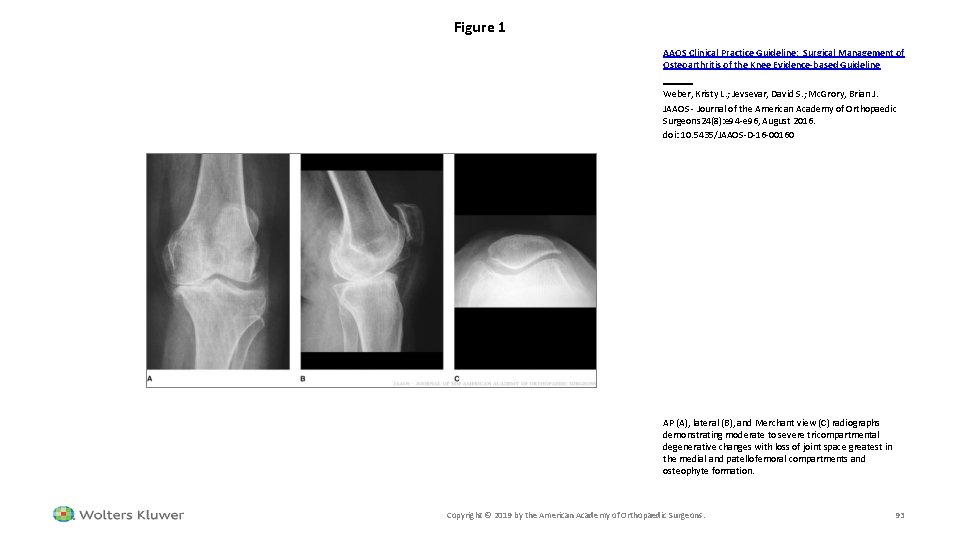
Figure 1 AAOS Clinical Practice Guideline: Surgical Management of Osteoarthritis of the Knee Evidence-based Guideline Weber, Kristy L. ; Jevsevar, David S. ; Mc. Grory, Brian J. JAAOS - Journal of the American Academy of Orthopaedic Surgeons 24(8): e 94 -e 96, August 2016. doi: 10. 5435/JAAOS-D-16 -00160 AP (A), lateral (B), and Merchant view (C) radiographs demonstrating moderate to severe tricompartmental degenerative changes with loss of joint space greatest in the medial and patellofemoral compartments and osteophyte formation. Copyright © 2019 by the American Academy of Orthopaedic Surgeons. 93
INITIAL MANAGEMENT § The patient started taking NSAIDS twice daily, with moderate relief of pain. She never used narcotic medications for her pain. She enrolled in a weight loss and structured physical therapy program and was able to decrease her body mass index to 28 while also strengthening her quadriceps. Good control of the diabetes mellitus was achieved and maintained. An intra-articular steroid injection provided 2 months of pain relief but the symptoms recurred, so she began to use a cane in her right hand when walking longer distances. © 2019 American Academy of Orthopaedic Surgeons
TOTAL KNEE ARTHROPLASTY § The patient met with an orthopaedic surgeon to be evaluated for knee arthroplasty. Despite her efforts to manage the inflammation, decrease her weight, and control her diabetes, she reported more progressively painful symptoms and thus made the decision to proceed with surgical management of OA of the knee after discussion of the risks and benefits. In a shared decision-making discussion, the patient was offered the option of TKA because of the tricompartmental degenerative changes. © 2019 American Academy of Orthopaedic Surgeons
TOTAL KNEE ARTHROPLASTY § § The procedure was performed under spinal anesthesia with a supplemental adductor canal block for perioperative pain control and to minimize opiate usage. The surgeon opted not to use a thigh tourniquet during the procedure in order to maximize pain reduction and postoperative function. No drain was used in the surgical wound. Tranexamic acid was used to minimize postoperative blood loss. The implant used was a cemented, posterior stabilized design with allpolyethylene tibial and patellar components. No antibiotics were used in the cement. Neither surgical navigation nor patient-specific instrumentation was used. © 2019 American Academy of Orthopaedic Surgeons
POSTOPERATIAVE MANAGEMENT § An icepack was placed over the left knee each nursing shift to decrease swelling. A continuous passive motion machine was not used. Twice daily postoperative physical therapy with full weight bearing was initiated on the day of the surgery. She had no postoperative complications and required no blood transfusions based on a postoperative hemoglobin level of 9. 6 mg/d. L. She was discharged on postoperative day 3 and enrolled in an outpatient physical therapy structured exercise program 3 days per week. © 2019 American Academy of Orthopaedic Surgeons
OUTCOME § § At 3 months postoperatively, the patient is ambulating independently without assistive devices. She requires no pain medications and is maintaining a regular self-initiated exercise program at the local gym. The arc of motion for the left knee measures 0° to 120°. She is satisfied with the outcome of the TKA. The patient had preoperative preparation with risk mitigation and rehabilitation recommended using the best evidence as outlined in the AAOS Clinical Practice Guideline: Surgical Management of Osteoarthritis of the Knee: Evidence-based Guideline. © 2019 American Academy of Orthopaedic Surgeons
SURGICAL MANAGEMENT OF OSTEOARTHRITIS OF THE KNEE CASE STUDIES Appropriate use criteria (AUC) provide treatment recommendations on a patient-specific level using evidence from AAOS clinical practice guidelines, along with clinician expertise and experience. A multidisciplinary clinician writing panel creates realistic patient profiles who may present with a particular orthopaedic disease in a clinical setting. A separate multidisciplinary clinician voting panel uses a modified Delphi method to rate the appropriateness of various procedures for those patient profiles. The American Academy of Orthopaedic Surgeons adopted the AUC for the Surgical Management of Osteoarthritis of the Knee on December 9, 2016. This AUC was developed to improve patient care and obtain the best outcomes while considering the subtleties and distinctions necessary in making clinical decisions for the surgical management of osteoarthritis of the knee. The following three clinical scenarios demonstrate how the AUC can be used in the decision-making process. Users can easily access this valuable tool via Ortho. Guidlines http: //www. orthoguidelines. org/go/auc/default. cfm? auc_id=224989&actionxm=Terms © 2019 American Academy of Orthopaedic Surgeons
AAOS Appropriate Use Criteria: Surgical Management of Osteoarthritis of the Knee Manner, Paul, A. , MD; Tubb, Creighton, C. , MD; Levine, Brett, R. , MD JAAOS - Journal of the American Academy of Orthopaedic Surgeons: May 1, 2018 - Volume 26 - Issue 9 - p e 194–e 197 doi: 10. 5435/JAAOS-D-17 -00425 Case Studies © 2019 American Academy of Orthopaedic Surgeons
CASE 1 - HISTORY A 33 -year-old man presented with medial-sided right knee pain that had worsened over the previous year. The patient denied any recent trauma, and the knee pain had limited him to ambulating only short distances at a time (fewer than five blocks). He denied any specific mechanical symptoms, such as locking, buckling, or feelings of instability. © 2019 American Academy of Orthopaedic Surgeons
CASE 1 – DISCUSSION Based on the patient’s history, radiographs, and arthroscopic images, the physician felt that the patient was not a candidate for further cartilage restoration surgery. There were three surgical options to consider, however, with one Appropriate, one May Be Appropriate, and one Rarely Appropriate option. Based on the AUC Surgical Management of Osteoarthritis of the Knee, for this patient osteotomy was judged Appropriate (median score, 7) and UKA was judged May Be Appropriate (median score, 4). In this young patient with unicompartmental disease, TKA would be Rarely Appropriate (median score, 3). The patient underwent opening wedge, high tibial osteotomy on his right knee. He completed a course of postoperative rehabilitation, and the osteotomy healed. The patient discontinued use of analgesic medications. At 2 -year follow-up, the patient had returned to an active lifestyle and was coaching his children’s youth sports with minimal to no pain (Figure 1). © 2019 American Academy of Orthopaedic Surgeons
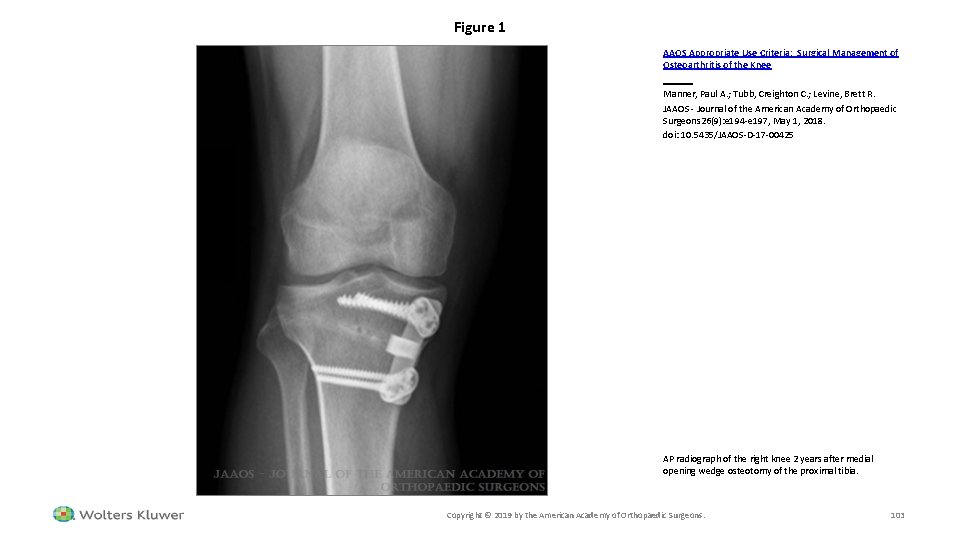
Figure 1 AAOS Appropriate Use Criteria: Surgical Management of Osteoarthritis of the Knee Manner, Paul A. ; Tubb, Creighton C. ; Levine, Brett R. JAAOS - Journal of the American Academy of Orthopaedic Surgeons 26(9): e 194 -e 197, May 1, 2018. doi: 10. 5435/JAAOS-D-17 -00425 AP radiograph of the right knee 2 years after medial opening wedge osteotomy of the proximal tibia. Copyright © 2019 by the American Academy of Orthopaedic Surgeons. 103
CASE 2 – HISTORY A 50 -year-old man presented with a 6 -month history of activity-limiting knee pain. The pain worsened during that period, leading to a decreased ability of the patient to participate in his routine exercise regimen. He was an avid cyclist and swimmer. © 2019 American Academy of Orthopaedic Surgeons
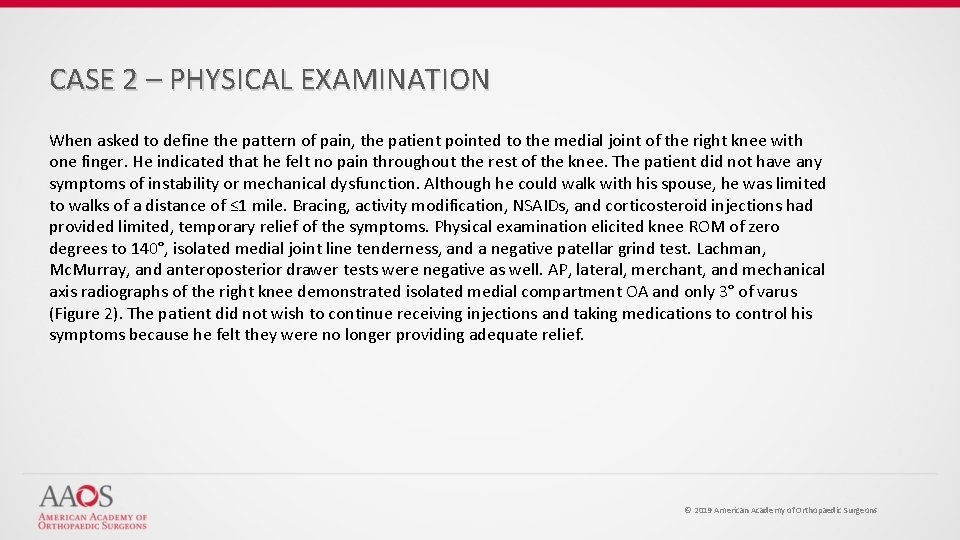
CASE 2 – PHYSICAL EXAMINATION When asked to define the pattern of pain, the patient pointed to the medial joint of the right knee with one finger. He indicated that he felt no pain throughout the rest of the knee. The patient did not have any symptoms of instability or mechanical dysfunction. Although he could walk with his spouse, he was limited to walks of a distance of ≤ 1 mile. Bracing, activity modification, NSAIDs, and corticosteroid injections had provided limited, temporary relief of the symptoms. Physical examination elicited knee ROM of zero degrees to 140°, isolated medial joint line tenderness, and a negative patellar grind test. Lachman, Mc. Murray, and anteroposterior drawer tests were negative as well. AP, lateral, merchant, and mechanical axis radiographs of the right knee demonstrated isolated medial compartment OA and only 3° of varus (Figure 2). The patient did not wish to continue receiving injections and taking medications to control his symptoms because he felt they were no longer providing adequate relief. © 2019 American Academy of Orthopaedic Surgeons
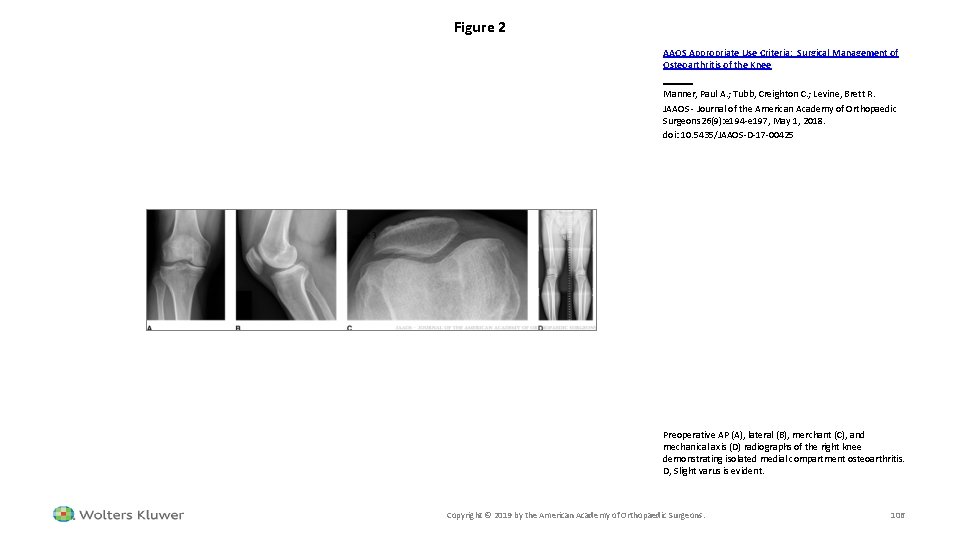
Figure 2 AAOS Appropriate Use Criteria: Surgical Management of Osteoarthritis of the Knee Manner, Paul A. ; Tubb, Creighton C. ; Levine, Brett R. JAAOS - Journal of the American Academy of Orthopaedic Surgeons 26(9): e 194 -e 197, May 1, 2018. doi: 10. 5435/JAAOS-D-17 -00425 Preoperative AP (A), lateral (B), merchant (C), and mechanical axis (D) radiographs of the right knee demonstrating isolated medial compartment osteoarthritis. D, Slight varus is evident. Copyright © 2019 by the American Academy of Orthopaedic Surgeons. 106
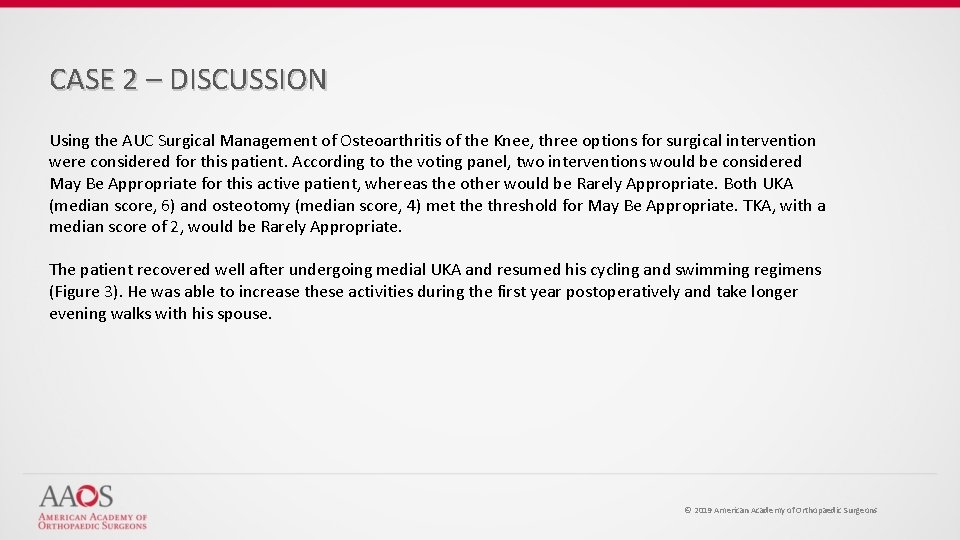
CASE 2 – DISCUSSION Using the AUC Surgical Management of Osteoarthritis of the Knee, three options for surgical intervention were considered for this patient. According to the voting panel, two interventions would be considered May Be Appropriate for this active patient, whereas the other would be Rarely Appropriate. Both UKA (median score, 6) and osteotomy (median score, 4) met the threshold for May Be Appropriate. TKA, with a median score of 2, would be Rarely Appropriate. The patient recovered well after undergoing medial UKA and resumed his cycling and swimming regimens (Figure 3). He was able to increase these activities during the first year postoperatively and take longer evening walks with his spouse. © 2019 American Academy of Orthopaedic Surgeons
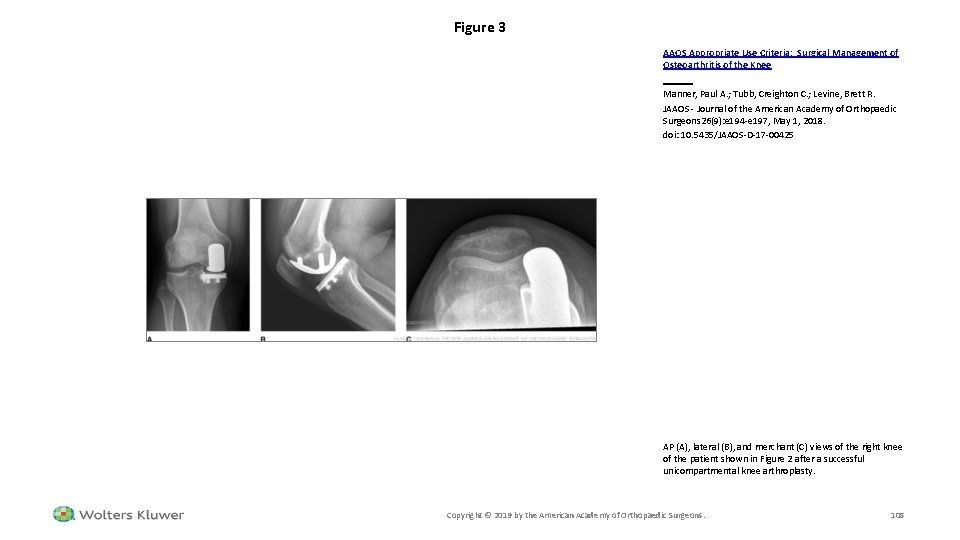
Figure 3 AAOS Appropriate Use Criteria: Surgical Management of Osteoarthritis of the Knee Manner, Paul A. ; Tubb, Creighton C. ; Levine, Brett R. JAAOS - Journal of the American Academy of Orthopaedic Surgeons 26(9): e 194 -e 197, May 1, 2018. doi: 10. 5435/JAAOS-D-17 -00425 AP (A), lateral (B), and merchant (C) views of the right knee of the patient shown in Figure 2 after a successful unicompartmental knee arthroplasty. Copyright © 2019 by the American Academy of Orthopaedic Surgeons. 108
CASE 3 – HISTORY A 70 -year-old man presented with a history of chronic left knee pain of 4 years’ duration that had worsened over time. At the time of this clinical visit he could walk no more than two blocks before having to stop because of pain. Although he had occasionally tried using a cane, he was able to ambulate without an assistive device despite the pain. To go up and down stairs, he used the banister and often took one step at a time. He could sit in a chair for >1 hour and could rise from the chair without using his arms. The patient scored his pain at rest as 3 out of 10. The pain increased in severity with weight bearing and activity, often reaching 5 to 7 out of 10 and, on rare occasions, a level of 10. The patient did not have a sense of knee instability but did feel as though the knee caught on occasion, with a resulting drastic increase in pain. His medical history included Crohn disease, sciatica, hearing loss, Meniere disease, depression, type 2 diabetes mellitus, hypertension, and hypercholesterolemia. He consumed 28 alcoholic drinks per week. Prior treatments included activity modification, intra-articular steroid and hyaluronic acid injections, NSAIDs, off-the-shelf bracing, and over-the-counter analgesics. © 2019 American Academy of Orthopaedic Surgeons
CASE 3 – PHYSICAL EXAMINATION The patient exhibited left knee ROM of 5° to 110° as well as overall varus alignment. Substantial medialsided tenderness to palpation was elicited in the left knee, but the patient did not experience pain on the patellar grind test or laterally. The Lachman, Mc. Murray, and anteroposterior drawer tests were negative. The knee exhibited stability under varus and valgus stress. Radiographic evaluation of the left knee included a weight-bearing AP view as well as lateral and Merchant views. Severe loss of medial compartment joint space was evident. A mechanical axis radiograph confirmed varus deformity of the right knee (Figure 4). © 2019 American Academy of Orthopaedic Surgeons
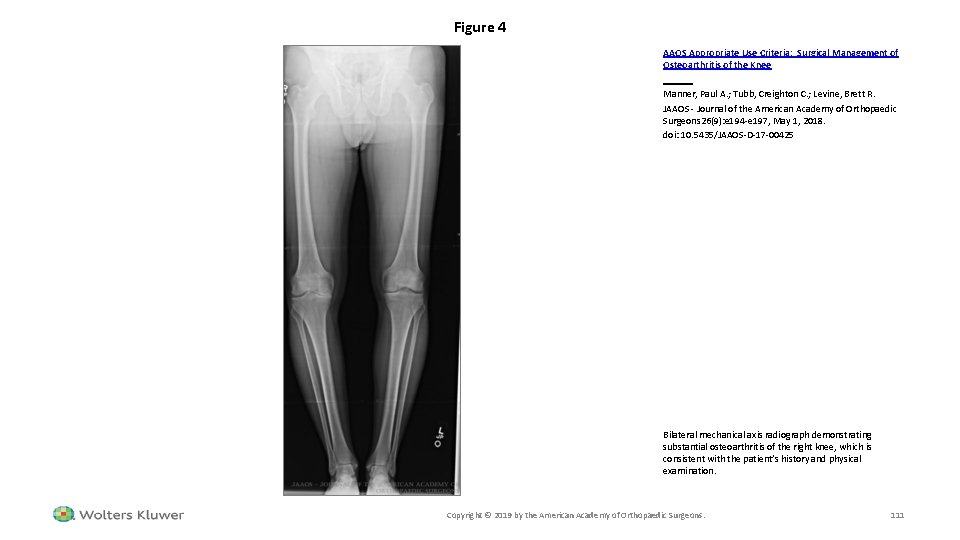
Figure 4 AAOS Appropriate Use Criteria: Surgical Management of Osteoarthritis of the Knee Manner, Paul A. ; Tubb, Creighton C. ; Levine, Brett R. JAAOS - Journal of the American Academy of Orthopaedic Surgeons 26(9): e 194 -e 197, May 1, 2018. doi: 10. 5435/JAAOS-D-17 -00425 Bilateral mechanical axis radiograph demonstrating substantial osteoarthritis of the right knee, which is consistent with the patient’s history and physical examination. Copyright © 2019 by the American Academy of Orthopaedic Surgeons. 111
CASE 3 – DISCUSSION After discussing the options with his treating physician, the patient elected to undergo surgery. On consulting the AUC, the physician found one treatment option recommended as Appropriate, one as May Be Appropriate, and one as Rarely Appropriate for this patient. With a median score of 8, TKA would be Appropriate given the constellation of findings in this case. UKA was deemed May Be Appropriate, with a median score of 5, whereas realignment osteotomy would be Rarely Appropriate, with a median score of 1. The patient underwent TKA, which resulted in improved ROM as well as resolution of his knee pain (Figure 5). © 2019 American Academy of Orthopaedic Surgeons
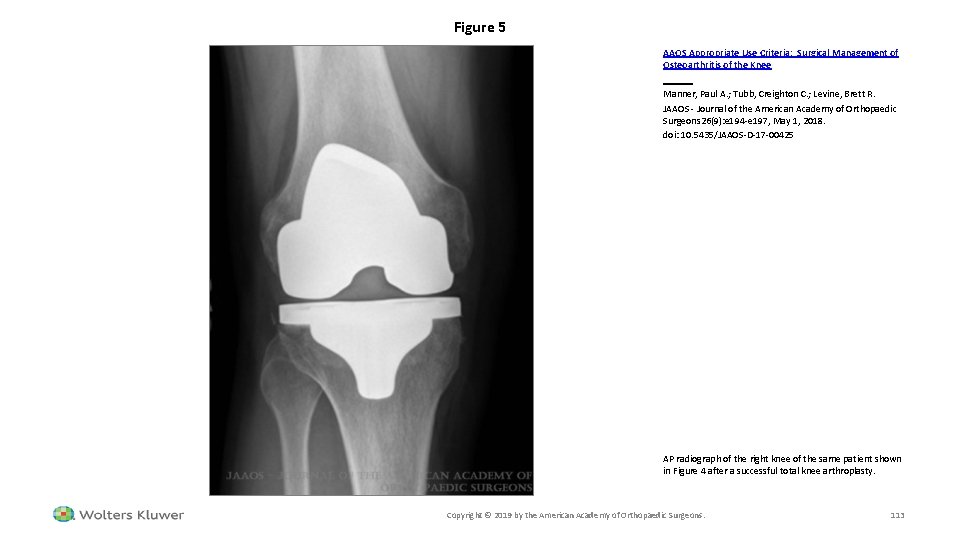
Figure 5 AAOS Appropriate Use Criteria: Surgical Management of Osteoarthritis of the Knee Manner, Paul A. ; Tubb, Creighton C. ; Levine, Brett R. JAAOS - Journal of the American Academy of Orthopaedic Surgeons 26(9): e 194 -e 197, May 1, 2018. doi: 10. 5435/JAAOS-D-17 -00425 AP radiograph of the right knee of the same patient shown in Figure 4 after a successful total knee arthroplasty. Copyright © 2019 by the American Academy of Orthopaedic Surgeons. 113
Free for both i. OS and Android or at www. orthoguidelines. org Provides easy access to all AAOS: • • • Clinical Practice Guidelines Full Guideline PDF’s Appropriate Use Criteria Case Studies Clinician Checklists Impactful Statements Plain Language Summaries Evidence-based Databases Evidence-based Methods, Appraisals and Standards © 2019 American Academy of Orthopaedic Surgeons
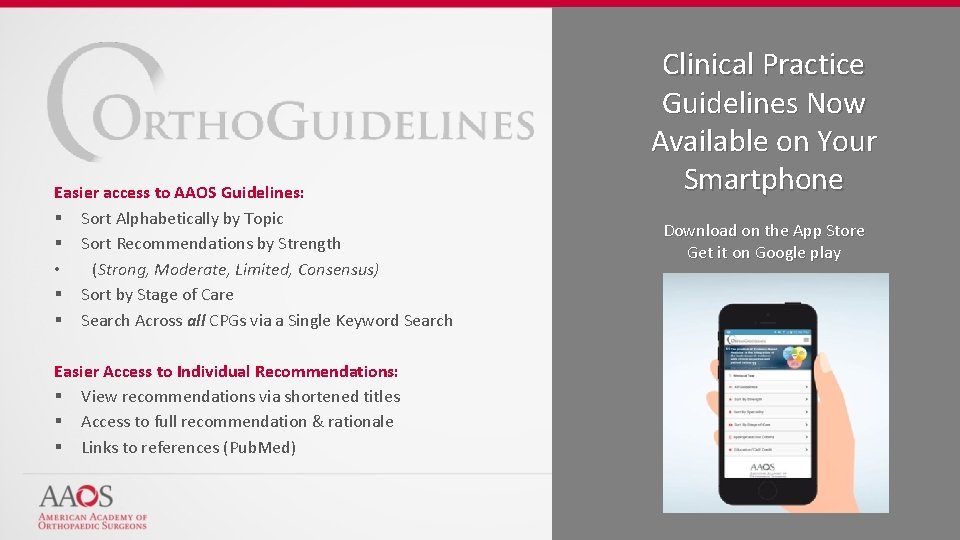
Easier access to AAOS Guidelines: § Sort Alphabetically by Topic § Sort Recommendations by Strength • (Strong, Moderate, Limited, Consensus) § Sort by Stage of Care § Search Across all CPGs via a Single Keyword Search Easier Access to Individual Recommendations: § View recommendations via shortened titles § Access to full recommendation & rationale § Links to references (Pub. Med) Clinical Practice Guidelines Now Available on Your Smartphone Download on the App Store Get it on Google play
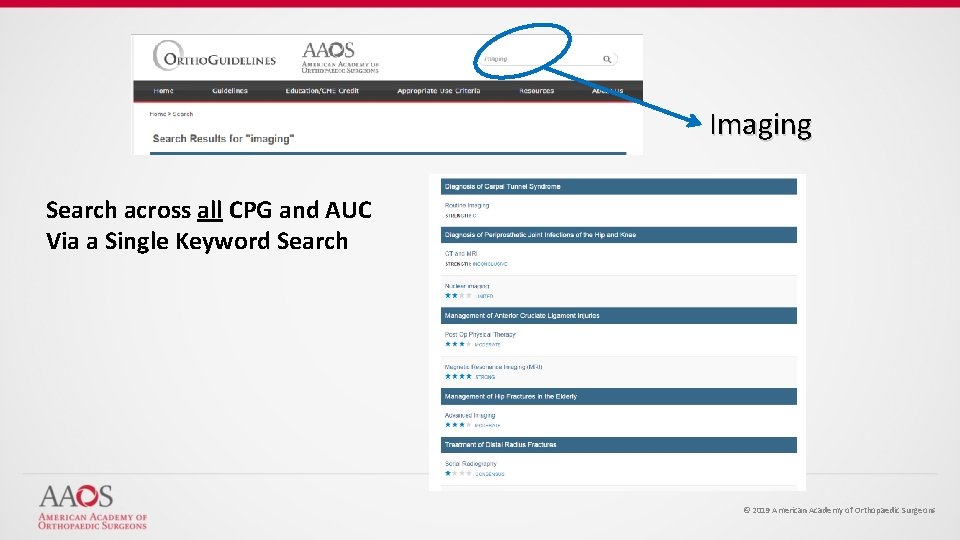
Imaging Search across all CPG and AUC Via a Single Keyword Search © 2019 American Academy of Orthopaedic Surgeons
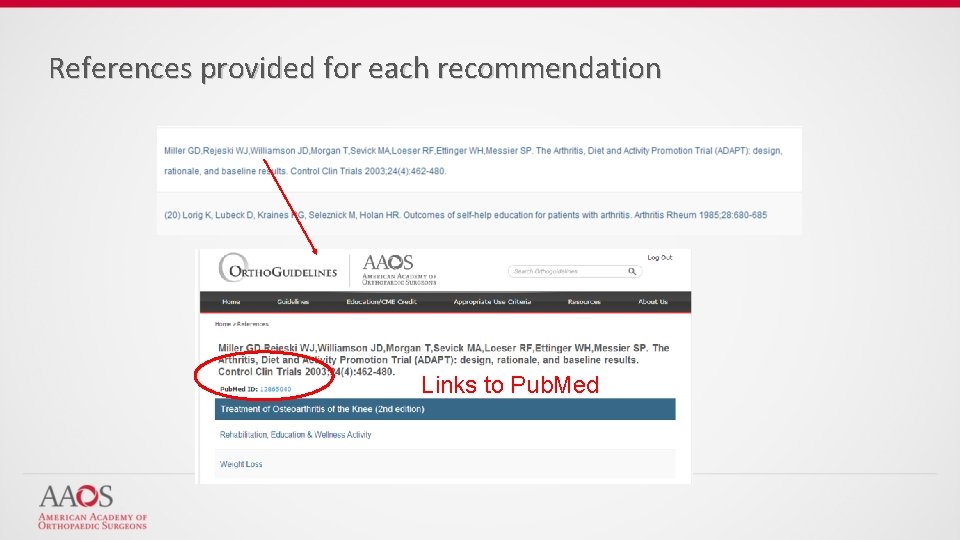
References provided for each recommendation Links to Pub. Med
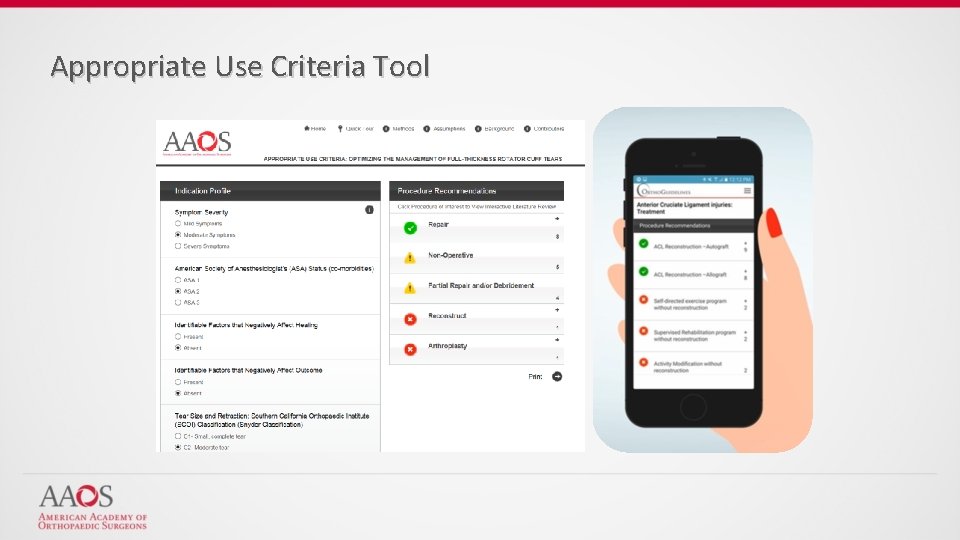
Appropriate Use Criteria Tool
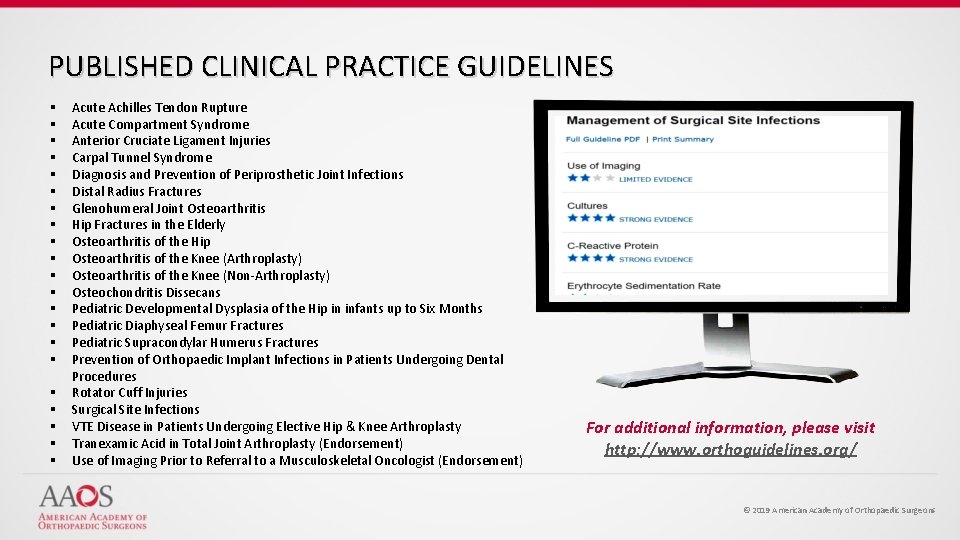
PUBLISHED CLINICAL PRACTICE GUIDELINES § § § § § § Acute Achilles Tendon Rupture Acute Compartment Syndrome Anterior Cruciate Ligament Injuries Carpal Tunnel Syndrome Diagnosis and Prevention of Periprosthetic Joint Infections Distal Radius Fractures Glenohumeral Joint Osteoarthritis Hip Fractures in the Elderly Osteoarthritis of the Hip Osteoarthritis of the Knee (Arthroplasty) Osteoarthritis of the Knee (Non-Arthroplasty) Osteochondritis Dissecans Pediatric Developmental Dysplasia of the Hip in infants up to Six Months Pediatric Diaphyseal Femur Fractures Pediatric Supracondylar Humerus Fractures Prevention of Orthopaedic Implant Infections in Patients Undergoing Dental Procedures Rotator Cuff Injuries Surgical Site Infections VTE Disease in Patients Undergoing Elective Hip & Knee Arthroplasty Tranexamic Acid in Total Joint Arthroplasty (Endorsement) Use of Imaging Prior to Referral to a Musculoskeletal Oncologist (Endorsement) For additional information, please visit http: //www. orthoguidelines. org/ © 2019 American Academy of Orthopaedic Surgeons
- Slides: 119