
SURFACTANTS EMULSIFIERS PRIMARY OBJECTIVES n n n FORM

SURFACTANTS - EMULSIFIERS

PRIMARY OBJECTIVES n n n FORM EMULSIONS STABILIZE EMULSIONS MODIFY STRUCTURES
Uses Of Surfactants n 1. Emulsifiers n n n n n Water In Oil - Low Hlb Oil In Water - High Hlb 2. Foam Stabilizers 3. Lipid Crystal Modifiers 4. Wetting Agents 5. Solubilizers 6. Starch Complexers 7. Protein Modifiers 8. Detergents

Interaction Of Surface Active Agents With Food Components n n n 1. Lipids 2. Water 3. Starch 4. Protein 5. Air 6. Ions

MOST SURFACTANTS INVOLVE INTERACTONS WITH LIPIDS
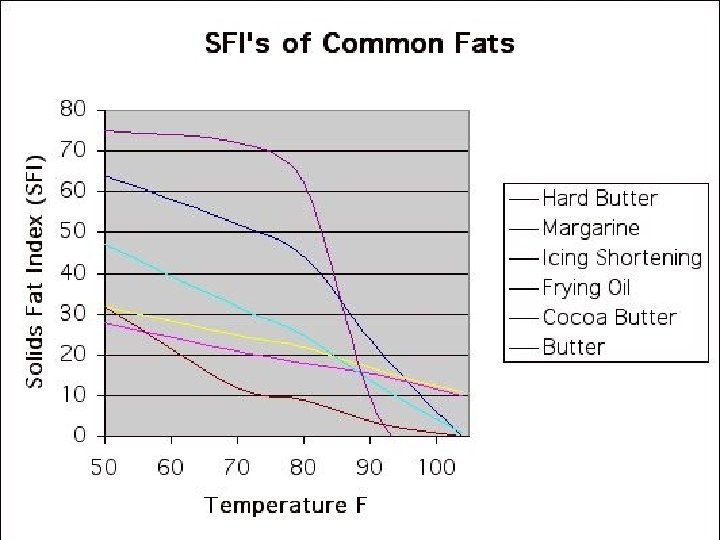
Solid Fat Index (SFI) n A measure of the ratio of solid fat to total fat. SFI is the older term and is based on dilatometry (change in volume – liquid fat has a greater volume than solid fat)
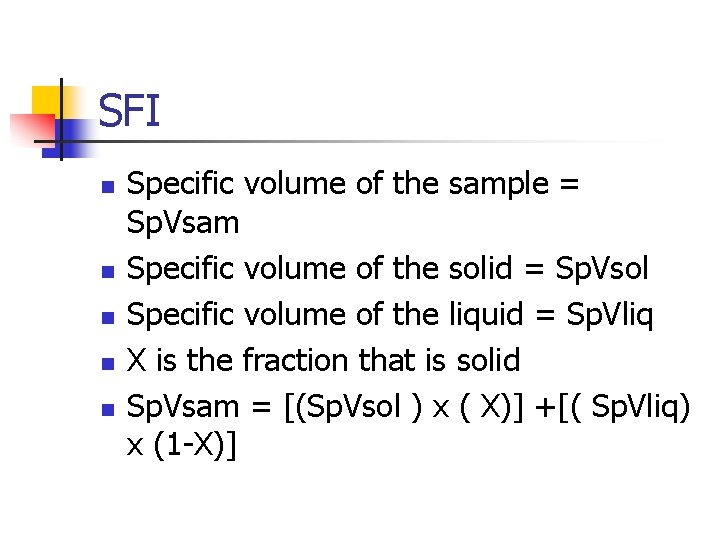
SFI n n n Specific volume of the sample = Sp. Vsam Specific volume of the solid = Sp. Vsol Specific volume of the liquid = Sp. Vliq X is the fraction that is solid Sp. Vsam = [(Sp. Vsol ) x ( X)] +[( Sp. Vliq) x (1 -X)]
Solid Fat Content (SFC) n n Also a measure of the solid fat to total fat ratio. SFC is determined by NMR which can readily distinguish between the nuclei of protons in crystalline fatand those of liquid fat. SFC is analytically less ambiguous to determine. There is no direct universal conversion to SFI is still widely used in the trade. Even though SFI is still most common among US suppliers, they most probably determine SFC and convert it to SFI based on an empirical equation.

Why do we add surfactants to foods ?
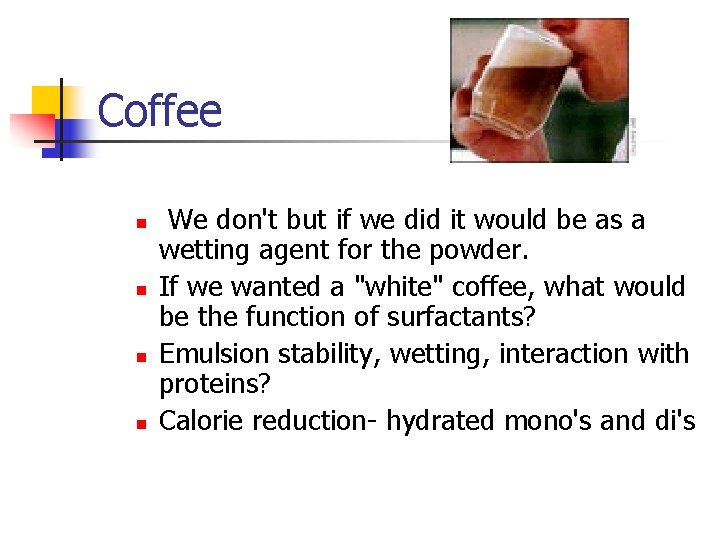
Coffee n n We don't but if we did it would be as a wetting agent for the powder. If we wanted a "white" coffee, what would be the function of surfactants? Emulsion stability, wetting, interaction with proteins? Calorie reduction- hydrated mono's and di's
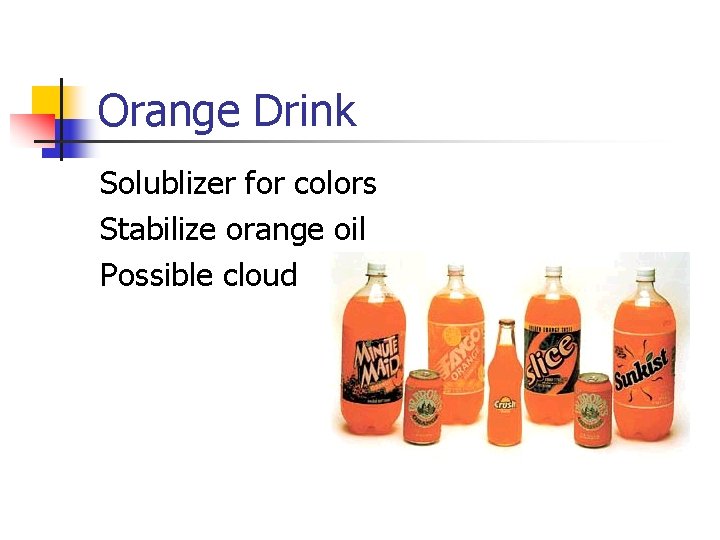
Orange Drink Solublizer for colors Stabilize orange oil Possible cloud
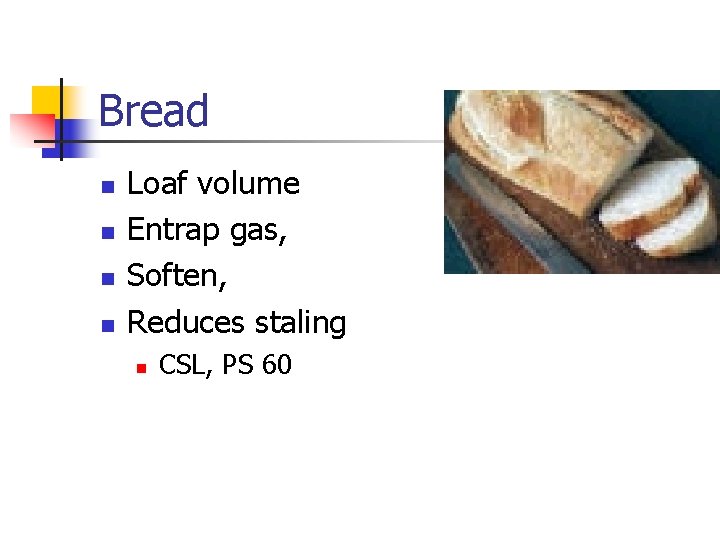
Bread n n Loaf volume Entrap gas, Soften, Reduces staling n CSL, PS 60
EMULSIFIERS IN BREAD BAKING n During mixing n n Improves wetability Improves distribution of shortening Interacts with starch, protein and fat Results in: n n Decreased mixing time Decreased shortening usage Improved mixing tolerance Improved physical characteristics of the dough
EMULSIFIERS IN BREAD BAKING n During fermentation n n During baking n n n Results in better gas retention Improved loaf volume Decreased water loss Finer, more uniform texture During Storage n n Increased softness Less staling

Pudding n n n Emulsification Wetting agent in powder Texture modifier
Ice cream n n n Emulsion stability and destability, Foam, Dryness isolate fat before and after homo
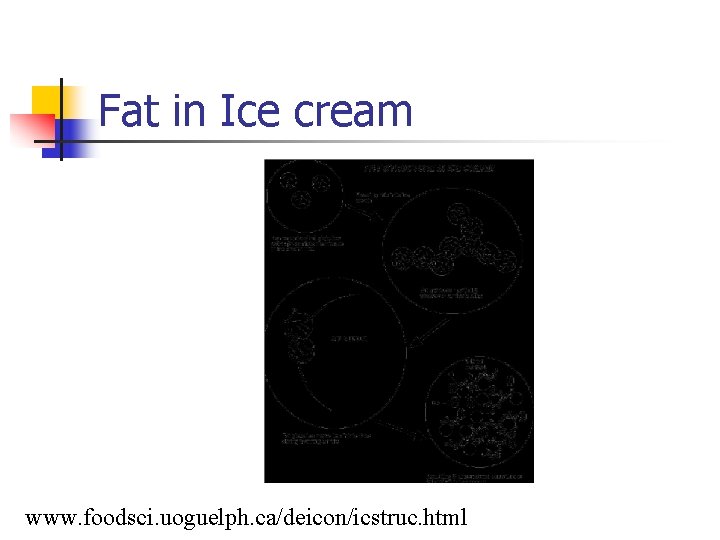
Fat in Ice cream www. foodsci. uoguelph. ca/deicon/icstruc. html
Candy Bar n Lecithin to stabilize fat crystals "bloom", control viscosity and thus coating
Cookie n Control spread n n protein and fat interaction Note: altering sugar may be a bigger factor
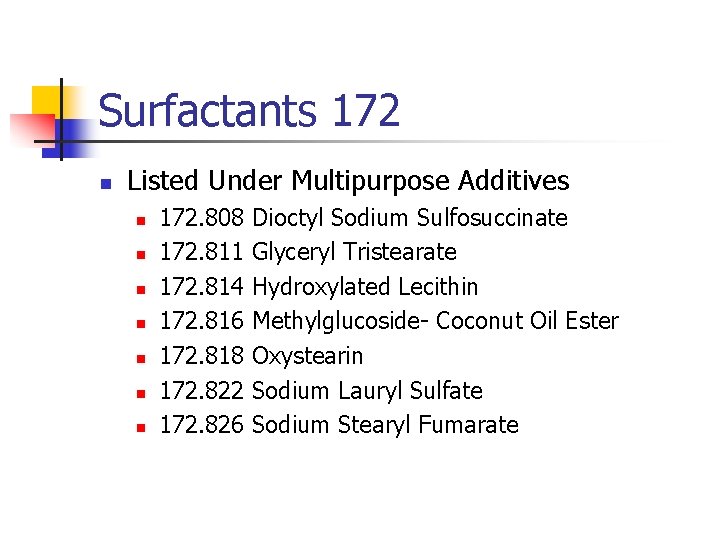
Surfactants 172 n Listed Under Multipurpose Additives n n n n 172. 808 Dioctyl Sodium Sulfosuccinate 172. 811 Glyceryl Tristearate 172. 814 Hydroxylated Lecithin 172. 816 Methylglucoside- Coconut Oil Ester 172. 818 Oxystearin 172. 822 Sodium Lauryl Sulfate 172. 826 Sodium Stearyl Fumarate
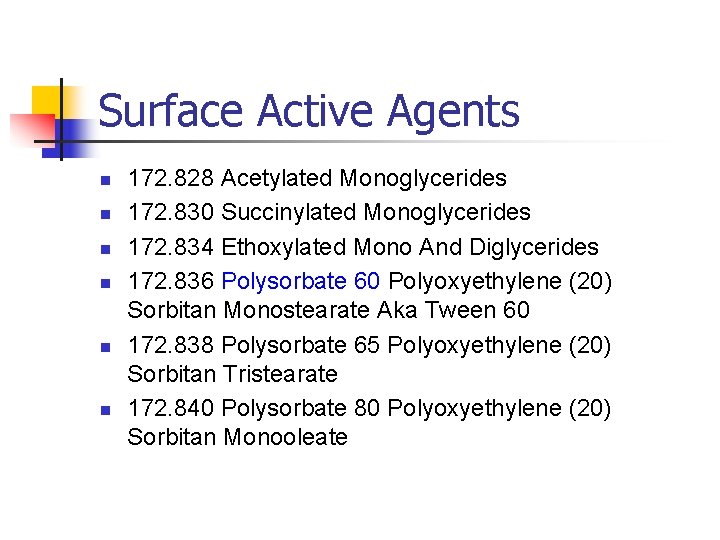
Surface Active Agents n n n 172. 828 Acetylated Monoglycerides 172. 830 Succinylated Monoglycerides 172. 834 Ethoxylated Mono And Diglycerides 172. 836 Polysorbate 60 Polyoxyethylene (20) Sorbitan Monostearate Aka Tween 60 172. 838 Polysorbate 65 Polyoxyethylene (20) Sorbitan Tristearate 172. 840 Polysorbate 80 Polyoxyethylene (20) Sorbitan Monooleate
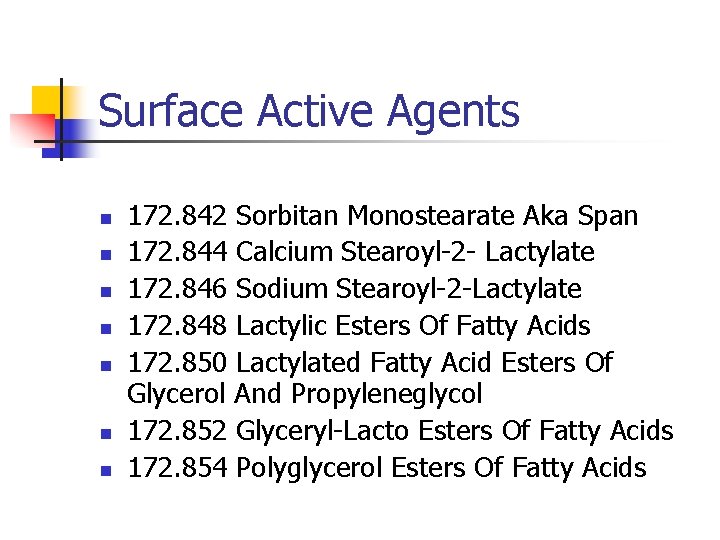
Surface Active Agents n n n n 172. 842 Sorbitan Monostearate Aka Span 172. 844 Calcium Stearoyl-2 - Lactylate 172. 846 Sodium Stearoyl-2 -Lactylate 172. 848 Lactylic Esters Of Fatty Acids 172. 850 Lactylated Fatty Acid Esters Of Glycerol And Propyleneglycol 172. 852 Glyceryl-Lacto Esters Of Fatty Acids 172. 854 Polyglycerol Esters Of Fatty Acids
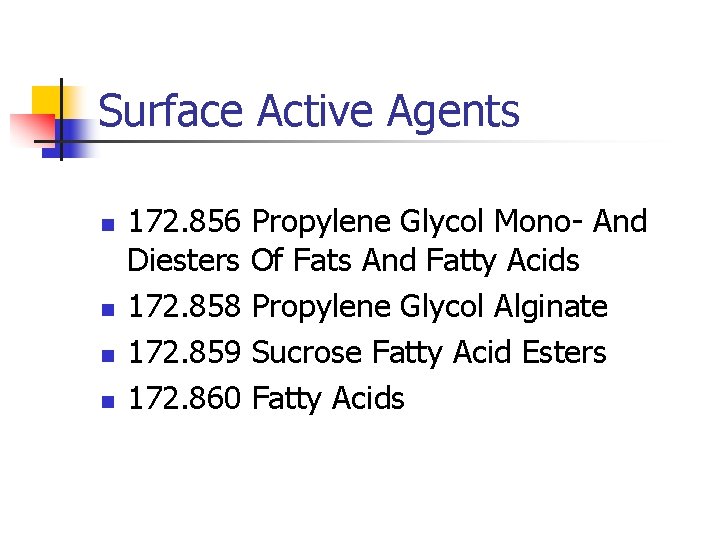
Surface Active Agents n n 172. 856 Propylene Glycol Mono- And Diesters Of Fats And Fatty Acids 172. 858 Propylene Glycol Alginate 172. 859 Sucrose Fatty Acid Esters 172. 860 Fatty Acids
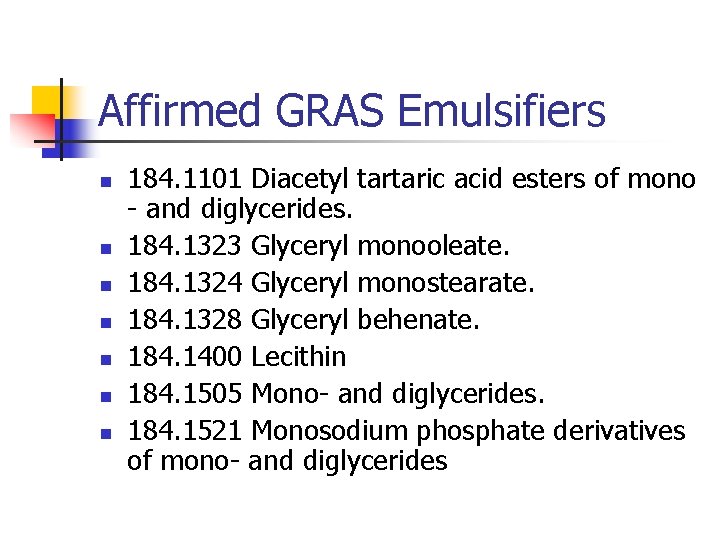
Affirmed GRAS Emulsifiers n n n n 184. 1101 Diacetyl tartaric acid esters of mono - and diglycerides. 184. 1323 Glyceryl monooleate. 184. 1324 Glyceryl monostearate. 184. 1328 Glyceryl behenate. 184. 1400 Lecithin 184. 1505 Mono- and diglycerides. 184. 1521 Monosodium phosphate derivatives of mono- and diglycerides

Emulsifier structures and information adapted from: http: //www. agsci. ubc. ca/course s/fnh/410/emulsify/4_16. htm

Mono & diglycerides n n n Most commonly used Generally as mono & di Highly lipophilic with HLB values range from 1 to 10 produced by transesterification of glycerol and triacylcerides used in bakery products, frozen desserts, icings, toppings, and peanut butter

Polysorbates n n Polyoxyenthyene esters of sorbitan monoesters Polysorbate 60 n polyoxyethylene sorbitan monostearate or TWEEN 60 - HLB = 14. 9 oil toppings, cake mixes, and cake icing Polysorbate 65 n n n polyoxyethylene sorbitan tristearate Permitted in ice cream, frozen custard Polysorbate 80 n n polyoxyethylene sorbitan tristearate Special dietetic foods, fat soluble vitamine
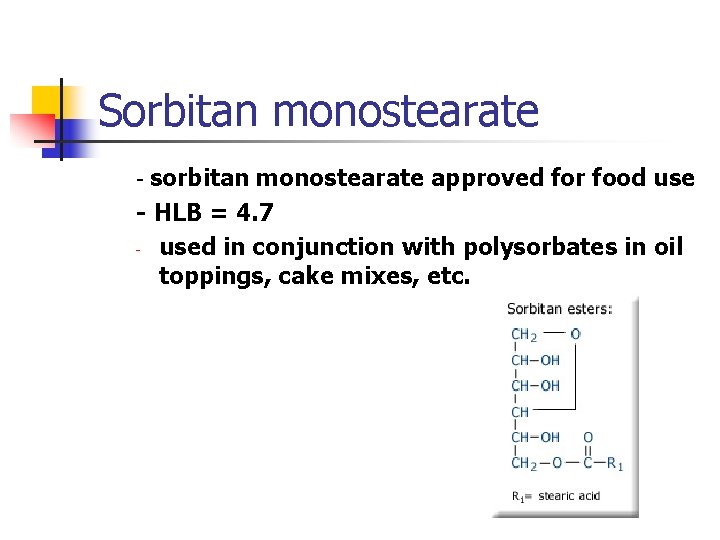
Sorbitan monostearate - sorbitan monostearate approved for food use - HLB = 4. 7 - used in conjunction with polysorbates in oil toppings, cake mixes, etc.
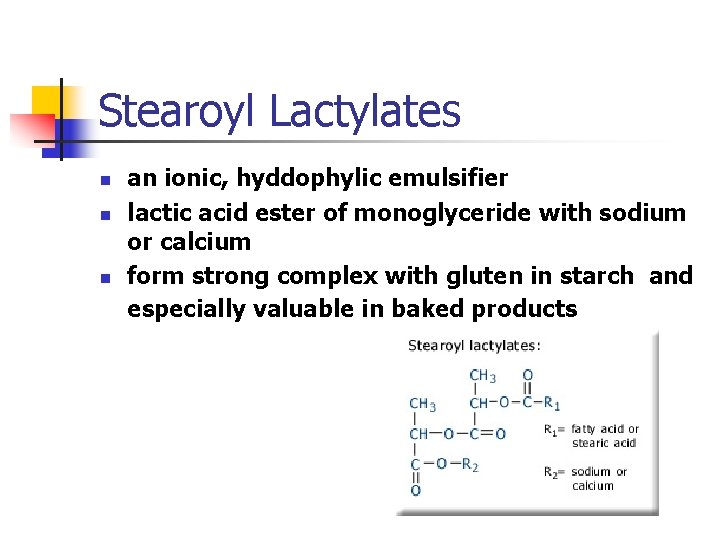
Stearoyl Lactylates n n n an ionic, hyddophylic emulsifier lactic acid ester of monoglyceride with sodium or calcium form strong complex with gluten in starch and especially valuable in baked products
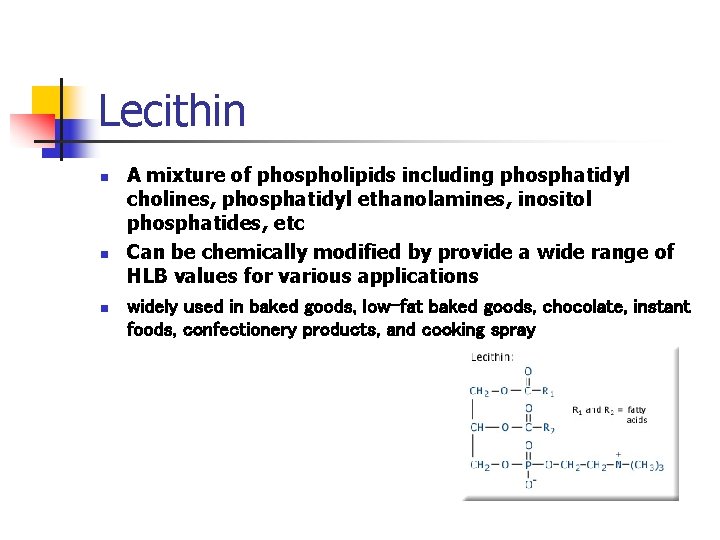
Lecithin n A mixture of phospholipids including phosphatidyl cholines, phosphatidyl ethanolamines, inositol phosphatides, etc Can be chemically modified by provide a wide range of HLB values for various applications widely used in baked goods, low-fat baked goods, chocolate, instant foods, confectionery products, and cooking spray
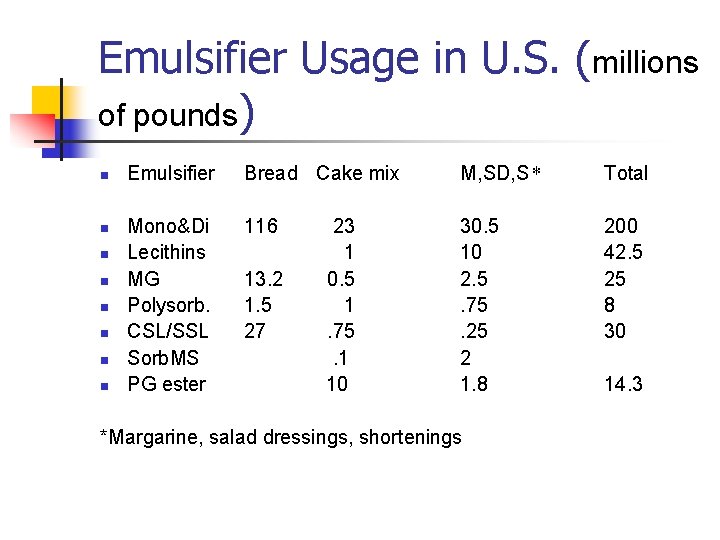
Emulsifier Usage in U. S. (millions of pounds) n n n n n Emulsifier Mono&Di Lecithins MG Polysorb. CSL/SSL Sorb. MS PG ester Bread Cake mix 116 23 1 13. 2 0. 5 1 27. 75 . 1 10 M, SD, S * Total 30. 5 10 2. 5. 75. 25 2 1. 8 200 42. 5 25 8 30 *Margarine, salad dressings, shortenings 14. 3
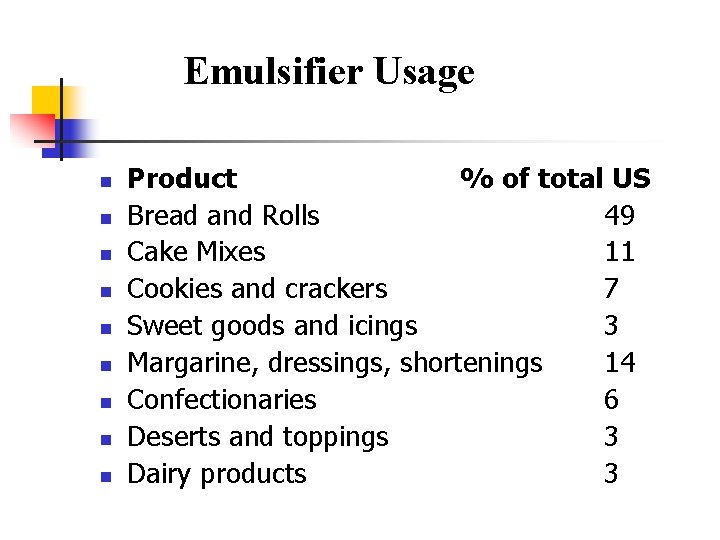
n n n n n Emulsifier Usage Product % of total US Bread and Rolls 49 Cake Mixes 11 Cookies and crackers 7 Sweet goods and icings 3 Margarine, dressings, shortenings 14 Confectionaries 6 Deserts and toppings 3 Dairy products 3

Hydrophillic-Lipophillic Balance (HLB) n n n This is a concept for choosing emulsifiers. The value of HLB ranges from 1 -20. Low HLB emulsifiers are soluble in oil while high HLB emulsifiers are soluble in water. .
Bancroft's Rule The type of emulsion (i. e. oil in water or water in oil) is dictated by the emulsifier and that the emulsifier should be soluble in the continuous phase. Low HLB emulsifier's are soluble in oil and give rise to water in oil emulsions

Solubility and HLB n n n n Solubility HLB Range No dispersability in water 1 -4 Poor Dispersion in water 3 -6 Milky appearance 6 -8 Stable milky appearance 8 -10 Tanslucent to clear dispersion 10 -13 Clear solution 13+

HLB VALUES OF SOME FOOD EMULSIFIERS EMULSIFIER HLB VALUE n Oleic acid * 1. 0 n Acetylated monoglycerides 1. 5 n Sorbitan trioleate 1. 8 n Glycerol dioleate 1. 8 n Sorbitan tristearate 2. 1 n Propyleneglycol monostearate 3. 4 n Glycerol Monoleate 3. 4 n Glycerol monostearate 3. 8

HLB VALUES OF SOME FOOD EMULSIFIERS EMULSIFIER HLB VALUE n Acetylated monoglycerides (stearate) 3. 8 n Sorbitan monooleate 4. 3 n Propylene glycol monolaurate 4. 5 n Sorbitan monostearate 4. 7 n Calcium stearoxyl-2 -lactylate * 5. 1 n Glycerol monolaurate 5. 2 n Sorbitan monopalmitate 6. 7 n Soy lecithin 8. 0 n Diacetylated tartaric acid esters n of monoglycerides 8. 0 n Sodium Stearoyl lactylate * 8. 3

HLB VALUES OF SOME FOOD EMULSIFIERS EMULSIFIER HLB VALUE n Sodium Stearoyl lactylate * 8. 3 n Sorbitan monolaurate ) 8. 6 n Polyoxyethylene (20) sorbitan tristearate 10. 5 n Polyoxyethylene (20) sorbitan trioleate 11. 0 n Polyoxyethylene (20) sorbitan monostearate 14. 9 n Sucrose monolaurate 15. 0 n Polyoxyethylene (20) sorbitan monooleate 15. 0 n Polyoxyethylene (20) sorbitan monopalmitate 15. 6
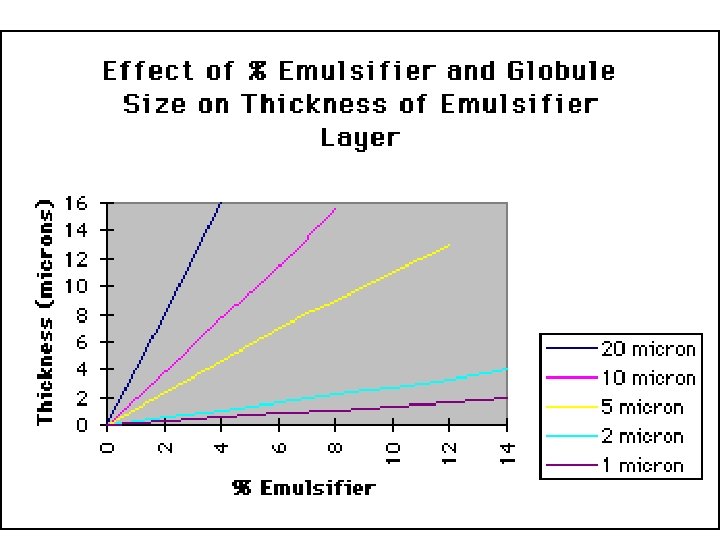
Stokes' Law n Creaming or sedimentation is proportional to: n n n 1. Diameter of the particle squared 2. Difference in density between the particle and the continuous phase And inversely proportional to: n 3. Viscosity of the continuous phase
Stokes’ Law n n Rate = [Diameter squared x density difference x g] / [16 x viscosity] How can we change diameter? How can we change density difference? How can we change viscosity?
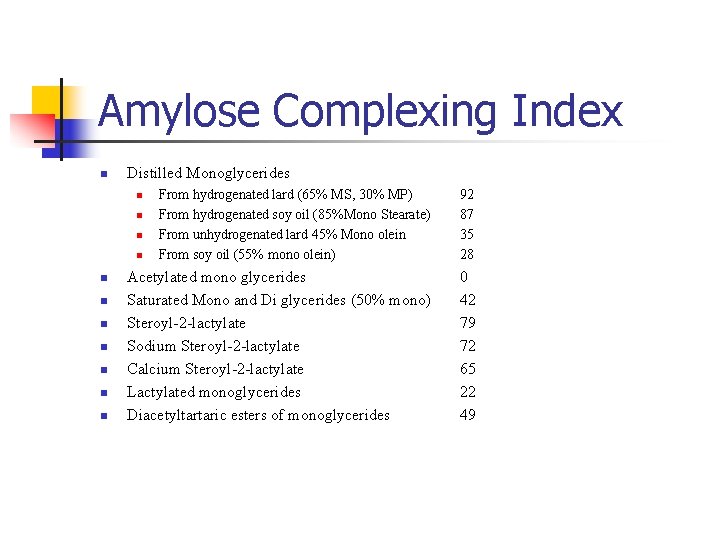
Amylose Complexing Index n Distilled Monoglycerides From hydrogenated lard (65% MS, 30% MP) From hydrogenated soy oil (85%Mono Stearate) From unhydrogenated lard 45% Mono olein From soy oil (55% mono olein) 92 87 35 28 Acetylated mono glycerides Saturated Mono and Di glycerides (50% mono) Steroyl-2 -lactylate Sodium Steroyl-2 -lactylate Calcium Steroyl-2 -lactylate Lactylated monoglycerides Diacetyltartaric esters of monoglycerides 0 42 79 72 65 22 49 n n n
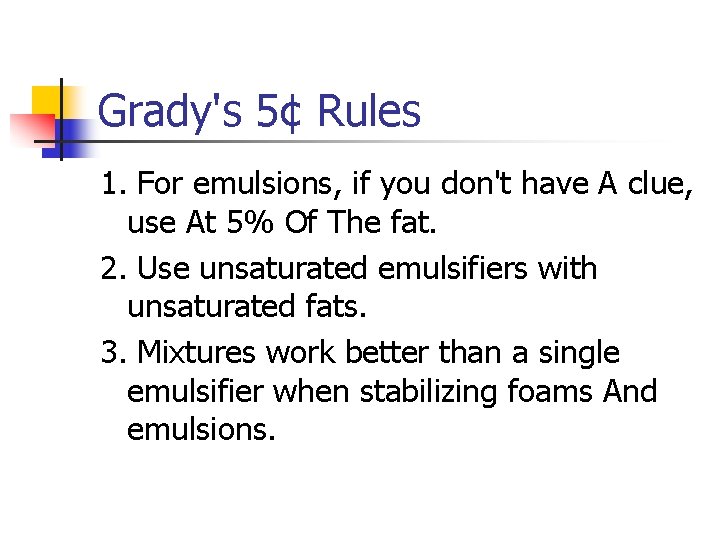
Grady's 5¢ Rules 1. For emulsions, if you don't have A clue, use At 5% Of The fat. 2. Use unsaturated emulsifiers with unsaturated fats. 3. Mixtures work better than a single emulsifier when stabilizing foams And emulsions.
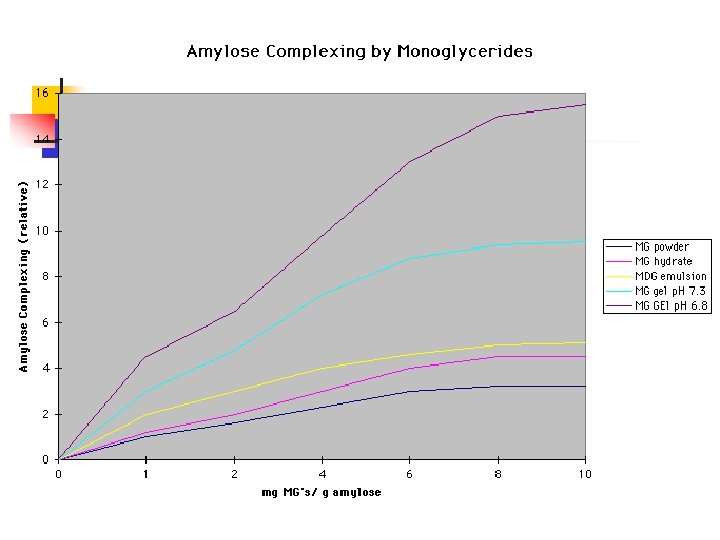
Grady's 5¢ Rules 4. Bancroft's Rule Emulsion Stability Is Favored By Solubility In The Continuous Phase i. e. High HLB----> oil/water Low HLB-----> water/oil 5. HLB and most other rules go out the window when protein and (sometimes) polysaccharides enter the system. 6. Only saturated monoglycerides complex with starch.

Grady's 5¢ Rules n 4. Bancroft's Rule n n Emulsion Stability Is Favored By Solubility In The Continuous Phase i. e. High HLB----> oil/water Low HLB-----> water/oil 5. HLB and most other rules go out the window when protein and (sometimes) polysaccharides enter the system. 6. Only saturated monoglycerides complex with starch.
Grady's 5¢ Rules n 7. Emulsifier forms affect functionality. n n flakes vs powder vs hydrates vs gels 8. Many functions are due to affects on polymorphism. 9. Emulsifier preparations frequently contain unsaturation and may be an important contributor to off flavors. 10. Emulsifier preparations are seldom pure and thus variation from manufacturer to manufacturer may be substantial.
Grady's 5¢ Rules 11. When you find a non-obvious usage of emulsifiers, the function is often related to interaction with starch or protein. 12. Order of addition may be very important. 13. Processing steps like homogenization may substantially change the function of emulsifiers.
Choosing a Fat n Nutrition n n Physical Properties n n n Mono unsaturated fatty acid content PUFA content Trans fatty acid content Cholesterol Melting point ( solidification ) Solids fat index (SFI) or Solids Fat Content (SFC) Chemical Properties Oxidative stability Flavor (or lack there of) Cost
- Slides: 51