
Surfactants 101 How do they work Why should
- Slides: 8
Surfactants 101 How do they work? Why should I use them?
How do they work? • Water naturally has surface tension because it is a polar molecule (it has positively and negatively charged ions) This means water likes bonding to itself. • Surfactants reduce the surface tension of H₂O by bonding H₂O molecules to molecules that are not water soluble.
How do they work? • Basically Surfactants make water “wetter” • This is especially important in spraying applications
How do they work? • Plants have a waxy coating on the surface of their leaves called the cuticle that in insoluble to water • This greatly reduces the amount of water that is absorbed by plant leaves • Water tends to bead up and drip off of leaves • Water and oil(wax) don’t mix
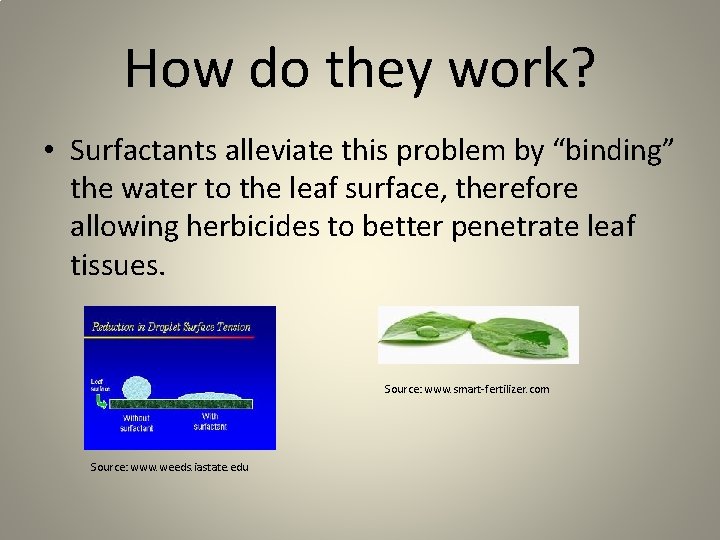
How do they work? • Surfactants alleviate this problem by “binding” the water to the leaf surface, therefore allowing herbicides to better penetrate leaf tissues. Source: www. smart-fertilizer. com Source: www. weeds. iastate. edu
Why should I use them? • There are many other benefits as well… – Acts as a spreader (for spray solutions) – Acts as an activator – Faster soil penetration – Aids Irrigation (less runoff and evaporation due to faster penetration) – Helps keep pesticides in suspension (due to its unique ability to bond soluble and insoluble substances)
Why should I use them? • Benefits continued… – Non-corrosive (protects your pumps, tanks, nozzles & is less corrosive than plain water! ) – Keeps equipment clean (prevents clogs and less downtime) – Biodegradable – Reduces effects of soil compaction – Concentrated (4 oz. /100 gal. of spray solution) – All of the above help increase yields!
Additional Info Do a Jar Test to ensure compatability Add the surfactant last Not recommended to use agitators/aerators Often increases the effectiveness of the pesticide, but use the manufacturers reccommendations • In irrigation or fertilizer applications increase rate to 16 oz. /acre • See the APSA-80 brochure for more information • •