
Surface Water Movement Earths water supply is recycled
- Slides: 40
Surface Water Movement • Earth’s water supply is recycled in a continuous process called the water cycle. • The overall process is one of repeated evaporation and condensation powered by the Sun’s energy.
• Once water reaches Earth’s surface it can evaporate into the atmosphere, soak into the ground, or flow down slopes on Earth’s surface. • Runoff is water flowing downslope along Earth’s surface. • Runoff may reach a stream, river, or lake, may evaporate or seep into the ground. • Water that seeps into Earth’s surface becomes groundwater.
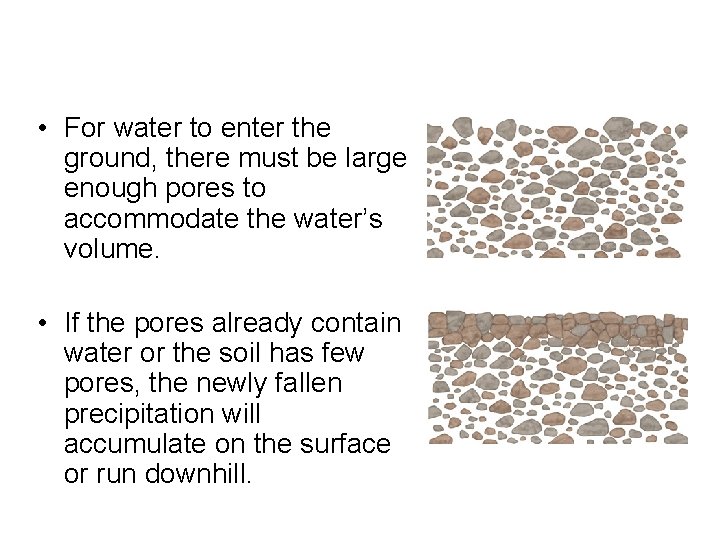
• For water to enter the ground, there must be large enough pores to accommodate the water’s volume. • If the pores already contain water or the soil has few pores, the newly fallen precipitation will accumulate on the surface or run downhill.
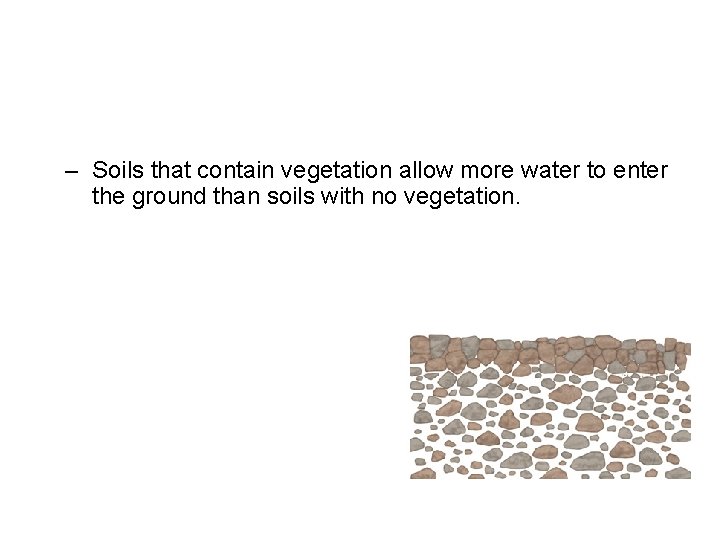
– Soils that contain vegetation allow more water to enter the ground than soils with no vegetation.
– Light, gentle precipitation infiltrates the dry ground. – During heavy precipitation, water falls too quickly to soak into the ground and becomes runoff. – A gentle, long-lasting rainfall is more beneficial to plants and causes less erosion by runoff than a torrential downpour.
– Humus creates pores in the soil, thereby increasing a soil’s ability to retain water. – Soil with a lot of coarse particles has relatively large pores between its particles that allow water to enter and pass through the soil quickly. – Soil with a lot of fine particles clumps together and has few or no spaces between the particles. – Small pores restrict both the amount of water that can enter the ground and the ease of movement of water through the soil.
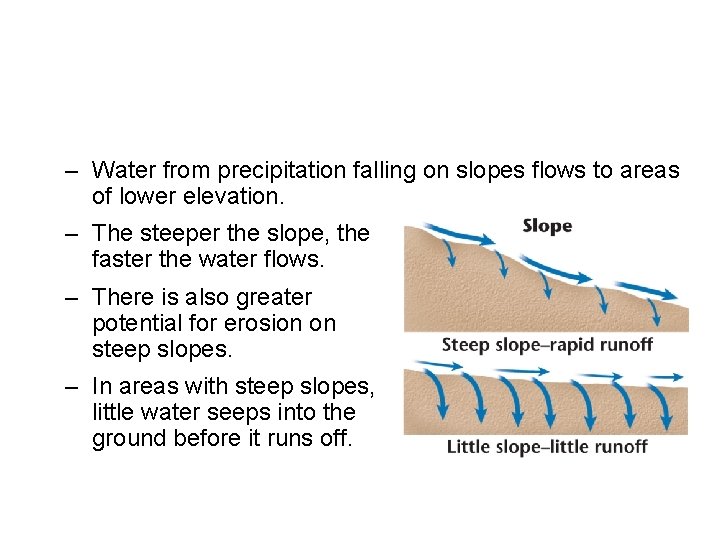
– Water from precipitation falling on slopes flows to areas of lower elevation. – The steeper the slope, the faster the water flows. – There is also greater potential for erosion on steep slopes. – In areas with steep slopes, little water seeps into the ground before it runs off.
• A stream is a channel with permanent water flow. • All streams flow downslope to lower elevations. • Tributaries are streams that flow into other streams, increasing the size of the stream it is joining. • A large stream is called a river, and all its tributaries make up a stream, or river system. • Small streams are called brooks and creeks.
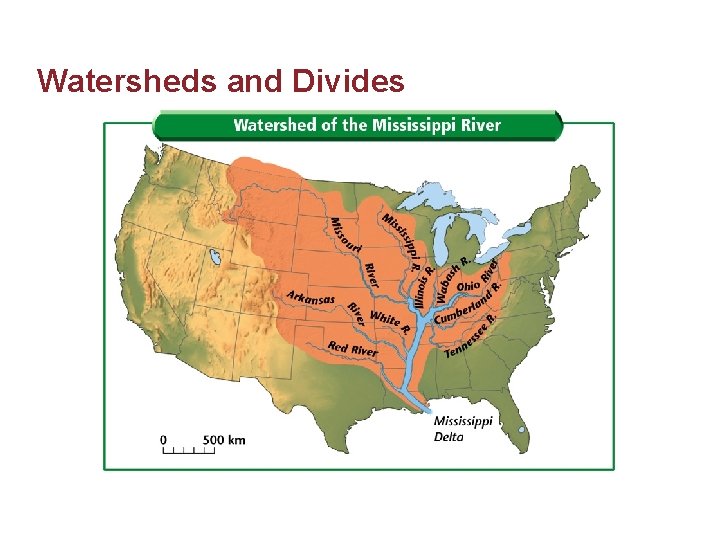
• A watershed is all of the land area whose water drains into a stream system. • A divide is a high land area that separates one watershed from another. • Each tributary in a stream system has its own watershed and divides.
Watersheds and Divides
• A stream’s load includes all the materials that the water in a stream carries. • A stream load includes the living and nonliving components. • A stream carries its load in solution, suspension, or as bed load.
– Material is carried in solution after it becomes dissolved in a stream’s water. – The amount of dissolved material that water carries is often expressed in parts per million, or ppm. – The total concentration of materials in solution in streams averages 115– 120 ppm. – Measuring the amount of material in solution helps scientists monitor water quality.
– All particles small enough to be held up by the turbulence of a stream’s moving water are carried in suspension. – Particles that are carried in suspension are part of a stream’s suspended load. – The amount of material in suspension varies with the volume and velocity of the stream water.
– A stream’s bed load consists of sand, pebbles, and cobbles that the stream’s water can roll or push along the bed of the stream. – Abrasion occurs as the particles grind against one another or against the solid rock of the streambed. – This action contributes to the physical weathering of the stream’s bottom and sides and the bed load itself.
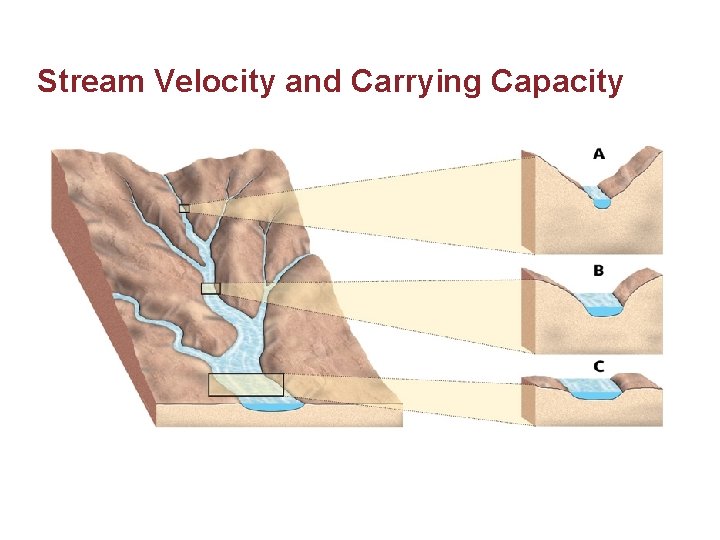
• A stream’s carrying capacity is its ability to transport material. • Carrying capacity depends on the velocity and the amount of water moving in the stream. • A stream’s water moves more quickly where there is less friction and greater slope. • The total volume of moving water also affects a stream’s carrying capacity.
Stream Velocity and Carrying Capacity
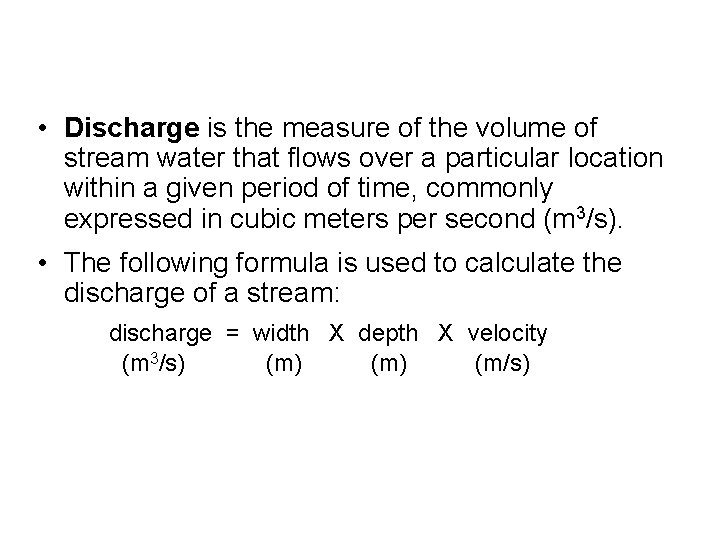
• Discharge is the measure of the volume of stream water that flows over a particular location within a given period of time, commonly expressed in cubic meters per second (m 3/s). • The following formula is used to calculate the discharge of a stream: discharge = width X depth X velocity (m 3/s) (m) (m/s)
• As a stream’s discharge increases, the stream’s carrying capacity increases. • A stream’s ability to erode the land increases when water velocity and volume increase. • A streambed can widen and deepen increasing the stream slope and adding to the stream’s carrying capacity.
• A flood occurs when more water pours into a stream than the banks of the stream channel can hold causing water to spill onto the adjacent land. • A stream’s floodplain is the broad, flat area that extends out from a stream’s bank and is covered by excess water during times of flooding.
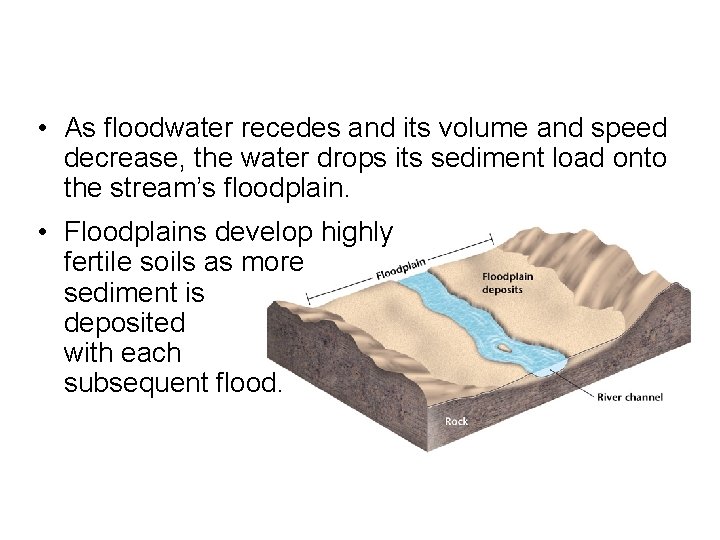
• As floodwater recedes and its volume and speed decrease, the water drops its sediment load onto the stream’s floodplain. • Floodplains develop highly fertile soils as more sediment is deposited with each subsequent flood.
• Flood stage is the level at which a stream overflows its banks and the crest of the stream is the maximum height.
• Flooding may occur over localized, small areas or across large regions. – An upstream flood is the flooding of a small area. – Sudden rainstorms that drop large amounts of rain within a short period of time cause upstream floods. – Downstream floods result from heavy accumulations of excess water from large regional drainage systems. – Downstream floods occur during or after long-lasting, intense storms or spring thaws of large snowpacks.
• Government agencies including the National Weather Service and The U. S. Geological Survey (USGS) monitor potential flood conditions.
• The first condition for stream formation is an adequate supply of water. • The region where water first accumulates to supply a stream is called the headwaters. • A stream channel forms as the moving water carves a pathway into the sediment or rock.
• Stream banks, the ground bordering the stream on each side, hold the moving water within the confines of the stream channel. • Headward erosion is the process by which small streams erode away the rock or soil at the head of the stream.
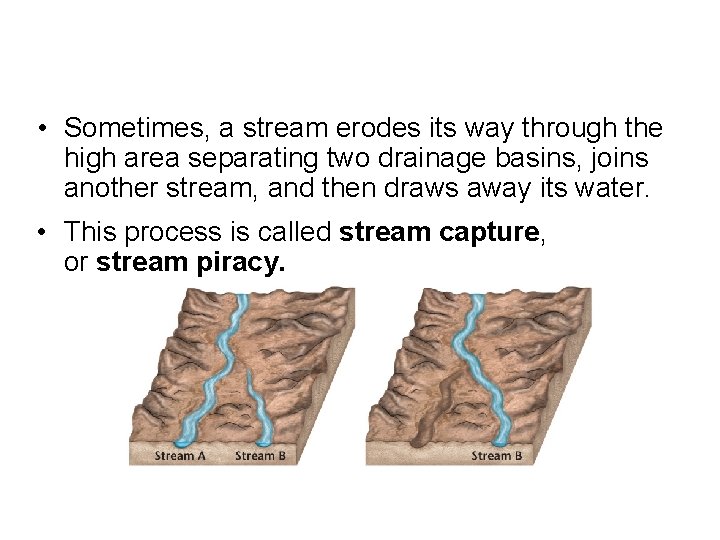
• Sometimes, a stream erodes its way through the high area separating two drainage basins, joins another stream, and then draws away its water. • This process is called stream capture, or stream piracy.
• As a stream erodes its path through the sediment or rock, a V-shaped channel develops. • V-shaped channels have steep sides and can form canyons. • Over time, a V-shaped valley will be eroded into a broader valley that has gentle slopes.
• A stream’s slope decreases as it nears its base level and the channel gets wider. • A meander is a bend or curve in a stream channel caused by moving water.
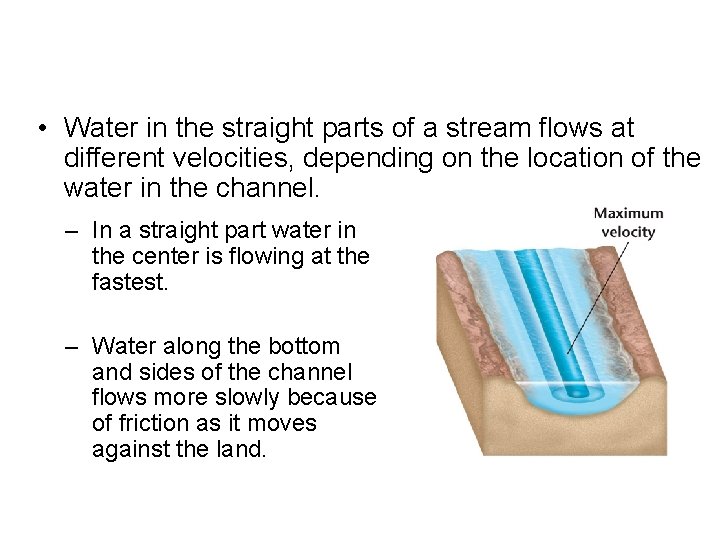
• Water in the straight parts of a stream flows at different velocities, depending on the location of the water in the channel. – In a straight part water in the center is flowing at the fastest. – Water along the bottom and sides of the channel flows more slowly because of friction as it moves against the land.
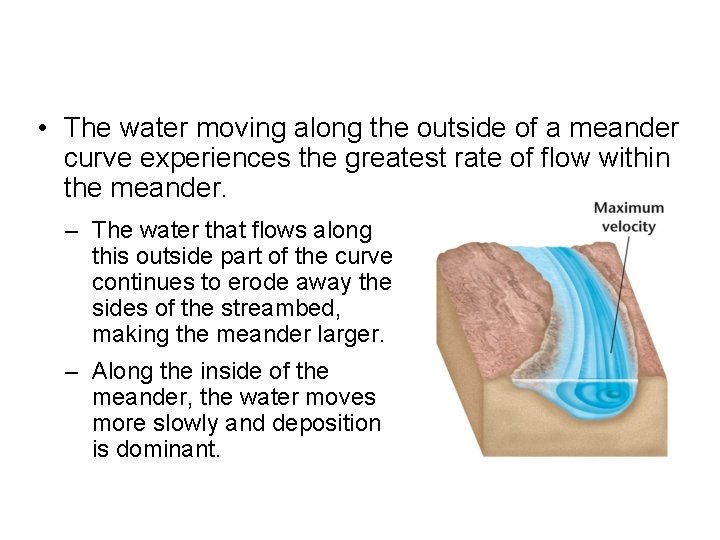
• The water moving along the outside of a meander curve experiences the greatest rate of flow within the meander. – The water that flows along this outside part of the curve continues to erode away the sides of the streambed, making the meander larger. – Along the inside of the meander, the water moves more slowly and deposition is dominant.
• It is common for a stream to cut off a meander and once again flow along a straighter path. • The cut off meander becomes an oxbow lake. • As a stream approaches its end point the gradient flattens out and its channel becomes very wide. • The mouth is the area of the stream that leads into the ocean or another large body of water.
• A stream’s speed slows down and its sediment load drops when its gradient abruptly decreases. • In dry regions, a stream’s gradient may suddenly decrease causing the stream to drop its sediment as a fan-shaped deposit called an alluvial fan. • Alluvial fans are sloping features formed at the bases of slopes and composed mostly of sand gravel.
• Streams also lose velocity and the ability to carry sediment when they join larger bodies of water. • A delta is the triangular deposit consisting of silt and clay particles that forms where a stream enters a large body of water.
• If the land over which the stream is flowing uplifts or if the base level lowers, the stream undergoes rejuvenation. • During rejuvenation, a stream resumes the process of downcutting toward its base level. • If rejuvenation occurs in an area where there are meanders, deep sided canyons are formed.
• A lake is a depression in the surface materials of a landscape that collects and holds water. • Reservoirs are lakes made for the primary purpose of storing water for a community’s use.
• Natural lakes form in different ways in surface depressions and in low areas. – Oxbow lakes form when streams cut off meanders and leave isolated channels of water. – Lakes can form when stream flow becomes blocked by sediment from landslides.
– Cirque lakes form when cirques carved high in the mountains by valley glaciers fill with water. – Kettle lakes formed when blocks of ice left on the outwash plain ahead of melting glaciers eventually melted and left depressions that filled with water. – Some lakes are formed when the ceilings of caves collapse.
– The amount of dissolved oxygen helps determine the quality of lake water and its ability to support life. – Eutrophication is the process by which lakes become rich in nutrients resulting in a change in the kinds of organisms in the lake. – Eutrophication speeds up with the addition of fertilizers, that contain nitrogen and phosphorus.
– A wetland is a land area that is covered with water for a large part of the year. • Bogs receive their water from precipitation soil tends to be rich in Sphagnum (peat moss).
– Wetlands serve as a filtering system that traps pollutants, sediments, and pathogenic bacteria contained in water sources. – Wetlands also provide vital habitats for migratory waterbirds and homes for an abundance of other wildlife. – From the late 1700 s to the mid 1980 s, the continental United States lost 50 percent of its wetlands.