
Surface Simplification Using Quadric Error Metrics Michael Garland


![Related Prior Work Vertex clustering [Rossignac-Borrel 93; Low-Tan 96] • Partition space; merge vertices](https://slidetodoc.com/presentation_image/59c4b32e7b4317161a87075c1becf419/image-25.jpg "Related Prior Work Vertex clustering [Rossignac-Borrel 93; Low-Tan 96] • Partition space; merge vertices")
![Related Prior Work Edge Collapse [Hoppe 96; Guéziec 95; Ronfard-Rossignac 96] • Iteratively contract](https://slidetodoc.com/presentation_image/59c4b32e7b4317161a87075c1becf419/image-26.jpg "Related Prior Work Edge Collapse [Hoppe 96; Guéziec 95; Ronfard-Rossignac 96] • Iteratively contract")
- Slides: 29
Surface Simplification Using Quadric Error Metrics Michael Garland Paul S. Heckbert August 1997
Surface Simplification
Overview Fast algorithm & good quality approximation • Practical trade-off of efficiency and quality Convenient characterization of error/shape • Compact & efficient Fairly general surface handling • Simplify non-manifold surfaces • Simplify topology as well as geometry
Surface Simplification: Our World View Simplify overly complex models rapidly • Minimize error between original and approximate Produce multiresolution models for rendering • Appearance is paramount – Holes and gaps usually disappear in the distance – Topology can be simplified • Want fine-grained operation for altering surface
Assumptions About Input Triangulated model with valid connectivity • Corners which coincide in space share vertices Surface need not have manifold topology • Edges can border any number of faces • Vertices shared by arbitrary collection of faces Application domain does not rely on topology • Medical Imaging: can’t leave out hole in the heart
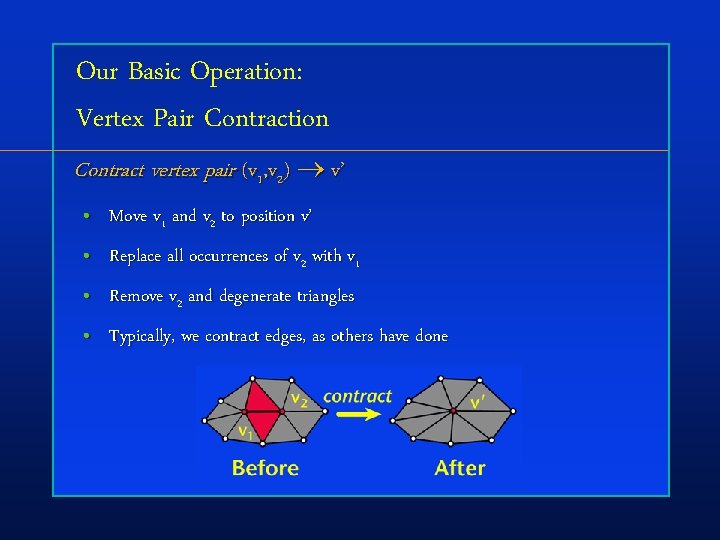
Our Basic Operation: Vertex Pair Contraction Contract vertex pair (v 1, v 2) v’ • Move v 1 and v 2 to position v’ • Replace all occurrences of v 2 with v 1 • Remove v 2 and degenerate triangles • Typically, we contract edges, as others have done
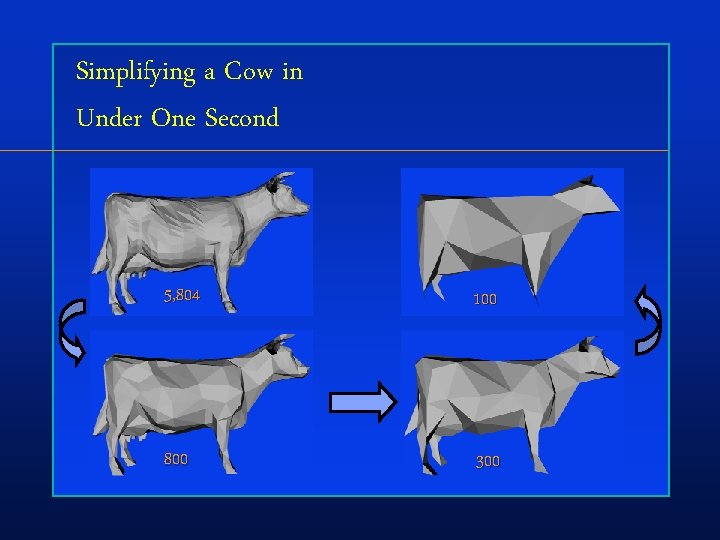
Simplifying a Cow in Under One Second 5, 804 100 800 300
How We Measure Error Measure error at current vertices For a given point v, measure sum of squared associated set of planes • Each vertex v has an associated set of planes – Initialize with planes of incident faces in original – Merge sets when contracting pairs – Initial error of each vertex is 0 distances to
How We Measure Error For a given point v, measure sum of squared associated set of planes • Locally, distance to plane equals distance to face • More efficient & compact than distance to face • Vertex’s set of planes records its history – Ronfard & Rossignac stored these sets explicitly – We track them implicitly using quadrics distances to
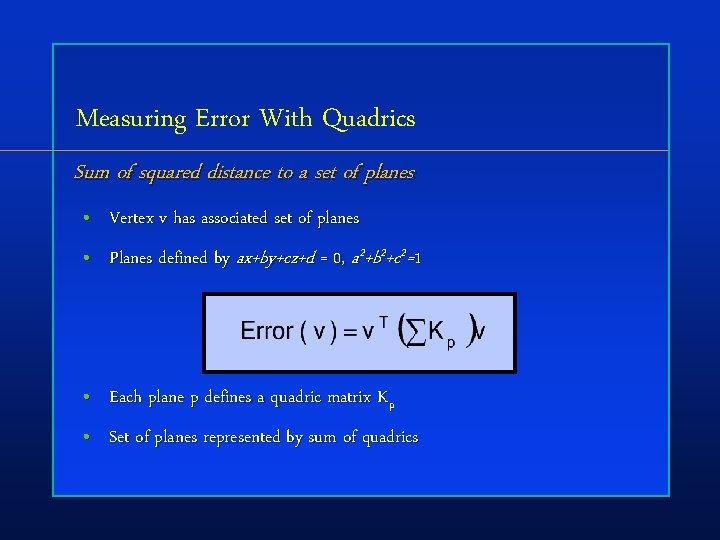
Measuring Error With Quadrics Sum of squared distance to a set of planes • Vertex v has associated set of planes • Planes defined by ax+by+cz+d = 0, a 2+b 2+c 2=1 • Each plane p defines a quadric matrix Kp • Set of planes represented by sum of quadrics
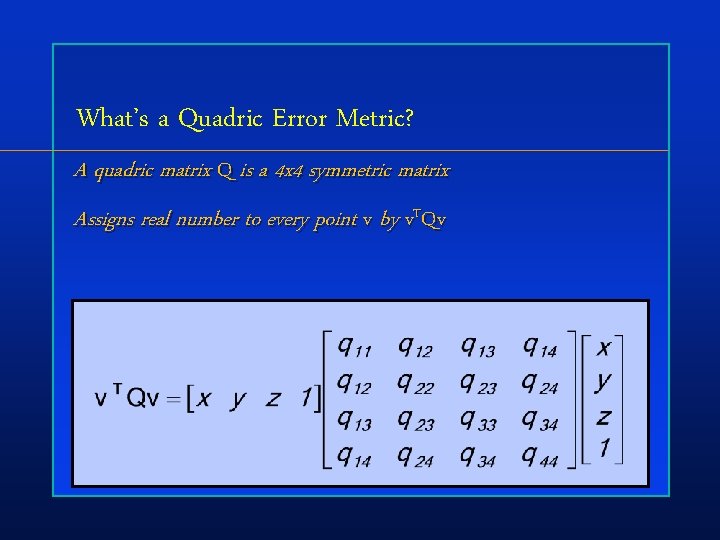
What’s a Quadric Error Metric? A quadric matrix Q is a 4 x 4 symmetric matrix Assigns real number to every point v by v. TQv
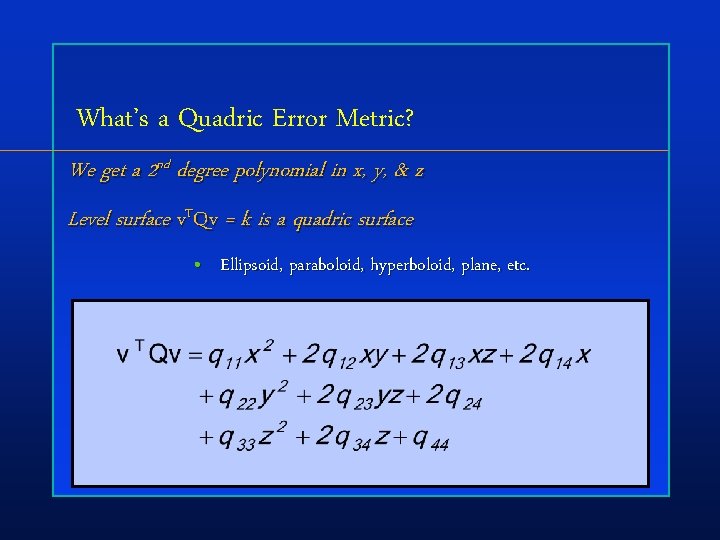
What’s a Quadric Error Metric? We get a 2 nd degree polynomial in x, y, & z Level surface v. TQv = k is a quadric surface • Ellipsoid, paraboloid, hyperboloid, plane, etc.
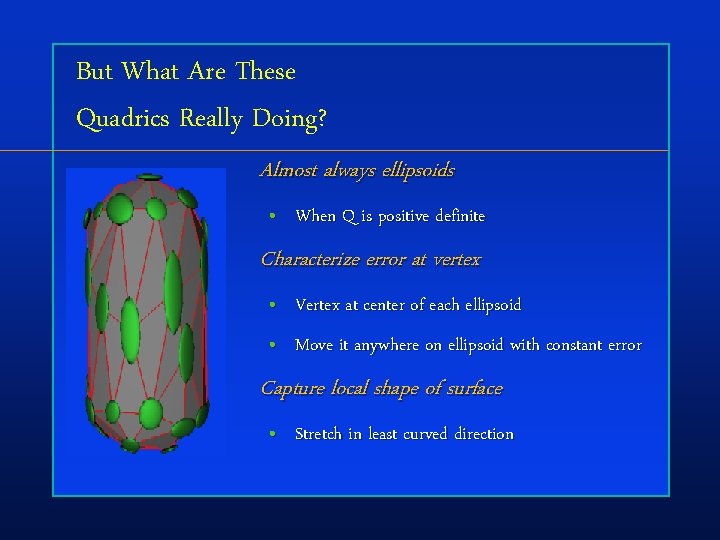
But What Are These Quadrics Really Doing? Almost always ellipsoids • When Q is positive definite Characterize error at vertex • Vertex at center of each ellipsoid • Move it anywhere on ellipsoid with constant error Capture local shape of surface • Stretch in least curved direction
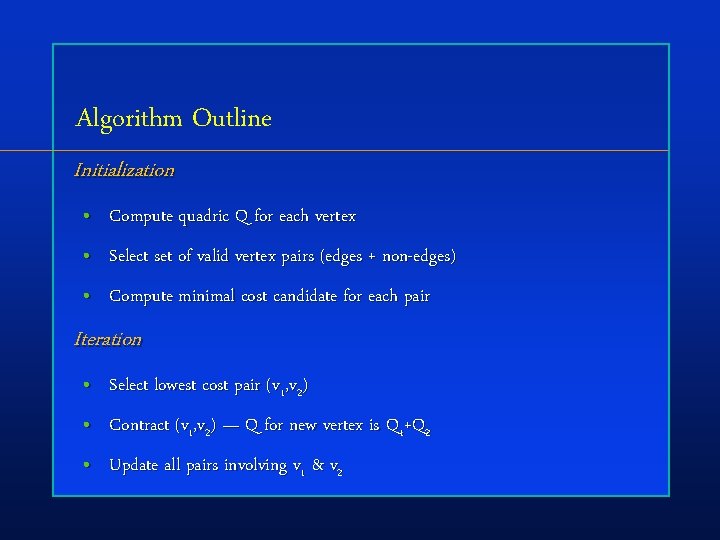
Algorithm Outline Initialization • Compute quadric Q for each vertex • Select set of valid vertex pairs (edges + non-edges) • Compute minimal cost candidate for each pair Iteration • Select lowest cost pair (v 1, v 2) • Contract (v 1, v 2) — Q for new vertex is Q 1+Q 2 • Update all pairs involving v 1 & v 2
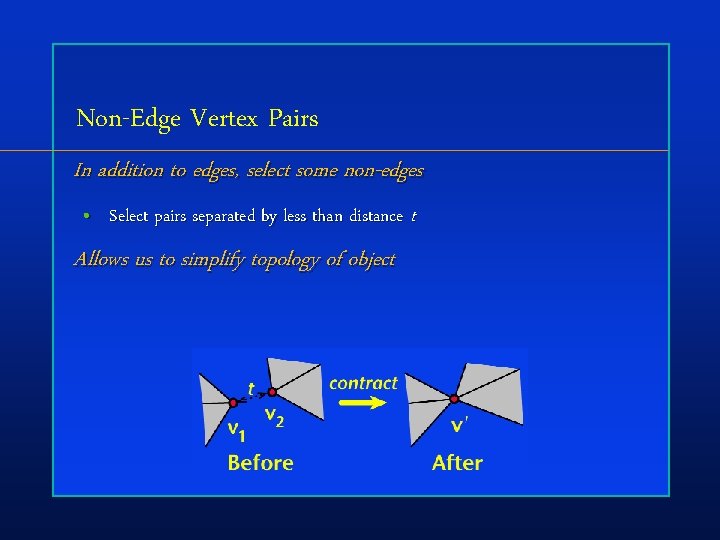
Non-Edge Vertex Pairs In addition to edges, select some non-edges • Select pairs separated by less than distance t Allows us to simplify topology of object
Video Clip
Additional Algorithm Details Open boundaries may be eaten away • For each edge with a single incident face – Find plane through edge perpendicular to face – Assign large weight & add into endpoints Contraction may fold mesh over on itself • Check normals before & after; reject if any flip Error metric dependent on initial mesh • Weight quadrics by triangle area
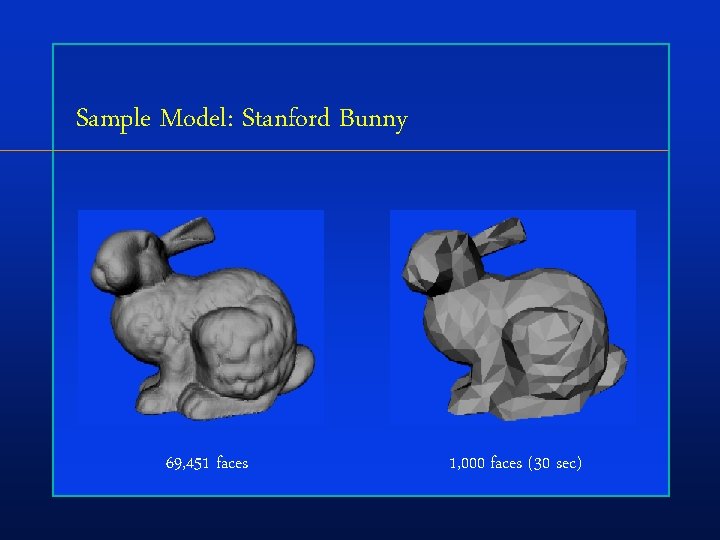
Sample Model: Stanford Bunny 69, 451 faces 1, 000 faces (30 sec)
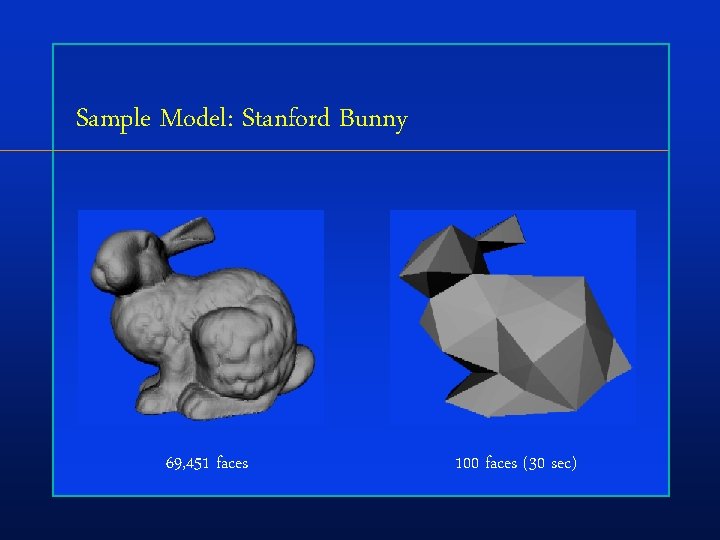
Sample Model: Stanford Bunny 69, 451 faces 100 faces (30 sec)
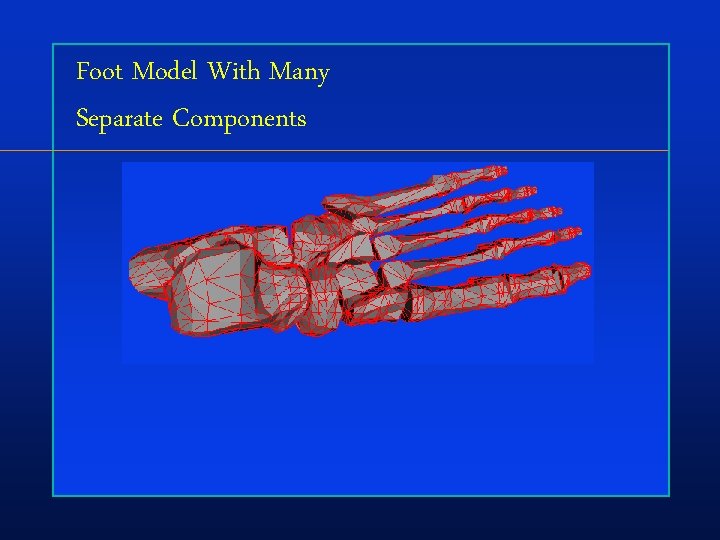
Foot Model With Many Separate Components
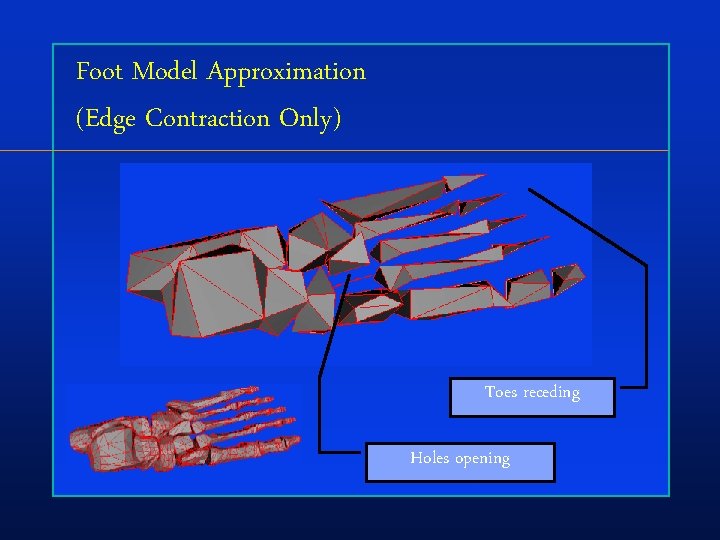
Foot Model Approximation (Edge Contraction Only) Toes receding Holes opening
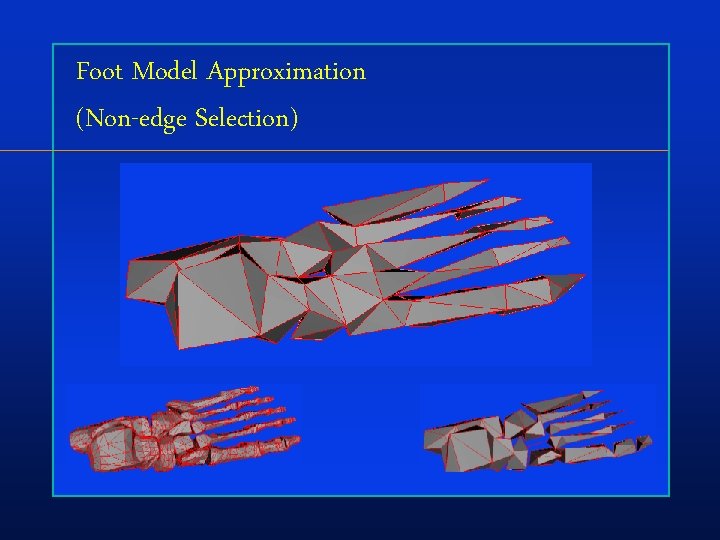
Foot Model Approximation (Non-edge Selection)
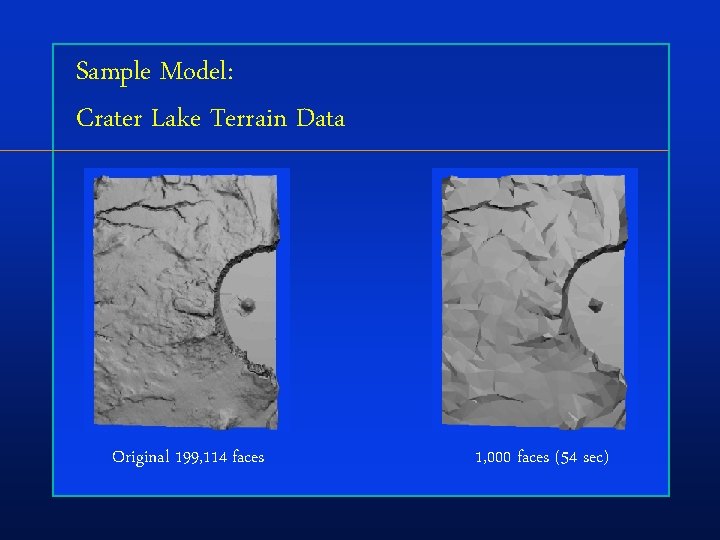
Sample Model: Crater Lake Terrain Data Original 199, 114 faces 1, 000 faces (54 sec)
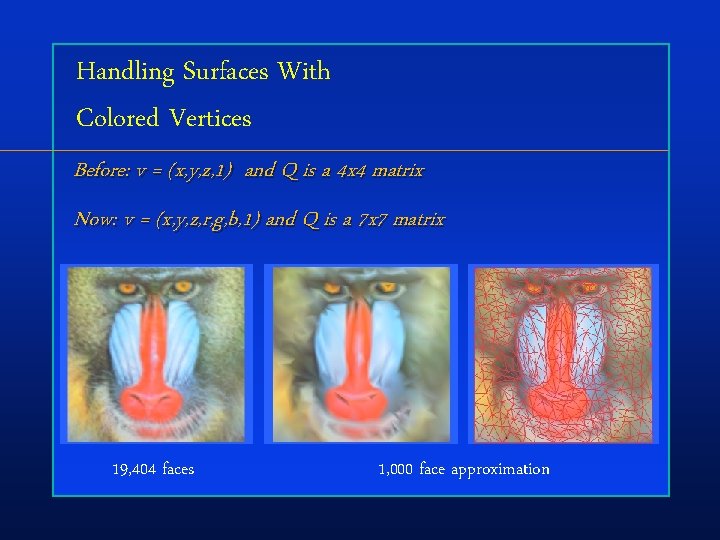
Handling Surfaces With Colored Vertices Before: v = (x, y, z, 1) and Q is a 4 x 4 matrix Now: v = (x, y, z, r, g, b, 1) and Q is a 7 x 7 matrix 19, 404 faces 1, 000 face approximation
Related Prior Work Vertex clustering [Rossignac-Borrel 93; Low-Tan 96] • Partition space; merge vertices within cells • Fast and general, but comparatively low quality Vertex Decimation [Schroeder et al 92; Soucy-Laurendeau 96] • Remove single vertex; retriangulate neighborhood • Comparable or lesser quality & typically slower • Typically limited to manifold regions • Less aggressive simplification
Related Prior Work Edge Collapse [Hoppe 96; Guéziec 95; Ronfard-Rossignac 96] • Iteratively contract edges; differ in edge selection • Some higher quality (e. g. , Hoppe 96), but significantly slower • Some comparable quality (e. g. , Ronfard-Rossignac), but not as general or efficient
Summary Efficient algorithm with quality results • Simple to implement; fast simplification • High quality approximations • Good compromise between highest quality and fastest simplification Simplifies both geometry and topology Can also handle surface properties (e. g. , color)
Future Work Constructing multiresolution models • Progressive meshes/simplicial complexes Quality and reliability joining components Planar regions are simplified rather randomly • Needs some bias towards good planar meshes
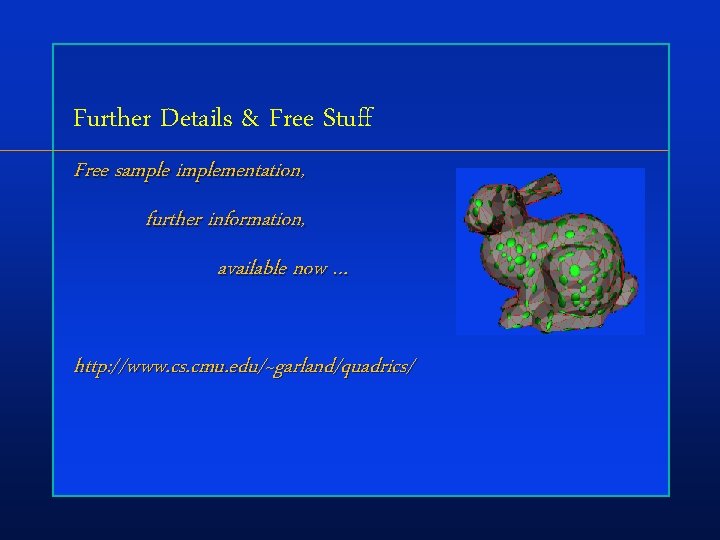
Further Details & Free Stuff Free sample implementation, further information, available now … http: //www. cs. cmu. edu/~garland/quadrics/