
Surface Simplification using Quadric Error Metrics Guowei Wu

- Slides: 25
Surface Simplification using Quadric Error Metrics Guowei Wu
Surface Simplification l l Triangulated surface model Several types of simplification techniques – – Vertex Decimation Vertex Clustering Iterative Edge Contraction Pair Contraction (QEM)
Surface Simplification l Limitation of other methods: – – – Vertex Decimation: maintain mesh topology, assume manifold model geometry Vertex Clustering: poor control on simplification process, low quality Edge Contraction: no aggregation, assume manifold model geometry.
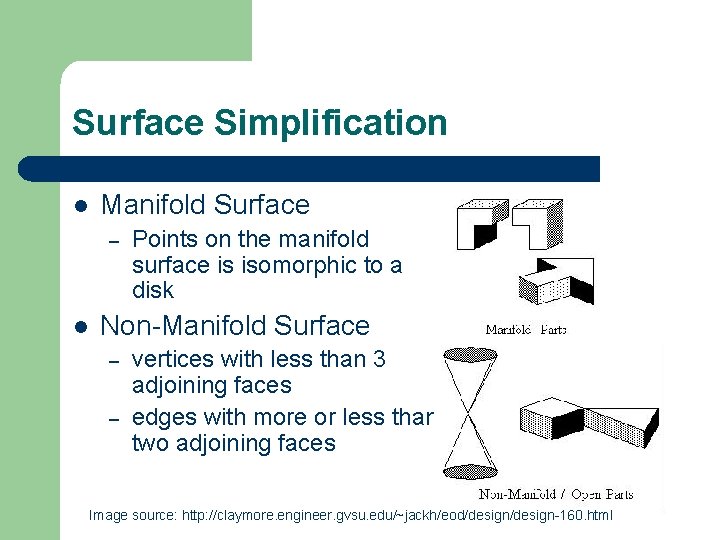
Surface Simplification l Manifold Surface – l Points on the manifold surface is isomorphic to a disk Non-Manifold Surface – – vertices with less than 3 adjoining faces edges with more or less than two adjoining faces Image source: http: //claymore. engineer. gvsu. edu/~jackh/eod/design-160. html
Model Boundary Representation l Manifold – – l Half-Edge data structure (directional edge) Winged-Edge data structure (every edge connects to exactly two faces, one on each side. ) Non-Manifold – Radial-Edge data structure (edges can connect to arbitrarily many faces)
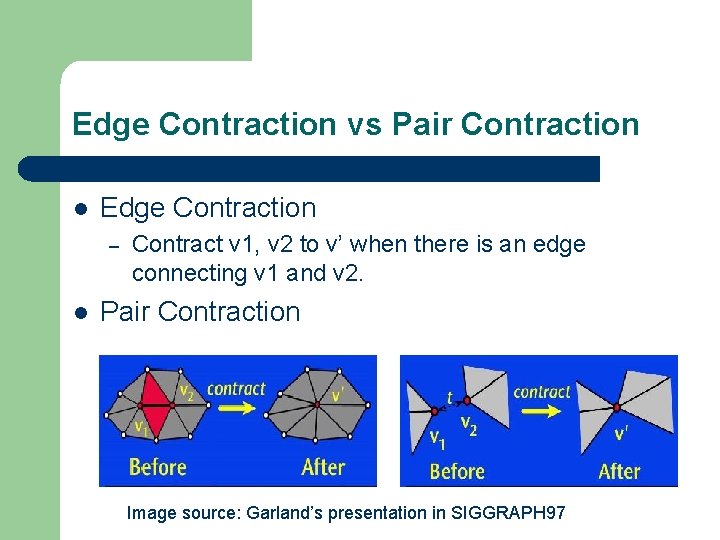
Edge Contraction vs Pair Contraction l Edge Contraction – l Contract v 1, v 2 to v’ when there is an edge connecting v 1 and v 2. Pair Contraction Image source: Garland’s presentation in SIGGRAPH 97
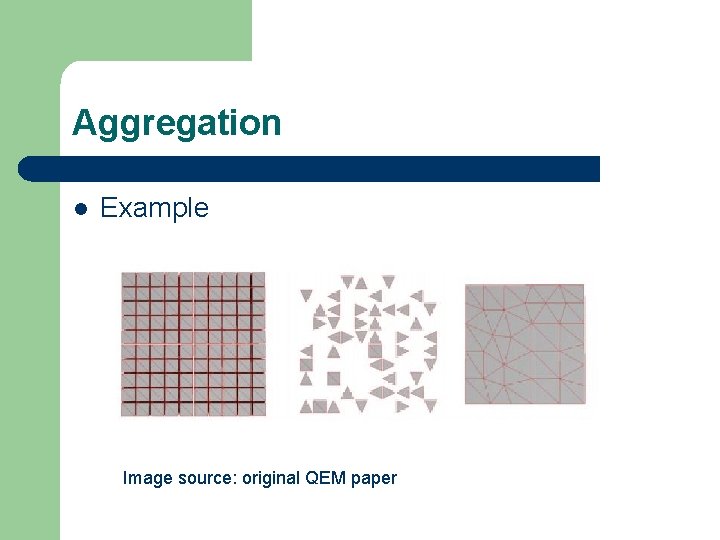
Aggregation l Example Image source: original QEM paper
Pair Selection l l Considering contracting every possible pair is not applicable. Select a pair v 1, v 2 – – (v 1, v 2) is an edge ||v 1 – v 2|| < t, t is a threshold
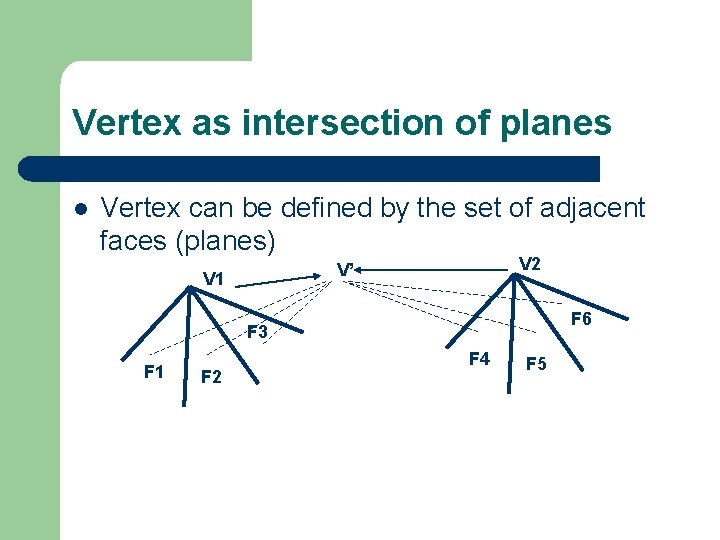
Vertex as intersection of planes l Vertex can be defined by the set of adjacent faces (planes) V 2 V’ V 1 F 6 F 3 F 1 F 2 F 4 F 5
Cost of Pair Contraction l l l The cost of contracting a pair (v 1, v 2) to v’ is the error of replacing v 1 and v 2 by the new created vertex v’. For a given point, the error is the sum of square distance to the associated set of planes. The cost of the contraction is the sum of square distance to the union of two sets of faces adjacent to v 1 and v 2. (F 1, F 2, F 3, F 4, F 5, F 6)
Quadric Error Metrics l l l In order to calculate the cost contraction, each vertex must keep track of a set of planes. After the contraction, the newly created vertex should keep track of the union of two sets of planes associated with the previous two vertices. Explicitly storing these planes takes more storage.
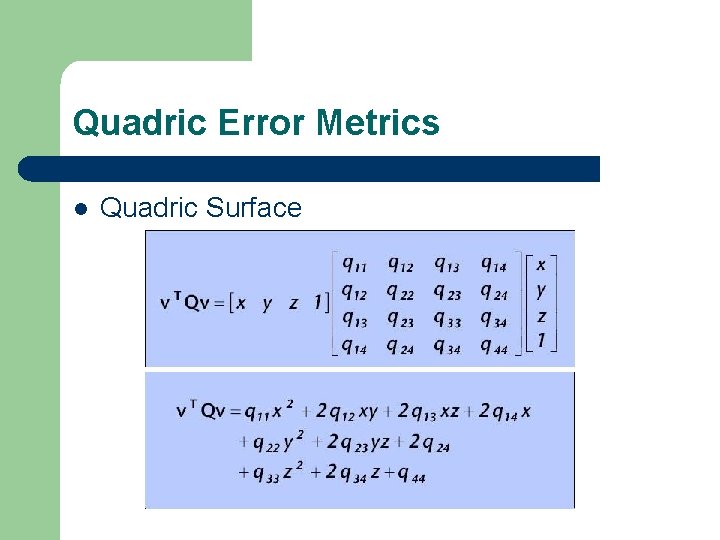
Quadric Error Metrics l l l We need the set of planes to calculate the cost of contraction, which is the sum of square distances to the set of planes. As long as the sum of square distance to the set of planes can be calculated, we do not need to store a set of plane equations. The set of plane equations associated with each vertex can be replaced by a 4 x 4 symmetric matrix Q.
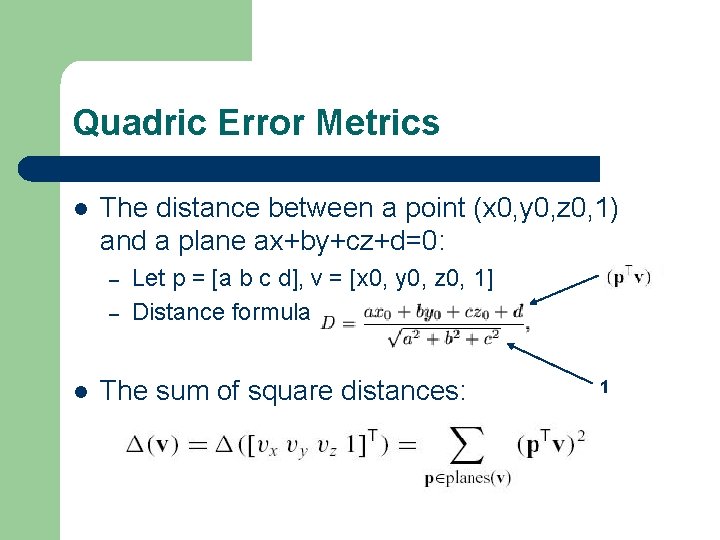
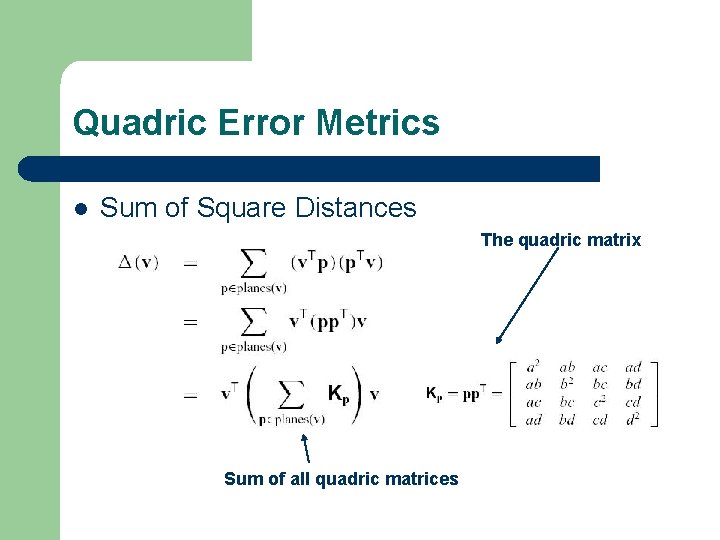
Quadric Error Metrics l The distance between a point (x 0, y 0, z 0, 1) and a plane ax+by+cz+d=0: – – l Let p = [a b c d], v = [x 0, y 0, z 0, 1] Distance formula The sum of square distances: 1
Quadric Error Metrics l Sum of Square Distances The quadric matrix Sum of all quadric matrices
Quadric Error Metrics l Quadric Surface
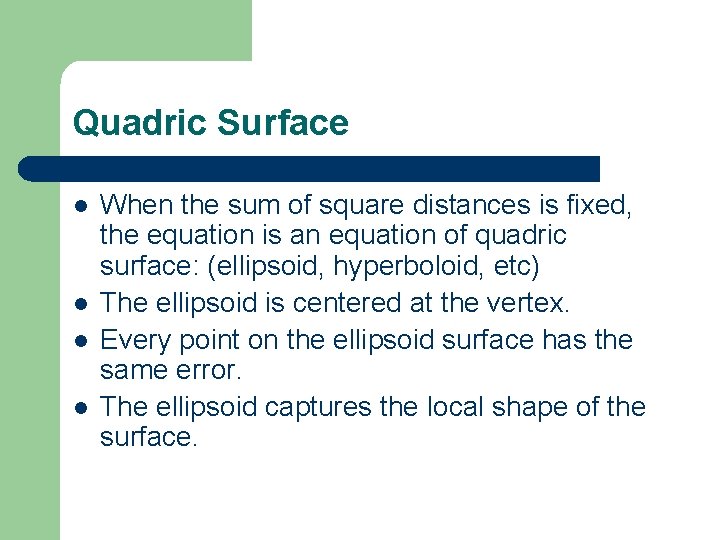
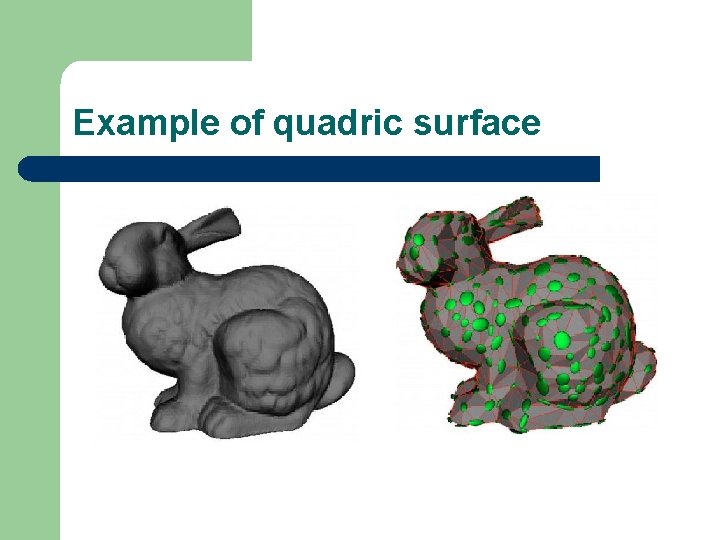
Quadric Surface l l When the sum of square distances is fixed, the equation is an equation of quadric surface: (ellipsoid, hyperboloid, etc) The ellipsoid is centered at the vertex. Every point on the ellipsoid surface has the same error. The ellipsoid captures the local shape of the surface.
Example of quadric surface
Optimal position for the new vertex l l Now we know how to evaluate the cost of contraction, so to determine the cost of contraction, we need to figure out the position of the new vertex after contraction. Solution: find the vertex location that minimize the cost of the contraction.
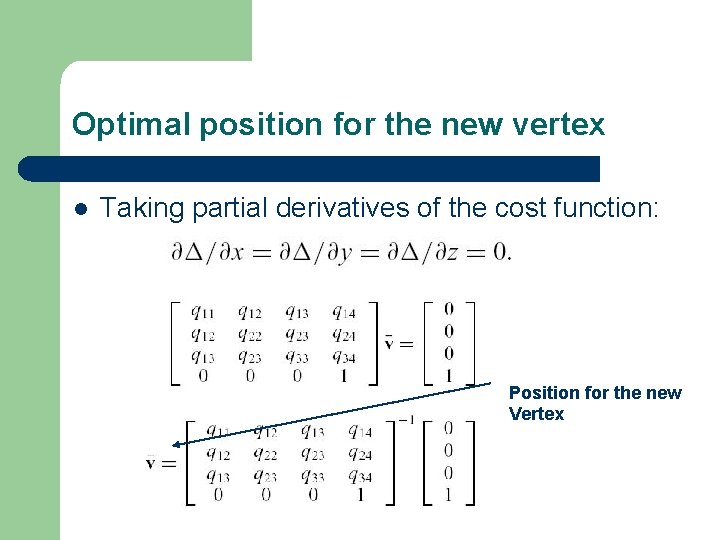
Optimal position for the new vertex l Taking partial derivatives of the cost function: Position for the new Vertex
Optimal position for the new vertex l If the matrix is not invertible, find the optimal vertex on the segment joining the vertex pair, or choosing among the two vertices and the midpoint of the two vertices.
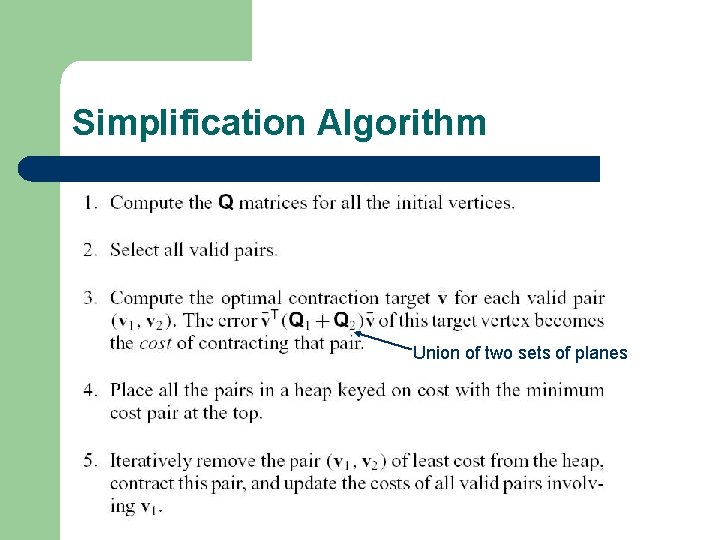
Simplification Algorithm Union of two sets of planes
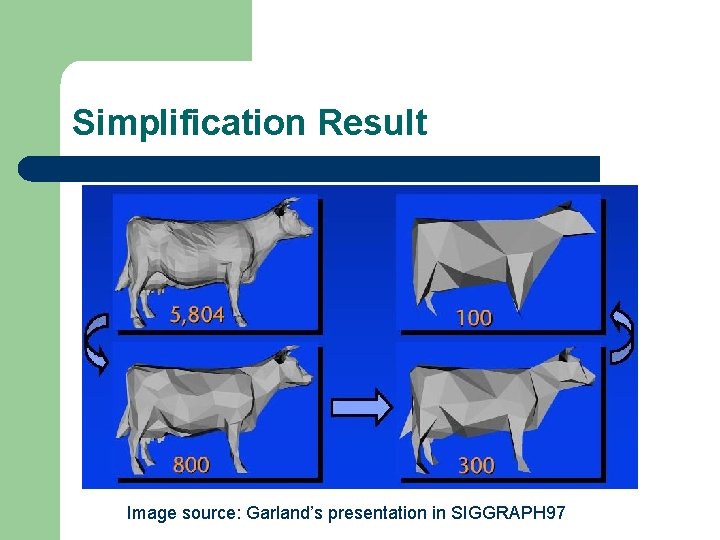
Simplification Result Image source: Garland’s presentation in SIGGRAPH 97
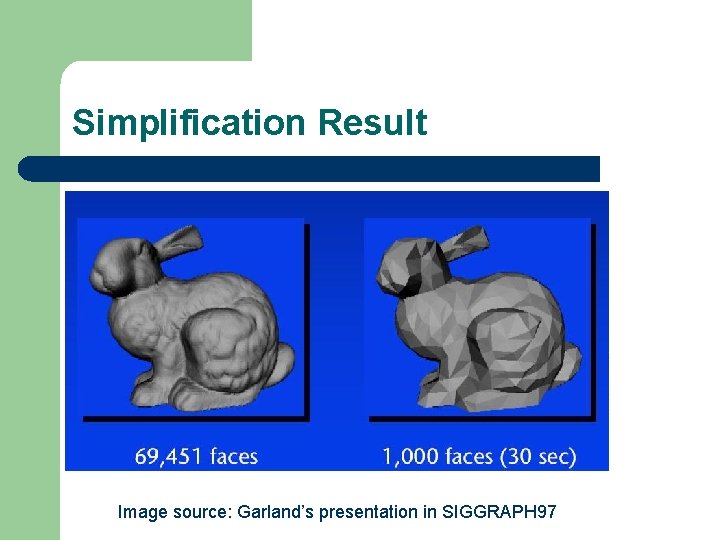
Simplification Result Image source: Garland’s presentation in SIGGRAPH 97
Conclusion l l l Fast Algorithm and good approximation Compact storage General surface handling
Reference l l l K. Weiler. The Radial Edge data structure: A topological representation for non-manifold geometric boundary modeling. In J. L. Encarnacao, M. J. Wozny, H. W. Mc. Laughlin, editors, Geometric Modeling for CAD Applications, pages 3 --36. Elsevier Science Publishers B. V. (North--Holland), Amsterdam, 1988. M. Garland P. Heckbert, "Simplification using quadric error metrics, " Proc. Siggraph 1997 Michael Garland Paul S. Heckbert , Simplifying Surfaces with Color and Texture using Quadric Error Metrics, IEEE Visualization 98