
Surface Roughness Investigations on Nb Samples using Optical
Surface Roughness Investigations on Nb Samples using Optical Profilometry A. Navitski, S. Lagotzky, G. Müller FB C Physik, Bergische Universität Wuppertal gmueller@uni-wuppertal. de • • • Motivation and strategy Surface roughness measurement techniques Results on polycrystalline Nb samples from DESY Results on single crystalline Nb samples from TJNAF Conclusion and outlook Nb samples from: A. Matheisen, D. Reschke, X. Singer, J. Ziegler (DESY) P. Kneisel (TJNAF) Financial support: Helmholtz Alliance “Physics at the Terascale” and BMBF G. Müller, 02. 03. 2011 Milano Meeting
Motivation and strategy Ø Enhanced field emission (EFE) is caused by particulates or scratches [1] Ø Quenches and high-field Q-drop might depend on surface roughness [2] Ø Number density of particulates can be much reduced by HPR [3], DIC [4] and clean room assembly, but influence of surface irregularities on EFE and quenches of poly/single crystalline EP/BCP Nb has been less studied [1] [2] [3] [4] A. Dangwal et al. , Phys. Rev. ST Accel. Beams 12, 023501 (2009). J. Knobloch et al. , Proc. 9 th Workshop on SRF (1999), p. 77. P. Kneisel et al. , Proc. 7 th Workshop on SRF (1995), p. 311. A. Dangwal et al. , J. Appl. Phys. 102, 044903 (2007). 1 -st step Systematic measurements of average surface roughness and local defect geometry for typical Nb samples by means of optical profilometry and AFM 2 -nd step Localization and characterization of effective field emitters (Eon (1 n. A), b, S) on the same Nb samples after HPR with FESM and in-situ SEM imaging 3 -rd step Ex-situ HRSEM/EDX identification of emitting defects and investigation of the correlation between EFE parameters and geometry of defects G. Müller, 02. 03. 2011 Milano Meeting
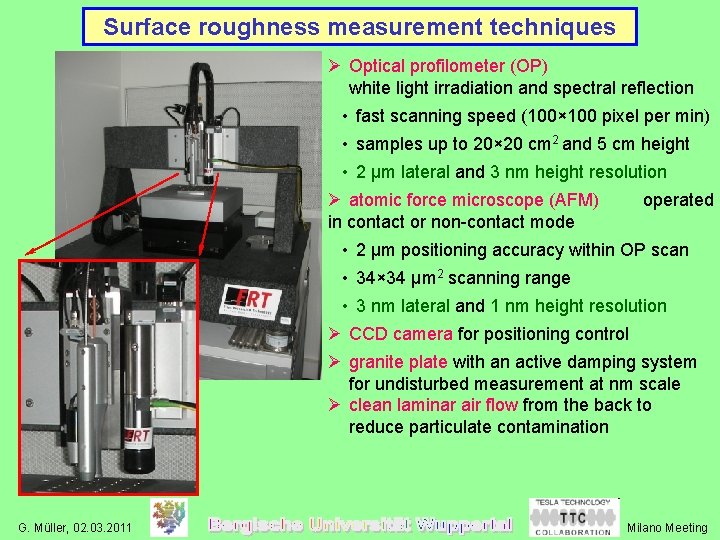
Surface roughness measurement techniques Ø Optical profilometer (OP) white light irradiation and spectral reflection • fast scanning speed (100× 100 pixel per min) • samples up to 20× 20 cm 2 and 5 cm height • 2 µm lateral and 3 nm height resolution Ø atomic force microscope (AFM) in contact or non-contact mode operated • 2 µm positioning accuracy within OP scan • 34× 34 µm 2 scanning range • 3 nm lateral and 1 nm height resolution Ø CCD camera for positioning control Ø granite plate with an active damping system for undisturbed measurement at nm scale Ø clean laminar air flow from the back to reduce particulate contamination G. Müller, 02. 03. 2011 Milano Meeting
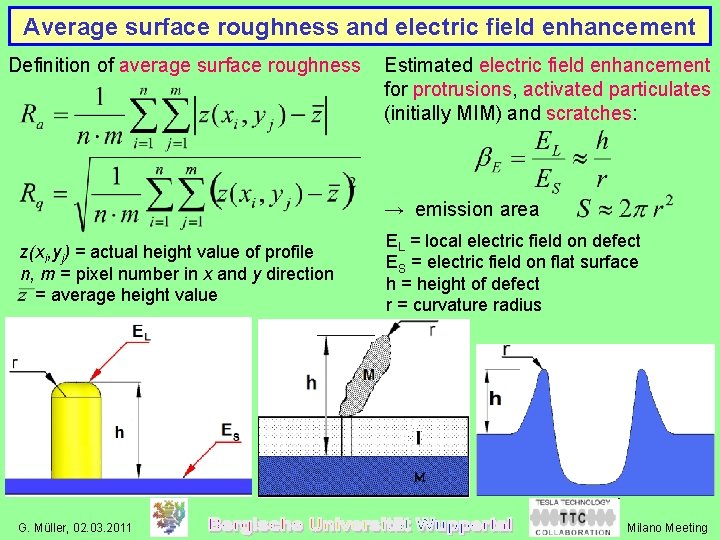
Average surface roughness and electric field enhancement Definition of average surface roughness Estimated electric field enhancement for protrusions, activated particulates (initially MIM) and scratches: → emission area z(xi, yj) = actual height value of profile n, m = pixel number in x and y direction = average height value G. Müller, 02. 03. 2011 EL = local electric field on defect ES = electric field on flat surface h = height of defect r = curvature radius Milano Meeting
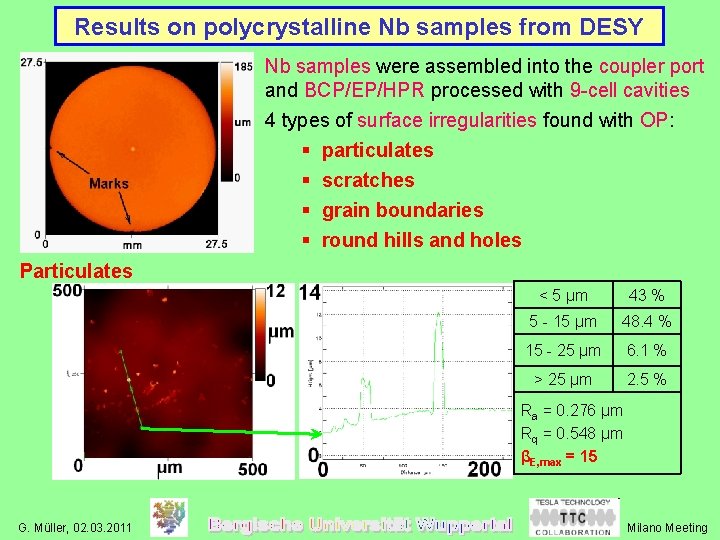
Results on polycrystalline Nb samples from DESY Nb samples were assembled into the coupler port and BCP/EP/HPR processed with 9 -cell cavities 4 types of surface irregularities found with OP: § particulates § scratches § grain boundaries § round hills and holes Particulates < 5 µm 43 % 5 - 15 µm 48. 4 % 15 - 25 µm 6. 1 % > 25 µm 2. 5 % Ra = 0. 276 µm Rq = 0. 548 µm βE, max = 15 G. Müller, 02. 03. 2011 Milano Meeting
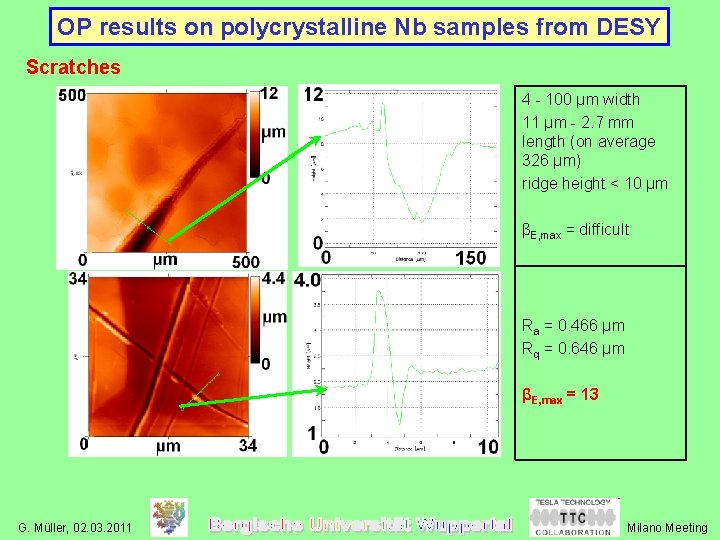
OP results on polycrystalline Nb samples from DESY Scratches 4 - 100 µm width 11 µm - 2. 7 mm length (on average 326 µm) ridge height < 10 µm βE, max = difficult Ra = 0. 466 µm Rq = 0. 646 µm βE, max = 13 G. Müller, 02. 03. 2011 Milano Meeting
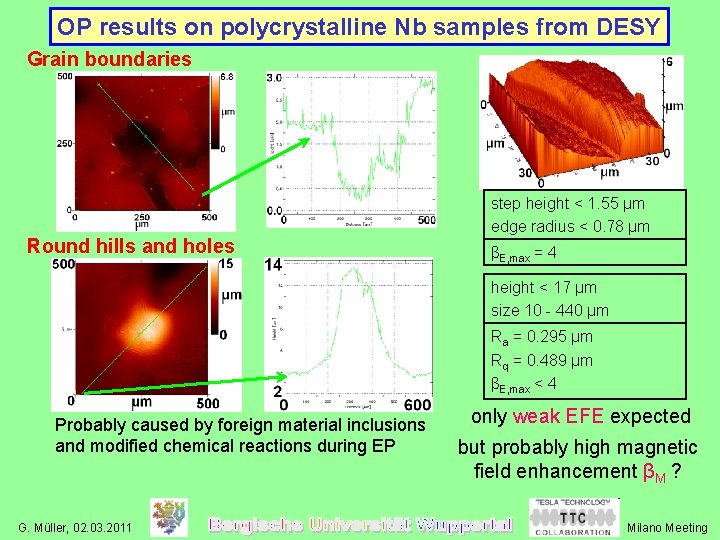
OP results on polycrystalline Nb samples from DESY Grain boundaries Round hills and holes step height < 1. 55 µm edge radius < 0. 78 µm βE, max = 4 height < 17 µm size 10 - 440 µm Ra = 0. 295 µm Rq = 0. 489 µm βE, max < 4 Probably caused by foreign material inclusions and modified chemical reactions during EP G. Müller, 02. 03. 2011 only weak EFE expected but probably high magnetic field enhancement βM ? Milano Meeting
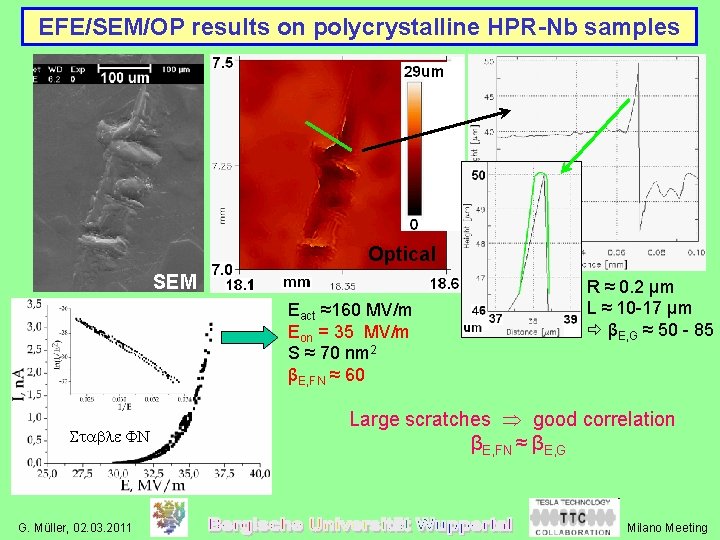
EFE/SEM/OP results on polycrystalline HPR-Nb samples Optical SEM Eact ≈160 MV/m Eon = 35 MV/m S ≈ 70 nm 2 βE, FN ≈ 60 Stable FN G. Müller, 02. 03. 2011 R ≈ 0. 2 µm L ≈ 10 -17 µm βE, G ≈ 50 - 85 Large scratches good correlation βE, FN ≈ βE, G Milano Meeting
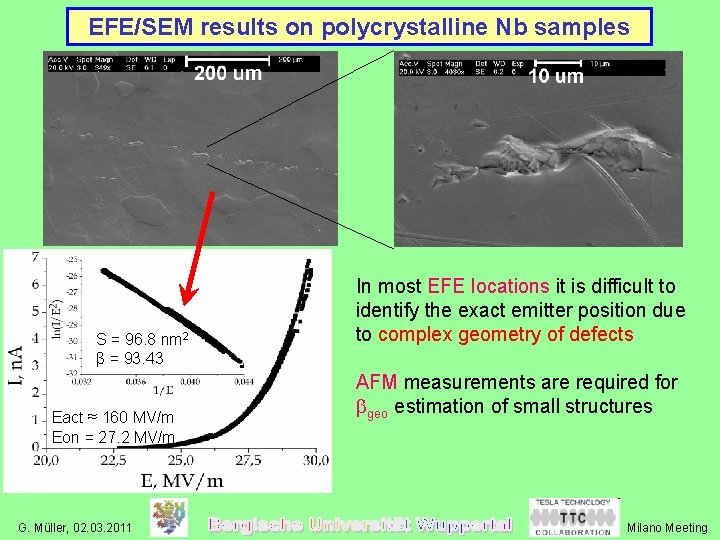
EFE/SEM results on polycrystalline Nb samples S = 96. 8 nm 2 β = 93. 43 Eact ≈ 160 MV/m Eon = 27. 2 MV/m G. Müller, 02. 03. 2011 In most EFE locations it is difficult to identify the exact emitter position due to complex geometry of defects AFM measurements are required for bgeo estimation of small structures Milano Meeting
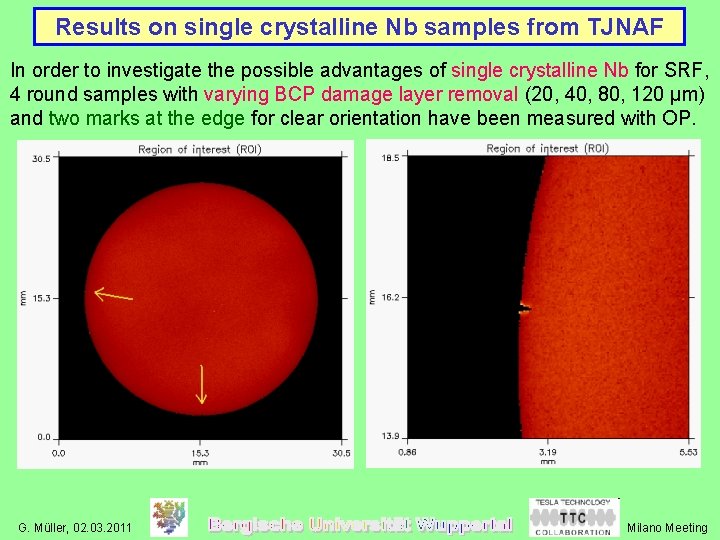
Results on single crystalline Nb samples from TJNAF In order to investigate the possible advantages of single crystalline Nb for SRF, 4 round samples with varying BCP damage layer removal (20, 40, 80, 120 µm) and two marks at the edge for clear orientation have been measured with OP. G. Müller, 02. 03. 2011 Milano Meeting
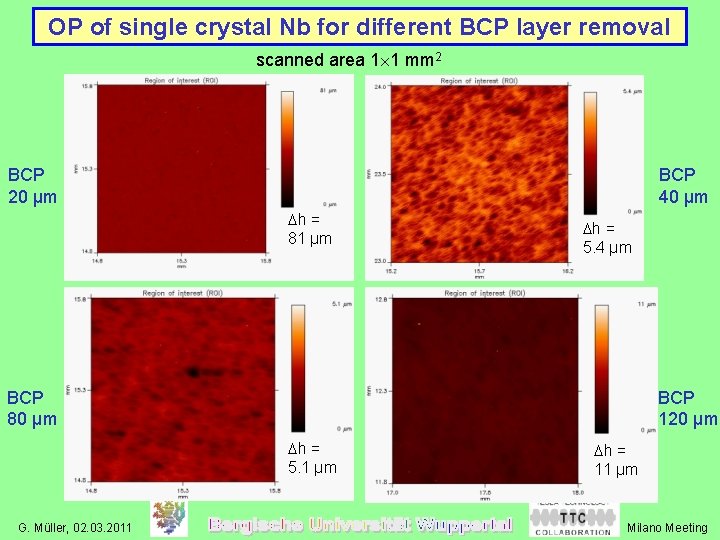
OP of single crystal Nb for different BCP layer removal scanned area 1 1 mm 2 BCP 40 µm BCP 20 µm Dh = 81 µm Dh = 5. 4 µm BCP 80 µm BCP 120 µm Dh = 5. 1 µm G. Müller, 02. 03. 2011 Dh = 11 µm Milano Meeting
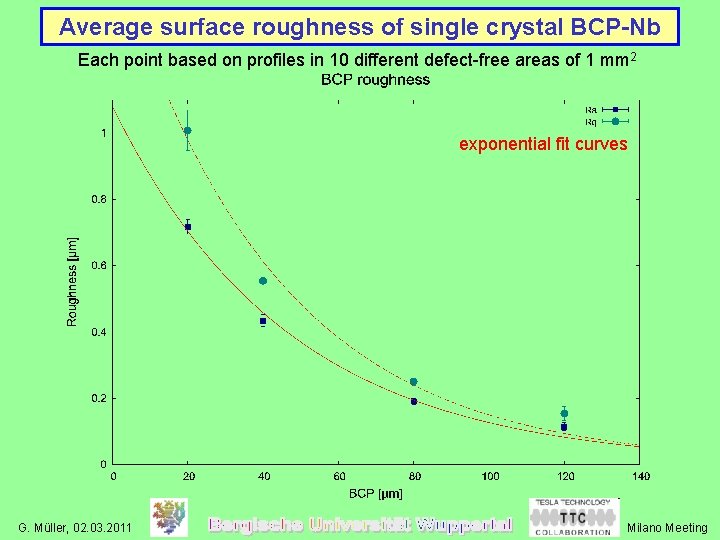
Average surface roughness of single crystal BCP-Nb Each point based on profiles in 10 different defect-free areas of 1 mm 2 exponential fit curves G. Müller, 02. 03. 2011 Milano Meeting
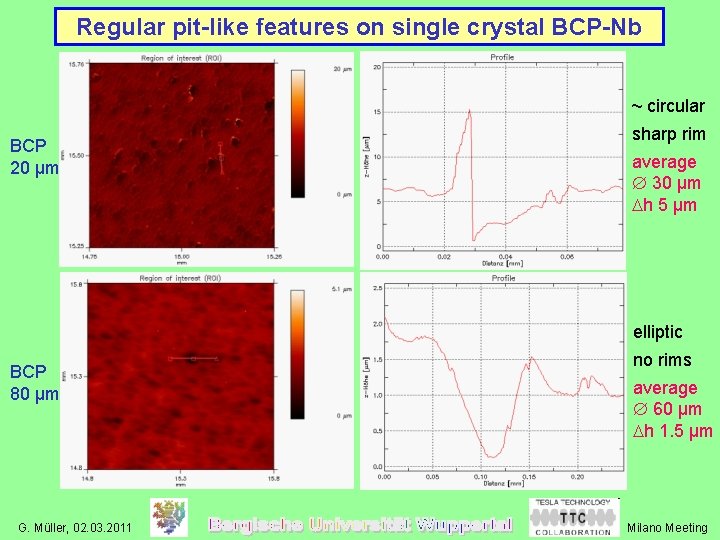
Regular pit-like features on single crystal BCP-Nb ~ circular BCP 20 µm sharp rim average 30 µm Dh 5 µm elliptic BCP 80 µm G. Müller, 02. 03. 2011 no rims average 60 µm Dh 1. 5 µm Milano Meeting
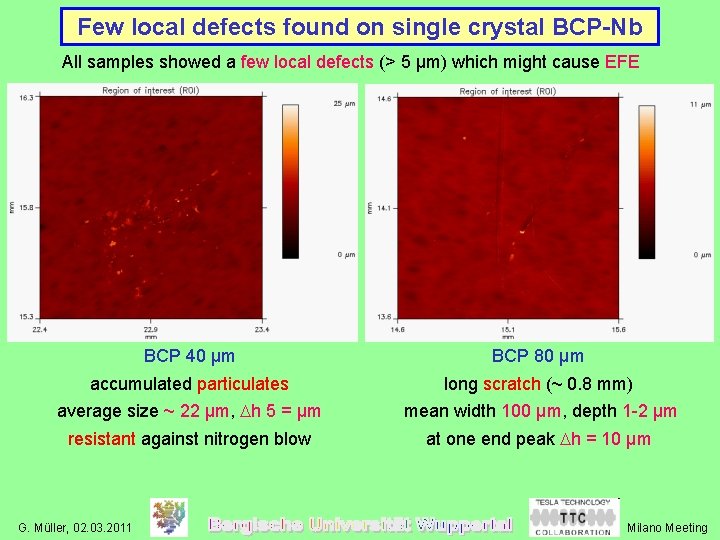
Few local defects found on single crystal BCP-Nb All samples showed a few local defects (> 5 µm) which might cause EFE BCP 40 µm BCP 80 µm accumulated particulates long scratch (~ 0. 8 mm) average size ~ 22 µm, Dh 5 = µm mean width 100 µm, depth 1 -2 µm resistant against nitrogen blow at one end peak Dh = 10 µm G. Müller, 02. 03. 2011 Milano Meeting
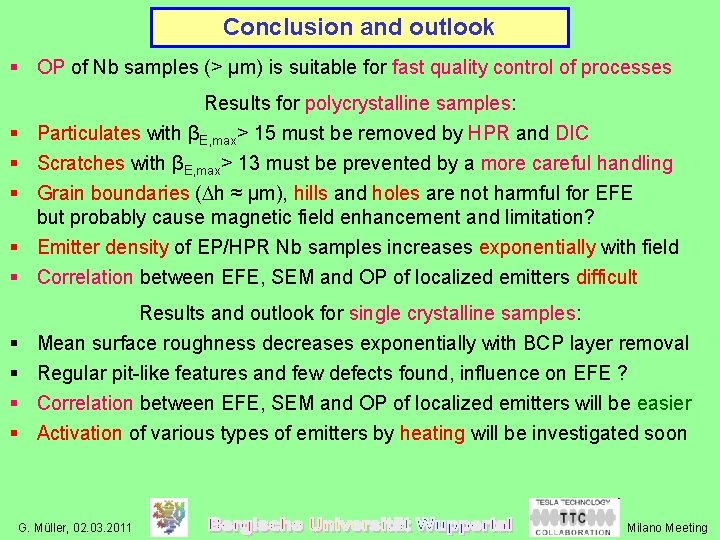
Conclusion and outlook § OP of Nb samples (> µm) is suitable for fast quality control of processes Results for polycrystalline samples: § Particulates with βE, max> 15 must be removed by HPR and DIC § Scratches with βE, max> 13 must be prevented by a more careful handling § Grain boundaries (Dh ≈ µm), hills and holes are not harmful for EFE but probably cause magnetic field enhancement and limitation? § Emitter density of EP/HPR Nb samples increases exponentially with field § Correlation between EFE, SEM and OP of localized emitters difficult § § Results and outlook for single crystalline samples: Mean surface roughness decreases exponentially with BCP layer removal Regular pit-like features and few defects found, influence on EFE ? Correlation between EFE, SEM and OP of localized emitters will be easier Activation of various types of emitters by heating will be investigated soon G. Müller, 02. 03. 2011 Milano Meeting
- Slides: 15