
Surface Reconstruction and Mesh Generation Nina Amenta University


- Slides: 65
Surface Reconstruction and Mesh Generation Nina Amenta University of California at Davis
Singer/Songwriters Joni Mitchell
Singer/Songwriters and Funk Bands Joni Mitchell
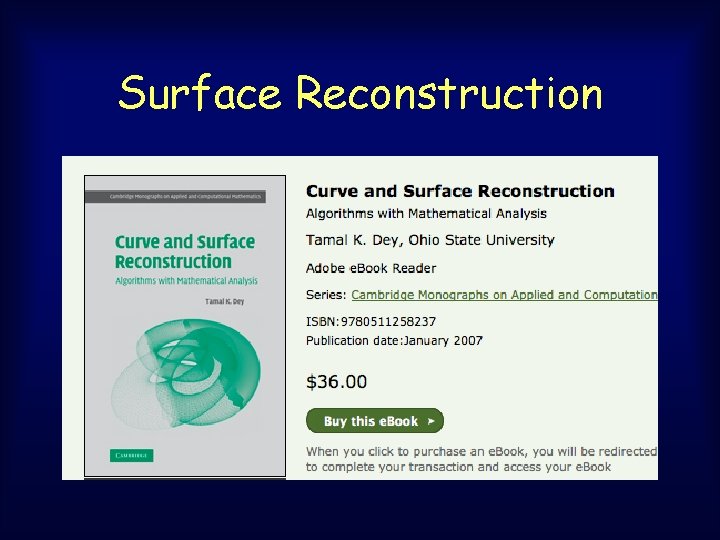
Surface Reconstruction
Mesh Generation
Other secondary sources • Jonathan Shewchuk lecture notes on mesh generation. • Surface reconstruction survey by Cazals and Giesen. • Chapter on meshing surfaces by Boissonnat, Cohen-Steiner, Mourrain, Rote, and Vegter.
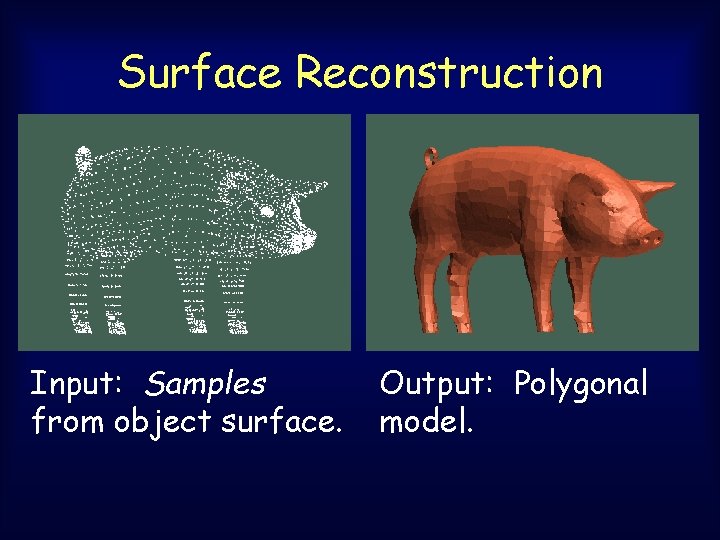
Surface Reconstruction Input: Samples from object surface. Output: Polygonal model.
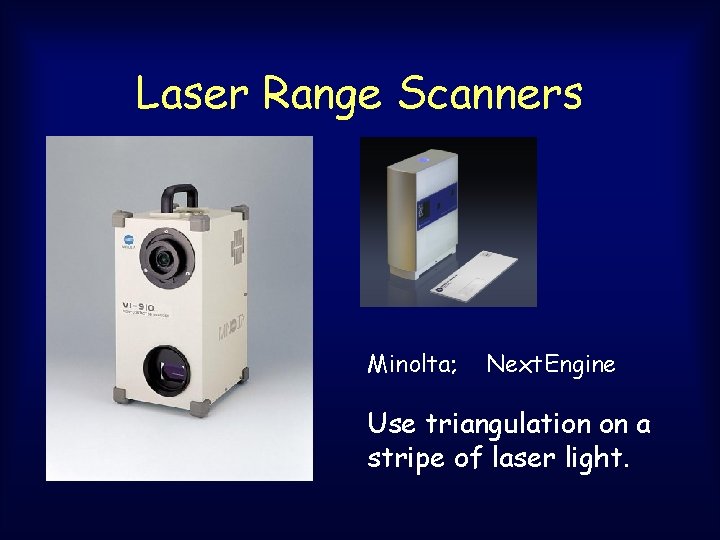
Laser Range Scanners Minolta; Next. Engine Use triangulation on a stripe of laser light.
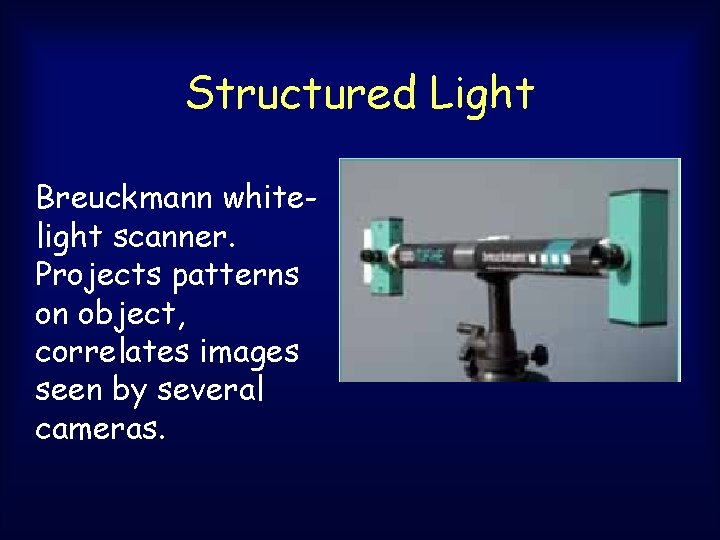
Structured Light Breuckmann whitelight scanner. Projects patterns on object, correlates images seen by several cameras.
Other ways to get points • Stereo/photogrammetry • Li. DAR Tend to be messier, CG methods not as appropriate.
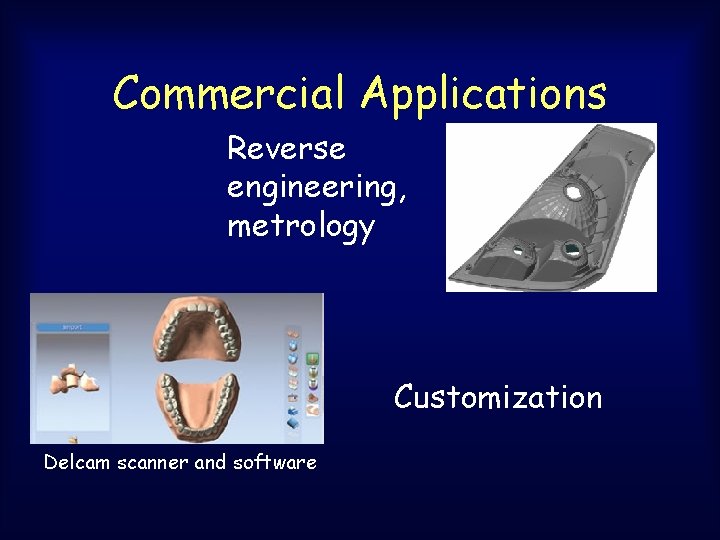
Commercial Applications Reverse engineering, metrology Customization Delcam scanner and software
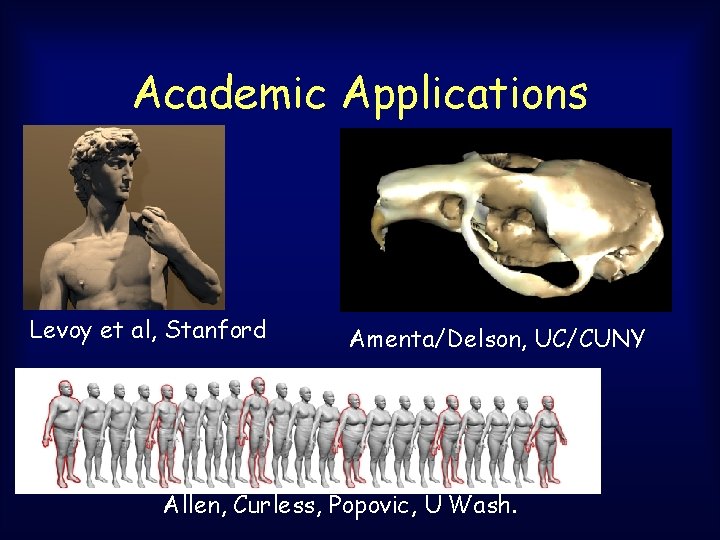
Academic Applications Levoy et al, Stanford Amenta/Delson, UC/CUNY Allen, Curless, Popovic, U Wash.
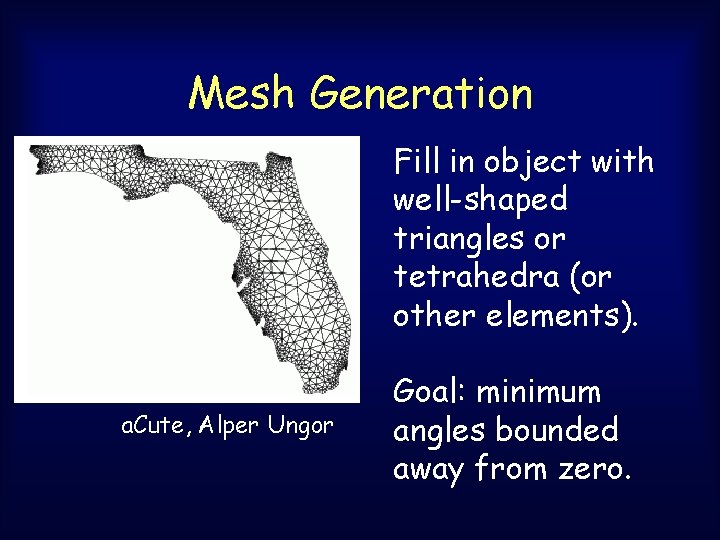
Mesh Generation Fill in object with well-shaped triangles or tetrahedra (or other elements). a. Cute, Alper Ungor Goal: minimum angles bounded away from zero.
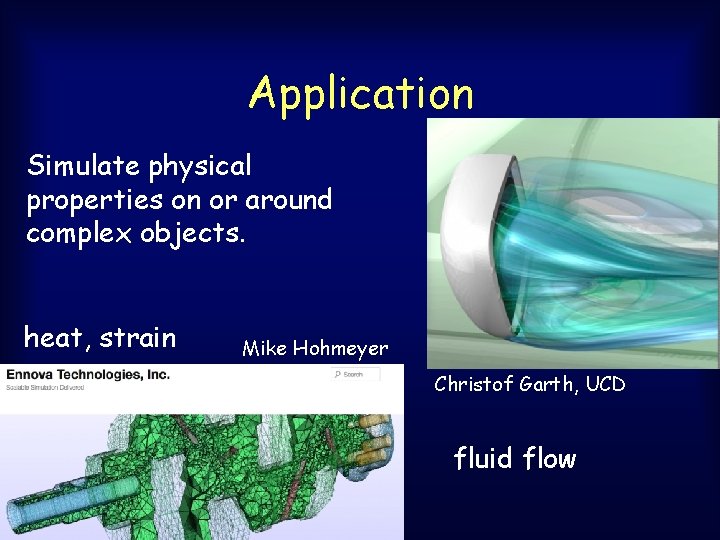
Application Simulate physical properties on or around complex objects. heat, strain Mike Hohmeyer Christof Garth, UCD fluid flow
Finite Element/Volume Methods Numerically solve PDE for physical quantity over space, on triangle/tet mesh. Finite Element: Linearly interpolate vertex data over elements. Finite Volume: Edges represent fluxes across dual Voronoi faces.
Attack of the Computational Geometers • Define problems • Voronoi/Delaunay constructions • Provably correct algorithms, constants, running times… • Plenty of structural geometric theory
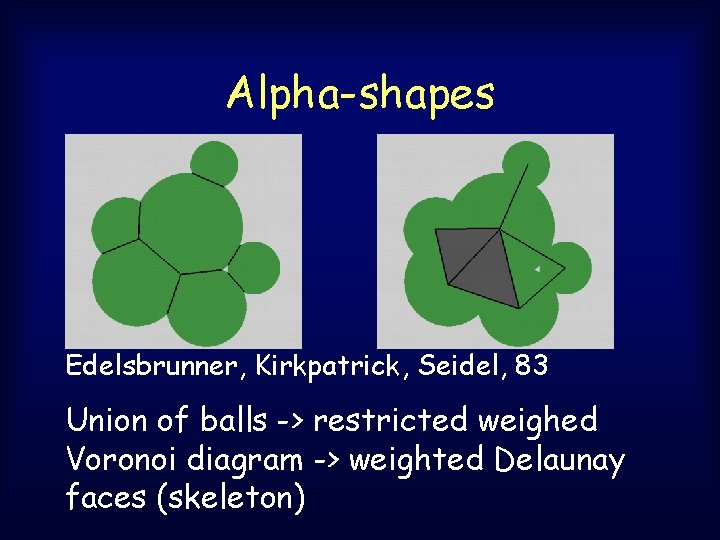
Alpha-shapes Edelsbrunner, Kirkpatrick, Seidel, 83 Union of balls -> restricted weighed Voronoi diagram -> weighted Delaunay faces (skeleton)
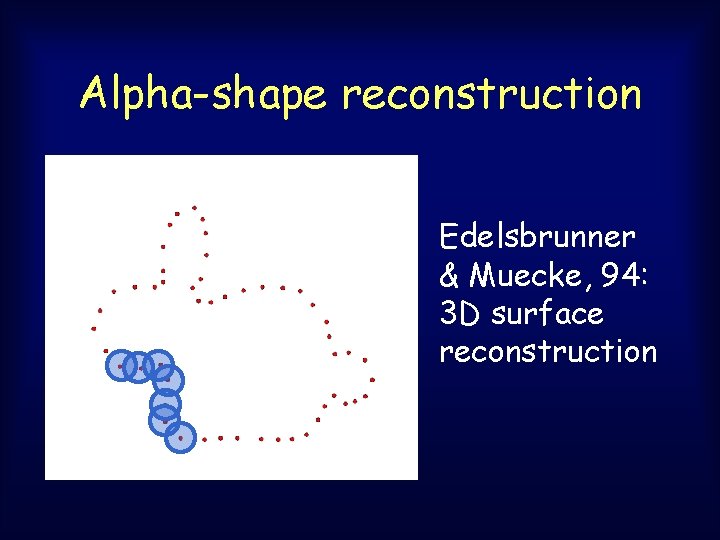
Alpha-shape reconstruction Edelsbrunner & Muecke, 94: 3 D surface reconstruction
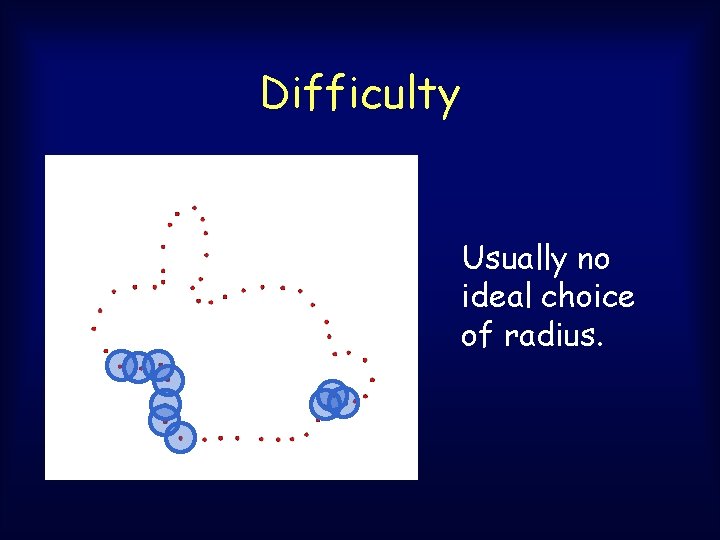
Difficulty Usually no ideal choice of radius.
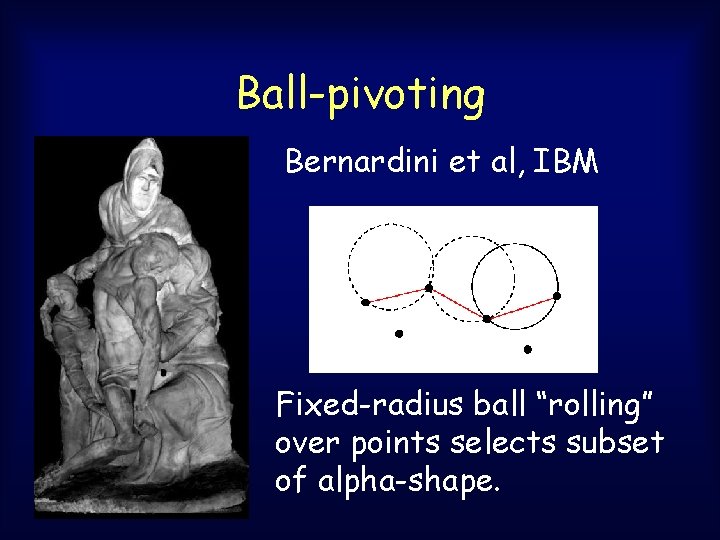
Ball-pivoting Bernardini et al, IBM Fixed-radius ball “rolling” over points selects subset of alpha-shape.
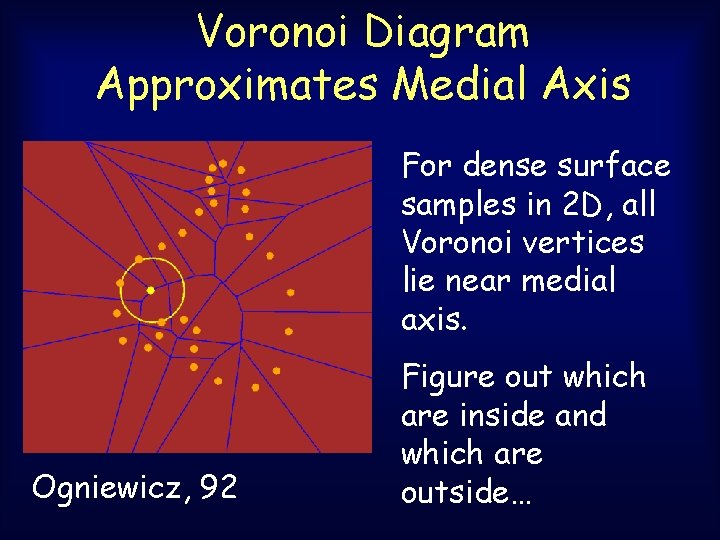
Voronoi Diagram Approximates Medial Axis For dense surface samples in 2 D, all Voronoi vertices lie near medial axis. Ogniewicz, 92 Figure out which are inside and which are outside…
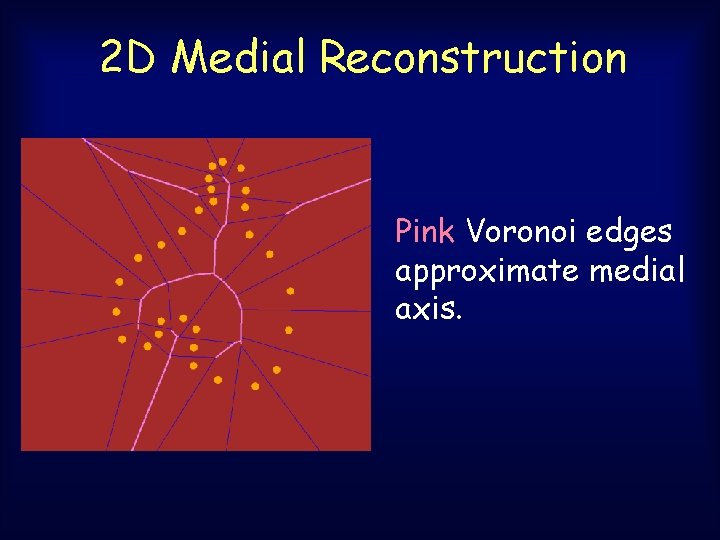
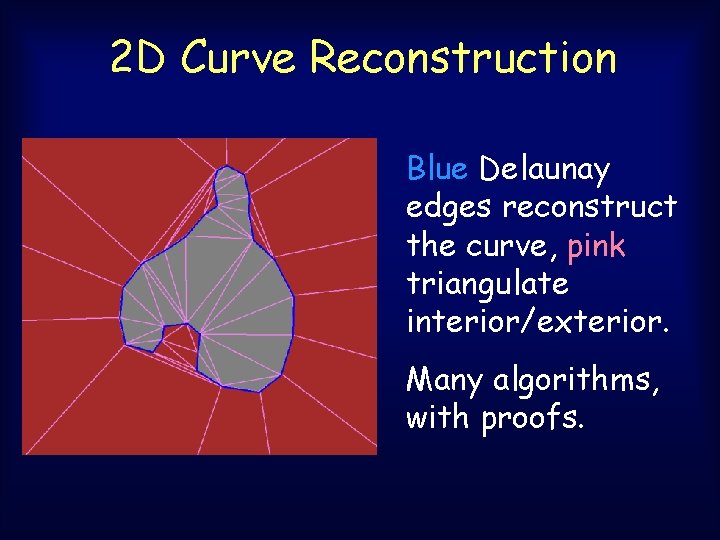
2 D Medial Reconstruction Pink Voronoi edges approximate medial axis.
2 D Curve Reconstruction Blue Delaunay edges reconstruct the curve, pink triangulate interior/exterior. Many algorithms, with proofs.
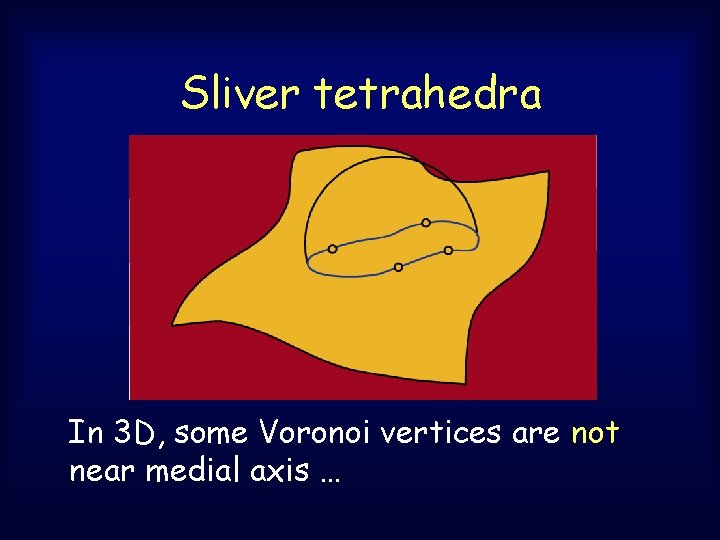
Sliver tetrahedra In 3 D, some Voronoi vertices are not near medial axis …
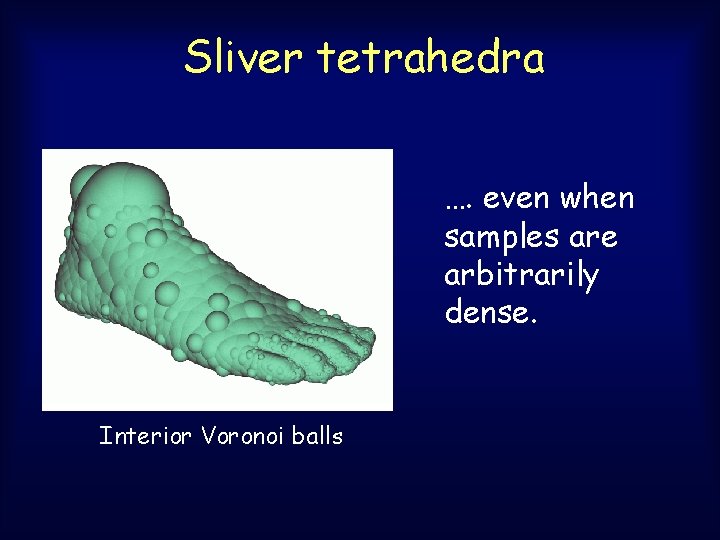
Sliver tetrahedra …. even when samples are arbitrarily dense. Interior Voronoi balls
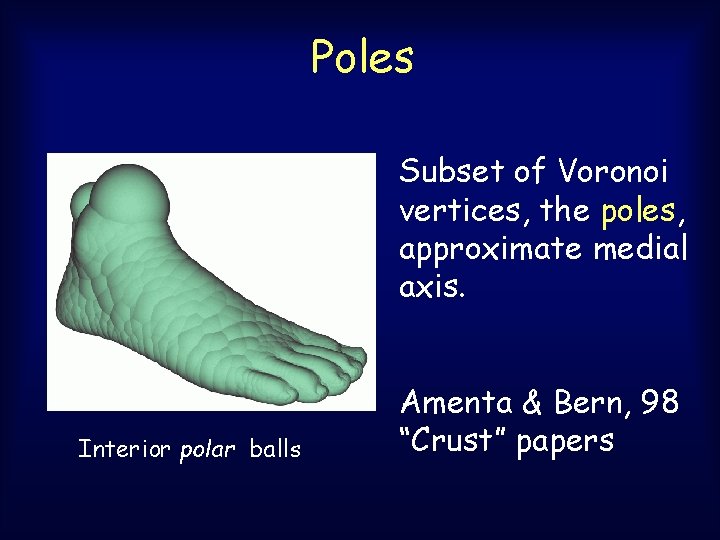
Poles Subset of Voronoi vertices, the poles, approximate medial axis. Interior polar balls Amenta & Bern, 98 “Crust” papers
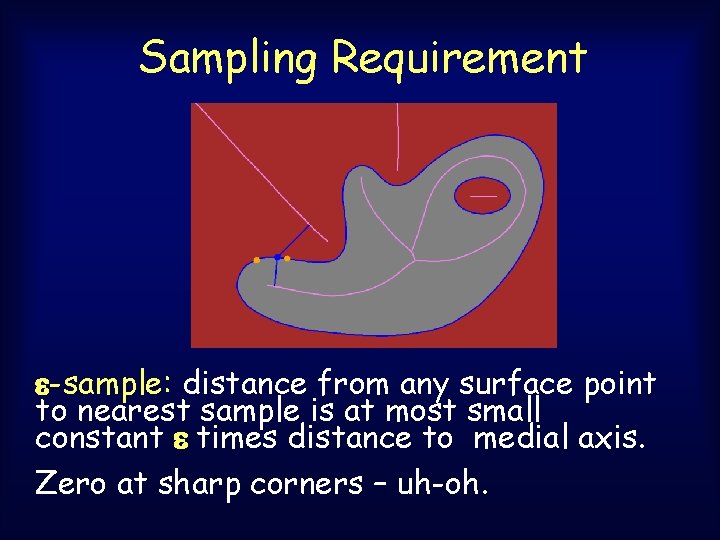
Sampling Requirement e-sample: distance from any surface point to nearest sample is at most small constant e times distance to medial axis. Zero at sharp corners – uh-oh.
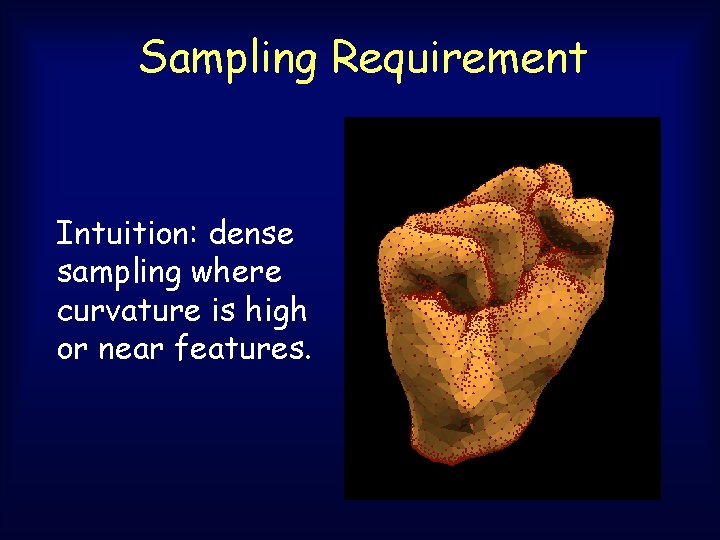
Sampling Requirement Intuition: dense sampling where curvature is high or near features.
Kinds of Results • Assuming input sampling is dense enough, then output triangulation will be homeomorphic to, and close to, the original surface. • Usually also demonstrate robustness by implementation.
Algorithms and Software Examine Delaunay triangles • Amenta and Bern, Crust • Amenta, Choi, Dey and Leekha, Cocone • Dey & Goswami, (water)-Tight Cocone • Dey & Giesen, undersampling errors Inside/Outside • Boissonnat, sculpting • Boissonnat and Cazals, Natural neighbor • Amenta, Choi and Kolluri, Power crust • Kolluri, Shewchuk, O’Brien, Spectral
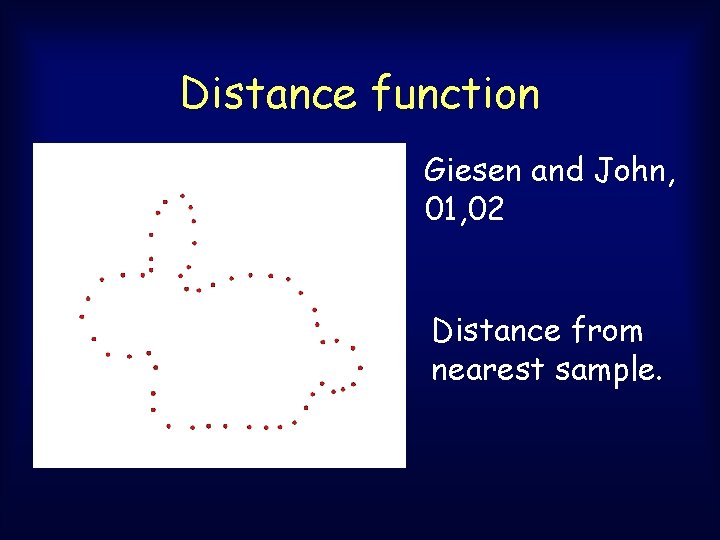
Distance function Giesen and John, 01, 02 Distance from nearest sample.
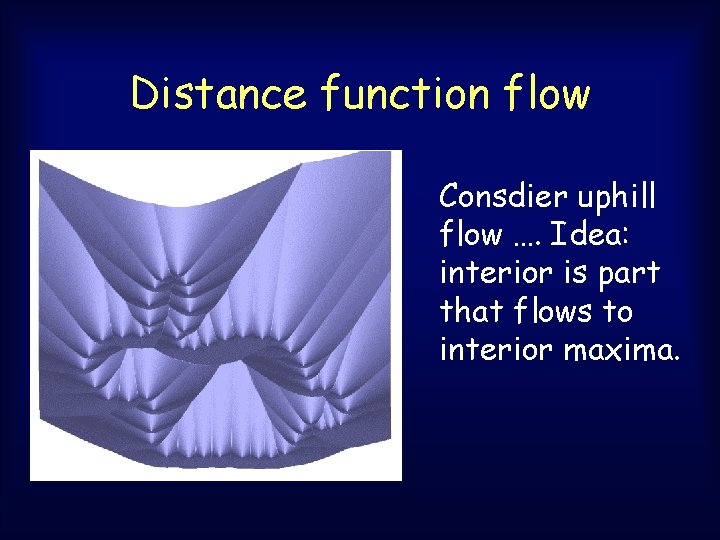
Distance function flow Consdier uphill flow …. Idea: interior is part that flows to interior maxima.
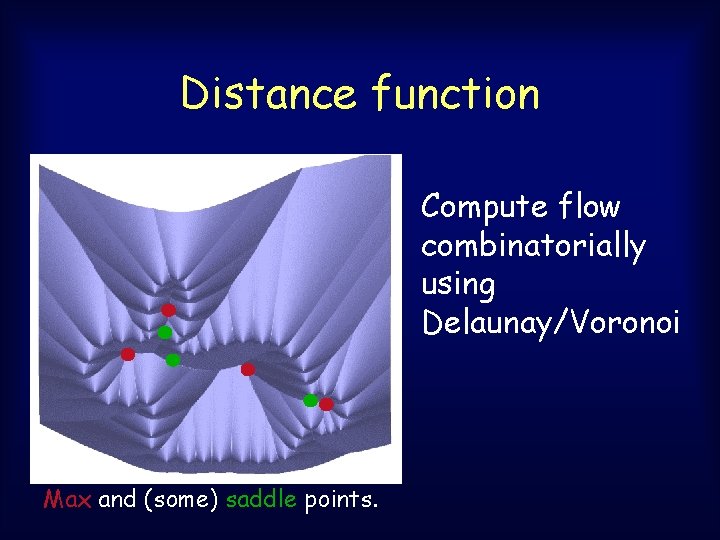
Distance function Compute flow combinatorially using Delaunay/Voronoi Max and (some) saddle points.
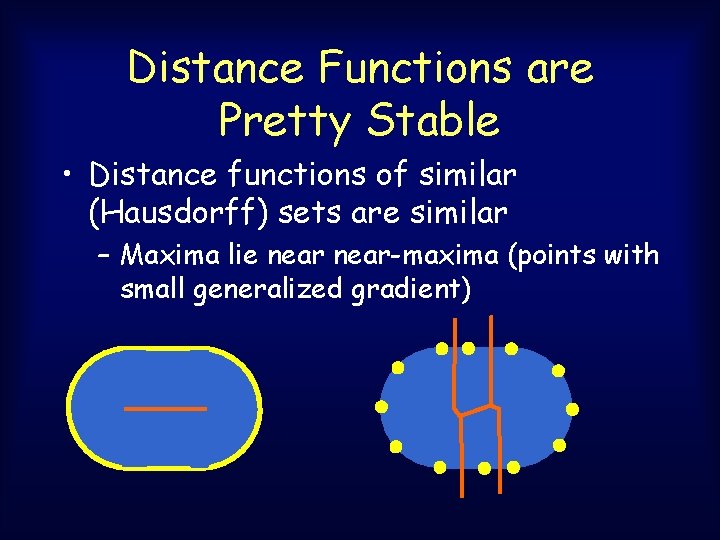
Distance Functions are Pretty Stable • Distance functions of similar (Hausdorff) sets are similar – Maxima lie near-maxima (points with small generalized gradient)
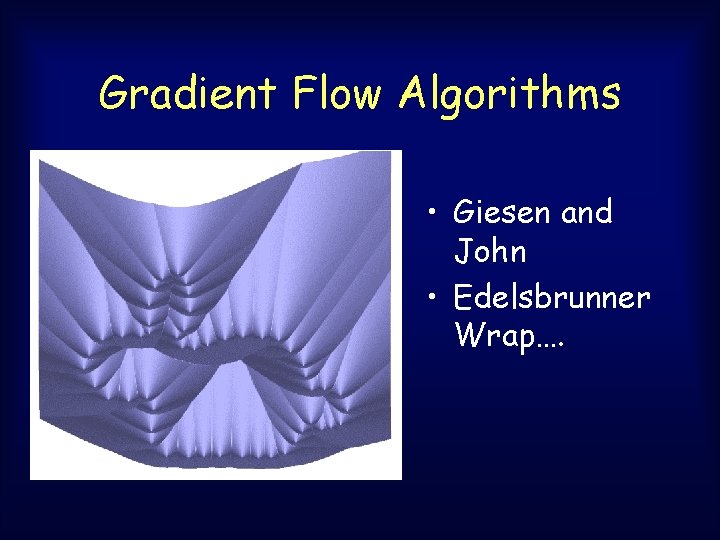
Gradient Flow Algorithms • Giesen and John • Edelsbrunner Wrap….
Geomagic Founded by Herbert Edelsbrunner. Leading system on the market.
Other Companies • Dessault – Catia – Andrei Liutier as “resident genius”, includes Nearestneighbor reconstruction? • Imageware, Rapid. Form, Scan. To 3 D. • Bottom line - They all know we’re out here, but we are not integral to their business.
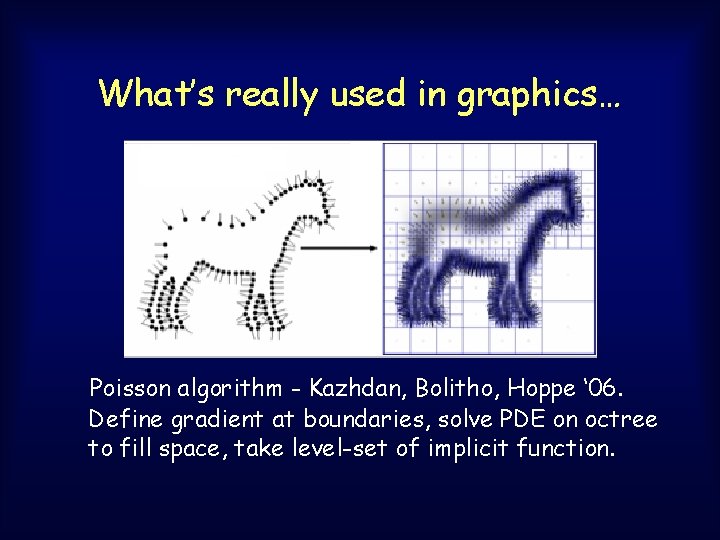
What’s really used in graphics… Poisson algorithm - Kazhdan, Bolitho, Hoppe ‘ 06. Define gradient at boundaries, solve PDE on octree to fill space, take level-set of implicit function.
• “This CGAL component implements a state-of-the-art surface reconstruction method: Poisson Surface Reconstruction. ”
Why? Noise • Noisy data sources are increasingly important. • Computing DT of whole point cloud is overkill. • Persistence is really not the answer. • Averaging in 3 D is faster and better. • Distance-like functions (Chazal talk)?
Why? Delaunay bottleneck • 3 D Delaunay triangulation O(n 2), O(n) in practice, but still slow. • Attali, Boissonnat, Lieutier ‘ 03 O(n lg n) DT complxity • Funke & Ramos, ‘ 02, Funke & Milosavljevic ‘ 07, O(n lg n) thinning and then reconstructing. • Cheng, Jin, Lau, this conference. More practical O(n lg n).
For comparison… • Delaunay of 1 million 3 D points ~ 1 minute. • GPU octree: 18 milliseconds • GPU k-NN: answer 1 million 50 -NN queries/second (based on Bern, Chan reduction to sorting) A. , Li, Simons, Parkaravor, Abbasinejad, Owens
What to work on? • Fast octree-based algorithms with proofs -> surface meshing algorithms. • Prove results about what people already do in practice. • Work on other problems related to building objects from data! • Eg, alignment (= matching)
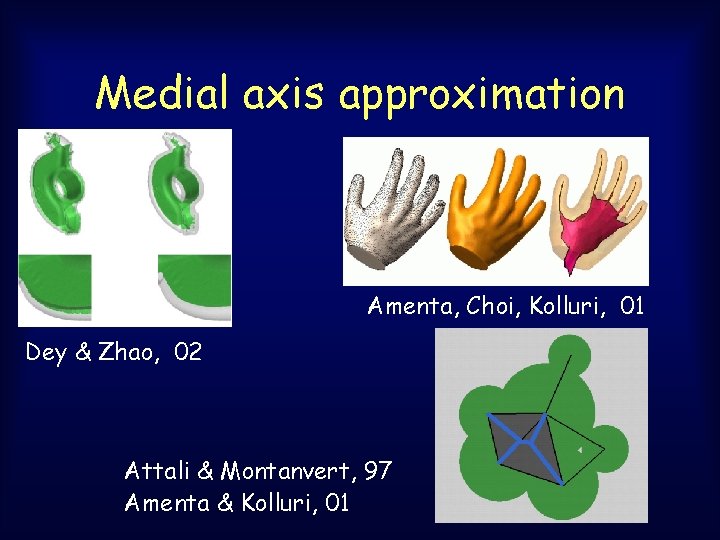
Medial axis approximation Amenta, Choi, Kolluri, 01 Dey & Zhao, 02 Attali & Montanvert, 97 Amenta & Kolluri, 01
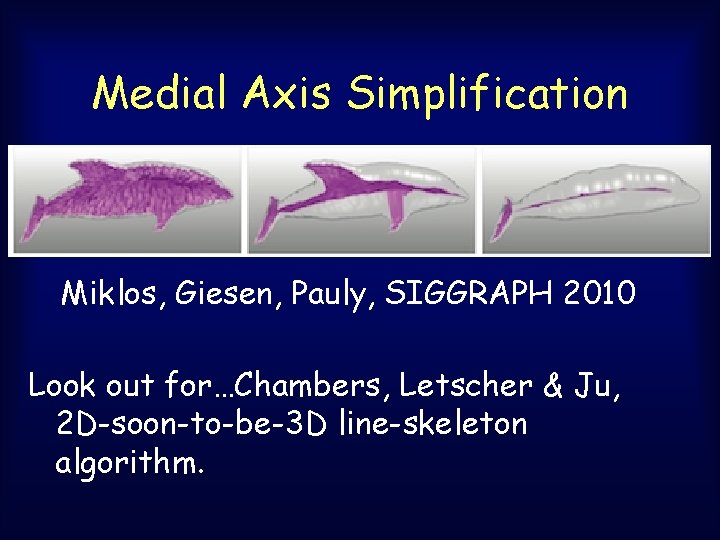
Medial Axis Simplification Miklos, Giesen, Pauly, SIGGRAPH 2010 Look out for…Chambers, Letscher & Ju, 2 D-soon-to-be-3 D line-skeleton algorithm.
Mesh generation …. like I know….
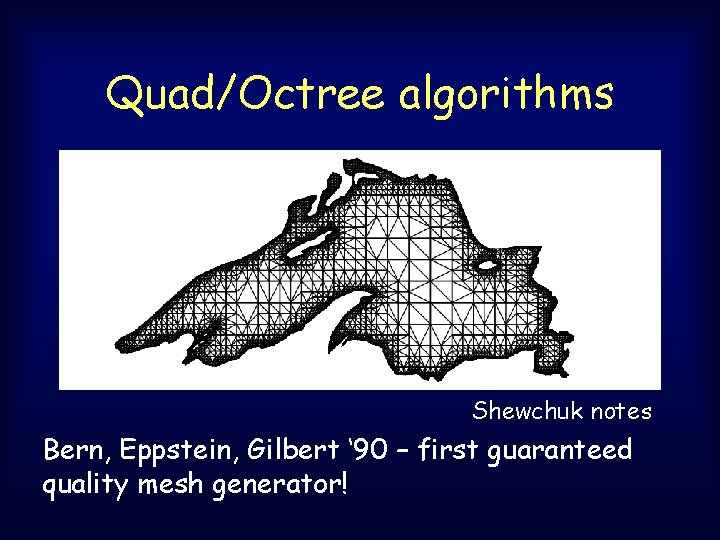
Quad/Octree algorithms Shewchuk notes Bern, Eppstein, Gilbert ‘ 90 – first guaranteed quality mesh generator!
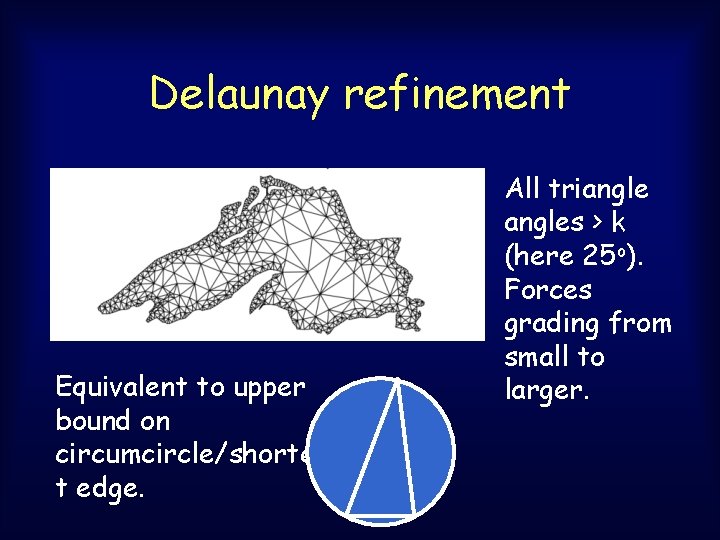
Delaunay refinement Equivalent to upper bound on circumcircle/shortes t edge. All triangles > k (here 25 o). Forces grading from small to larger.
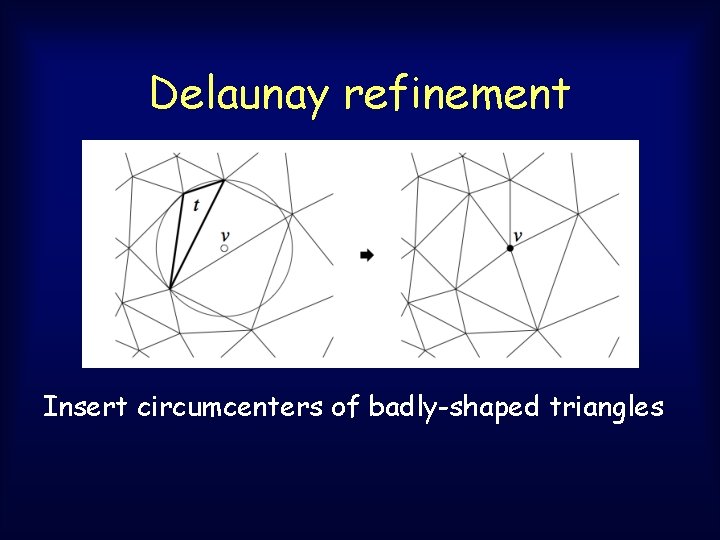
Delaunay refinement Insert circumcenters of badly-shaped triangles
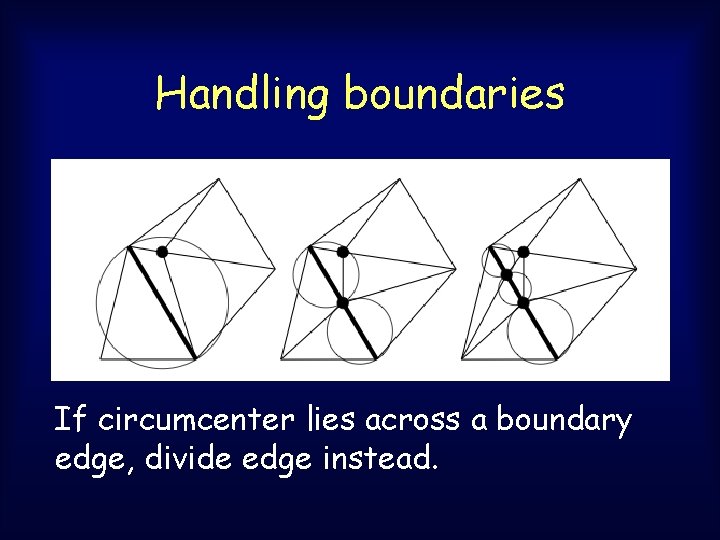
Handling boundaries If circumcenter lies across a boundary edge, divide edge instead.
2 D Meshing Software • • Triangle, Shewchuk. a. Cute, Ungor (advancing front). CGAL. Very widely used.
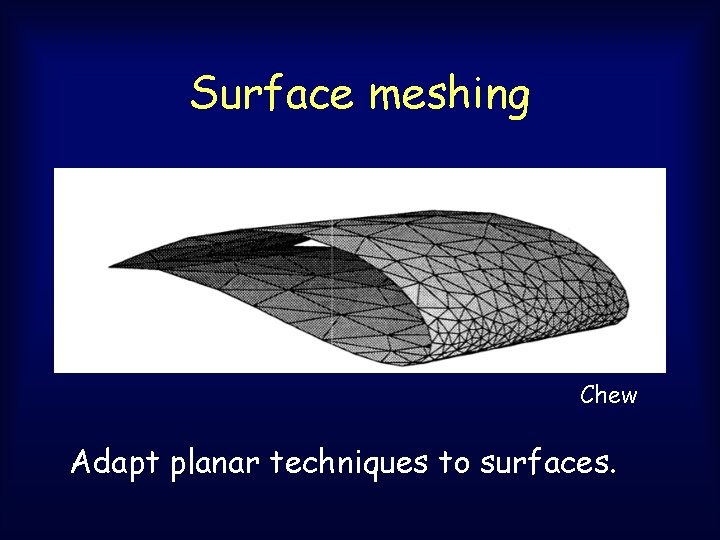
Surface meshing Chew Adapt planar techniques to surfaces.
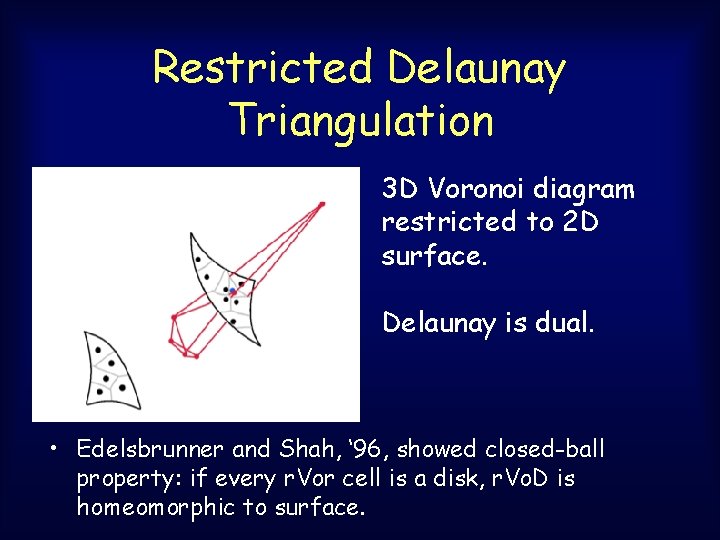
Restricted Delaunay Triangulation 3 D Voronoi diagram restricted to 2 D surface. Delaunay is dual. • Edelsbrunner and Shah, ‘ 96, showed closed-ball property: if every r. Vor cell is a disk, r. Vo. D is homeomorphic to surface.
Kind of results • Surface can be covered with wellshaped triangles, and the number of triangles is O(minimal). • Requires the input surface boundary to have no sharp angle; otherwise algorithm may not terminate!
Delaunay refinement • Smooth • - Chew – Boissonnat and Oudot – Cheng, Dey, Ramos and Ray • Piecewise-smooth – Rineau and Yvinec – Cheng, Dey and Ramos – Cheng, Dey and Levine (software!)
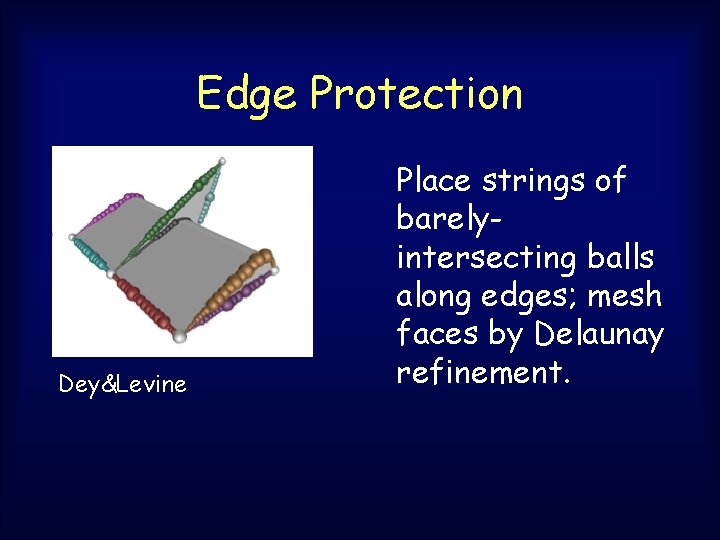
Edge Protection Dey&Levine Place strings of barelyintersecting balls along edges; mesh faces by Delaunay refinement.
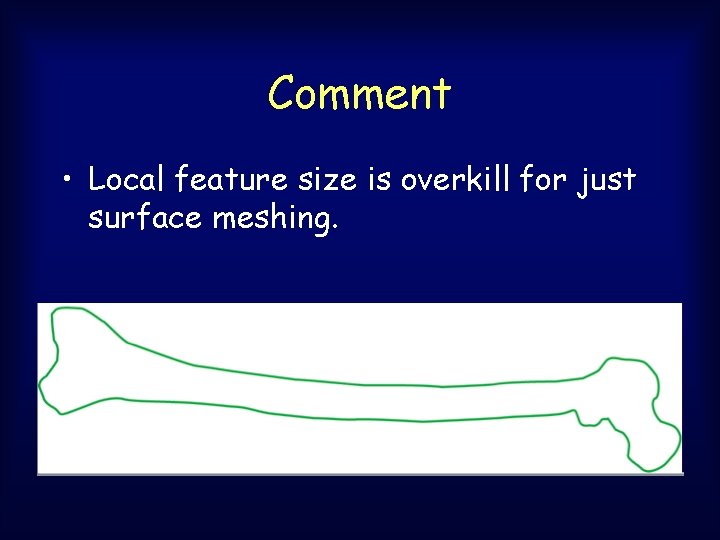
Comment • Local feature size is overkill for just surface meshing.
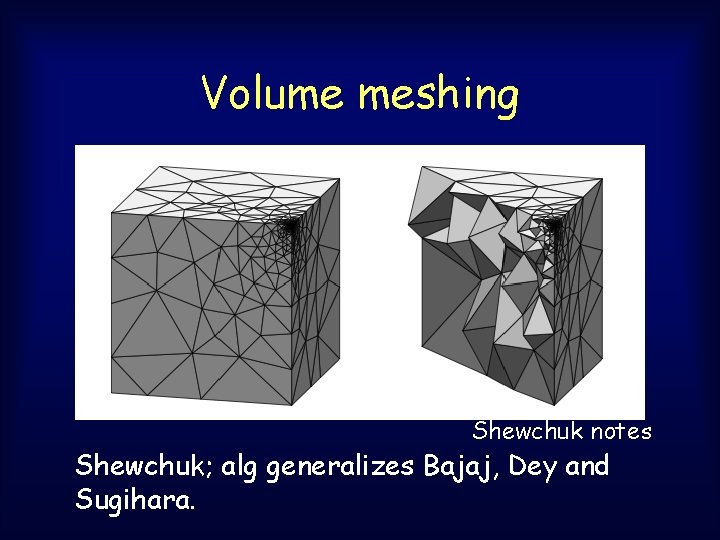
Volume meshing Shewchuk notes Shewchuk; alg generalizes Bajaj, Dey and Sugihara.
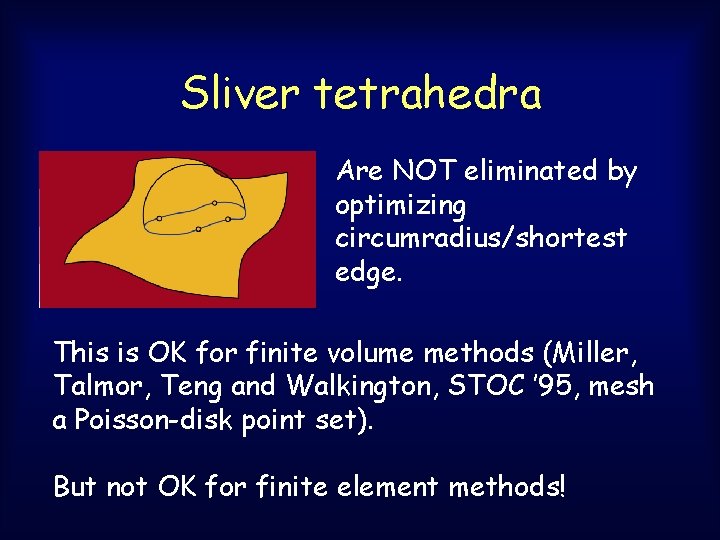
Sliver tetrahedra Are NOT eliminated by optimizing circumradius/shortest edge. This is OK for finite volume methods (Miller, Talmor, Teng and Walkington, STOC ’ 95, mesh a Poisson-disk point set). But not OK for finite element methods!
Sliver removal • Sliver exudation, ‘ 00, Cheng, Dey, Edelsbrunner, Facello and Teng. Adjust weights of mesh vertices to squeeze out slivers. Dihedral guaranteed to be bounded away from zero. • Randomized perturbation, Chew ‘ 97 and Li and Teng ‘ 01.
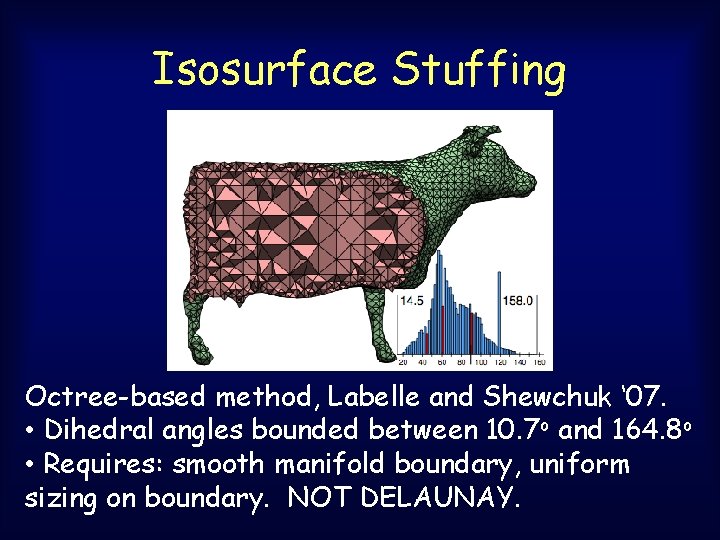
Isosurface Stuffing Octree-based method, Labelle and Shewchuk ‘ 07. • Dihedral angles bounded between 10. 7 o and 164. 8 o • Requires: smooth manifold boundary, uniform sizing on boundary. NOT DELAUNAY.
Free Tet Meshing Software • Several algorithms implemented in CGAL Stéphane Tayeb, Yvinec, L. Rineau, Alliez and Tournois. • Tet. Gen, Hang Si, Weierstrass Institute for Applied Analysis and Stochastics (WIAS) • Some day…Pyramid, Shewchuk.
Industry/Government • Ansys – Sells simulation capability, not meshes. • Many CAD systems, eg. Solid. Works. • Sandia organizes International Meshing Roundtable. • This is very incomplete.
What to work on? …you’re asking me? . . . • Stuff I didn’t talk about – Anisotropic meshing (Canas & Gortler, this conference) – Quad/hex meshing • Digital differential geometry? • Get out and meet people.
Conclusions • Real problems, real science/industry, real impact. • Theoretical structures and results, and software. • Bridging the gap to practice is an ongoing challenge, not necessarily our top priority.