
Surface plasmon resonance sensing Surface plasmon waves extend
![MODEL: pproach was developed by Moharam and Gaylord [20] and is a full vectorial](https://slidetodoc.com/presentation_image_h/ebf589e64f8bea4d102bbdf5271e0d96/image-8.jpg "MODEL: pproach was developed by Moharam and Gaylord [20] and is a full vectorial")

- Slides: 13
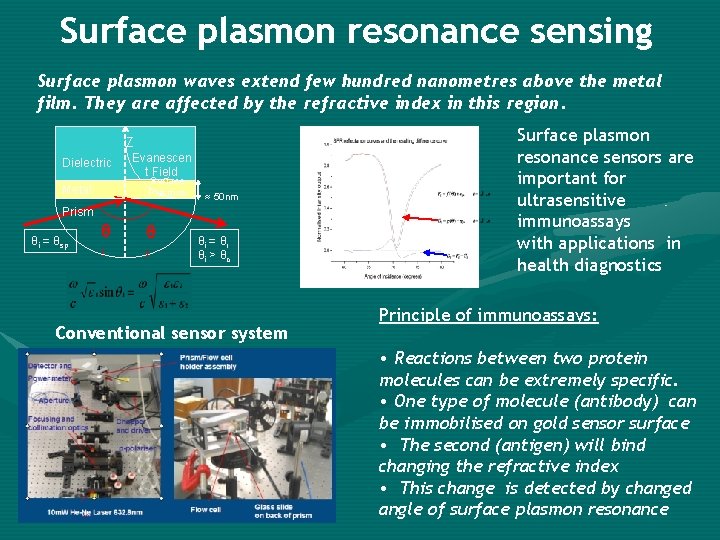
Surface plasmon resonance sensing Surface plasmon waves extend few hundred nanometres above the metal film. They are affected by the refractive index in this region. Z Dielectric Evanescen t Field Surface Plasmon Metal ≈ 50 nm Prism θi = θsp θ θ i r θi = θr θi > θc Conventional sensor system Surface plasmon resonance sensors are important for ultrasensitive immunoassays with applications in health diagnostics Principle of immunoassays: • Reactions between two protein molecules can be extremely specific. • One type of molecule (antibody) can be immobilised on gold sensor surface • The second (antigen) will bind changing the refractive index • This change is detected by changed angle of surface plasmon resonance
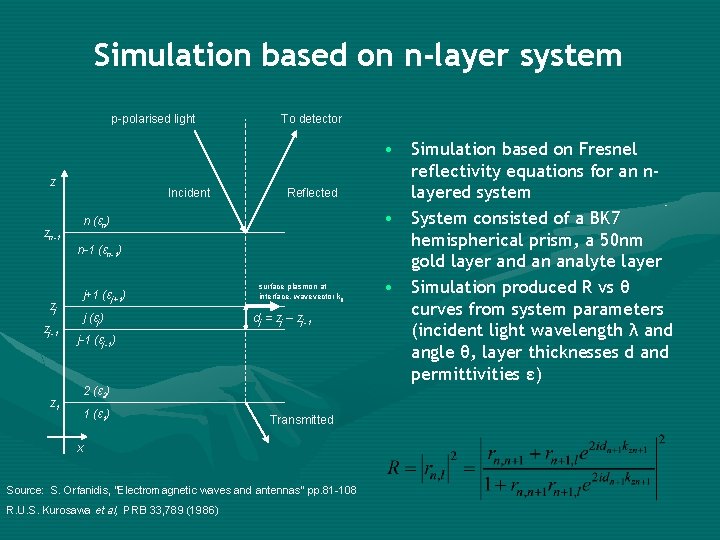
Simulation based on n-layer system p-polarised light z zn-1 Incident To detector Reflected n (εn) n-1 (εn-1) zj zj-1 z 1 j+1 (εj+1) j (εj) surface plasmon at interface, wavevector k|| dj = zj – zj-1 (εj-1) 2 (ε 2) 1 (ε 1) Transmitted x Source: S. Orfanidis, “Electromagnetic waves and antennas” pp. 81 -108 R. U. S. Kurosawa et al, PRB 33, 789 (1986) • Simulation based on Fresnel reflectivity equations for an nlayered system • System consisted of a BK 7 hemispherical prism, a 50 nm gold layer and an analyte layer • Simulation produced R vs θ curves from system parameters (incident light wavelength λ and angle θ, layer thicknesses d and permittivities ε)
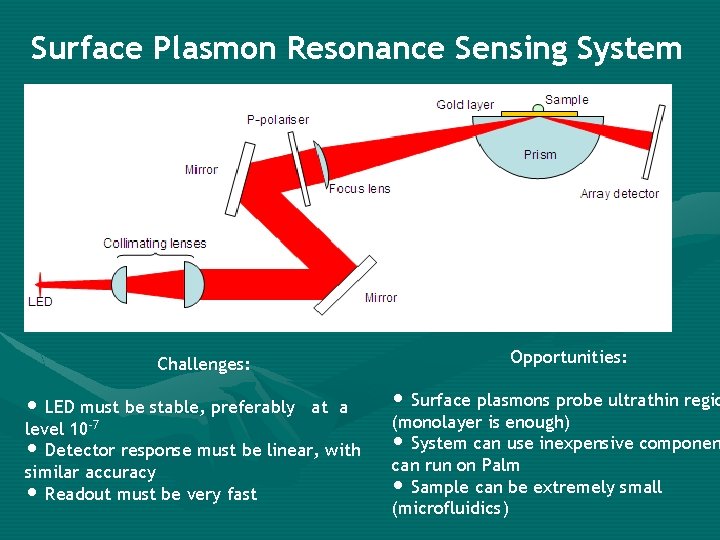
Surface Plasmon Resonance Sensing System Opportunities: Challenges: • LED must be stable, preferably at a level 10 -7 • Detector response must be linear, with similar accuracy • Readout must be very fast • Surface plasmons probe ultrathin regio (monolayer is enough) • System can use inexpensive componen can run on Palm • Sample can be extremely small (microfluidics)
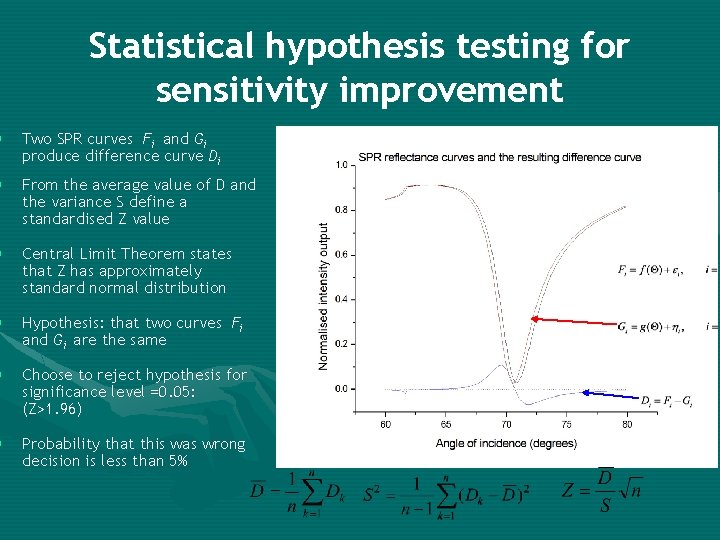
Statistical hypothesis testing for sensitivity improvement § Two SPR curves Fi and Gi produce difference curve Di § From the average value of D and the variance S define a standardised Z value § Central Limit Theorem states that Z has approximately standard normal distribution § Hypothesis: that two curves Fi and Gi are the same § Choose to reject hypothesis for significance level =0. 05: (Z>1. 96) § Probability that this was wrong decision is less than 5%
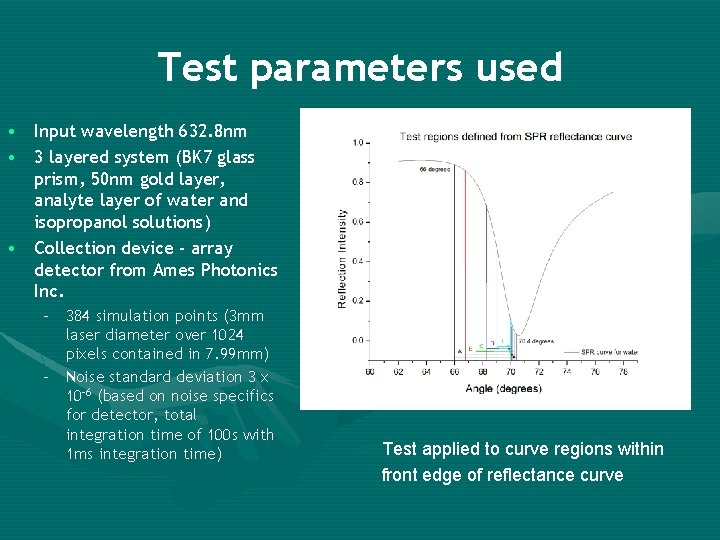
Test parameters used • Input wavelength 632. 8 nm • 3 layered system (BK 7 glass prism, 50 nm gold layer, analyte layer of water and isopropanol solutions) • Collection device - array detector from Ames Photonics Inc. – 384 simulation points (3 mm laser diameter over 1024 pixels contained in 7. 99 mm) – Noise standard deviation 3 x 10 -6 (based on noise specifics for detector, total integration time of 100 s with 1 ms integration time) n Test applied to curve regions within front edge of reflectance curve
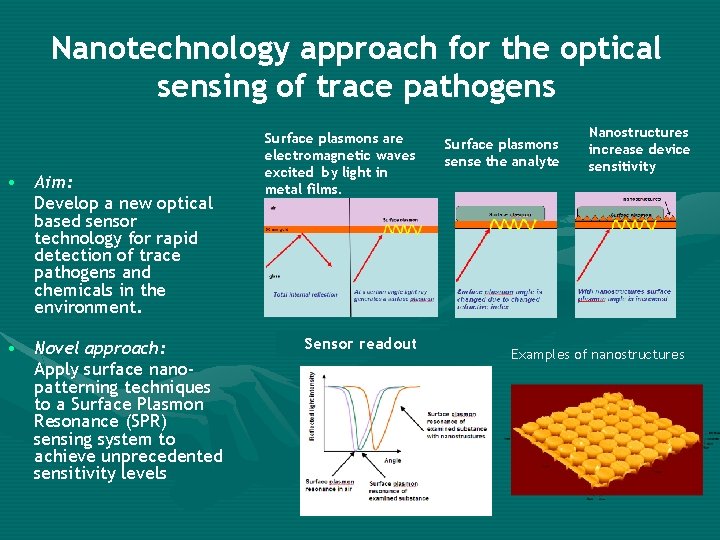
Nanotechnology approach for the optical sensing of trace pathogens • Aim: Develop a new optical based sensor technology for rapid detection of trace pathogens and chemicals in the environment. • Novel approach: Apply surface nanopatterning techniques to a Surface Plasmon Resonance (SPR) sensing system to achieve unprecedented sensitivity levels Surface plasmons are electromagnetic waves excited by light in metal films. Sensor readout Surface plasmons sense the analyte Nanostructures increase device sensitivity Examples of nanostructures
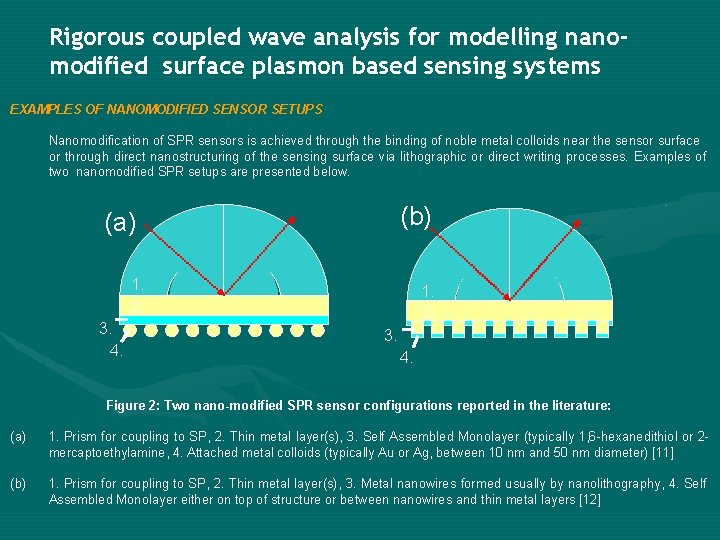
Rigorous coupled wave analysis for modelling nanomodified surface plasmon based sensing systems EXAMPLES OF NANOMODIFIED SENSOR SETUPS Nanomodification of SPR sensors is achieved through the binding of noble metal colloids near the sensor surface or through direct nanostructuring of the sensing surface via lithographic or direct writing processes. Examples of two nanomodified SPR setups are presented below. (b) (a) 1. 2. 3. 4. Figure 2: Two nano-modified SPR sensor configurations reported in the literature: (a) 1. Prism for coupling to SP, 2. Thin metal layer(s), 3. Self Assembled Monolayer (typically 1, 6 -hexanedithiol or 2 mercaptoethylamine, 4. Attached metal colloids (typically Au or Ag, between 10 nm and 50 nm diameter) [11] (b) 1. Prism for coupling to SP, 2. Thin metal layer(s), 3. Metal nanowires formed usually by nanolithography, 4. Self Assembled Monolayer either on top of structure or between nanowires and thin metal layers [12]
MODEL: pproach was developed by Moharam and Gaylord [20] and is a full vectorial solution of Maxwell's equations. proach is based on the following steps: entation of periodically varying permittivity (for example in a grating structure) using Fourier series expansion: cation of Maxwell’s wave equations for incident light polarisation, through consideration of the orientation to the electromagne to the periodicity of the grating, using vector identities: n * is simplified for p-polarised (transverse magnetic) light incidence as (from figure 1) H is perpendicular to Using the vector identity ng: so and ctric or magnetic field within the grating is written using a space-harmonic representation: As the Fourier harmonics within the grating are a function of the grating perpen n only, this allows the Maxwell equations within the grating to be written as a set of ordinary coupled differential equations w ents (in the case of a rectangular grating), allowing an eigenvalue approach to their solution. ontinuity considerations of the electromagnetic field at the boundary of the grating, the Fourier harmonics may be matched to t on of the fields beyond the grating region to determine the efficiency of each propagating order. Boundary conditions for p-polarisation are:
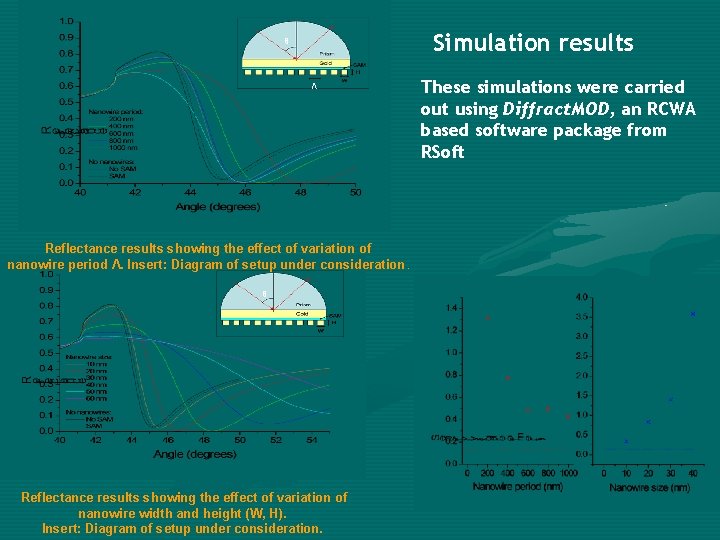
Simulation results θ Λ Reflectance results showing the effect of variation of nanowire period Λ. Insert: Diagram of setup under consideration. θ Reflectance results showing the effect of variation of nanowire width and height (W, H). Insert: Diagram of setup under consideration. These simulations were carried out using Diffract. MOD, an RCWA based software package from RSoft
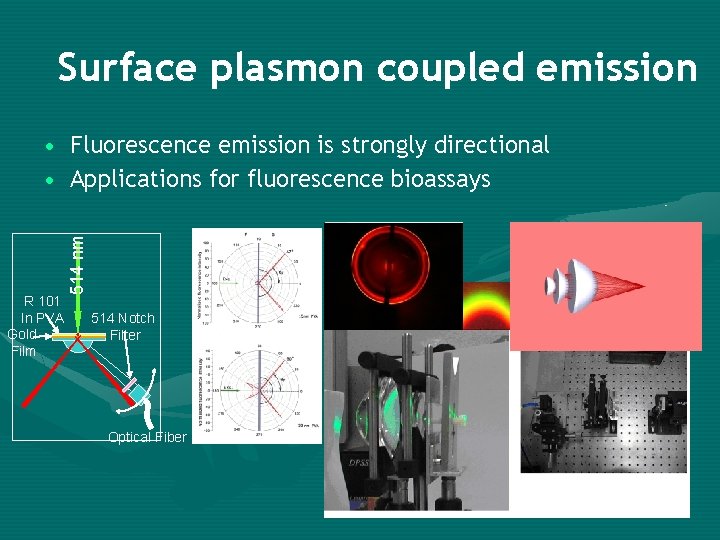
Surface plasmon coupled emission R 101 In PVA Gold Film 514 nm • Fluorescence emission is strongly directional • Applications for fluorescence bioassays 514 Notch Filter Optical Fiber
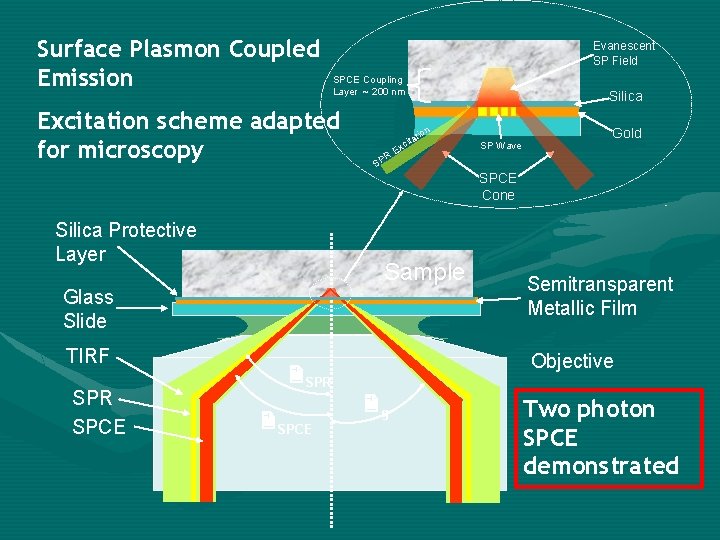
Surface Plasmon Coupled Emission Evanescent SP Field SPCE Coupling Layer ~ 200 nm Excitation scheme adapted for microscopy Silica n tio a cit R SP Ex SP Wave Gold SPCE Cone Silica Protective Layer Sample Glass Slide TIRF SPR SPCE Objective SPR SPCE Semitransparent Metallic Film g Two photon SPCE demonstrated
Schematic diagram of a model bioassay Feasibility of bioassays in dense media
Relevant publications • “Plastic Versus Glass Support for an Immunoassay on Metal-Coated Surfaces in • • • Optically Dense Samples Utilizing Directional Surface Plasmon-Coupled Emission Evgenia G. Matveeva, Ignacy Gryczynski, Joanna Malicka, Zygmunt Gryczynski, Ewa Goldys, Joseph Howe, Klaus W. Berndt, and Joseph R. Lakowicz, Journal of Fluorescence vol. 15, no. 6 : 865 -71, Nov. 2005 “Directional two-photon induced surface plasmon-coupled emission” Gryczynski, Ignacy; Malicka, Joanna; Lakowicz, Joseph R. ; Goldys, Ewa M. ; Calander, Nils; Gryczynski, Zygmunt, Thin Solid Films, 491(1 -2), 173 -176, (2005). “Ultrasensitive detection in optically dense physiological media: applications to fast reliable biological assays”. Matveeva, Evgenia G. ; Gryczynski, Ignacy; Berndt, Klaus W. ; Lakowicz, Joseph R. ; Goldys, Ewa; Gryczynski, Zygmunt. Proceedings of SPIE-The International Society for Optical Engineering (2006), 6092 125 -133. “Detection limit improvement of surface plasmon resonance based biosensors using statistical hypothesis testing”, Barnett, Anne; Goldys, Ewa M. ; Dybek, Konrad, Proceedings of SPIE-The International Society for Optical Engineering (2005), 5703(Plasmonics in Biology and Medicine II), 71 -78. “Strategies for noise reduction and sensitivity increase for a Surface Plasmon Resonance (SPR) based biosensing system”, A. Barnett, E. M. Goldys, K. Dybek. OWLS Conference, Optics Within Life Sciences” Melbourne 28 Nov 2004 – 1 Dec 2004