
Surface measurement of vibration transmissibility of the human
Surface measurement of vibration transmissibility of the human spine during daily life activities Dafne Z. Morgado R. MSc, Siobhan Strike Ph. D, Raymond Lee Ph. D Department of Life Sciences Contact information: d. morgado-ramirez@roehampton. ac. uk
![Introduction • The human spine has shock absorbing properties [1, 2] – Physical activity,](http://slidetodoc.com/presentation_image_h2/48b39fa1cf1ee072931e329f7e1864bf/image-2.jpg "Introduction • The human spine has shock absorbing properties [1, 2] – Physical activity,")
Introduction • The human spine has shock absorbing properties [1, 2] – Physical activity, shock and whole body vibration • The precise effect of daily life physical activities on the mechanics of the spine is still not well understood. • Dynamic properties of the spine – Vibration transmissibility from an input vertebra to an output vertebra [3] 1. Sandover J. Clinical Biomechanics 3(4): 249 -256, 1988. 2. Smeathers JE. Clinical Biomechanics 4: 34 -40, 1989. 3. Mansfield NJ. Industrial Health 43(3): 378 -389, 2005.
Introduction • Studies have not yet presented a factorial assessment of vibration transmitted through the spine during daily life physical activities. • Reliable method that may help us understanding the conditions under which the human spine is effectively and safely stimulated. • Objective Validate the surface measurement of vertical vibration transmissibility over the spine during physical activity.
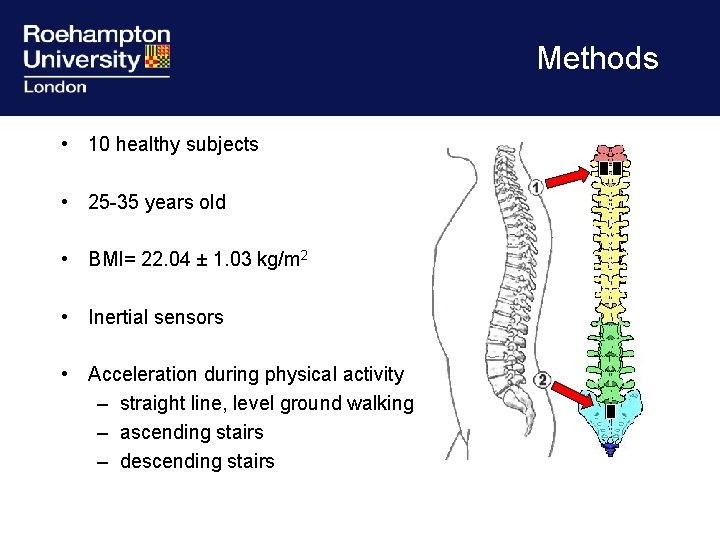
Methods • 10 healthy subjects • 25 -35 years old • BMI= 22. 04 ± 1. 03 kg/m 2 • Inertial sensors • Acceleration during physical activity – straight line, level ground walking – ascending stairs – descending stairs

Methods • Partial correction 1 Skin-sensor interface movement – Nudge test – Single degree of freedom linear model [4] 4. Kitazaki S and Griffin MJ. Journal of Biomechanics 28(7): 885 -890, 1995.
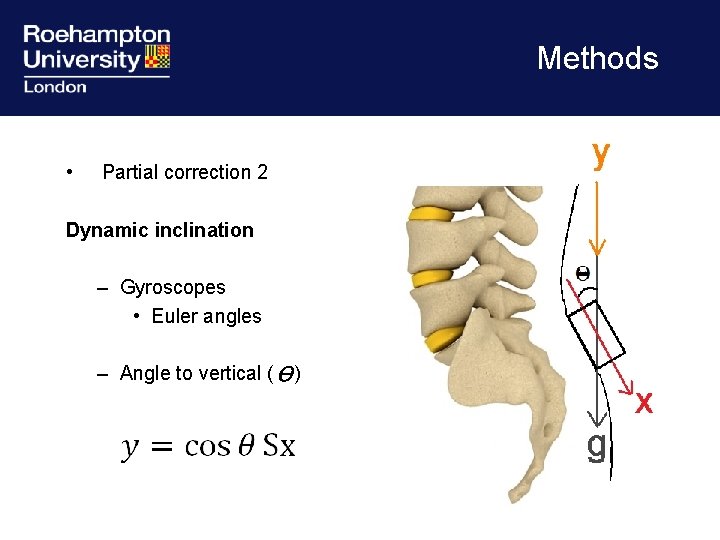
Methods • Partial correction 2 Dynamic inclination – Gyroscopes • Euler angles – Angle to vertical (Θ)
![Methods • Vibration transmissibility calculation [3] – Power Spectral density method (PSD) • Energy](http://slidetodoc.com/presentation_image_h2/48b39fa1cf1ee072931e329f7e1864bf/image-7.jpg "Methods • Vibration transmissibility calculation [3] – Power Spectral density method (PSD) • Energy")
Methods • Vibration transmissibility calculation [3] – Power Spectral density method (PSD) • Energy contained within a frequency band – Frequency response • Frequency range 0. 5 – 20 Hz – Human gait: 0. 75 – 9. 8 Hz [5 -7] – Low pass filter at 20 Hz 5. Antonsson EK and Mann RW. Journal of Biomechanics 18(1): 39 -47, 1985. 6. Angeloni C, Riley PO and Krebs DE. IEEE Transactions on Rehabilitation Engineering 2(1): 40 -46, 1994. 7. Capozzo A. Journal of Biomechanics 15(8): 599 -609, 1982.
![Skin movement Hinz et al. , 1988 [8] Location T 1 Left Right Sample](http://slidetodoc.com/presentation_image_h2/48b39fa1cf1ee072931e329f7e1864bf/image-8.jpg "Skin movement Hinz et al. , 1988 [8] Location T 1 Left Right Sample")
Skin movement Hinz et al. , 1988 [8] Location T 1 Left Right Sample size 10 8 1 1 Sensor mass (g) 20 25. 4 3. 4 0. 5 Attachment technique and contact area This study Kitazaki and Smeathers, Griffin, 1995 1989 [2] [4] 39. 2 mm by 26. 1 mm and double sided adhesive tape S 1 L 3 L 2* T 2 S 2 T 1 T 5 L 3 S 1 35 mm by 40 60 mm 2 of Epoxide compound, contact mm stiff card adhesive area not reported. and double tape over the sided sensor an adhesive skin tape 8. Hinz B, et al. European Journal of Applied Physiology and Occupational Physiology 57(6): 707 -713, 1988.
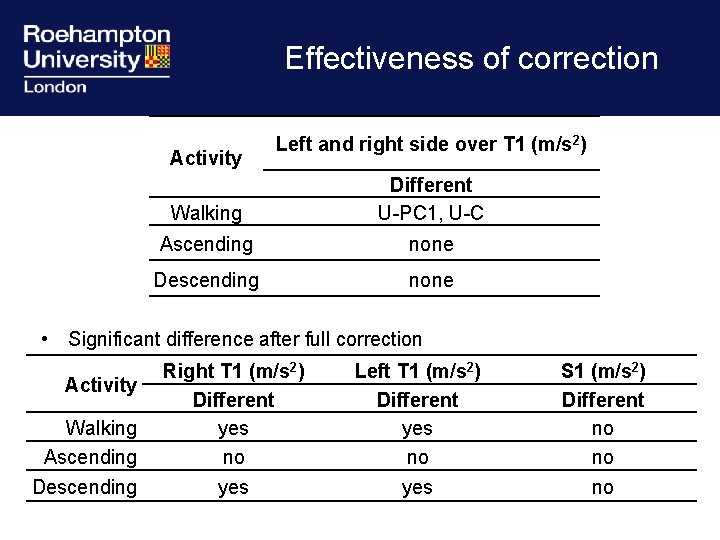
Effectiveness of correction Activity Left and right side over T 1 (m/s 2) Walking Different U-PC 1, U-C Ascending none Descending none • Significant difference after full correction Activity Walking Ascending Descending Right T 1 (m/s 2) Different yes no yes Left T 1 (m/s 2) Different yes no yes S 1 (m/s 2) Different no no no
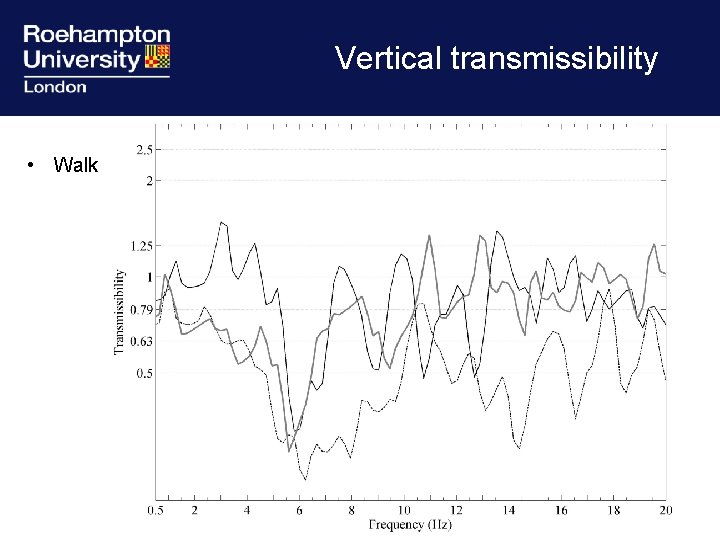
Vertical transmissibility • Walk
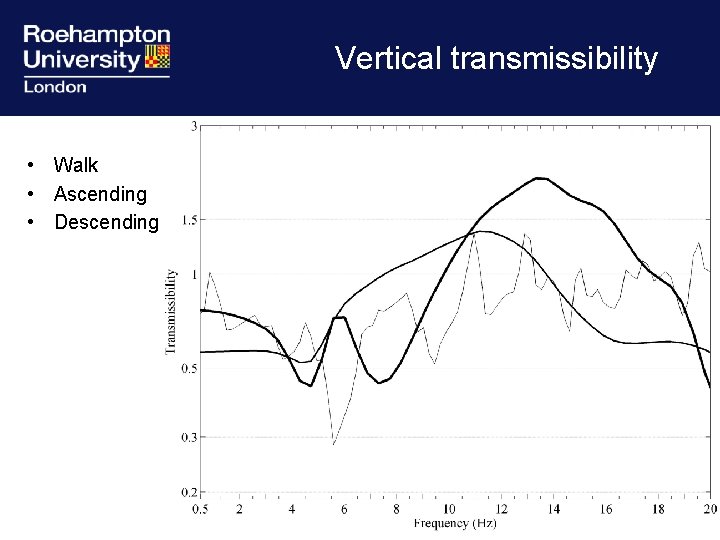
Vertical transmissibility • Walk • Ascending • Descending
Conclusions • We are able to correct vibration signals for errors due to skin deformation and inertial sensor inclination. – Therefore surface measurement of vertical vibration transmissibility over the spine and during daily life activities is possible with the correction method presented. • Changes in posture during daily life activities have a significant influence on the degree of transmissibility.
Future Work • Characterize vertical vibration transmissibility during physical activities • Identify movements and frequencies – Harmful – Beneficial
- Slides: 13