
Surface Irregularity Test The Straightedge Method PREPARED BY
Surface Irregularity Test The Straightedge Method PREPARED BY: ASSISTANT LECTURER TEBA TARIQ KHALED

Purpose: Rutted pavement surfaces may have an adverse influence on vehicle handling characteristics and may impede surface drainage, which may reduce friction properties and contribute to hydroplaning. This test method is applied to measure the rut depth at a chosen location in a pavement surface using a straightedge and a gauge.

Apparatus: 1. Straightedge: • Width: The bottom rectangular surface of the straightedge shall be at least 20 mm width but not more than 75 mm (3. 0 in. ) wide in the measurement plane. • Length: The preferred lengths of the straightedge are either 2 m or 3. The length shall ensure that the straightedge spans the two highest points on either side of the rut. The minimum length shall be at least 1. 73 m. 2. Gauge: The rut-depth measuring gauge shall be graduated to 1 mm or finer.
Procedure 1. Straightedge Placement: A- Place the straightedge across the rut. Allow the straightedge to rest upon the pavement at two contact areas, such that sliding the straightedge along its length in both directions will not change the contact areas on the pavement. B- Place the straightedge in a plane perpendicular to the direction of traffic movement. The bottom surface of the straightedge shall be parallel to the longitudinal slope of the pavement. C- The longitudinal interval between successive straightedge placements should be related to the precision required for the use of the data. 2. Gauge Placement: Place the gauge between the two contact areas perpendicular to the reference plane created by the bottom of the straightedge and perpendicular to the longitudinal slope of the pavement. The bottom of the gauge shall be in contact with the pavement at the time of the measurement.
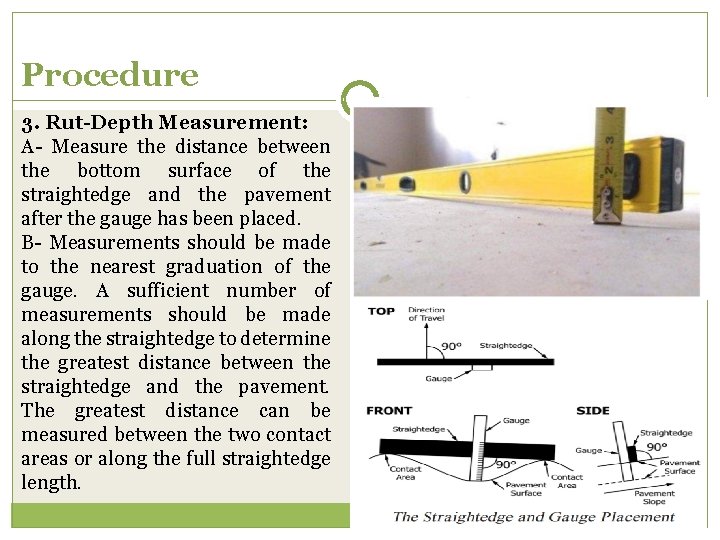
Procedure 3. Rut-Depth Measurement: A- Measure the distance between the bottom surface of the straightedge and the pavement after the gauge has been placed. B- Measurements should be made to the nearest graduation of the gauge. A sufficient number of measurements should be made along the straightedge to determine the greatest distance between the straightedge and the pavement. The greatest distance can be measured between the two contact areas or along the full straightedge length.

Results The cross-section of pavement can be presented as this figure.

Report

Thank You
- Slides: 8