
Surface Heat Load Modelling on Tungsten Monoblocks in
Surface Heat Load Modelling on Tungsten Monoblocks in the ITER Divertor FIP/1 -2 25 th Fusion Energy Conference October 13 -17, 2014 Saint Petersburg, Russian Federation J. P. Gunn, 1 S. Carpentier-Chouchana, 2 R. Dejarnac, 3 F. Escourbiac, 4 T. Hirai, 4 M. Kočan, 4 V. Komarov, 4 M. Komm, 3 A. Kukushkin, 4 R. A. Pitts, 4 Z. Wei 5 CEA, IRFM, F-13108 Saint-Paul-Lez-Durance, France. 2 EIRL S. Carpentier-Chouchana, 13650 Meyrargues, France. 3 Institute of Plasma Physics, AS CR v. v. i. , Czech Republic. 4 ITER Organization, Route de Vinon-sur-Verdon, CS 90 046, 13067 St. Paul Lez Durance Cedex, France 5 Southwestern Institute of Physics, | 10 AVRIL 2012 P. O. Box 432, Chengdu, Sichuan 610041, CEA China. 1
INTRODUCTION AND SUMMARY Full-W divertor from start of ITER operations Outstanding issue now is W monoblock shaping design Decision to be taken by end of 2015 Seeking a design solution that will withstand highest stationary loads and mitigated ELMs during baseline burning operation DT at end of first divertor lifetime (but non-mitigated ELMs a problem already for low active phases) Ø Ø Ø heat load specifications shaping solutions under investigation orbit modelling of heat deposition thermal response of monoblocks to inter-ELM heat loads penetration of ELM energy into poloidal and toroidal gaps 2

HEAT LOAD SPECIFICATIONS Full tungsten divertor in ITER: water-cooled W monoblocks (MB) MB design must satisfy heat load specifications Steady State (SS) inter-ELM detached regime 10 MW/m 2 Slow Transient (ST) reattachment (300 events) 20 MW/m 2 up to 10 s Fast Transient (FT) mitigated ELMs 0. 6 MJ / ELM ~ 0. 5 MJ/m 2 These specifications correspond to heat flux perpendicular to an ideal, axisymmetric divertor with no castellations or MB shaping. Question: what will be thermal response if we expose shaped MBs to a physicsbased model of divertor plasma that delivers the specified power loads? -subject of contract SSA-29 between CEA and ITER (2013) Inner Vertical Outer Vertical Target (IVT) Target (OVT) High Heat Flux areas Monoblocks 3
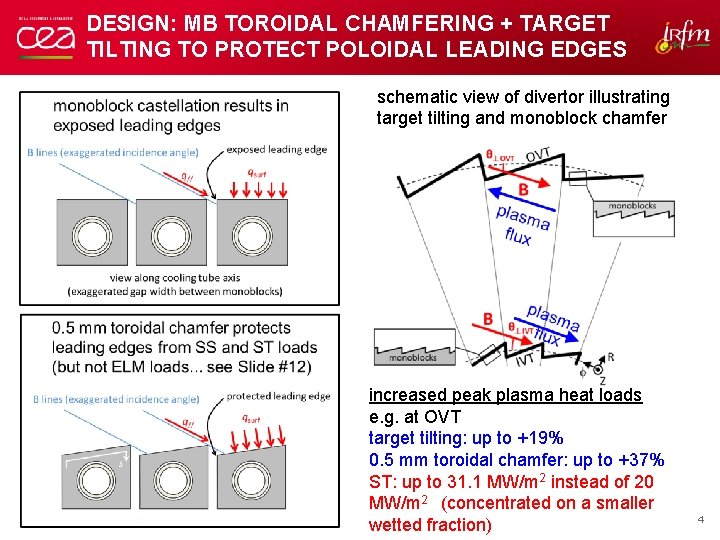
DESIGN: MB TOROIDAL CHAMFERING + TARGET TILTING TO PROTECT POLOIDAL LEADING EDGES schematic view of divertor illustrating target tilting and monoblock chamfer increased peak plasma heat loads e. g. at OVT target tilting: up to +19% 0. 5 mm toroidal chamfer: up to +37% ST: up to 31. 1 MW/m 2 instead of 20 MW/m 2 (concentrated on a smaller wetted fraction) 4
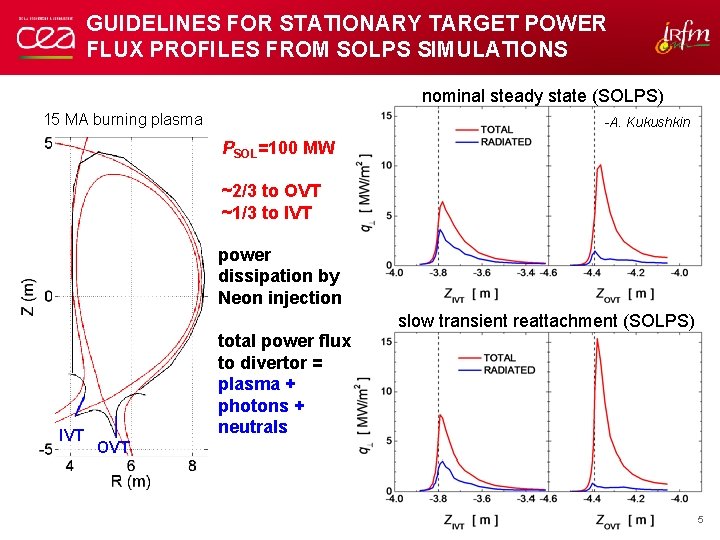
GUIDELINES FOR STATIONARY TARGET POWER FLUX PROFILES FROM SOLPS SIMULATIONS nominal steady state (SOLPS) 15 MA burning plasma -A. Kukushkin PSOL=100 MW ~2/3 to OVT ~1/3 to IVT power dissipation by Neon injection slow transient reattachment (SOLPS) IVT total power flux to divertor = plasma + photons + neutrals OVT 5

MONOBLOCK GEOMETRY AND B-FIELD ORIENTATION BZ BR q// 6 mm W armour thickness BΦ Z Φ R ± 0. 3 mm OVT all calculations assume worst case radial misalignment between adjacent plasma-facing units (PFU) 6
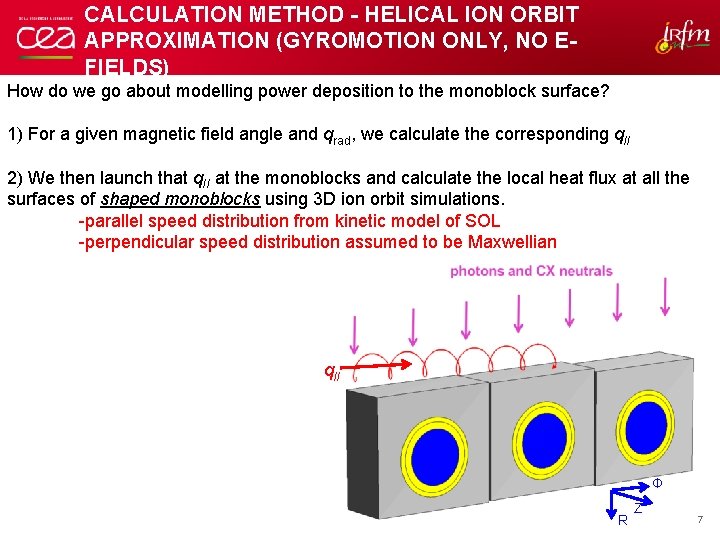
CALCULATION METHOD - HELICAL ION ORBIT APPROXIMATION (GYROMOTION ONLY, NO EFIELDS) How do we go about modelling power deposition to the monoblock surface? 1) For a given magnetic field angle and qrad, we calculate the corresponding q// 2) We then launch that q// at the monoblocks and calculate the local heat flux at all the surfaces of shaped monoblocks using 3 D ion orbit simulations. -parallel speed distribution from kinetic model of SOL -perpendicular speed distribution assumed to be Maxwellian q// Φ R Z 7
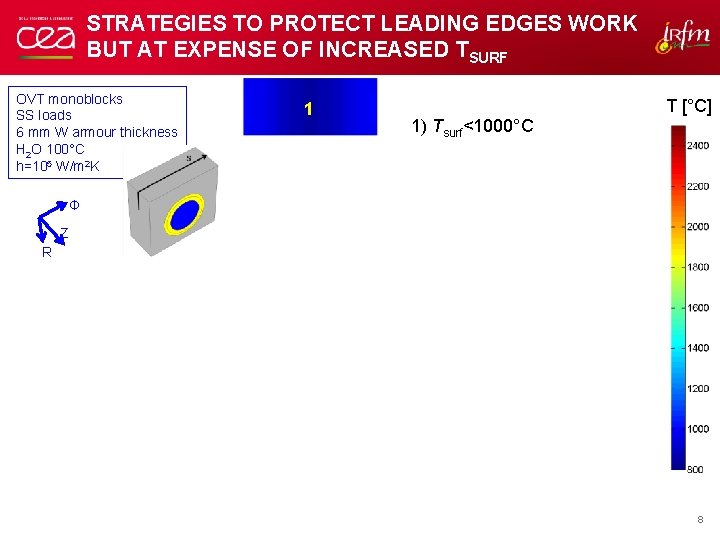
STRATEGIES TO PROTECT LEADING EDGES WORK BUT AT EXPENSE OF INCREASED TSURF OVT monoblocks SS loads 6 mm W armour thickness H 2 O 100°C h=105 W/m 2 K 1 T [°C] 1) Tsurf<1000°C Φ Z R 8
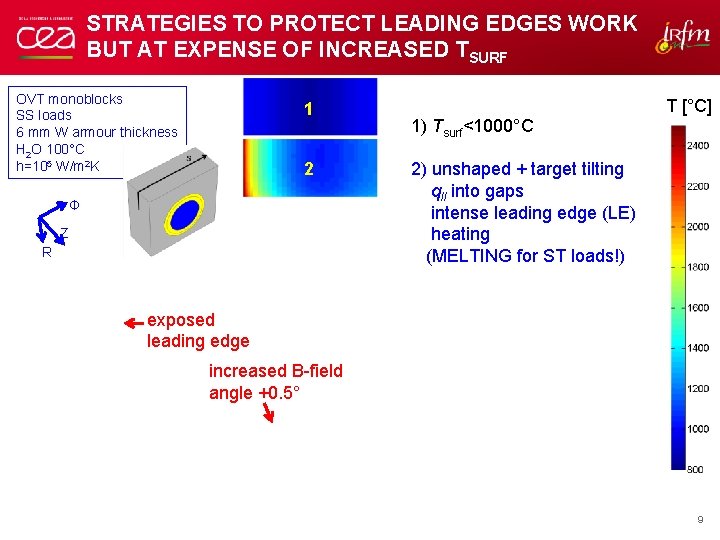
STRATEGIES TO PROTECT LEADING EDGES WORK BUT AT EXPENSE OF INCREASED TSURF OVT monoblocks SS loads 6 mm W armour thickness H 2 O 100°C h=105 W/m 2 K 1 2 Φ Z R T [°C] 1) Tsurf<1000°C 2) unshaped + target tilting q// into gaps intense leading edge (LE) heating (MELTING for ST loads!) exposed leading edge increased B-field angle +0. 5° 9
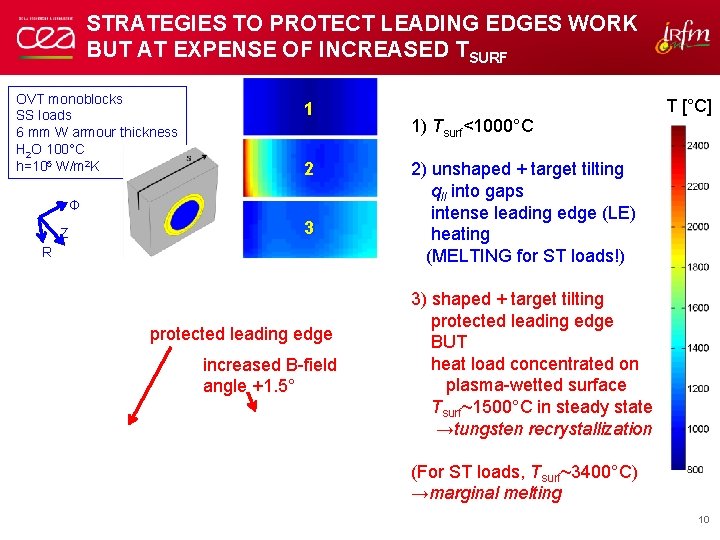
STRATEGIES TO PROTECT LEADING EDGES WORK BUT AT EXPENSE OF INCREASED TSURF OVT monoblocks SS loads 6 mm W armour thickness H 2 O 100°C h=105 W/m 2 K 1 2 Φ Z 3 R protected leading edge increased B-field angle +1. 5° T [°C] 1) Tsurf<1000°C 2) unshaped + target tilting q// into gaps intense leading edge (LE) heating (MELTING for ST loads!) 3) shaped + target tilting protected leading edge BUT heat load concentrated on plasma-wetted surface Tsurf~1500°C in steady state →tungsten recrystallization (For ST loads, Tsurf~3400°C) →marginal melting 10
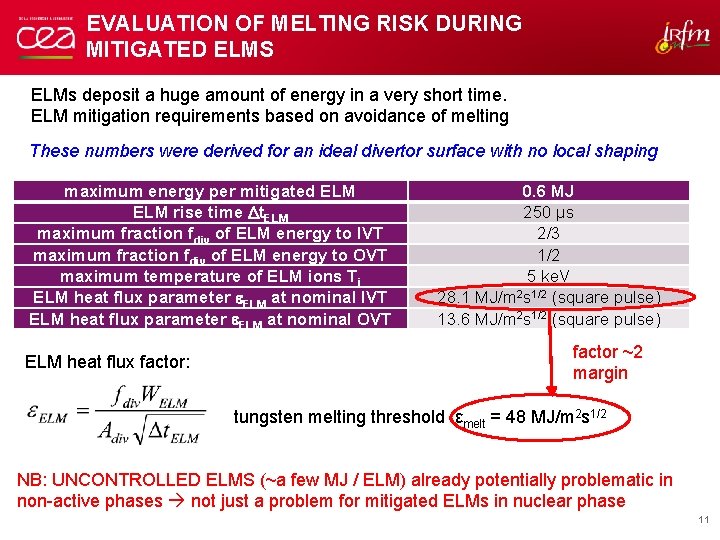
EVALUATION OF MELTING RISK DURING MITIGATED ELMS ELMs deposit a huge amount of energy in a very short time. ELM mitigation requirements based on avoidance of melting These numbers were derived for an ideal divertor surface with no local shaping maximum energy per mitigated ELM rise time t. ELM maximum fraction fdiv of ELM energy to IVT maximum fraction fdiv of ELM energy to OVT maximum temperature of ELM ions Ti ELM heat flux parameter ELM at nominal IVT ELM heat flux parameter ELM at nominal OVT ELM heat flux factor: 0. 6 MJ 250 µs 2/3 1/2 5 ke. V 28. 1 MJ/m 2 s 1/2 (square pulse) 13. 6 MJ/m 2 s 1/2 (square pulse) factor ~2 margin tungsten melting threshold εmelt = 48 MJ/m 2 s 1/2 NB: UNCONTROLLED ELMS (~a few MJ / ELM) already potentially problematic in non-active phases not just a problem for mitigated ELMs in nuclear phase 11
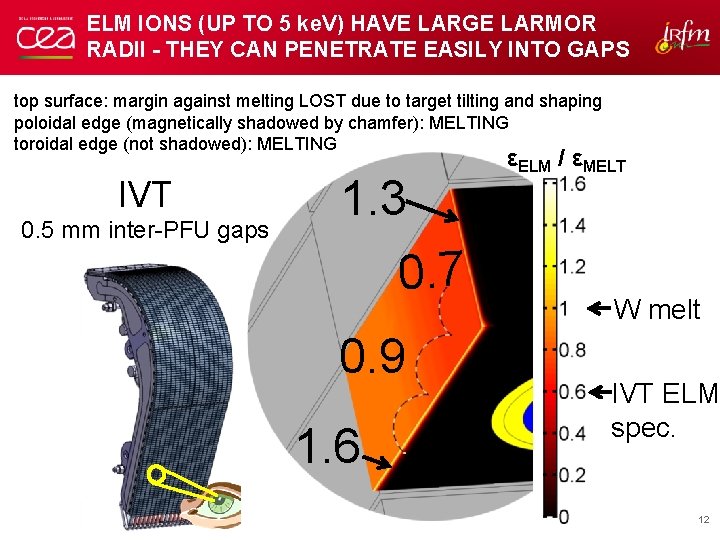
ELM IONS (UP TO 5 ke. V) HAVE LARGE LARMOR RADII - THEY CAN PENETRATE EASILY INTO GAPS top surface: margin against melting LOST due to target tilting and shaping poloidal edge (magnetically shadowed by chamfer): MELTING toroidal edge (not shadowed): MELTING IVT 0. 5 mm inter-PFU gaps 1. 3 0. 7 0. 9 1. 6 εELM / εMELT W melt IVT ELM spec. 12
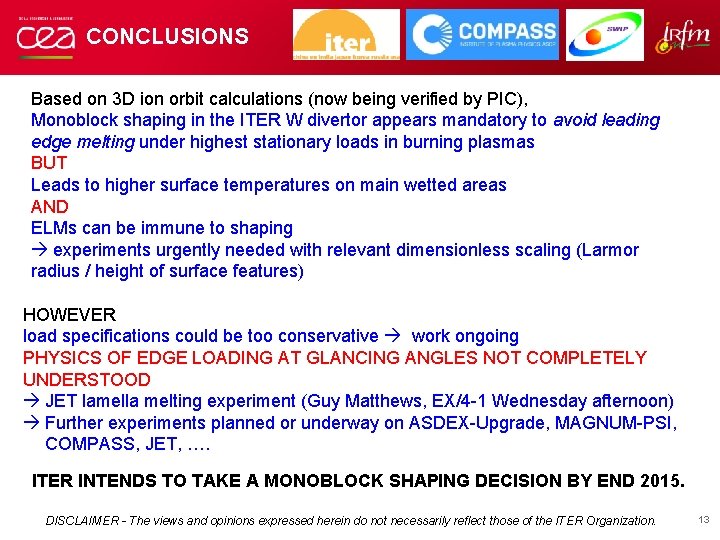
CONCLUSIONS Based on 3 D ion orbit calculations (now being verified by PIC), Monoblock shaping in the ITER W divertor appears mandatory to avoid leading edge melting under highest stationary loads in burning plasmas BUT Leads to higher surface temperatures on main wetted areas AND ELMs can be immune to shaping experiments urgently needed with relevant dimensionless scaling (Larmor radius / height of surface features) HOWEVER load specifications could be too conservative work ongoing PHYSICS OF EDGE LOADING AT GLANCING ANGLES NOT COMPLETELY UNDERSTOOD JET lamella melting experiment (Guy Matthews, EX/4 -1 Wednesday afternoon) Further experiments planned or underway on ASDEX-Upgrade, MAGNUM-PSI, COMPASS, JET, …. ITER INTENDS TO TAKE A MONOBLOCK SHAPING DECISION BY END 2015. DISCLAIMER - The views and opinions expressed herein do not necessarily reflect those of the ITER Organization. 13
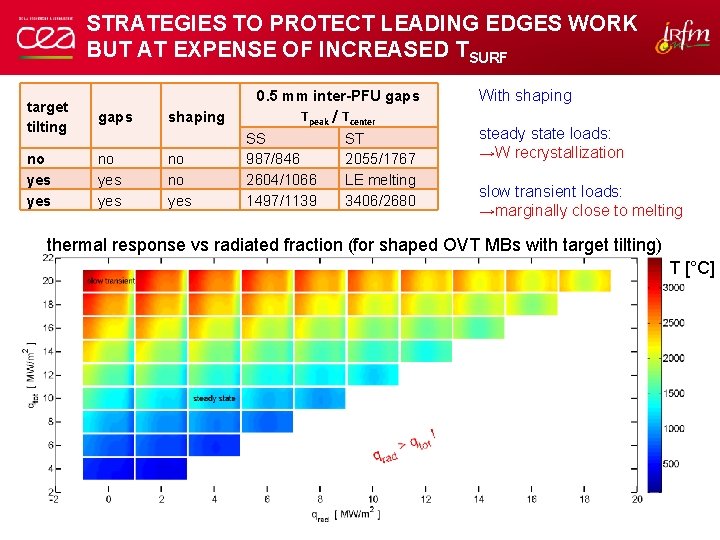
STRATEGIES TO PROTECT LEADING EDGES WORK BUT AT EXPENSE OF INCREASED TSURF target tilting gaps no yes yes shaping no no yes 0. 5 mm inter-PFU gaps Tpeak / Tcenter SS 987/846 2604/1066 1497/1139 ST 2055/1767 LE melting 3406/2680 With shaping steady state loads: →W recrystallization slow transient loads: →marginally close to melting thermal response vs radiated fraction (for shaped OVT MBs with target tilting) T [°C]
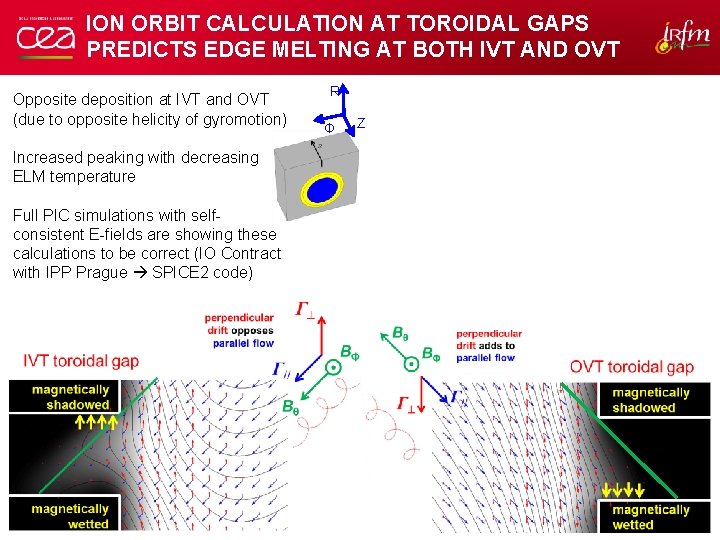
ION ORBIT CALCULATION AT TOROIDAL GAPS PREDICTS EDGE MELTING AT BOTH IVT AND OVT Opposite deposition at IVT and OVT (due to opposite helicity of gyromotion) R Φ Z Increased peaking with decreasing ELM temperature Full PIC simulations with selfconsistent E-fields are showing these calculations to be correct (IO Contract with IPP Prague SPICE 2 code) 15
- Slides: 15