
Surface Drainage CE 453 Lecture 25 1 Objectives
Surface Drainage CE 453 Lecture 25 1
Objectives • Identify rural drainage requirements and design • Ref: AASHTO Highway Drainage Guidelines (1999), Iowa DOT Design Manual Chapter 4 and Model Drainage Manual (2005) 2

Surface Drainage • A means by which surface water is removed from pavement and ROW • Redirects water into appropriately designed channels • Eventually discharges into natural water systems Garber & Hoel, 2002 3
Surface Drainage • Two types of water – Surface water – rain and snow – Ground water – can be a problem when a water table is near surface Garber & Hoel, 2002 4
Inadequate Drainage • Damage to highway structures • Loss of capacity • Visibility problems with spray and loss of retroreflectivity • Safety problems, reduced friction and hydroplaning Garber & Hoel, 2002 5
Drainage • Transverse slopes – Removes water from pavement surface – Facilitated by cross-section elements (crossslope, shoulder slope) • Longitudinal slopes – Minimum gradient of alignment to maintain adequate slope in longitudinal channels • Longitudinal channels – Ditches along side of road to collect surface water after run-off 6
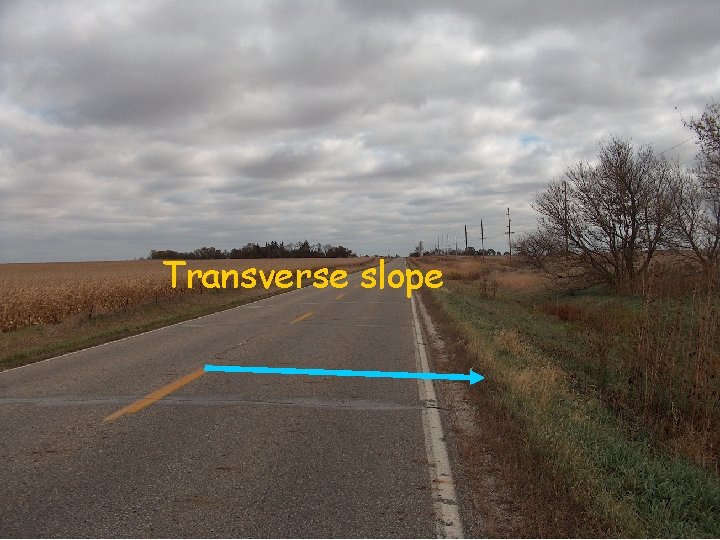
Transverse slope 7
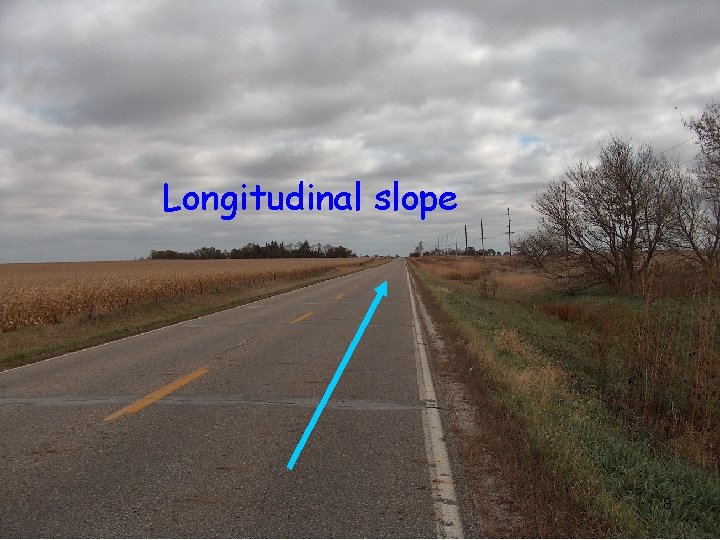
Longitudinal slope 8
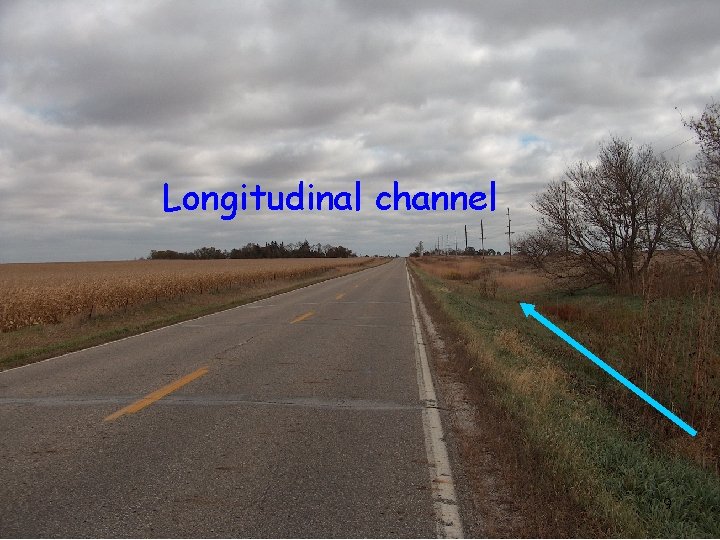
Longitudinal channel 9
Surface Drainage System Design Tradeoffs: Steep slopes provide good hydraulic capacity and lower ROW costs, but reduce safety and increase erosion and maintenance costs 10

Surface Drainage System Design Three phases 1. Estimate of the quantity of water to reach the system 2. Hydraulic design of system elements 3. Comparison of different materials that serve same purpose 11
Hydrologic Analysis: Rational Method Useful for small, usually urban, watersheds (<10 acres, but DOT says <200 acres) Q = CIA (english) or Q = 0. 0028 CIA (metric) Q = runoff (ft 3/sec) or (m 3/sec) C = coefficient representing ratio or runoff to rainfall I = intensity of rainfall (in/hour or mm/hour) A = drainage area (acres or hectares) Iowa DOT Design Manual, Chapter 4, The Rational Method 12
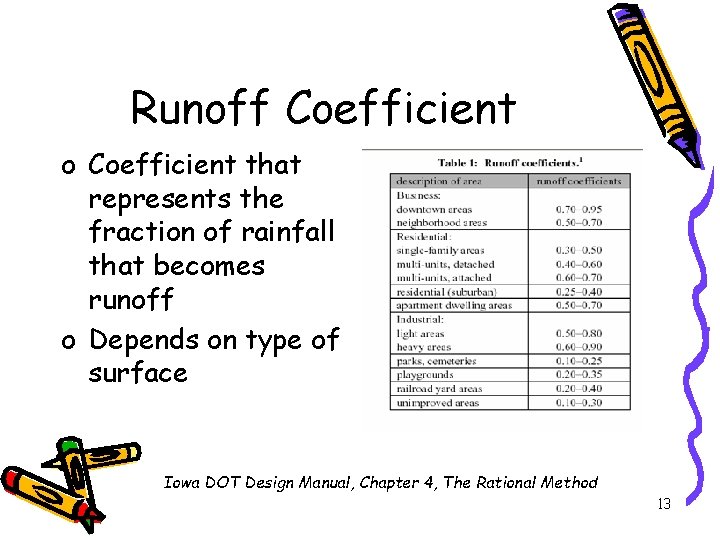
Runoff Coefficient o Coefficient that represents the fraction of rainfall that becomes runoff o Depends on type of surface Iowa DOT Design Manual, Chapter 4, The Rational Method 13
Runoff Coefficient depends on: • • Character of soil Shape of drainage area Antecedent moisture conditions Slope of watershed Amount of impervious soil Land use Duration Intensity 14
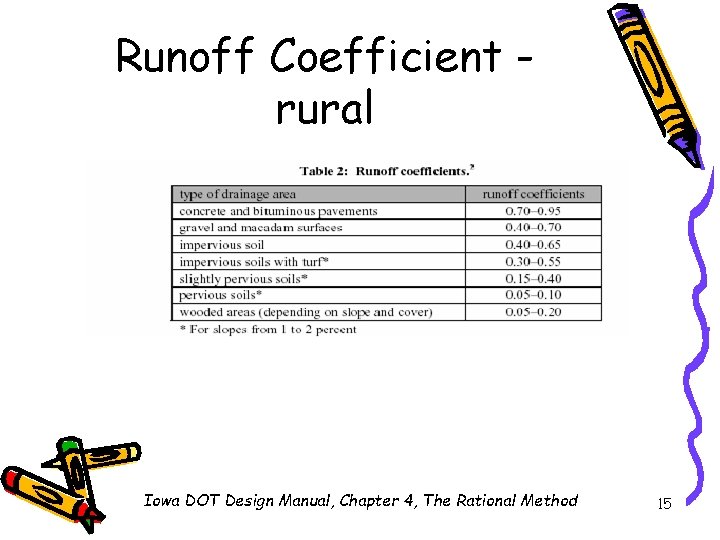
Runoff Coefficient rural Iowa DOT Design Manual, Chapter 4, The Rational Method 15
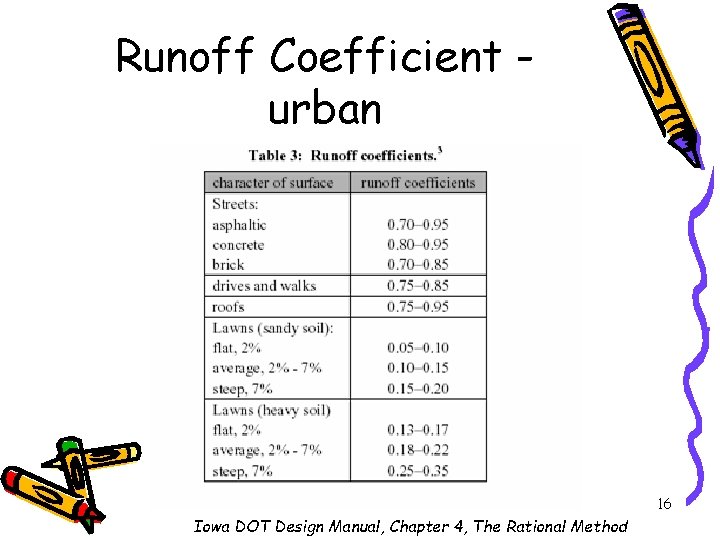
Runoff Coefficient urban 16 Iowa DOT Design Manual, Chapter 4, The Rational Method
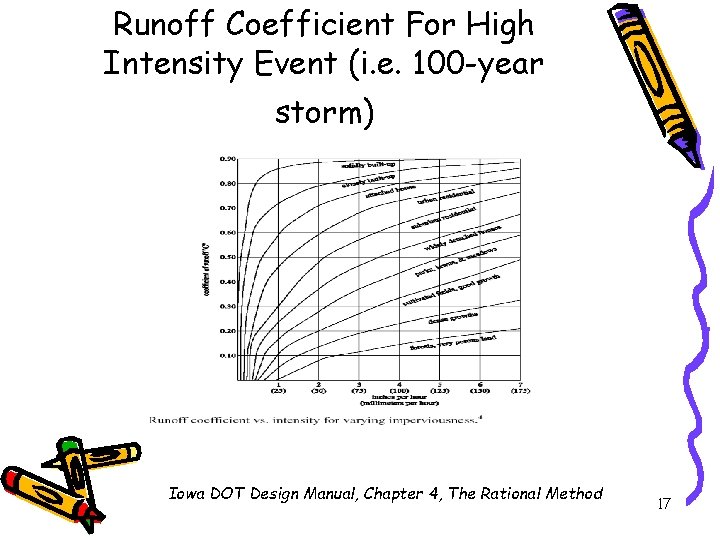
Runoff Coefficient For High Intensity Event (i. e. 100 -year storm) Iowa DOT Design Manual, Chapter 4, The Rational Method 17
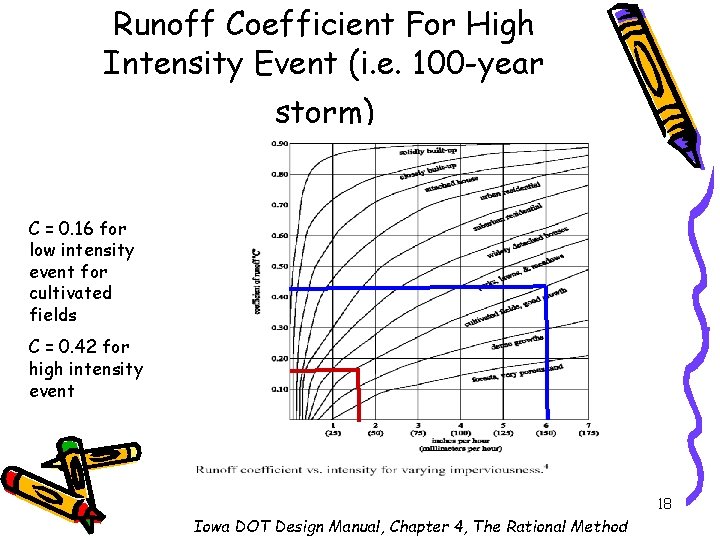
Runoff Coefficient For High Intensity Event (i. e. 100 -year storm) C = 0. 16 for low intensity event for cultivated fields C = 0. 42 for high intensity event 18 Iowa DOT Design Manual, Chapter 4, The Rational Method
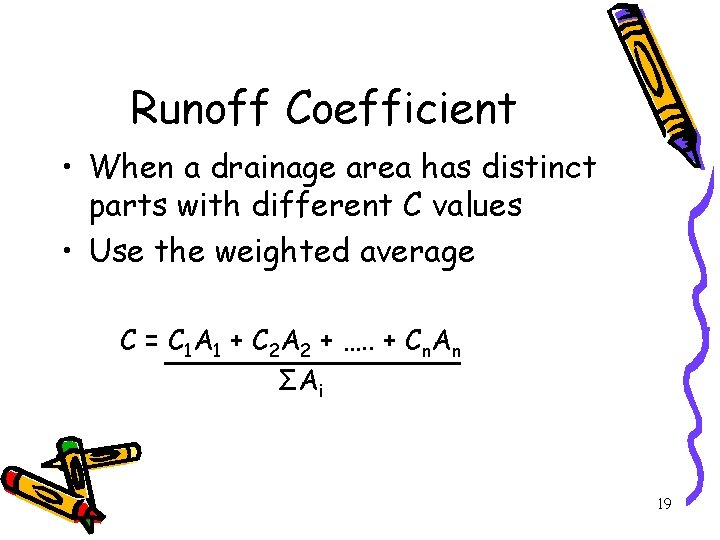
Runoff Coefficient • When a drainage area has distinct parts with different C values • Use the weighted average C = C 1 A 1 + C 2 A 2 + …. . + Cn. An ΣAi 19
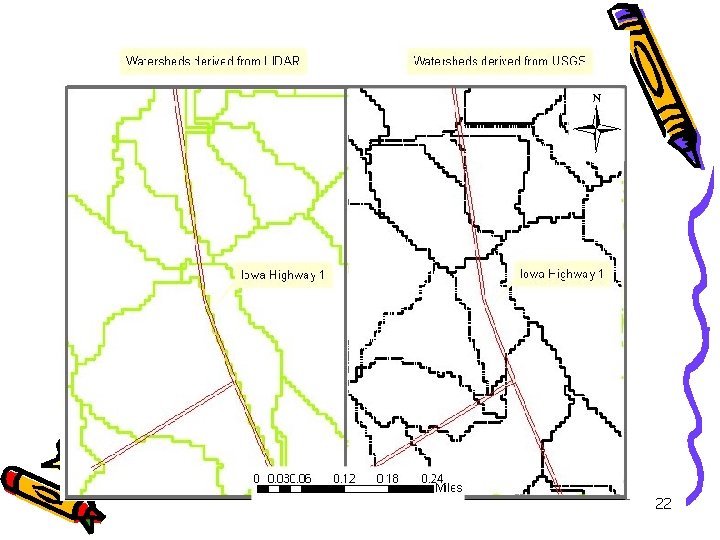
Watershed Area • For DOT method measured in hectares • Combined area of all surfaces that drain to a given intake or culvert inlet • Determine boundaries of area that drain to same location – i. e high points mark boundary – Natural or human-made barriers 20
Watershed Area • • • Topographic maps Aerial photos Digital elevation models Drainage maps Field reviews 21
22
Intensity • Average intensity for a selected frequency and duration over drainage area for duration of storm • Based on “design” event (i. e. 50 -year storm) – Overdesign is costly – Underdesign may be inadequate • Duration is important • Based on values of Tc and T • Tc = time of concentration • T = recurrence interval or design frequency 23
Design Event Recurrence Interval • 2 -year interval -- Design of intakes and spread of water on pavement for primary highways and city streets • 10 -year interval -- Design of intakes and spread of water on pavement for freeways and interstate highways • 50 - year -- Design of subways (underpasses) and sag vertical curves where storm sewer pipe is the only outlet • 100 – year interval -- Major storm check on all projects 24
Time of Concentration (tc) • Time for water to flow from hydraulically most distant point on the watershed to the point of interest • Rational method assumes peak run-off rate occurs when rainfall intensity (I) lasts (duration) >= Tc • Used as storm duration • Iowa DOT says don’t use Tc<5 minutes 25
Time of Concentration (Tc) • Depends on: – Size and shape of drainage area – Type of surface – Slope of drainage area – Rainfall intensity – Whether flow is entirely overland or whether some is channelized 26
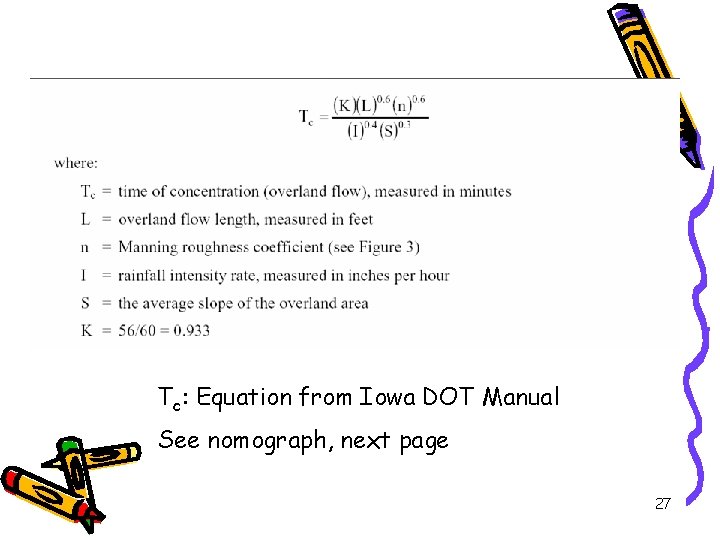
Tc: Equation from Iowa DOT Manual See nomograph, next page 27
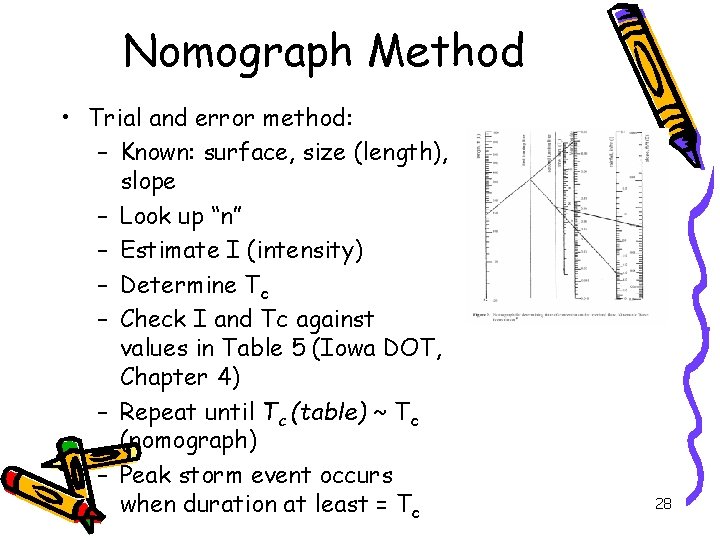
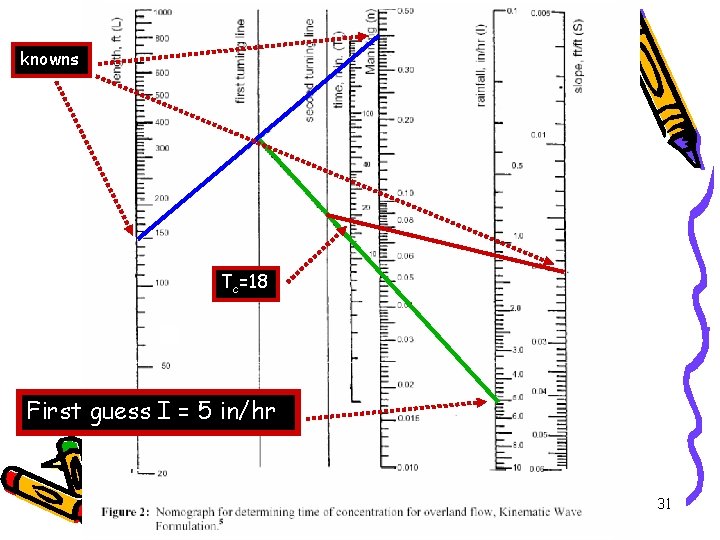
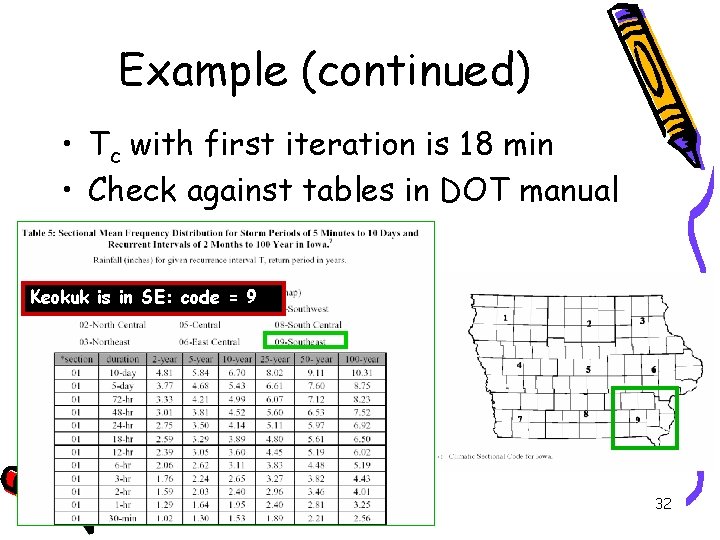
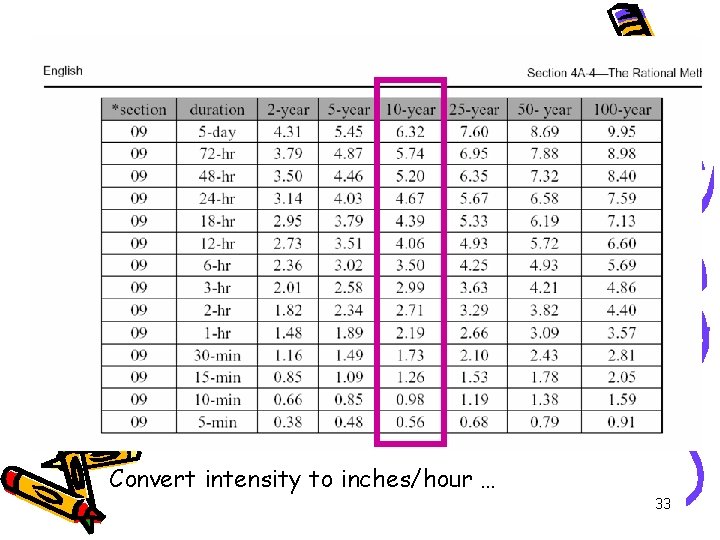
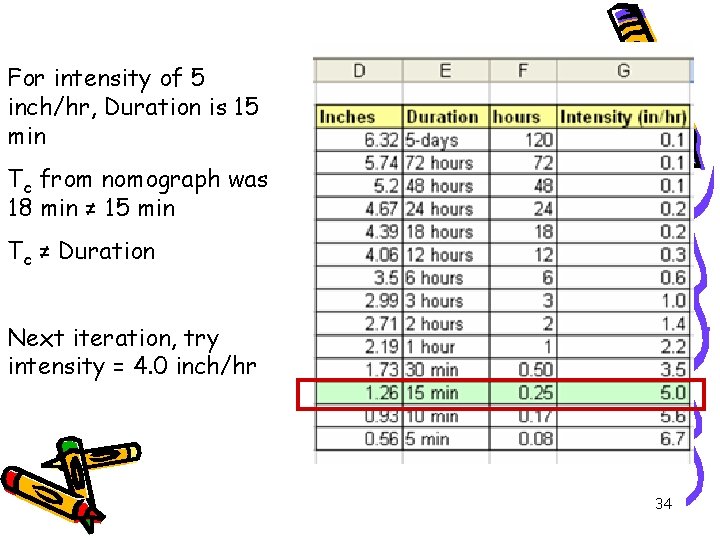
Nomograph Method • Trial and error method: – Known: surface, size (length), slope – Look up “n” – Estimate I (intensity) – Determine Tc – Check I and Tc against values in Table 5 (Iowa DOT, Chapter 4) – Repeat until Tc (table) ~ Tc (nomograph) – Peak storm event occurs when duration at least = Tc 28
Example (Iowa DOT Method) • • Iterative finding I and Tc L = 150 feet Average slope, S = 0. 02 (2%) Grass Recurrence interval, T = 10 years Location: Keokuk Find I From Iowa DOT Design Manual 29
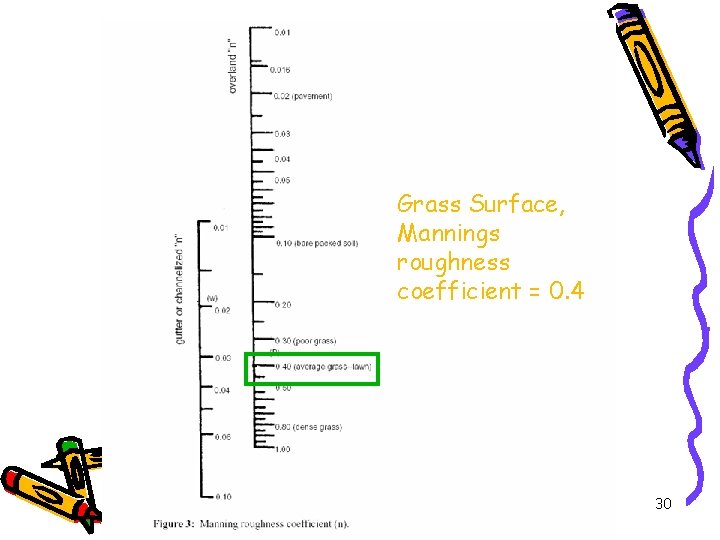
Grass Surface, Mannings roughness coefficient = 0. 4 30
knowns Tc=18 First guess I = 5 in/hr 31
Example (continued) • Tc with first iteration is 18 min • Check against tables in DOT manual Keokuk is in SE: code = 9 32
Convert intensity to inches/hour … 33
For intensity of 5 inch/hr, Duration is 15 min Tc from nomograph was 18 min ≠ 15 min Tc ≠ Duration Next iteration, try intensity = 4. 0 inch/hr 34
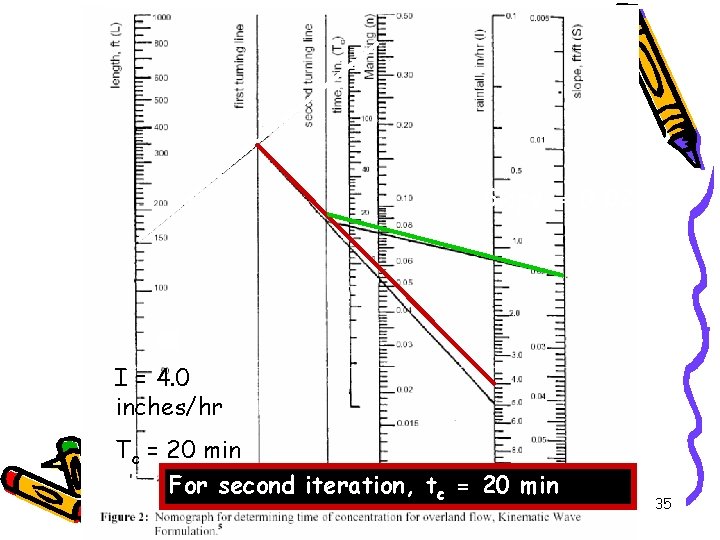
Slope = 0. 02 I = 4. 0 inches/hr Tc = 20 min For second iteration, tc = 20 min 35
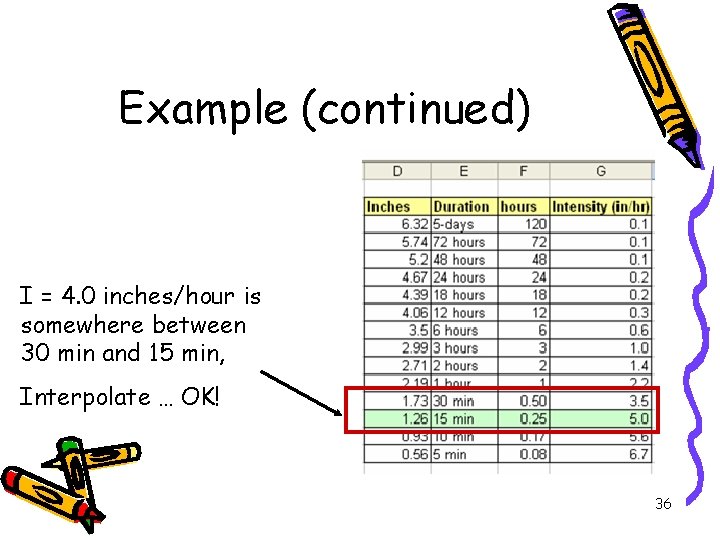
Example (continued) I = 4. 0 inches/hour is somewhere between 30 min and 15 min, Interpolate … OK! 36
What does this mean? • It means that for a ten-year storm, the greatest intensity to be expected for a storm lasting at least the Tc (18 min. ) is 4. 0 inches per hour … • that is the design intensity 37
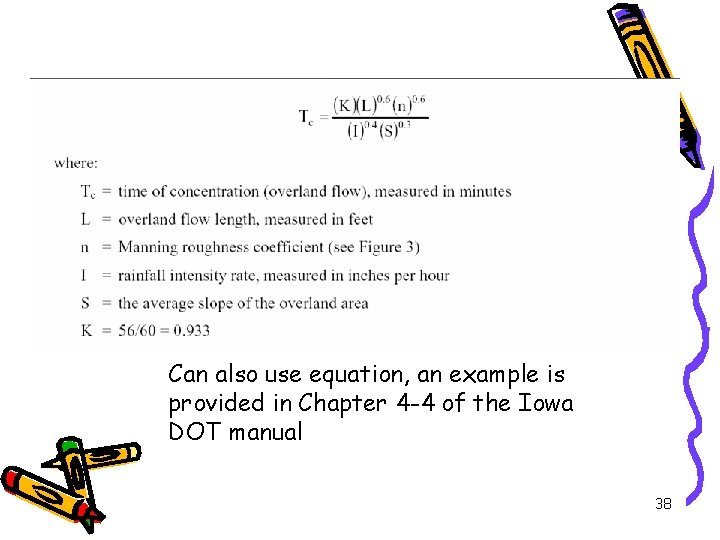
Can also use equation, an example is provided in Chapter 4 -4 of the Iowa DOT manual 38
Rational method • • used for mostly urban applications limited to about 10 acres in size Q = CIA Calculate once C, I, and A have been found 39
Area • Area of watershed • Defined by topography • Use GIS contours in lab 40
41
Lab-type Example • • 60 -acre watershed 50 -year storm Mixed cover Rolling terrain 42
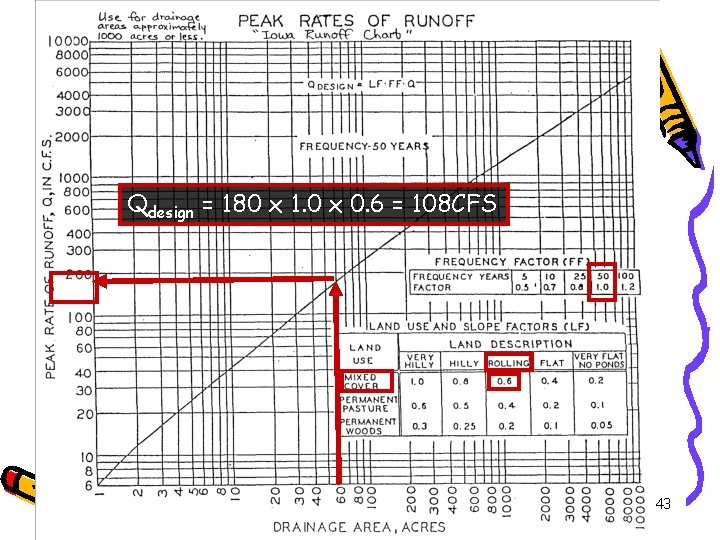
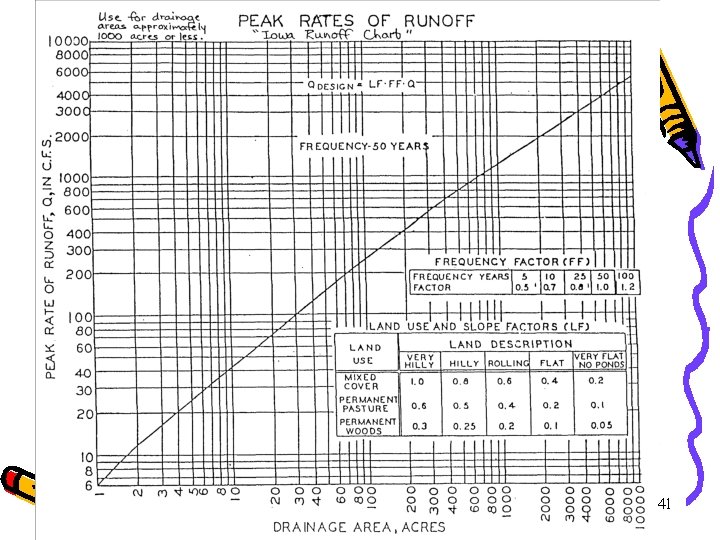
Qdesign = 180 x 1. 0 x 0. 6 = 108 CFS 180 43
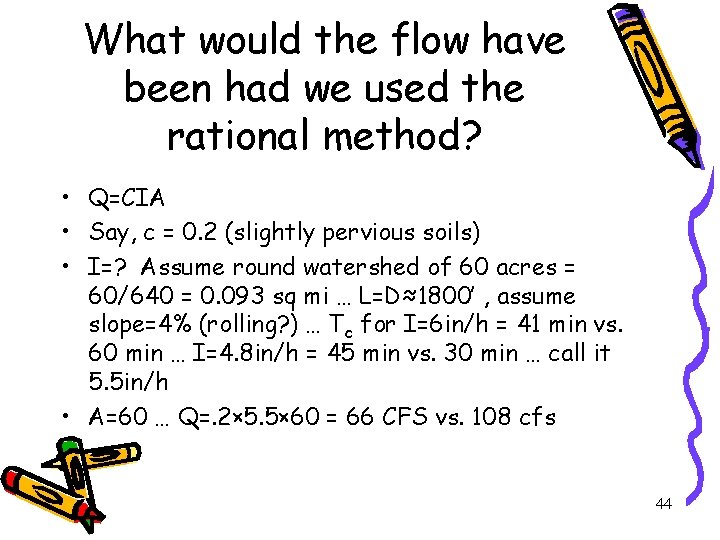
What would the flow have been had we used the rational method? • Q=CIA • Say, c = 0. 2 (slightly pervious soils) • I=? Assume round watershed of 60 acres = 60/640 = 0. 093 sq mi … L=D≈1800’ , assume slope=4% (rolling? ) … Tc for I=6 in/h = 41 min vs. 60 min … I=4. 8 in/h = 45 min vs. 30 min … call it 5. 5 in/h • A=60 … Q=. 2× 5. 5× 60 = 66 CFS vs. 108 cfs 44
- Slides: 44