
Supranational Organizations What Are Supranational Organizations Supranational organization
- Slides: 24
Supranational Organizations
What Are Supranational Organizations? Supranational organization: A separate entity composed of three or more states that forge an association and form an administrative structure for mutual benefit in pursuit of shared goals
The United Nations Main Aims: Tolerance and friendship among all nation, racial or religious groups. Maintenance of peace
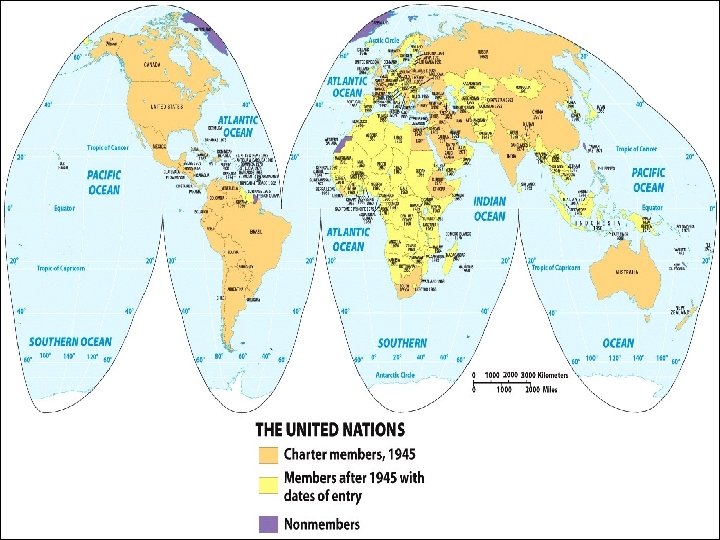
When did it begin? • The United Nations is made up of 196 countries from around the world. It is often called the UN. • It was set up in 1945, after the Second World War, as a way of bringing people together and to avoid further wars. • It started with 51 countries. The United Kingdom is one of the original members. Germany did not join until 1973.
Global Scale: The United Nations
Why is it important to have an organization that is bigger than any one country? • Stops governments mistreating people • Helps stop wars between countries • Looks after all the world's young people
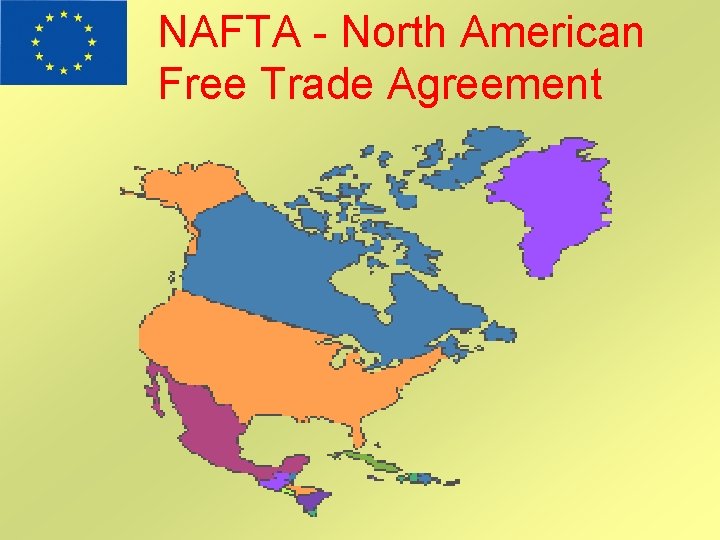
NAFTA - North American Free Trade Agreement
The North American Free Trade Area • Comprised of United States, Canada, and Mexico. • Largest free trade area in the world – GDP $15 trillion. • NAFTA created in 1994 by President Clinton. • Extended Maquiladoras beyond 20 miles of the border. • U. S. and Mexico trade at $540 B in 2015. 8
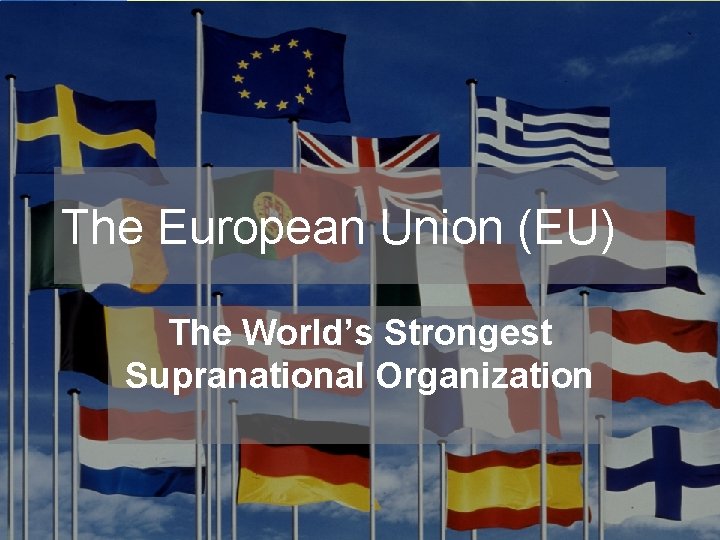
The European Union (EU) The World’s Strongest Supranational Organization
What is it? • The European Union (EU) is a family of democratic European countries, committed to working together for peace and prosperity. • It is not a State intended to replace existing states, but it does represent a greater compromise of sovereignty than any other international organization. • Member States have set up common institutions to which they delegate some of their sovereignty so that decisions on specific matters of joint interest can be made democratically at European level. • This pooling of sovereignty is also called "European integration"
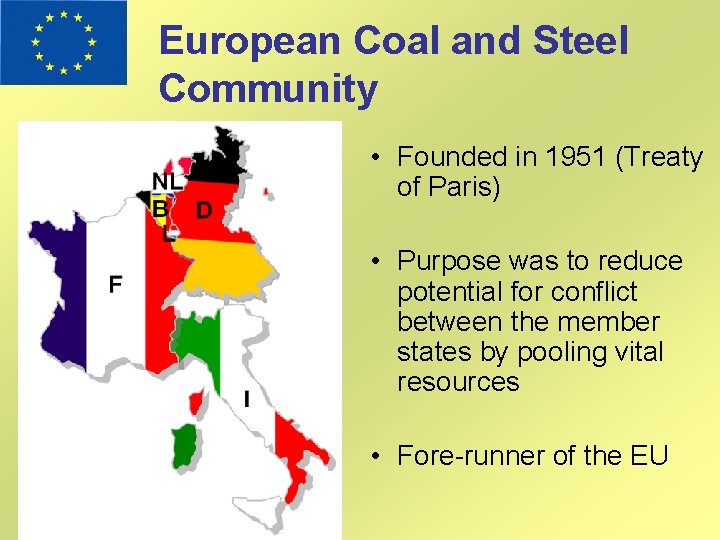
European Coal and Steel Community • Founded in 1951 (Treaty of Paris) • Purpose was to reduce potential for conflict between the member states by pooling vital resources • Fore-runner of the EU
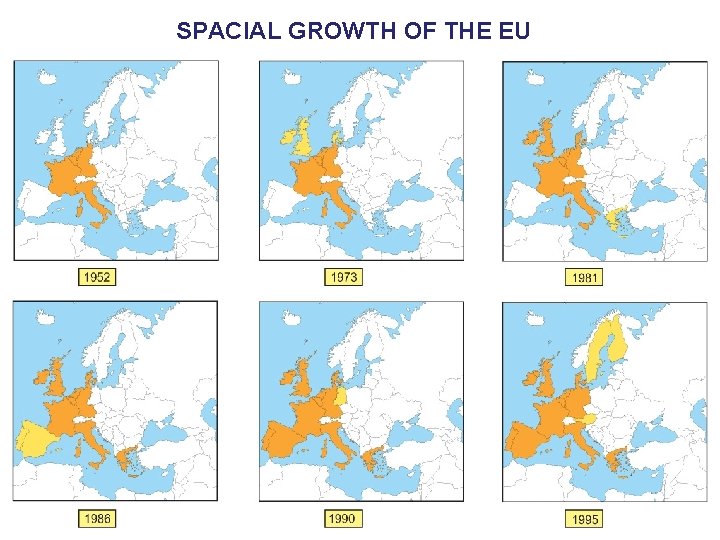
History of the EU • Phases of growth • History of the European Union lie in the Second World War. European integration conceived to prevent such killing and destruction from ever happening again European Economic Community (EEC) - 1958: Belgium, Germany, France, Italy, Luxembourg and the Netherlands (1958) European Communities (EC) 1967: Denmark, Ireland UK (1973), Greece (1981), Spain and Portugal (1986) European Union (EU) – 1992: Austria, Finland Sweden (1995), 10 new countries join May 9, 2004
SPACIAL GROWTH OF THE EU
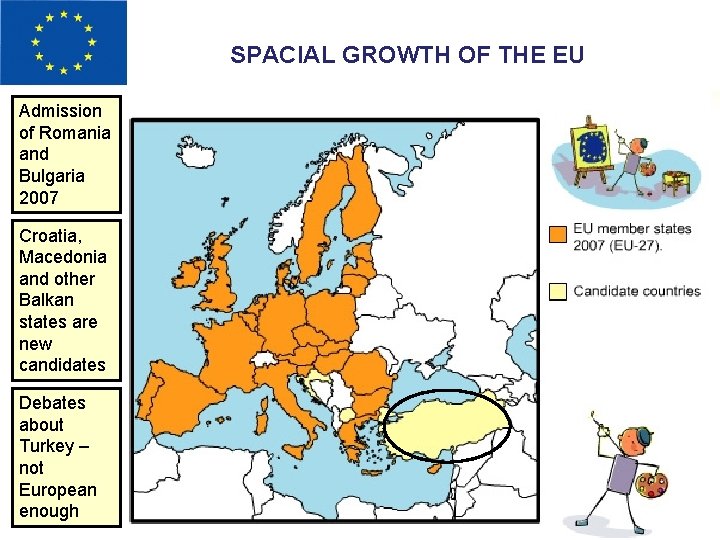
SPACIAL GROWTH OF THE EU Admission of Romania and Bulgaria 2007 Croatia, Macedonia and other Balkan states are new candidates Debates about Turkey – not European enough
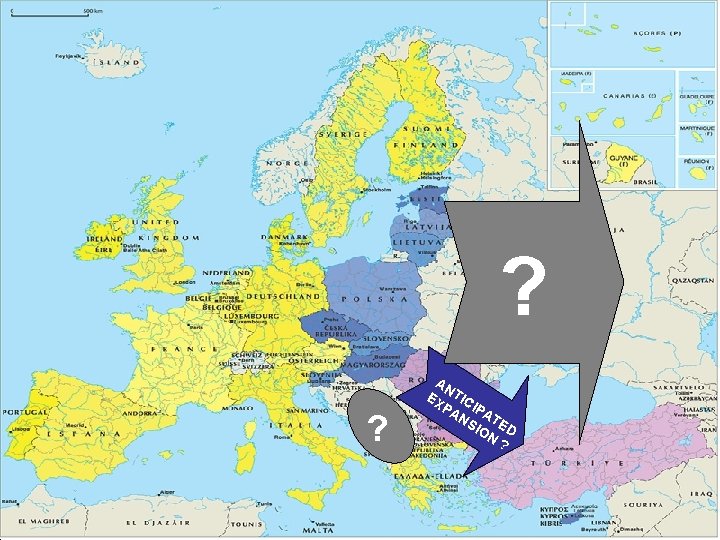
? ? AN EX TIC PA IPA NS TE IO D N ?
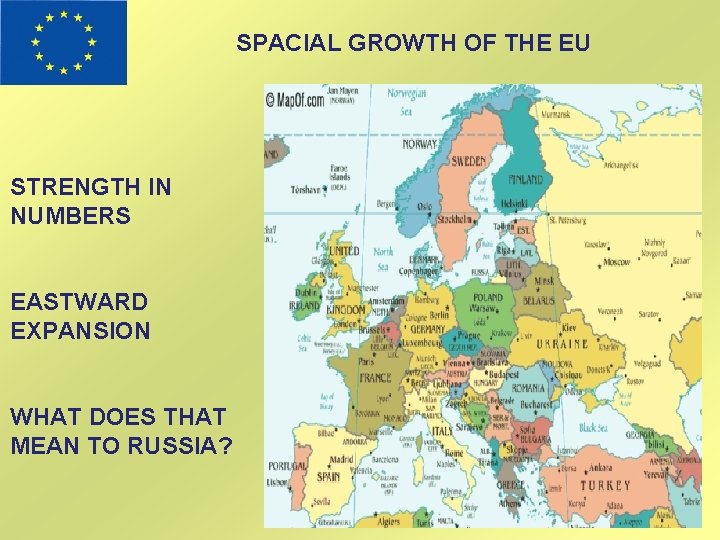
SPACIAL GROWTH OF THE EU STRENGTH IN NUMBERS EASTWARD EXPANSION WHAT DOES THAT MEAN TO RUSSIA?
How does it work? • There are five EU institutions, each playing a specific role: – European Parliament (one of two legislative bodies in the EU; elected by the peoples of the Member States) – Council of the European Union (EU’s highest Legislative Body; has legislative initiative; is made up of representatives appointed by member states according to a population-based allotment) – European Commission (EU’s executive body; one commissioner per country appointed by each government) – Court of Justice (ensures compliance with the EU laws) – Court of Auditors (manages the EU budget)
How does it work? • These are flanked by five other important bodies: – European Economic and Social Committee (expresses the opinions of organized civil society on economic and social issues) – Committee of the Regions (expresses the opinions of regional and local authorities) – European Central Bank (responsible for monetary policy and managing the Euro) – European Ombudsman (deals with citizens' complaints about administration by any EU institution or body) – European Investment Bank (helps achieve EU objectives by financing investment projects)
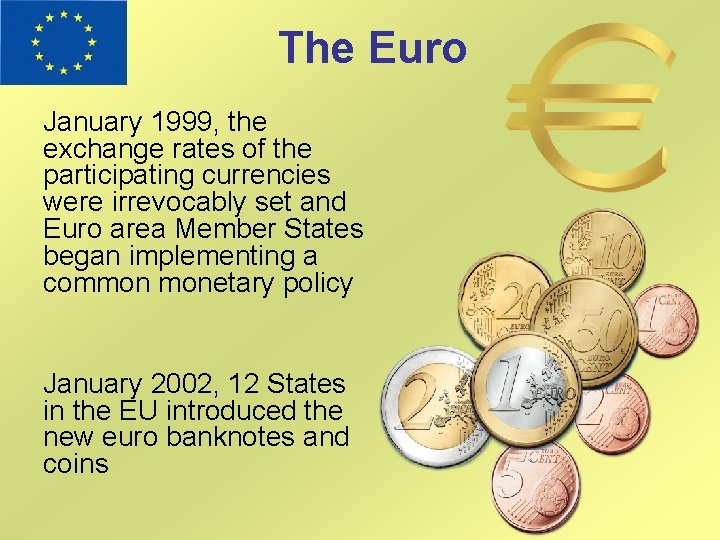
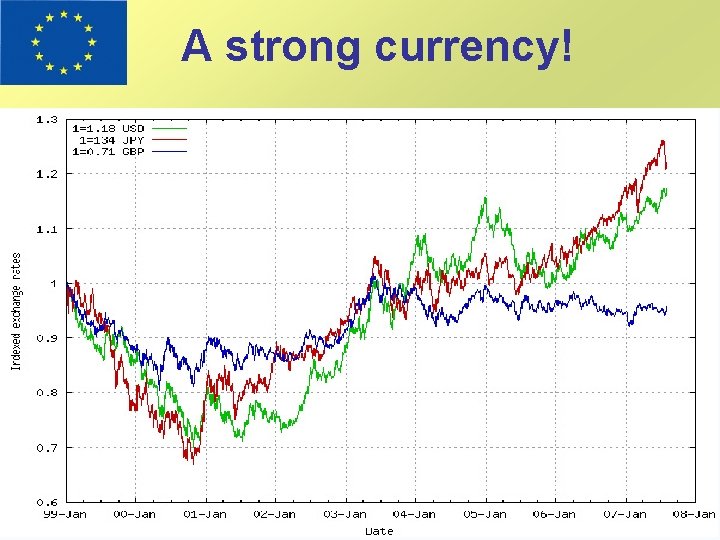
The Euro January 1999, the exchange rates of the participating currencies were irrevocably set and Euro area Member States began implementing a common monetary policy January 2002, 12 States in the EU introduced the new euro banknotes and coins
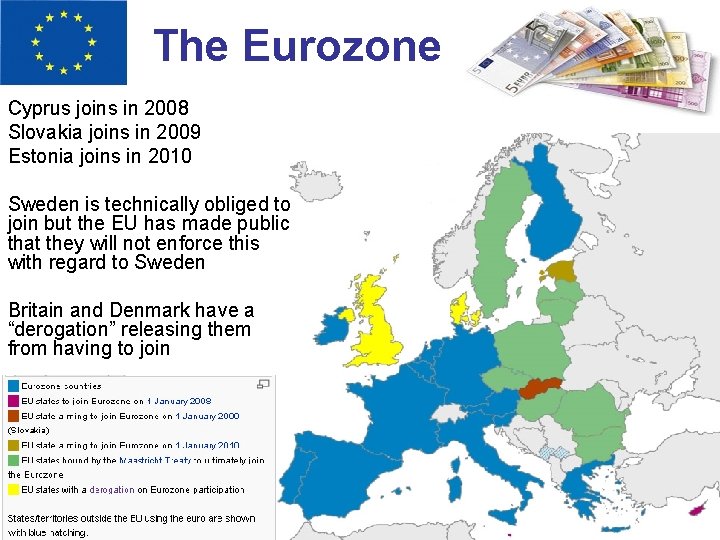
The Eurozone Cyprus joins in 2008 Slovakia joins in 2009 Estonia joins in 2010 Sweden is technically obliged to join but the EU has made public that they will not enforce this with regard to Sweden Britain and Denmark have a “derogation” releasing them from having to join
A strong currency!
Impact of the Eurozone • What impact do you think the Eurozone has on cultural diffusion? • What impact do you think the Eurozone has on economic development? • Why are some countries avoiding joining?