
Suppositories by Ali K Alobaidy Suppositories Are solid
Suppositories by Ali K. Alobaidy
Suppositories • Are solid dosage form intended for insertion into vaginal or rectal cavities where they melt, soften or dissolve and exert localized or systemic effects. • The shape and size of Suppositories must be such that it is capable of being easily insert into the intended body orifice without causing undue distention, and once inserted, it must be retained for appropriate period.

Types of suppository base AThe fatty bases: These bases melt at body temperature and consist of the naturally occurring theobroma oil (Cocoa – butter) and synthetic hard fats. BWater – soluble and water – miscible bases: These bases dissolve or disperse in the body fluids. There are two groups of water – soluble bases: 1. Glycero – gelatin bases. 2. Macrogol (PEG) bases.
Preparation of Suppository Suppositories are formulated in different shapes and sizes (usually 1 – 4 g). The suppository consists of a vehicle in which the drug is incorporated and in some cases, additives are co formulated. Suppositories are manufactured by two general methods: AFusion method (hot process): The drug is added to the melted base and the mixture allowed cooling after pouring into molds. BCompression method (cold process): The drug is incorporated with the un-melted base and the resulting mass shaped either by hand or by compression force in a metallic mold.
Mold calibration • The mold is generally made of melt in two halves which are clamped together with a screw. • The capacity of the mold is confirmed by filling the mold with the chosen base. The weight of the perfect products is taken and a mean weight calculated. This value is the calibration value of the mold for that particular base.

Displacement value (DVs) • The volume of a suppository from a particular mold is uniform but its weight will vary because the density of the medicaments usually differs from the density of the base. • The displacement value of a drug is the number of parts by weight of drug which displaces one part weight of the base
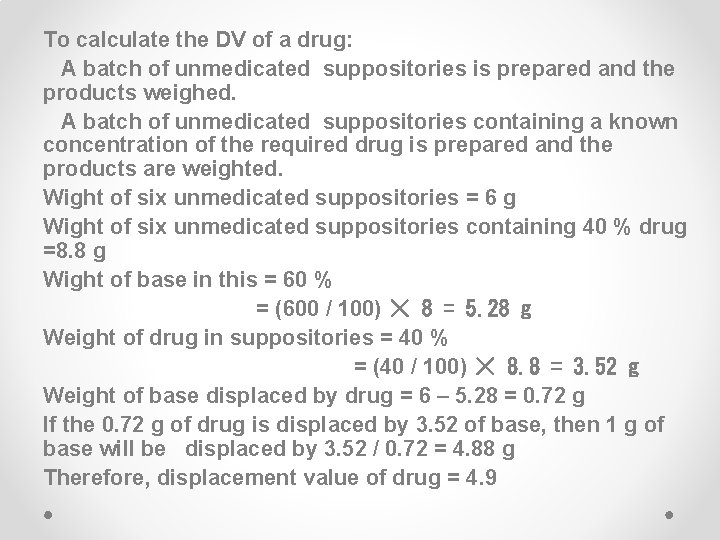
To calculate the DV of a drug: A batch of unmedicated suppositories is prepared and the products weighed. A batch of unmedicated suppositories containing a known concentration of the required drug is prepared and the products are weighted. Wight of six unmedicated suppositories = 6 g Wight of six unmedicated suppositories containing 40 % drug =8. 8 g Wight of base in this = 60 % = (600 / 100) ☓ 8 = 5. 28 g Weight of drug in suppositories = 40 % = (40 / 100) ☓ 8. 8 = 3. 52 g Weight of base displaced by drug = 6 – 5. 28 = 0. 72 g If the 0. 72 g of drug is displaced by 3. 52 of base, then 1 g of base will be displaced by 3. 52 / 0. 72 = 4. 88 g Therefore, displacement value of drug = 4. 9
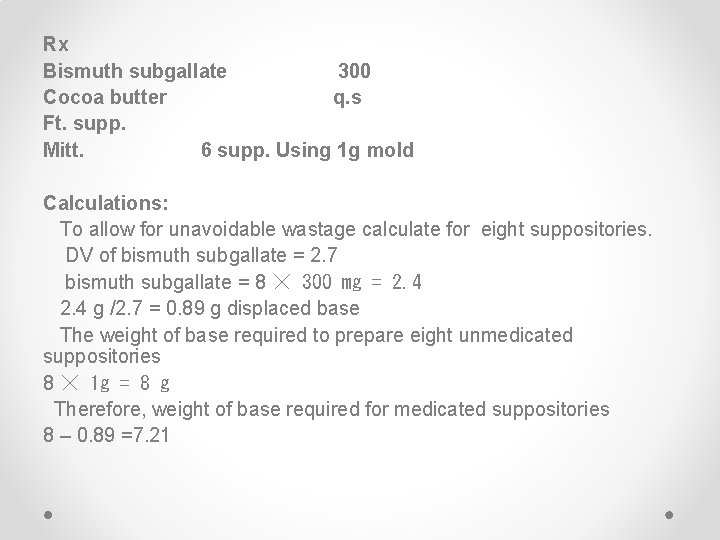
Rx Bismuth subgallate 300 Cocoa butter q. s Ft. supp. Mitt. 6 supp. Using 1 g mold Calculations: To allow for unavoidable wastage calculate for eight suppositories. DV of bismuth subgallate = 2. 7 bismuth subgallate = 8 ☓ 300 mg = 2. 4 g /2. 7 = 0. 89 g displaced base The weight of base required to prepare eight unmedicated suppositories 8 ☓ 1 g = 8 g Therefore, weight of base required for medicated suppositories 8 – 0. 89 =7. 21
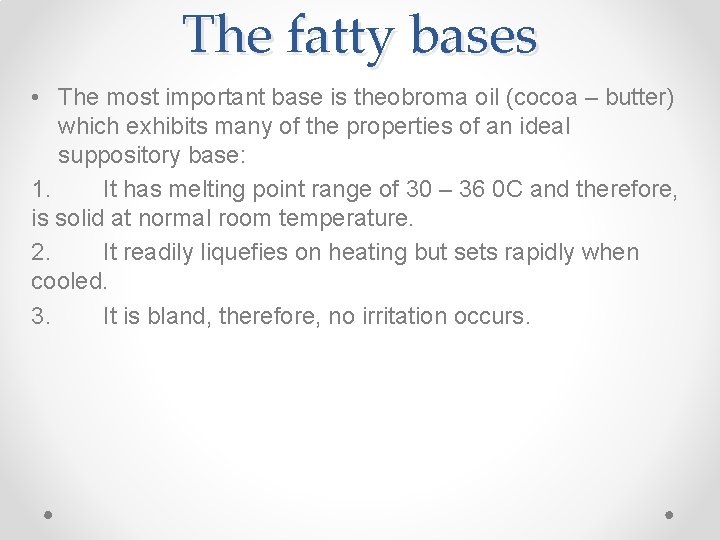
The fatty bases • The most important base is theobroma oil (cocoa – butter) which exhibits many of the properties of an ideal suppository base: 1. It has melting point range of 30 – 36 0 C and therefore, is solid at normal room temperature. 2. It readily liquefies on heating but sets rapidly when cooled. 3. It is bland, therefore, no irritation occurs.
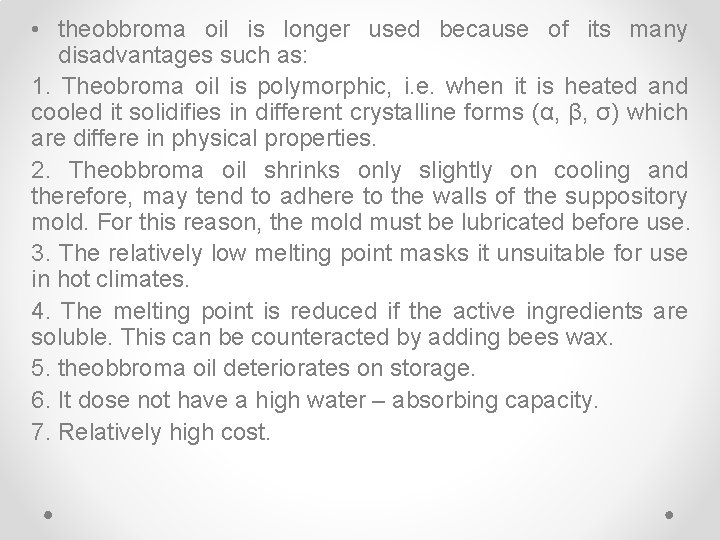
• theobbroma oil is longer used because of its many disadvantages such as: 1. Theobroma oil is polymorphic, i. e. when it is heated and cooled it solidifies in different crystalline forms (α, β, σ) which are differe in physical properties. 2. Theobbroma oil shrinks only slightly on cooling and therefore, may tend to adhere to the walls of the suppository mold. For this reason, the mold must be lubricated before use. 3. The relatively low melting point masks it unsuitable for use in hot climates. 4. The melting point is reduced if the active ingredients are soluble. This can be counteracted by adding bees wax. 5. theobbroma oil deteriorates on storage. 6. It dose not have a high water – absorbing capacity. 7. Relatively high cost.
Preparation of suppositories using theobbroma oil base 1. Accurately weigh required amount of base, place in beaker and put on water – bath, over gentle heat. 2. Allow approximately two – thirds of the base to melt and remove from the heat. The residual heat will be sufficient for the rest of the base to melt. 3. Reduce the particle size of the active ingredients, if necessary. This will be done by either grinding in a mortar and pestle or sieving. 4. Weigh the correct amount of medicament and place on a slab. 5. Add about half of the molten base to the powdered drug and rub together with a spatula. 6. scrap this mixture off the slab, using the spatula and place back into the beaker. 7. If necessary, put the backer back over the water – bath to re-melt the ingredients. 8. Remove from the heat and stir constantly until almost on the point of setting. 9. Quickly pour into the mold, slightly overfilling each cavity. This is to allow for contraction on cooling. 10. Leave the mold ant its contents to cool for about 5 minutes and then, using a spatula, trim the tops of the suppositories. 11. Allow to cool for another 10 – 15 minutes until the suppositories are completely firm and set.

Rx DV 0. 9 Tannic acid gr. v Oil of theobroma q. s Ft. supp. Mitt. iii supp. Using 2 g mold. Sig. insert one as direct Calculations: 0. 33 ☓ 5 = 1. 65 g tannic acid The wight of base required to prepare five ummedicated suppositories = 5 ☓ 2 g = 10 g base 1. 65 g / 0. 9 = 1. 83 the base displaced by tannic acid Therefore, weight of the base required for medicated suppositories = 10 g – 1. 83 g = 8. 17 g The total weight = 8. 17 g + 1. 65 g = 9. 82 g The weight of each suppository = 9. 82 ÷ 5 = 1. 96 g
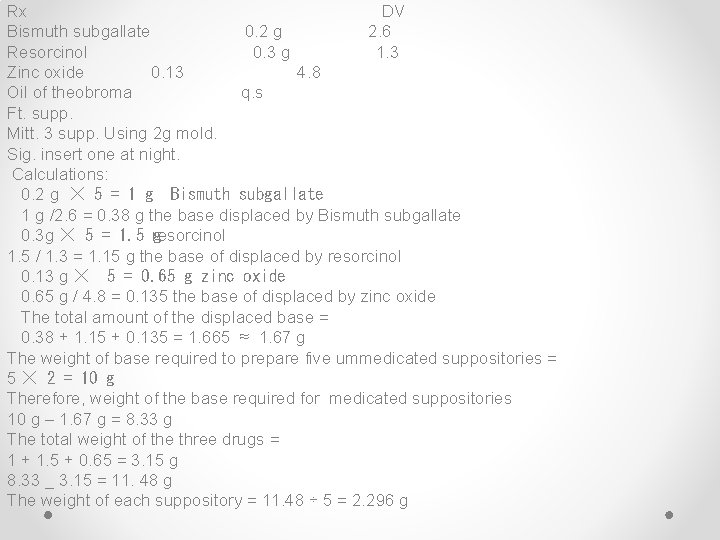
Rx DV Bismuth subgallate 0. 2 g 2. 6 Resorcinol 0. 3 g 1. 3 Zinc oxide 0. 13 4. 8 Oil of theobroma q. s Ft. supp. Mitt. 3 supp. Using 2 g mold. Sig. insert one at night. Calculations: 0. 2 g ☓ 5 = 1 g Bismuth subgallate 1 g /2. 6 = 0. 38 g the base displaced by Bismuth subgallate 0. 3 g ☓ 5 = 1. 5 resorcinol g 1. 5 / 1. 3 = 1. 15 g the base of displaced by resorcinol 0. 13 g ☓ 5 = 0. 65 g zinc oxide 0. 65 g / 4. 8 = 0. 135 the base of displaced by zinc oxide The total amount of the displaced base = 0. 38 + 1. 15 + 0. 135 = 1. 665 ≈ 1. 67 g The weight of base required to prepare five ummedicated suppositories = 5 ☓ 2 = 10 g Therefore, weight of the base required for medicated suppositories 10 g – 1. 67 g = 8. 33 g The total weight of the three drugs = 1 + 1. 5 + 0. 65 = 3. 15 g 8. 33 _ 3. 15 = 11. 48 g The weight of each suppository = 11. 48 ÷ 5 = 2. 296 g
Glycero – gelatin bases (Water Soluble Bases) • These are compirse a mixture of glycerol and water, which is stiffened with gelatin. The commonest in use is glycerol suppositories BP which has 14 % w/w gelatin and 70 % w/w glycerol. In hot climates, the gelatin content can be increased to 18 % w/w. • Stiffer masses containing a higher proportion of gelatin are also used when the product contains more than about 20 % of semi – liquid or liquid because such additions make the pervious mass to soft.
• The glycero – gelatin base frequently used than the fatty bases for a variety of reasons: 1. clycero– gelatin bases have a physiological effect (laxative effect). 2. They are much more difficult to prepare and handle. 3. The solution time depends on the content and quality of the gelatin and the gas of the suppository. 4. They are hygroscopic and therefore, require careful storage and may cause rectal irritation. 5. Because of the water content, microbial contamination is more likely than with the fatty bases. Preservatives may require to be added to the product. 6. Gelatin is incompatible with protein precipitants such as tannic acid
Preparation of suppositories using Glycero– gelatin base 1. The correct amount of gelatin is weighted out and placed in a previously weighed beaker. 2. Sufficient water to just cover the gelatin is added and the contents left for about five minutes. 3. When the gelatin has softened, any excess water is drained off. This step is not necessary if powdered gelatin is being used. 4. the exact amount of glycerol is then weighed into the beaker 5. The beaker is placed on a water – bath, over gentle heat and the mixture gently stirred until the gelatin has method. 6. When the gelatin is melted, the beaker is removed from the heat and weighed. If the weight is less than the required total, water is added, to the correct weight. If the contents of the beaker are too heavy it must be put back on, the heat and the excess water evaporated off. 7. When the correct weight is achieved the active ingredient is added with careful stirring. 8. The mixture is then poured into the prepared mold, lubricated with either a rachis or almond oil. It is not necessary to overfill the molds and this type of product does not require to be trimmed.
Rx Glycerinated gelatin suppositories (B. P. ) Gelatin 14 g Glycerol 70 g Purified water q. s 100 g Ft. supp. Mitt. 5 supp. Using 1 g mold. Sig. one supp. To be used when required.
Rx Glycerin suppositories (U. S. P. ) Glycerol Sodium stearate Purified water To make about Ft. supp. Mitt. 5 supp. using 2 g mold. Sig. one supp. at night. 91 g 9 g 5 g 100 g
Rx Soap glycerin suppositories Glycerol 90 g Sodium carbonate 9 g Stearic acid 5 g Ft. supp. Mitt. 5 supp. using 1 g mold. Sig. supp. used as direct.
Macrogol (PEG) These are polyethylene glycols which are blended together to produce suppository bases which vary in melting points, dissolution rates and physical characteristics. High polymers produce preparations, which release the drug slowly. They are also brittle, less brittle products, which release the drug more readily can be prepared by mixing high polymers with medium and low polymers. Drug is released as the base dissolves in the rectal contents. Macrogols have several properties, which make them ideal suppository bases: 1. They have no physiological effect, e. g. do not produce a laxative effect. 2. They are not prone to microbial contamination. 3. Some polymers have at a high melting point. These are useful for drugs, which lower the melting point of other bases. 4. They have a high water –absorbing capacity.
The disadvantages of macrogols: 1. They are hygroscopic which means they must be carefully stored. Irritation of the rectal mucosa can also occur. 2. They are incompatible with several drugs e. g. benzocaine penicillin, tannins, phenol and bismuth salts. 3. They became brittle if cooled too quickly and may become brittle on storage. 4. Crystal growth occurs with some active ingredients.
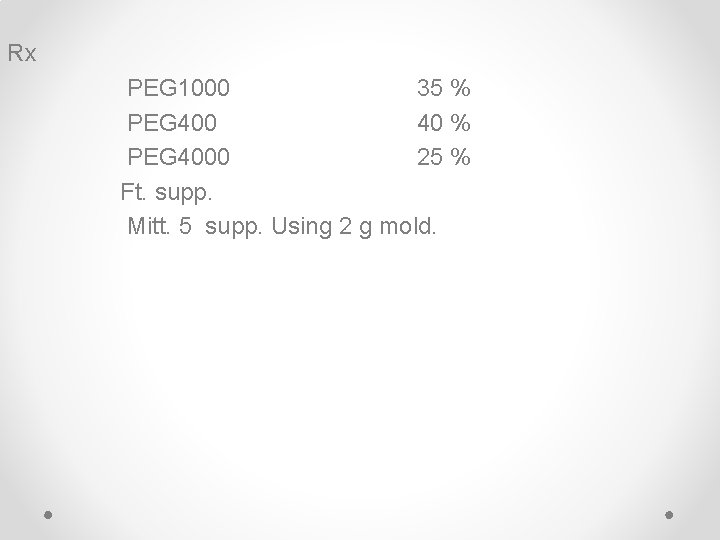
Rx PEG 1000 35 % PEG 400 40 % PEG 4000 25 % Ft. supp. Mitt. 5 supp. Using 2 g mold.
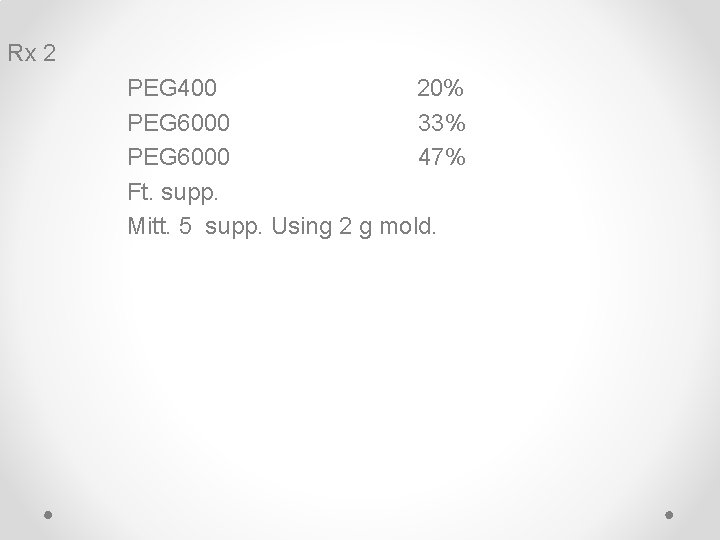
Rx 2 PEG 400 20% PEG 6000 33% PEG 6000 47% Ft. supp. Mitt. 5 supp. Using 2 g mold.
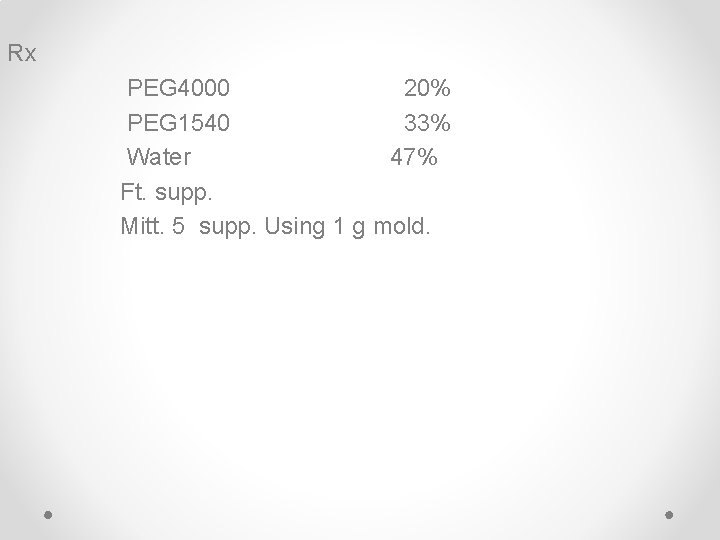
Rx PEG 4000 20% PEG 1540 33% Water 47% Ft. supp. Mitt. 5 supp. Using 1 g mold.
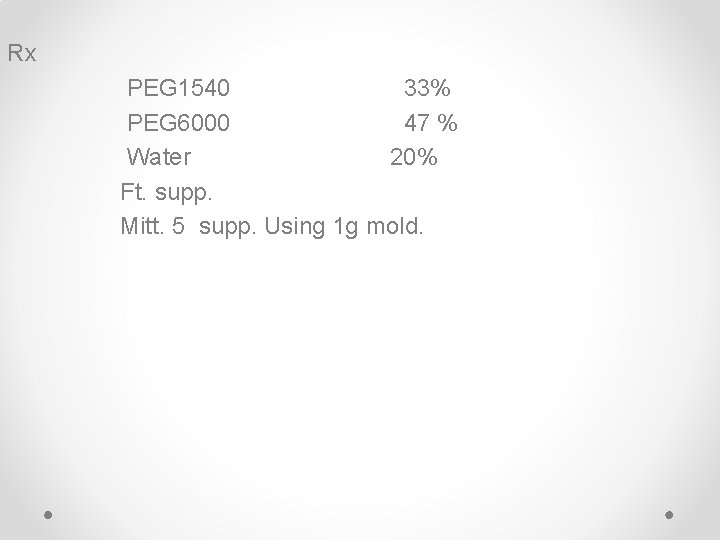
Rx PEG 1540 33% PEG 6000 47 % Water 20% Ft. supp. Mitt. 5 supp. Using 1 g mold.
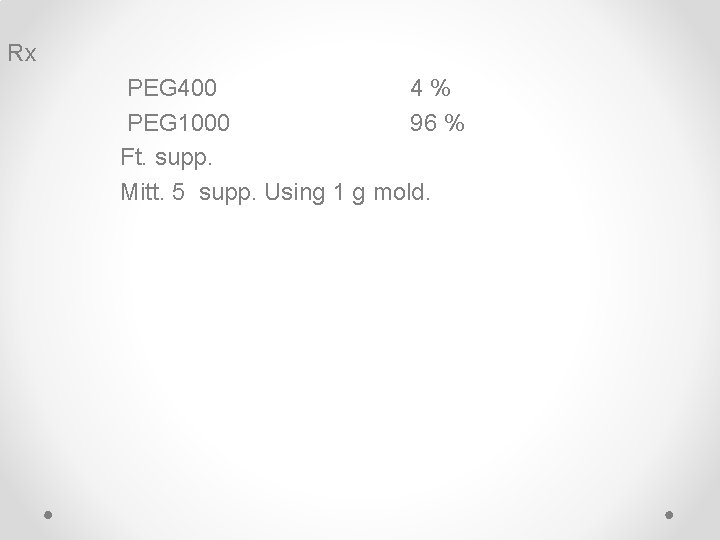
Rx PEG 400 4% PEG 1000 96 % Ft. supp. Mitt. 5 supp. Using 1 g mold.
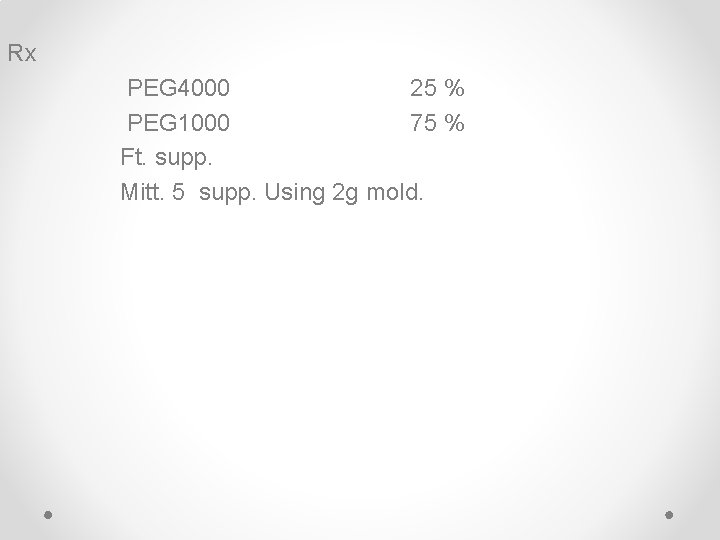
Rx PEG 4000 25 % PEG 1000 75 % Ft. supp. Mitt. 5 supp. Using 2 g mold.
- Slides: 27