
Supportive Services for Veteran Families SSVF Data SSVF
- Slides: 30
Supportive Services for Veteran Families (SSVF) Data SSVF Data Collection & Reporting 101 Updated 9/14
Learning Goals • Learn goals and function of HMIS • Learn roles and responsibilities involved in an HMIS implementation • Learn what data is collected in HMIS • Learn SSVF reporting requirements • Learn steps and sequencing of HMIS set-up 2
What is HMIS? A Homeless Management Information System (HMIS) is a community-based software application that collects and reports on client-level information about the characteristics and needs of people who are served by projects intended to prevent and end homelessness 3
Homelessness Data Before HMIS • Estimates of the numbers of homeless people locally, regionally, and nationally varied widely • Projects filed paper reports with counts of people served, often based on paper records • Communities conducted point-in-time counts but there was no way to get an unduplicated count of people at the community level over time • There was no reliable way to assess the effectiveness of homeless projects 4
Goals of HMIS • Measure project effectiveness • Generate an unduplicated count of homeless persons for each Continuum of Care (Co. C) • Help understand the extent and nature of homelessness locally, regionally, and nationally • Understand patterns of service use 5
VA Participation in HMIS • The utility of HMIS data at the local level depends on participation by all projects that serve people who are homeless and at risk of homelessness, regardless of funding source • VA is committed to grantee participation in HMIS to support community-based service planning and coordination for Veterans who are homeless and at risk of homelessness 6
SSVF and HMIS • SSVF HMIS Requirements: – Participation in the HMIS implementations of each Co. C in which services are provided, either by direct data entry or by providing an export of client-level data – Required to export SSVF HMIS data monthly and upload into VA Repository • Work with your local HMIS to get your SSVF project set up • Technical assistance is available to your project, your HMIS, and the HMIS vendor 7
Local HMIS Requirements • A local HMIS may have additional requirements • Communicate with your local HMIS administrator to be sure that you understand local requirements • If local requirements conflict with SSVF program requirements, contact your regional coordinator to request technical assistance 8
Grantee Roles and Responsibilities: The SSVF Grantee is responsible for all activity associated with agency staff and use of the HMIS, including: – – – – Co. C Participation HMIS Participation and Governance Compliance Privacy and Security Compliance HMIS Policy and Procedure Compliance Data Quality Compliance Community Planning/Use of Data Subcontractor(s) HMIS use 9
HMIS System Administrator Each HMIS implementation designates a system administrator to provide day-to-day management and support to the HMIS project • Project set-up guidance • Training and technical assistance support • Oversight and monitoring of HMIS operations • Management of HMIS documentation, including client consent, privacy and security practices, and other policy and procedures 10
HMIS System Administrator Contact your local System Administrator to identify the locally specific HMIS participation requirements: • Training, certifications, fees, participation standards, monitoring expectations • Assistance with monthly data uploads to the VA Repository • Local system administrators are likely to be your initial resource for TA and support 11
HMIS Software Solution Provider/ Vendor • Software solution provider is the company that created and/or services the software your HMIS uses • There are many different software solution providers. Each may play a slightly different role in each community • Solution providers often release general product use documentation that may be very helpful for SSVF program staff. 12
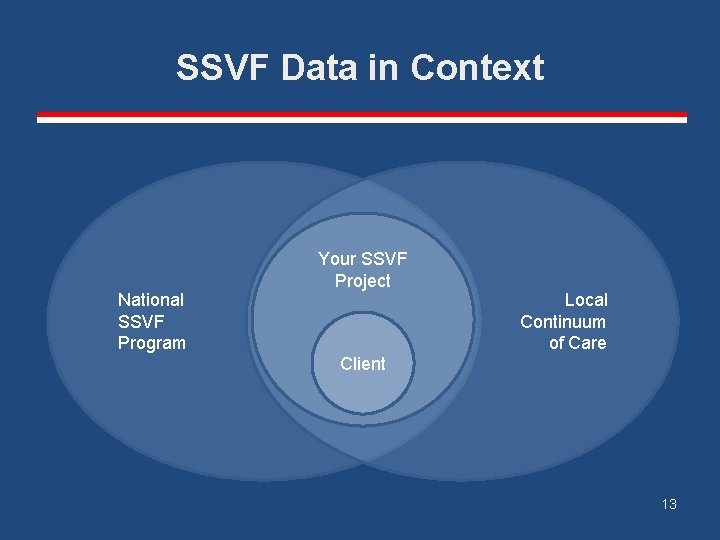
SSVF Data in Context National SSVF Program Your SSVF Project Local Continuum of Care Client 13
Co. C Staff The Co. C addresses homelessness for a defined geographic region through coordinated planning, funding, and management of homeless assistance resources • Coordinates system of housing and services to address homeless needs • Designates a HMIS to track the extent of homelessness and measure project effectiveness • Establishes strategic plan for the Co. C 14
Co. C Staff Co. C may operate the HMIS or may designate/ authorize a HMIS lead agency to perform the following: § Establish HMIS participation guidelines and expectations § Establish privacy protections for client data entered into HMIS § Establish security protections to create safe and secure HMIS operating environments § Monitor and enforce compliance with participation requirements 15
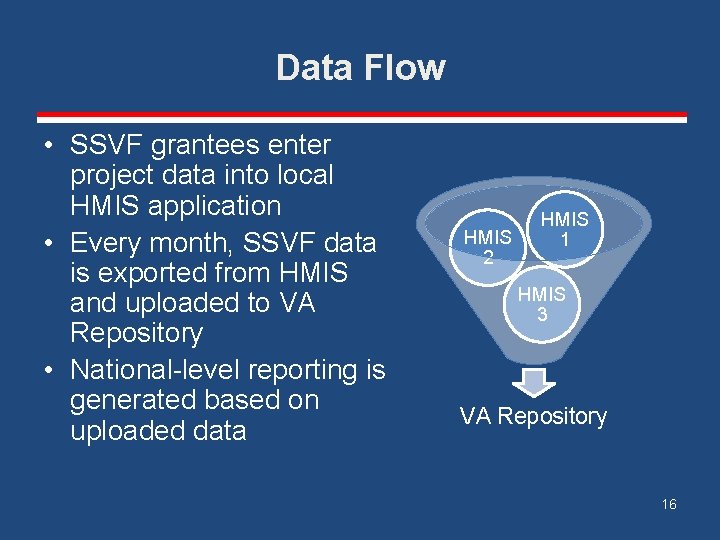
Data Flow • SSVF grantees enter project data into local HMIS application • Every month, SSVF data is exported from HMIS and uploaded to VA Repository • National-level reporting is generated based on uploaded data HMIS 2 HMIS 1 HMIS 3 VA Repository 16
Data Collected in HMIS • • Who are your clients? When did you serve them? What are their characteristics? What are their circumstances at the time they enter your project? • Do they have any special needs? • What services are you providing? • Did their circumstances change while in your project? 17
Special Issues • Information about specific disabilities is collected as clients enter the project, at least once per year while they are enrolled, and at project exit • If you collect data related to HIV/AIDS or substance abuse for SSVF and enter it into HMIS, that data may not be shared with other organizations • If your HMIS doesn’t allow keeping HIV/AIDS and substance abuse data private, don’t enter it into HMIS 18
HMIS Data Collection for Those with History of Domestic Violence • Only projects whose primary mission is to serve victims of DV are prohibited from entering client data into HMIS (per VAWA). • All other SSVF grantees are required to collect and enter data into HMIS for 100% of participants. • Contact Regional Coordinator if SSVF requirement appears to be in conflict with state, local law or local HMIS policy. 19
Data Reporting Requirements • Repository upload: – Upload of client and project level data to a secure SSVF Repository managed by the VA – Upload anytime between the 1 st and 5 th business days of each month – Each upload contains a data set reflecting project activity from project inception to the date of export – See VA Data Guide for more detailed instructions on the upload process • Quarterly Reports: – Complete quarterly reports addressing programmatic and financial information. – For more information, see VA Web site at: http: //www. va. gov/homeless/ssvfuniversity. asp? page=/program_requirement s/reporting 20
What Is Data Quality? • Data Quality Indicators – Timeliness – Completeness – Accuracy • Data Quality Processes – Monitoring – Incentives and enforcement
Data Quality Requirements • Data collection and HMIS data entry is mandatory for SSVF Grantees • Data is uploaded to the VA SSVF Repository during the first 5 business days of each month • Uploads are rejected if data quality is below thresholds • Reference “Creating a Comprehensive Data Quality Plan” SSVF Power. Point training and Data Guide for more information 22
Planning and HMIS Set-up 1. SSVF grantees should contact the Co. C(s) and HMIS staff. 2. Negotiate and execute agreements. – Start HMIS training, including data collection and privacy and security training – Work with HMIS staff for data entry needs 3. If the SSVF Grant covers multiple Co. C jurisdictions, decide where data will be entered. 4. If grant has subcontractors, decide if they will enter data directly into HMIS. 5. Request accounts for all Repository users, including back-up staff.
Planning and HMIS Set-up 6. Establish and test data collection workflow and tools. 7. Determine HMIS reporting capabilities. 8. Determine who will upload data to the VA Repository monthly. • Preferred method: HMIS Administrator will upload • Alternative: Grantee will manage the upload process • Caution: The Grantee is ultimately responsible for complete, accurate and timely uploads to the Repository – even if the HMIS Lead Agency agrees to manage the upload process!
Basic Steps and Sequencing for Implementation Set-up – Develop intake forms that capture required VA SSVF information – Develop the SSVF workflow – Establish data collection and entry policies and procedures – Train staff 25
Basic Steps and Sequencing for Implementation Set-up – Establish management and end user accountability for data accuracy, timeliness and completeness. – Train SSVF staff to consistently collect and record all required information per policies/procedures and workflow. – Test data entry using HMIS training database. – Confirm that HMIS can produce all information needed for monthly and quarterly VA reporting. 26
Basic Steps and Sequencing for Implementation Data Collection and Entry – Supervise client data collection and entry – Include regular data monitoring as part of the data collection and entry process to assure that information is timely, complete and accurate – Provide feedback and additional training, as necessary, to data entry staff 27
Basic Steps and Sequencing for Implementation Before Exporting Data From HMIS – Confirm that all information for the calendar month has been entered into HMIS – Use any available data quality tools to check for missing or erroneous data prior to the end of each month and update records in HMIS 28
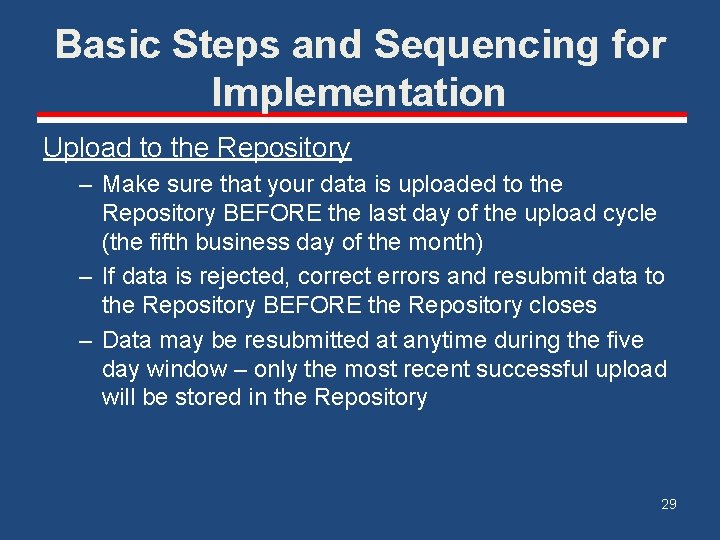
Basic Steps and Sequencing for Implementation Upload to the Repository – Make sure that your data is uploaded to the Repository BEFORE the last day of the upload cycle (the fifth business day of the month) – If data is rejected, correct errors and resubmit data to the Repository BEFORE the Repository closes – Data may be resubmitted at anytime during the five day window – only the most recent successful upload will be stored in the Repository 29
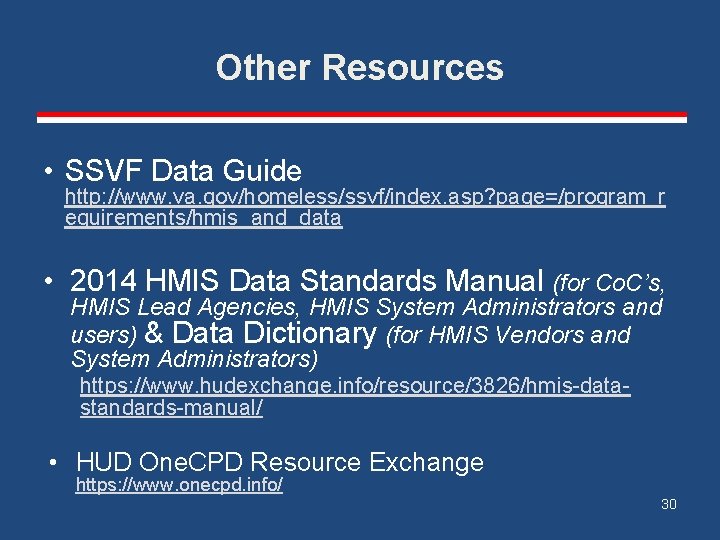
Other Resources • SSVF Data Guide http: //www. va. gov/homeless/ssvf/index. asp? page=/program_r equirements/hmis_and_data • 2014 HMIS Data Standards Manual (for Co. C’s, HMIS Lead Agencies, HMIS System Administrators and users) & Data Dictionary (for HMIS Vendors and System Administrators) https: //www. hudexchange. info/resource/3826/hmis-datastandards-manual/ • HUD One. CPD Resource Exchange https: //www. onecpd. info/ 30