
Supportive Planning and Operations Team SPOT Initiative Stakeholder
- Slides: 30
Supportive Planning and Operations Team (SPOT) Initiative Stakeholder Meeting Bureau of Health Care Safety and Quality January 11, 2017 Slide 1
Objectives • Overview of SPOT Initiative • Assessment Findings • Overall Findings from Quality Assurance and Performance Improvement (QAPI) Assessment • Findings from Five Elements of Assessment • Themes from Staff Comments • Targeted Training • “In-person” instruction with QAPI Resources &Tools • Safe Resident Handling • Continuing SPOT Activities Slide 2
Overview—SPOT Initiative Objectives: • Build upon Centers for Medicare and Medicaid Services (CMS) regulatory requirements • Utilize quality assurance and performance improvement (QAPI) as a framework addressing safety and quality • Implement practices and tools for sustainability Activities: • Focus initiative in 40 nursing homes in Massachusetts • Utilize an evidence-based tool to conduct assessments and provide individualized reports with recommendations and technical assistance—best practices frameworks • Provide additional targeted in-person training to sub-group of nursing homes • Summarize findings in a report and share with stakeholders Slide 3
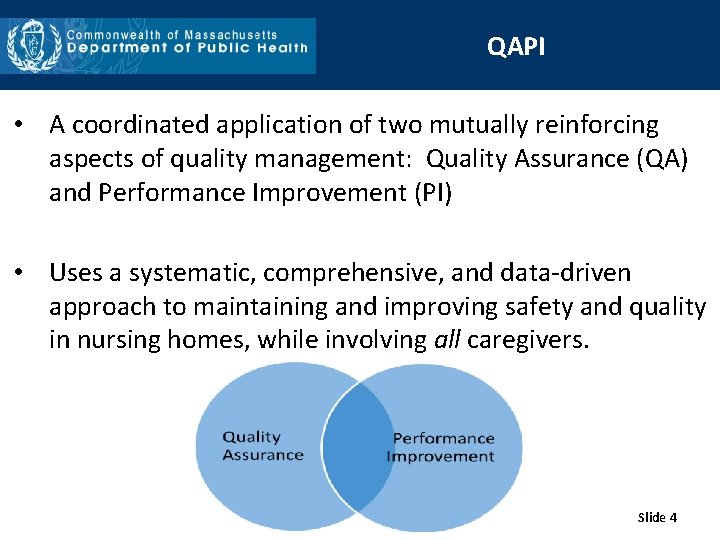
QAPI • A coordinated application of two mutually reinforcing aspects of quality management: Quality Assurance (QA) and Performance Improvement (PI) • Uses a systematic, comprehensive, and data-driven approach to maintaining and improving safety and quality in nursing homes, while involving all caregivers. Slide 4
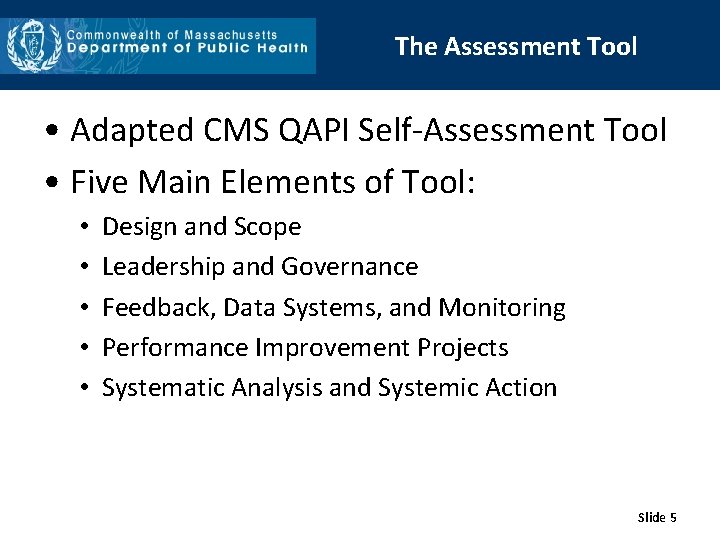
The Assessment Tool • Adapted CMS QAPI Self-Assessment Tool • Five Main Elements of Tool: • • • Design and Scope Leadership and Governance Feedback, Data Systems, and Monitoring Performance Improvement Projects Systematic Analysis and Systemic Action Slide 5
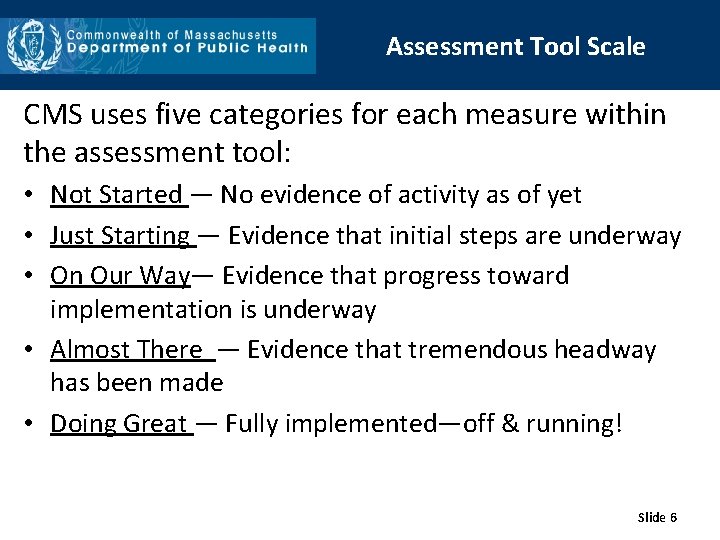
Assessment Tool Scale CMS uses five categories for each measure within the assessment tool: • Not Started — No evidence of activity as of yet • Just Starting — Evidence that initial steps are underway • On Our Way— Evidence that progress toward implementation is underway • Almost There — Evidence that tremendous headway has been made • Doing Great — Fully implemented—off & running! Slide 6
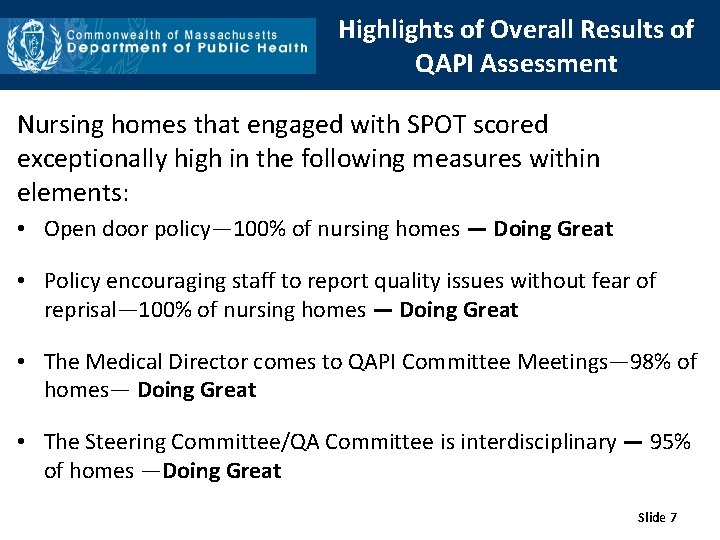
Highlights of Overall Results of QAPI Assessment Nursing homes that engaged with SPOT scored exceptionally high in the following measures within elements: • Open door policy— 100% of nursing homes — Doing Great • Policy encouraging staff to report quality issues without fear of reprisal— 100% of nursing homes — Doing Great • The Medical Director comes to QAPI Committee Meetings— 98% of homes— Doing Great • The Steering Committee/QA Committee is interdisciplinary — 95% of homes —Doing Great Slide 7
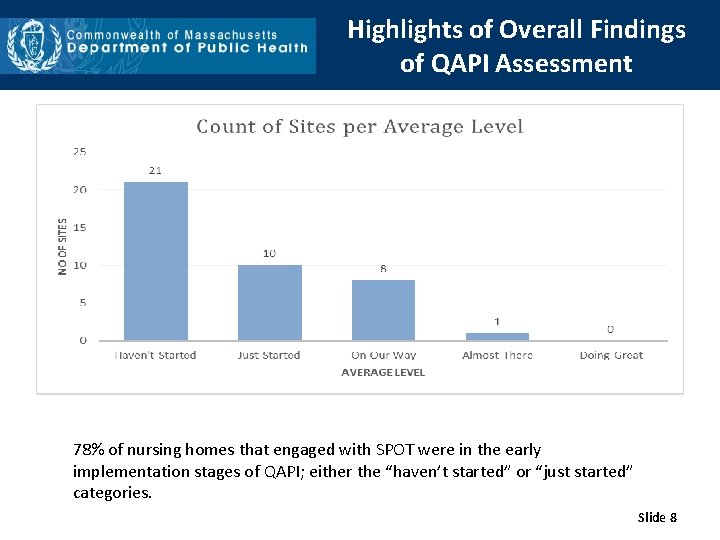
Highlights of Overall Findings of QAPI Assessment 78% of nursing homes that engaged with SPOT were in the early implementation stages of QAPI; either the “haven’t started” or “just started” categories. Slide 8
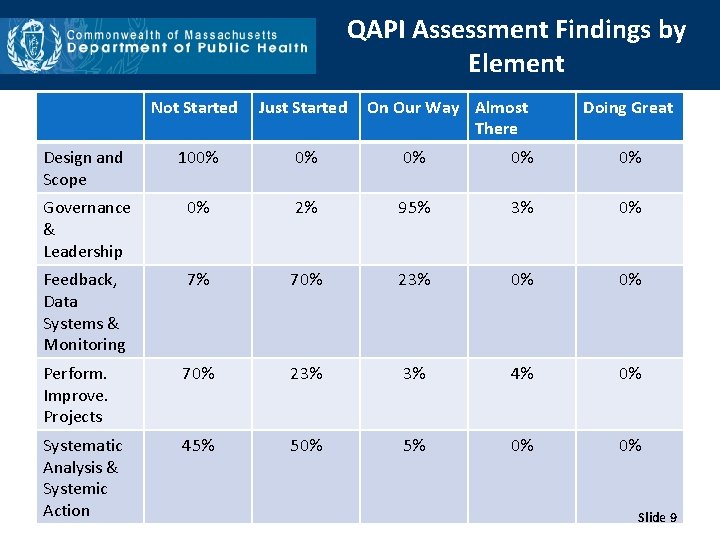
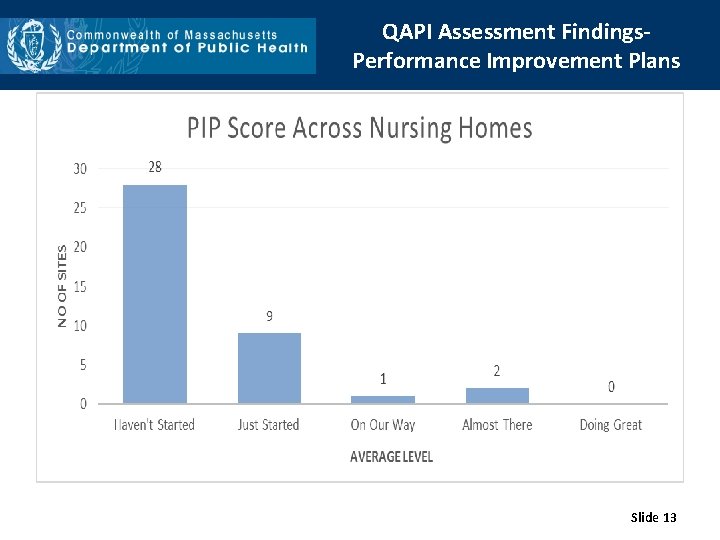
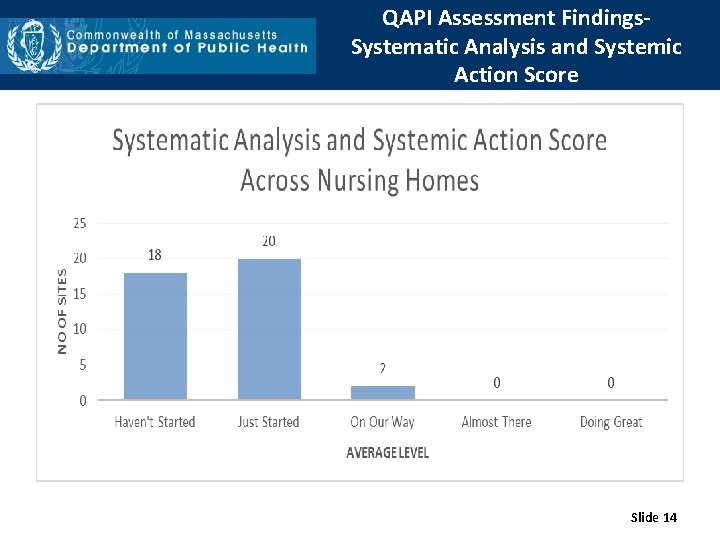
QAPI Assessment Findings by Element Not Started Just Started On Our Way Almost There Doing Great Design and Scope 100% 0% 0% Governance & Leadership 0% 2% 95% 3% 0% Feedback, Data Systems & Monitoring 7% 70% 23% 0% 0% Perform. Improve. Projects 70% 23% 3% 4% 0% Systematic Analysis & Systemic Action 45% 50% 5% 0% 0% Slide 9
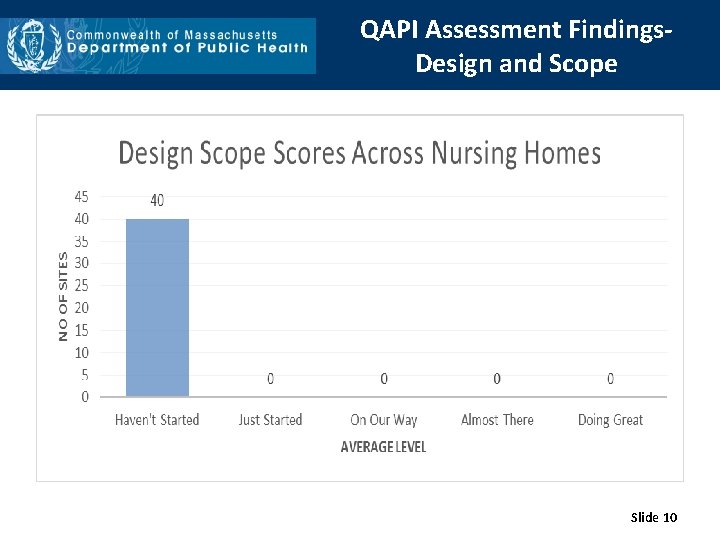
QAPI Assessment Findings. Design and Scope Slide 10
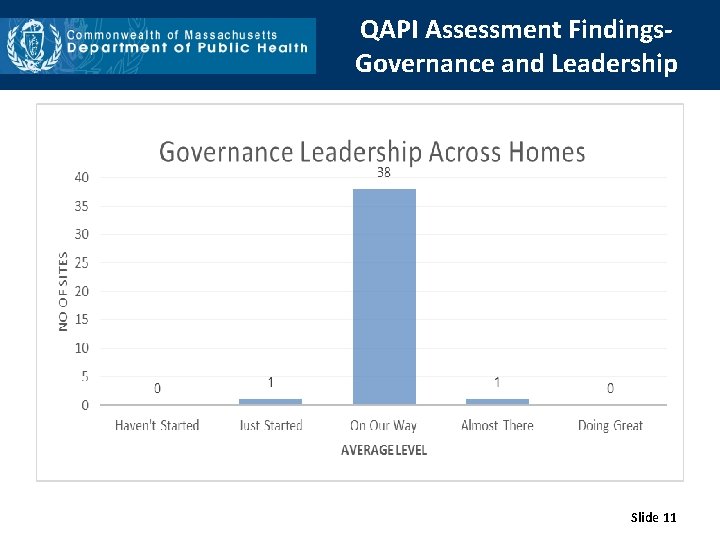
QAPI Assessment Findings. Governance and Leadership Slide 11
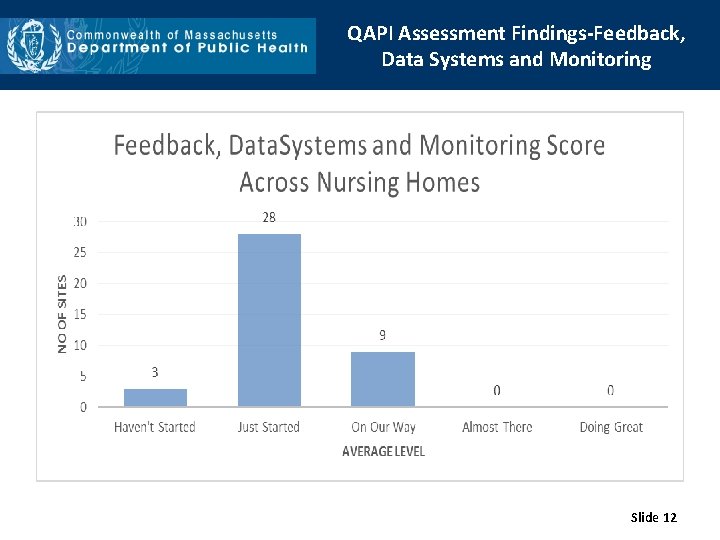
QAPI Assessment Findings-Feedback, Data Systems and Monitoring Slide 12
QAPI Assessment Findings. Performance Improvement Plans Slide 13
QAPI Assessment Findings. Systematic Analysis and Systemic Action Score Slide 14
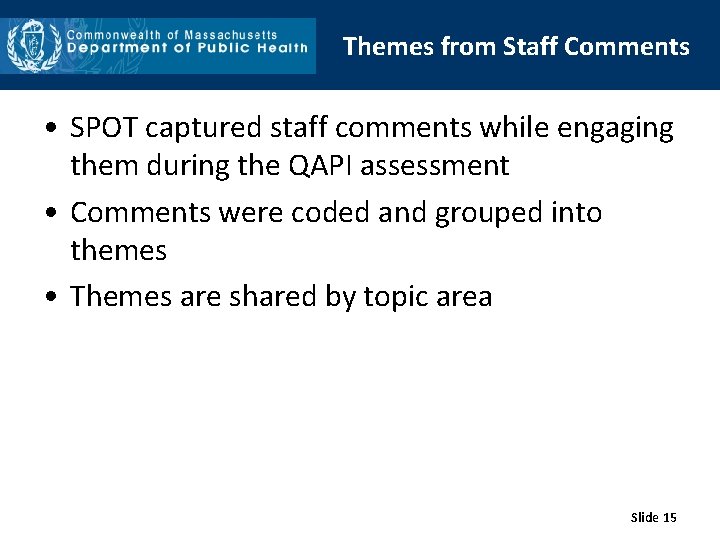
Themes from Staff Comments • SPOT captured staff comments while engaging them during the QAPI assessment • Comments were coded and grouped into themes • Themes are shared by topic area Slide 15
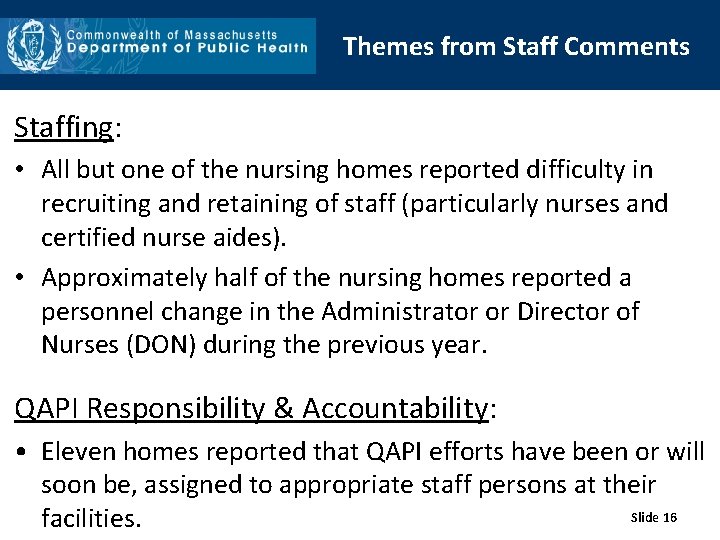
Themes from Staff Comments Staffing: • All but one of the nursing homes reported difficulty in recruiting and retaining of staff (particularly nurses and certified nurse aides). • Approximately half of the nursing homes reported a personnel change in the Administrator or Director of Nurses (DON) during the previous year. QAPI Responsibility & Accountability: • Eleven homes reported that QAPI efforts have been or will soon be, assigned to appropriate staff persons at their Slide 16 facilities.
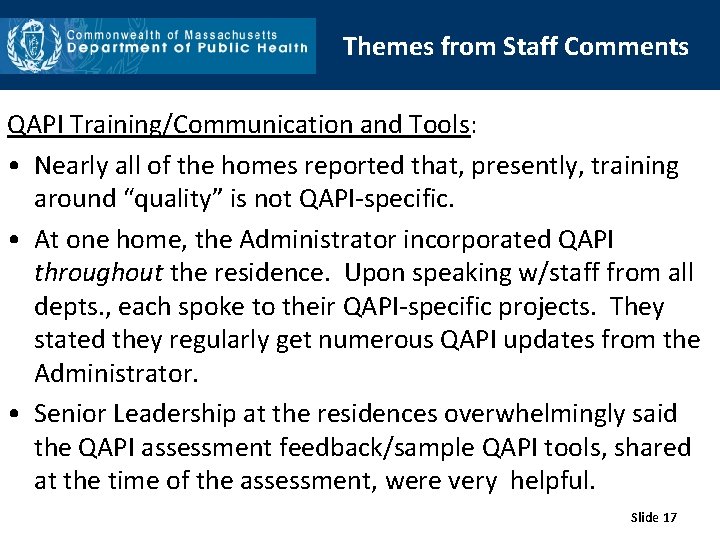
Themes from Staff Comments QAPI Training/Communication and Tools: • Nearly all of the homes reported that, presently, training around “quality” is not QAPI-specific. • At one home, the Administrator incorporated QAPI throughout the residence. Upon speaking w/staff from all depts. , each spoke to their QAPI-specific projects. They stated they regularly get numerous QAPI updates from the Administrator. • Senior Leadership at the residences overwhelmingly said the QAPI assessment feedback/sample QAPI tools, shared at the time of the assessment, were very helpful. Slide 17
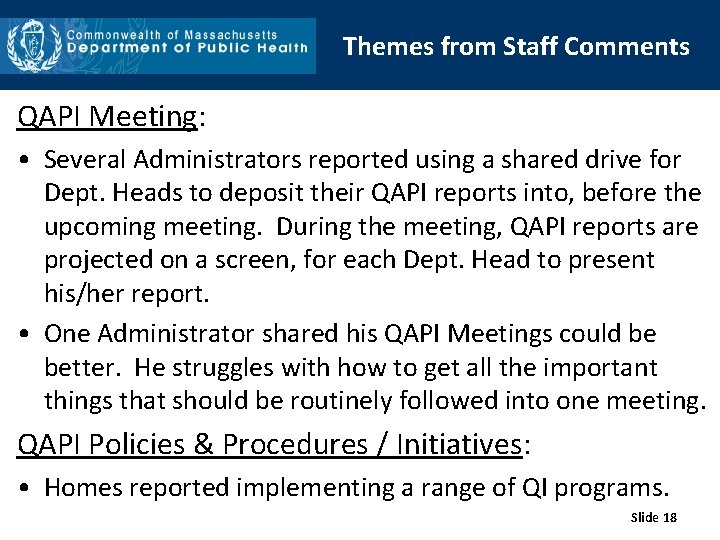
Themes from Staff Comments QAPI Meeting: • Several Administrators reported using a shared drive for Dept. Heads to deposit their QAPI reports into, before the upcoming meeting. During the meeting, QAPI reports are projected on a screen, for each Dept. Head to present his/her report. • One Administrator shared his QAPI Meetings could be better. He struggles with how to get all the important things that should be routinely followed into one meeting. QAPI Policies & Procedures / Initiatives: • Homes reported implementing a range of QI programs. Slide 18
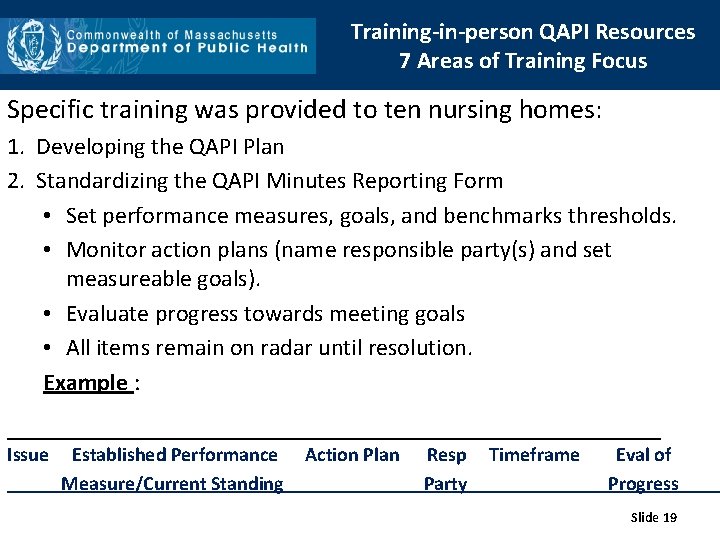
Training-in-person QAPI Resources 7 Areas of Training Focus Specific training was provided to ten nursing homes: 1. Developing the QAPI Plan 2. Standardizing the QAPI Minutes Reporting Form • Set performance measures, goals, and benchmarks thresholds. • Monitor action plans (name responsible party(s) and set measureable goals). • Evaluate progress towards meeting goals • All items remain on radar until resolution. Example : _____________________ Issue Established Performance Measure/Current Standing Action Plan Resp Party Timeframe Eval of Progress Slide 19
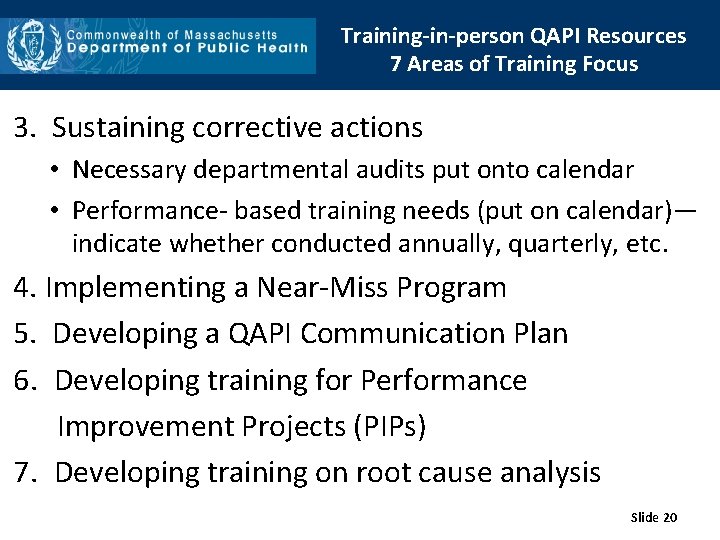
Training-in-person QAPI Resources 7 Areas of Training Focus 3. Sustaining corrective actions • Necessary departmental audits put onto calendar • Performance- based training needs (put on calendar)— indicate whether conducted annually, quarterly, etc. 4. Implementing a Near-Miss Program 5. Developing a QAPI Communication Plan 6. Developing training for Performance Improvement Projects (PIPs) 7. Developing training on root cause analysis Slide 20
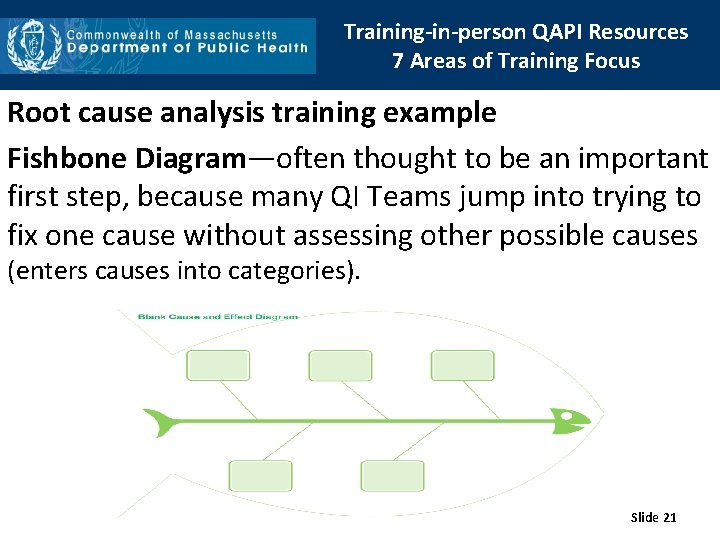
Training-in-person QAPI Resources 7 Areas of Training Focus Root cause analysis training example Fishbone Diagram—often thought to be an important first step, because many QI Teams jump into trying to fix one cause without assessing other possible causes (enters causes into categories). Slide 21
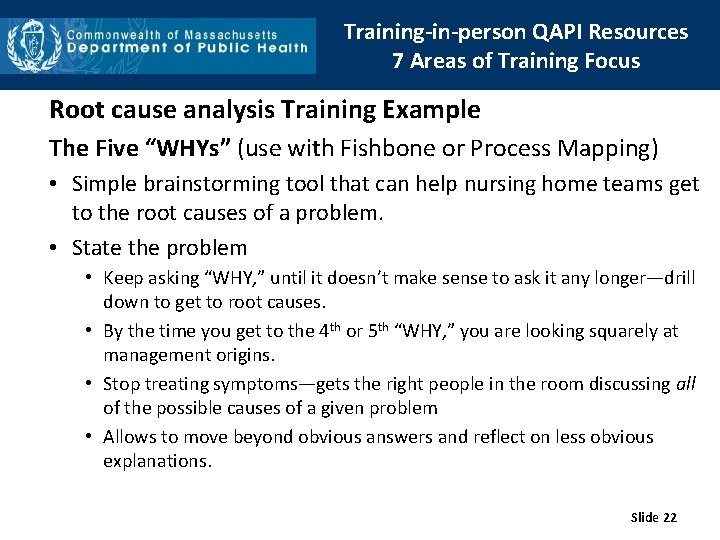
Training-in-person QAPI Resources 7 Areas of Training Focus Root cause analysis Training Example The Five “WHYs” (use with Fishbone or Process Mapping) • Simple brainstorming tool that can help nursing home teams get to the root causes of a problem. • State the problem • Keep asking “WHY, ” until it doesn’t make sense to ask it any longer—drill down to get to root causes. • By the time you get to the 4 th or 5 th “WHY, ” you are looking squarely at management origins. • Stop treating symptoms—gets the right people in the room discussing all of the possible causes of a given problem • Allows to move beyond obvious answers and reflect on less obvious explanations. Slide 22
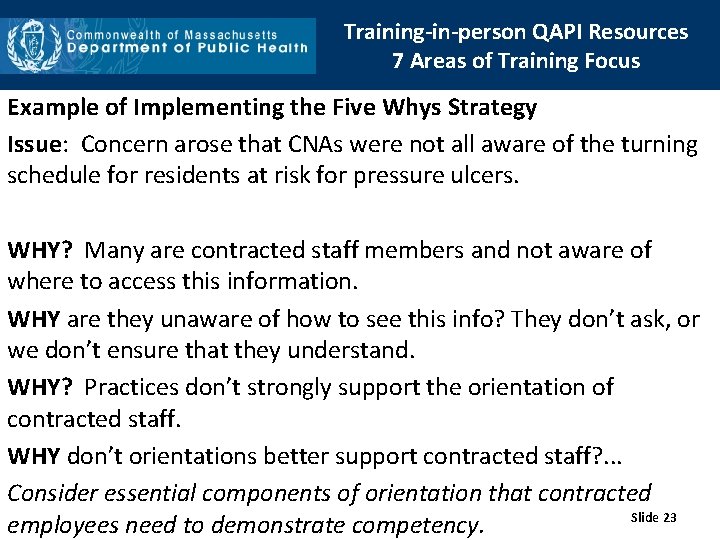
Training-in-person QAPI Resources 7 Areas of Training Focus Example of Implementing the Five Whys Strategy Issue: Concern arose that CNAs were not all aware of the turning schedule for residents at risk for pressure ulcers. WHY? Many are contracted staff members and not aware of where to access this information. WHY are they unaware of how to see this info? They don’t ask, or we don’t ensure that they understand. WHY? Practices don’t strongly support the orientation of contracted staff. WHY don’t orientations better support contracted staff? . . . Consider essential components of orientation that contracted Slide 23 employees need to demonstrate competency.
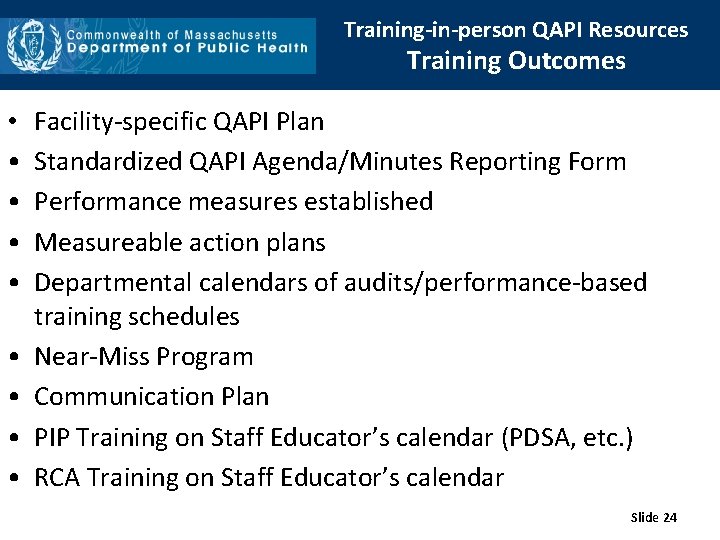
Training-in-person QAPI Resources Training Outcomes • • • Facility-specific QAPI Plan Standardized QAPI Agenda/Minutes Reporting Form Performance measures established Measureable action plans Departmental calendars of audits/performance-based training schedules Near-Miss Program Communication Plan PIP Training on Staff Educator’s calendar (PDSA, etc. ) RCA Training on Staff Educator’s calendar Slide 24
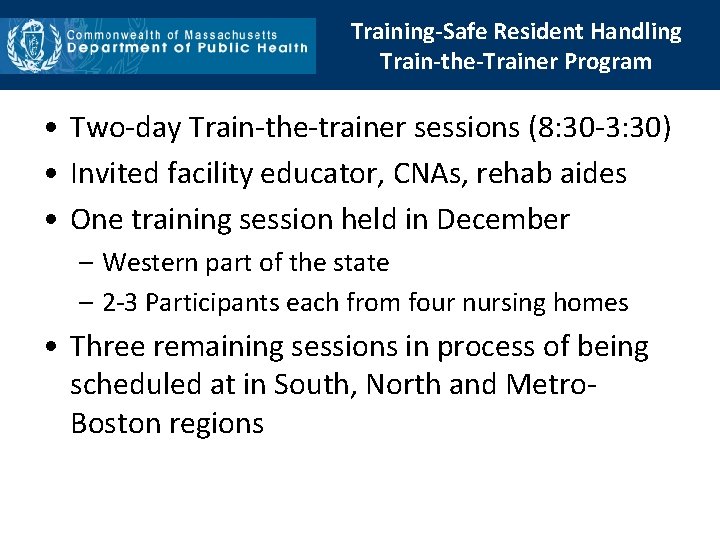
Training-Safe Resident Handling Train-the-Trainer Program • Two-day Train-the-trainer sessions (8: 30 -3: 30) • Invited facility educator, CNAs, rehab aides • One training session held in December – Western part of the state – 2 -3 Participants each from four nursing homes • Three remaining sessions in process of being scheduled at in South, North and Metro. Boston regions
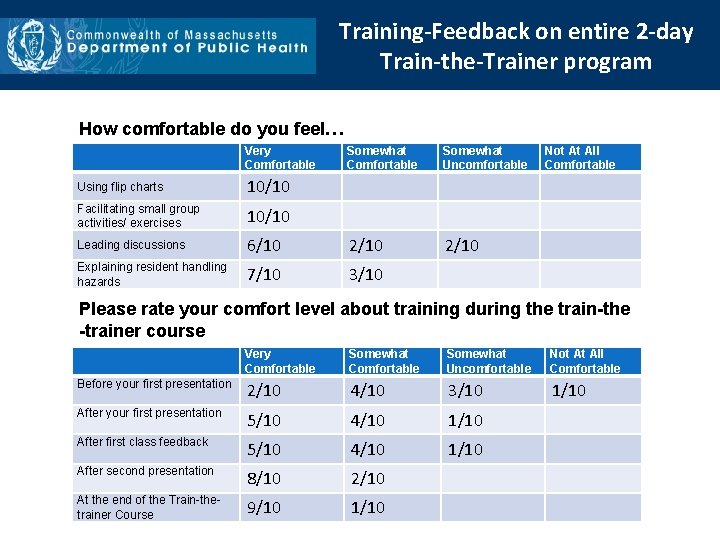
Training-Feedback on entire 2 -day Train-the-Trainer program How comfortable do you feel… Very Comfortable Somewhat Uncomfortable 2/10 Using flip charts 10/10 Facilitating small group activities/ exercises 10/10 Leading discussions 6/10 2/10 Explaining resident handling hazards 7/10 3/10 Not At All Comfortable Please rate your comfort level about training during the train-the -trainer course Very Comfortable Somewhat Uncomfortable Not At All Comfortable Before your first presentation 2/10 4/10 3/10 1/10 After your first presentation 5/10 4/10 1/10 After first class feedback 5/10 4/10 1/10 After second presentation 8/10 2/10 At the end of the Train-thetrainer Course 9/10 1/10
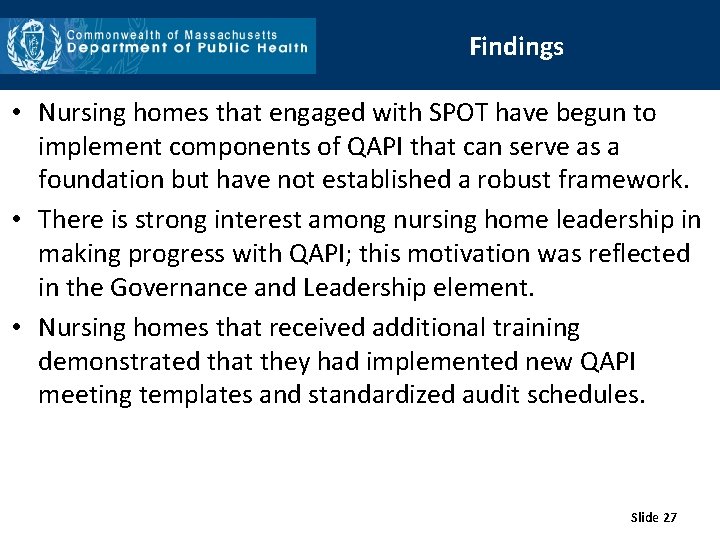
Findings • Nursing homes that engaged with SPOT have begun to implement components of QAPI that can serve as a foundation but have not established a robust framework. • There is strong interest among nursing home leadership in making progress with QAPI; this motivation was reflected in the Governance and Leadership element. • Nursing homes that received additional training demonstrated that they had implemented new QAPI meeting templates and standardized audit schedules. Slide 27
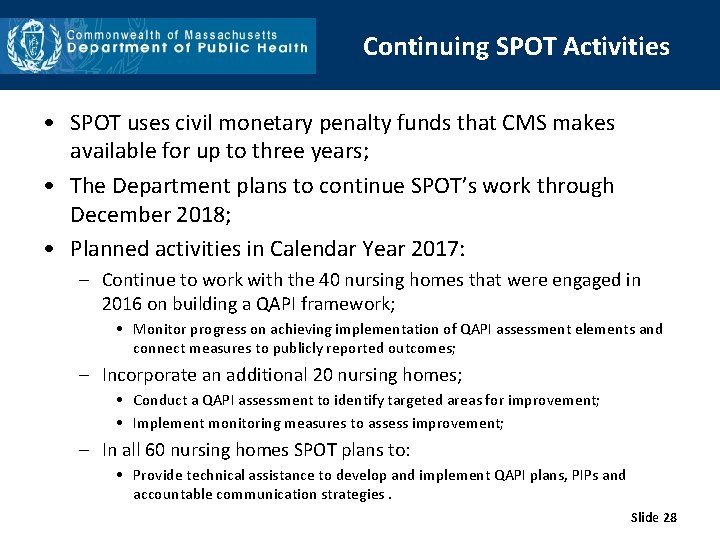
Continuing SPOT Activities • SPOT uses civil monetary penalty funds that CMS makes available for up to three years; • The Department plans to continue SPOT’s work through December 2018; • Planned activities in Calendar Year 2017: – Continue to work with the 40 nursing homes that were engaged in 2016 on building a QAPI framework; • Monitor progress on achieving implementation of QAPI assessment elements and connect measures to publicly reported outcomes; – Incorporate an additional 20 nursing homes; • Conduct a QAPI assessment to identify targeted areas for improvement; • Implement monitoring measures to assess improvement; – In all 60 nursing homes SPOT plans to: • Provide technical assistance to develop and implement QAPI plans, PIPs and accountable communication strategies. Slide 28
Questions Slide 29
Thank you to all of the nursing homes who engaged with SPOT in 2016. Slide 30