
Supportive Pathways Module 2 Supportive Pathways Education Program
- Slides: 51
Supportive Pathways Module 2
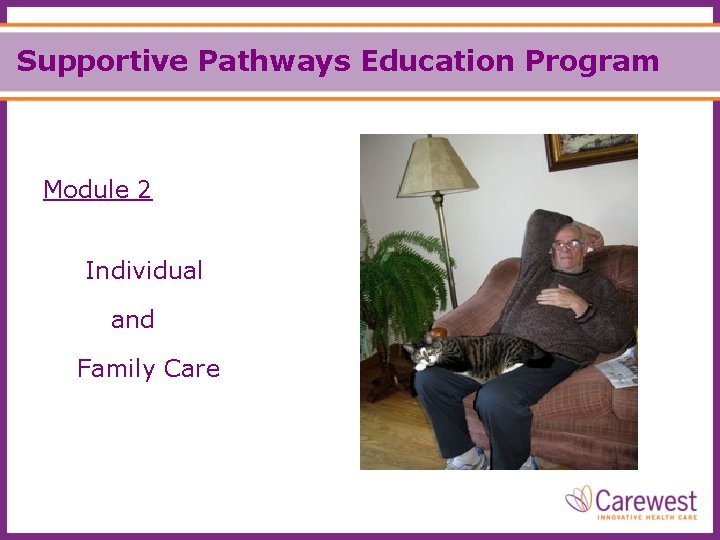
Supportive Pathways Education Program Module 2 Individual and Family Care
Objectives To understand the value of “seeing” the person behind the disease and how to individualize care To understand how culture and spiritual values can impact care To discuss how to work with families to create quality partnerships
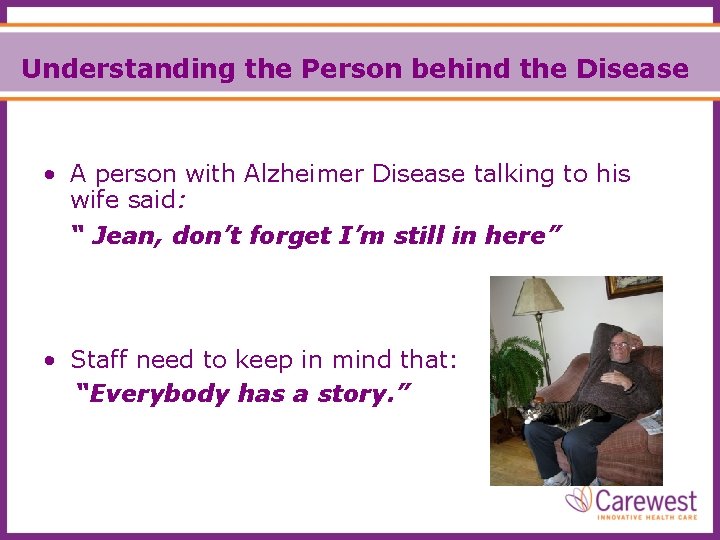
Understanding the Person behind the Disease • A person with Alzheimer Disease talking to his wife said: “ Jean, don’t forget I’m still in here” • Staff need to keep in mind that: “Everybody has a story. ”
Did we know them? How often do you read the obituaries (or attend their funerals) and find out ‘new’ information about a person you have cared for?
Who am I? What things make us who we are? What makes up our personhood? If you had dementia and were unable to ‘tell your life story’ What is the one thing you would want staff to know about you?
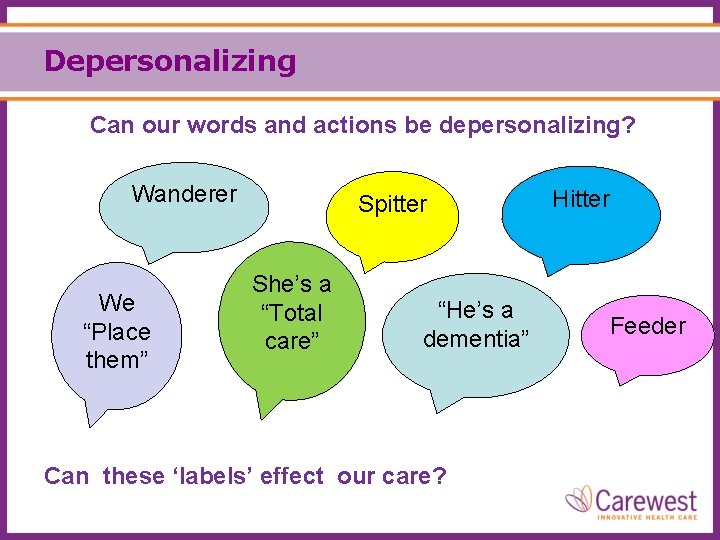
Depersonalizing Can our words and actions be depersonalizing? Wanderer We “Place them” Spitter She’s a “Total care” “He’s a dementia” Can these ‘labels’ effect our care? Hitter Feeder
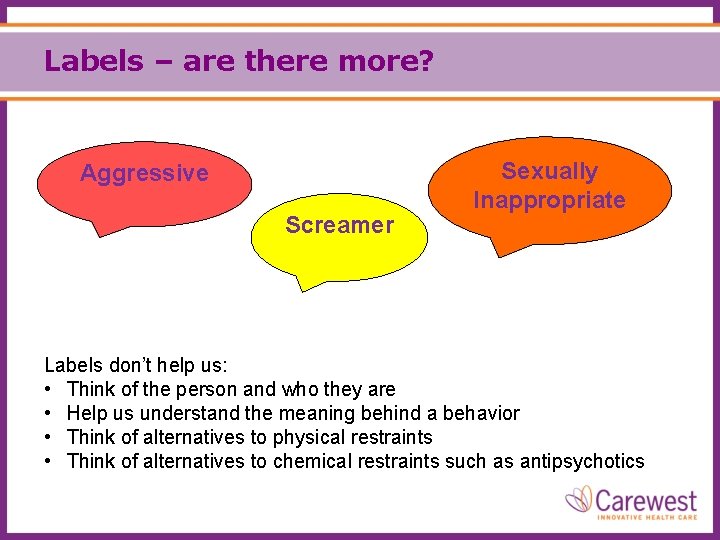
Labels – are there more? Aggressive Screamer Sexually Inappropriate Labels don’t help us: • Think of the person and who they are • Help us understand the meaning behind a behavior • Think of alternatives to physical restraints • Think of alternatives to chemical restraints such as antipsychotics
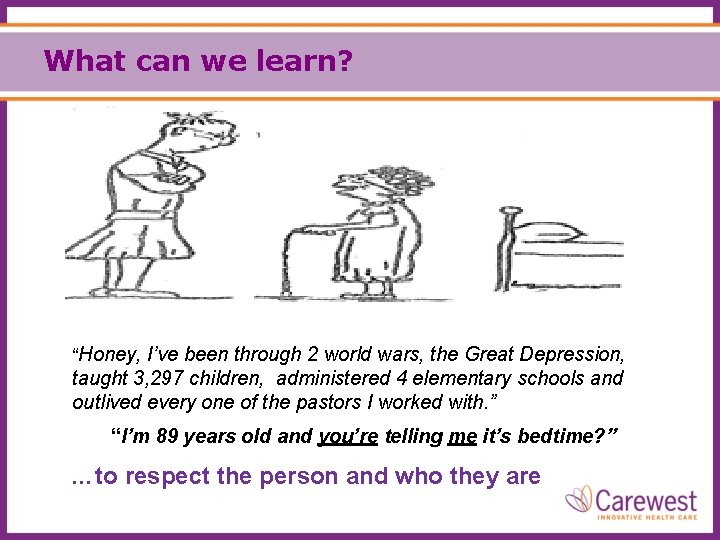
What can we learn? “Honey, I’ve been through 2 world wars, the Great Depression, taught 3, 297 children, administered 4 elementary schools and outlived every one of the pastors I worked with. ” “I’m 89 years old and you’re telling me it’s bedtime? ” … to respect the person and who they are
Supporting ‘Personhood’ • To support ‘personhood’ we provide individualized care. • Caregiver Golden Rule: Treat others as they would like to be treated.
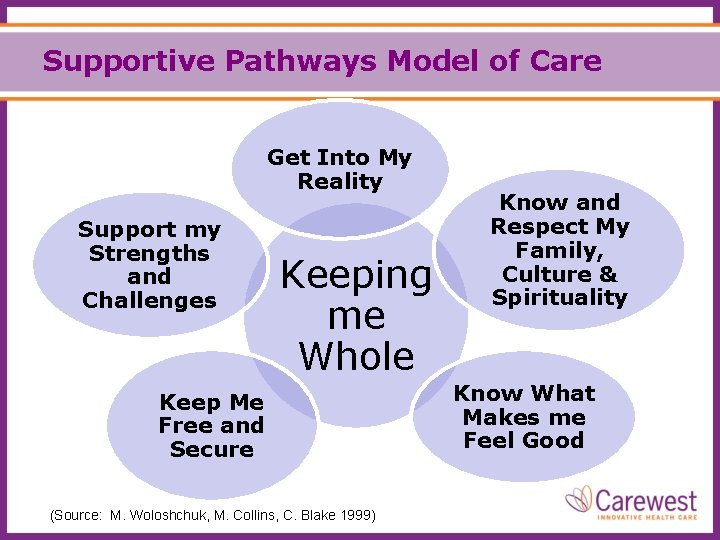
Supportive Pathways Model of Care Get Into My Reality Support my Strengths and Challenges Keeping me Whole Keep Me Free and Secure (Source: M. Woloshchuk, M. Collins, C. Blake 1999) Know and Respect My Family, Culture & Spirituality Know What Makes me Feel Good
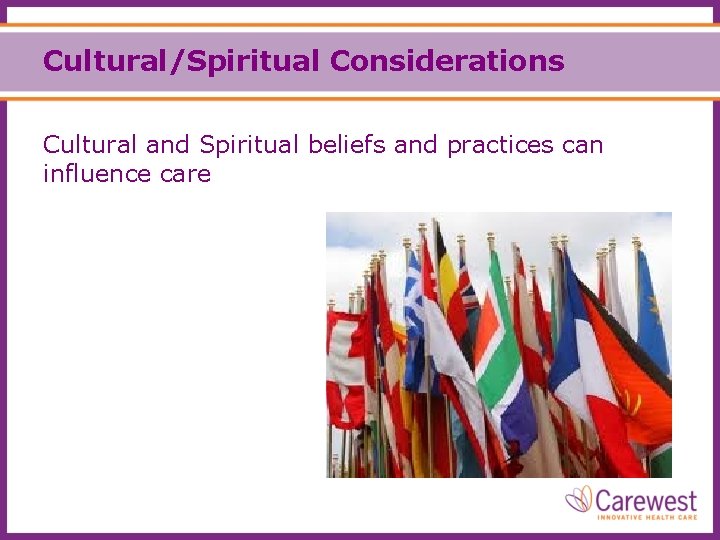
Cultural/Spiritual Considerations Cultural and Spiritual beliefs and practices can influence care
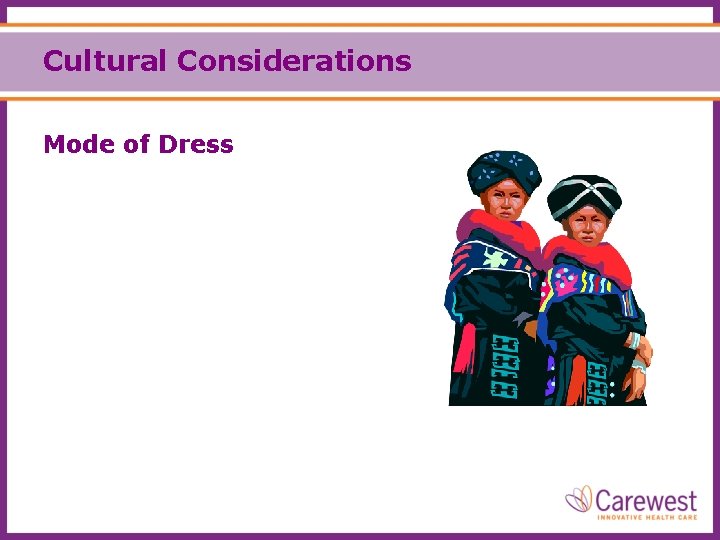
Cultural Considerations Mode of Dress
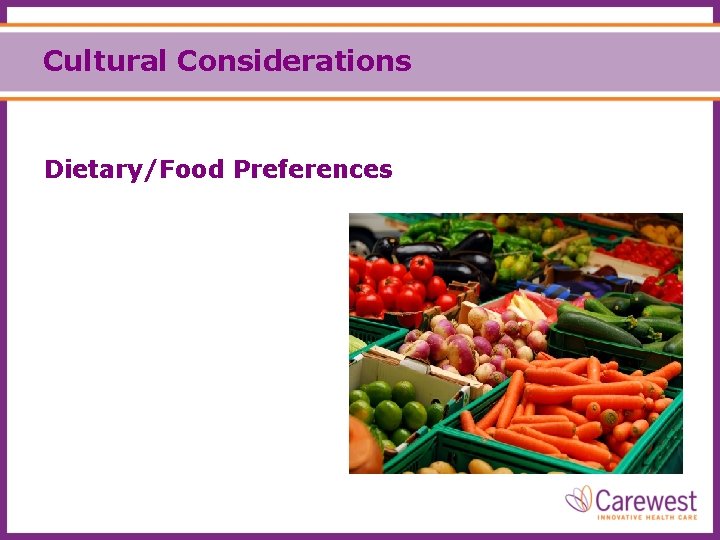
Cultural Considerations Dietary/Food Preferences
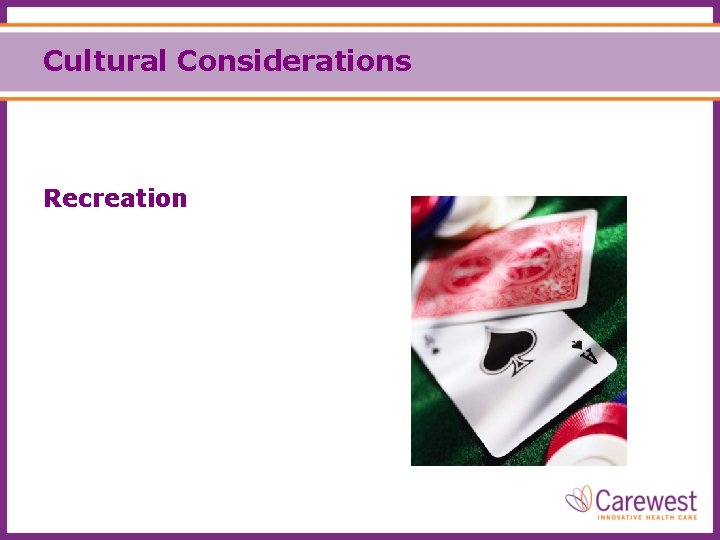
Cultural Considerations Recreation
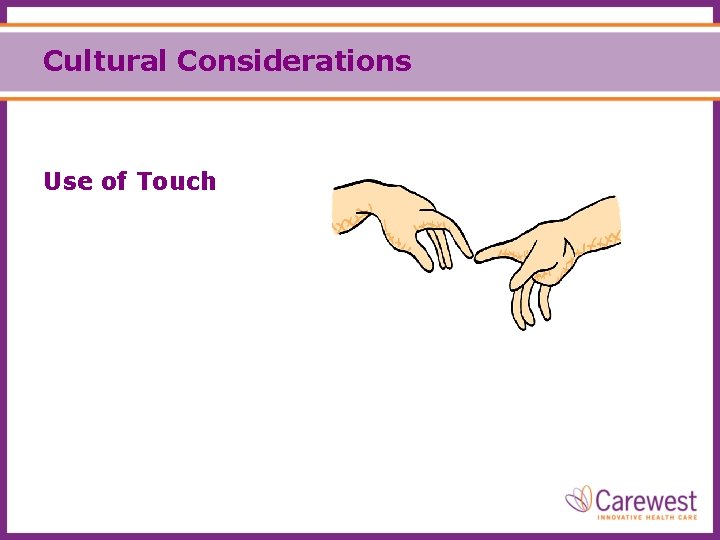
Cultural Considerations Use of Touch
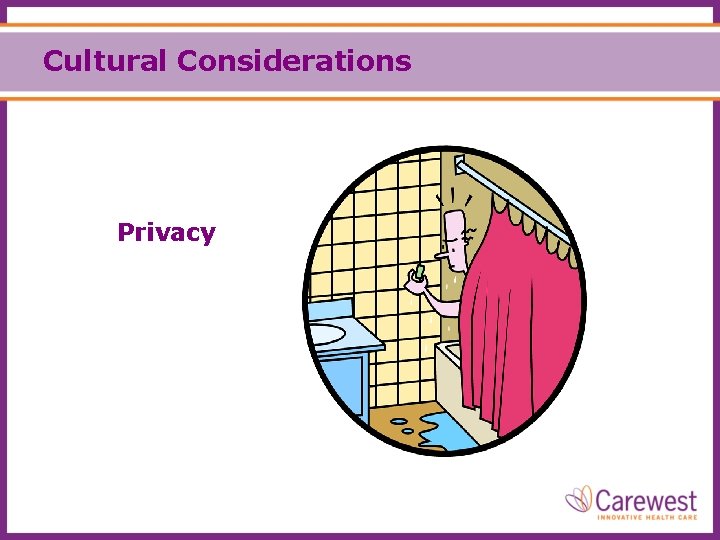
Cultural Considerations Privacy
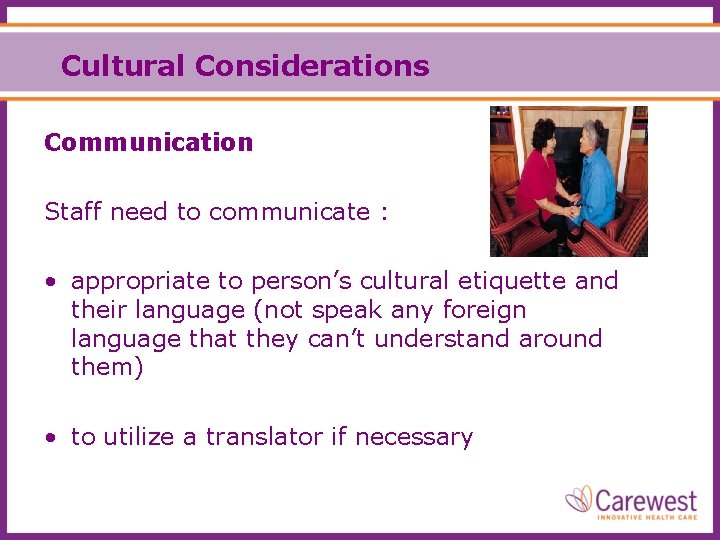
Cultural Considerations Communication Staff need to communicate : • appropriate to person’s cultural etiquette and their language (not speak any foreign language that they can’t understand around them) • to utilize a translator if necessary
Spiritual Considerations Spiritual Beliefs and Practices
Cultural Considerations Health and Healing Practices
Cultural Considerations End of Life Care
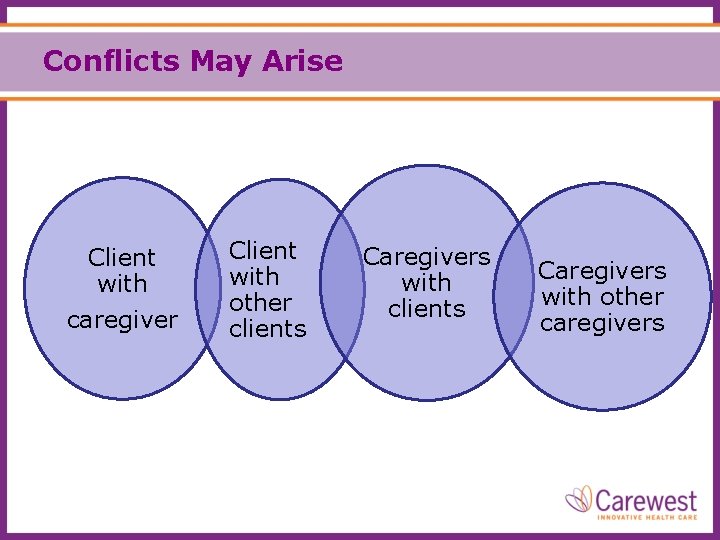
Conflicts May Arise Client with caregiver Client with other clients Caregivers with other caregivers
Cultural Considerations • Do you have any additional stories about different cultural beliefs in the clients you care for? Alternative health care practices? • How are cultural considerations communicated to the staff in your work place?
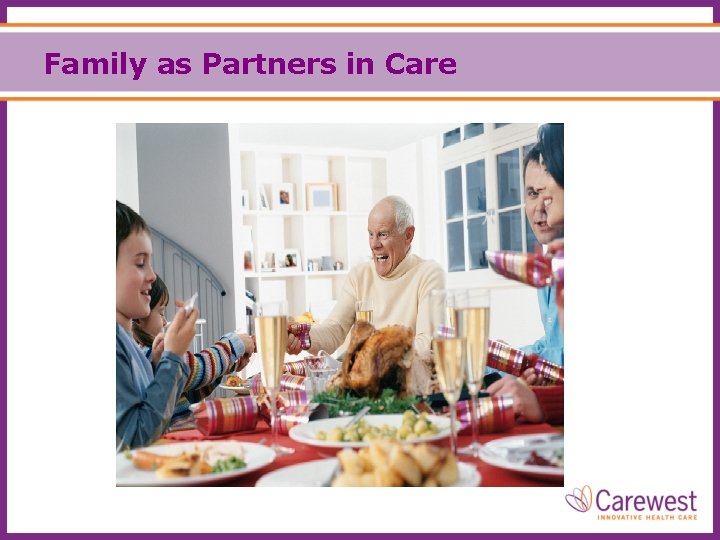
Family as Partners in Care
Living With Dementia
Family - Coping With Dementia “Featherhead” Video
“Featherhead” Debriefing When he took the bread from her do you think he was abusive? Could a similar situation occur while the person was in care – with family or staff?
Featherhead Debriefing Was he responding to a loss? Was he distressed? What supports are needed/available in the community and in care centres – for family and staff?
“Featherhead “ Debriefing Have you worked with situations the video portrayed? What are some supports caregivers need?
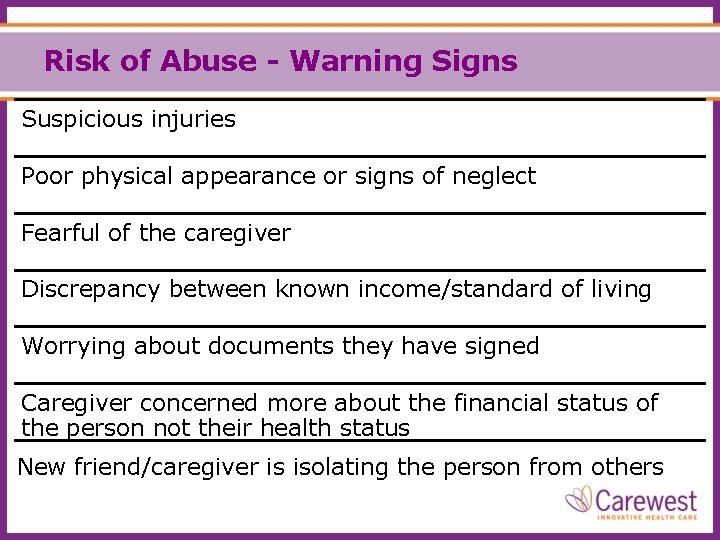
Risk of Abuse - Warning Signs Suspicious injuries Poor physical appearance or signs of neglect Fearful of the caregiver Discrepancy between known income/standard of living Worrying about documents they have signed Caregiver concerned more about the financial status of the person not their health status New friend/caregiver is isolating the person from others
Why Families Need to Seek Support Some caregivers have described dementia as the “longest goodbye”. (Bourgeois 2002)
Family How would you define family? “Family are who they say they are” Wright & Leahey, 1994
Who knows the client best? Do we as staff or does the family know the person best? Family
Program Goals Family will be encouraged to be involved to their desired level
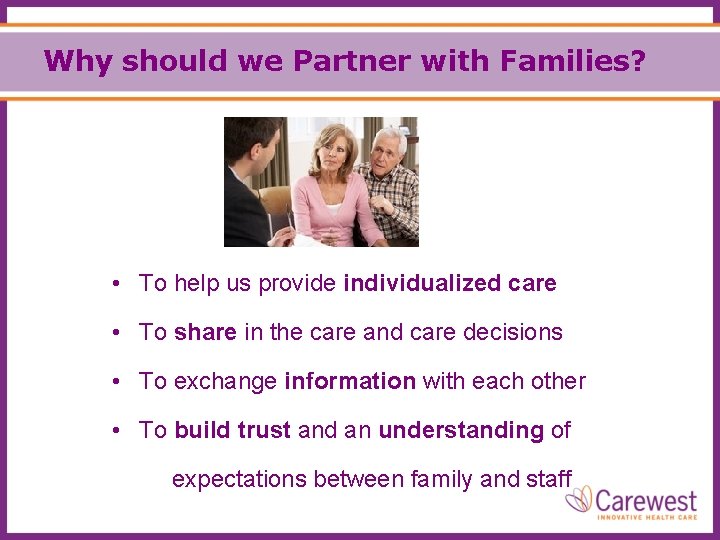
Why should we Partner with Families? • To help us provide individualized care • To share in the care and care decisions • To exchange information with each other • To build trust and an understanding of expectations between family and staff
What Families can Share • the person’s life story – who they are e. g. important people, events, routines and activities • their likes and dislikes – ‘what makes them smile’ • changes that seem to be due to their dementia and any other conditions they have • what they were like before these changes occurred • the person’s cultural and spiritual beliefs/practices
Other Helpful Information …. • tips or strategies that have helped the person with dementia • what family feels is important in regards to the person’s care • any questions and concerns the family have (Family Input is so Valuable)
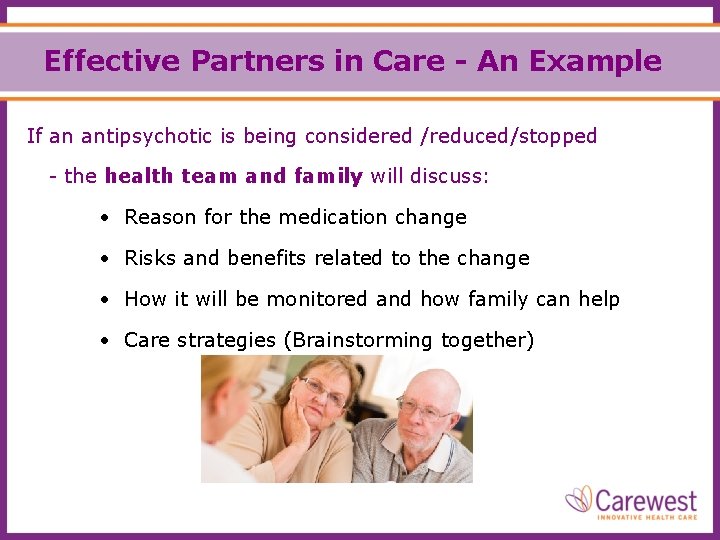
Effective Partners in Care - An Example If an antipsychotic is being considered /reduced/stopped - the health team and family will discuss: • Reason for the medication change • Risks and benefits related to the change • How it will be monitored and how family can help • Care strategies (Brainstorming together)
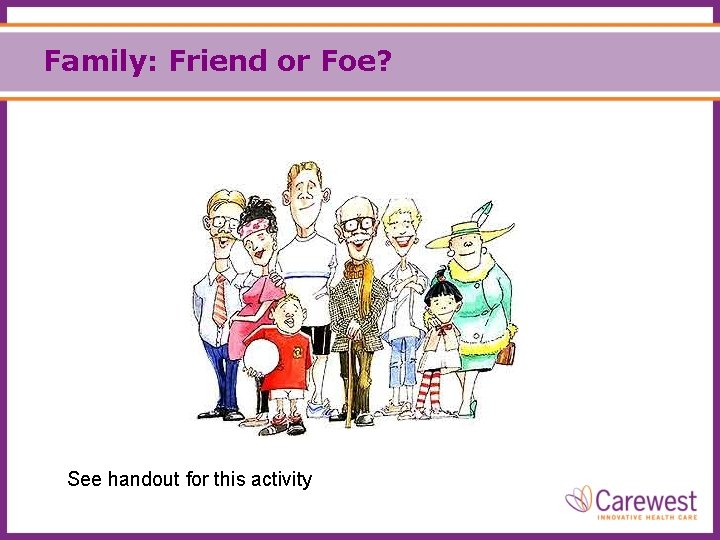
Family: Friend or Foe? See handout for this activity
Our Relationship with Families • How many of us think of ‘partners’ when we think of families? • What do we think of when we think of families? Helpful? Loving? Dedicated? Uninvolved ? Dysfunctional? Demanding? Having unrealistic expectations? In denial? • Will it help us to be more understanding when we realize that family members may be ‘distressed’?
Things We Say That Distresses Families? • NOT my job! • NOT my shift! • I’m on my break! • I’m just back today • We’re short staffed today • We have lots of clients Marlene Collins 2009
Things We Do That Distresses Families? • Appear to ignore family when they visit • Not include clients in conversations • Not follow through when we say we will • Seem to be chatting with co-workers (non-work related) • Talking on our cell phone in a client area • Appear to ignore call bells How do we turn these actions into positives?
Understanding Distressed Families Some families already have: • Elevated expectations • Wishes for the person to be back to normal • Different Beliefs/Values • Experienced lack of community support due to the community at large having limited knowledge and experience with dementia Marlene Collins 2009
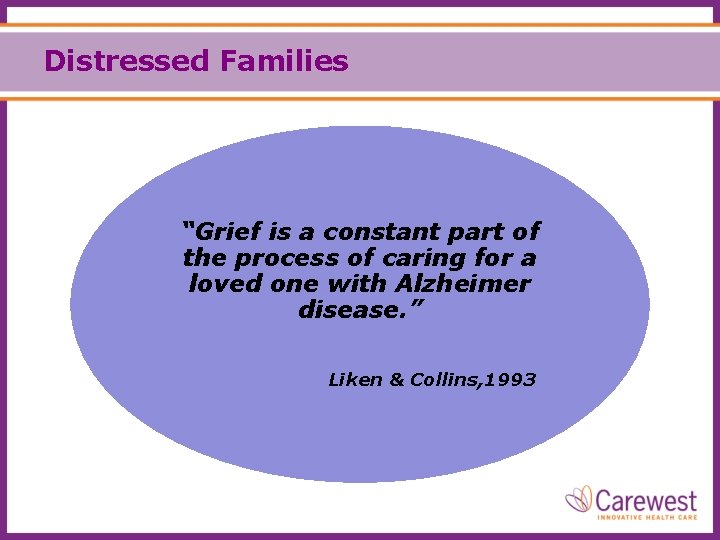
Distressed Families “Grief is a constant part of the process of caring for a loved one with Alzheimer disease. ” Liken & Collins, 1993
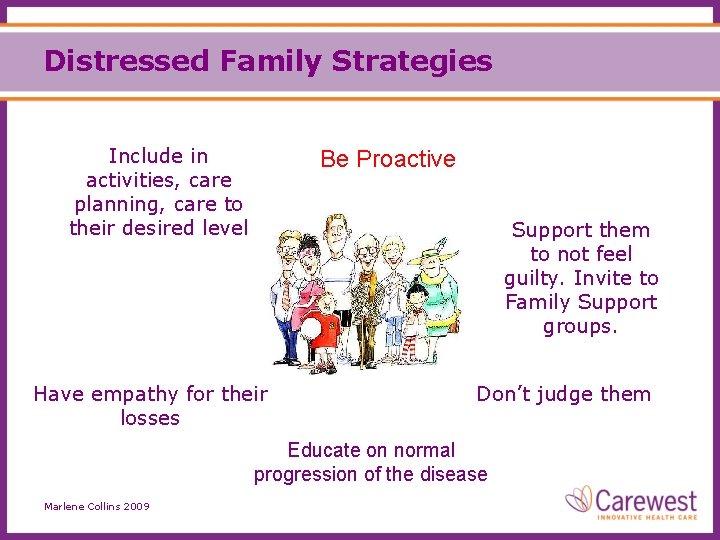
Distressed Family Strategies Include in activities, care planning, care to their desired level Be Proactive Support them to not feel guilty. Invite to Family Support groups. Have empathy for their losses Don’t judge them Educate on normal progression of the disease Marlene Collins 2009
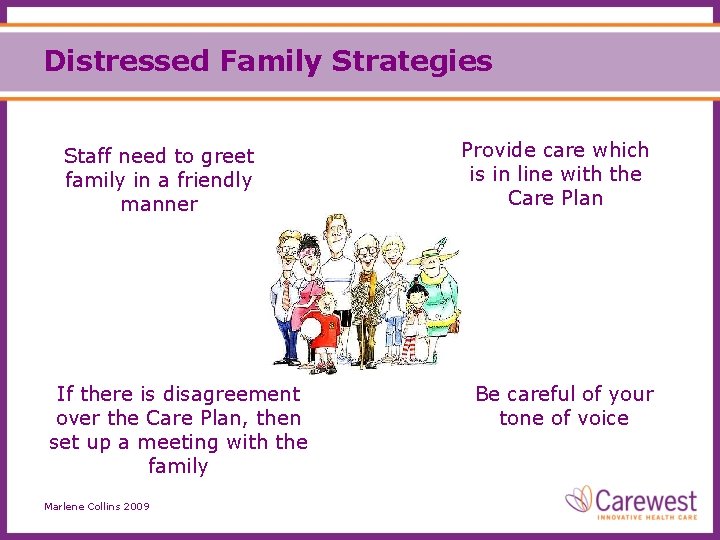
Distressed Family Strategies Staff need to greet family in a friendly manner If there is disagreement over the Care Plan, then set up a meeting with the family Marlene Collins 2009 Provide care which is in line with the Care Plan Be careful of your tone of voice
Jack and Lucy’s Story
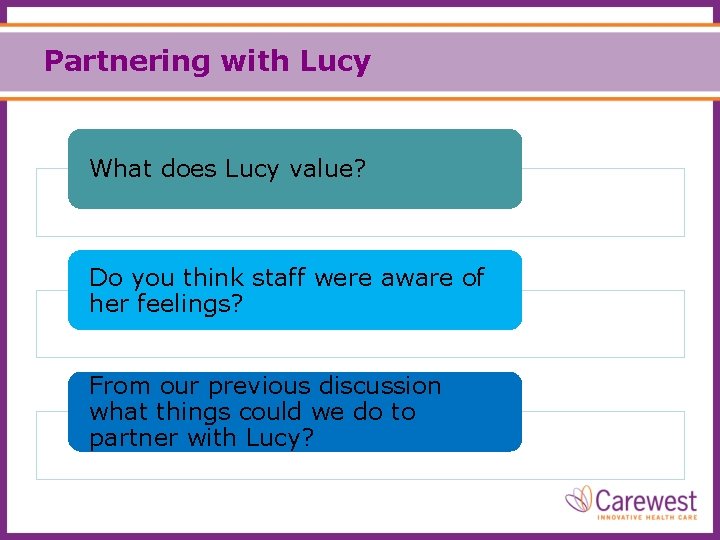
Partnering with Lucy What does Lucy value? Do you think staff were aware of her feelings? From our previous discussion what things could we do to partner with Lucy?
Questions? Please refer to your handouts
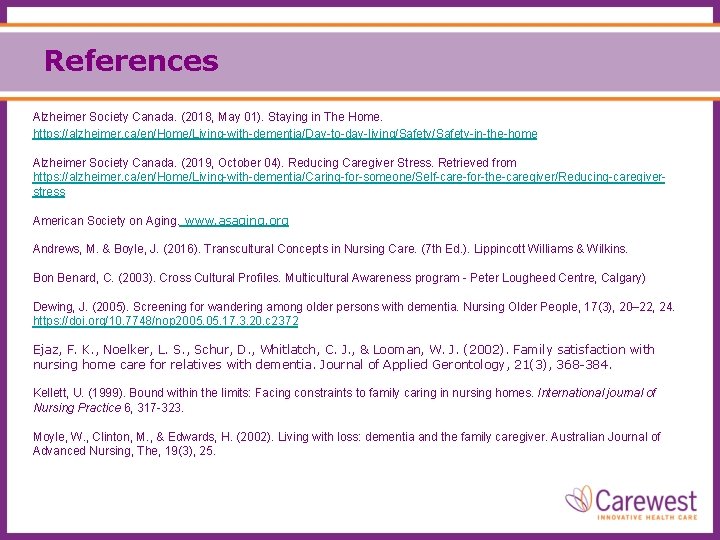
References Alzheimer Society Canada. (2018, May 01). Staying in The Home. https: //alzheimer. ca/en/Home/Living-with-dementia/Day-to-day-living/Safety-in-the-home Alzheimer Society Canada. (2019, October 04). Reducing Caregiver Stress. Retrieved from https: //alzheimer. ca/en/Home/Living-with-dementia/Caring-for-someone/Self-care-for-the-caregiver/Reducing-caregiverstress American Society on Aging. www. asaging. org Andrews, M. & Boyle, J. (2016). Transcultural Concepts in Nursing Care. (7 th Ed. ). Lippincott Williams & Wilkins. Bon Benard, C. (2003). Cross Cultural Profiles. Multicultural Awareness program - Peter Lougheed Centre, Calgary) Dewing, J. (2005). Screening for wandering among older persons with dementia. Nursing Older People, 17(3), 20– 22, 24. https: //doi. org/10. 7748/nop 2005. 17. 3. 20. c 2372 Ejaz, F. K. , Noelker, L. S. , Schur, D. , Whitlatch, C. J. , & Looman, W. J. (2002). Family satisfaction with nursing home care for relatives with dementia. Journal of Applied Gerontology, 21(3), 368 -384. Kellett, U. (1999). Bound within the limits: Facing constraints to family caring in nursing homes. International journal of Nursing Practice 6, 317 -323. Moyle, W. , Clinton, M. , & Edwards, H. (2002). Living with loss: dementia and the family caregiver. Australian Journal of Advanced Nursing, The, 19(3), 25.
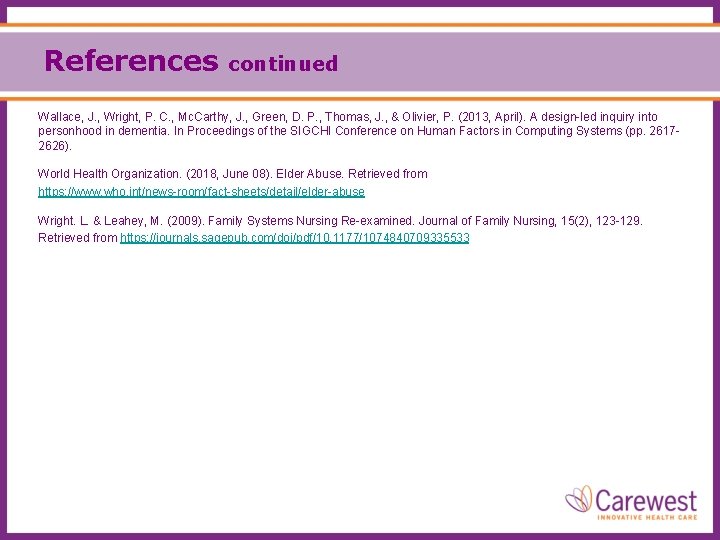
References continued Wallace, J. , Wright, P. C. , Mc. Carthy, J. , Green, D. P. , Thomas, J. , & Olivier, P. (2013, April). A design-led inquiry into personhood in dementia. In Proceedings of the SIGCHI Conference on Human Factors in Computing Systems (pp. 26172626). World Health Organization. (2018, June 08). Elder Abuse. Retrieved from https: //www. who. int/news-room/fact-sheets/detail/elder-abuse Wright. L. & Leahey, M. (2009). Family Systems Nursing Re-examined. Journal of Family Nursing, 15(2), 123 -129. Retrieved from https: //journals. sagepub. com/doi/pdf/10. 1177/1074840709335533