
Supporting young people to make positive transitions from
- Slides: 2
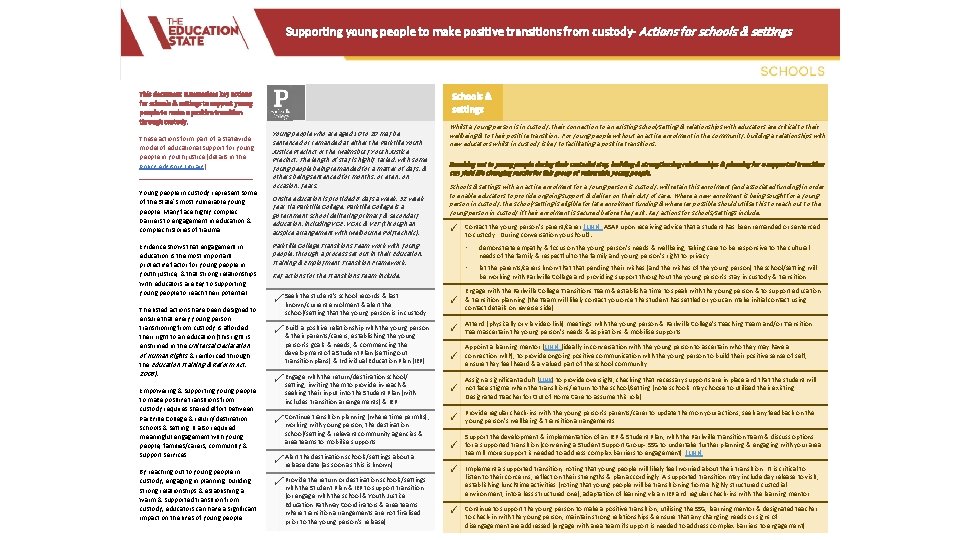
Supporting young people to make positive transitions from custody- Actions for schools & settings This document summarises key actions for schools & settings to support young people to make a positive transition through custody. These actions form part of a statewide model of educational support for young people in youth justice (details in the Policy Advisory Library). Young people in custody represent some of the State’s most vulnerable young people. Many face highly complex barriers to engagement in education & complex histories of trauma. Evidence shows that engagement in education is the most important protective factor for young people in youth justice, & that strong relationships with educators are key to supporting young people to reach their potential. The listed actions have been designed to ensure that every young person transitioning from custody is afforded their right to an education (this right is enshrined in the Universal Declaration of Human Rights & reinforced through the Education Training & Reform Act, 2006). Empowering & supporting young people to make positive transitions from custody requires shared effort between Parkville College & return/destination schools & setting. It also required meaningful engagement with young people, families/carers, community & support services. By reaching out to young people in custody, engaging in planning, building strong relationships & establishing a warm & supported transition from custody, educators can have a significant impact on the lives of young people. Schools & settings Young people who are aged 10 to 20 may be sentenced or remanded at either the Parkville Youth Justice Precinct or the Malmsbury Youth Justice Precinct. The length of stay is highly varied, with some young people being remanded for a matter of days, & others being sentenced for months, or even, on occasion, years. Onsite education is provided 6 days a week, 52 week year via Parkville College is a government school delivering primary & secondary education, including VCE, VCAL & VET (through an auspice arrangement with Melbourne Polytechnic). Whilst a young person is in custody, their connection to an existing school/setting & relationships with educators are critical to their wellbeing & to their positive transition. For young people without an active enrolment in the community, building a relationships with new educators whilst in custody is key to facilitating a positive transitions. Reaching out to young people during their custodial stay, building & strengthening relationships & planning for a supported transition can yield life changing results for this group of vulnerable young people. Schools & settings with an active enrolment for a young person is custody, will retain this enrolment (and associated funding) in order to enable educators to provide ongoing support & deliver on their duty of care. Where a new enrolment is being sought for a young person in custody, the school/setting is eligible for late enrolment funding & wherever possible should utilise this to reach out to the young person in custody if their enrolment is secured before they exit. Key actions for schools/settings include: ✓ Parkville College Transitions Team work with young people, through a process set out in their Education, Training & Employment Transition Framework. Key actions for the Transitions Team include: Contact the young person’s parent/carer (LINK) ASAP upon receiving advice that a student has been remanded or sentenced to custody. During conversation you should: • demonstrate empathy & focus on the young person’s needs & wellbeing, taking care to be responsive to the cultural needs of the family & respectful to the family and young person’s right to privacy • let the parents/carers know that pending their wishes (and the wishes of the young person) the school/setting will be working with Parkville College and providing support throughout the young person’s stay in custody & transition the student’s school records & last ✓ Seek known/current enrolment & alert the ✓ Engage with the Parkville College Transitions Team & establish a time to speak with the young person & to support education & transition planning (the Team will likely contact you once the student has settled or you can make initial contact using contact details on reverse side) a positive relationship with the young person ✓ Build & their parents/carers, establishing the young ✓ Attend (physically or via video link) meetings with the young person & Parkville College’s Teaching Team and/or Transition Team ascertain the young person’s needs & aspirations & mobilise supports ✓ Appoint a learning mentor (LINK) (ideally in conversation with the young person to ascertain who they may have a connection with), to provide ongoing positive communication with the young person to build their positive sense of self, ensure they feel heard & a valued part of the school community ✓ Assign a significant adult (LINK) to provide oversight, checking that necessary supports are in place and that the student will not face stigma when the transitions/return to the school/setting (note schools may choose to utilised their existing Designated Teacher for Out of Home Care to assume this role) ✓ Provide regular check-ins with the young person’s parents/carer to update them on your actions, seek any feedback on the young person’s wellbeing & transition arrangements. ✓ Support the development & implementation of an IEP & Student Plan, with the Parkville Transition Team & discuss options for a supported transition (convening a Student Support Group- SSG to undertake further planning & engaging with your area team if more support is needed to address complex barriers to engagement) (LINK) school/setting that the young person is in custody person’s goals & needs, & commencing the development of a Student Plan (setting out transition plans) & Individual Education Plan (IEP) with the return/destination school/ ✓ Engage setting, inviting them to provide in-reach & seeking their input into the Student Plan (with includes transition arrangements) & IEP transition planning (where time permits), ✓ Continue working with young person, the destination school/setting & relevant community agencies & area teams to mobilise supports the destination schools/settings about a ✓ Alert release date (as soon as this is known) ✓ Provide the return or destination schools/settings with the Student Plan & IEP to support transition (or engage with the school & Youth Justice Education Pathway Coordinators & area teams where transition arrangements are not finalised prior to the young person’s release) ✓ Implement a supported transition, noting that young people will likely feel worried about their transition. It is critical to listen to their concerns, reflect on their strengths & plan accordingly. A supported transition may include day release to visit, establishing lunchtime activities (noting that young people will be transitioning from a highly structured custodial environment, into a less structured one), adaptation of learning via an IEP and regular check-ins with the learning mentor ✓ Continue to support the young person to make a positive transition, utilising the SSG, learning mentor & designated teacher to check-in with the young person, maintain strong relationships & ensure that any changing needs or signs of disengagement are addressed (engage with area team if support is needed to address complex barriers to engagement)
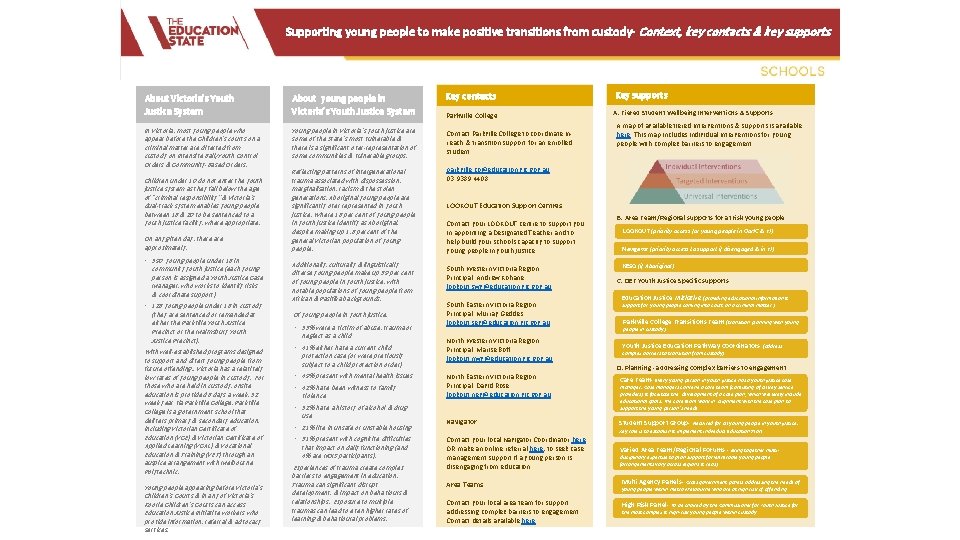
Supporting young people to make positive transitions from custody- Context, key contacts & key supports Key Contacts contacts About Victoria’s Youth Justice System About young people in Victoria’s Youth Justice System In Victoria, most young people who appear before the Children’s courts on a criminal matter are diverted from custody on Intensive Bail/Youth Control Orders & Community-Based Orders. Young people in Victoria’s youth justice are some of the State’s most vulnerable & there is a significant over-representation of some communities & vulnerable groups. Contact Parkville College to coordinate inreach & transition support for an enrolled student Reflecting patterns of intergenerational trauma associated with dispossession, marginalisation, racism & the stolen generations, Aboriginal young people are significantly over represented in youth justice. Where 18 per cent of young people in youth justice identify as Aboriginal, despite making up 1. 6 percent of the general Victorian population of young people. parkville. co@education. vic. gov. au 03 9389 4408 Children under 10 do not enter the youth justice system as they fall below the age of “criminal responsibility” & Victoria’s dual-track system enables young people between 18 & 20 to be sentenced to a youth justice facility, where appropriate. On any given day, there approximately: • 590 young people under 18 in community youth justice (each young person is assigned a Youth Justice Case Manager, who works to identify risks & coordinate support) • 128 young people under 18 in custody (they are sentenced or remanded at either the Parkville Youth Justice Precinct or the Malmsbury Youth Justice Precinct). With well-established programs designed to support and divert young people from future offending, , Victoria has a relatively low rates of young people in custody. For those who are held in custody, onsite education is provided 6 days a week, 52 week year via Parkville College is a government school that delivers primary & secondary education, including Victorian Certificate of Education (VCE) & Victorian Certificate of Applied Learning (VCAL) & Vocational Education & Training (VET) through an auspice arrangement with Melbourne Polytechnic. Young people appearing before Victoria’s Children’s Courts & in any of Victoria’s Koorie Children’s Courts can access Education Justice Initiative workers who provide information, referral & advocacy services. Additionally, culturally & linguistically diverse young people make up 39 per cent of young people in youth justice, with notable populations of young people from African & Pasifika backgrounds. Of young people in youth justice: • 53% were a victim of abuse, trauma or neglect as a child • 41% either have a current child protection case (or were previously subject to a child protection order) • 49% present with mental health issues • 42% have been witness to family violence • 52% have a history of alcohol & drug use • 21% live in unsafe or unstable housing • 31% present with cognitive difficulties that impact on daily functioning (and 4% are NDIS participants). Experiences of trauma create complex barriers to engagement in education. Trauma can significant disrupt development, & impact on behaviours & relationships. Exposure to multiple traumas can lead to even higher rates of learning & behavioural problems. Parkville College Key Supports supports A. Tiered Student Wellbeing Interventions & Supports A map of available tiered interventions & supports is available here. This map includes individual interventions for young people with complex barriers to engagement. LOOKOUT Education Support Centres Contact your LOOKOUT centre to support you in appointing a Designated Teacher and to help build your schools capacity to support young people in youth justice. South Western Victoria Region Principal: Andrew Kohane lookout. swv@education. vic. gov. au South Eastern Victoria Region Principal: Murray Geddes lookout. sev@education. vic. gov. au North Western Victoria Region Principal: Marise Boff lookout. nwv@education. vic. gov. au B. Area Team/Regional supports for at risk young people LOOKOUT (priority access for young people in Oo. HC & YJ) Navigator (priority access to support if disengaged & in YJ) KESO (if Aboriginal) C. DET Youth Justice Specific supports Education Justice Initiative (providing educational information & support for young people coming into court on a criminal matter ) Parkville College Transitions Team (transition planning with young people in custody) Youth Justice Education Pathway Coordinators (address complex barriers to transition from custody) D. Planning - addressing complex barriers to engagement North Eastern Victoria Region Principal: David Rose lookout. nev@education. vic. gov. au Care Team- Every young person in youth justice has a youth justice case Navigator Student Support Group- Required for all young people in youth justice. manager. Case managers convene a care team (consisting of all key service providers) & facilitate the development of a case plan, which will likely include educational goals. The care team work in alignment with the case plan to support the young person’s needs Key role is to establish & implement Individual Education Plan. Contact your local Navigator Coordinator here OR make an online referral here, to seek case management support if a young person is disengaging from education Varied Area Team/Regional Forums - Bring together multidisciplinary expertise to plan support for vulnerable young people (arrangements vary across regions & reas) Area Teams Multi Agency Panels- Cross government panels addressing the needs of Contact your local area team for support addressing complex barriers to engagement. Contact details available here High Risk Panel- To be chaired by the Commissioner for Youth Justice for young people within metro Melbourne who are at high risk of offending the most complex & high-risk young people within custody