
Supporting Transition for New Graduate Nurses via a
- Slides: 25
Supporting Transition for New Graduate Nurses: via a Statewide Nurse Internship Model Vermont Nurses In Partnership Susan A. Boyer, RN, M. Ed. , FAHCEP 1 © 2003 - 2008 Vermont Nurses In Partnership, Inc. All rights reserved. No copying without permission. vt-nurses@earthlink. net
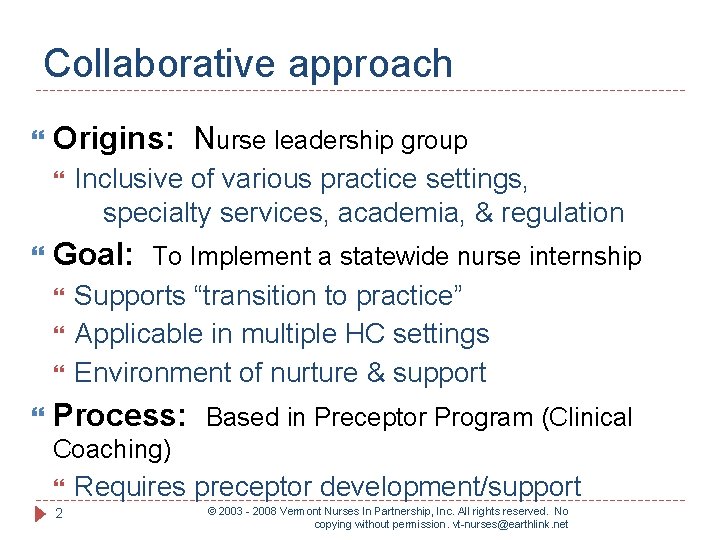
Collaborative approach Origins: Nurse leadership group Goal: To Implement a statewide nurse internship Inclusive of various practice settings, specialty services, academia, & regulation Supports “transition to practice” Applicable in multiple HC settings Environment of nurture & support Process: Based in Preceptor Program (Clinical Coaching) 2 Requires preceptor development/support © 2003 - 2008 Vermont Nurses In Partnership, Inc. All rights reserved. No copying without permission. vt-nurses@earthlink. net
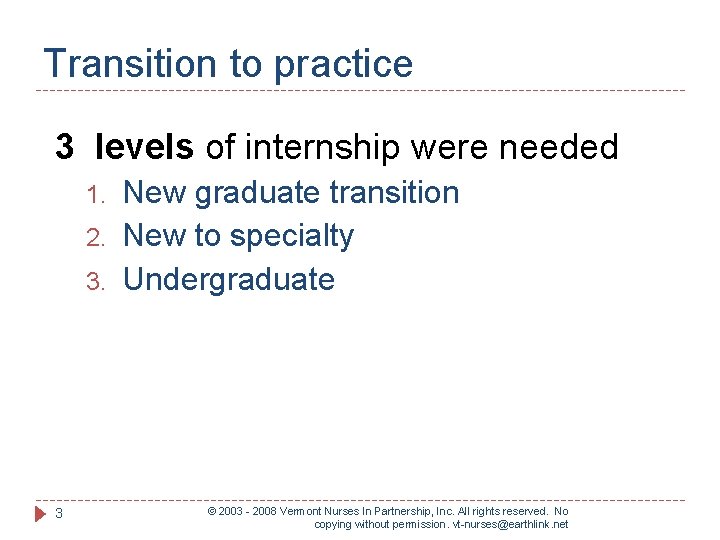
Transition to practice 3 levels of internship were needed 1. 2. 3. 3 New graduate transition New to specialty Undergraduate © 2003 - 2008 Vermont Nurses In Partnership, Inc. All rights reserved. No copying without permission. vt-nurses@earthlink. net
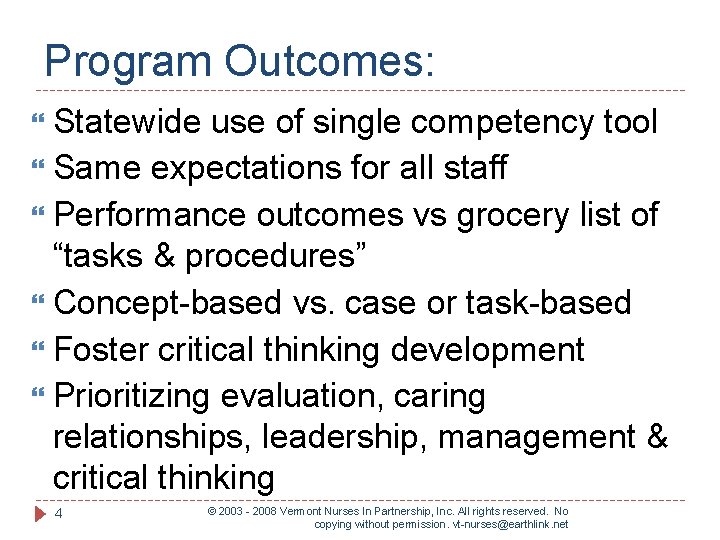
Program Outcomes: Statewide use of single competency tool Same expectations for all staff Performance outcomes vs grocery list of “tasks & procedures” Concept-based vs. case or task-based Foster critical thinking development Prioritizing evaluation, caring relationships, leadership, management & critical thinking 4 © 2003 - 2008 Vermont Nurses In Partnership, Inc. All rights reserved. No copying without permission. vt-nurses@earthlink. net
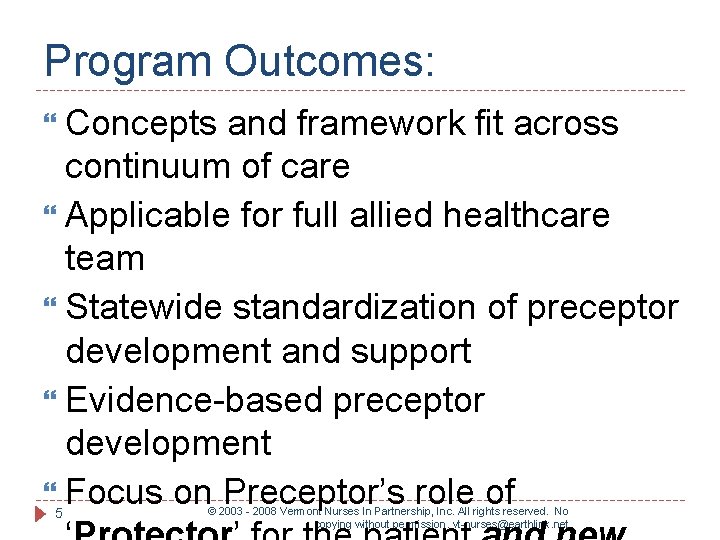
Program Outcomes: Concepts and framework fit across continuum of care Applicable for full allied healthcare team Statewide standardization of preceptor development and support Evidence-based preceptor development Focus on Preceptor’s role of 5 © 2003 - 2008 Vermont Nurses In Partnership, Inc. All rights reserved. No copying without permission. vt-nurses@earthlink. net
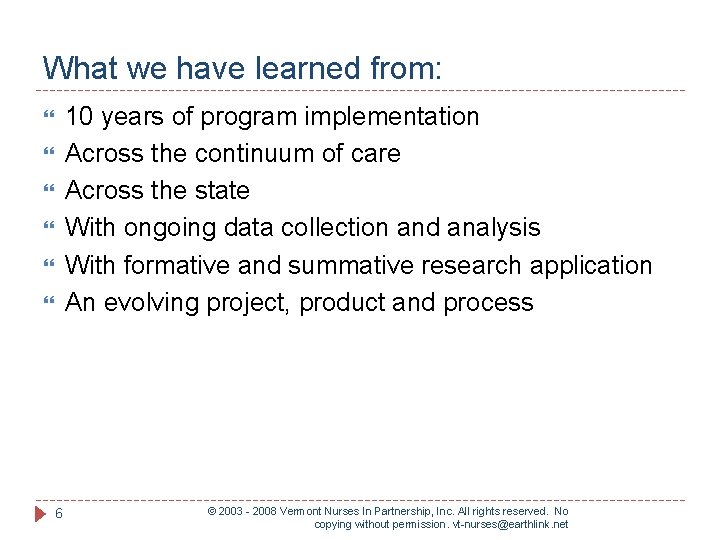
What we have learned from: 10 years of program implementation Across the continuum of care Across the state With ongoing data collection and analysis With formative and summative research application An evolving project, product and process 6 © 2003 - 2008 Vermont Nurses In Partnership, Inc. All rights reserved. No copying without permission. vt-nurses@earthlink. net
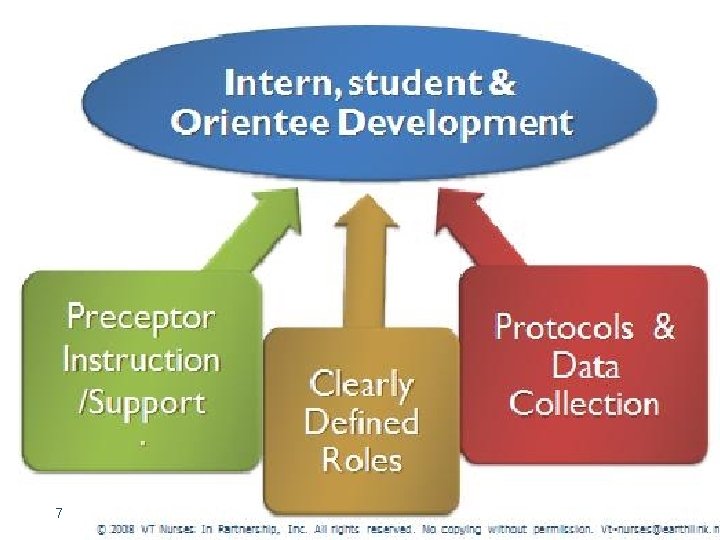
7
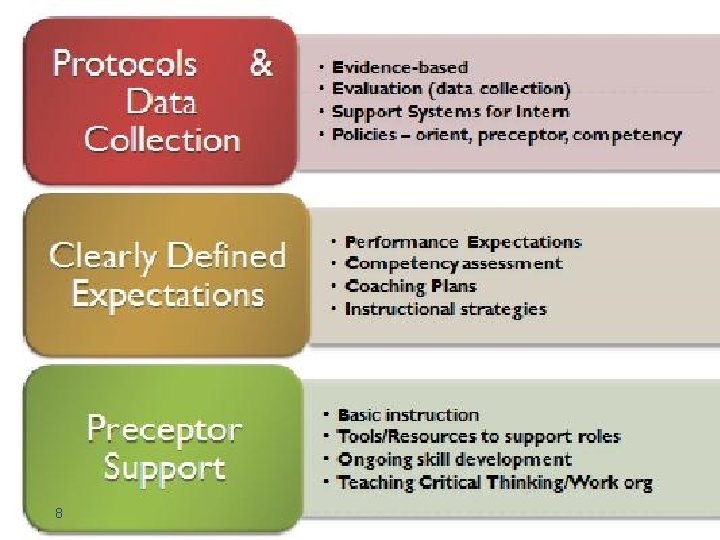
8
9
10
Why Preceptorship? Builds one on one relationship Improves satisfaction, retention, and orientation process Provides bridge between theory and reality Develops capability Protects and ensures safety for patient, new care provider and organization Collects evidence of competence 11 © 2003 - 2008 Vermont Nurses In Partnership, Inc. All rights reserved. No copying without permission. vt-nurses@earthlink. net
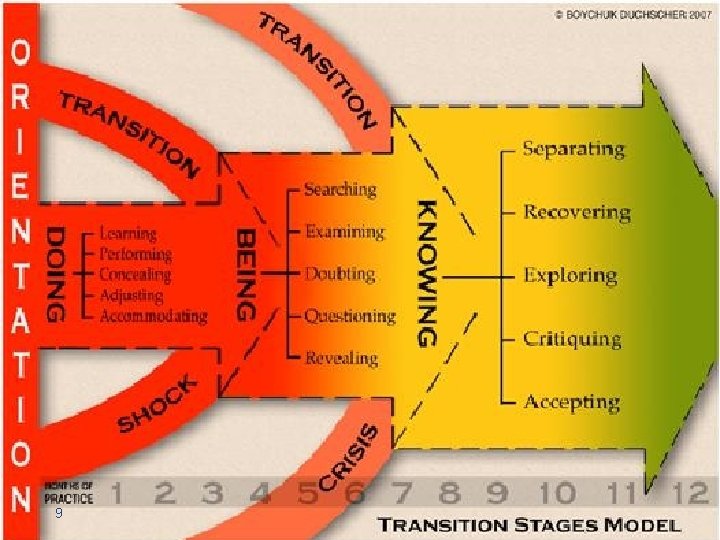
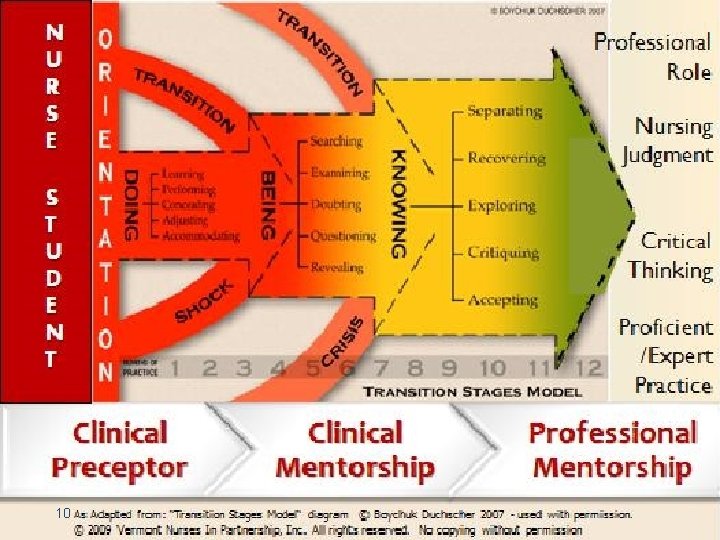
Why mentorship? Ongoing development of clinical capability Support through 2 nd & 3 rd phases of Boychuk’s “Transition Stages” Development of nursing judgment Development towards proficient practice Transition within the profession Deciding how and where you fit within the nursing profession 12 © 2003 - 2008 Vermont Nurses In Partnership, Inc. All rights reserved. No copying without permission. vt-nurses@earthlink. net
Determining content? How do we determine “what to teach” in regards to development of preceptors and clinical coaches? What's the goal? 13 © 2003 - 2008 Vermont Nurses In Partnership, Inc. All rights reserved. No copying without permission. vt-nurses@earthlink. net
Establish our goal Preceptors will collect evidence of clinical capability of the novice care provider. Must effectively develop capability, where it is missing 14 © 2003 - 2008 Vermont Nurses In Partnership, Inc. All rights reserved. No copying without permission. vt-nurses@earthlink. net
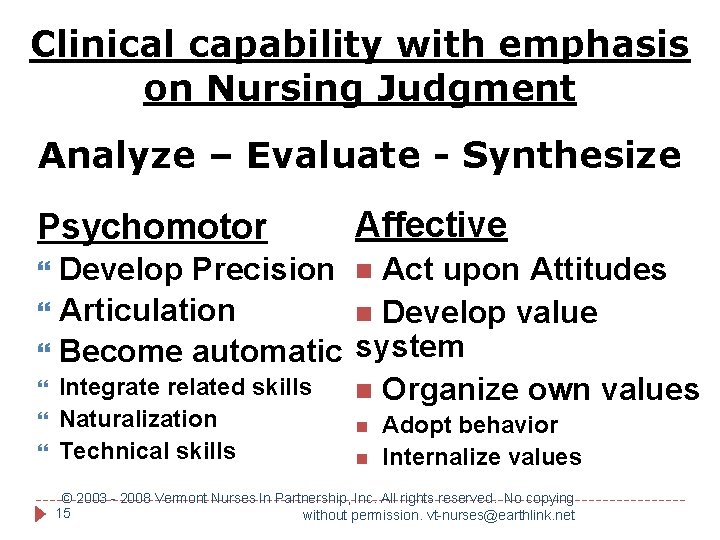
Clinical capability with emphasis on Nursing Judgment Analyze – Evaluate - Synthesize Psychomotor Affective Develop Precision n Act upon Attitudes Articulation n Develop value Become automatic system Integrate related skills n Organize own values Naturalization Technical skills n n Adopt behavior Internalize values © 2003 - 2008 Vermont Nurses In Partnership, Inc. All rights reserved. No copying 15 without permission. vt-nurses@earthlink. net
Goal: To effectively develop & collect evidence of capability Preceptors will require: Effective Communication Supportive Interpersonal Skills Core teaching/learning principles Foster critical thinking skills Team process: Relationship-based care Relationship-based development 16 © 2003 - 2008 Vermont Nurses In Partnership, Inc. All rights reserved. No copying without permission. vt-nurses@earthlink. net
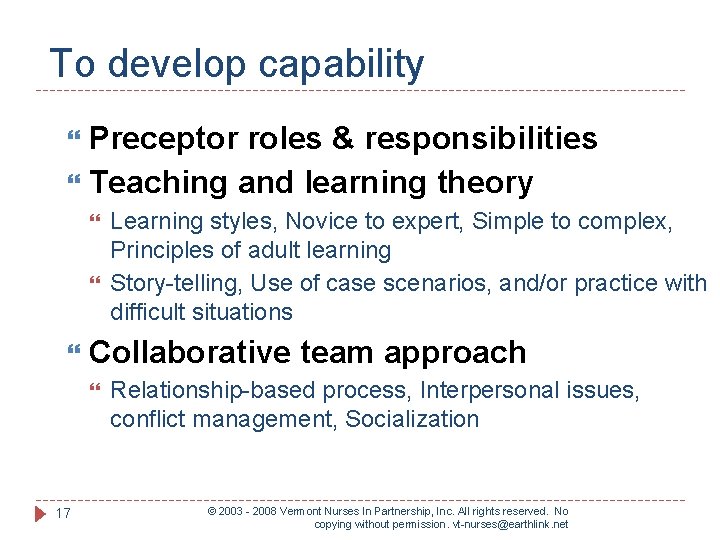
To develop capability Preceptor roles & responsibilities Teaching and learning theory Collaborative team approach 17 Learning styles, Novice to expert, Simple to complex, Principles of adult learning Story-telling, Use of case scenarios, and/or practice with difficult situations Relationship-based process, Interpersonal issues, conflict management, Socialization © 2003 - 2008 Vermont Nurses In Partnership, Inc. All rights reserved. No copying without permission. vt-nurses@earthlink. net
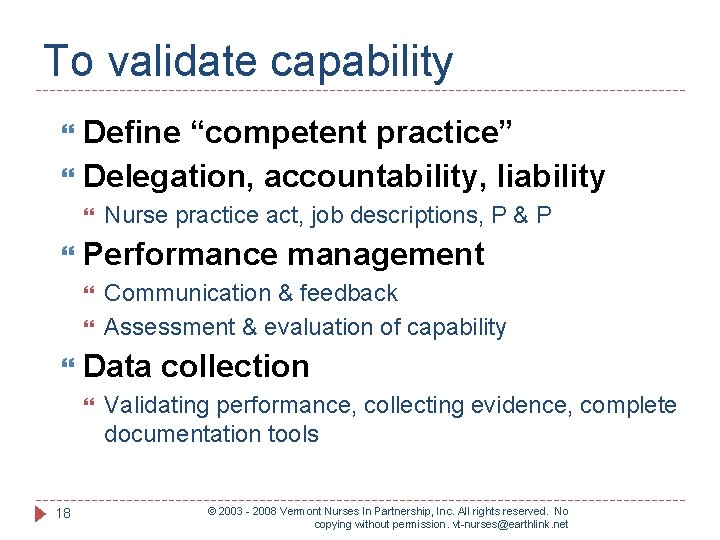
To validate capability Define “competent practice” Delegation, accountability, liability Performance management Communication & feedback Assessment & evaluation of capability Data collection 18 Nurse practice act, job descriptions, P & P Validating performance, collecting evidence, complete documentation tools © 2003 - 2008 Vermont Nurses In Partnership, Inc. All rights reserved. No copying without permission. vt-nurses@earthlink. net
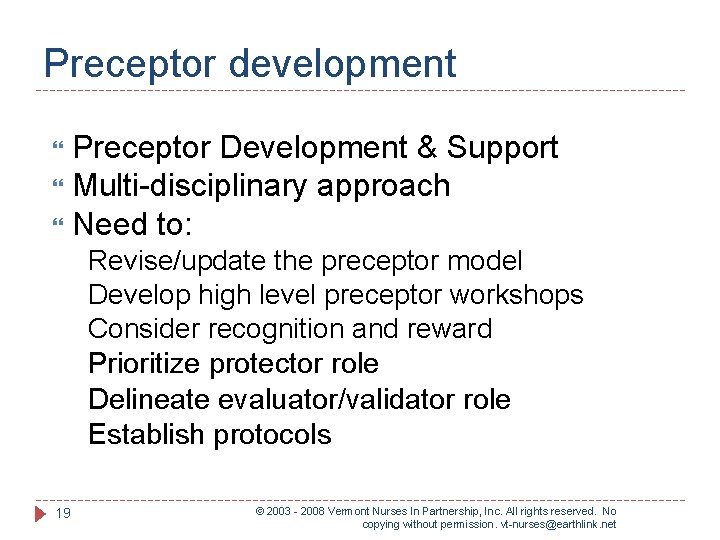
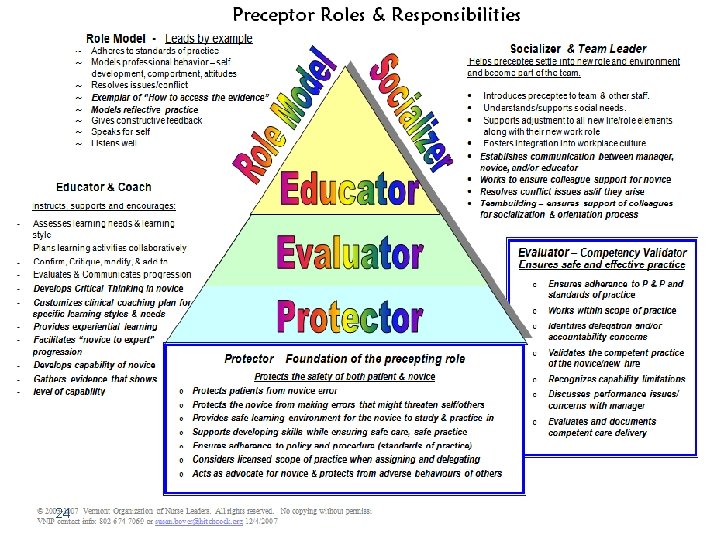
Preceptor development Preceptor Development & Support Multi-disciplinary approach Need to: Revise/update the preceptor model Develop high level preceptor workshops Consider recognition and reward Prioritize protector role Delineate evaluator/validator role Establish protocols 19 © 2003 - 2008 Vermont Nurses In Partnership, Inc. All rights reserved. No copying without permission. vt-nurses@earthlink. net
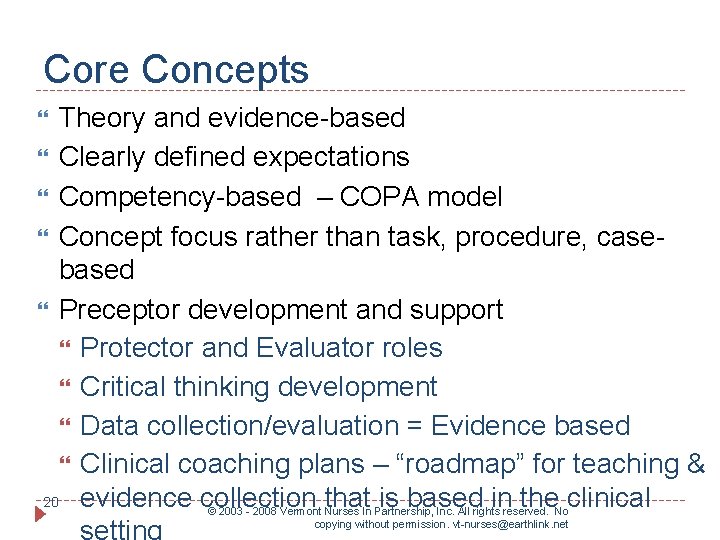
Core Concepts Theory and evidence-based Clearly defined expectations Competency-based – COPA model Concept focus rather than task, procedure, casebased Preceptor development and support Protector and Evaluator roles Critical thinking development Data collection/evaluation = Evidence based Clinical coaching plans – “roadmap” for teaching & 20 evidence collection that is based in the clinical © 2003 - 2008 Vermont Nurses In Partnership, Inc. All rights reserved. No copying without permission. vt-nurses@earthlink. net
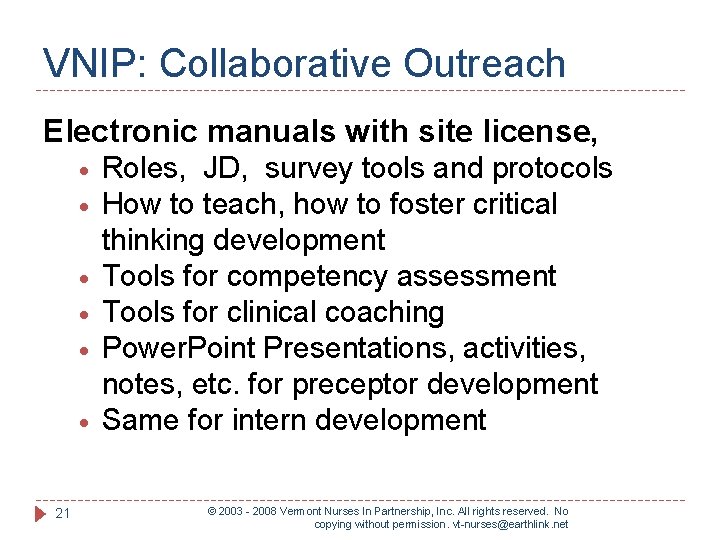
VNIP: Collaborative Outreach Electronic manuals with site license, 21 Roles, JD, survey tools and protocols How to teach, how to foster critical thinking development Tools for competency assessment Tools for clinical coaching Power. Point Presentations, activities, notes, etc. for preceptor development Same for intern development © 2003 - 2008 Vermont Nurses In Partnership, Inc. All rights reserved. No copying without permission. vt-nurses@earthlink. net
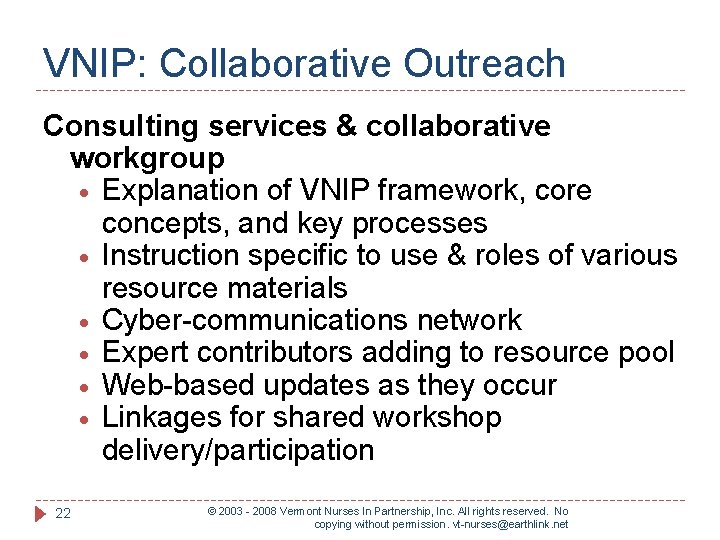
VNIP: Collaborative Outreach Consulting services & collaborative workgroup Explanation of VNIP framework, core concepts, and key processes Instruction specific to use & roles of various resource materials Cyber-communications network Expert contributors adding to resource pool Web-based updates as they occur Linkages for shared workshop delivery/participation 22 © 2003 - 2008 Vermont Nurses In Partnership, Inc. All rights reserved. No copying without permission. vt-nurses@earthlink. net
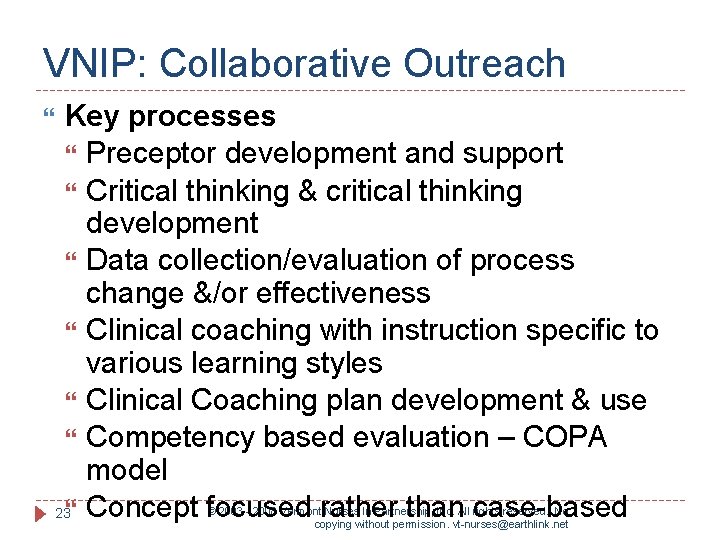
VNIP: Collaborative Outreach Key processes Preceptor development and support Critical thinking & critical thinking development Data collection/evaluation of process change &/or effectiveness Clinical coaching with instruction specific to various learning styles Clinical Coaching plan development & use Competency based evaluation – COPA model 23 Concept focused rather than case-based © 2003 - 2008 Vermont Nurses In Partnership, Inc. All rights reserved. No copying without permission. vt-nurses@earthlink. net
24
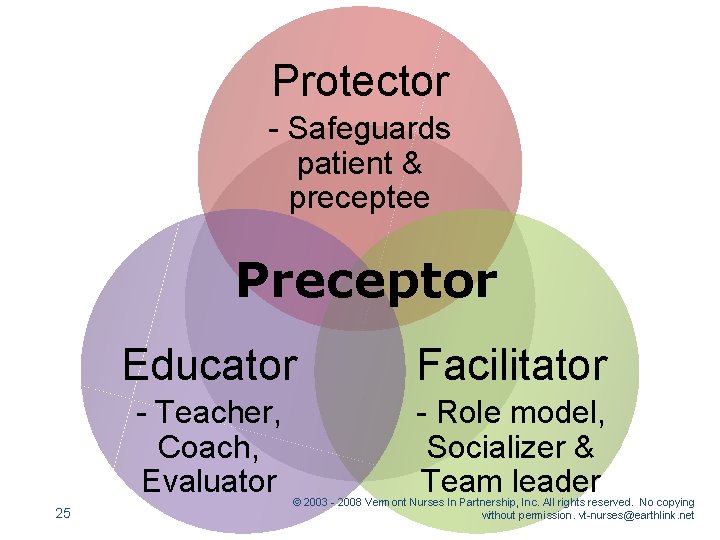
Protector - Safeguards patient & preceptee Preceptor 25 Educator Facilitator - Teacher, Coach, Evaluator - Role model, Socializer & Team leader © 2003 - 2008 Vermont Nurses In Partnership, Inc. All rights reserved. No copying without permission. vt-nurses@earthlink. net