
Supporting Tools 6 Steps to Problem Solving Why
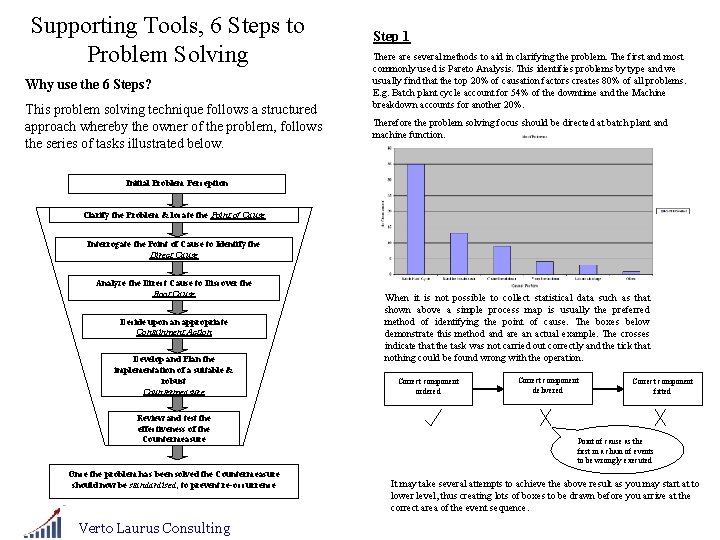
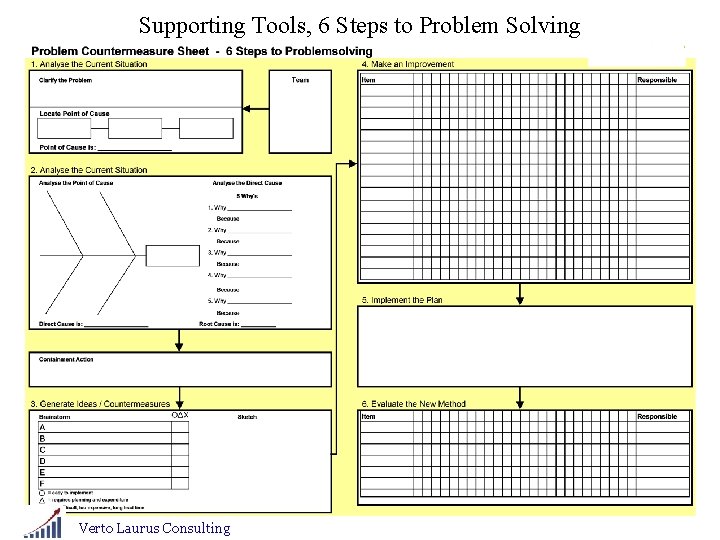
Supporting Tools, 6 Steps to Problem Solving Why use the 6 Steps? This problem solving technique follows a structured approach whereby the owner of the problem, follows the series of tasks illustrated below. Step 1 There are several methods to aid in clarifying the problem. The first and most commonly used is Pareto Analysis. This identifies problems by type and we usually find that the top 20% of causation factors creates 80% of all problems. E. g. Batch plant cycle account for 54% of the downtime and the Machine breakdown accounts for another 20%. Therefore the problem solving focus should be directed at batch plant and machine function. Initial Problem Perception Clarify the Problem & locate the Point of Cause Interrogate the Point of Cause to Identify the Direct Cause Analyze the Direct Cause to Discover the Root Cause Decide upon an appropriate Containment Action Develop and Plan the implementation of a suitable & robust Countermeasure Review and test the effectiveness of the Countermeasure Once the problem has been solved the Countermeasure should now be standardised, to prevent re-occurrence Verto Laurus Consulting When it is not possible to collect statistical data such as that shown above a simple process map is usually the preferred method of identifying the point of cause. The boxes below demonstrate this method and are an actual example. The crosses indicate that the task was not carried out correctly and the tick that nothing could be found wrong with the operation. Correct component ordered Correct component delivered Correct component fitted Point of cause as the first in a chain of events to be wrongly executed It may take several attempts to achieve the above result as you may start at to lower level, thus creating lots of boxes to be drawn before you arrive at the correct area of the event sequence.
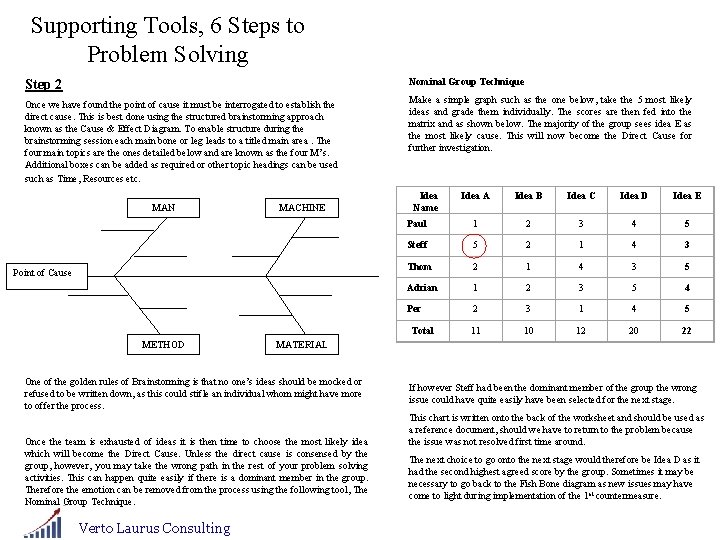
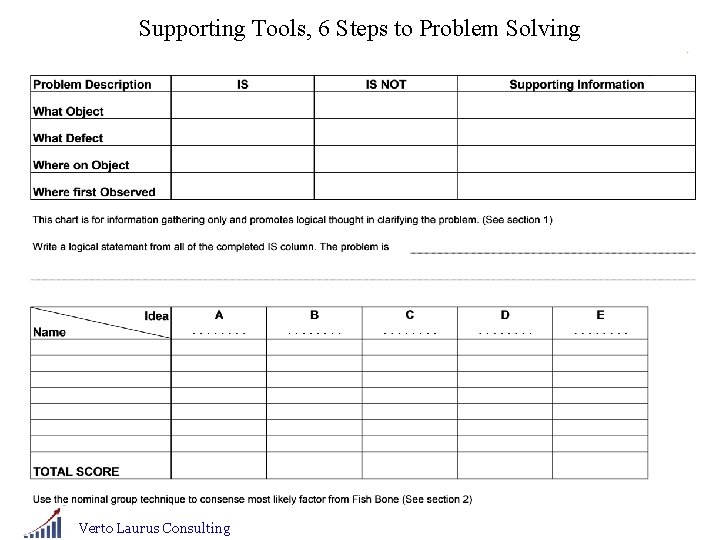
Supporting Tools, 6 Steps to Problem Solving Step 2 Nominal Group Technique Once we have found the point of cause it must be interrogated to establish the direct cause. This is best done using the structured brainstorming approach known as the Cause & Effect Diagram. To enable structure during the brainstorming session each main bone or leg leads to a titled main area. The four main topics are the ones detailed below and are known as the four M’s. Additional boxes can be added as required or other topic headings can be used such as Time, Resources etc. Make a simple graph such as the one below, take the 5 most likely ideas and grade them individually. The scores are then fed into the matrix and as shown below. The majority of the group sees idea E as the most likely cause. This will now become the Direct Cause for further investigation. MAN MACHINE Point of Cause Idea Name Idea A Idea B Idea C Idea D Idea E Paul 1 2 3 4 5 Steff 5 2 1 4 3 Thom 2 1 4 3 5 Adrian 1 2 3 5 4 Per 2 3 1 4 5 11 10 12 20 22 Total METHOD MATERIAL One of the golden rules of Brainstorming is that no one’s ideas should be mocked or refused to be written down, as this could stifle an individual whom might have more to offer the process. Once the team is exhausted of ideas it is then time to choose the most likely idea which will become the Direct Cause. Unless the direct cause is consensed by the group, however, you may take the wrong path in the rest of your problem solving activities. This can happen quite easily if there is a dominant member in the group. Therefore the emotion can be removed from the process using the following tool, The Nominal Group Technique. Verto Laurus Consulting If however Steff had been the dominant member of the group the wrong issue could have quite easily have been selected for the next stage. This chart is written onto the back of the worksheet and should be used as a reference document, should we have to return to the problem because the issue was not resolved first time around. The next choice to go onto the next stage would therefore be Idea D as it had the second highest agreed score by the group. Sometimes it may be necessary to go back to the Fish Bone diagram as new issues may have come to light during implementation of the 1 st countermeasure.
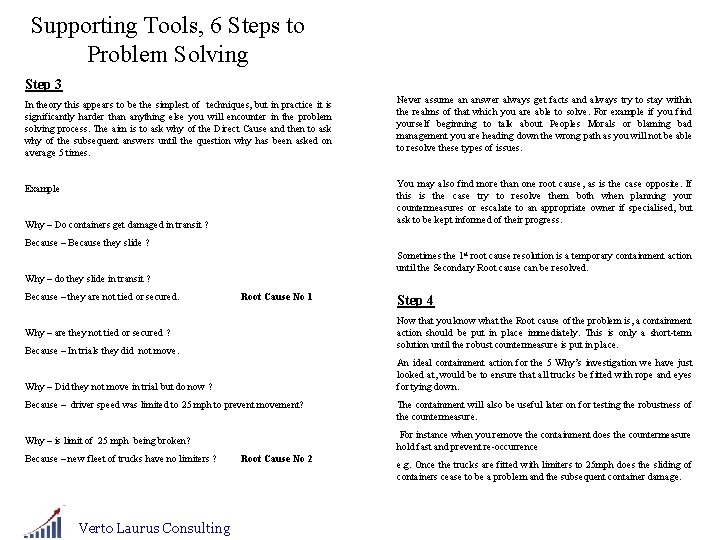
Supporting Tools, 6 Steps to Problem Solving Step 3 In theory this appears to be the simplest of techniques, but in practice it is significantly harder than anything else you will encounter in the problem solving process. The aim is to ask why of the Direct Cause and then to ask why of the subsequent answers until the question why has been asked on average 5 times. Never assume an answer always get facts and always try to stay within the realms of that which you are able to solve. For example if you find yourself beginning to talk about Peoples Morals or blaming bad management you are heading down the wrong path as you will not be able to resolve these types of issues. Example You may also find more than one root cause, as is the case opposite. If this is the case try to resolve them both when planning your countermeasures or escalate to an appropriate owner if specialised, but ask to be kept informed of their progress. Why – Do containers get damaged in transit ? Because – Because they slide ? Sometimes the 1 st root cause resolution is a temporary containment action until the Secondary Root cause can be resolved. Why – do they slide in transit ? Because – they are not tied or secured. Root Cause No 1 Now that you know what the Root cause of the problem is, a containment action should be put in place immediately. This is only a short-term solution until the robust countermeasure is put in place. Why – are they not tied or secured ? Because – In trials they did not move. An ideal containment action for the 5 Why’s investigation we have just looked at, would be to ensure that all trucks be fitted with rope and eyes for tying down. Why – Did they not move in trial but do now ? Because – driver speed was limited to 25 mph to prevent movement? Verto Laurus Consulting The containment will also be useful later on for testing the robustness of the countermeasure. For instance when you remove the containment does the countermeasure hold fast and prevent re-occurrence Why – is limit of 25 mph being broken? Because – new fleet of trucks have no limiters ? Step 4 Root Cause No 2 e. g. Once the trucks are fitted with limiters to 25 mph does the sliding of containers cease to be a problem and the subsequent container damage.
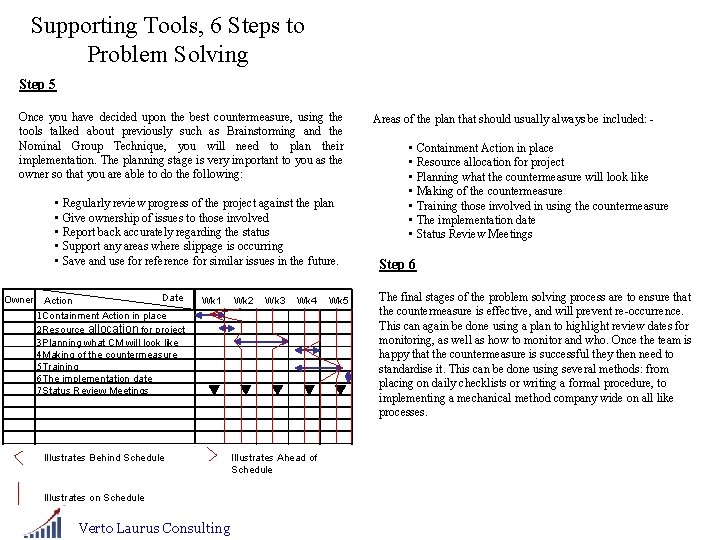
Supporting Tools, 6 Steps to Problem Solving Step 5 Once you have decided upon the best countermeasure, using the tools talked about previously such as Brainstorming and the Nominal Group Technique, you will need to plan their implementation. The planning stage is very important to you as the owner so that you are able to do the following: • Regularly review progress of the project against the plan • Give ownership of issues to those involved • Report back accurately regarding the status • Support any areas where slippage is occurring • Save and use for reference for similar issues in the future. Owner Date Action Wk 1 Wk 2 Wk 3 Wk 4 1 Containment Action in place 2 Resource allocation for project 3 Planning what CM will look like 4 Making of the countermeasure 5 Training 6 The implementation date 7 Status Review Meetings Illustrates Behind Schedule Illustrates on Schedule Verto Laurus Consulting Illustrates Ahead of Schedule Wk 5 Areas of the plan that should usually always be included: - • Containment Action in place • Resource allocation for project • Planning what the countermeasure will look like • Making of the countermeasure • Training those involved in using the countermeasure • The implementation date • Status Review Meetings Step 6 The final stages of the problem solving process are to ensure that the countermeasure is effective, and will prevent re-occurrence. This can again be done using a plan to highlight review dates for monitoring, as well as how to monitor and who. Once the team is happy that the countermeasure is successful they then need to standardise it. This can be done using several methods: from placing on daily checklists or writing a formal procedure, to implementing a mechanical method company wide on all like processes.
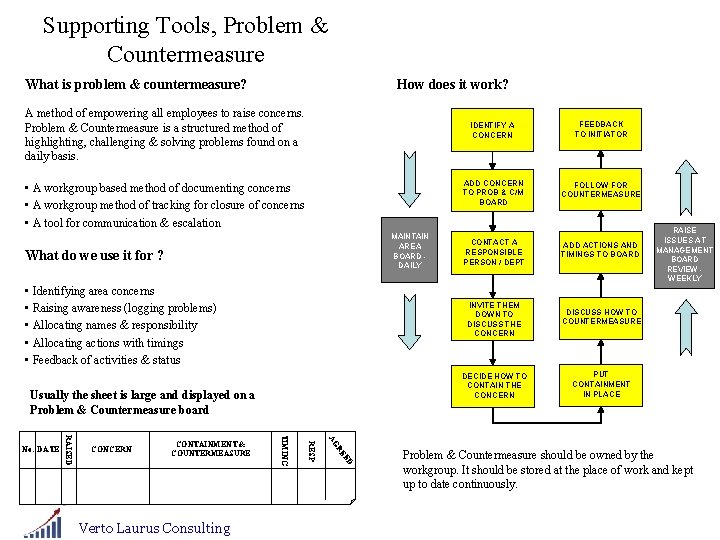
Supporting Tools, Problem & Countermeasure What is problem & countermeasure? How does it work? A method of empowering all employees to raise concerns. Problem & Countermeasure is a structured method of highlighting, challenging & solving problems found on a daily basis. • A workgroup based method of documenting concerns • A workgroup method of tracking for closure of concerns • A tool for communication & escalation MAINTAIN AREA BOARD DAILY What do we use it for ? • Identifying area concerns • Raising awareness (logging problems) • Allocating names & responsibility • Allocating actions with timings • Feedback of activities & status Usually the sheet is large and displayed on a Problem & Countermeasure board ED RE Verto Laurus Consulting FEEDBACK TO INITIATOR ADD CONCERN TO PROB & C/M BOARD FOLLOW FOR COUNTERMEASURE CONTACT A RESPONSIBLE PERSON / DEPT ADD ACTIONS AND TIMINGS TO BOARD INVITE THEM DOWN TO DISCUSS THE CONCERN DISCUSS HOW TO COUNTERMEASURE DECIDE HOW TO CONTAIN THE CONCERN PUT CONTAINMENT IN PLACE RAISE ISSUES AT MANAGEMENT BOARD REVIEW WEEKLY AG CONTAINMENT & COUNTERMEASURE RESP CONCERN TIMING RAISED No. DATE IDENTIFY A CONCERN Problem & Countermeasure should be owned by the workgroup. It should be stored at the place of work and kept up to date continuously.
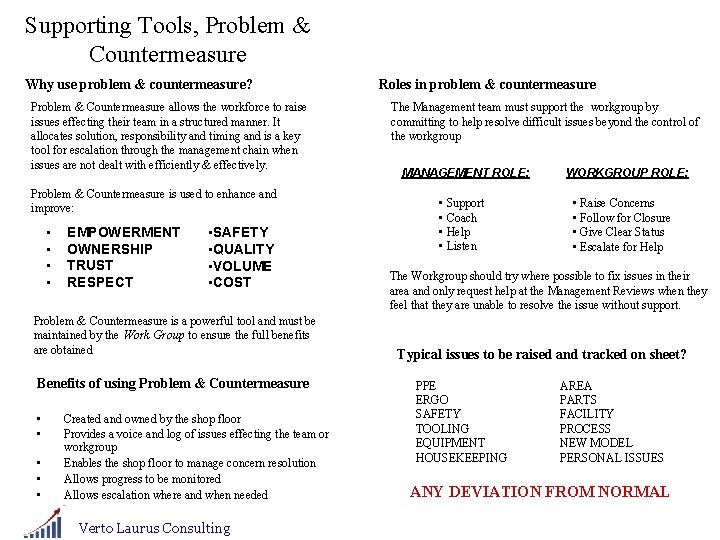
Supporting Tools, Problem & Countermeasure Why use problem & countermeasure? Problem & Countermeasure allows the workforce to raise issues effecting their team in a structured manner. It allocates solution, responsibility and timing and is a key tool for escalation through the management chain when issues are not dealt with efficiently & effectively. Problem & Countermeasure is used to enhance and improve: • • EMPOWERMENT OWNERSHIP TRUST RESPECT • SAFETY • QUALITY • VOLUME • COST Problem & Countermeasure is a powerful tool and must be maintained by the Work Group to ensure the full benefits are obtained Benefits of using Problem & Countermeasure • • • Created and owned by the shop floor Provides a voice and log of issues effecting the team or workgroup Enables the shop floor to manage concern resolution Allows progress to be monitored Allows escalation where and when needed Verto Laurus Consulting Roles in problem & countermeasure The Management team must support the workgroup by committing to help resolve difficult issues beyond the control of the workgroup MANAGEMENT ROLE: • Support • Coach • Help • Listen WORKGROUP ROLE: • Raise Concerns • Follow for Closure • Give Clear Status • Escalate for Help The Workgroup should try where possible to fix issues in their area and only request help at the Management Reviews when they feel that they are unable to resolve the issue without support. Typical issues to be raised and tracked on sheet? PPE ERGO SAFETY TOOLING EQUIPMENT HOUSEKEEPING AREA PARTS FACILITY PROCESS NEW MODEL PERSONAL ISSUES ANY DEVIATION FROM NORMAL
Supporting Tools, 6 Steps to Problem Solving Verto Laurus Consulting
Supporting Tools, 6 Steps to Problem Solving Verto Laurus Consulting
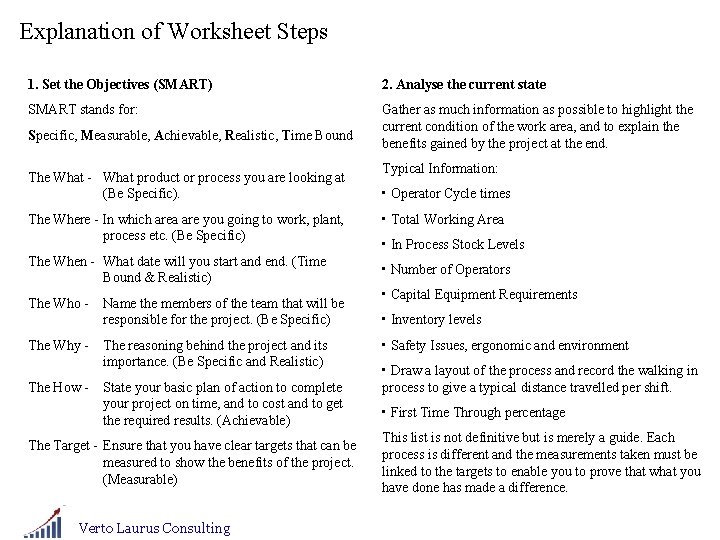
Explanation of Worksheet Steps 1. Set the Objectives (SMART) 2. Analyse the current state SMART stands for: Gather as much information as possible to highlight the current condition of the work area, and to explain the benefits gained by the project at the end. Specific, Measurable, Achievable, Realistic, Time Bound The What - What product or process you are looking at (Be Specific). The Where - In which area are you going to work, plant, process etc. (Be Specific) The When - What date will you start and end. (Time Bound & Realistic) The Who The Why The How - Name the members of the team that will be responsible for the project. (Be Specific) The reasoning behind the project and its importance. (Be Specific and Realistic) State your basic plan of action to complete your project on time, and to cost and to get the required results. (Achievable) The Target - Ensure that you have clear targets that can be measured to show the benefits of the project. (Measurable) Verto Laurus Consulting Typical Information: • Operator Cycle times • Total Working Area • In Process Stock Levels • Number of Operators • Capital Equipment Requirements • Inventory levels • Safety Issues, ergonomic and environment • Draw a layout of the process and record the walking in process to give a typical distance travelled per shift. • First Time Through percentage This list is not definitive but is merely a guide. Each process is different and the measurements taken must be linked to the targets to enable you to prove that what you have done has made a difference.
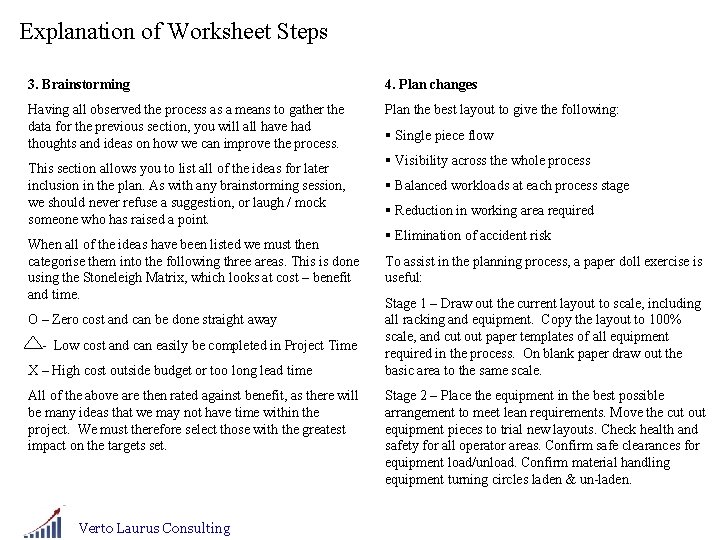
Explanation of Worksheet Steps 3. Brainstorming 4. Plan changes Having all observed the process as a means to gather the data for the previous section, you will all have had thoughts and ideas on how we can improve the process. Plan the best layout to give the following: This section allows you to list all of the ideas for later inclusion in the plan. As with any brainstorming session, we should never refuse a suggestion, or laugh / mock someone who has raised a point. When all of the ideas have been listed we must then categorise them into the following three areas. This is done using the Stoneleigh Matrix, which looks at cost – benefit and time. O – Zero cost and can be done straight away - Low cost and can easily be completed in Project Time X – High cost outside budget or too long lead time All of the above are then rated against benefit, as there will be many ideas that we may not have time within the project. We must therefore select those with the greatest impact on the targets set. Verto Laurus Consulting § Single piece flow § Visibility across the whole process § Balanced workloads at each process stage § Reduction in working area required § Elimination of accident risk To assist in the planning process, a paper doll exercise is useful: Stage 1 – Draw out the current layout to scale, including all racking and equipment. Copy the layout to 100% scale, and cut out paper templates of all equipment required in the process. On blank paper draw out the basic area to the same scale. Stage 2 – Place the equipment in the best possible arrangement to meet lean requirements. Move the cut out equipment pieces to trial new layouts. Check health and safety for all operator areas. Confirm safe clearances for equipment load/unload. Confirm material handling equipment turning circles laden & un-laden.
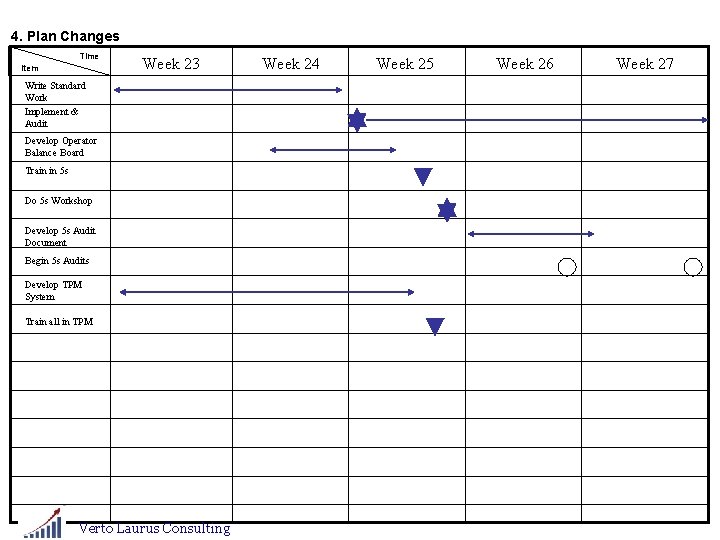
4. Plan Changes Time Item Week 23 Write Standard Work Implement & Audit Develop Operator Balance Board Train in 5 s Do 5 s Workshop Develop 5 s Audit Document Begin 5 s Audits Develop TPM System Train all in TPM Verto Laurus Consulting Week 24 Week 25 Week 26 Week 27
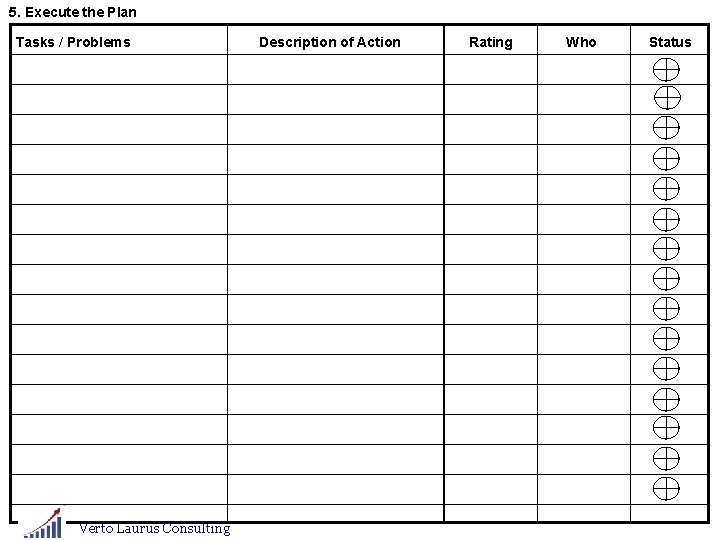
5. Execute the Plan Tasks / Problems Verto Laurus Consulting Description of Action Rating Who Status
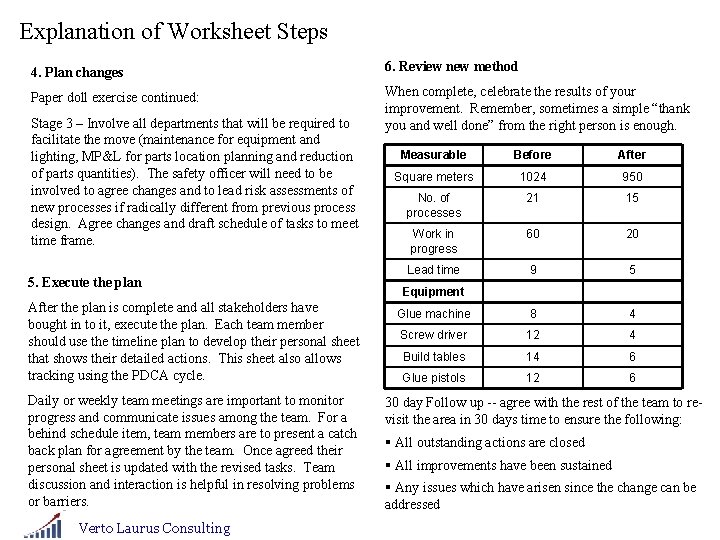
Explanation of Worksheet Steps 4. Plan changes 6. Review new method Paper doll exercise continued: When complete, celebrate the results of your improvement. Remember, sometimes a simple “thank you and well done” from the right person is enough. Stage 3 – Involve all departments that will be required to facilitate the move (maintenance for equipment and lighting, MP&L for parts location planning and reduction of parts quantities). The safety officer will need to be involved to agree changes and to lead risk assessments of new processes if radically different from previous process design. Agree changes and draft schedule of tasks to meet time frame. 5. Execute the plan After the plan is complete and all stakeholders have bought in to it, execute the plan. Each team member should use the timeline plan to develop their personal sheet that shows their detailed actions. This sheet also allows tracking using the PDCA cycle. Daily or weekly team meetings are important to monitor progress and communicate issues among the team. For a behind schedule item, team members are to present a catch back plan for agreement by the team. Once agreed their personal sheet is updated with the revised tasks. Team discussion and interaction is helpful in resolving problems or barriers. Verto Laurus Consulting Measurable Before After Square meters 1024 950 No. of processes 21 15 Work in progress 60 20 Lead time 9 5 Glue machine 8 4 Screw driver 12 4 Build tables 14 6 Glue pistols 12 6 Equipment 30 day Follow up -- agree with the rest of the team to revisit the area in 30 days time to ensure the following: § All outstanding actions are closed § All improvements have been sustained § Any issues which have arisen since the change can be addressed
- Slides: 13