
SUPPORTING STUDENTS WITH EXAM STRESS Dr Tee Mc

- Slides: 28
SUPPORTING STUDENTS WITH EXAM STRESS Dr Tee Mc. Caldin – University of Manchester tee. mccaldin@manchester. ac. uk
SESSION PLAN • What is exam stress? • What impact can teachers have? • What do individual students say? • How can we put all this into practice?
BUT FIRST • What do you understand by “exam stress”? – What are the signs and symptoms? – What type of student do you imagine it effects? – Does it affect all students? – Can it ever be a good thing?
WHAT IS EXAM STRESS?
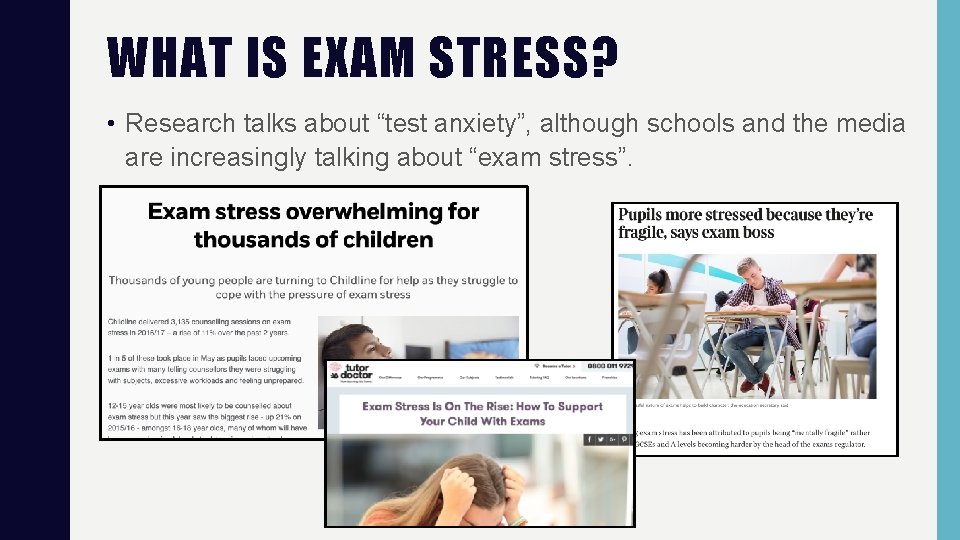
WHAT IS EXAM STRESS? • Research talks about “test anxiety”, although schools and the media are increasingly talking about “exam stress”.
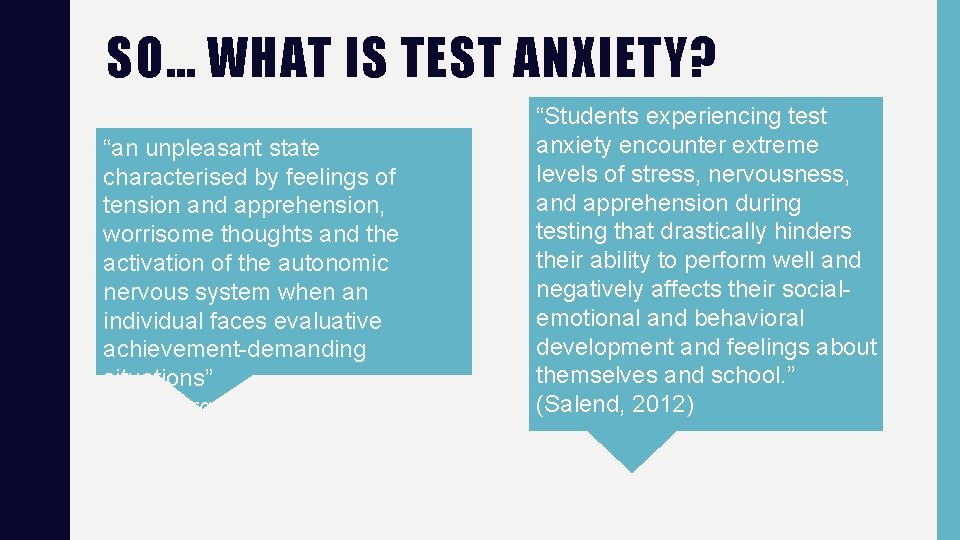
SO… WHAT IS TEST ANXIETY? “an unpleasant state characterised by feelings of tension and apprehension, worrisome thoughts and the activation of the autonomic nervous system when an individual faces evaluative achievement-demanding situations” (Spielberger, 1972 p. 40) “Students experiencing test anxiety encounter extreme levels of stress, nervousness, and apprehension during testing that drastically hinders their ability to perform well and negatively affects their socialemotional and behavioral development and feelings about themselves and school. ” (Salend, 2012)
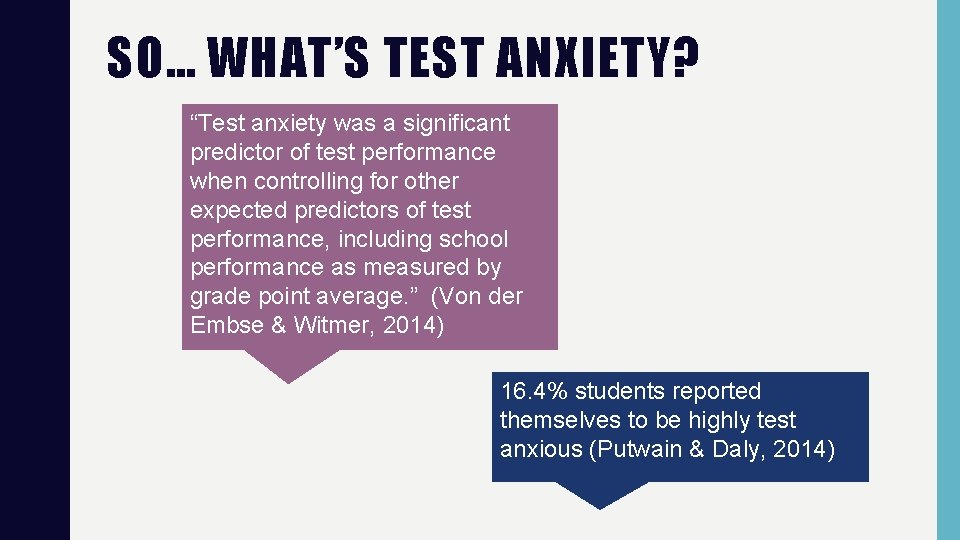
SO… WHAT’S TEST ANXIETY? “Test anxiety was a significant predictor of test performance when controlling for other expected predictors of test performance, including school performance as measured by grade point average. ” (Von der Embse & Witmer, 2014) 16. 4% students reported themselves to be highly test anxious (Putwain & Daly, 2014)
CAN TEACHERS HAVE AN IMPACT ON EXAM STRESS?
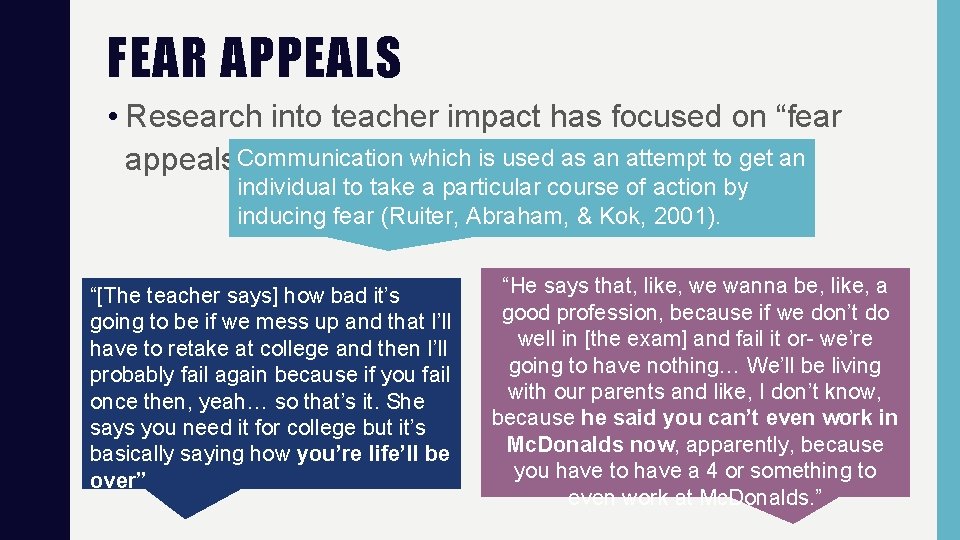
FEAR APPEALS • Research into teacher impact has focused on “fear appeals”Communication which is used as an attempt to get an individual to take a particular course of action by inducing fear (Ruiter, Abraham, & Kok, 2001). “[The teacher says] how bad it’s going to be if we mess up and that I’ll have to retake at college and then I’ll probably fail again because if you fail once then, yeah… so that’s it. She says you need it for college but it’s basically saying how you’re life’ll be over” “He says that, like, we wanna be, like, a good profession, because if we don’t do well in [the exam] and fail it or- we’re going to have nothing… We’ll be living with our parents and like, I don’t know, because he said you can’t even work in Mc. Donalds now, apparently, because you have to have a 4 or something to even work at Mc. Donalds. ”
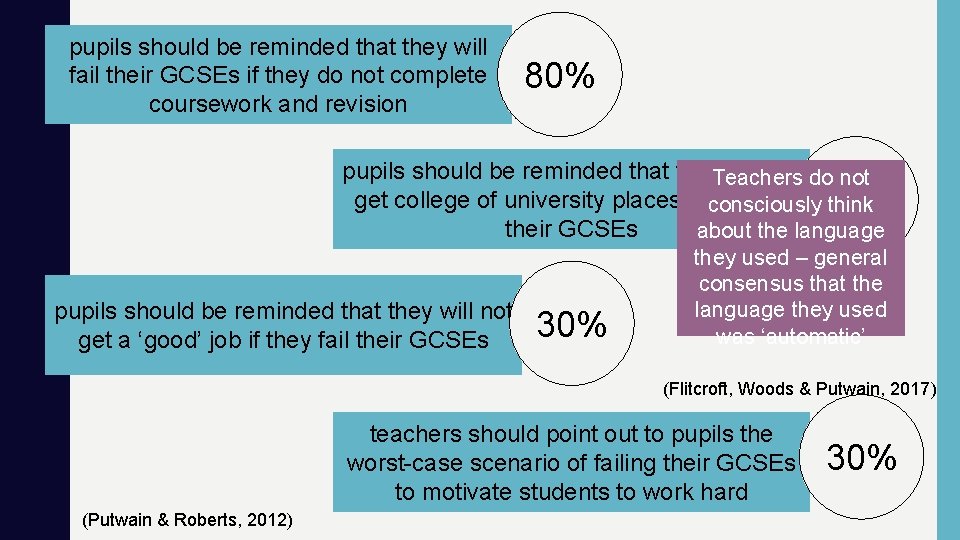
pupils should be reminded that they will fail their GCSEs if they do not complete coursework and revision 80% pupils should be reminded that they. Teachers will not do not get college of university places if they fail 65% consciously think their GCSEs about the language pupils should be reminded that they will not get a ‘good’ job if they fail their GCSEs 30% they used – general consensus that the language they used was ‘automatic’ (Flitcroft, Woods & Putwain, 2017) teachers should point out to pupils the worst-case scenario of failing their GCSEs to motivate students to work hard (Putwain & Roberts, 2012) 30%
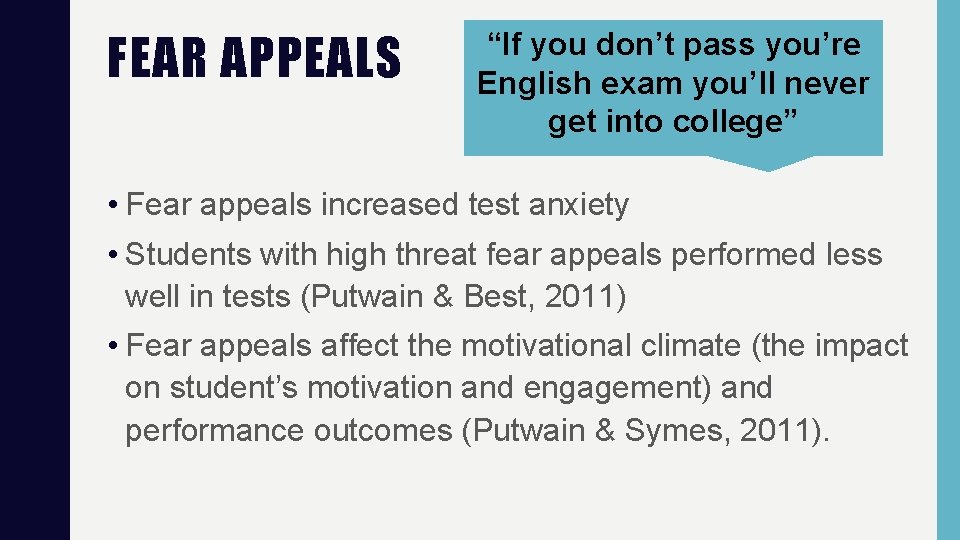
FEAR APPEALS “If you don’t pass you’re English exam you’ll never get into college” • Fear appeals increased test anxiety • Students with high threat fear appeals performed less well in tests (Putwain & Best, 2011) • Fear appeals affect the motivational climate (the impact on student’s motivation and engagement) and performance outcomes (Putwain & Symes, 2011).
THE PROBLEM WITH RESEARCH SO FAR….
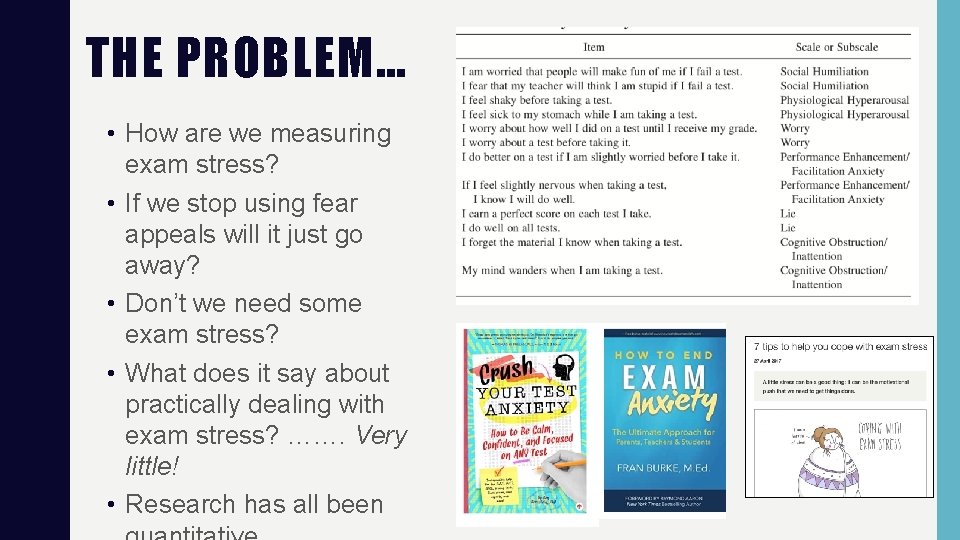
THE PROBLEM… • How are we measuring exam stress? • If we stop using fear appeals will it just go away? • Don’t we need some exam stress? • What does it say about practically dealing with exam stress? ……. Very little! • Research has all been
WHAT DO INDIVIDUAL STUDENTS SAY?
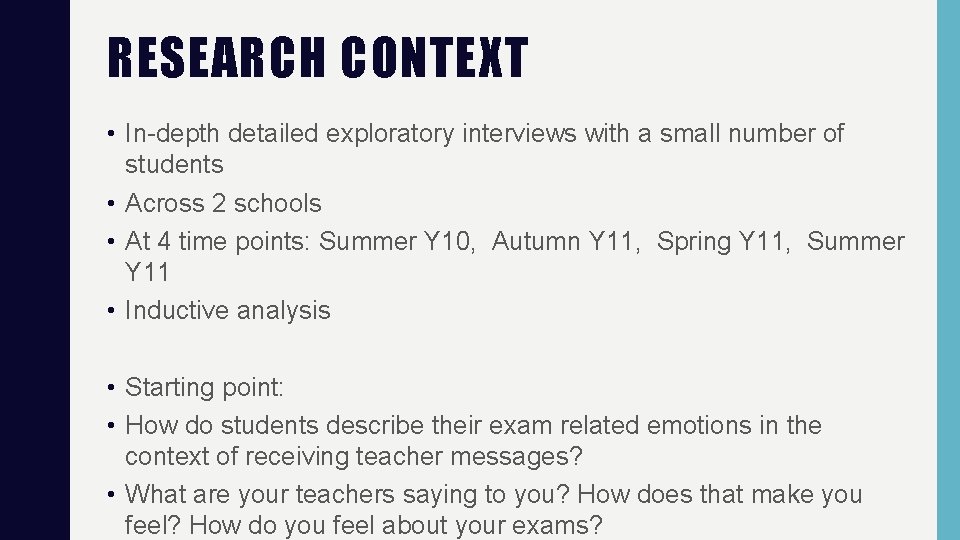
RESEARCH CONTEXT • In-depth detailed exploratory interviews with a small number of students • Across 2 schools • At 4 time points: Summer Y 10, Autumn Y 11, Spring Y 11, Summer Y 11 • Inductive analysis • Starting point: • How do students describe their exam related emotions in the context of receiving teacher messages? • What are your teachers saying to you? How does that make you feel? How do you feel about your exams?
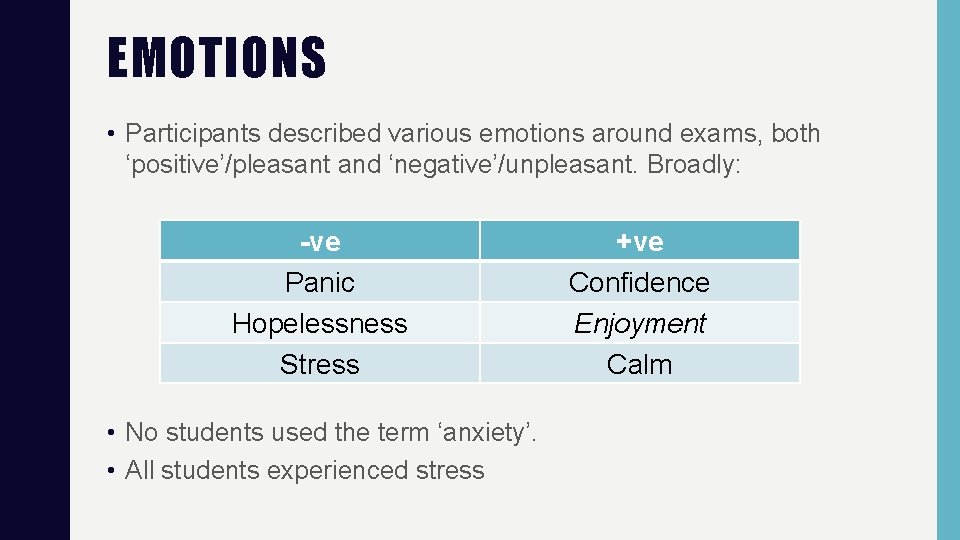
EMOTIONS • Participants described various emotions around exams, both ‘positive’/pleasant and ‘negative’/unpleasant. Broadly: -ve Panic Hopelessness Stress • No students used the term ‘anxiety’. • All students experienced stress +ve Confidence Enjoyment Calm
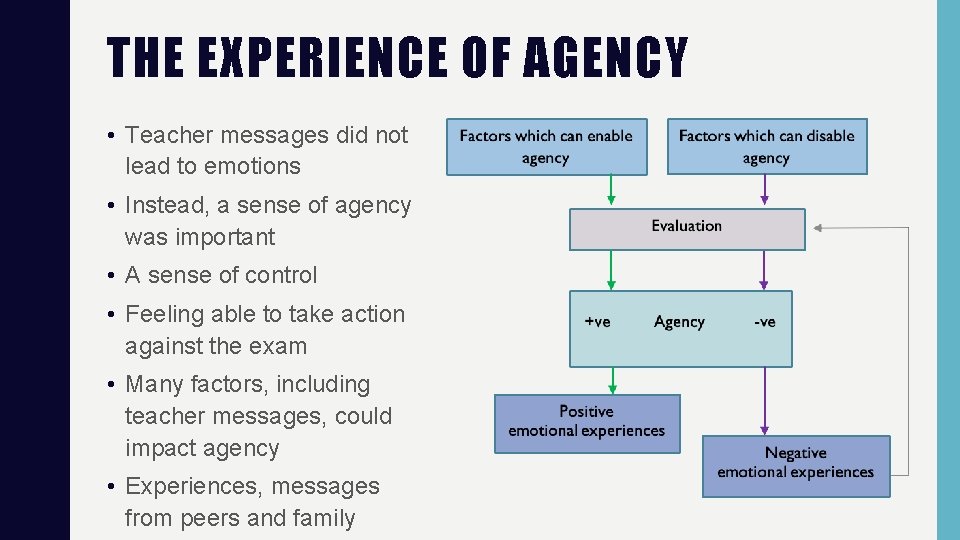
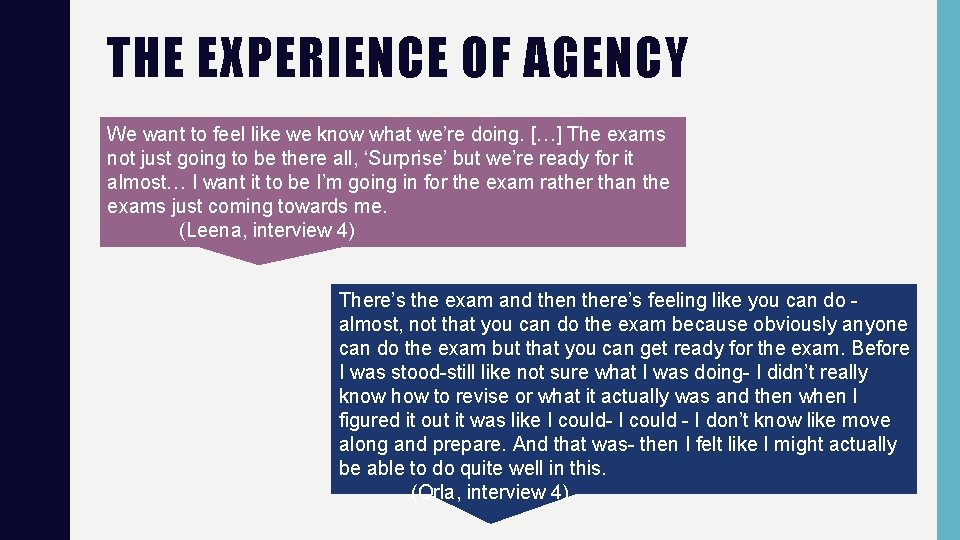
THE EXPERIENCE OF AGENCY • Teacher messages did not lead to emotions • Instead, a sense of agency was important • A sense of control • Feeling able to take action against the exam • Many factors, including teacher messages, could impact agency • Experiences, messages from peers and family
THE EXPERIENCE OF AGENCY We want to feel like we know what we’re doing. […] The exams not just going to be there all, ‘Surprise’ but we’re ready for it almost… I want it to be I’m going in for the exam rather than the exams just coming towards me. (Leena, interview 4) There’s the exam and then there’s feeling like you can do almost, not that you can do the exam because obviously anyone can do the exam but that you can get ready for the exam. Before I was stood-still like not sure what I was doing- I didn’t really know how to revise or what it actually was and then when I figured it out it was like I could- I could - I don’t know like move along and prepare. And that was- then I felt like I might actually be able to do quite well in this. (Orla, interview 4)
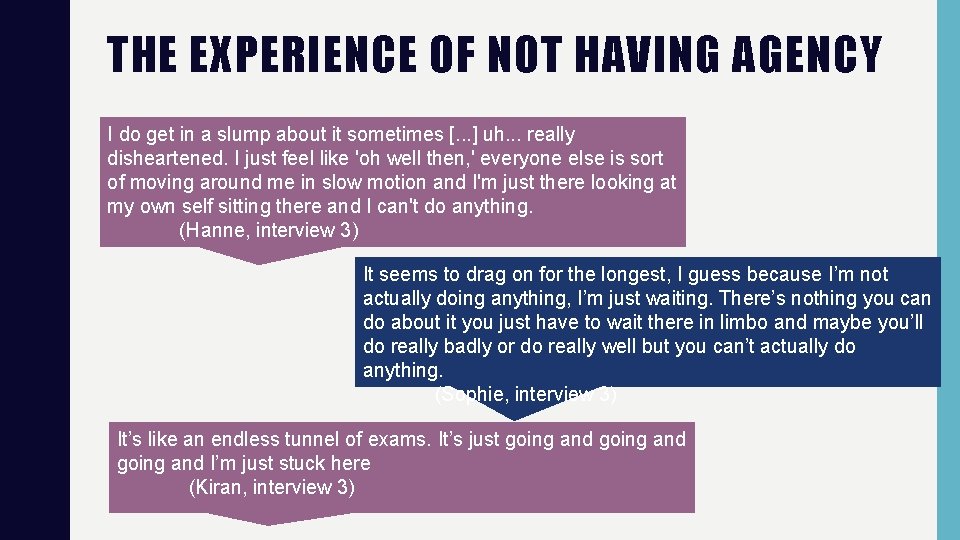
THE EXPERIENCE OF NOT HAVING AGENCY I do get in a slump about it sometimes [. . . ] uh. . . really disheartened. I just feel like 'oh well then, ' everyone else is sort of moving around me in slow motion and I'm just there looking at my own self sitting there and I can't do anything. (Hanne, interview 3) It seems to drag on for the longest, I guess because I’m not actually doing anything, I’m just waiting. There’s nothing you can do about it you just have to wait there in limbo and maybe you’ll do really badly or do really well but you can’t actually do anything. (Sophie, interview 3) It’s like an endless tunnel of exams. It’s just going and I’m just stuck here (Kiran, interview 3)
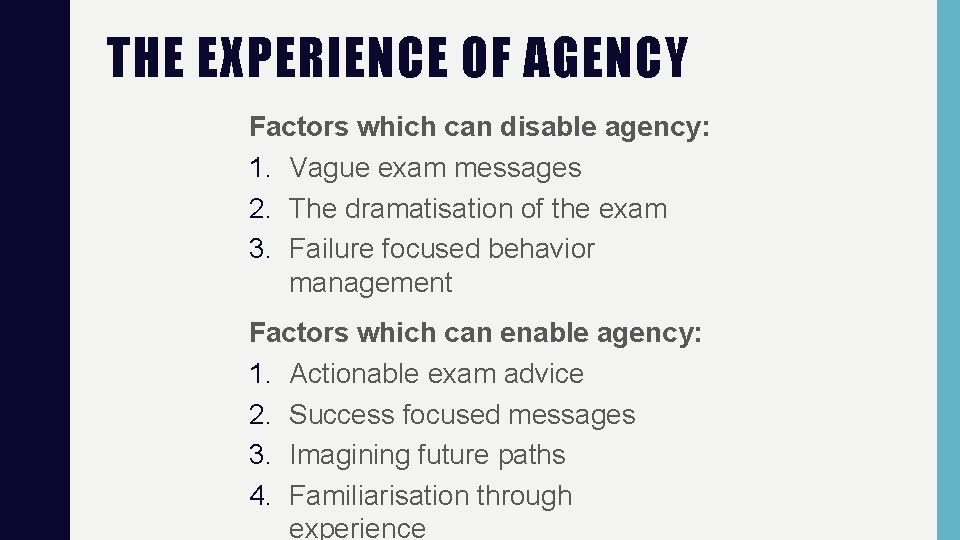
THE EXPERIENCE OF AGENCY Factors which can disable agency: 1. Vague exam messages 2. The dramatisation of the exam 3. Failure focused behavior management Factors which can enable agency: 1. Actionable exam advice 2. Success focused messages 3. Imagining future paths 4. Familiarisation through experience
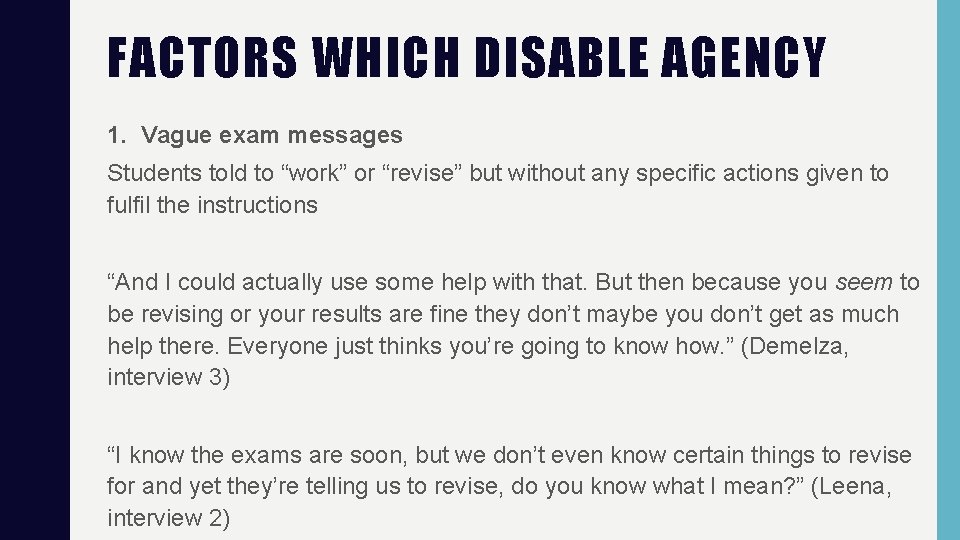
FACTORS WHICH DISABLE AGENCY 1. Vague exam messages Students told to “work” or “revise” but without any specific actions given to fulfil the instructions “And I could actually use some help with that. But then because you seem to be revising or your results are fine they don’t maybe you don’t get as much help there. Everyone just thinks you’re going to know how. ” (Demelza, interview 3) “I know the exams are soon, but we don’t even know certain things to revise for and yet they’re telling us to revise, do you know what I mean? ” (Leena, interview 2)
FACTORS WHICH DISABLE AGENCY 2. The dramatisation of the exam The exam as “massive” to which no prior experience compares, having theatrical and unfamiliar processes and procedures, and ”built up” by those around them “We’ve been hearing about the exams since we got to this school, basically. Just being told they’re the biggest thing we’ll have to do, they’re the end point working towards. ” (Owen, interview 1) “She just said that it’s really scary in the exam hall. You don’t know what’s going to happen, and they check everything that you’re doing, and they watch you all the time, and I was like, ‘Oh my god’” (Ethan, interview 2)
FACTORS WHICH DISABLE AGENCY 3. Failure focused behaviour management Messages from teachers, focused on exam failure and used in behaviour management situations “When everyone’s mucking about there’s just a point where she’ll be like ‘ok, you have to focus now, you have to stop doing whatever and concentrate because otherwise you’re not going to learn what you need’ and that we’ll fail these exams. ” (Owen, interview 3) “I don’t want to think about it and then it’s, like, I could be doing something useful with this time but I’ve had to stop and listen to something that’s just gonna make me feel bad. ” (Leena, interview 3)
FACTORS WHICH ENABLE AGENCY 1. Actionable exam advice Any message given by any source which included a specific and detailed action students could take, either at that particular moment in time, during their revision, or during the exam itself. “Well because he’s changed his approach. Instead of always telling us ‘oh you’re doing fine, just do it’ and instead is saying like ‘baby steps, take it slowly, here’s the next step’ and not putting like a lot of work on you, pressure at once, so kind of calmed down sort of thing. It’s more like guiding now like ‘here’s what to do next’. ” (Hanne, interview 3) “How am I possibly going to fit this in, because it doesn’t really, like if he gave us some techniques to like remember everything, so it can kind of be a little stressful” (Kiran, interview 1)
FACTORS WHICH ENABLE AGENCY 2. Success focused messages Either positively commented on students’ current performance or positively predicted their future performance while providing specific information as evidence. “He’s like ‘yeah, I don’t see why you think you can’t do it because you did the last thing you didn’t think you could do’. He actually feels like he gives you proof and then everyone’s like ‘oh I can do it’ because sometimes you can’t actually see what you can do because you don’t always know that yourself” (Orla, interview 2) “She doesn’t say it like ‘I think you’ll be fine’ it was a definite ‘you’ll be fine, you’ve done this before, you know what’s coming up’ so I think being more assertive is helpful (Sophie, interview 3)
FACTORS WHICH ENABLE AGENCY 3. Imagining future paths Being able to understand imagine a future beyond working towards their exams, and envisaging a way through their current situation to these imagined futures. The idea that the exams will eventually be over. “Especially now until the end of the thing, I’m going to do more revision, making sure, because I’ve got that I don’t know, not sense of urgency, but I can see that I’ve got something at the end of it, because I’ve got that apprenticeship set up” (Owen, interview 2) “But quite a few of us have planned a little party thing at the end, down the beach, so that’s nice, we like had to do it ourselves because obviously like, there’s only so much you can do as a school to like make it celebratory but it gives us something to look forward to” (Ethan, interview 4)
FACTORS WHICH ENABLE AGENCY 4. Familiarisation through experience Any experiences of sitting exams or doing exam questions that students believed represented the real experience they would have during their exams. “I think it is because it’s kind of getting us used to our surroundings really, because the sports hall is never used, there’s never any chairs set out unless it’s for the exam. So I guess if we get used to sitting in there and being silent and everything it’s getting us used to it really” (Sophie, interview 2) “We'd had mocks before I knew what it was going to be like when we did these ones so it wasn't so bad going in and everything because it was just the same as last time. “ (Owen, interview 3)
HOW CAN WE PUT THIS INTO PRACTICE? • An individual approach – No experience is identical • Preventative vs reactive – Work on agency, rather than anxiety • Communication and dialogue – Students can tell you how they are feeling and why • Specific, actionable and crucially explicit exam advice