
Supporting Students and Employees With Disabilities During the
Supporting Students and Employees With Disabilities During the COVID-19 Pandemic Presentation Title Goes Here Subtitle of Caryn Bills Presentation Associate Chancellor for Access and Equity Justin O’Sullivan ADA Coordinator Sophia Hamilton DRC Director Access copy available for download at drc. uic. edu/presentations
AGENDA • OAE Overview • Justin O’Sullivan - ADA Coordinator • Assistant Director Digital Accessibility • COVID-19 • DRC Basics • COVID Specific Access Challenges • Q+A
The Office for Access and Equity • Office for Access and Equity (“OAE”) is the office charged with the responsibility of assuring compliance for all faculty and staff with state and federal antidiscrimination laws. • OAE is also charged with the facilitation of reasonable accommodations and the interactive process for employees and students pursuant to American with Disabilities Act, the Illinois Human Rights Act, and UIC’s Employment Accommodation Policy. • OAE is responsible for the coordination and issuance of official UIC responses to claims of discrimination made by students, faculty and staff both internally and externally.
University Non-Discrimination Statement The University of Illinois will not engage in discrimination or harassment against any person because of race, color, religion, national origin, ancestry, age, marital status, disability, sexual orientation including gender identity, unfavorable discharge from the military or status as a protected veteran, arrest records, genetic information, citizenship status and/or order of protection status, and will comply with all federal and state nondiscrimination, equal opportunity and affirmative action laws, orders, and regulations. (https: //www. hr. uillinois. edu/policy_library/university_of_illinois_non_discrimination_statement)
Non-Discrimination Statement (cont. ) The University of Illinois System makes a commitment to the most fundamental principles of academic freedom, equality of opportunity, and human dignity. Requires that decisions involving students and employees be based on individual merit and be free from invidious discrimination in all its forms. Reflects and incorporates the laws that prohibit discrimination and harassment and the protected classifications that are prescribed in the laws. The policy applies to admissions, employment, access to and treatment in university programs and activities.
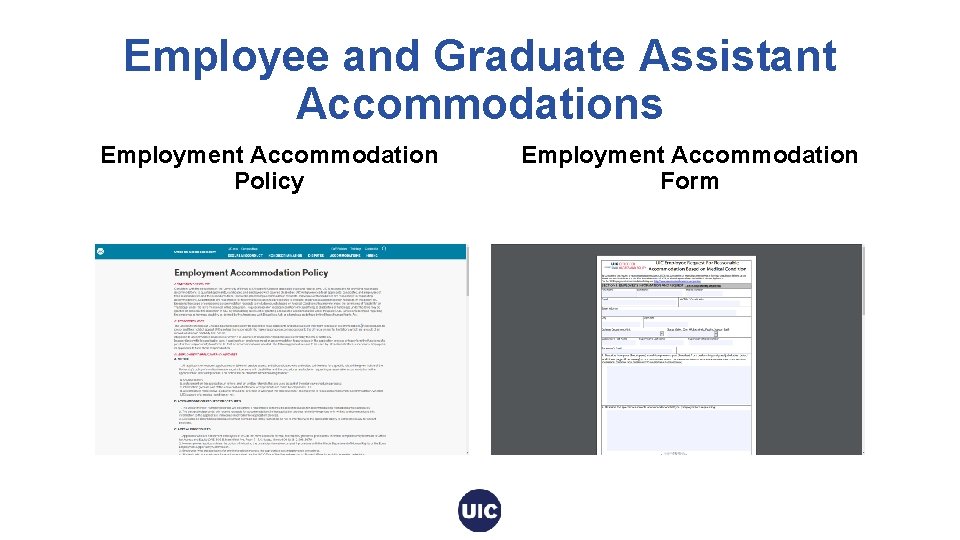
Employee and Graduate Assistant Accommodations Employment Accommodation Policy Employment Accommodation Form
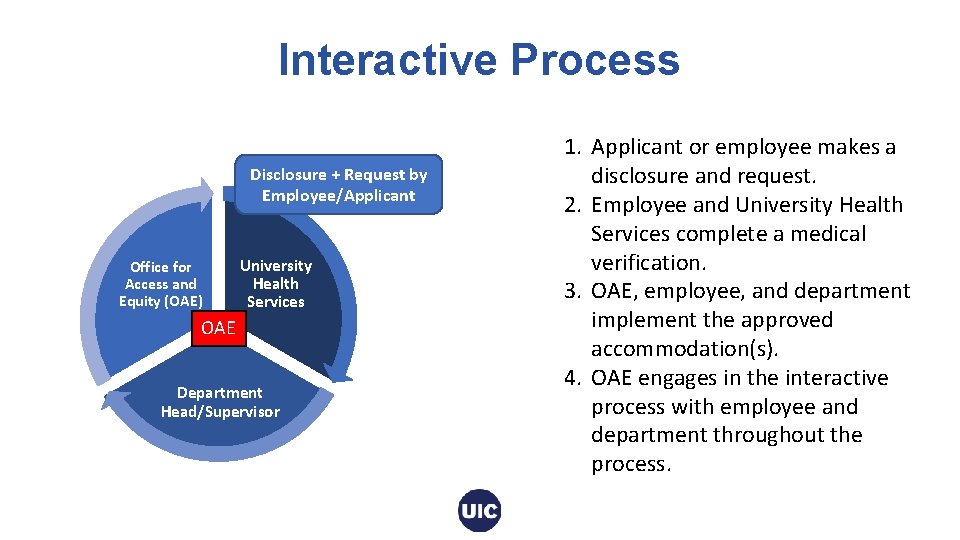
Interactive Process Disclosure + Request by Employee/Applicant Office for Access and Equity (OAE) University Health Services OAE Department Head/Supervisor 1. Applicant or employee makes a disclosure and request. 2. Employee and University Health Services complete a medical verification. 3. OAE, employee, and department implement the approved accommodation(s). 4. OAE engages in the interactive process with employee and department throughout the process.

Types of Reasonable Accommodations vary depending upon the individualized needs of the applicant or employee. Some examples are below. Modified Work Sites Accessible Facilities Assistive Devices Modified Work Schedules Revised Work Duties Providing Readers and Interpreters
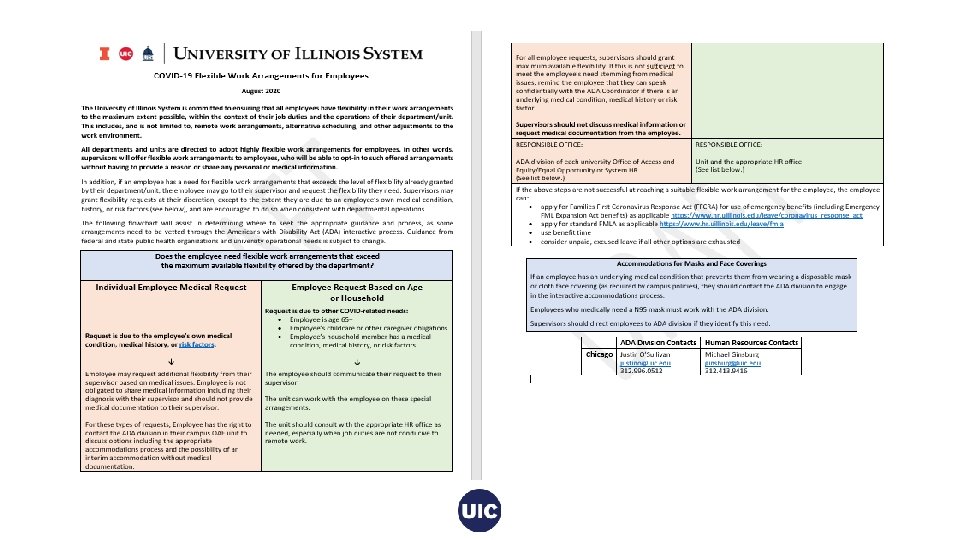
Guidelines on COVID-19 Flexible Work Arrangements for Employees The University of Illinois System is committed to ensuring that all employees have flexibility in their work arrangements to the maximum extent possible, within the context of their job duties and the operations of their department/unit. This includes, and is not limited to, remote work arrangements, alternative scheduling, and other adjustments to the work environment. The flowchart on our next slide will assist in determining where to seek the appropriate guidance and process, as some arrangements need to be vetted through the Americans with Disability Act (ADA) interactive process. Guidance from federal and state public health organizations and university operational needs is subject to change. For more information, please review the Guidelines on COVID-19 Flexible Work Arrangements for Employees document: https: //uofi. app. box. com/s/bfwpp 141 k 0 yjejcssmbrkmwgg 12 jzgnm
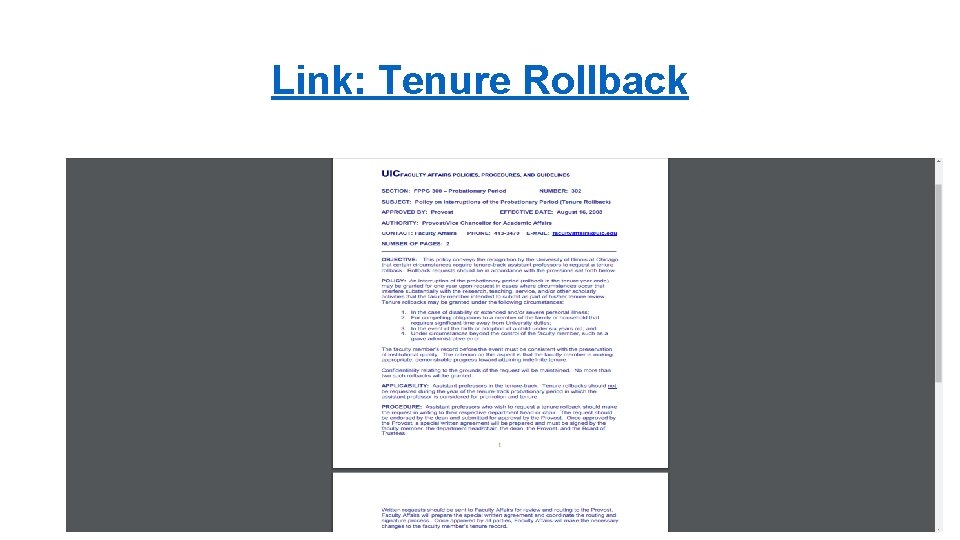
Link: Tenure Rollback
Summary: Reasonable Accommodation • The University has a legal obligation to provide reasonable accommodations based on disability or medical condition, pregnancy, and religion. • The Offices for Access and Equity facilitate the Interactive Process to review, approve, and implement reasonable accommodation requests.
DRC BASICS
Located in Suite 1070 of SSB 1200 W Harrison Street – remote for Fall 2020 http: //drc. uic. edu
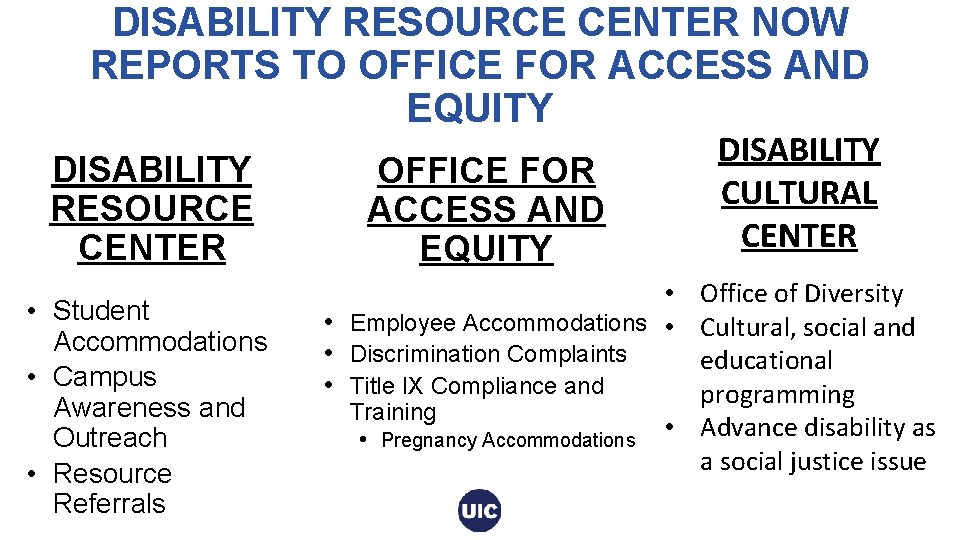
DISABILITY RESOURCE CENTER NOW REPORTS TO OFFICE FOR ACCESS AND EQUITY DISABILITY RESOURCE CENTER • Student Accommodations • Campus Awareness and Outreach • Resource Referrals OFFICE FOR ACCESS AND EQUITY DISABILITY CULTURAL CENTER • Office of Diversity • Employee Accommodations • Cultural, social and • Discrimination Complaints educational • Title IX Compliance and programming Training • Pregnancy Accommodations • Advance disability as a social justice issue
CONTEXT FOR DRC WORK
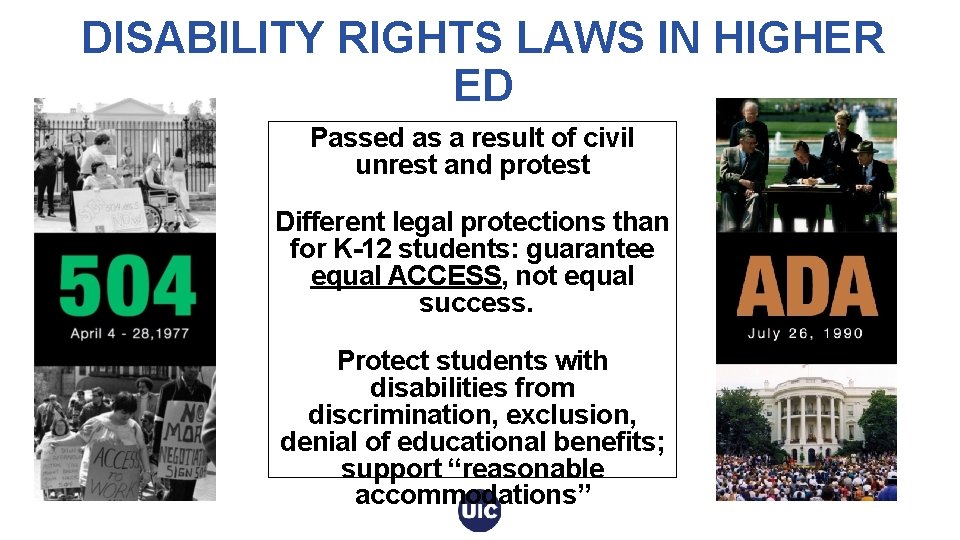
DISABILITY RIGHTS LAWS IN HIGHER ED Passed as a result of civil unrest and protest Different legal protections than for K-12 students: guarantee equal ACCESS, not equal success. Protect students with disabilities from discrimination, exclusion, denial of educational benefits; support “reasonable accommodations”
HOW DO WE DEFINE DISABILITY? Legally: a physical or mental impairment that substantially limits a major life function Medical Model: a diagnosis; a problem within a person that needs to be “fixed” Social model: environmental, attitudinal, and societal barriers cause disability Universal Design: building environments without barriers benefits everyone
REASONABLE ACCOMMODATIONS
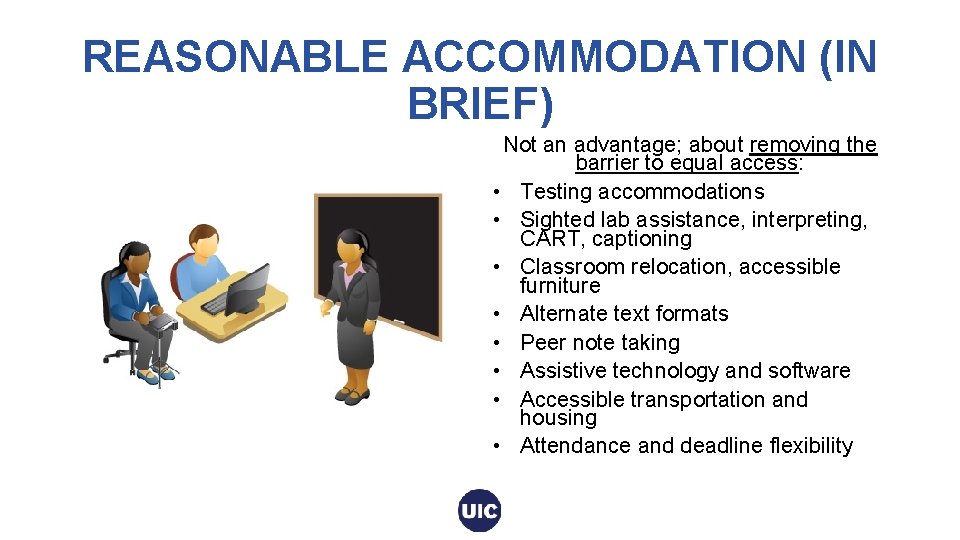
REASONABLE ACCOMMODATION (IN BRIEF) Not an advantage; about removing the barrier to equal access: • Testing accommodations • Sighted lab assistance, interpreting, CART, captioning • Classroom relocation, accessible furniture • Alternate text formats • Peer note taking • Assistive technology and software • Accessible transportation and housing • Attendance and deadline flexibility
REASONABLE ACCOMMODATIONS ARE NOT… • NOT of a personal nature (personal care attendant, mobility equipment, etc. ) • CANNOT pose a direct threat to student or others • CANNOT significantly alter curriculum (essential elements of course) • Based on curriculum, not speculation or generalizations about the field, workforce, “real world, ” etc. • Can only be denied after a fact-based and collaborative process – not unilaterally by instructor
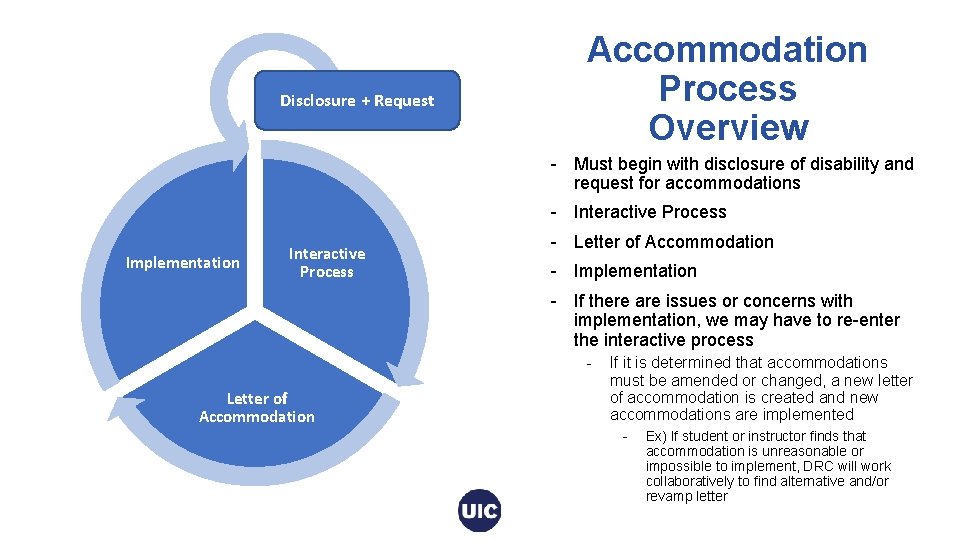
Disclosure + Request Accommodation Process Overview - Must begin with disclosure of disability and request for accommodations - Interactive Process Implementation Interactive Process - Letter of Accommodation - Implementation - If there are issues or concerns with implementation, we may have to re-enter the interactive process - Letter of Accommodation If it is determined that accommodations must be amended or changed, a new letter of accommodation is created and new accommodations are implemented - Ex) If student or instructor finds that accommodation is unreasonable or impossible to implement, DRC will work collaboratively to find alternative and/or revamp letter
IMPLEMENTING ACCOMMODATIONS
LETTER OF ACCOMMODATION Student will share Letter of Accommodation (LOA) with course instructor-- LOAs do not expire and instructors may receive them at any point during the semester. Accommodations are not retroactive – they are provided going forward from receipt of the LOA. The DRC is available if there any questions or issues with implementation for your particular course at drc@uic. edu and at (312) 413 -2183.
WHEN YOU RECEIVE AN LOA • Don’t feel pressure to respond immediately • Do not deny accommodations without contacting DRC. • Consider what you say: this conversation is sensitive, and jokes or off-hand remarks can be very impactful in this moment • Schedule a time to meet. Focus on accommodations (not diagnosis). Write down expectations. Call us if you need us!

COVID SPECIFIC CHALLENGES
Barriers to Access in Online Environments • Changing or new access needs • Complications with disclosure • Uneven accessibility on multimedia like videos and audio • Materials that are not optimized for screen-readers
ACCESSIBLE TEACHING & ACCOMMODATIONS ONLINE Check out the AAAC + DRC + DCC Guide! • Feedback Loops and Structured Flexibility • Access invitation using Referral Resources • Flexible approach with deadlines • Multimodal Learning & Assessment • Captions • Alternatives to timed close book tests • Text accessibility • Alt Text • Accessible Word, PPT, PDF docs
MORE RESOURCES Disability Resource Center Website: Guide to Accommodations Disability Cultural Center Website: Accessible Teaching resources Online Events Accessibility Guide (DCC + DCC)
QUESTIONS? Disability Resource Center | Office of Access and Equity
- Slides: 30