
Supporting student requests for accommodations on USMLE exams
- Slides: 23
Supporting student requests for accommodations on USMLE exams Neera R. Jain, MS, CRC University of California, San Francisco Lisa M. Meeks, Ph. D University of California, San Francisco School of Medicine Jayme Bograd AAMC The presenters’ views and opinions are their own and do not necessarily reflect the position of the AAMC.
The Coalition and the UCSF School of Medicine wish to thank the AAMC for their generous support in developing this webinar series.
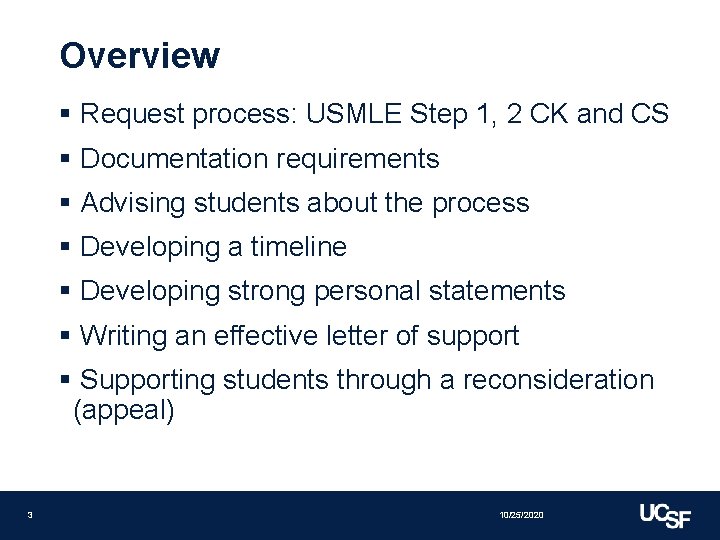
Overview § Request process: USMLE Step 1, 2 CK and CS § Documentation requirements § Advising students about the process § Developing a timeline § Developing strong personal statements § Writing an effective letter of support § Supporting students through a reconsideration (appeal) 3 10/25/2020
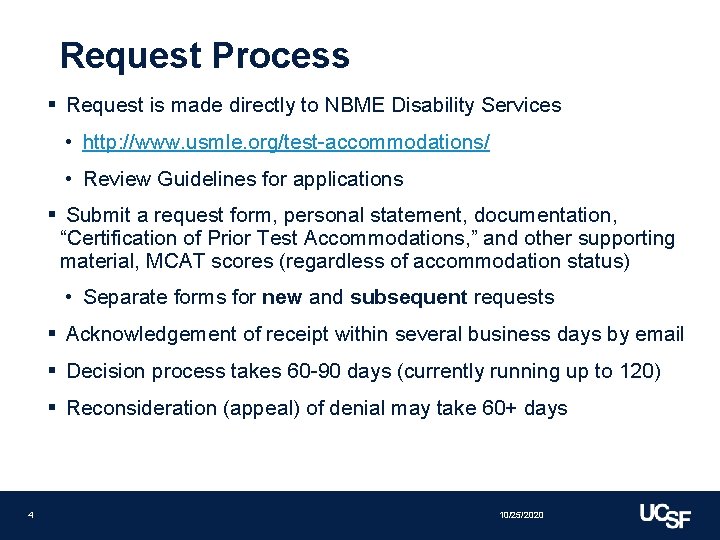
Request Process § Request is made directly to NBME Disability Services • http: //www. usmle. org/test-accommodations/ • Review Guidelines for applications § Submit a request form, personal statement, documentation, “Certification of Prior Test Accommodations, ” and other supporting material, MCAT scores (regardless of accommodation status) • Separate forms for new and subsequent requests § Acknowledgement of receipt within several business days by email § Decision process takes 60 -90 days (currently running up to 120) § Reconsideration (appeal) of denial may take 60+ days 4 10/25/2020
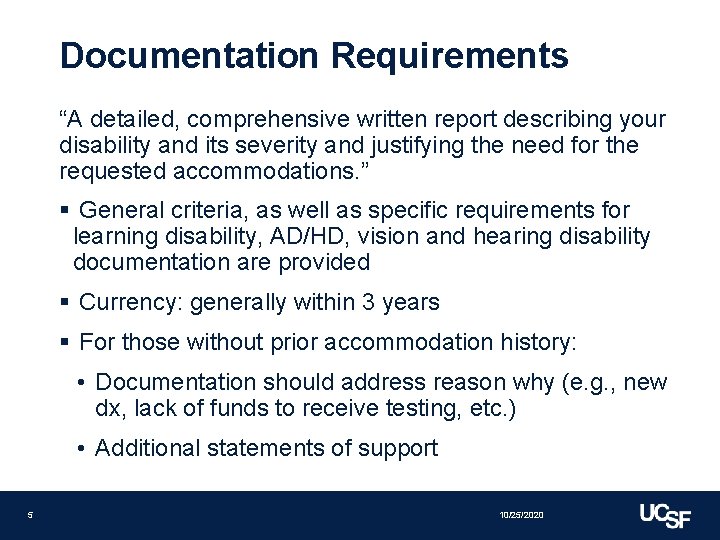
Documentation Requirements “A detailed, comprehensive written report describing your disability and its severity and justifying the need for the requested accommodations. ” § General criteria, as well as specific requirements for learning disability, AD/HD, vision and hearing disability documentation are provided § Currency: generally within 3 years § For those without prior accommodation history: • Documentation should address reason why (e. g. , new dx, lack of funds to receive testing, etc. ) • Additional statements of support 5 10/25/2020
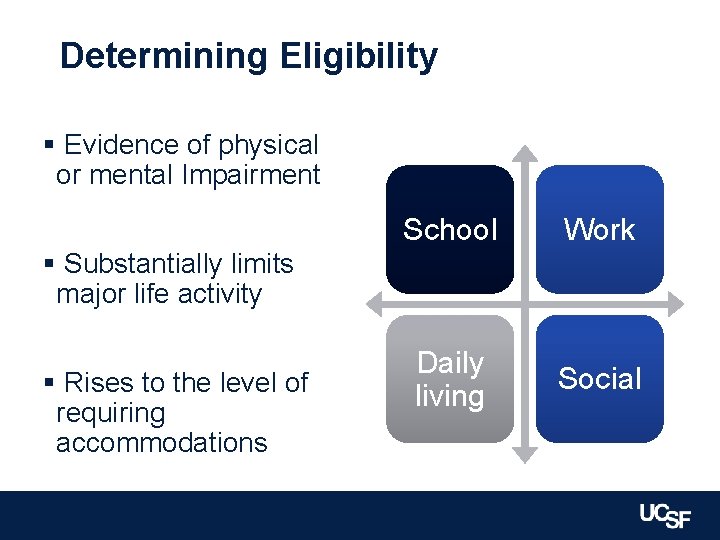
Determining Eligibility § Evidence of physical or mental Impairment School Work Daily living Social § Substantially limits major life activity § Rises to the level of requiring accommodations
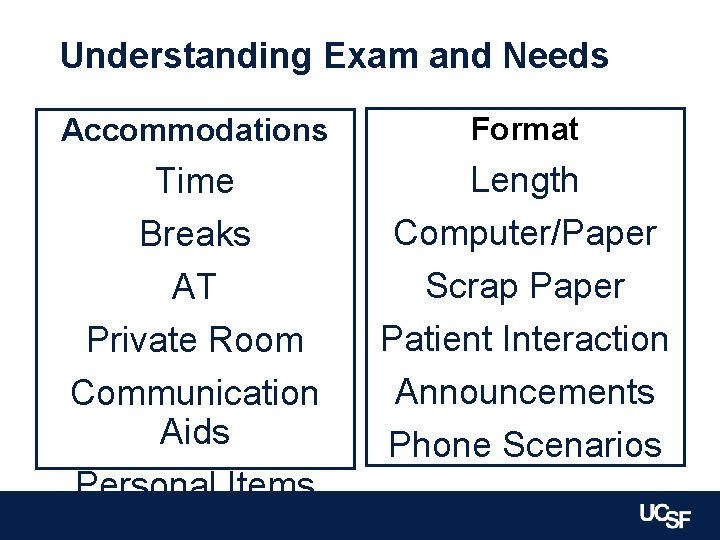
Understanding Exam and Needs Accommodations Format Time Breaks AT Private Room Communication Aids Personal Items Length Computer/Paper Scrap Paper Patient Interaction Announcements Phone Scenarios
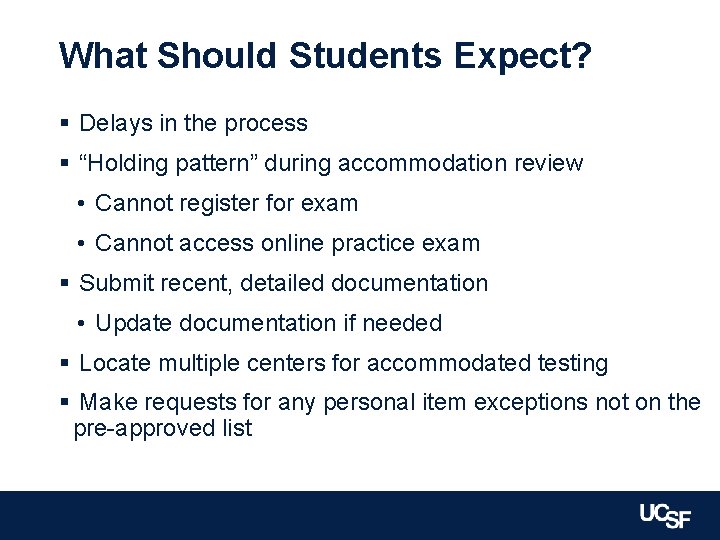
What Should Students Expect? § Delays in the process § “Holding pattern” during accommodation review • Cannot register for exam • Cannot access online practice exam § Submit recent, detailed documentation • Update documentation if needed § Locate multiple centers for accommodated testing § Make requests for any personal item exceptions not on the pre-approved list
Start as soon as they walk in the door
Why Start Early? § 2 nd year gets hectic § Putting off application causes stress § Historical information gathering takes time § Process of applying takes up to 10 months § Potential waitlist for evaluators § Limited free time § Cost of assessments § Psychological impact of writing the personal statement § Revisions for personal statement (2 -3) § Collecting letters of support
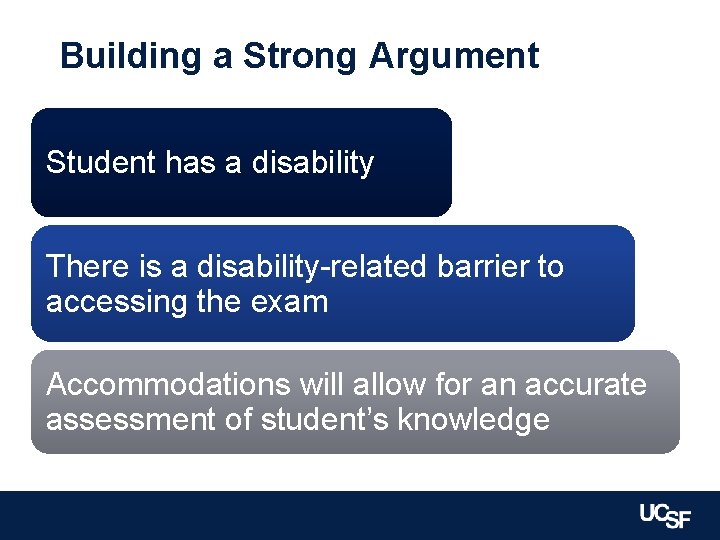
Building a Strong Argument Student has a disability There is a disability-related barrier to accessing the exam Accommodations will allow for an accurate assessment of student’s knowledge
How You Can Support § Work with students to begin a file of historical documentation at the DS office § Evaluate documentation with an eye to NBME requirements § Set an ideal timeline for students to begin working on their application… send reminders § Be available to review drafts of personal statements and answer any questions § Write a strong letter of support
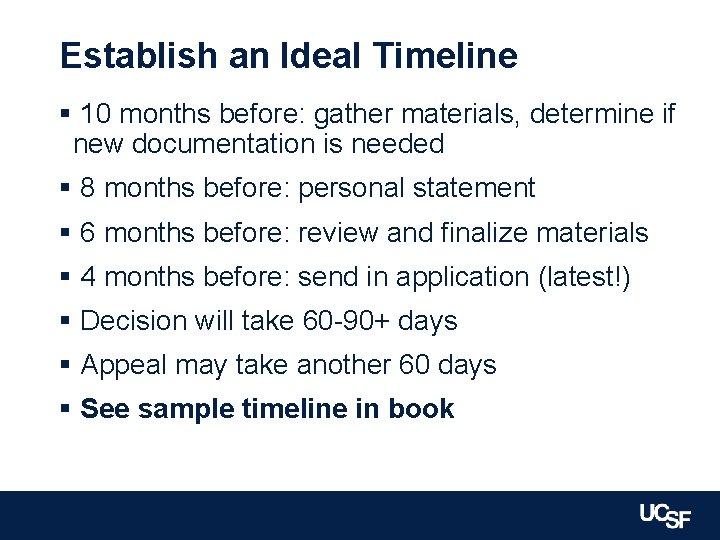
Establish an Ideal Timeline § 10 months before: gather materials, determine if new documentation is needed § 8 months before: personal statement § 6 months before: review and finalize materials § 4 months before: send in application (latest!) § Decision will take 60 -90+ days § Appeal may take another 60 days § See sample timeline in book
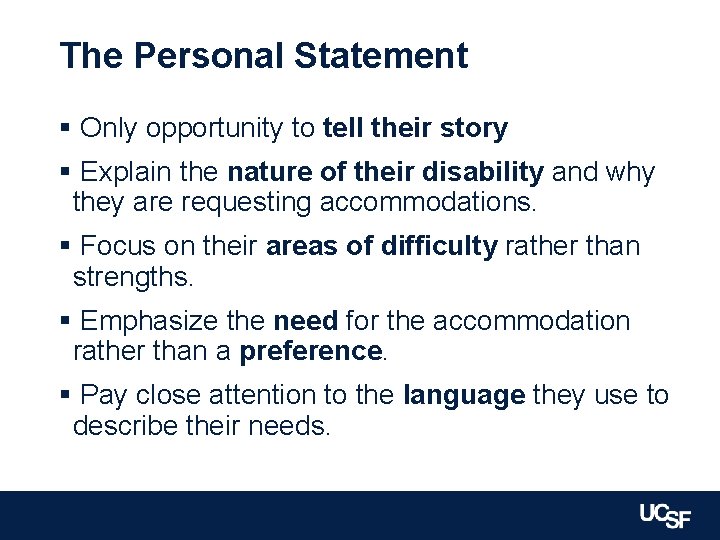
The Personal Statement § Only opportunity to tell their story § Explain the nature of their disability and why they are requesting accommodations. § Focus on their areas of difficulty rather than strengths. § Emphasize the need for the accommodation rather than a preference. § Pay close attention to the language they use to describe their needs.
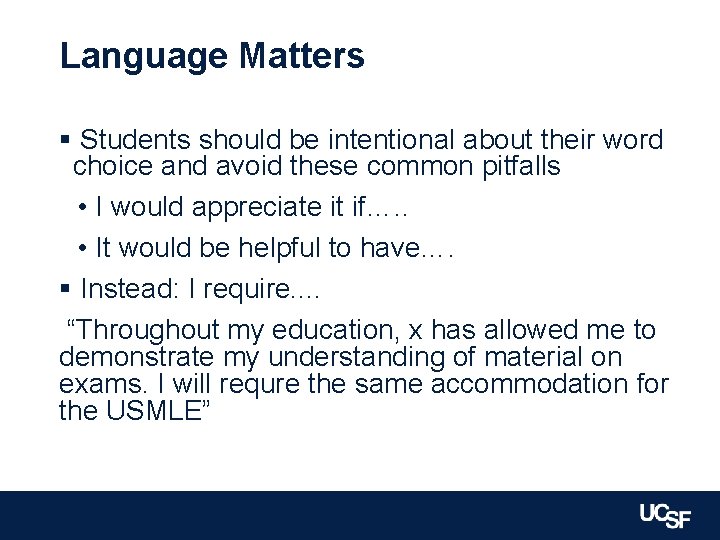
Language Matters § Students should be intentional about their word choice and avoid these common pitfalls • I would appreciate it if…. . • It would be helpful to have…. § Instead: I require. . “Throughout my education, x has allowed me to demonstrate my understanding of material on exams. I will requre the same accommodation for the USMLE”
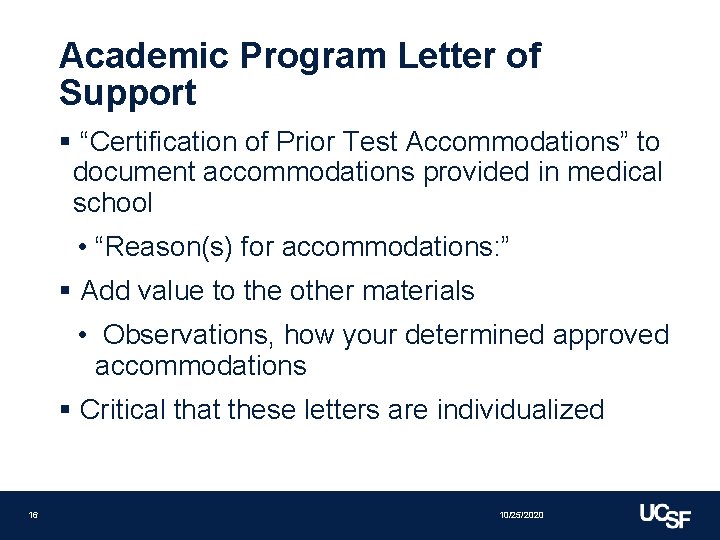
Academic Program Letter of Support § “Certification of Prior Test Accommodations” to document accommodations provided in medical school • “Reason(s) for accommodations: ” § Add value to the other materials • Observations, how your determined approved accommodations § Critical that these letters are individualized 16 10/25/2020
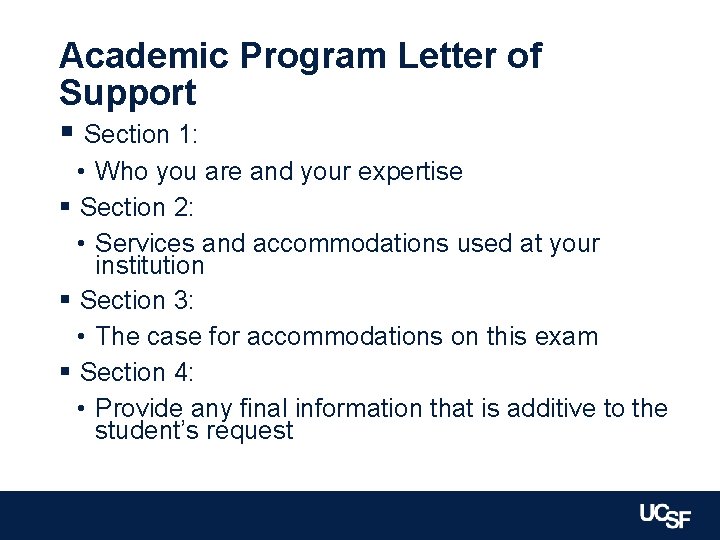
Academic Program Letter of Support § Section 1: • Who you are and your expertise § Section 2: • Services and accommodations used at your institution § Section 3: • The case for accommodations on this exam § Section 4: • Provide any final information that is additive to the student’s request
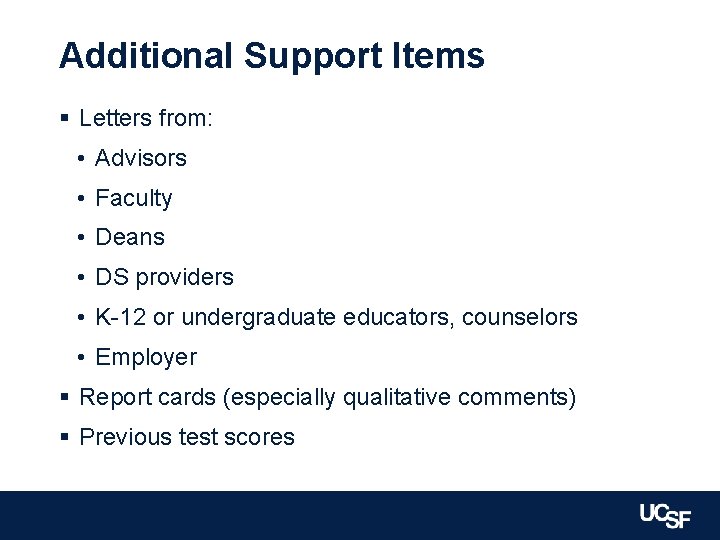
Additional Support Items § Letters from: • Advisors • Faculty • Deans • DS providers • K-12 or undergraduate educators, counselors • Employer § Report cards (especially qualitative comments) § Previous test scores
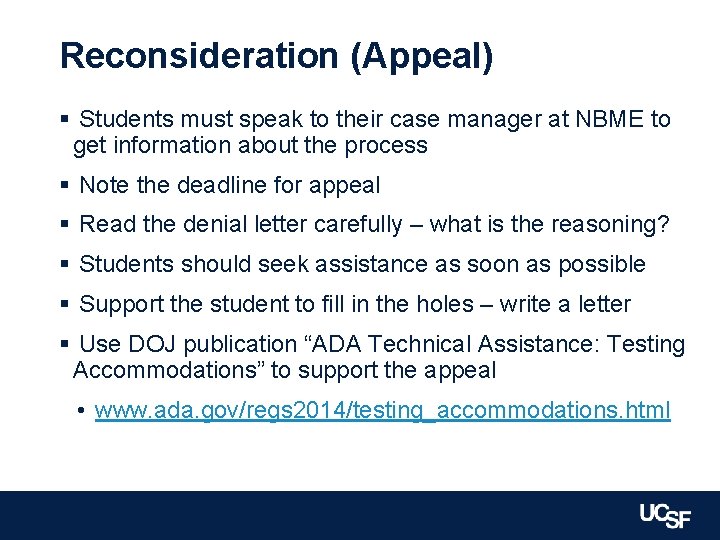
Reconsideration (Appeal) § Students must speak to their case manager at NBME to get information about the process § Note the deadline for appeal § Read the denial letter carefully – what is the reasoning? § Students should seek assistance as soon as possible § Support the student to fill in the holes – write a letter § Use DOJ publication “ADA Technical Assistance: Testing Accommodations” to support the appeal • www. ada. gov/regs 2014/testing_accommodations. html
Reference This presentation is informed by: Jain, N. R. , Lewis, C. , Meeks, L. M. & Tucker, T. H. (2015). Requesting Accommodations on Standardized Exams. In L. M. Meeks & N. R. Jain (Eds. ). The Guide to Assisting Students With Disabilities: Equal Access in Health Science and Professional Education (pp. 89 -113). New York, NY: Springer Publishing. Where indicated, handouts are copyrighted material from this chapter, provided for educational purposes. 20 Coalition for Disability Access in Graduate Health Science and Medical Education 10/25/2020
Questions? 21 10/25/2020
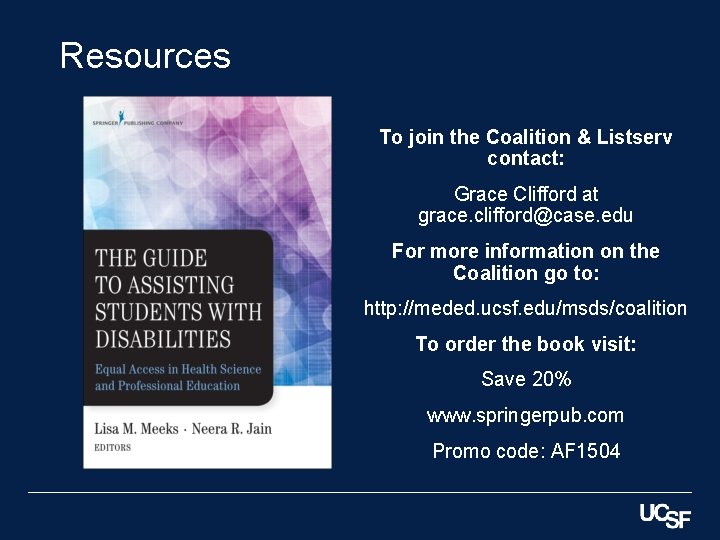
Resources To join the Coalition & Listserv contact: Grace Clifford at grace. clifford@case. edu For more information on the Coalition go to: http: //meded. ucsf. edu/msds/coalition To order the book visit: Save 20% www. springerpub. com Promo code: AF 1504
Stay tuned forthcoming webinars. § Details and Registration: § www. aamc. org/gsa