
Supporting Standards Group Activities and Challenges Supporting Standards
- Slides: 21
Supporting Standards Group Activities and Challenges Supporting Standards Group 19 November 2019 Geneva, Swtizerland .
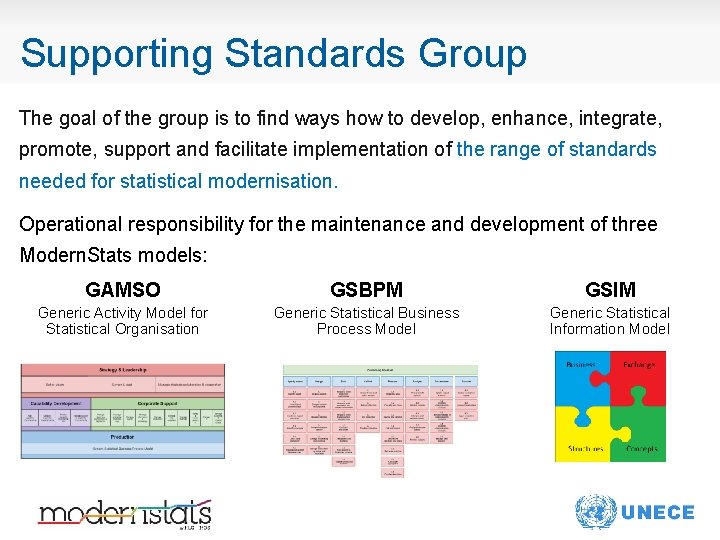
Supporting Standards Group The goal of the group is to find ways how to develop, enhance, integrate, promote, support and facilitate implementation of the range of standards needed for statistical modernisation. Operational responsibility for the maintenance and development of three Modern. Stats models: GAMSO GSBPM GSIM Generic Activity Model for Statistical Organisation Generic Statistical Business Process Model Generic Statistical Information Model
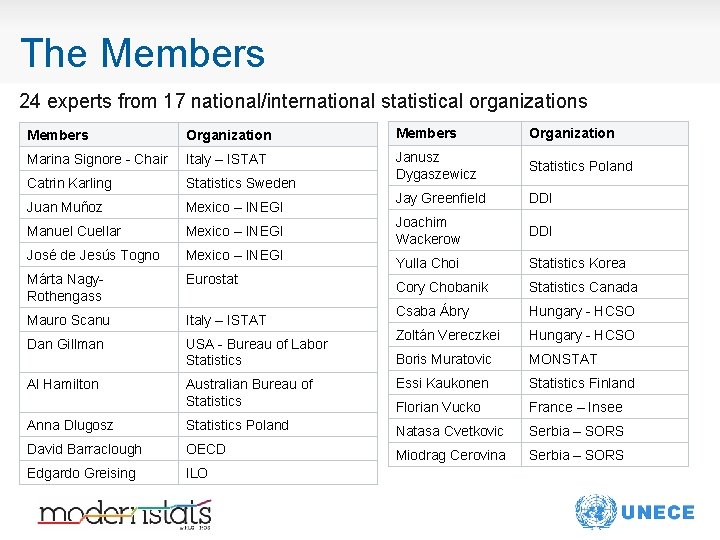
The Members 24 experts from 17 national/international statistical organizations Members Organization Marina Signore - Chair Italy – ISTAT Statistics Poland Catrin Karling Statistics Sweden Janusz Dygaszewicz Juan Muñoz Mexico – INEGI Jay Greenfield DDI Manuel Cuellar Mexico – INEGI Joachim Wackerow DDI José de Jesús Togno Mexico – INEGI Yulla Choi Statistics Korea Márta Nagy. Rothengass Eurostat Cory Chobanik Statistics Canada Mauro Scanu Italy – ISTAT Csaba Ábry Hungary - HCSO Dan Gillman USA - Bureau of Labor Statistics Zoltán Vereczkei Hungary - HCSO Boris Muratovic MONSTAT Al Hamilton Australian Bureau of Statistics Essi Kaukonen Statistics Finland Florian Vucko France – Insee Anna Dlugosz Statistics Poland Natasa Cvetkovic Serbia – SORS David Barraclough OECD Miodrag Cerovina Serbia – SORS Edgardo Greising ILO
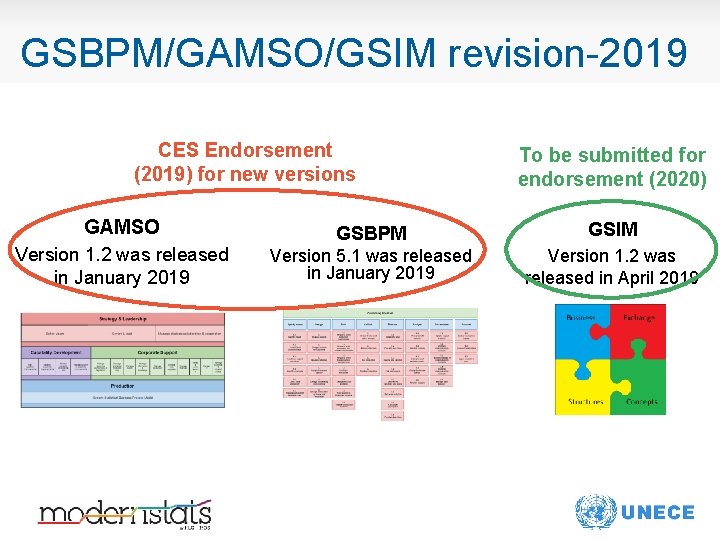
GSBPM/GAMSO/GSIM revision-2019 CES Endorsement (2019) for new versions To be submitted for endorsement (2020) GAMSO GSBPM GSIM Version 1. 2 was released in January 2019 Version 5. 1 was released in January 2019 Version 1. 2 was released in April 2019
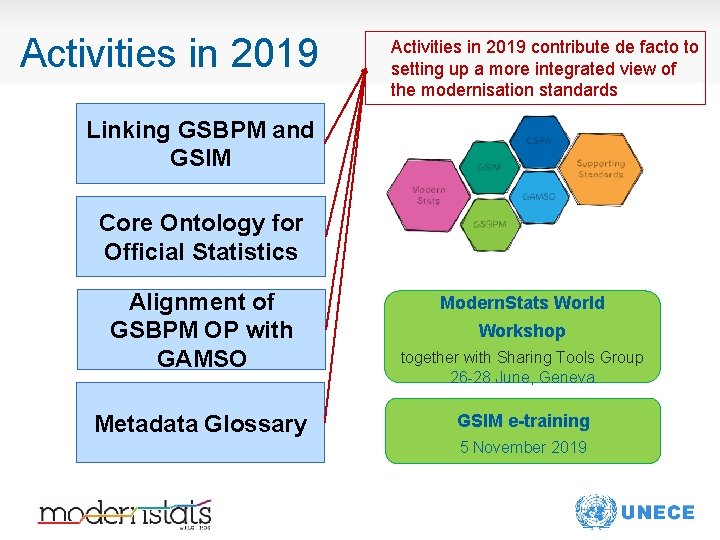
Activities in 2019 contribute de facto to setting up a more integrated view of the modernisation standards Linking GSBPM and GSIM Core Ontology for Official Statistics Alignment of GSBPM OP with GAMSO Metadata Glossary Modern. Stats World Workshop together with Sharing Tools Group 26 -28 June, Geneva GSIM e-training 5 November 2019
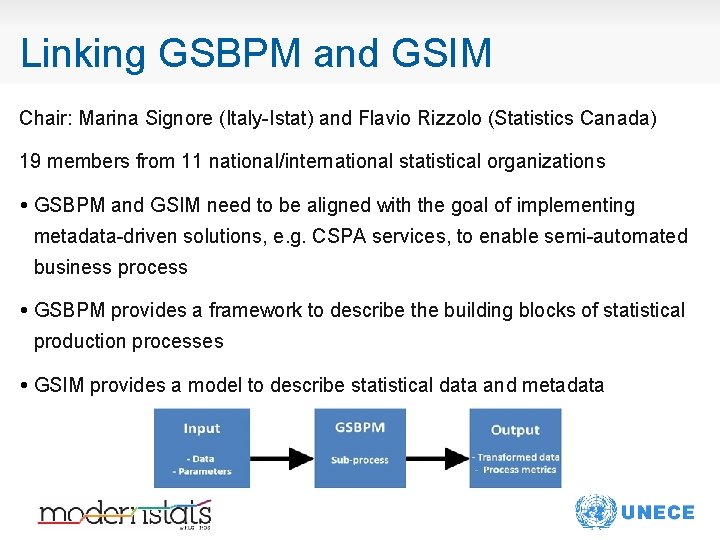
Linking GSBPM and GSIM Chair: Marina Signore (Italy-Istat) and Flavio Rizzolo (Statistics Canada) 19 members from 11 national/international statistical organizations • GSBPM and GSIM need to be aligned with the goal of implementing metadata-driven solutions, e. g. CSPA services, to enable semi-automated business process • GSBPM provides a framework to describe the building blocks of statistical production processes • GSIM provides a model to describe statistical data and metadata
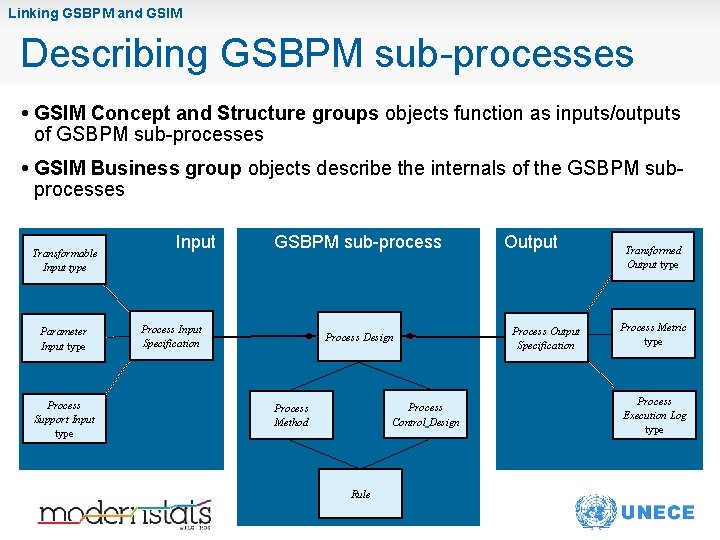
Linking GSBPM and GSIM Describing GSBPM sub-processes • GSIM Concept and Structure groups objects function as inputs/outputs of GSBPM sub-processes • GSIM Business group objects describe the internals of the GSBPM subprocesses Transformable Input type Parameter Input type Process Support Input type Input GSBPM sub-process Process Input Specification Process Design Process Control Design Process Method Rule Output Process Output Specification Transformed Output type Process Metric type Process Execution Log type
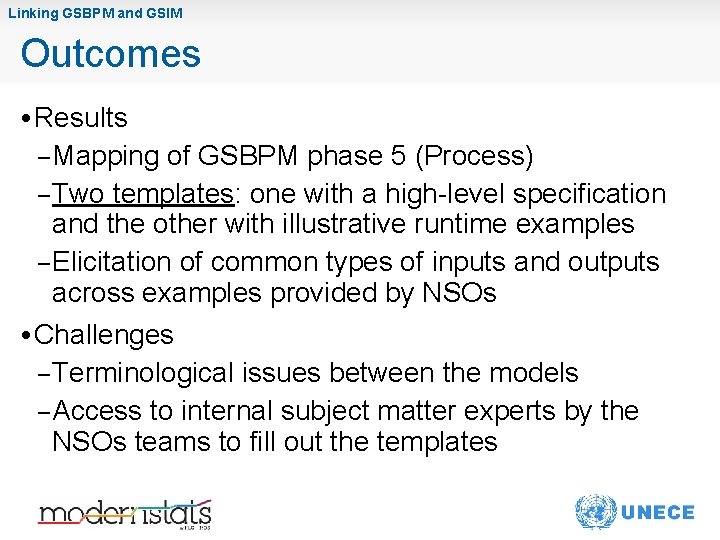
Linking GSBPM and GSIM Outcomes • Results – Mapping of GSBPM phase 5 (Process) – Two templates: one with a high-level specification and the other with illustrative runtime examples – Elicitation of common types of inputs and outputs across examples provided by NSOs • Challenges – Terminological issues between the models – Access to internal subject matter experts by the NSOs teams to fill out the templates
Core Ontology for Official Statistics Chair: Franck Cotton (France-Insee) 12 members from 7 national/international statistical organizations Modern. Stats standards A lot of models, frameworks: GSBPM, GSIM, GSDEM, GAMSO, CSPA, CSDA… Problems: Not always formally defined (e. g. GSBPM, GAMSO. . . ) Conceived separately and not always perfectly aligned No link to external models or standards Harmonisation work started in the Supporting Standards group The COOS is part of this effort
Core Ontology for Official Statistics Development • Objectives Link Modern. Stats Models to one another Link with external models (SKOS, PROV-O, ORG…) Provide machine-actionable version of main features of the models • Timetable 2017: first proof of concept November 2018: activity launched Today: first version of ontology created by working group Next HLG-MOS workshop (end of November) to greenlight next steps
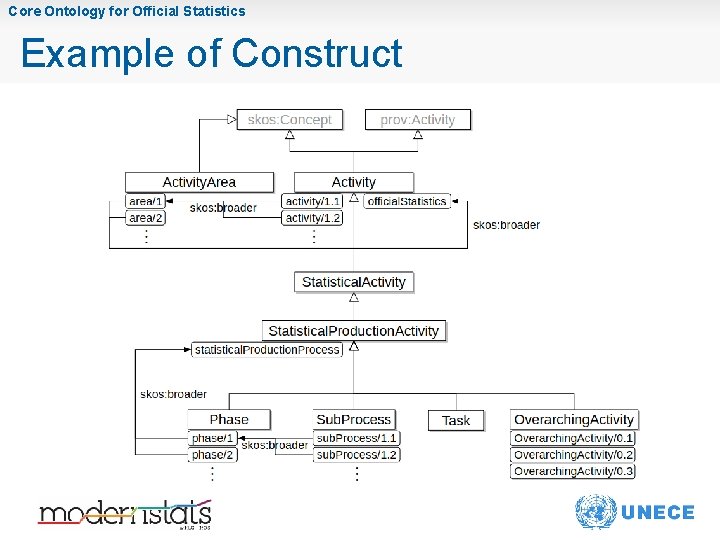
Core Ontology for Official Statistics Example of Construct
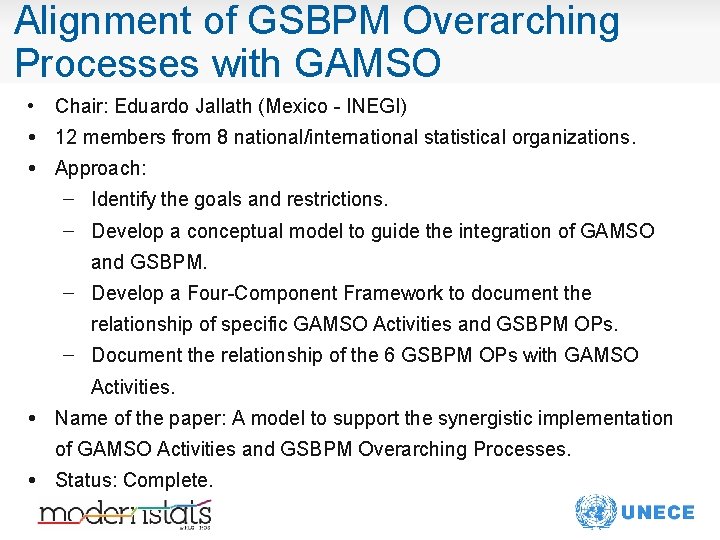
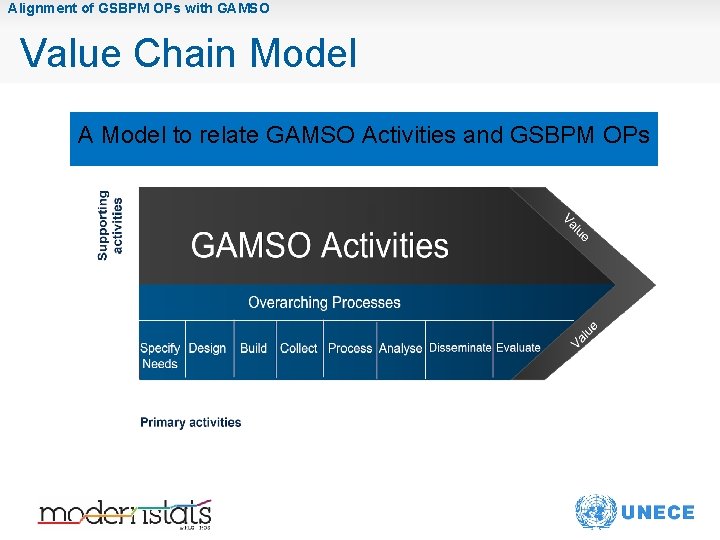
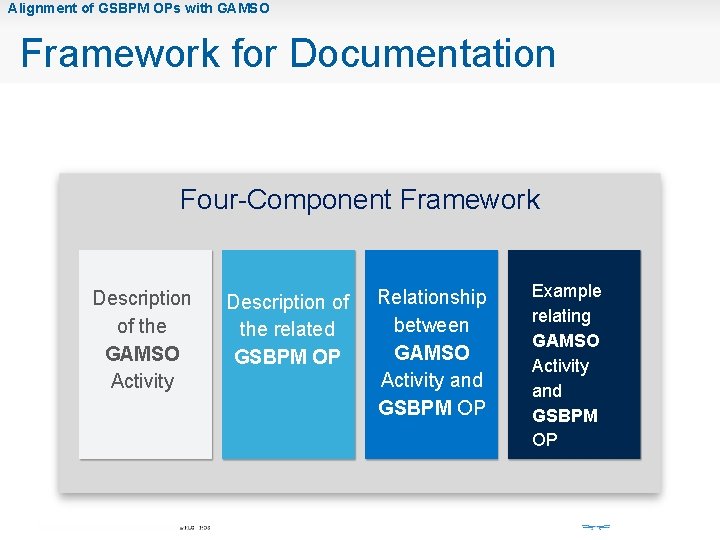
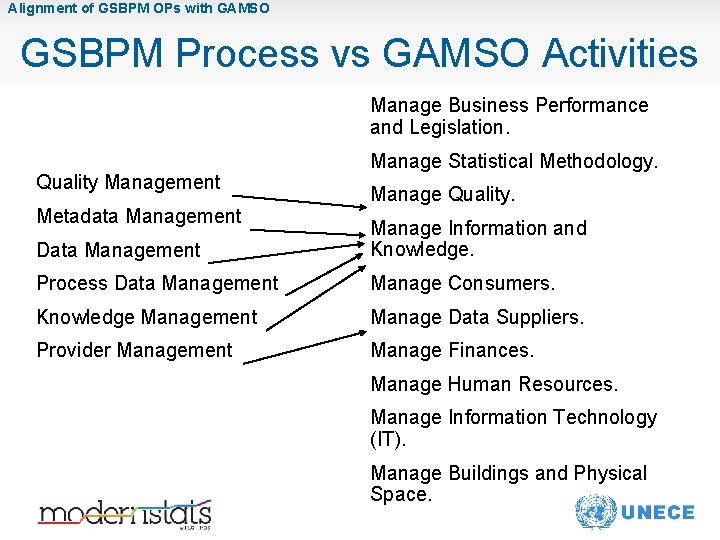
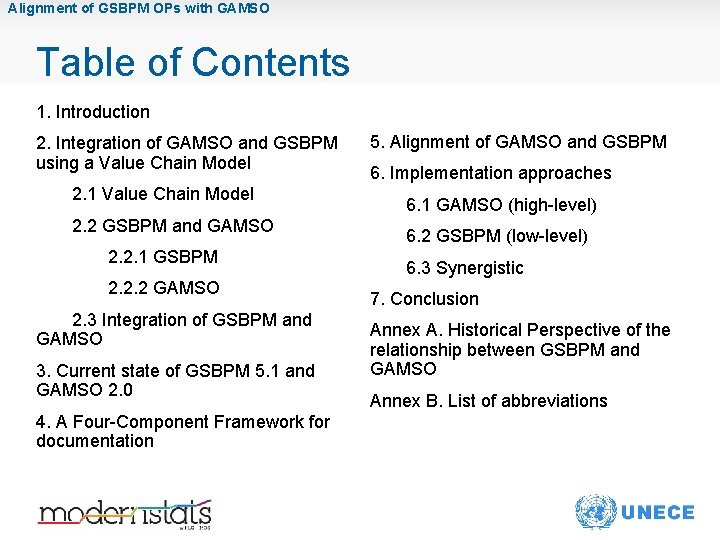
Alignment of GSBPM Overarching Processes with GAMSO • Chair: Eduardo Jallath (Mexico - INEGI) • 12 members from 8 national/international statistical organizations. • Approach: – Identify the goals and restrictions. – Develop a conceptual model to guide the integration of GAMSO and GSBPM. – Develop a Four-Component Framework to document the relationship of specific GAMSO Activities and GSBPM OPs. – Document the relationship of the 6 GSBPM OPs with GAMSO Activities. • Name of the paper: A model to support the synergistic implementation of GAMSO Activities and GSBPM Overarching Processes. • Status: Complete.
Alignment of GSBPM OPs with GAMSO Value Chain Model A Model to relate GAMSO Activities and GSBPM OPs
Alignment of GSBPM OPs with GAMSO Framework for Documentation Four-Component Framework Description of the GAMSO Activity Description of the related GSBPM OP Relationship between GAMSO Activity and GSBPM OP Example relating GAMSO Activity and GSBPM OP
Alignment of GSBPM OPs with GAMSO GSBPM Process vs GAMSO Activities Manage Business Performance and Legislation. Quality Management Metadata Management Manage Statistical Methodology. Manage Quality. Data Management Manage Information and Knowledge. Process Data Management Manage Consumers. Knowledge Management Manage Data Suppliers. Provider Management Manage Finances. Manage Human Resources. Manage Information Technology (IT). Manage Buildings and Physical Space.
Alignment of GSBPM OPs with GAMSO Table of Contents 1. Introduction 2. Integration of GAMSO and GSBPM using a Value Chain Model 2. 1 Value Chain Model 2. 2 GSBPM and GAMSO 2. 2. 1 GSBPM 2. 2. 2 GAMSO 2. 3 Integration of GSBPM and GAMSO 3. Current state of GSBPM 5. 1 and GAMSO 2. 0 4. A Four-Component Framework for documentation 5. Alignment of GAMSO and GSBPM 6. Implementation approaches 6. 1 GAMSO (high-level) 6. 2 GSBPM (low-level) 6. 3 Synergistic 7. Conclusion Annex A. Historical Perspective of the relationship between GSBPM and GAMSO Annex B. List of abbreviations
Metadata Glossary Chair: Dan Gillman (USA-Bureau of Labour Statistics) 11 members from 8 national/international statistical organizations Approach: • Intended to be a central, unified and definitive source for the terms and definitions in the Modern. Stats Models • Disambiguation between homographs (same spelling, slightly different meanings) and identification of synonyms (different spelling, same or similar meanings) • Planned output: alphabetically organized list or terms, their definitions, sources for the definitions, source of the term (in which standard(s) does it appear), explanatory text that further contextualizes the meaning, and references to other similar, broader, and narrower terms
Metadata Glossary • Completed review of terms of GAMSO and GSBPM • Current Work in 2019 – Review of GSIM terms – Assess definitions based upon • Principles for definition writing • Technical content – Recommend changes, if needed • Provide comments to GSIM discussion forum – Approximately 150 GSIM terms – Reviewed about half terms so far – Expected completion: April 2020
GSIM e-training Presenters: Jenny Linnerud (Statistics Norway), Catrin Karling, Patrik Wahlgren (Statistics Sweden), Mikko Saloila, Essi Kaukonen (Statistics Finland), Giorgia Simeoni, Mauro Scanu (Italy-Istat), Francine Kalonji (Statistics Canada) Registered participants: 146 from 25 national/international statistical organizations – One day training course – Very well balanced between explanations of the model and examples of countries implementation – The package (presentations and slides) available on the wiki
Future activities and challenges 7 Activity proposals submitted by the Supporting Standards Group § 3 are continuation of 2019 activities § 4 are proposals for new activities following needs expressed by countries, emerged from discussion at Modern. Stat Workshop or from 2019 activities § quite ambitious program which reflects the great interest of Statistical Organisations around Modern. Stats Models § important not to loose the momentum: the interest is high because several organisations are now implementing the models and need support
Acknowledgments ü Experts committed in the work of the Supporting Standards Group (not always Members of Supporting Standards!) ü Chairs of the task teams üUnece and Inkyung Choi for her invaluable support