
Supporting Staff in the Presence of Unacceptable behaviour
'Supporting Staff in the Presence of Unacceptable behaviour'. Hosted by St Christopher’s Hospice Monday 11 th December 2017
Introduction & welcome
'Supporting Staff in the Presence of Unacceptable behaviour'. Disruptive (unacceptable) behaviours in residential care can pose a significant challenge to staff attempting to support residents with personal care. At the same time the behaviour could present a risk for residents to achieve a satisfying transition into a new care environment, and/or to their quality of life. It can often be a major source for work-related stress for staff. (NHS
What can you do to ‘manage’ or ‘prevent’ behaviours staff find unacceptable
Firstly consider the impact on staff Then lets consider what types of behaviours and their possible causes
How to help staff after encountering behaviour that they have experienced as unacceptable • Acknowledge the person’s feelings about what has happened – encourage them to talk about the incident • If your staff are upset or shaken after what has happened provide them with support – talk about what happened and acknowledge how they are feeling. Allow staff time to recover. • Encourage staff not to judge the person harshly for what has happened being aggressive may be the only way a person with dementia for example, can let us know how they are feeling. • Reassure staff not to take it personally or feel that they have failed. However if it is understood that it was something they did which contributed to the person’s distress, try to learn from this and build this into a learning opportunity. • Encourage the person to record the incident
More ways to assist staff • Schedule a staff forum to share what has happened and collectively consider - Analysing the behaviour - A reflective session to unravel the possible causes and agree a collective response - Learn from other staff who may have ‘managed’ - Have an action plan and review the action plan
Suggestions for organizations • Organisational actions: design, recruit and retain a workforce that is equipped to support people whose behaviour can be unacceptable • Build a resource to support staff skills and knowledge: Q. what competencies and qualities do organisations need to recruit and train their workforce to meet the needs of their residents. • Offer targeted training to staff with follow up
Reported experiences of staff to behaviour they find unacceptable Care staff have reported that a significant proportion of their colleagues often display such emotional reactions as sadness, despair, anger, annoyance, fear and disgust to episodes of challenging behaviour by residents. Care staff reported that the most significant sources of stress were associated with caring for someone with difficult behaviours centred upon the ‘daily grind’ of caring, their difficulty in understanding the person's behaviour, the unpredictability of the behaviour and the apparent absence of an effective way forward.
Possible ways of Preventing and Responding to Behaviours considered by staff as “unacceptable ” Observe to see if there is a pattern to the behaviour Learn what triggers certain responses Use de escalation techniques Maintain a ABC chart Communicate clearly and remain calm using methods appropriate to their abilities Don’t allow scapegoating to occur Ensure you have risk assessments in place Enlist the support of other professionals
The term ‘unacceptable OR challenging behaviour’ is often used as a description, diagnostic pseudonym when representing a diverse oppositional repertoire of many aetiologies (reason for) Temperamental Behaviours • Disruptive, offensive or behaviour • Frustration, Irritability & restlessness, insecurity and impulsivity • Previous characteristics or personality or troubled past history • Response to pain / discomfort which the individual cannot express Environmental Response • Unawareness of the setting in which the behaviour is exhibited • Unconscious recollection of a past event which has triggered current behaviour • Misunderstanding of an accent of the care giver/tone of voice/speed of delivery of communication • Communicate dissatisfaction with their environment or lack of support
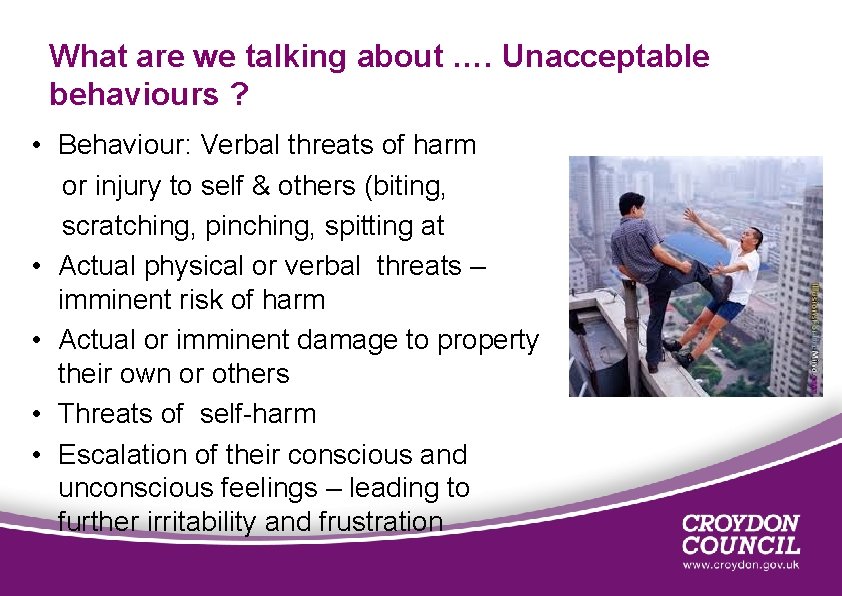
What are we talking about …. Unacceptable behaviours ? • Behaviour: Verbal threats of harm or injury to self & others (biting, scratching, pinching, spitting at • Actual physical or verbal threats – imminent risk of harm • Actual or imminent damage to property their own or others • Threats of self-harm • Escalation of their conscious and unconscious feelings – leading to further irritability and frustration
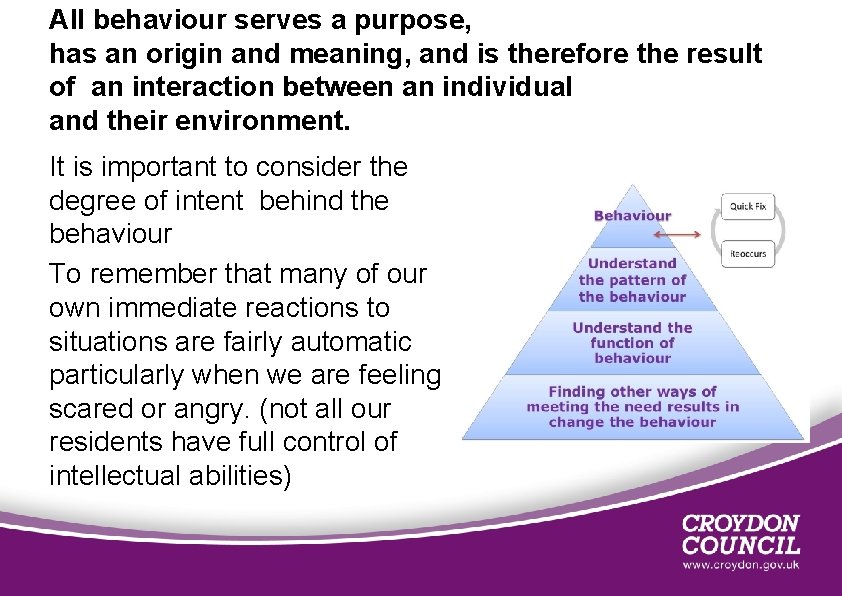
All behaviour serves a purpose, has an origin and meaning, and is therefore the result of an interaction between an individual and their environment. It is important to consider the degree of intent behind the behaviour To remember that many of our own immediate reactions to situations are fairly automatic particularly when we are feeling scared or angry. (not all our residents have full control of intellectual abilities)
Suggested strategies for responding to unacceptable behaviours - The Do’s & Don’t’s • Interventions should always be based on a systematic assessment of the behaviour. (It is important to have a good idea about the cause of the behaviour before trying to change it. ) • Don’t respond in a abrupt and hasty way • Don’t raise your voice in response • Take time to discuss with colleagues any signals – there is usually a trigger or warning sign • Enlist the support of positive support plans • Interventions should be developed to maximise a person’s quality of life, rather than to suppress an unwanted or unacceptable behaviour. • Interventions should never be restrictive but (proportionate) • Take an interest in and learn about the person (what makes them happy) • Be consistent as a staff team
Key Messages ……. • Communication is a two-way process • All behaviours are a means of communication • Unfamiliarity with places, people, smells and contexts can result in frustration, distress, confusion and fear of the unknown • Insensitive approaches by staff can lead to a strong response and exacerbation of the behaviour • Take staff feelings and experiences into account otherwise it may result in stress and H & S, or resignation
Important resources available for reference and guidance - there are lots of resources • Supporting staff working with people who challenge services www. skillsforcare. org. uk • Preventing and Responding to Aggressive Behaviours (Dementia Training 2016) • Clinically related challenging behavior – NHS Consultation 2013 • The ABC Chart : www. the challenging behaviours foundation
- Slides: 16