
Supporting service users with their medicines Lesley Edgar
























- Slides: 70
Supporting service users with their medicines Lesley Edgar NICE Implementation Facilitator NI © NICE 2020. All rights reserved. Subject to notice of rights.
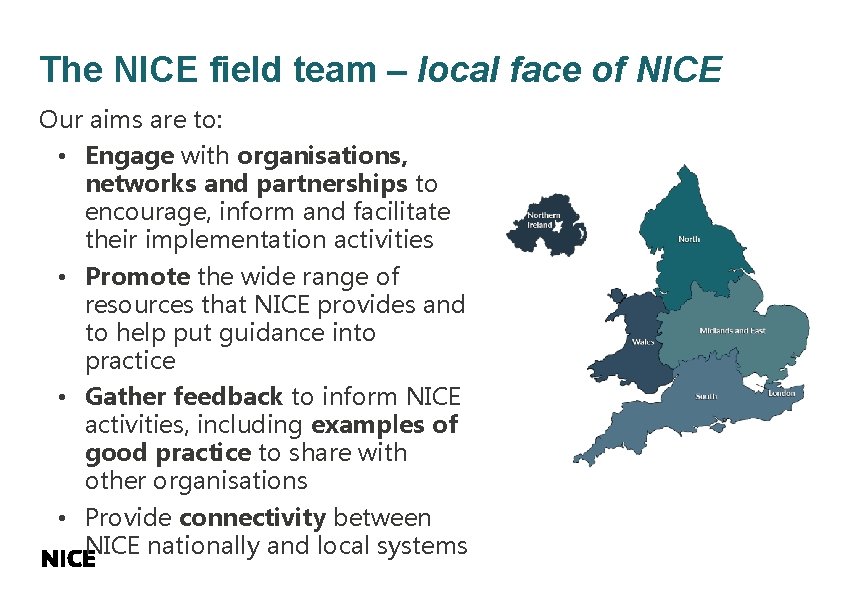
The NICE field team – local face of NICE Our aims are to: • Engage with organisations, networks and partnerships to encourage, inform and facilitate their implementation activities • Promote the wide range of resources that NICE provides and to help put guidance into practice • Gather feedback to inform NICE activities, including examples of good practice to share with other organisations • Provide connectivity between NICE nationally and local systems
Objectives • Review how medicines are managed in DCAs • Review the governance of medicines management in order to drive improvement • Share experiences and good practice of medicines management in DCAs • Increased knowledge of NICE resources to support medicines management – and how to find them
Quality Improvements across Northern Ireland – the policy context • Health and Wellbeing 2026: Delivering Together • Medicines Optimisation Quality Framework
What is medicines optimisation? NICE definition ‘A person centred approach to safe and effective medicine use to ensure the best possible outcomes from their medicines’ Medicines Optimisation: the safe and effective use of medicines to enable the best possible outcomes (NG 5) March 2015
Medicines Optimisation Quality Framework (Do. H) • Medicines optimisation model • Describes what patients can expect when medicines are included in their care plan in each of four different settings. hospital, general practice, pharmacy, social care • Quality standards • Describe the best practices that should be delivered in each setting, identifies the gaps in best practice and the actions needed to address them in order to deliver high quality outcomes when medicines are prescribed, dispensed or administered • Implementation through integrated innovation and change programme • Which will identify test and scale up models of best practice
What is a medicine? • All prescription and non prescription healthcare treatments such as oral medicines, topical medicines, inhaled products, injections, wound care products, appliances and vaccines
The service user • Not all Service Users in receipt of personal care will need help with medicines • They have the right to be involved in decisions – no decision about me without me • Promote, maintain their independence • Level of support from family/friends
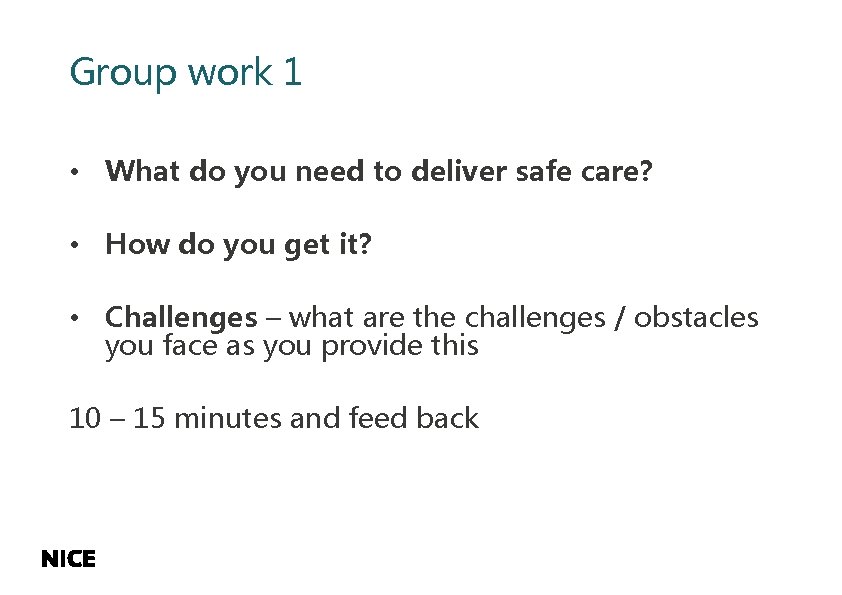
Group work 1 • What do you need to deliver safe care? • How do you get it? • Challenges – what are the challenges / obstacles you face as you provide this 10 – 15 minutes and feed back
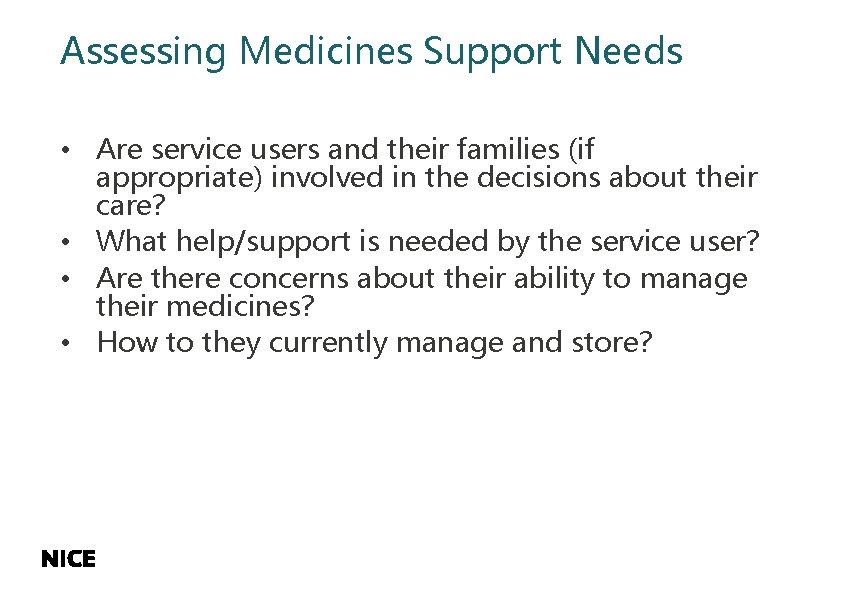
Assessing Medicines Support Needs • Are service users and their families (if appropriate) involved in the decisions about their care? • What help/support is needed by the service user? • Are there concerns about their ability to manage their medicines? • How to they currently manage and store?
Assessing Medicines Support Needs • What medicines do they use and when? • Why do they take them? • Are they medicines, tablets, creams, patches, inhalers, eye/eardrops or liquids • Are there specific directions or devices used to administer – oral syringe • Are the medicines needed at a particular time?
Assessing Medicines Support Needs • • Record the discussions and agreements Details should be in the care plan Are any medicines taken ‘PRN’? What about OTC medicines or herbal or nutritional supplements
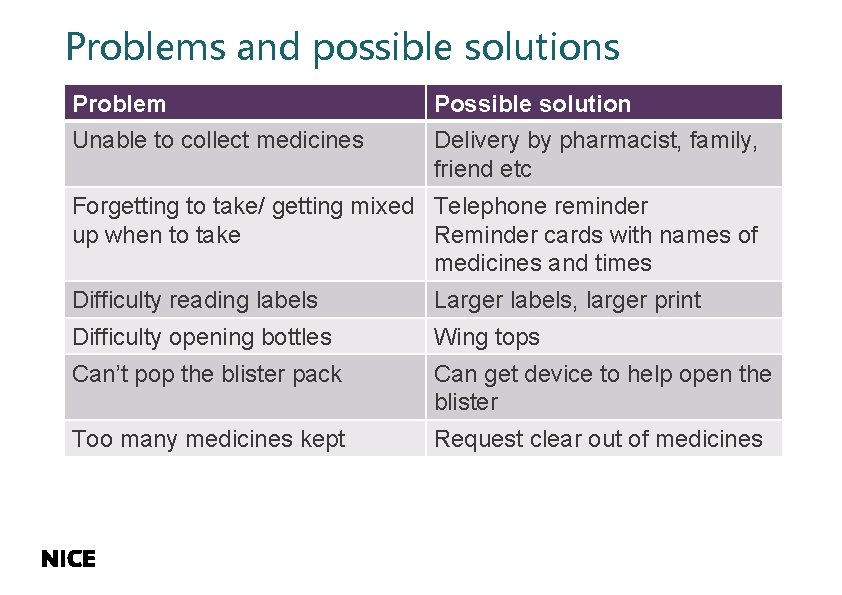
Problems and possible solutions Problem Possible solution Unable to collect medicines Delivery by pharmacist, family, friend etc Forgetting to take/ getting mixed Telephone reminder up when to take Reminder cards with names of medicines and times Difficulty reading labels Larger labels, larger print Difficulty opening bottles Wing tops Can’t pop the blister pack Can get device to help open the blister Too many medicines kept Request clear out of medicines
Remember • What would you want if you were in their place? • Can you deliver what they want / need? • Are they satisfied? 14
Relevant NICE Guidance • Managing medicines for adults receiving care in the community (NG 67) March 2017 • Home Care: delivering personal care and practical support to older people living in their own homes (NG 21) September 2015 • Managing medicines in care homes (SC 1) March 2014 • Medicines optimisation: the safe and effective use of medicines to enable the best possible outcomes (NG 5) March 2015
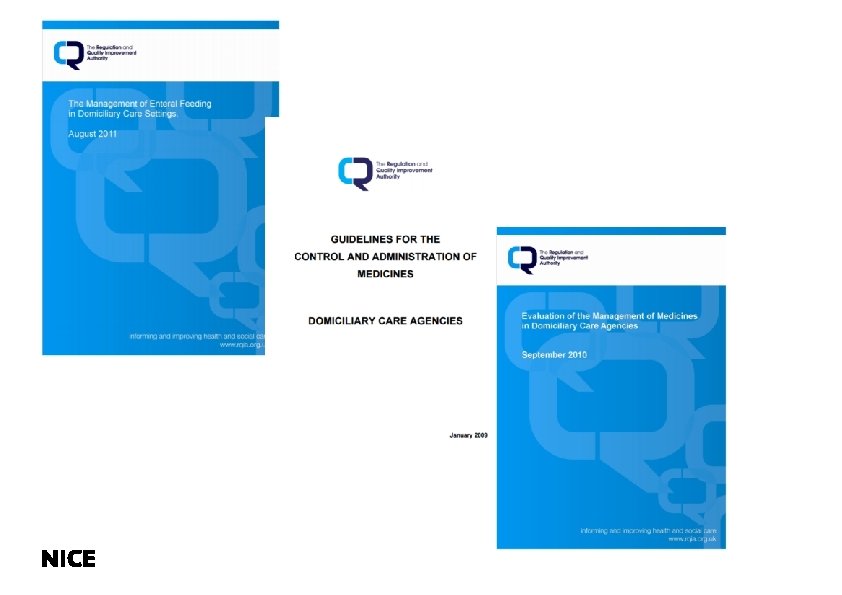
RQIA Guidance • 2009: Guidance on medicines to help agencies develop their policies and procedures as part of the registration process • 2010: Evaluation of the Management of Medicines in Domiciliary Care Agencies • 2018: Sharing innovation and good practice
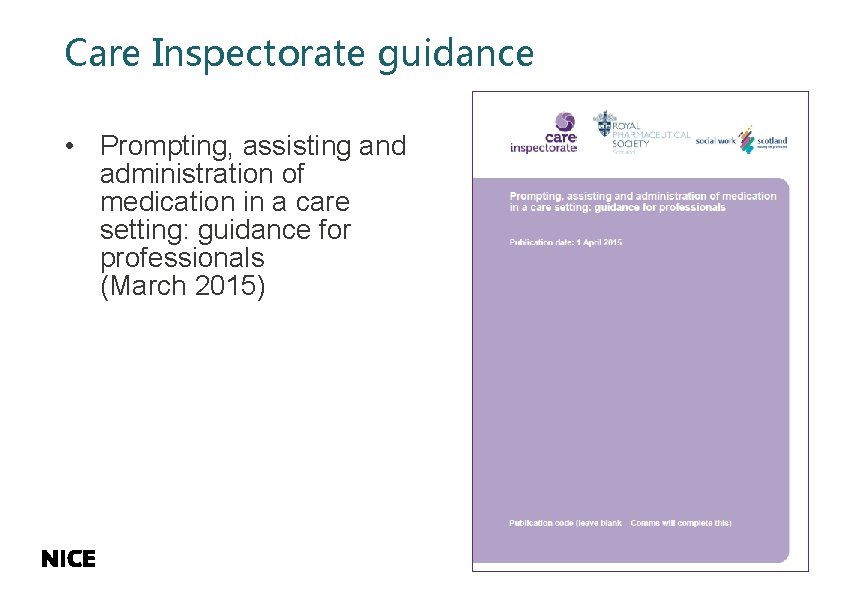
Care Inspectorate guidance • Prompting, assisting and administration of medication in a care setting: guidance for professionals (March 2015)
Governance for Safe Practice • Clear agreement between trust and providers about level of support to be provided • Assessment of service users’ needs and preferences • Detailed medicine policy in place that reflects all aspects of how staff manage medicines
Group work 2 Medicines policy • Why do you need one? • What should be in it? 10 – 15 minutes and feed back
Medicines policy • • Policy and procedure understood by all Involve service user and their family in discussions Accurate up to date information Bought off the shelf?
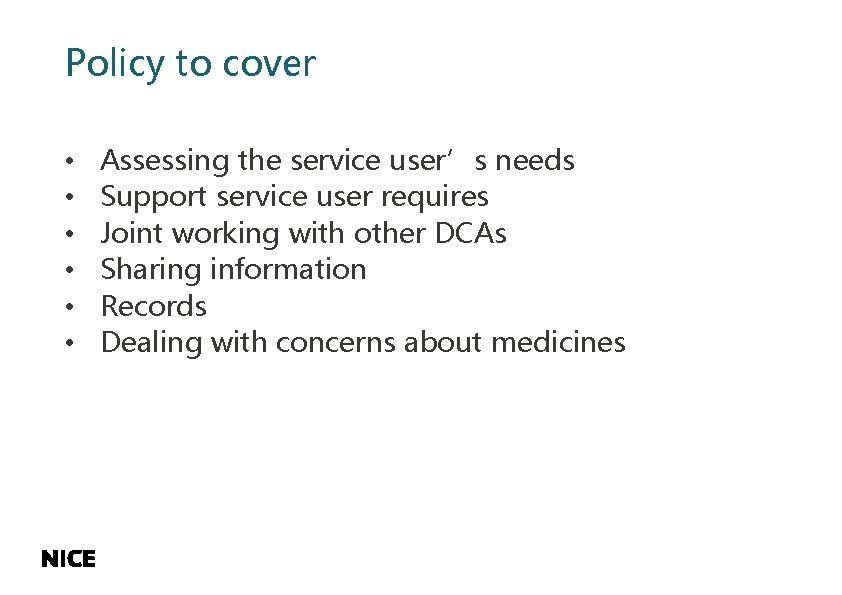
Policy to cover • • • Assessing the service user’s needs Support service user requires Joint working with other DCAs Sharing information Records Dealing with concerns about medicines
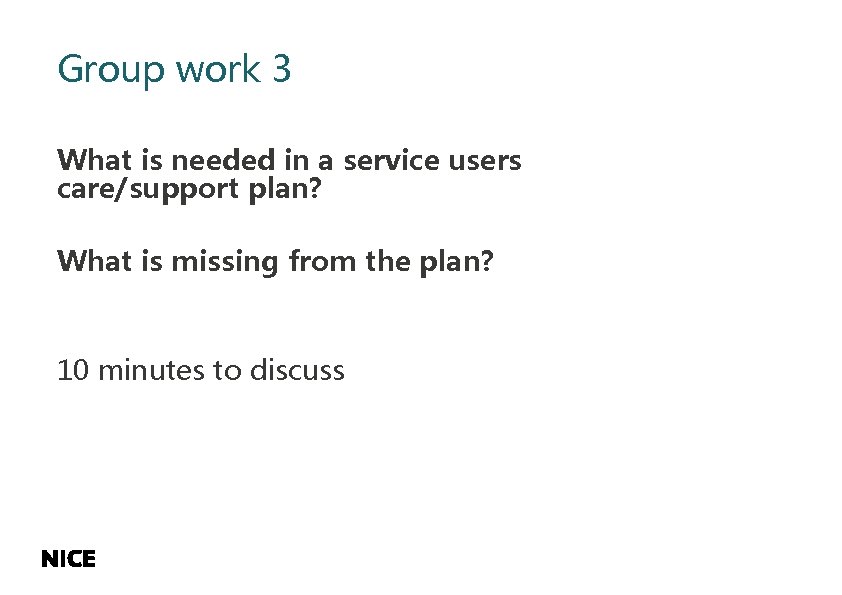
Group work 3 What is needed in a service users care/support plan? What is missing from the plan? 10 minutes to discuss
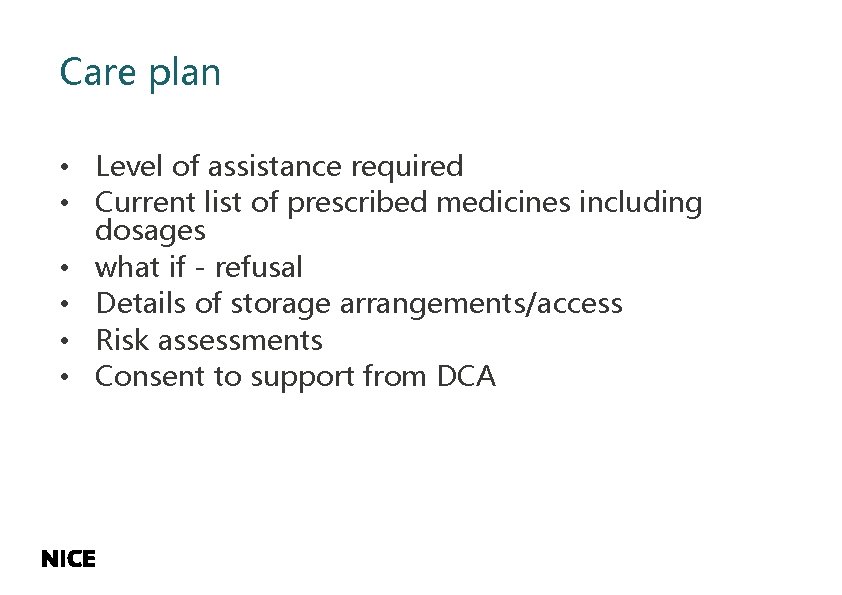
Care plan • Level of assistance required • Current list of prescribed medicines including dosages • what if - refusal • Details of storage arrangements/access • Risk assessments • Consent to support from DCA
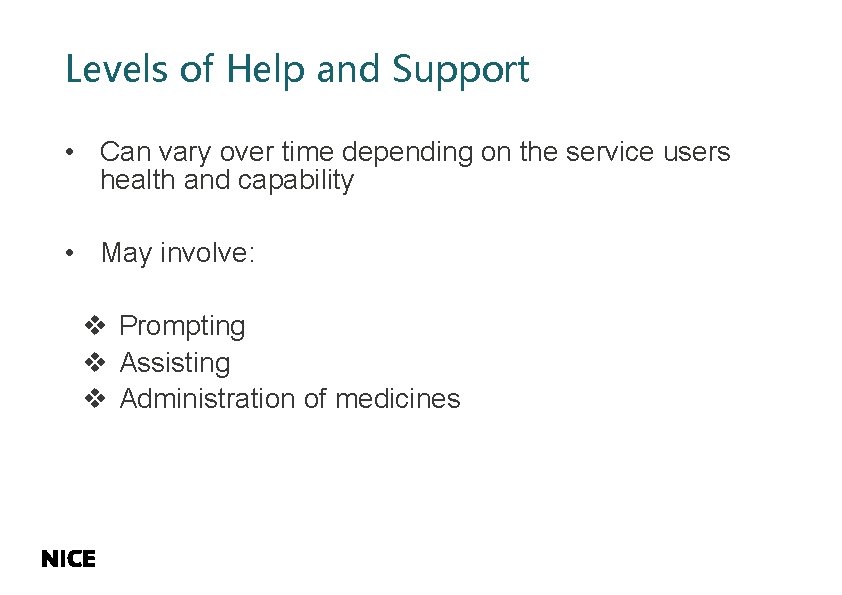
Levels of Help and Support • Can vary over time depending on the service users health and capability • May involve: v Prompting v Assisting v Administration of medicines
Prompting • The action of saying something to persuade, encourage or remind someone to do or say something
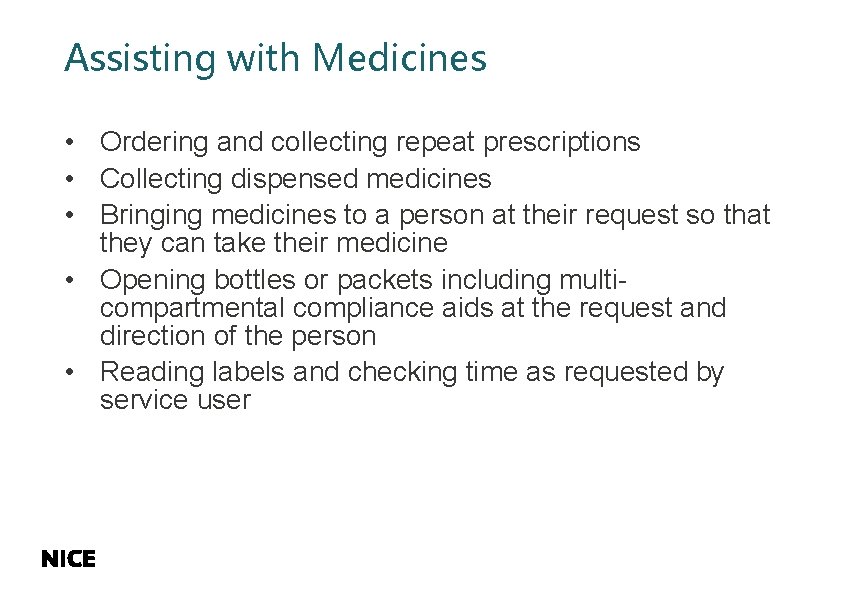
Assisting with Medicines • Ordering and collecting repeat prescriptions • Collecting dispensed medicines • Bringing medicines to a person at their request so that they can take their medicine • Opening bottles or packets including multicompartmental compliance aids at the request and direction of the person • Reading labels and checking time as requested by service user
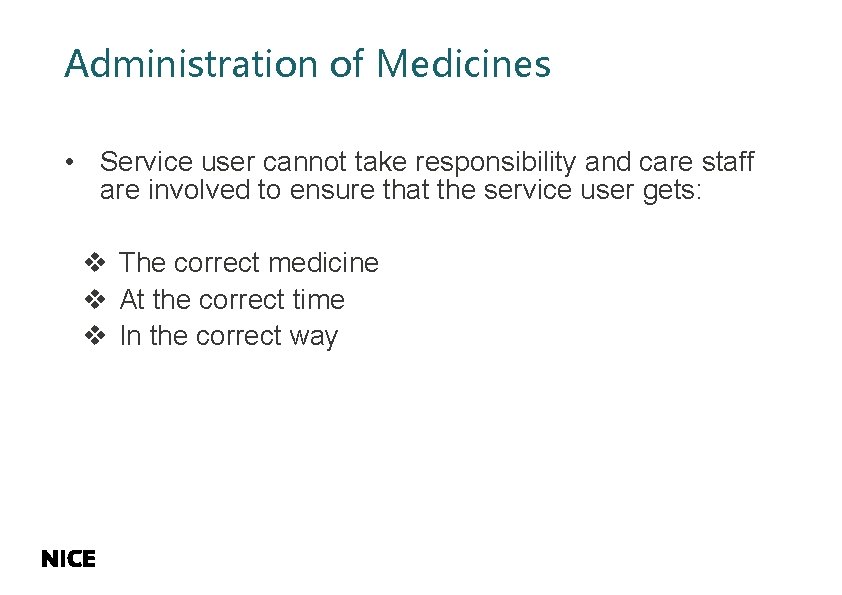
Administration of Medicines • Service user cannot take responsibility and care staff are involved to ensure that the service user gets: v The correct medicine v At the correct time v In the correct way
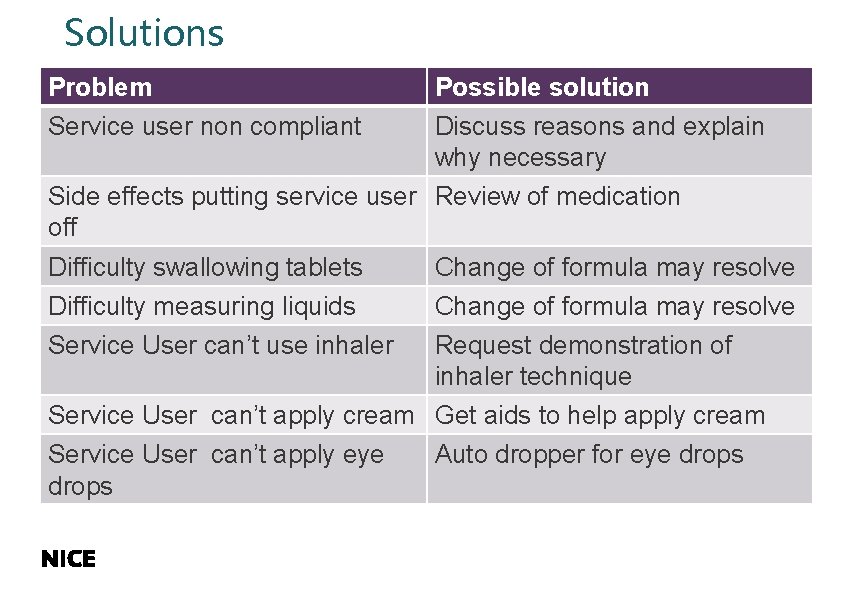
Solutions Problem Possible solution Service user non compliant Discuss reasons and explain why necessary Side effects putting service user Review of medication off Difficulty swallowing tablets Change of formula may resolve Difficulty measuring liquids Change of formula may resolve Service User can’t use inhaler Request demonstration of inhaler technique Service User can’t apply cream Get aids to help apply cream Service User can’t apply eye drops Auto dropper for eye drops
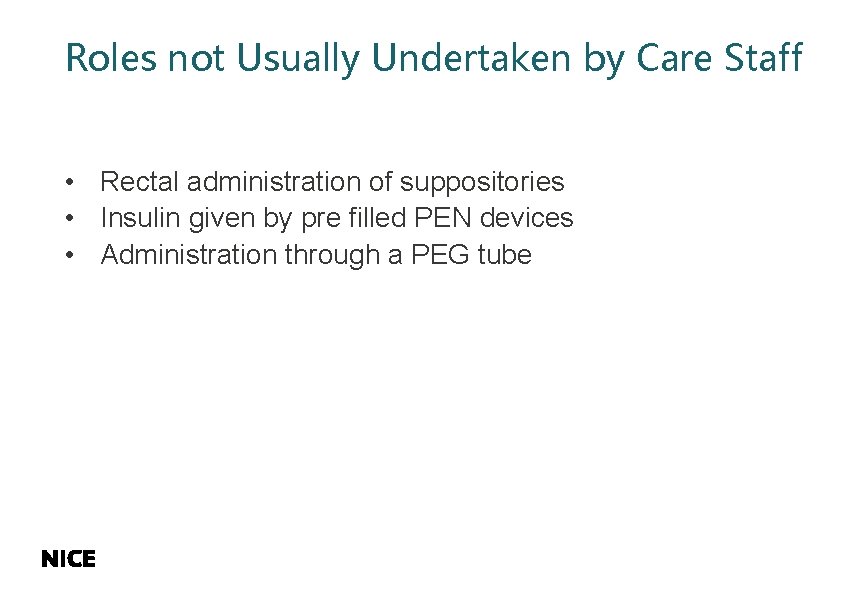
Roles not Usually Undertaken by Care Staff • Rectal administration of suppositories • Insulin given by pre filled PEN devices • Administration through a PEG tube
When could administering medicines be considered abuse? • If forcing Service User to take medicines when they refuse • Hiding in food because they refuse • Refusing them treats if they do not take their medicine
Covert Administration • Giving medicines without the service users knowledge • Consider under Human Rights • If necessary, clear discussion, agreement and care plan should be in place
Ordering, Supplying, Storing and Disposal of Medicines • Responsibility usually stays with service user and/or their family • There should be clear agreement if other processes are in place
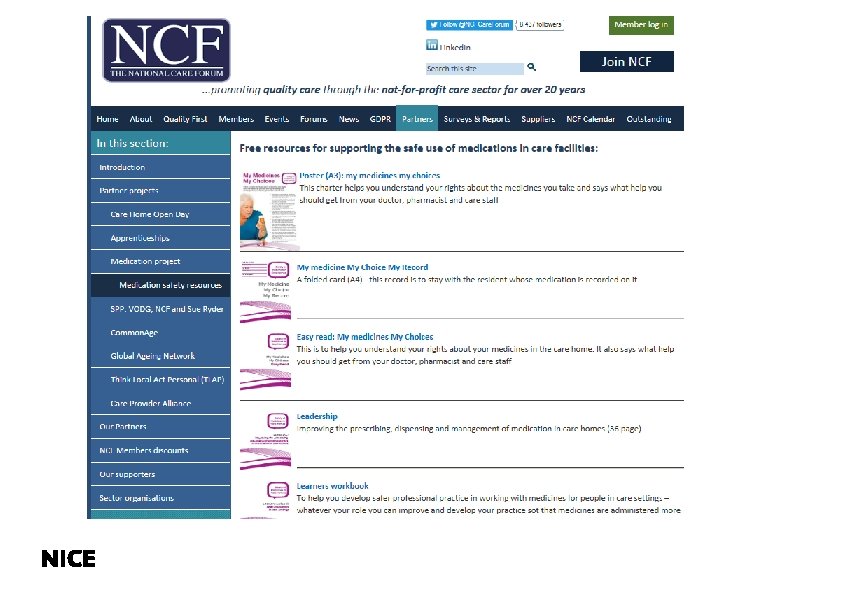
Training and Competency • Resources: v. NICE v. National Care Forum v. NISCC app • Staff must be trained and competent for the tasks undertaken
Training • Meet the needs of care staff and service users • How to prepare correct dose of medicine • How to administer medication – tablets, capsules, liquids, eye, ear and nose drops, inhalers, external preparations • The 6 Rs • Storage and expiry dates • Checking medicine not already given
Training Expectations re side effects? What to do about refusals and mistakes? What about PRN medicines? What about non-prescribed medicines? Records Trainer qualifications (in general for DCA), knowledgeable, relevant current experience • Assessment of care staff • • •
Record Keeping • Accurate and up to date • Systems in place for making changes if medicines change • Record level of support provided • Record if medicines not taken • Agreement about process if both agency and family administer medicines e. g. pain relief
Warfarin
Controlled Drugs • It is a prescribed medicine • Is there a difference in what you do? v. Paracetamol tablets vs MST tablets v. Pain patch vs Butrans patch
Common Issues • • • Time sensitive medicines Social activities Storage Medicines for later Refusal of medicines Management of specific health conditions
When required medicines (PRN) • • • Confirm need When was last dose administered Minimum interval Date and time when given Two medicines same ingredients
Group work 4 • Service user home after a fall and physio visiting 2 -3 time a week to improve mobility. No exercises done with physio as he is in pain. Physio found he hadn’t taken paracetamol. She had left note in care plan to give paracetamol 30 minutes before her visit. Supply in box labelled “two to be taken 4 times a day when required” • DCA had not given as not in blister • DISCUSS – how to avoid this situation
Over the counter medicines • Choice of service user • May interact with prescribed medicines • Assurance from GP or pharmacist that they are safe to take • Record appropriately • Do not offer any opinion or advice on the medicines
Managing Concerns • • Medicines can be complex Service users may have several health conditions They may take multiple medicines Do you and staff know how and where to raise any concerns? • Seek advice from prescriber or pharmacist • Arrangements to report to trust and manager when medicines are administered incorrectly
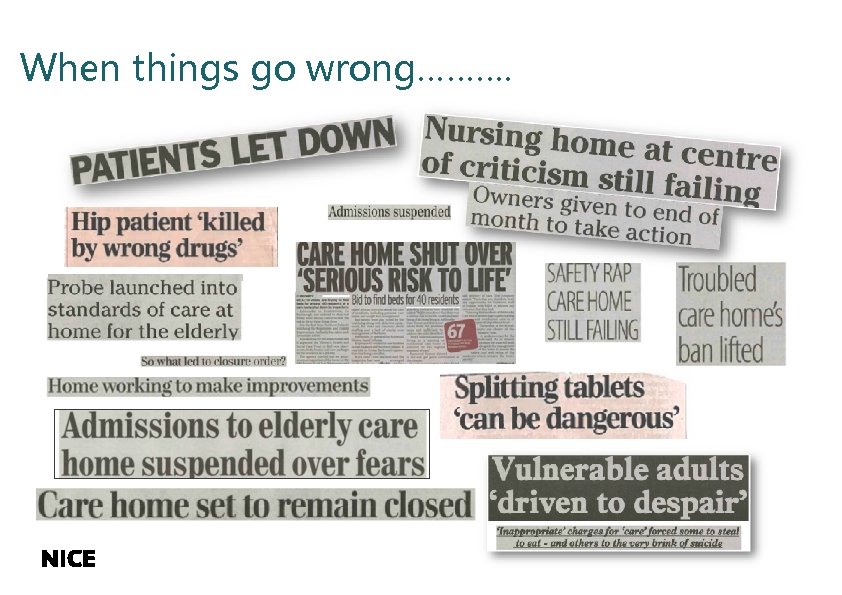
When things go wrong……….
Incidents No one is perfect Incidents will occur Know action to take No longer report to RQIA unless PSNI involvement? • Advice available from RQIA • •
How to minimise likelihood of incidents • Staff should be trained and competent for the tasks they are expected to undertake • Know the DCA medicine policy • Follow the care plan • Understand what they can and can’t do • Stop think and seek advice if in doubt. • Staff must be sure of management support irrespective of time of day
Actions to take • Inform line manager who should seek advice from prescriber • Stay with SU until the risks of the situation have been assessed • Investigate what happened • Learning from incident • Share anonymously with all staff • Adhere to DCA medicine policy
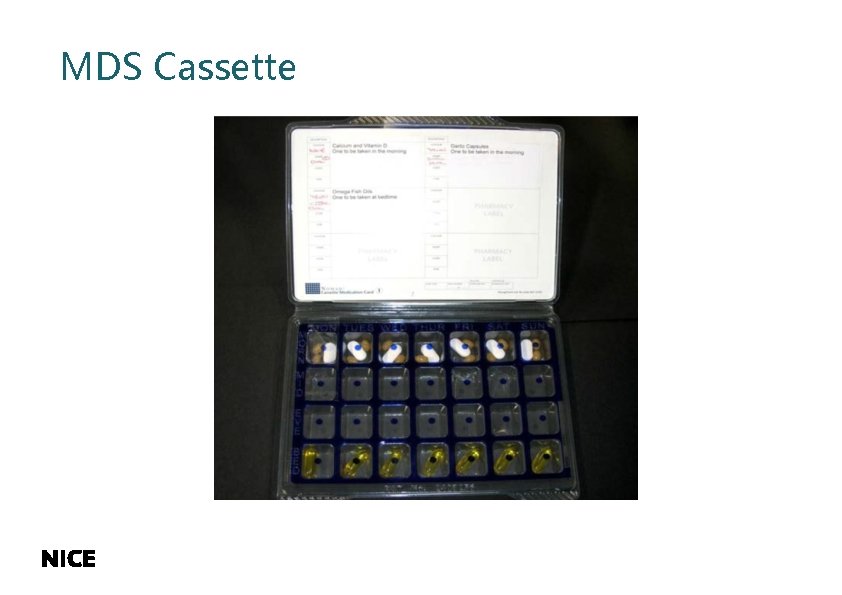
MDS Cassette
MDS vs conventional packaging • Community pharmacist role • MDS service supplied by pharmacist • Some introducing charging or limiting the number they can provide • Knock on effect for DCA? • Medicines take longer to administer, prompt • Service Users require more help to prepare medicines
RQIA Pharmacist Team • One senior inspector • Five pharmacist inspectors • Inspect a range of different services including: nursing homes, residential homes, children’s homes, hospitals, prisons 52
Summary • Everyone is an individual • One size does not fit all • There are no black and white answers REMEMBER…. . Trained competent and confident staff Risk assess the task
And now for something NICE……. 54
Role of NICE The national point of reference for advice on safe, effective and cost effective practice in health and social care, providing guidance, advice and standards aligned to the needs of its users and the demands of a resource constrained system Evidence Guidance Quality standards Improved outcomes www. nice. org. u k
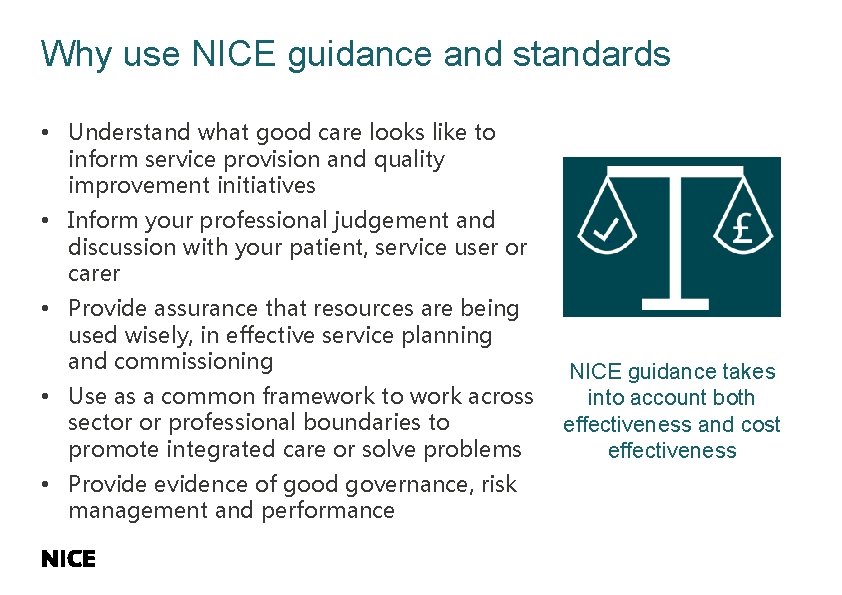
Why use NICE guidance and standards • Understand what good care looks like to inform service provision and quality improvement initiatives • Inform your professional judgement and discussion with your patient, service user or carer • Provide assurance that resources are being used wisely, in effective service planning and commissioning • Use as a common framework to work across sector or professional boundaries to promote integrated care or solve problems • Provide evidence of good governance, risk management and performance NICE guidance takes into account both effectiveness and cost effectiveness
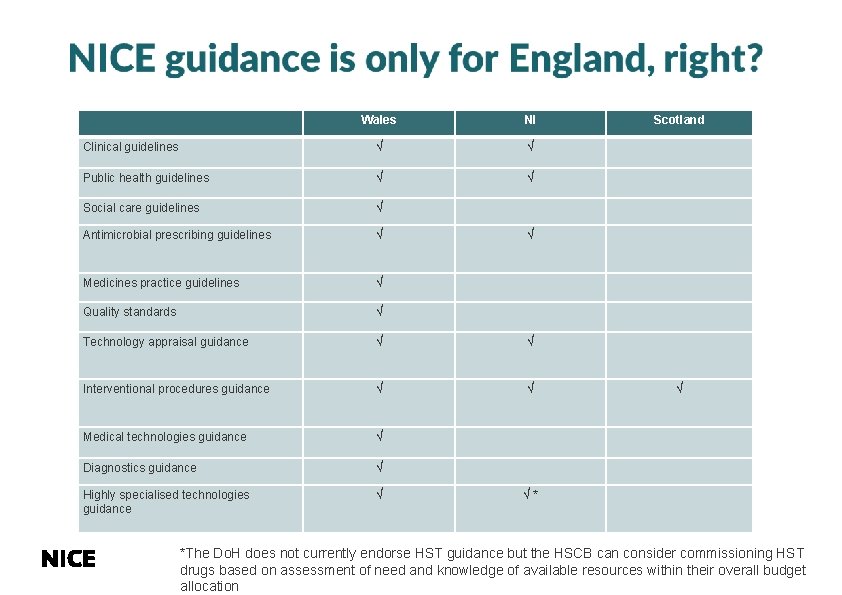
Wales NI Clinical guidelines √ √ Public health guidelines √ √ Social care guidelines √ Antimicrobial prescribing guidelines √ Medicines practice guidelines √ Quality standards √ Technology appraisal guidance √ √ Interventional procedures guidance √ √ Medical technologies guidance √ Diagnostics guidance √ Highly specialised technologies guidance √ Scotland √ √ √* *The Do. H does not currently endorse HST guidance but the HSCB can consider commissioning HST drugs based on assessment of need and knowledge of available resources within their overall budget allocation
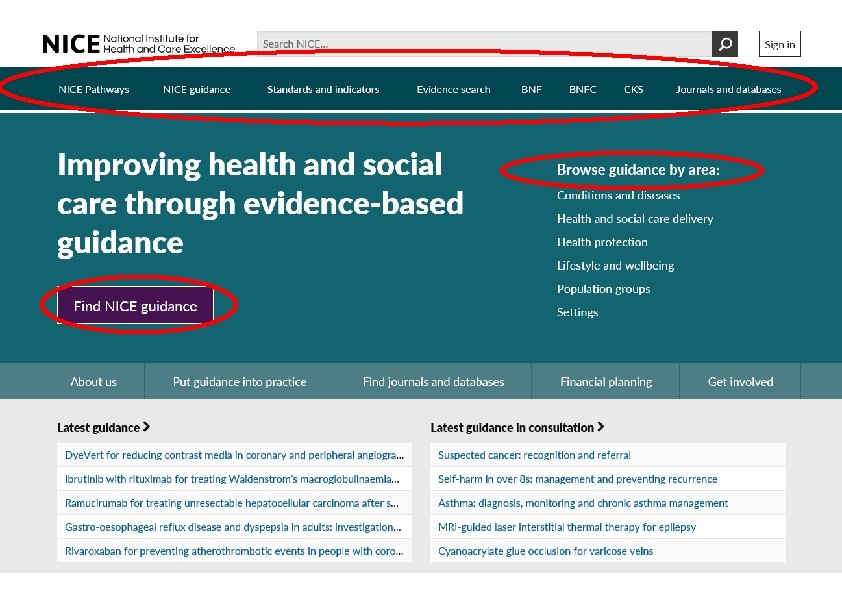
58
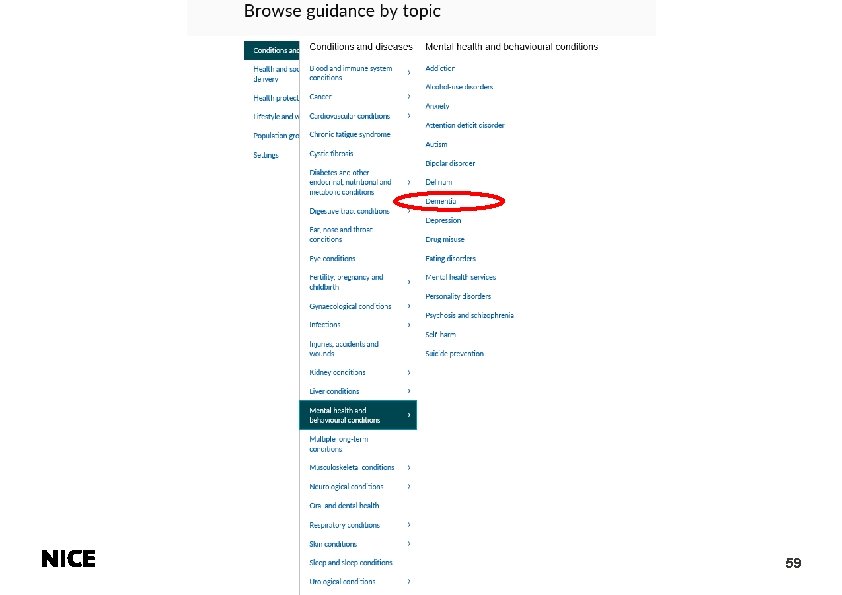
59
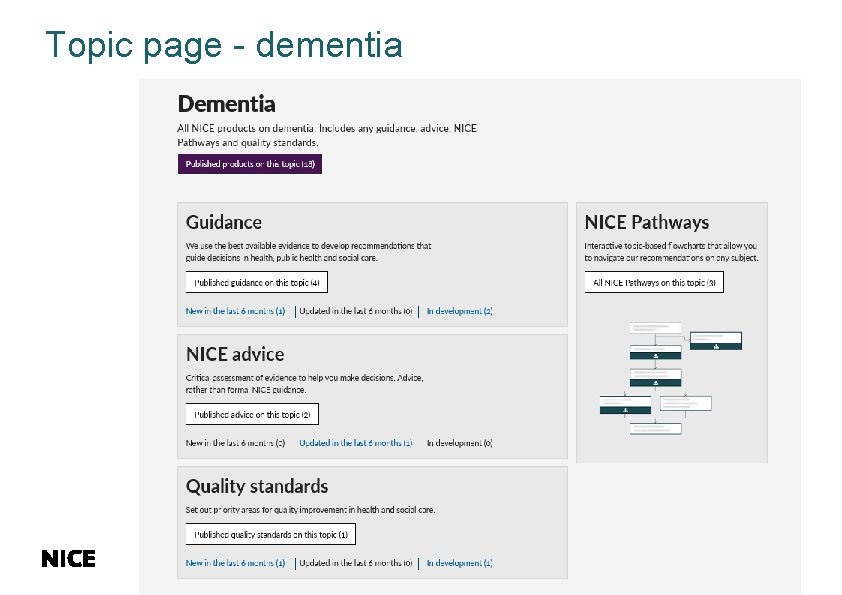
Topic page - dementia
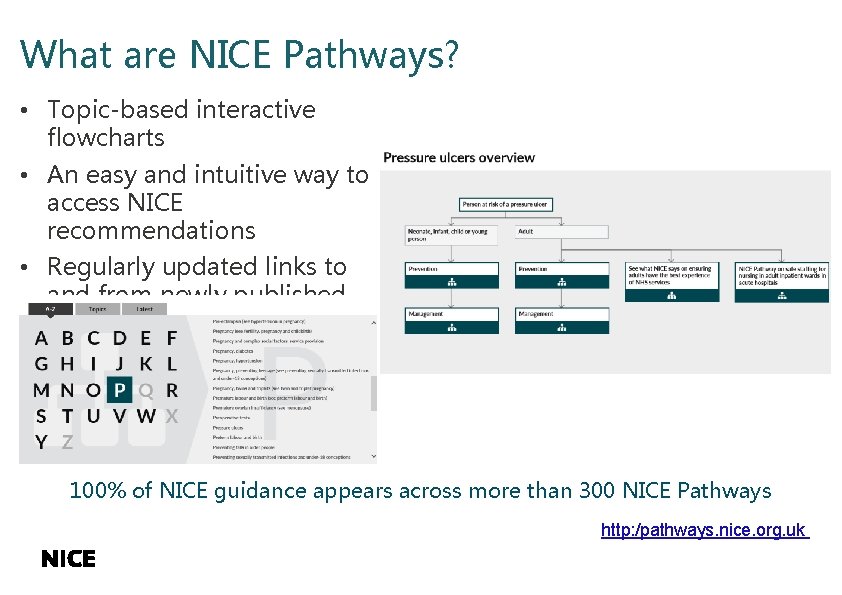
What are NICE Pathways? • Topic-based interactive flowcharts • An easy and intuitive way to access NICE recommendations • Regularly updated links to and from newly published topics 100% of NICE guidance appears across more than 300 NICE Pathways http: /pathways. nice. org. uk
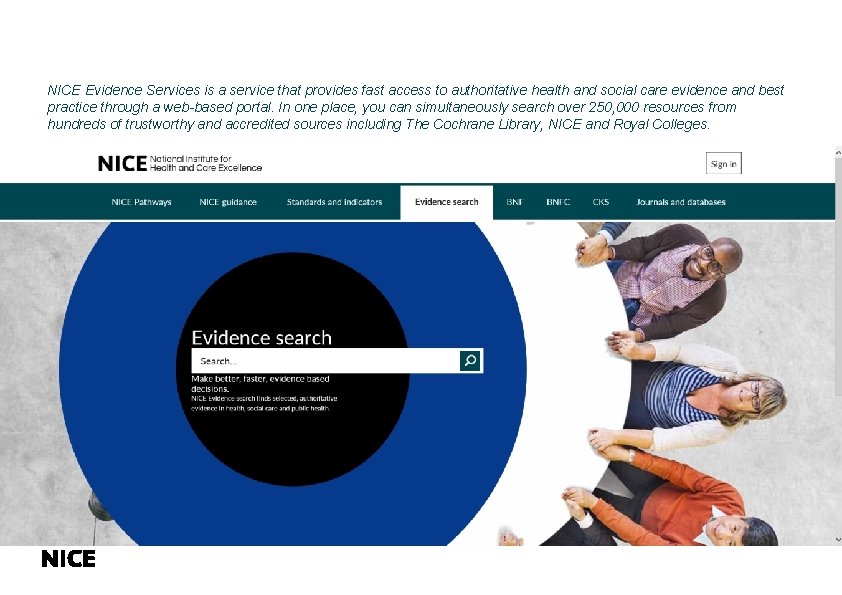
NICE Evidence Services is a service that provides fast access to authoritative health and social care evidence and best practice through a web-based portal. In one place, you can simultaneously search over 250, 000 resources from hundreds of trustworthy and accredited sources including The Cochrane Library, NICE and Royal Colleges.
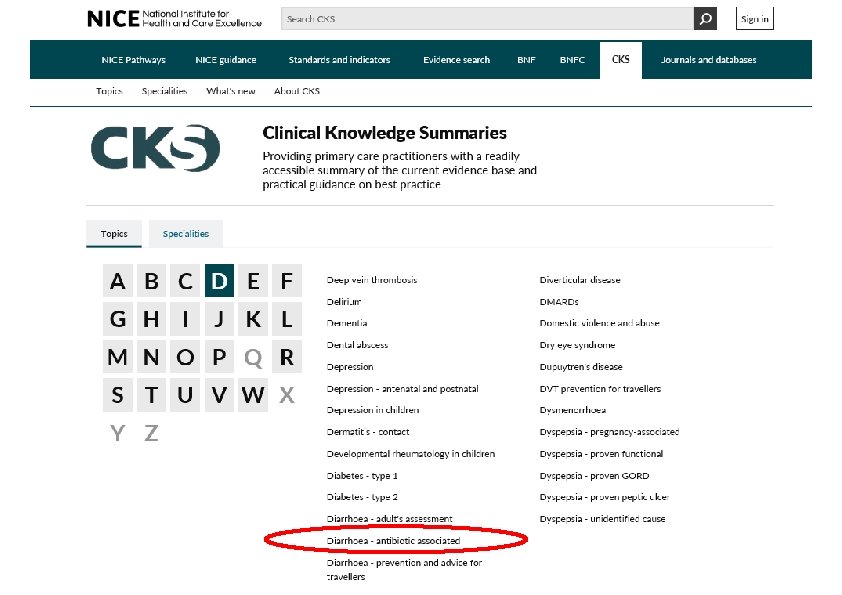
63
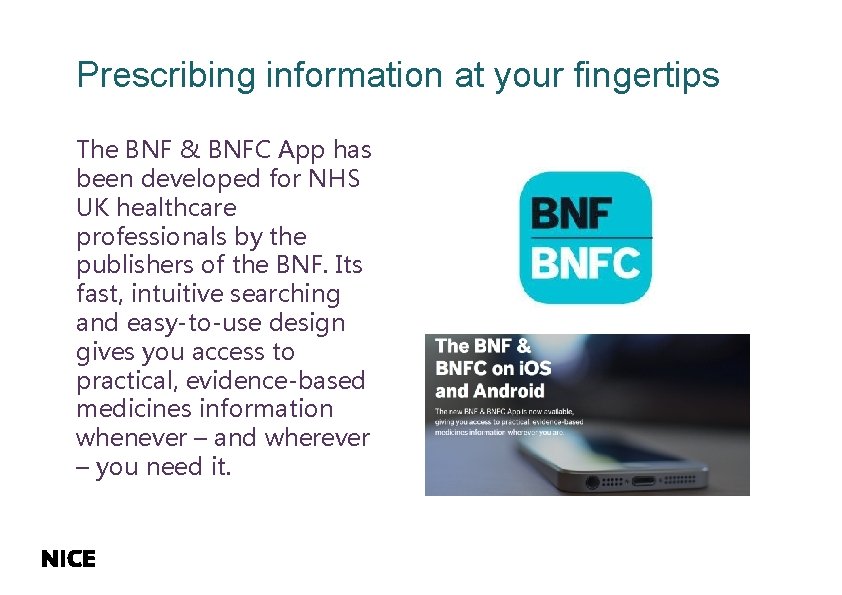
Prescribing information at your fingertips The BNF & BNFC App has been developed for NHS UK healthcare professionals by the publishers of the BNF. Its fast, intuitive searching and easy-to-use design gives you access to practical, evidence-based medicines information whenever – and wherever – you need it.
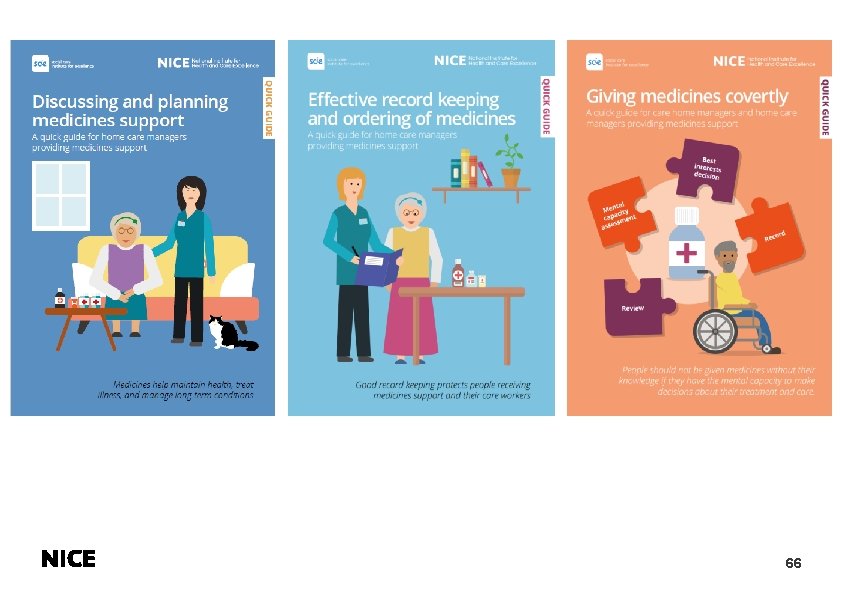
Implementation – practical support We provide a range of resources to help maximise uptake and use of evidence and guidance 65
66
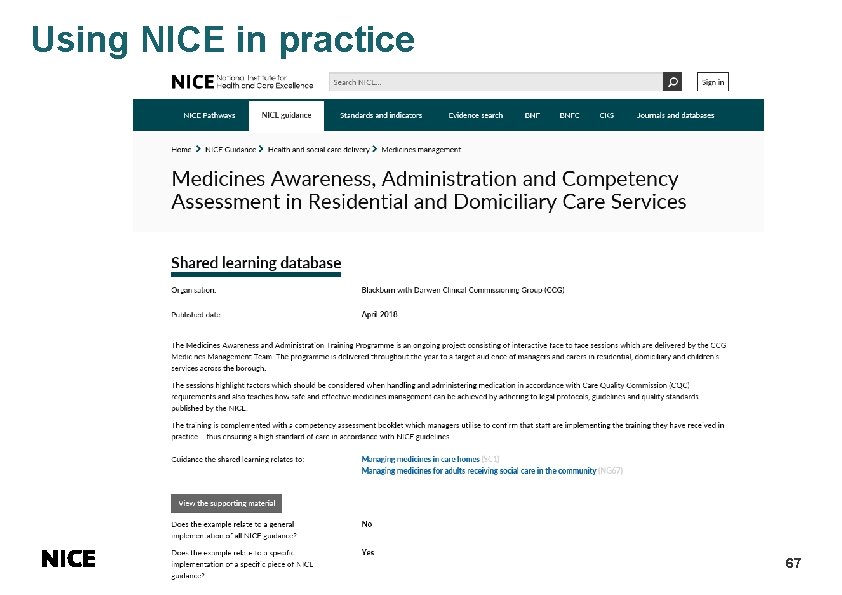
Using NICE in practice 67
Staying up to date with NICE News - monthly e-newsletter on consultations, published and forthcoming guidance. Evidence Updates - highlights new evidence relating to published, accredited guidance with a commentary from NICE Medicines Awareness Service - daily and/or weekly access to evidence-based medicines information Social media - 100, 000+ people now follow us on Twitter for guidance updates @NICEcomms http: //www. nice. org. uk/News/NICE-newsletters-and-alerts
Get involved with NICE Comment on draft guidance and standards All draft guidance and quality standards are consulted on prior to final publication. Register as a stakeholder to comment. Join a working committee Contribute to the production of guidance and quality standards. Vacancies are advertised on our website. Become a NICE Fellow or NICE Scholar Join us for a fixed period, for a day or more each month, to share your expertise, enthuse your colleagues or work upon an agreed research project of mutual interest. In return benefit from NICE’s expertise, mentorship and support. Getting involved with NICE encourages local clinical engagement with relevant topics, fosters a culture of using evidence based guidance, and supports individual professional development. www. nice. org. uk/getinvolved
Any questions?