
SUPPORTING LEARNING AND REVISION Active Learning Learning Styles

- Slides: 15
SUPPORTING LEARNING AND REVISION � Active Learning � Learning Styles and Methods
ACTIVE LEARNING Encourage your child to ACTIVELY learn rather than PASSIVELY learn
ACTIVE LEARNING Where possible - help provide the right resources for your child to work: post-it notes, pen, ruler, paper, scissors & glue, internet access if you have it, dictionary, highlighter pens, coloured pens, revision guides, revision CDs and podcasts
ACTIVE LEARNING We learn: • 10% of what we read • 20% of what we hear • 30% of what we see • 40% of what we see and hear • 70% of what is discussed • 95% of what we teach to someone else This means that the best method of learning is having to explain or teach a topic to someone else.
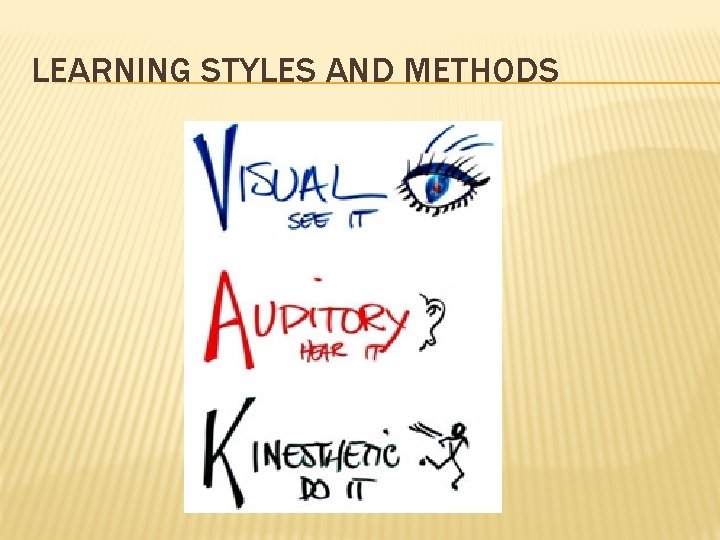
LEARNING STYLES AND METHODS
VISUAL LEARNERS Recopy notes – then condense in particular colours � Visually organise or reorganise notes using columns, categories, outline forms, etc. � Remember where information was located in visual field � Create timelines, models, charts, grids, etc. � Write/rewrite facts, formulas, notes on wall-hanging, bedsheet, poster for visual review at any time � Facts, formulas, notes on index cards arranged/rearranged on wall, pin-board, floor, bed �
VISUAL LEARNERS � Use colour-coded markers or cards for previous two above � Use visual mnemonics � Remember information by drawing out mindmaps � TV/video supplements important for understanding or remembering � Use "background" visual activity helps you to concentrate � Use highlighters � Near memorisation of chapter/notes
AUDITORY LEARNERS � Discuss concepts/facts/aspects with friend immediately after new learning � Revise with friend(s) by trying to teach them the information � Tape records lesson or notes for re-listening later � Say facts/formulas/information over and over to retain � Simultaneous talk and walk whilst studying � Set information to rhyme, rhythm, music, football chants, to aid retention
AUDITORY LEARNERS � Aural Mnemonics � Remember where information was located in auditory field (e. g. tagged to "who said that? ") � Use of different voices to study (like creating a script, or acting out a play) � TV/video/radio supplements useful for obtaining information � Create your own podcast and listen without taking notes � Prefer group discussion and/or study groups
KINAESTHETIC STYLE � Copy notes over and over to make them neat or organised � Prefers to take notes during lesson as an aid to concentration � Must take notes, even when detailed outline is distributed � Simultaneous talking-walking, talking-exercising study, or walking-reading study � Move hands or feet for rhythm emphasis while remembering information
KINAESTHETIC LEARNING � Trace key words with finger, marker, hand � Re-enact situations while studying � Act out information in the form of play (using different characters for different topics) � Constructs (e. g. house of cards, blocks, etc. ) to remember information � Plan a revision game on the computer/board game
FOR ALL LEARNING STYLES � Ensure you practise on Past Papers � Get hold of the exam board mark schemes and examiners reports � Use grade boundaries to check your progress � Don’t just revise topics you are confident in � Use your teacher as much as possible
STUDENT ADVICE
PARENT ADVICE
SUPPORTING SUCCESS