
Supporting learners with literacy difficulties in the secondary
- Slides: 29
Supporting learners with literacy difficulties in the secondary classroom
We’ve all experienced: Class clown Talking Not rather than settling paying attention
problems Become discouraged very quickly due to lack of initial success ‘Inattentive / lazy’ – they may be working harder than everyone else No new motivation – little experience of success Lack self-confidence Appear to avoid work Disorganised Lack stamina Have a poor self-image
What areas are affected? Reading Spelling Writing Memory Concentration Personal organisation Self-esteem metacognition
Before units / tasks begin Provide Send equipment checklists a list of upcoming vocabulary home to parents with explanations of meanings
Starting out on tasks- the basics Make learning intentions clear Always write page and question numbers on the board Encourage students to discuss the nature of tasks before starting individual work Ask students to repeat what they have to do Issue one task at a time Provide models and/or templates for layout
The tasks themselves Have a series of mini-break activities students can opt into when they need to Allow students to ask those around them for help Provide print outs of notes If there a range of tasks, prioritise them if they don’t all need to be completed Consider setting time limits
Differentiation Accessibility not simplification Teach up, not down John Hattie: learning should be held constant and time should be allowed to vary, rather than the opposite.
Sometimes we: Pre teach ideas Remove Make complex texts ideas simpler Teach basic, generic skills Provide writing frames and word banks
Reading Decoding Processing Comprehension Picking up where they left off
Decoding & Processing bigger text Increased line spacing Avoid shiny whiteboards & glossy paper Consider recordings / text to speech
Other basic practicalities Try to avoid italics /underlining Key information should be separated and highlighted – e. g. in a box Break up continuous prose with bullet points / numbers
Picking up where they left off / finding a place Highlighting Looking where they are at task first and highlighting what might be useful
Checking readability Word Click the File tab, and then click Options. Click Proofing. When correcting spelling and grammar in Word, make sure the Check grammar with spelling check box is selected. Select Show readability statistics. After you enable this feature, open a file that you want to check, and check the spelling. When Outlook or Word finishes checking the spelling and grammar, it displays information about the reading level of the document.
Flesch Reading Ease Score – 100 point scale – the higher the number, the easier it is to understand Aim for between 60 -70 Flesch – Kincaid grade level score – rates text on a US grade-school level – i. e. a score of 5 means a 10 year old can understand it (5 th grader). Aim for a score of approximately 7 to 8 Don’t take out subject terminology – make sentences shorter
Comprehension Vocabulary work Be clear about how the text is used. q Why do we read in different subjects? q How does that influence our response / expectations? q What are we going to ask students to do with the text? (find facts, agree / disagree etc – identify instruction words)
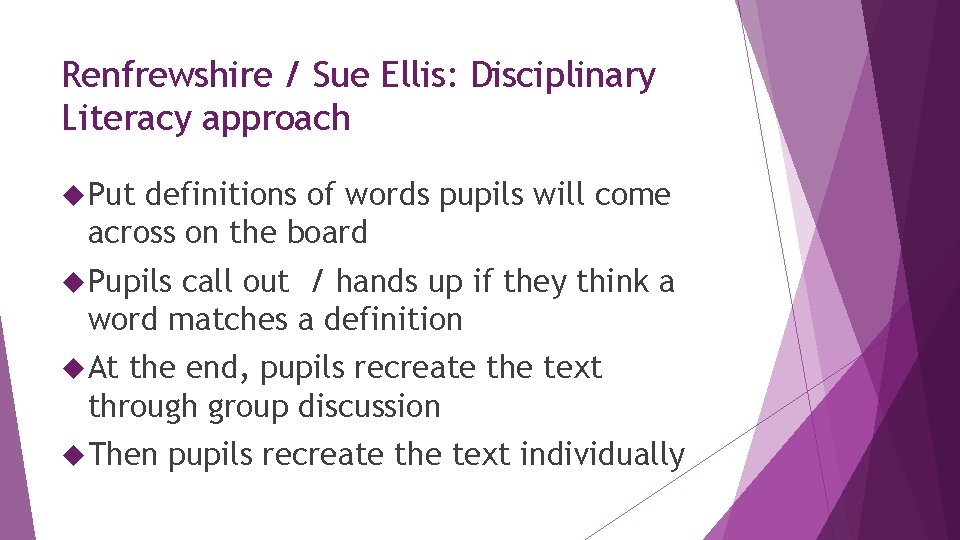
Renfrewshire / Sue Ellis: Disciplinary Literacy approach Put definitions of words pupils will come across on the board Pupils call out / hands up if they think a word matches a definition At the end, pupils recreate the text through group discussion Then pupils recreate the text individually
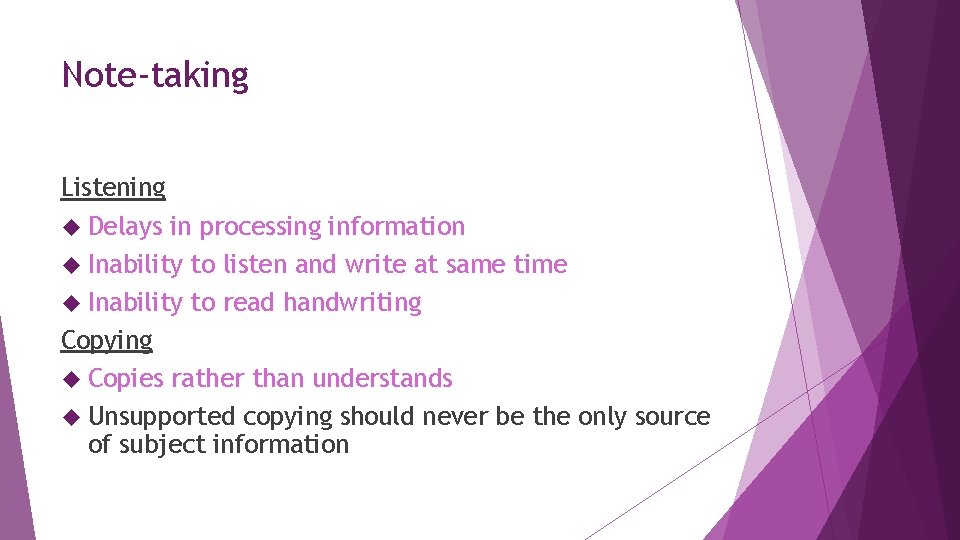
Note-taking Listening Delays in processing information Inability to listen and write at same time Inability to read handwriting Copying Copies rather than understands Unsupported copying should never be the only source of subject information
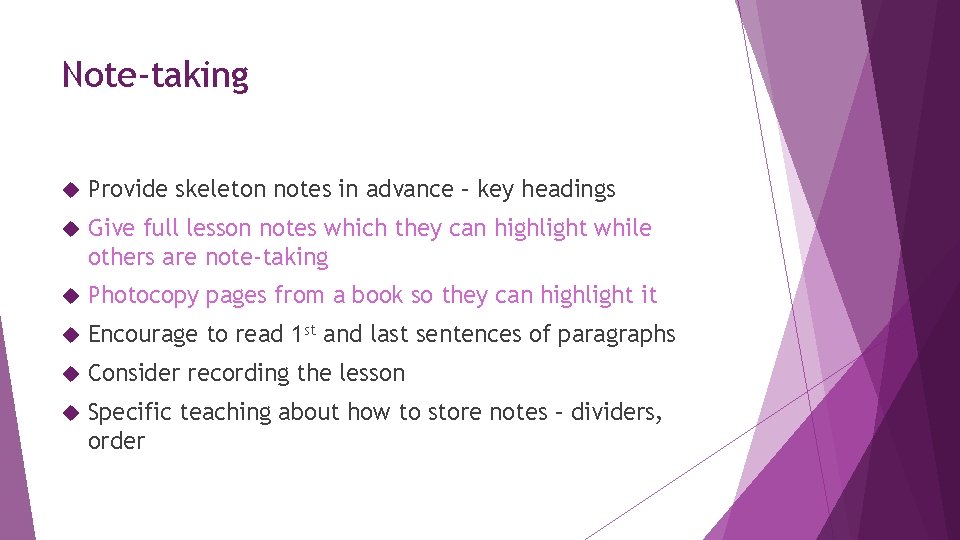
Note-taking Provide skeleton notes in advance – key headings Give full lesson notes which they can highlight while others are note-taking Photocopy pages from a book so they can highlight it Encourage to read 1 st and last sentences of paragraphs Consider recording the lesson Specific teaching about how to store notes – dividers, order
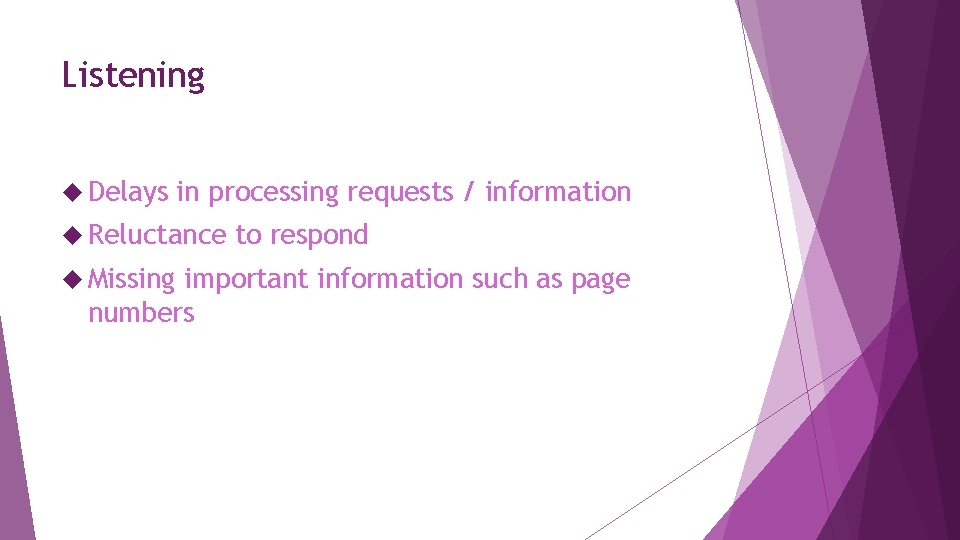
Listening Delays in processing requests / information Reluctance Missing to respond important information such as page numbers
Listening solutions Summarise Repeat what you’ve said at the end instructions several times / at key points Use physical prompts – e. g. use fingers for listing tasks Write page numbers down
Discussion Delays in processing lead to seemingly irrelevant contributions Problems with turn taking Interrupting in case they forget
discussion Teach turn-taking explicitly, including cues Encourage pupils to wait for responses before moving on Ensure classmates respond appropriately
Writing What List are you testing? key words / terms / spellings Accept alternatives – mind maps, diagrams, bullet points, recorded voice files Provide blanks of diagrams, charts, tables
Using ICT What How are the issues? do we overcome them?
Getting to the end of tasks Summarise Create what you’ve covered opportunities to practice Think of ways to create extra time – have an additional non essential task, hand out notes instead of copying Don’t automatically set unfinished reading/writing as homework Make sure homework is recorded correctly
Organisation / coordination Forgetting books, equipment, homework Following the wrong timetable Getting lost Lateness Taking a long time to settle
Organisation strategies Provide checklists for books / equipment Communicate with parents about timekeeping / homework Try different timetable formats – different days in different colours Keep in class til crowds disappear Consider teaching laboratory/ workshop safety in a multisensory way so they use all of their senses to determine safety
What development work can you do to ensure that literacy support is embedded In your classroom? In your department? In your school?