
Supporting Language and Early Literacy at Home and
- Slides: 35
Supporting Language and Early Literacy: at Home and in Early Childhood and Community Settings Session 6: Infants and Toddlers
Our Mission: To engage in a collaborative process to develop and disseminate cross-systems early literacy professional development that is evidence-based and culturally responsive to address the needs of all children, birth through five Early Literacy Advisory Group Great Lakes Inter-Tribal Council For more information, please contact: Gaye Tylka, Project Coordinator, gtylka@cesa 4. k 12. wi. us; 608. 786. 4844
Your. FACILITATORS … • (insert your name/title here) • Insert your co-presenter’s name/title here)
GOALS for this Session … Participants will: • Consider characteristics of infants and toddlers and the roles adults play in supporting their development • Explore standards that guide developmental expectations and best practice • Demonstrate appropriate shared reading strategies for infants and toddlers • Describe strategies to support language development during routines and playtime • Discuss strategies for engaging families in language and literacy experiences
AGENDA for Today’s Session
Discussion in pairs or small groups: • What do you already know about infant toddler language and early literacy development? • What do you hope to learn from today’s session?
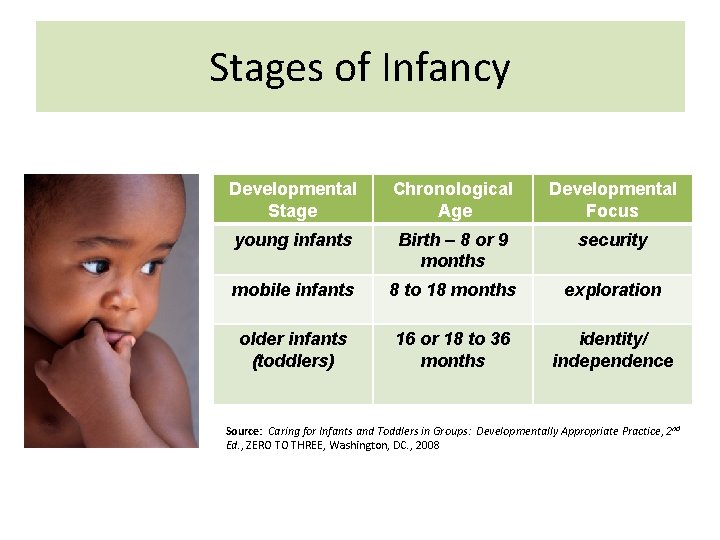
Stages of Infancy Developmental Stage Chronological Age Developmental Focus young infants Birth – 8 or 9 months security mobile infants 8 to 18 months exploration older infants (toddlers) 16 or 18 to 36 months identity/ independence Source: Caring for Infants and Toddlers in Groups: Developmentally Appropriate Practice, 2 nd Ed. , ZERO TO THREE, Washington, DC. , 2008
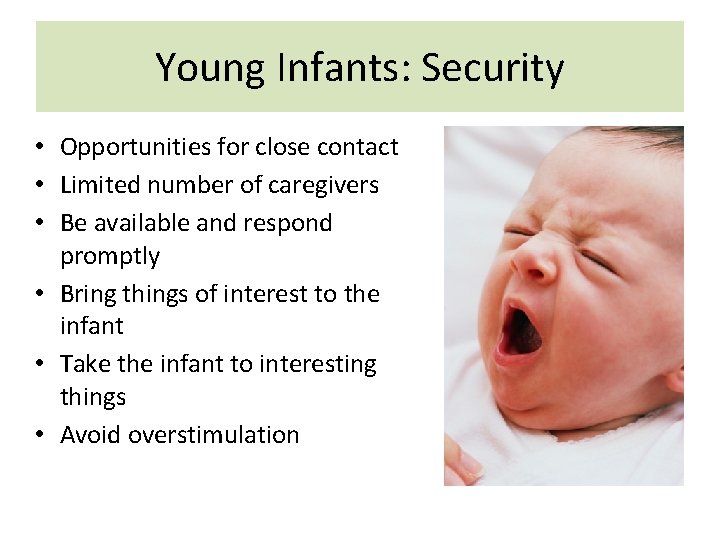
Young Infants: Security • Opportunities for close contact • Limited number of caregivers • Be available and respond promptly • Bring things of interest to the infant • Take the infant to interesting things • Avoid overstimulation
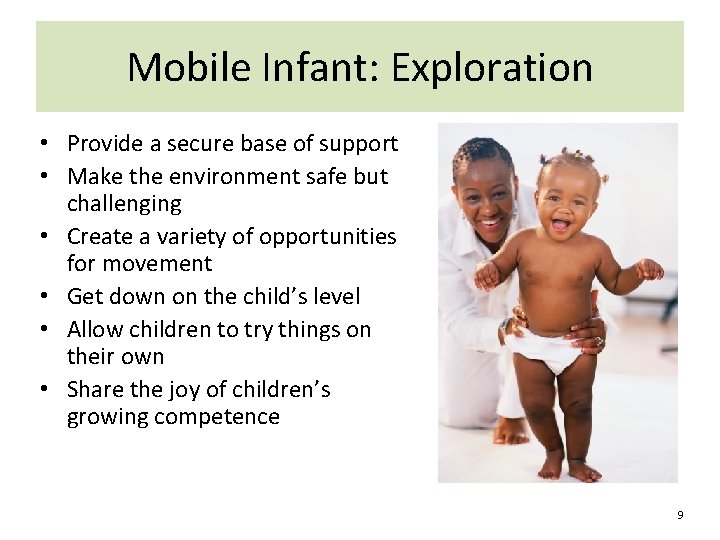
Mobile Infant: Exploration • Provide a secure base of support • Make the environment safe but challenging • Create a variety of opportunities for movement • Get down on the child’s level • Allow children to try things on their own • Share the joy of children’s growing competence 9
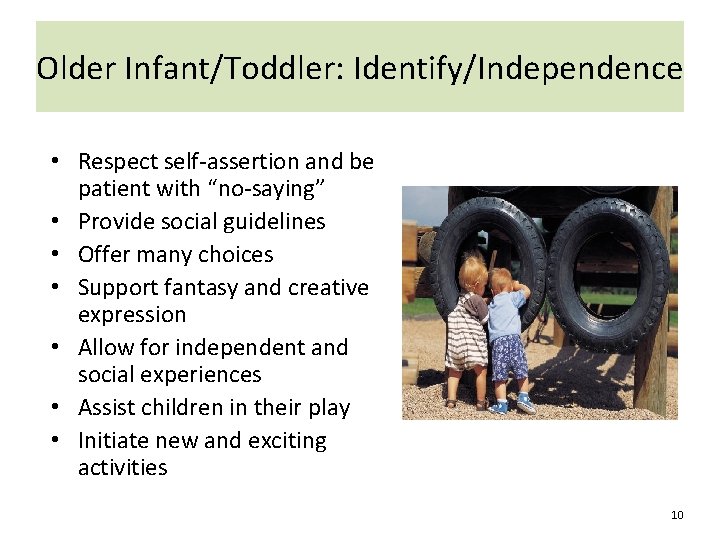
Older Infant/Toddler: Identify/Independence • Respect self-assertion and be patient with “no-saying” • Provide social guidelines • Offer many choices • Support fantasy and creative expression • Allow for independent and social experiences • Assist children in their play • Initiate new and exciting activities 10
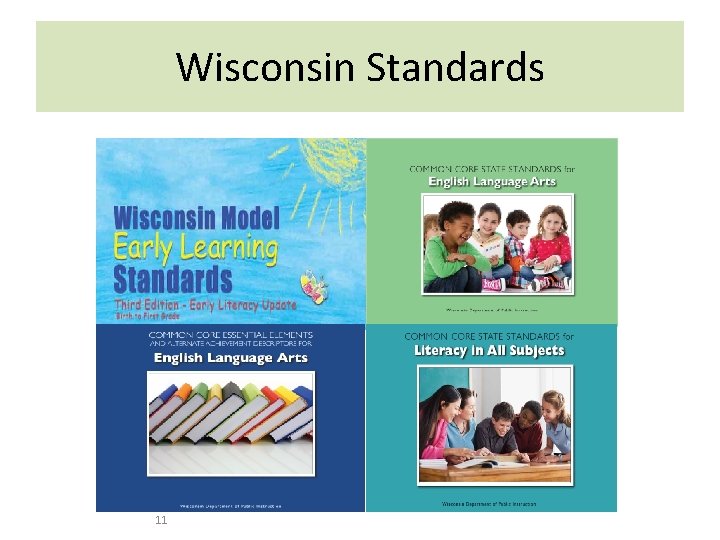
Wisconsin Standards 11
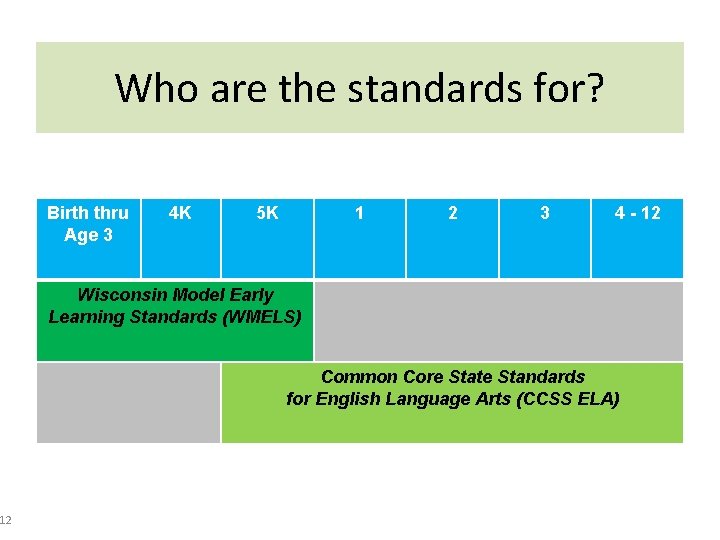
12 Who are the standards for? Birth thru Age 3 4 K 5 K 1 2 3 4 - 12 Wisconsin Model Early Learning Standards (WMELS) Common Core State Standards for English Language Arts (CCSS ELA)
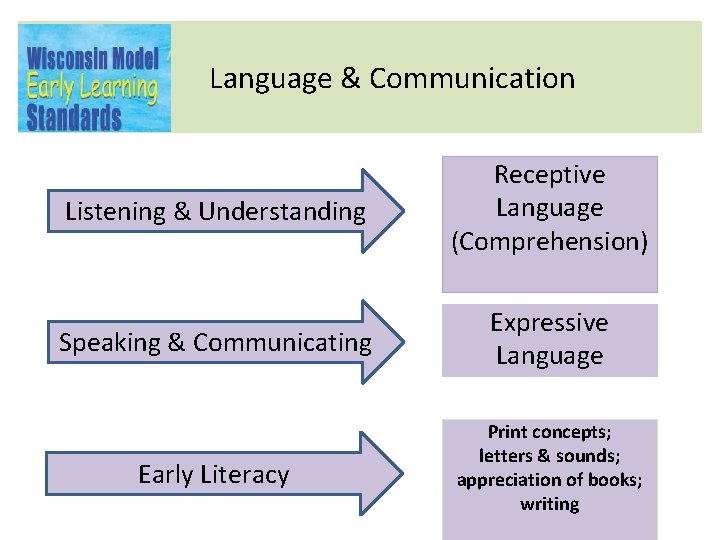
Language & Communication Listening & Understanding Receptive Language (Comprehension) Speaking & Communicating Expressive Language Early Literacy Print concepts; letters & sounds; appreciation of books; writing
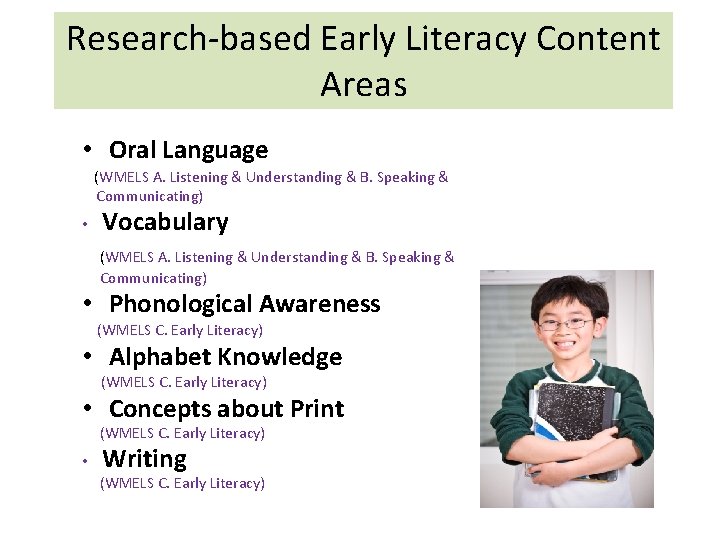
Research-based Early Literacy Content Areas • Oral Language (WMELS A. Listening & Understanding & B. Speaking & Communicating) • Vocabulary (WMELS A. Listening & Understanding & B. Speaking & Communicating) • Phonological Awareness (WMELS C. Early Literacy) • Alphabet Knowledge (WMELS C. Early Literacy) • Concepts about Print (WMELS C. Early Literacy) • Writing (WMELS C. Early Literacy)
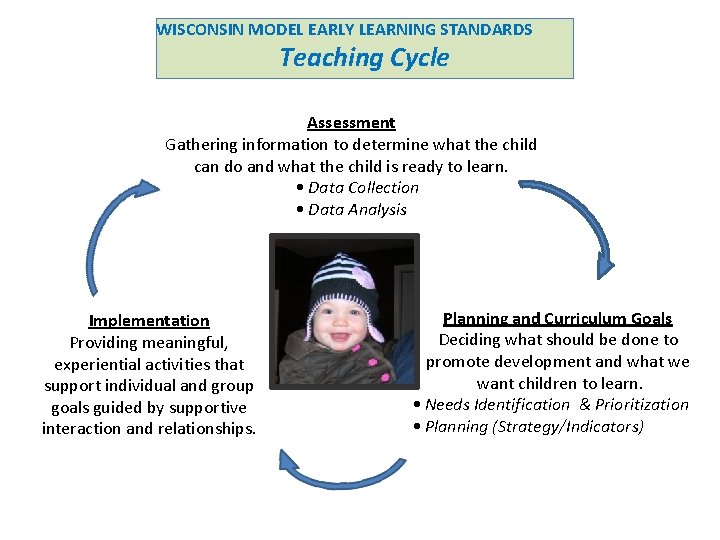
WISCONSIN MODEL EARLY LEARNING STANDARDS Teaching Cycle Assessment Gathering information to determine what the child can do and what the child is ready to learn. • Data Collection • Data Analysis Implementation Providing meaningful, experiential activities that support individual and group goals guided by supportive interaction and relationships. Planning and Curriculum Goals Deciding what should be done to promote development and what we want children to learn. • Needs Identification & Prioritization • Planning (Strategy/Indicators)
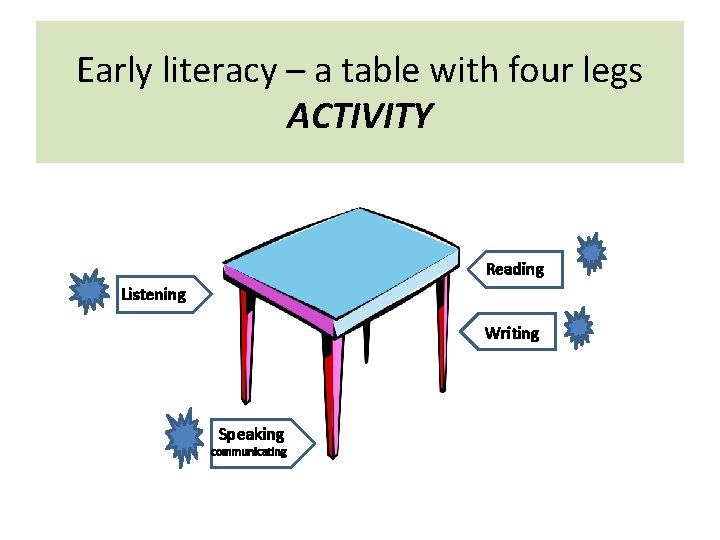
Early literacy – a table with four legs ACTIVITY Reading Listening Writing Speaking communicating
What does literacy mean for infants and toddlers? Center for the Developing Child - Harvard University
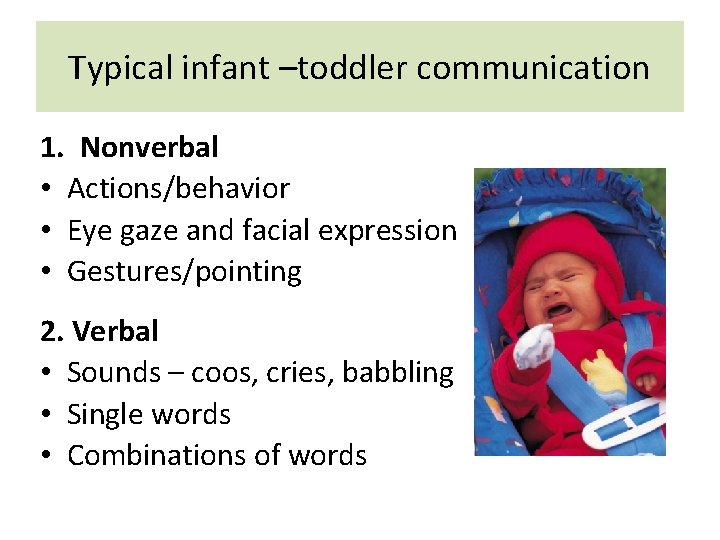
Typical infant –toddler communication 1. Nonverbal • Actions/behavior • Eye gaze and facial expression • Gestures/pointing 2. Verbal • Sounds – coos, cries, babbling • Single words • Combinations of words
General language support mobile infants - toddlers • • Keep your sentences simple Speak slowly Don’t require maintained eye contact ; a glance is OK PLAY. Child leads, you follow COMMENT on what is happening Model how to talk about actions & objects Model how to problem-solve Let the child talk (OK to sit and listen/observe sometimes) Source: Sippl, T. Coaching Parents to Foster Their Child’s Expressive Language Skills, American Speech & Hearing Association, 2013 http: //blog. asha. org/2013/11/05/coaching-parents-to-foster-their-childs-expressive-language-skills
General vocabulary building support • NARRATE children’s activities (describe what the child is doing while s/he is doing it) • Repeat & Expand on child’s language (Child: “Dog. ” Adult: “Yes, it is a dog. He is a big, red dog. ”) • Use new words that connect to words the child already knows/uses. (Child: “Big dog. ” Adult: “Yes, it is a big dog. Another word for “big” is “enormous”; that is an enormous dog!”)
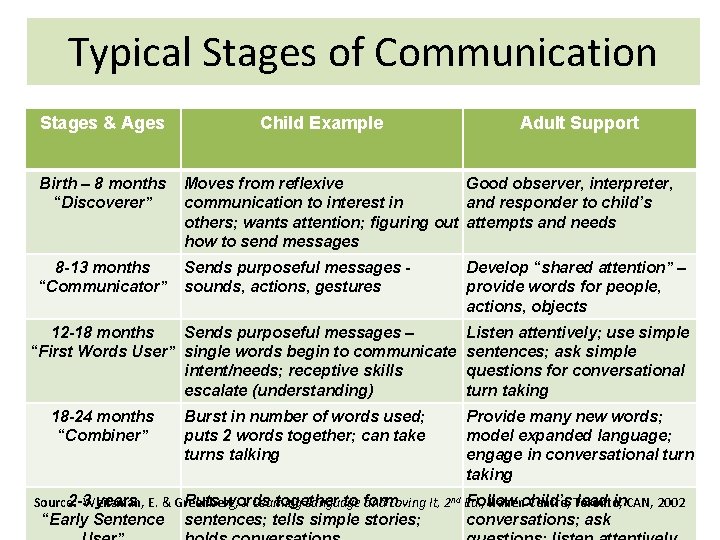
Typical Stages of Communication Stages & Ages Child Example Adult Support Birth – 8 months “Discoverer” Moves from reflexive Good observer, interpreter, communication to interest in and responder to child’s others; wants attention; figuring out attempts and needs how to send messages 8 -13 months “Communicator” Sends purposeful messages sounds, actions, gestures 12 -18 months Sends purposeful messages – “First Words User” single words begin to communicate intent/needs; receptive skills escalate (understanding) 18 -24 months “Combiner” Burst in number of words used; puts 2 words together; can take turns talking Develop “shared attention” – provide words for people, actions, objects Listen attentively; use simple sentences; ask simple questions for conversational turn taking Provide many new words; model expanded language; engage in conversational turn taking 2 -3 Weitzman, years E. & Greenberg, Puts words together to form Follow lead in. CAN, 2002 Source: J. Learning Language and Loving It, 2 nd Ed. , Hanenchild’s Centre, Toronto, “Early Sentence sentences; tells simple stories; conversations; ask
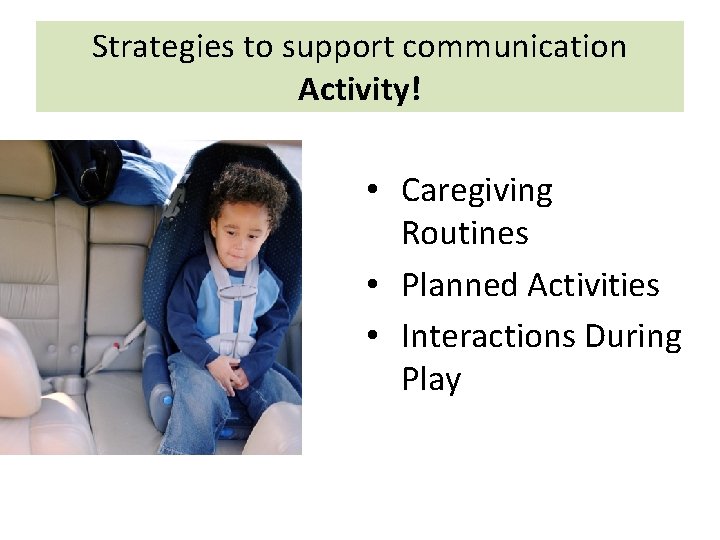
Strategies to support communication Activity! • Caregiving Routines • Planned Activities • Interactions During Play
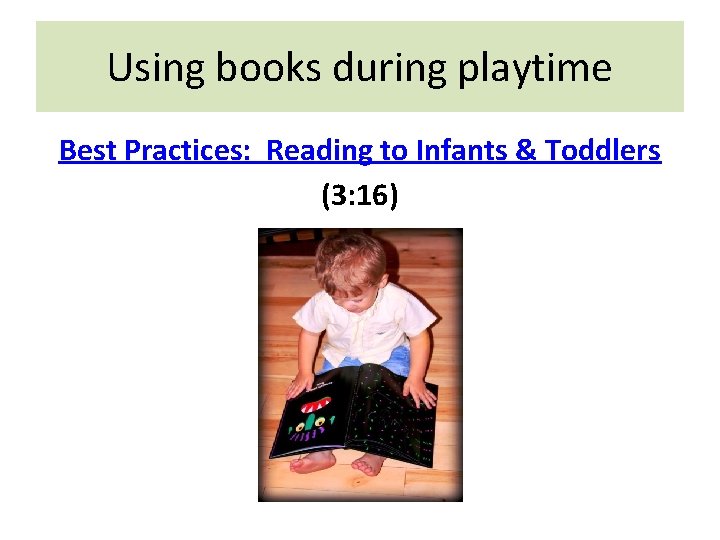
Using books during playtime Best Practices: Reading to Infants & Toddlers (3: 16)
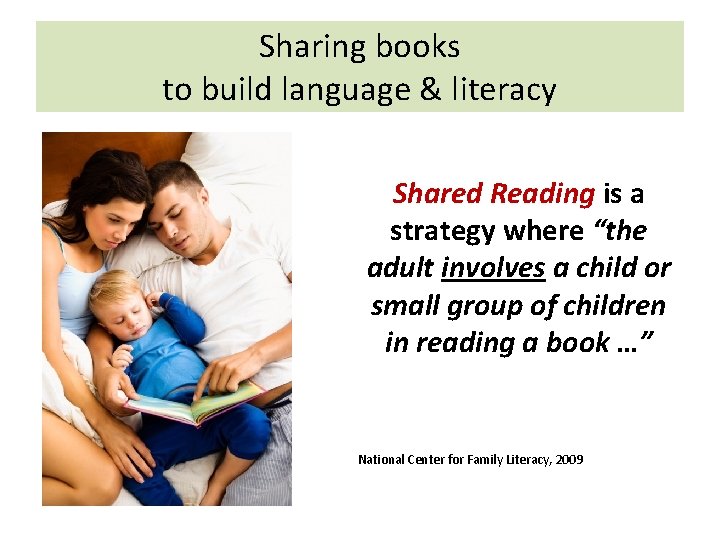
Sharing books to build language & literacy Shared Reading is a strategy where “the adult involves a child or small group of children in reading a book …” National Center for Family Literacy, 2009
American Academy of Pediatrics (APP) Policy Statement “The AAP recommends that pediatric providers promote early literacy development … beginning in infancy … by … advising all parents that reading aloud with young children can enhance parent-child relationships and prepare young minds to learn language and early literacy skills; (2) counseling all parents about developmentally appropriate sharedreading activities …” Literacy Promotion: An Essential Component of Primary Care Pediatric Practice, p. 1, originally published online 6/23/2014 http: //pediatrics. aappublications. org/content/early/2014/06/19/peds. 2014 -1384. full. pdf+html
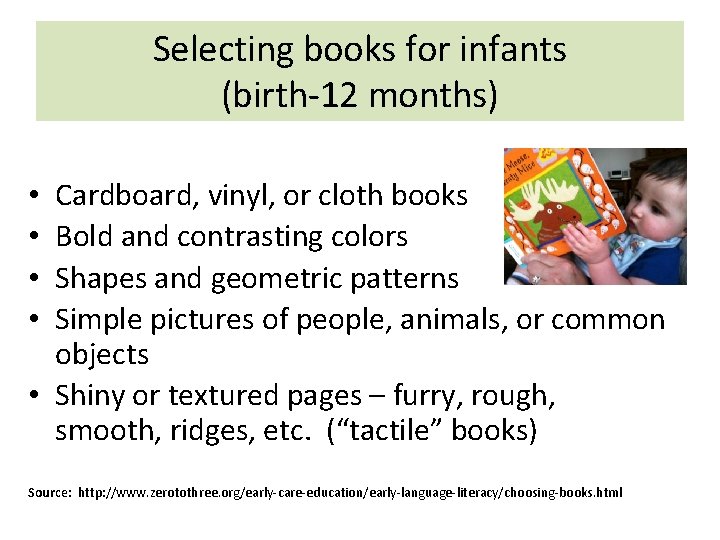
Selecting books for infants (birth-12 months) Cardboard, vinyl, or cloth books Bold and contrasting colors Shapes and geometric patterns Simple pictures of people, animals, or common objects • Shiny or textured pages – furry, rough, smooth, ridges, etc. (“tactile” books) • • Source: http: //www. zerotothree. org/early-care-education/early-language-literacy/choosing-books. html
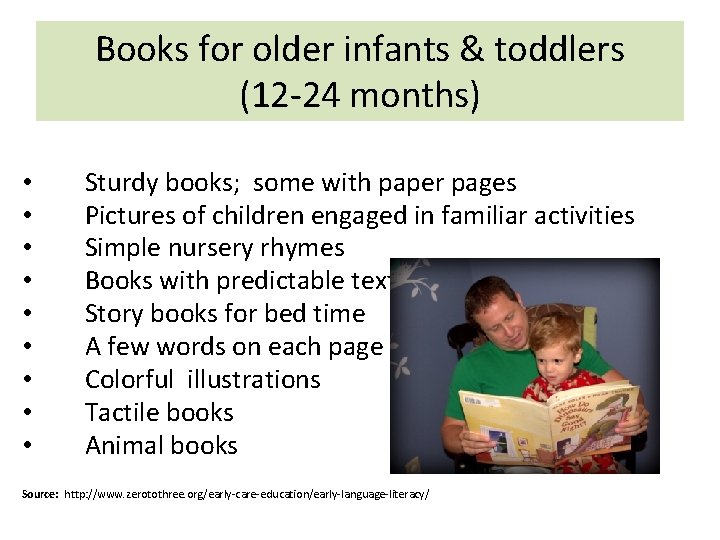
Books for older infants & toddlers (12 -24 months) • • • Sturdy books; some with paper pages Pictures of children engaged in familiar activities Simple nursery rhymes Books with predictable text Story books for bed time A few words on each page Colorful illustrations Tactile books Animal books Source: http: //www. zerotothree. org/early-care-education/early-language-literacy/
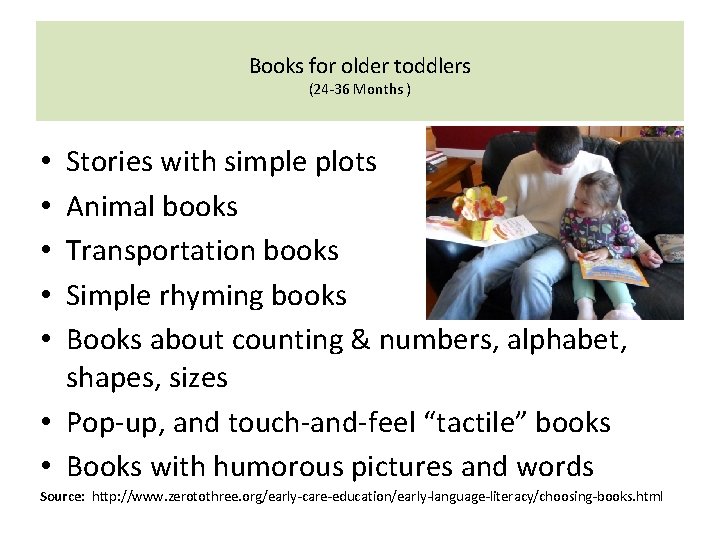
Books for older toddlers (24 -36 Months ) Stories with simple plots Animal books Transportation books Simple rhyming books Books about counting & numbers, alphabet, shapes, sizes • Pop-up, and touch-and-feel “tactile” books • Books with humorous pictures and words • • • Source: http: //www. zerotothree. org/early-care-education/early-language-literacy/choosing-books. html
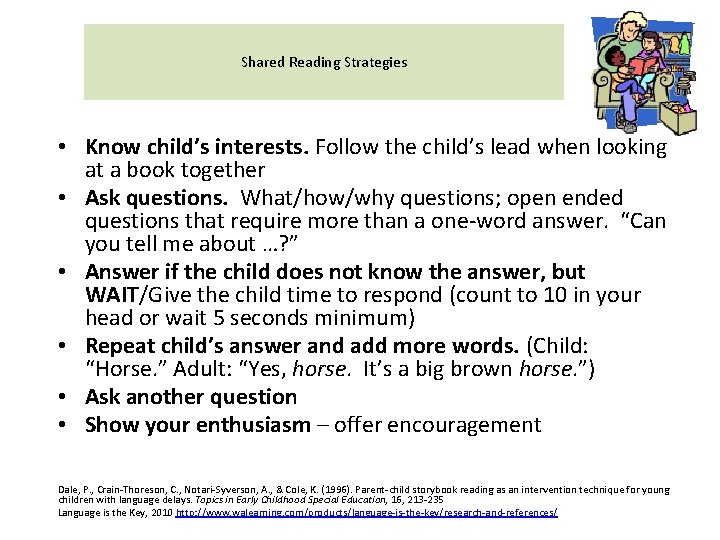
Shared Reading Strategies • Know child’s interests. Follow the child’s lead when looking at a book together • Ask questions. What/how/why questions; open ended questions that require more than a one-word answer. “Can you tell me about …? ” • Answer if the child does not know the answer, but WAIT/Give the child time to respond (count to 10 in your head or wait 5 seconds minimum) • Repeat child’s answer and add more words. (Child: “Horse. ” Adult: “Yes, horse. It’s a big brown horse. ”) • Ask another question • Show your enthusiasm – offer encouragement Dale, P. , Crain-Thoreson, C. , Notari-Syverson, A. , & Cole, K. (1996). Parent-child storybook reading as an intervention technique for young children with language delays. Topics in Early Childhood Special Education, 16, 213 -235 Language is the Key, 2010 http: //www. walearning. com/products/language-is-the-key/research-and-references/
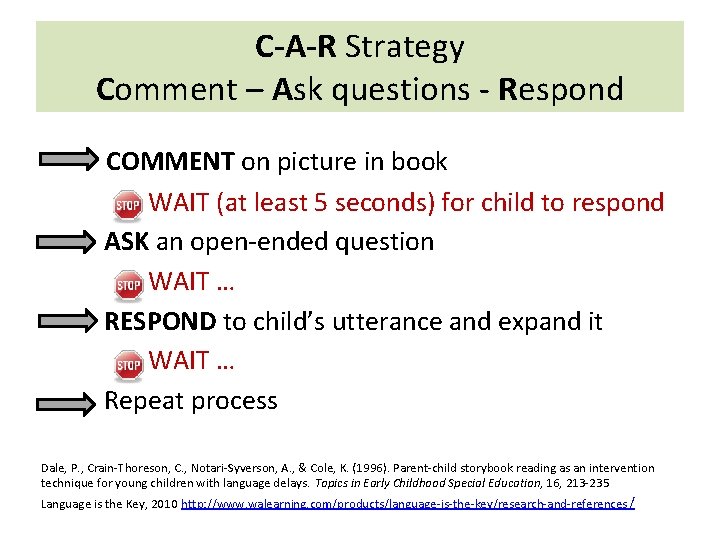
C-A-R Strategy Comment – Ask questions - Respond COMMENT on picture in book WAIT (at least 5 seconds) for child to respond ASK an open-ended question WAIT … RESPOND to child’s utterance and expand it WAIT … Repeat process Dale, P. , Crain-Thoreson, C. , Notari-Syverson, A. , & Cole, K. (1996). Parent-child storybook reading as an intervention technique for young children with language delays. Topics in Early Childhood Special Education, 16, 213 -235 Language is the Key, 2010 http: //www. walearning. com/products/language-is-the-key/research-and-references /
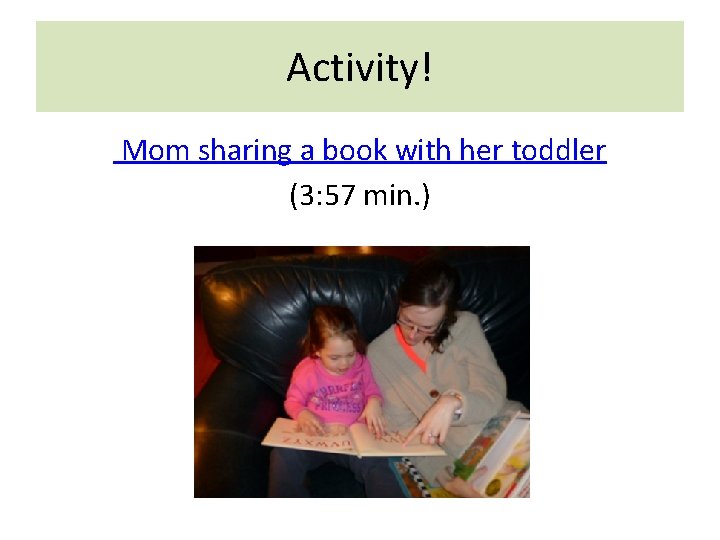
Activity! Mom sharing a book with her toddler (3: 57 min. )
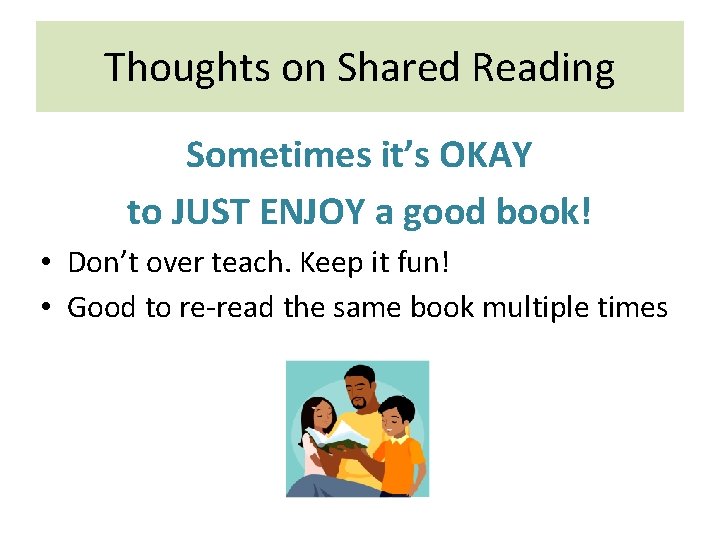
Thoughts on Shared Reading Sometimes it’s OKAY to JUST ENJOY a good book! • Don’t over teach. Keep it fun! • Good to re-read the same book multiple times
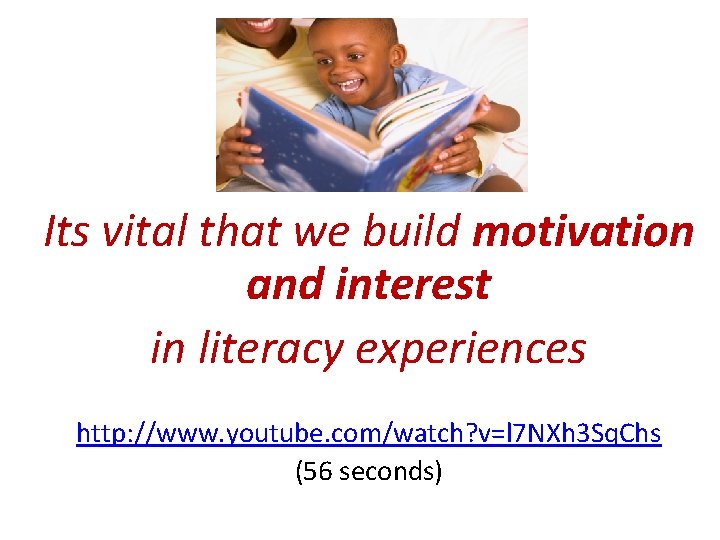
Its vital that we build motivation and interest in literacy experiences http: //www. youtube. com/watch? v=l 7 NXh 3 Sq. Chs (56 seconds)
Double Focus! Highly effective teachers and caregivers… provide daily, intentional language and early literacy learning opportunities for the children they serve, and … engage families in providing daily, intentional language and early literacy learning opportunities for their own children! Winton, P. J. , Mc. Collum, J. A. , & Catlett, C. Practical Approaches to Early Childhood Professional Development: Evidence, Strategies, & Resources. Zero to Three, Washington, DC. , 2008
Wrap-up • Share a new concept or specific strategy you learned that you will use. • What questions do you still have about supporting language and early literacy?