
Supporting Healthy Body Images and Messages for Youth
Supporting Healthy Body Images and Messages for Youth* Rachel Williams, CCE-Seneca Nigel Gannon, NYS 4 -H * This PPT is formatted according to the CCE Digital Accessibility Guidelines.
Today’s Overview & Objectives I. Working Agreements II. Defining Body Image III. General Considerations IV. Body Image Continuum V. Cultivating a Positive Body Image / Body Positivity VI. Providing/Finding Support: Resources VII. Activities
Working Agreements • Take risks. Take the first step. • Respectful sharing of ideas. • No judgment. • Listen. Actively listen. • Allow time for digestion. • Think outside the box. • Mindful of body language (silent communication). • Ouch/Oops: Honor Triggers. • Encourage Participation. • Embrace vulnerability.
Mentimeter Comments When you hear the term “body image”, what comes to mind for you? Go to: menti. com Code: 60 66 30
Body Image Four unique aspects: Perceptual body image: how you see your body Affective body image: how you feel about your body Cognitive body image: how you think about your body Behavioral body image: the way you behave as a result of your perceptual, affective, and cognitive body image
General Considerations Social-emotional wellness or strength is a strong protective factor: self-confidence, self-esteem The role of the primary care provider is essential and—primary! Good choices for your body, for YOU. Healthy messages and practices do not include “diet”: alternatively, Fueling for Health, Eating for Wellness, Foods that Fuel
Motivations Media Smart Youth Collage Activity Diversity, Equity, & Inclusion Considering Social Identities Cultivating Safe Spaces Identity-based Bullying Behaviors Our Lived Experiences
HOW NOT TO TALK TO A CHILD WHO IS OVERWEIGHT For all the attention paid to weight and its health effects in medical settings, the social and emotional side is often neglected…. “Weight is now one of the most frequent reasons kids are teased or bullied”…. In addition to the well-documented effects on children’s mental health and self esteem… research has shown very harmful effects on children’s eating behavior, and increased risk that they will stay sedentary and gain weight. -Rebecca Puhl, Clinical Psychologist, University of Connecticut; Lead Author, Policy Statement for the American Academy of Pediatrics
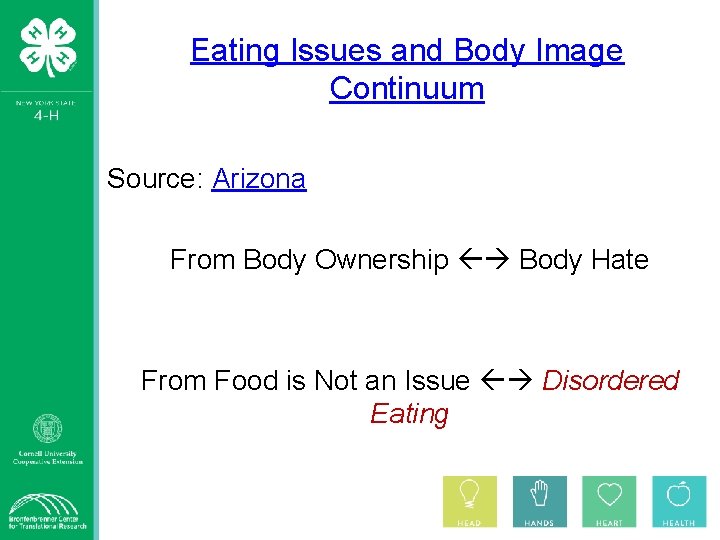
Eating Issues and Body Image Continuum Source: Arizona From Body Ownership Body Hate From Food is Not an Issue Disordered Eating
Language Matters Eating Disordered v. Disordered Eating
Cultivating a Positive Body Image Appreciate all your body does for you. Focus on health. *SLEEP Question unreasonable standards.
Health at Every Size Respect • Celebrates body diversity • Honors differences in size, age, race, ethnicity, gender, dis/ability, sexual orientation, religion, class, and other human attributes. Critical Awareness • Challenges scientific and cultural assumptions • Values body knowledge and lived experiences.
Health at Every Size Compassionate Self-care Finding the joy in moving one’s body and being physically active Eating in a flexible and attuned manner that values pleasure and honors internal cues of hunger, satiety, and appetite, while respecting the social conditions that frame eating options.
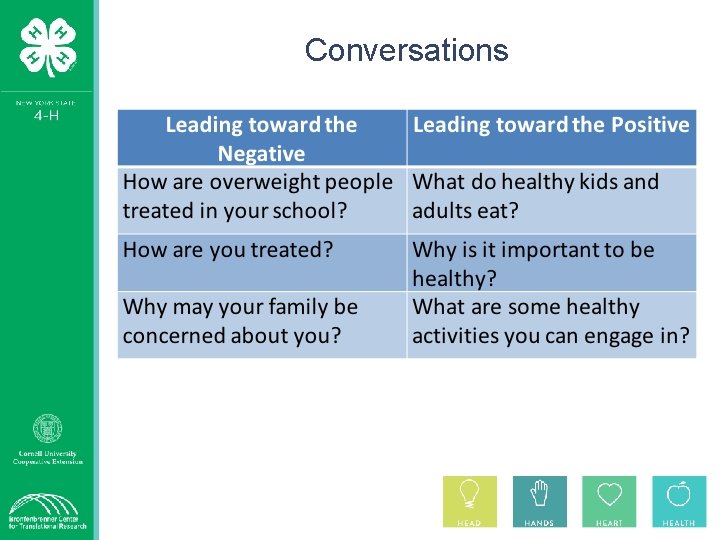
Conversations
On Risk Factors & Warning Signs Nuanced; Verbal, Behavioral, Physical Co-occurrence: Depression Anxiety Substance Use Disorders See Resources Page
National & Local Resources *Primary Care Provider & General Mental Health Organizations The National Eating Disorders Association health information and referral hotline: 800 -931 -2237 • National Eating Disorders Association screening tool • New York Map of Experts • New York Comprehensive Care Centers Alliance for Eating Disorders Awareness National Association of Anorexia Nervosa and Associated Disorders (ANAD) Something Fishy
Body Positivity The Be Body Positive Model Core Competencies 1. Reclaim Health 2. Practice Intuitive Self-Care 3. Cultivate Self Love 4. Declare Your Own Authentic Beauty 5. Build Community
Body Positivity Your body is the seat of your intuition; it is the avenue through which you connect to your gut instincts—to what you know. Intuition is the most reliable authority to guide the choices you make. Your body talks to you in sensations; feelings of tension, fear, hunger, pleasure, aliveness, and pain are just some of the ways it attempts to communicate with you. This is why staying connected to your physical self—with as little conflict as possible— is fundamental to health and wellbeing. --Connie Sobczak, Embody: Learning to Love Your Unique Body (and quite that critical voice!)
Cultural Messages Group Breakout What cultural values affect the topic of body image, and how do they support or inhibit body acceptance?
Activities Addressing Negative Self Talk Adjusting Appearance Assumptions MSY Collage Activity (Related: On Media Messages & Stigma in Your Thoughts Matter) Social Media Meditation
Negative Self-Talk: Peer Support Teenz. Talk With disordered eating: • negative self-talk and appearance assumptions are exaggerated by an individual • negative self talk is reinforced by not eating • compliments may be reinforcing
Building Body Acceptance On Negative Self-Talk: If I look attractive, then people will value me. If I don’t hide the real me, then people will not accept me. Fat-Talk Free Week
Building Body Acceptance Adjusting Appearance Assumptions Worksheet • Assumption I would like to adjust • Where might this assumption have come from? Why is it still here? • What impact does this assumption have on my life? • In what ways is this assumption unreasonable, unrealistic or unhelpful? • What is an alternative assumption that is more balanced and flexible? • What can I do to put this assumption into practice on a daily basis?
MSY Collage Activity See website for download.
Mindfulness See S-E Welness website, right-hand column, for various mindfulness resources and guided meditations. Many options. Free.
Questions, Comments, Appreciations Thank you!
- Slides: 26