
Supporting ELs in the Classroom ELs at Germantown
- Slides: 47
+ Supporting ELs in the Classroom
ELs at Germantown ELs – 40 + Transitional- 15 ***Many of our ELs do not have language/content support at home.
+ ILP vs. IEP ELs do not have IEPs, but they do have ILPs (Individual Language Plans). The ILPs provide personal background information including scoring. Additionally, the form lists accommodations for instruction, assignments, and assessments. Look at which boxes are checked.
+ Based on research, grades 6 -12 prove to be the most challenging for ELs due to the expectations of learning social language simultaneously with academic language.
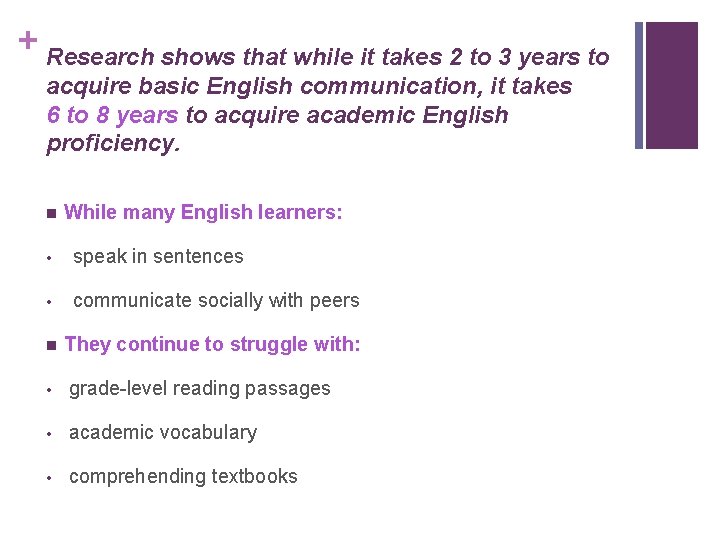
+ Research shows that while it takes 2 to 3 years to acquire basic English communication, it takes 6 to 8 years to acquire academic English proficiency. n While many English learners: • speak in sentences • communicate socially with peers n They continue to struggle with: • grade-level reading passages • academic vocabulary • comprehending textbooks
How do I determine who is + an English Language Learner?
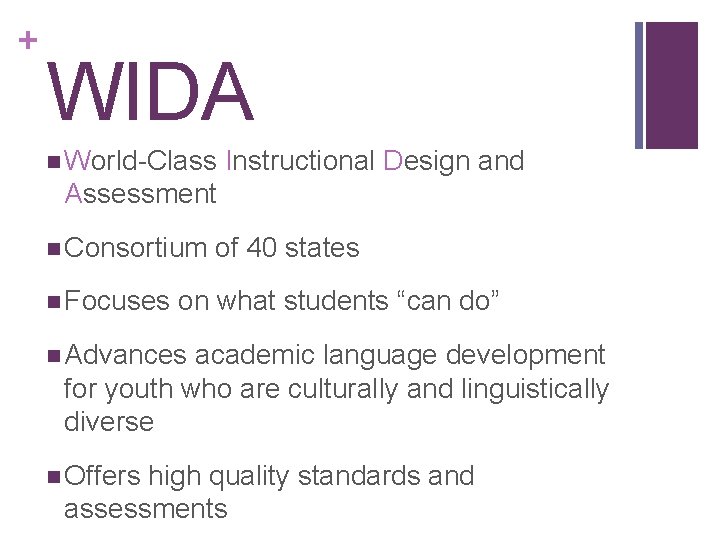
+ WIDA n World-Class Instructional Design and Assessment n Consortium n Focuses of 40 states on what students “can do” n Advances academic language development for youth who are culturally and linguistically diverse n Offers high quality standards and assessments
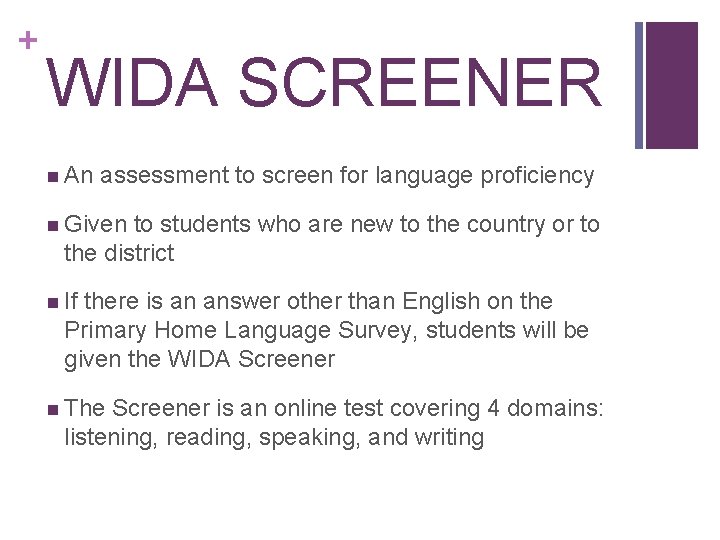
+ WIDA SCREENER n An assessment to screen for language proficiency n Given to students who are new to the country or to the district n If there is an answer other than English on the Primary Home Language Survey, students will be given the WIDA Screener n The Screener is an online test covering 4 domains: listening, reading, speaking, and writing
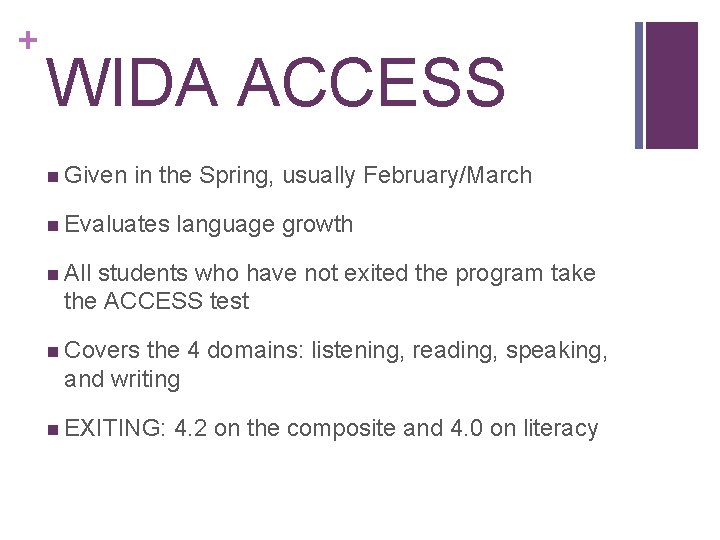
+ WIDA ACCESS n Given in the Spring, usually February/March n Evaluates language growth n All students who have not exited the program take the ACCESS test n Covers the 4 domains: listening, reading, speaking, and writing n EXITING: 4. 2 on the composite and 4. 0 on literacy
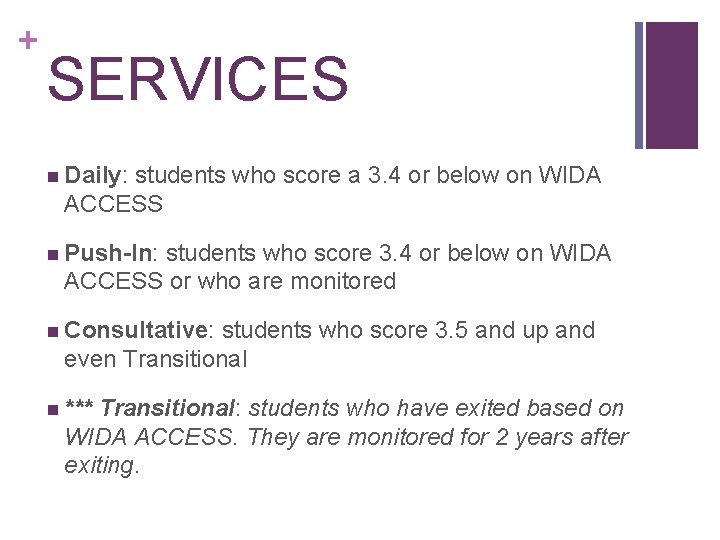
+ SERVICES n Daily: students who score a 3. 4 or below on WIDA ACCESS n Push-In: students who score 3. 4 or below on WIDA ACCESS or who are monitored n Consultative: students who score 3. 5 and up and even Transitional n *** Transitional: students who have exited based on WIDA ACCESS. They are monitored for 2 years after exiting.
+ . . . ACCOMMODATIONS
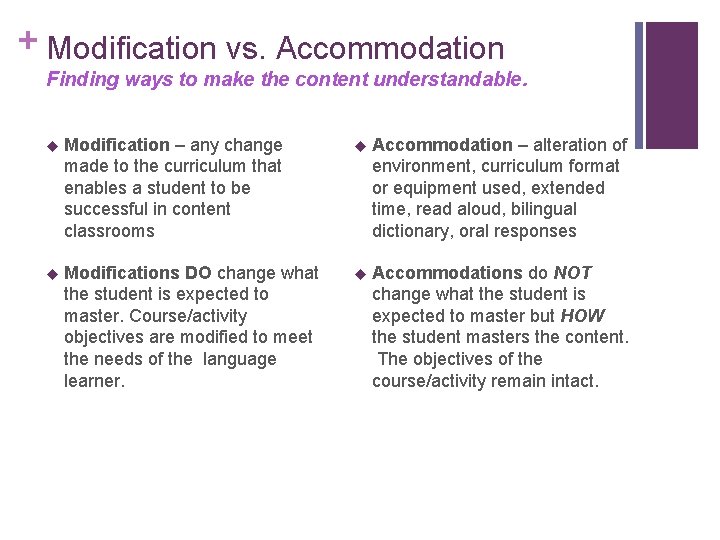
+ Modification vs. Accommodation Finding ways to make the content understandable. u Modification – any change made to the curriculum that enables a student to be successful in content classrooms u Accommodation u Modifications u Accommodations DO change what the student is expected to master. Course/activity objectives are modified to meet the needs of the language learner. – alteration of environment, curriculum format or equipment used, extended time, read aloud, bilingual dictionary, oral responses do NOT change what the student is expected to master but HOW the student masters the content. The objectives of the course/activity remain intact.
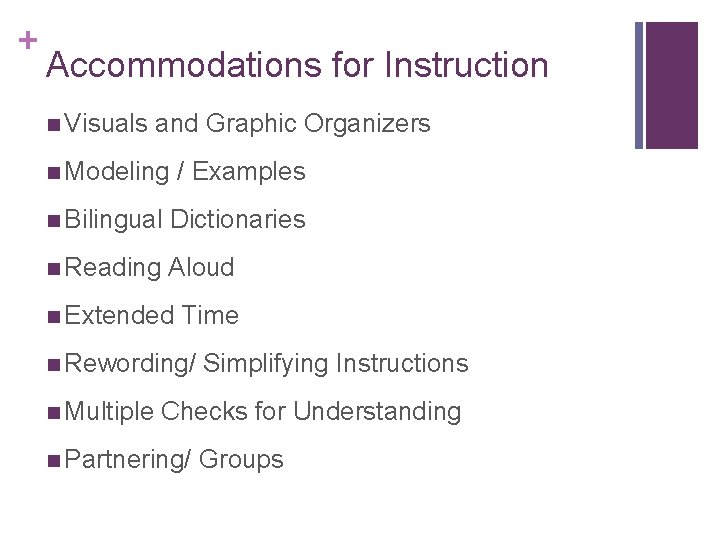
+ Accommodations for Instruction n Visuals and Graphic Organizers n Modeling / Examples n Bilingual Dictionaries n Reading Aloud n Extended Time n Rewording/ n Multiple Simplifying Instructions Checks for Understanding n Partnering/ Groups
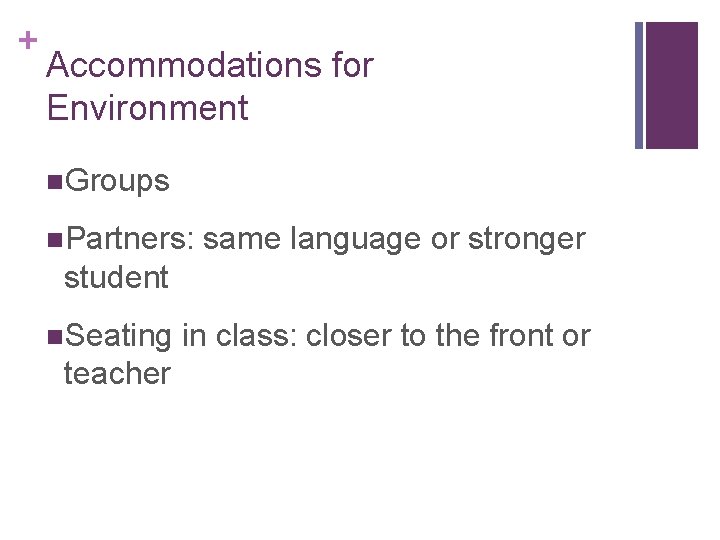
+ Accommodations for Environment n. Groups n. Partners: same language or stronger student n. Seating teacher in class: closer to the front or
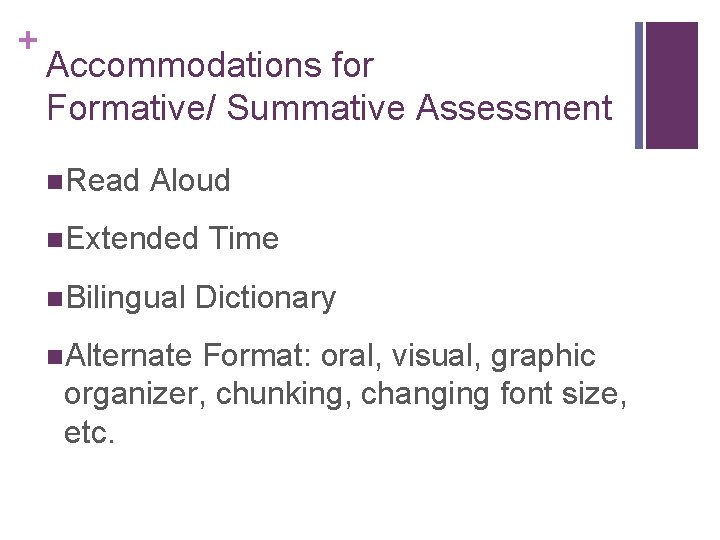
+ Accommodations for Formative/ Summative Assessment n. Read Aloud n. Extended n. Bilingual n. Alternate Time Dictionary Format: oral, visual, graphic organizer, chunking, changing font size, etc.
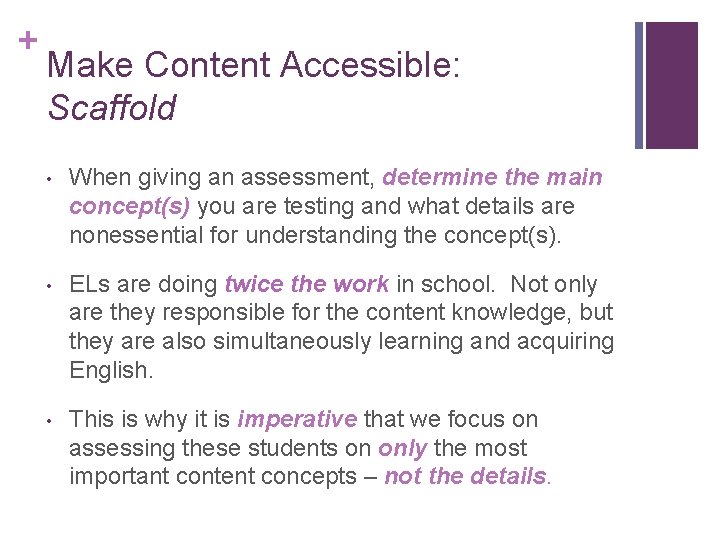
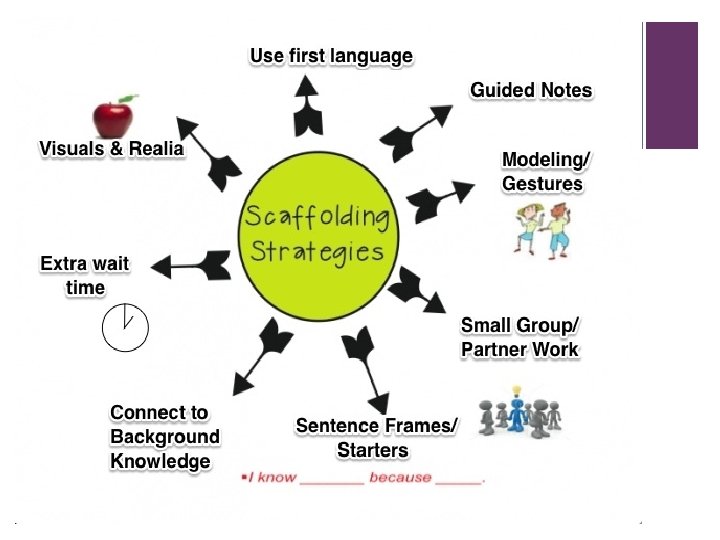
+ Make Content Accessible: Scaffold • When giving an assessment, determine the main concept(s) you are testing and what details are nonessential for understanding the concept(s). • ELs are doing twice the work in school. Not only are they responsible for the content knowledge, but they are also simultaneously learning and acquiring English. • This is why it is imperative that we focus on assessing these students on only the most important content concepts – not the details.
+ INSTRUCTIONA L STRATEGIES
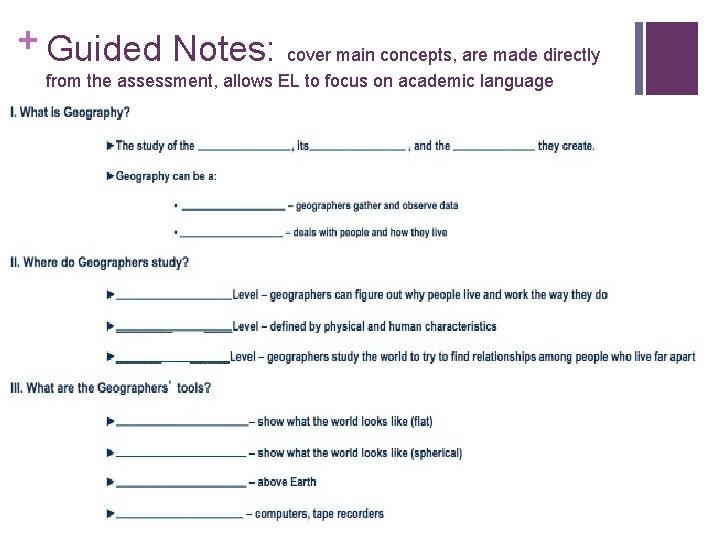
+ Guided Notes: cover main concepts, are made directly from the assessment, allows EL to focus on academic language
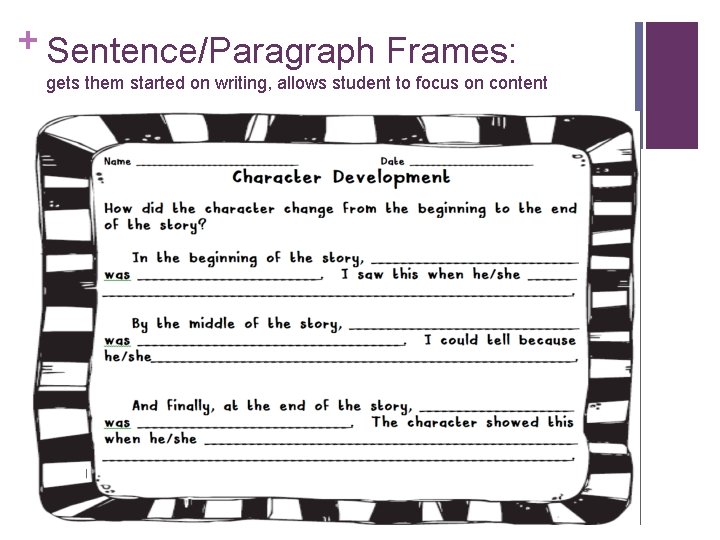
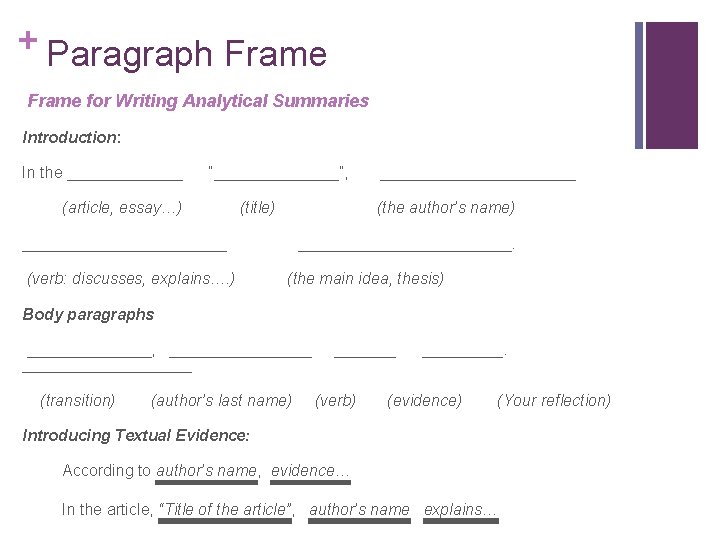
+ Sentence/Paragraph Frames: gets them started on writing, allows student to focus on content
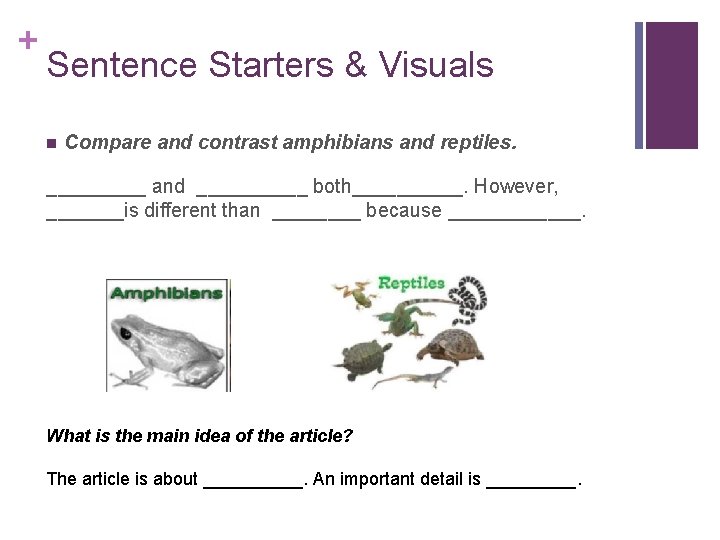
+ Sentence Starters & Visuals n Compare and contrast amphibians and reptiles. _____ and _____ both_____. However, _______is different than ____ because ______. What is the main idea of the article? The article is about _____. An important detail is _____.
+ Paragraph Frame for Writing Analytical Summaries Introduction: In the _______ “_______”, (article, essay…) (title) (the author’s name) ____________ (verb: discusses, explains…. ) ________________________. (the main idea, thesis) Body paragraphs _______, ___________________ (transition) (author’s last name) _______ (verb) _____. (evidence) (Your reflection) Introducing Textual Evidence: According to author’s name, evidence… In the article, “Title of the article”, author’s name explains…
+ LANGUAGE. . .
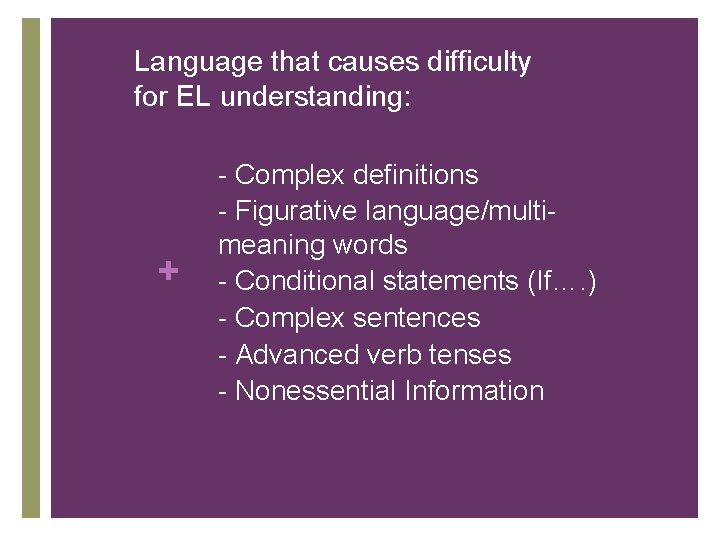
Language that causes difficulty for EL understanding: • • + • • - Complex definitions - Figurative language/multimeaning words - Conditional statements (If…. ) - Complex sentences - Advanced verb tenses - Nonessential Information
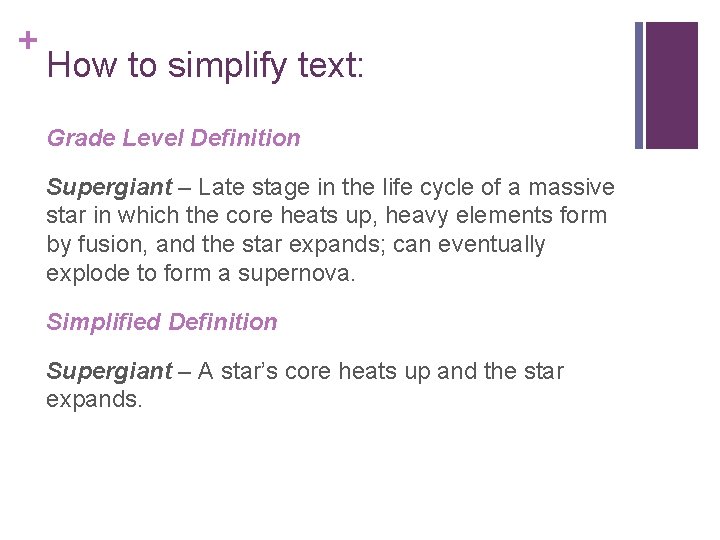
+ How to simplify text: Grade Level Definition Supergiant – Late stage in the life cycle of a massive star in which the core heats up, heavy elements form by fusion, and the star expands; can eventually explode to form a supernova. Simplified Definition Supergiant – A star’s core heats up and the star expands.
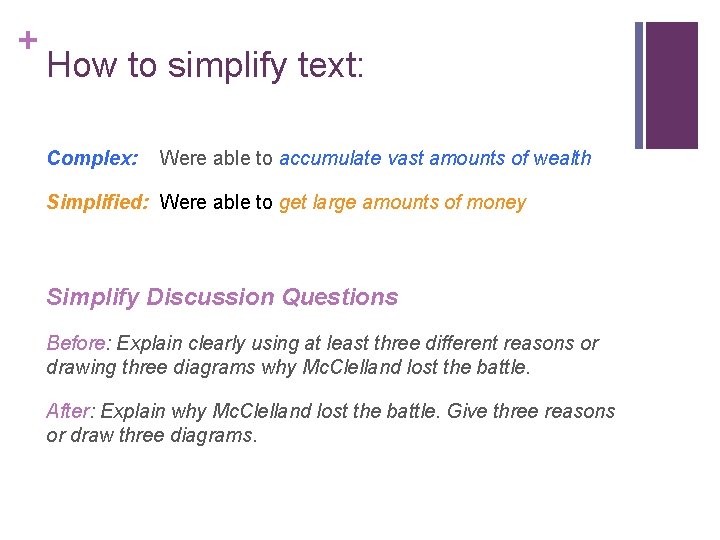
+ How to simplify text: Complex: Were able to accumulate vast amounts of wealth Simplified: Were able to get large amounts of money Simplify Discussion Questions Before: Explain clearly using at least three different reasons or drawing three diagrams why Mc. Clelland lost the battle. After: Explain why Mc. Clelland lost the battle. Give three reasons or draw three diagrams.
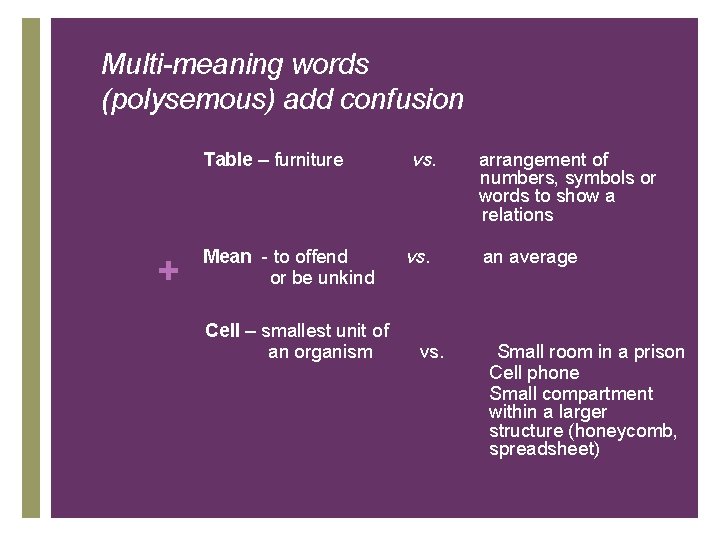
Multi-meaning words (polysemous) add confusion + 1. Table – furniture 2. Mean - to offend or be unkind Cell – smallest unit of an organism vs. arrangement of numbers, symbols or words to show a relations an average Small room in a prison Cell phone Small compartment within a larger structure (honeycomb, spreadsheet)
ASSESSMENT + S. . . .
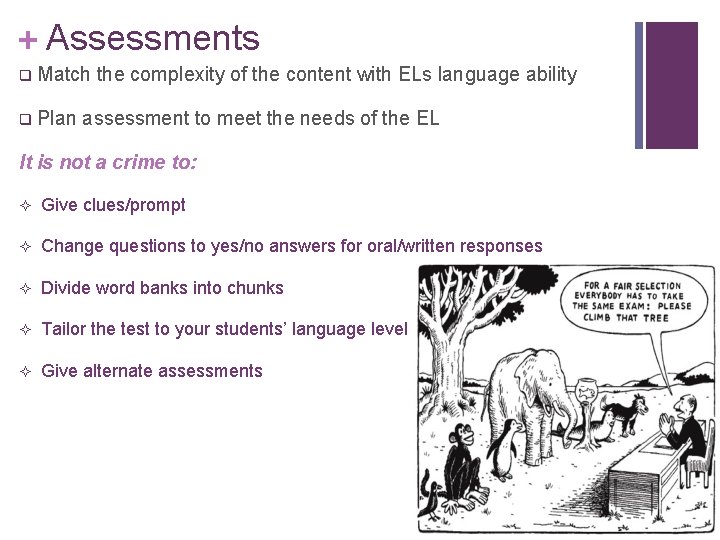
+ Assessments q Match q Plan the complexity of the content with ELs language ability assessment to meet the needs of the EL It is not a crime to: ² Give clues/prompt ² Change questions to yes/no answers for oral/written responses ² Divide word banks into chunks ² Tailor the test to your students’ language level ² Give alternate assessments
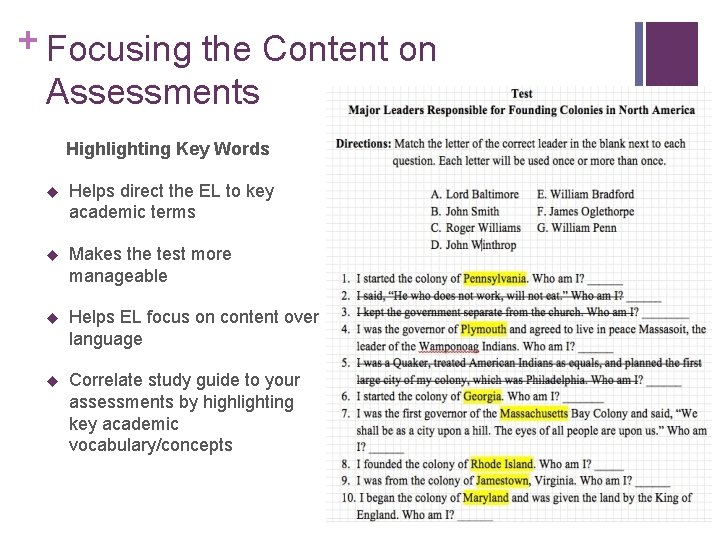
+ Focusing the Content on Assessments Highlighting Key Words u Helps direct the EL to key academic terms u Makes the test more manageable u Helps EL focus on content over language u Correlate study guide to your assessments by highlighting key academic vocabulary/concepts
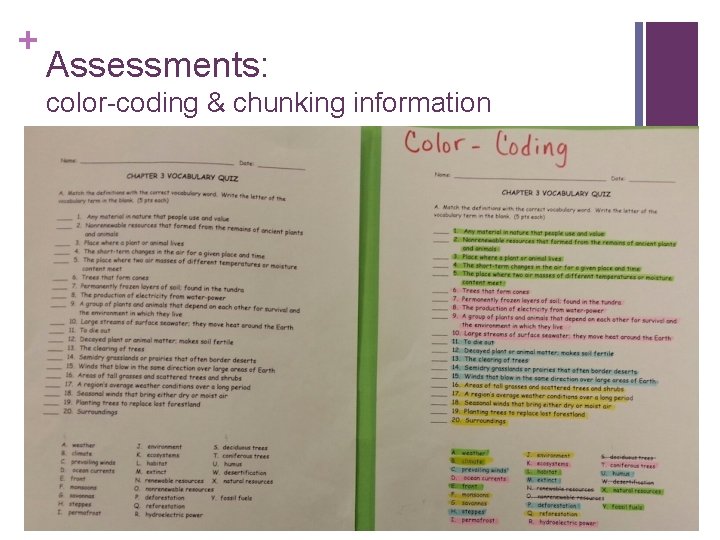
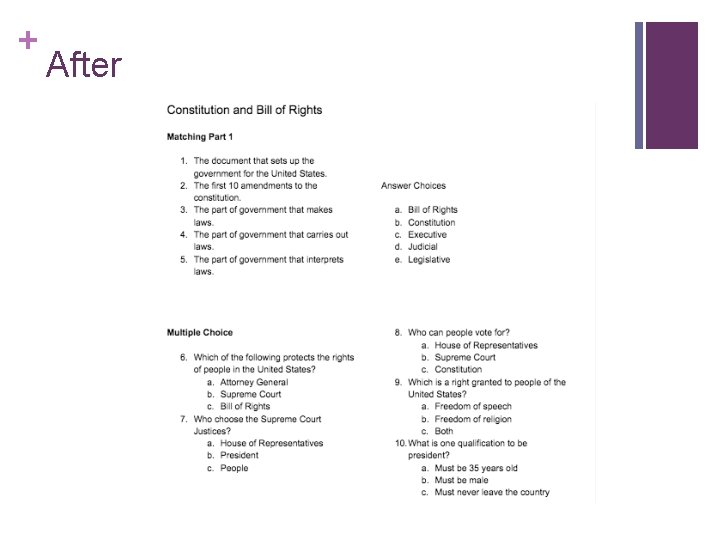
+ Assessments: color-coding & chunking information
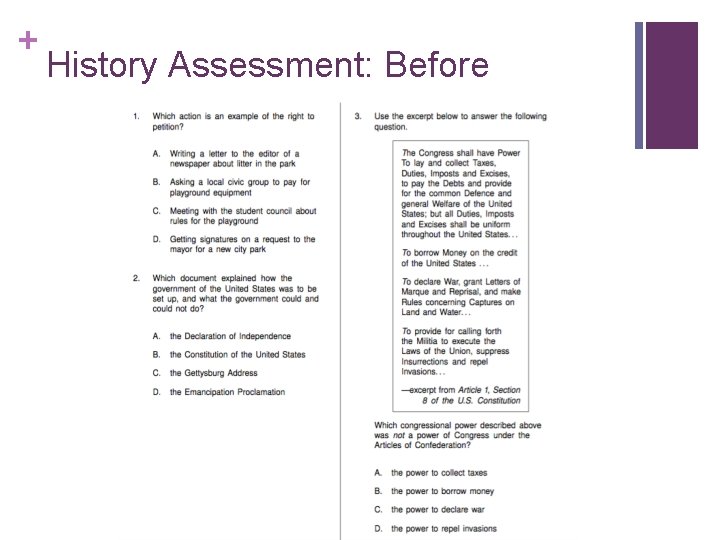
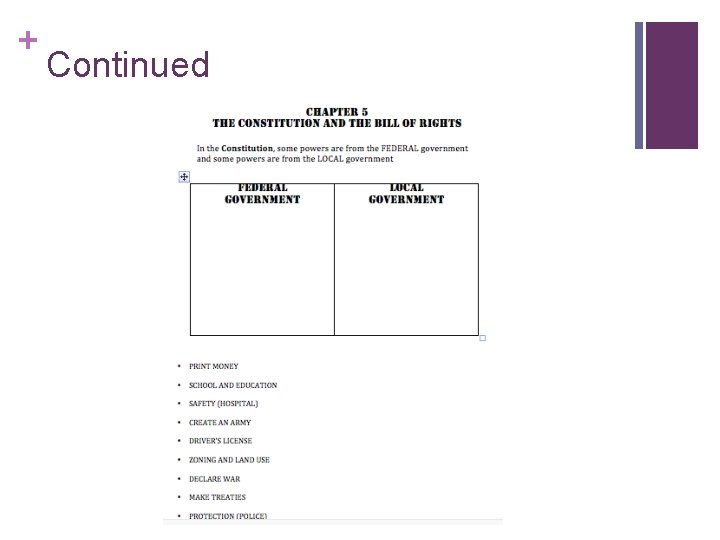
+ History Assessment: Before
+ After
+ Continued
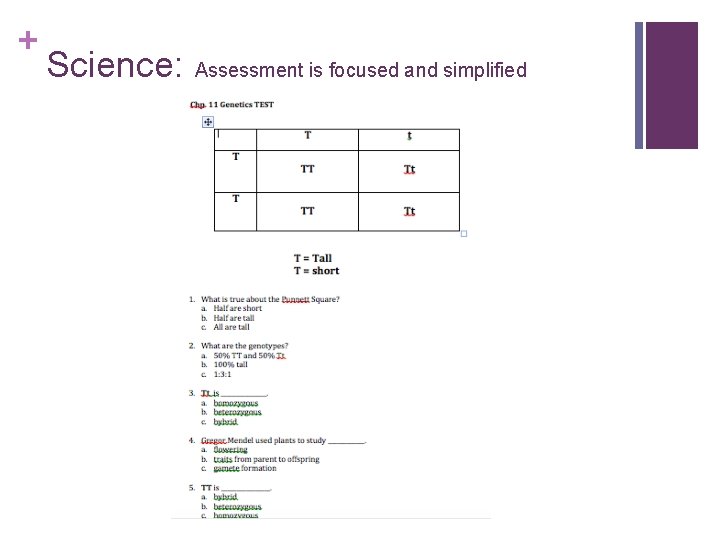
+ Science: Assessment is focused and simplified
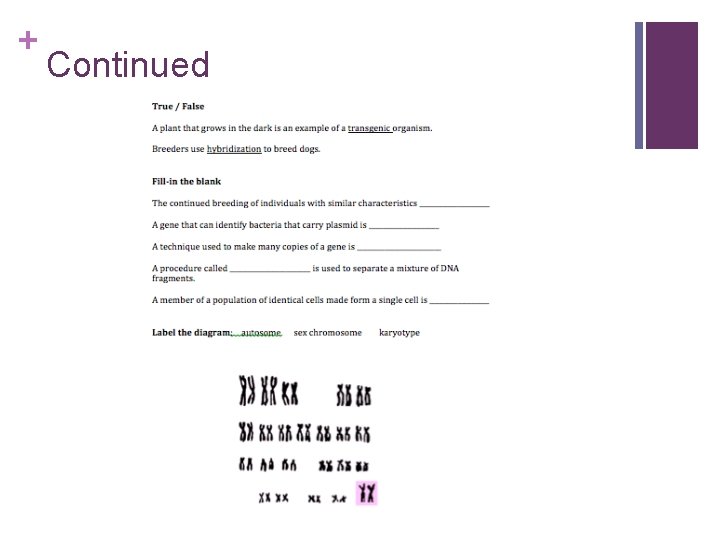
+ Continued
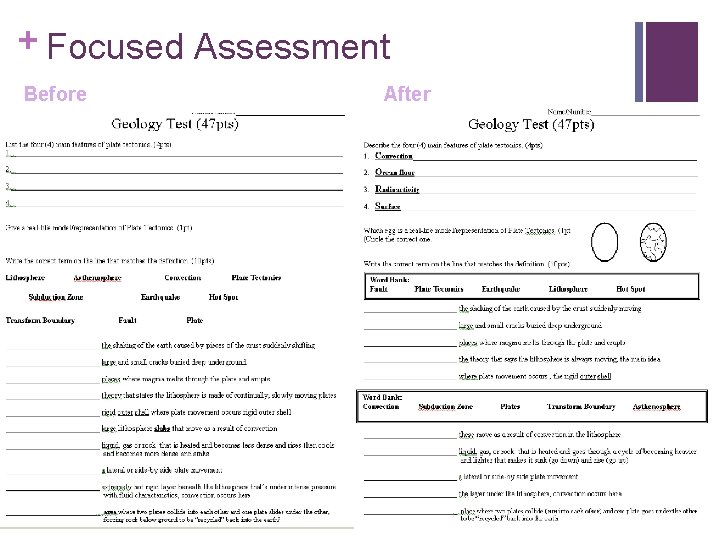
+ Focused Assessment Before After
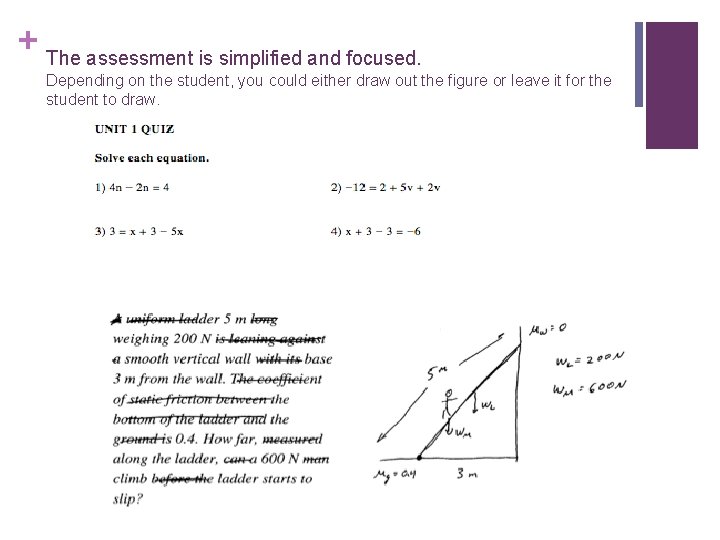
+ The assessment is simplified and focused. Depending on the student, you could either draw out the figure or leave it for the student to draw.
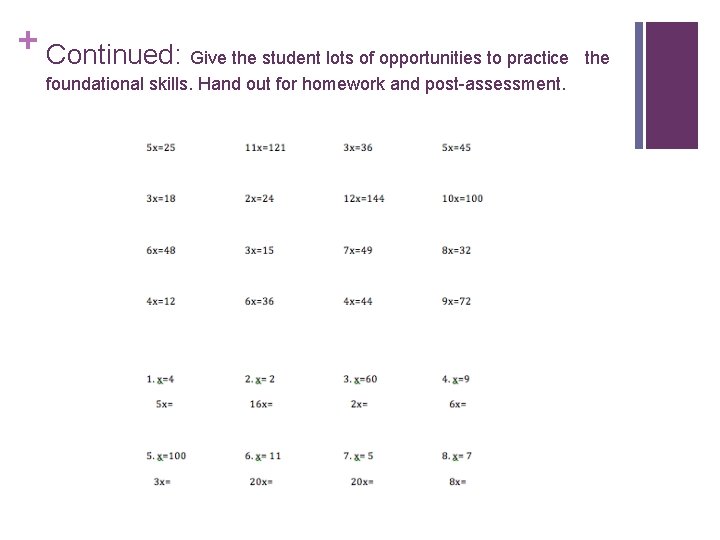
+ Continued: Give the student lots of opportunities to practice foundational skills. Hand out for homework and post-assessment. the
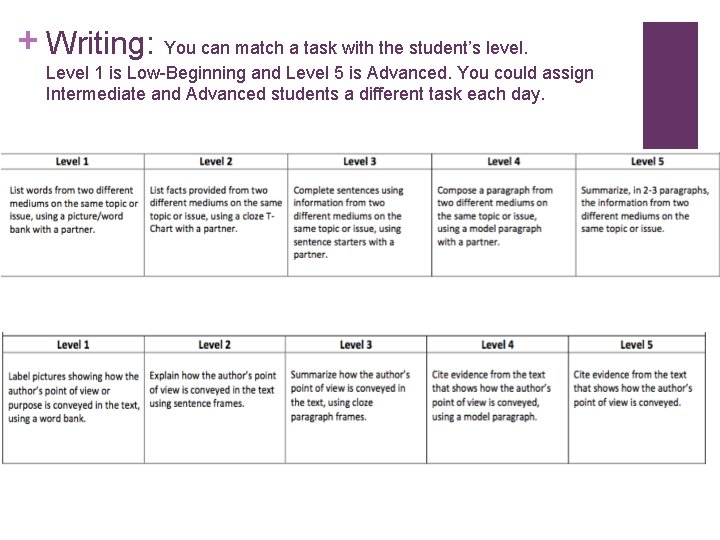
+ Writing: You can match a task with the student’s level. Level 1 is Low-Beginning and Level 5 is Advanced. You could assign Intermediate and Advanced students a different task each day.
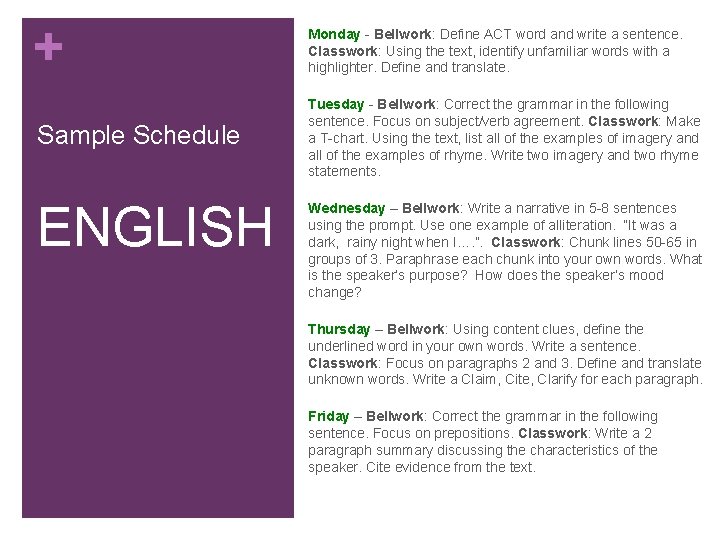
+ Monday - Bellwork: Define ACT word and write a sentence. Classwork: Using the text, identify unfamiliar words with a highlighter. Define and translate. Sample Schedule Tuesday - Bellwork: Correct the grammar in the following sentence. Focus on subject/verb agreement. Classwork: Make a T-chart. Using the text, list all of the examples of imagery and all of the examples of rhyme. Write two imagery and two rhyme statements. ENGLISH Wednesday – Bellwork: Write a narrative in 5 -8 sentences using the prompt. Use one example of alliteration. “It was a dark, rainy night when I…. ”. Classwork: Chunk lines 50 -65 in groups of 3. Paraphrase each chunk into your own words. What is the speaker’s purpose? How does the speaker’s mood change? Thursday – Bellwork: Using content clues, define the underlined word in your own words. Write a sentence. Classwork: Focus on paragraphs 2 and 3. Define and translate unknown words. Write a Claim, Cite, Clarify for each paragraph. Friday – Bellwork: Correct the grammar in the following sentence. Focus on prepositions. Classwork: Write a 2 paragraph summary discussing the characteristics of the speaker. Cite evidence from the text.
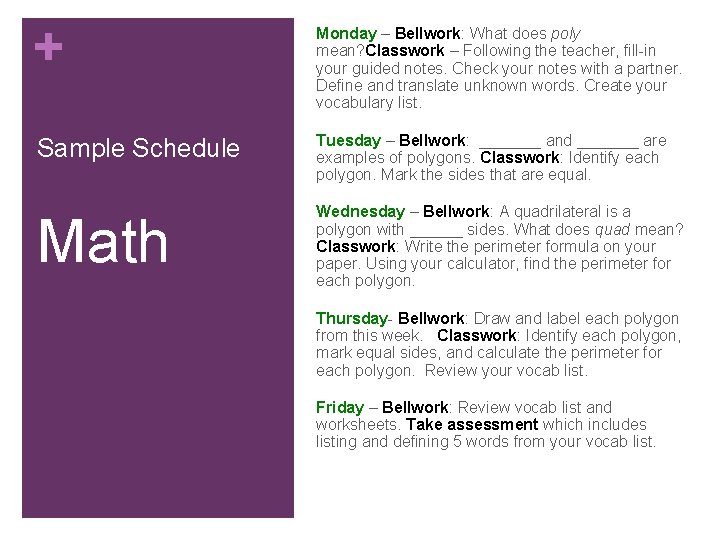
+ Monday – Bellwork: What does poly mean? Classwork – Following the teacher, fill-in your guided notes. Check your notes with a partner. Define and translate unknown words. Create your vocabulary list. Sample Schedule Tuesday – Bellwork: _______ and _______ are examples of polygons. Classwork: Identify each polygon. Mark the sides that are equal. Math Wednesday – Bellwork: A quadrilateral is a polygon with ______ sides. What does quad mean? Classwork: Write the perimeter formula on your paper. Using your calculator, find the perimeter for each polygon. Thursday- Bellwork: Draw and label each polygon from this week. Classwork: Identify each polygon, mark equal sides, and calculate the perimeter for each polygon. Review your vocab list. Friday – Bellwork: Review vocab list and worksheets. Take assessment which includes listing and defining 5 words from your vocab list.
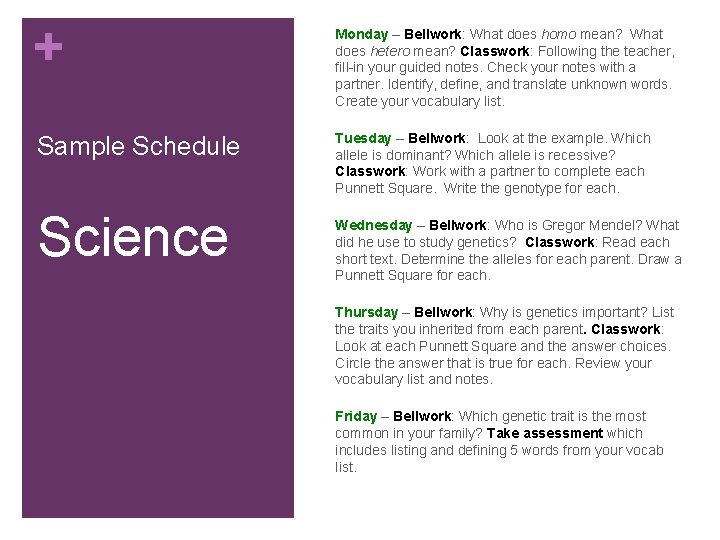
+ Sample Schedule Science Monday – Bellwork: What does homo mean? What does hetero mean? Classwork: Following the teacher, fill-in your guided notes. Check your notes with a partner. Identify, define, and translate unknown words. Create your vocabulary list. Tuesday – Bellwork: Look at the example. Which allele is dominant? Which allele is recessive? Classwork: Work with a partner to complete each Punnett Square. Write the genotype for each. Wednesday – Bellwork: Who is Gregor Mendel? What did he use to study genetics? Classwork: Read each short text. Determine the alleles for each parent. Draw a Punnett Square for each. Thursday – Bellwork: Why is genetics important? List the traits you inherited from each parent. Classwork: Look at each Punnett Square and the answer choices. Circle the answer that is true for each. Review your vocabulary list and notes. Friday – Bellwork: Which genetic trait is the most common in your family? Take assessment which includes listing and defining 5 words from your vocab list.
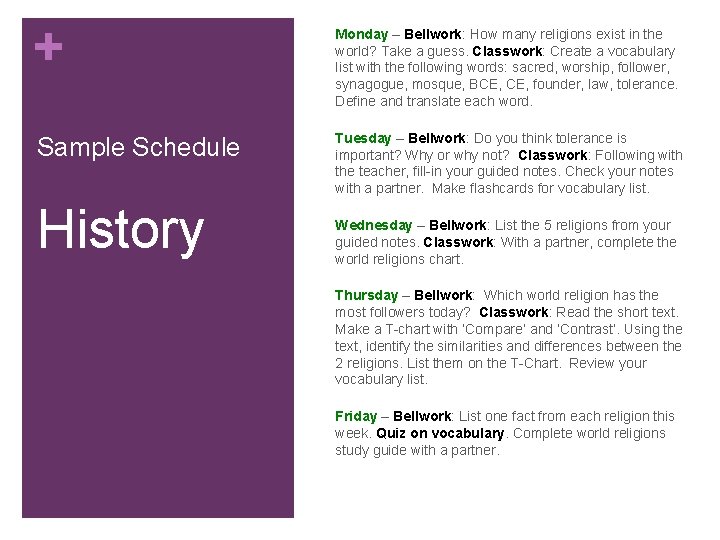
+ Sample Schedule History Monday – Bellwork: How many religions exist in the world? Take a guess. Classwork: Create a vocabulary list with the following words: sacred, worship, follower, synagogue, mosque, BCE, founder, law, tolerance. Define and translate each word. Tuesday – Bellwork: Do you think tolerance is important? Why or why not? Classwork: Following with the teacher, fill-in your guided notes. Check your notes with a partner. Make flashcards for vocabulary list. Wednesday – Bellwork: List the 5 religions from your guided notes. Classwork: With a partner, complete the world religions chart. Thursday – Bellwork: Which world religion has the most followers today? Classwork: Read the short text. Make a T-chart with ‘Compare’ and ‘Contrast’. Using the text, identify the similarities and differences between the 2 religions. List them on the T-Chart. Review your vocabulary list. Friday – Bellwork: List one fact from each religion this week. Quiz on vocabulary. Complete world religions study guide with a partner.
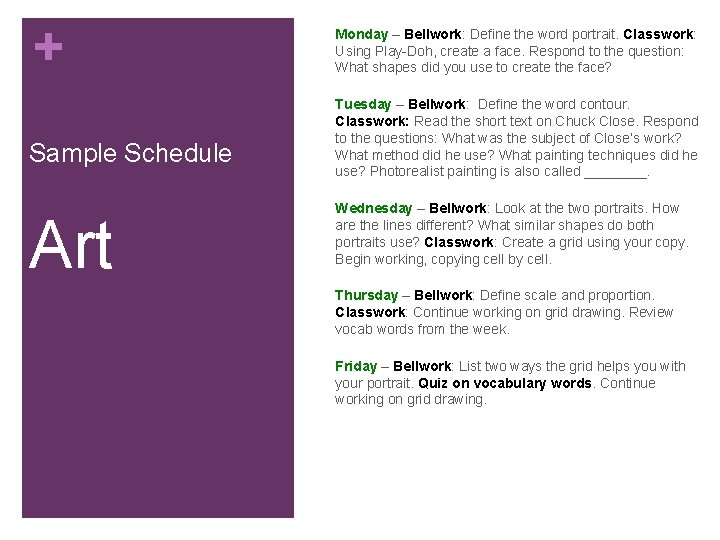
+ Sample Schedule Art Monday – Bellwork: Define the word portrait. Classwork: Using Play-Doh, create a face. Respond to the question: What shapes did you use to create the face? Tuesday – Bellwork: Define the word contour. Classwork: Read the short text on Chuck Close. Respond to the questions: What was the subject of Close’s work? What method did he use? What painting techniques did he use? Photorealist painting is also called ____. Wednesday – Bellwork: Look at the two portraits. How are the lines different? What similar shapes do both portraits use? Classwork: Create a grid using your copy. Begin working, copying cell by cell. Thursday – Bellwork: Define scale and proportion. Classwork: Continue working on grid drawing. Review vocab words from the week. Friday – Bellwork: List two ways the grid helps you with your portrait. Quiz on vocabulary words. Continue working on grid drawing.
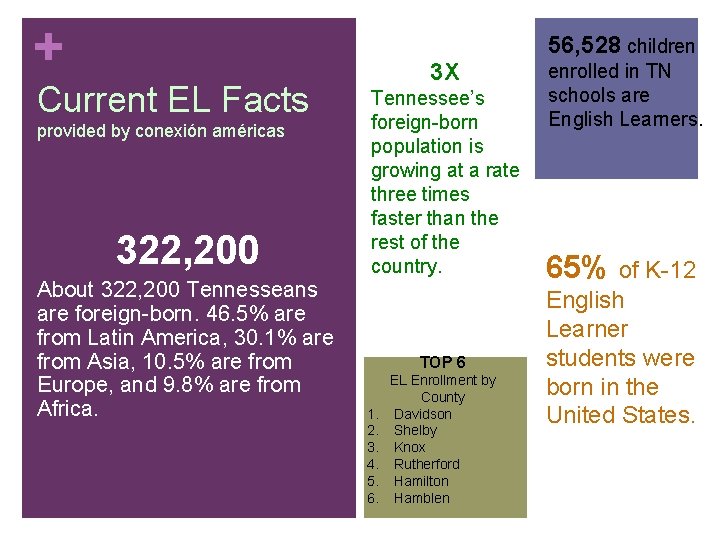
+ 56, 528 children Current EL Facts provided by conexión américas 322, 200 About 322, 200 Tennesseans are foreign-born. 46. 5% are from Latin America, 30. 1% are from Asia, 10. 5% are from Europe, and 9. 8% are from Africa. 3 X Tennessee’s foreign-born population is growing at a rate three times faster than the rest of the country. TOP 6 1. 2. 3. 4. 5. 6. EL Enrollment by County Davidson Shelby Knox Rutherford Hamilton Hamblen enrolled in TN schools are English Learners. 65% of K-12 English Learner students were born in the United States.
+ Presentation by Samantha Sporer . . . .