
Supporting Doctors from Different Backgrounds Dr Julia Whiteman

Supporting Doctors from Different Backgrounds Dr Julia Whiteman Dean of Postgraduate Medicine North West London
Supporting safe transition for internationally educated health professionals (IEHP) working in the NHS in London
Challenges: • Enabling the rich diversity of backgrounds of doctors and other health professionals to deliver high quality health care…… • …. . in a rich diversity of settings • Cultural awareness including professional culture • Colleagues appreciating cultural differences • Clinical experience and capability • Understanding of the complexity of the NHS @NHS_Health. Ed. Eng
Challenges: Communication • Appreciation of communication complexities – Linguistic and language – Non-verbal communication • Norms may be both explicit (stated rules) or implicit (‘that’s just what we do’) NB GMP include both @NHS_Health. Ed. Eng
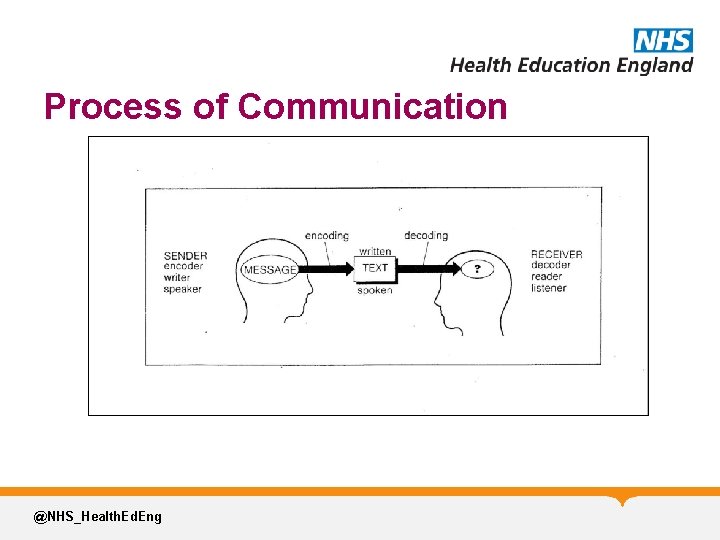
Process of Communication @NHS_Health. Ed. Eng
Intent and effect may differ • Intent may be misread – notably when non-native speakers transfer patterns of interaction from first language • Source of ‘interference’ may not be recognised • Causes of breakdown may be complex: • Language • Non-verbal behaviour • Cultural values • Concepts of professionalism • Ethnocentric position – reasons may be generalised –attributed to ‘language barrier’, attitude, lack of competence @NHS_Health. Ed. Eng
Sociolinguistic aspects Informed by culture – deviation from norm may be more harshly judged than language errors (Wolfson 2002) • Para-linguistic: pace, volume of speech, ‘noises’ • Extra-linguistic: body language, personal space, gesture, touch • Interactional style: formality, directness, content (extent and perceived relevance) structure or lack of • Conversational norms: turn-taking, interruption, use of silence Wolfson N. Rules of speaking. In: Richards JC and Schmidt RW, eds. Language and Communication. Harlow, Essex: Addison Wesley Longman 1983: 61– 87 @NHS_Health. Ed. Eng
Influence of Culture • Cultural values • Usually acquired through early socialisation • Deeply held and often out of awareness • Resistant to change (Hall 1997) • Inform behaviour and expectations of others • Determine what is considered polite, friendly, humorous, taboo, empathetic etc in communication • Hall, Edward T. Beyond Culture, Anchor Books 1997 @NHS_Health. Ed. Eng
Approaches to support Develop a repertoire of approaches: • Recognise differences in learning needs in UK graduates • Teach communication in context • Not just ‘how’ and ‘what’ – emphasise / explore the ‘why’ • Involve professionals from a variety of backgrounds • Soaps @NHS_Health. Ed. Eng
The challenge for educators • Recognise that this is difficult • Seek supervision support and development – including E&D • Reflect on own assumptions @NHS_Health. Ed. Eng
Encourage trainees from different backgrounds to: • Become familiar with professional expectations of performance • Recognise the implicit cultural values underpinning this – and how they may differ from own • Understand the form and style of communication expected in a given situation • Consciously decode and reflect on a ranges of written and verbal interactions: the good and the less good @NHS_Health. Ed. Eng
Other enablers • Flexing induction programmes to meet need • Managing expectations on both sides • Social integration • Allow time - acquiring new skills may require ‘unlearning’ of old patterns
Further support London Professional Support Unit Internationally Educated Health Professionals http: //www. lpmde. ac. uk/professional-development/iehp @NHS_Health. Ed. Eng
- Slides: 13