
Supporting Distressed Distressing Students Stephanie Brown Ph D
Supporting Distressed & Distressing Students Stephanie Brown, Ph. D. , Associate VP of Student Enrichment, Health and Support Denise Lucero-Miller, Ph. D. Director for Counseling & Psychological Services Lt. Jennifer Niederhaus, Police Lieutenant, Department of Public Safety Michelle Kelly Reeves, Interim Director Civility & Community Standards
TWU Student § Lack of familiarity with norms, expectations, and procedures in higher education environment § Academic, financial and personal stress § Multiple life demands § Pre-existing mental health and trauma history § Emerging psychological problems § Increased responsibility and independence
Role of Faculty & Staff §In a position to directly observe & notice changes in student functioning §Students may exhibit, talk, and/or write about signs of distress §Established relationship may set stage for intervention §In a position to help students access campus resources
Academic Signs of Student Distress §Repeated tardiness/absences §Missed, late or incomplete assignments and/or exams §Deterioration in quality/quantity of work §Erratic performance §Repeated requests for special considerations §Exaggerated responses to grades §Disturbing content/references in writing assignments including suicide, trauma, violence or morbid content

Physical/Psychological Signs of Distress Poor hygiene Tearfulness Unusually animated Sleeping in class Unusual fatigue Notably withdrawn Sad facial expression Restlessness Expressed hopelessness Weight changes Inattentiveness Suicidal references Emotional outbursts Irritability Odd social behaviors References to death Bizarre behavior Rapid mood shifts Incoherent speech Hopelessness Signs of alcohol/drugs

Awareness of Cultural Differences §Race §Ethnicity §Gender §Religious/Spiritual Affiliation §Sexual Orientation
How to Respond §Ask to speak with the student privately. §Identify why you are concerned. § Use clear and concrete examples in non-judgmental terms (i. e. “I’ve noticed you’ve been absent from class lately and I’m concerned. ”) § Listen to thoughts and feelings in a sensitive, non-threatening way. Communicate understanding by repeating back the essence of what the student told you. Try to include both content and feeling.
How to Respond § Set clear and appropriate boundaries as relevant. § Invite student to share his/her reaction. § Avoid interrupting, judging, evaluating, and criticizing even if the student asks for your opinion. It is important to respect the student’s value system, even if you don’t agree with it. § Problem-solve with the student. Help him/her develop a rational plan of action.
How to Respond §Do not discuss your concerns with other students. §Gently suggest CAPS as an option for support. §Inform student that CAPS is heavily utilized and students do not have to be “losing it” to seek support. §Inform student that CAPS services are free & confidential (not part of academic record). §Offer to walk student over.
How Student Life Office Can Assist § Academic interventions- Withdrawal/Late Drops § General questions, support & assistance, navigating TWU § Educate students about campus resources and services; facilitate connection § Consult with faculty, staff and students about concerns § Behavior Intervention Teams § Students of Concern/CARE § Behavioral Assessment Team (BAT)
Behavioral Intervention Teams Students of Concern/CARE Team (Fall 2017) ▪ Facilitate early intervention with students who appear to be struggling with non-academic concerns that may impede their academic progress or success ▪ Try to facilitate wrap around support to address issues and retain them ▪ Prevent escalation of behavior or issues Behavioral Assessment Team (BAT) ▪ Violence prevention ▪ Address and monitor behaviors that interfere with University living, learning environment and/or put safety of others/community at risk ▪Foster communication across campus about concerning behavior/decrease silos ▪Intervene at earliest and lowest possible levels with focus on maintaining community safety and facilitating student well-being/success
Examples of Issues Addressed by BAT §Conduct which assumes a stance of being substantially in charge or attempting to control processes, outcomes or decisions that are inappropriate given the person’s standing or position. §Persistently or aggressively pursuing options that don’t reasonably exist. Continuing to do so after being instructed to cease. §Persistent behavior which disrupts the functioning of a course or program or which interrupts the ability of other individuals to function normally at the University.
Examples of Issues Address by SOC/CARE §Student persistently makes non-threatening but odd or disjointed remarks in class. Odd interpersonal style that make others in class uncomfortable. §Student repeatedly and openly discloses information about mental health history to strangers and wears clothing that displays evidence of self-mutilation (e. g. , cutting). §Student is seeking an inordinate amount of support from professors and/or peers about personal or health issues; is in constant state of crisis that is draining others and distracting them from their academic pursuits.
How to Report §On TWU website, Google “Civility”. § http: //www. twu. edu/civility/ § Report an Incident § Code of Conduct or Behavior Assessment Team § Note that these processes can run simultaneously
Office of Civility and Community Standards §Safe, effective educational environment for all. §It may be appropriate to address conduct violations. § Potential harmful, disrespectful or harassing behavior to other students, faculty or staff § Other potential violations of the Code of Conduct Jones Hall 1 st floor http: //www. twu. edu/civility/ 940 -898 -2968
Office of Civility and Community Standards §Before issues occur, communicate with students about expected behaviors. §Student Handbook is now online: § https: //servicecenter. twu. edu/TDClient/KB/? Category. ID=4491 § Section 5: Students Rights and Responsibilities (Student Code of Conduct) § Can also access it from the Civility webpage §Processes will change over time. § Make sure to correct syllabi with correct versions of information or include the Civility website with a statement regarding expected behavior.
Department of Public Safety §Threatening Behaviors §Warning Signs § There are several indicators of a potential threat which, taken by themselves, may not be immediately obvious. § Nevertheless, you may only be seeing part of what is going on § Tell a supervisor or campus resource person any cause for concern that you may have immediately. § One-on-one settings, group interaction, public behavior, letters, emails, blogs, websites, social networking sites, photos, phone calls, text messages, etc.
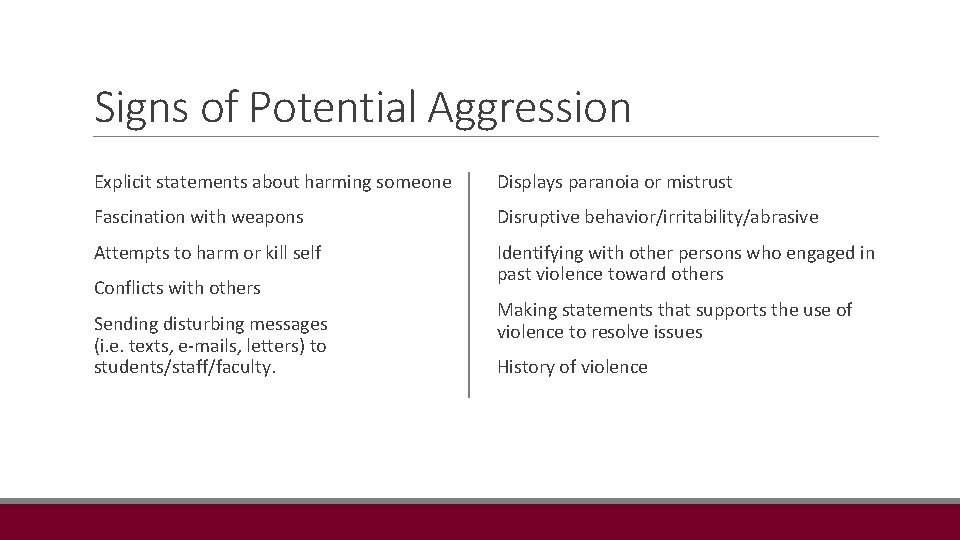
Signs of Potential Aggression Explicit statements about harming someone Displays paranoia or mistrust Fascination with weapons Disruptive behavior/irritability/abrasive Attempts to harm or kill self Identifying with other persons who engaged in past violence toward others Conflicts with others Sending disturbing messages (i. e. texts, e-mails, letters) to students/staff/faculty. Making statements that supports the use of violence to resolve issues History of violence
When to call DPS §Contact TWU Police immediately if § The person is yelling at you or another student in an aggressive way. § They use profanity and you or another is offended § There is any form of offensive or unwanted touching such as poking a finger in your chest, grabbing your arm, etc. § Anytime you feel unsafe! §Documentation of behaviors is always helpful. §If you feel unsafe, DPS provides escorts to and from your class and/or vehicle.
What should I avoid? §Staying in the situation if you feel unsafe. §Meeting with the student alone. §Engaging in a screaming match. §Ignoring signs that the student’s anger is escalating. §Touching or crowding the student. §Ignoring your gut reaction that you are in danger.
Key Campus Resources Counseling & Psychological Services: § § § Provides psychological services to currently enrolled students Services are free and confidential Individual, couples, and group therapy Walk-in crisis services and after-hours on-call Mental health outreach programming Consultation with Faculty/Staff West Jones Hall http: //www. twu. edu/counseling 940 -898 -3801 Office of Student Life: § § Behavioral Intervention Teams Academic interventions- Withdrawal/Late Drops General questions, support & assistance, navigating TWU Educate students about campus resources and services; facilitate connection § Consult with faculty, staff and students about concerns Student Union 2 nd Floor http: //www. twu. edu/student-life-office/ 940 -898 -3615
Key Campus Resources Disability Student Services § Students with documented visible &/or invisible disability are eligible § Students must apply/provide documentation § Provide academic accommodations, guidance & support CFO 106 http: //www. twu. edu/disability-services/ 940. 898. 3835 (voice)
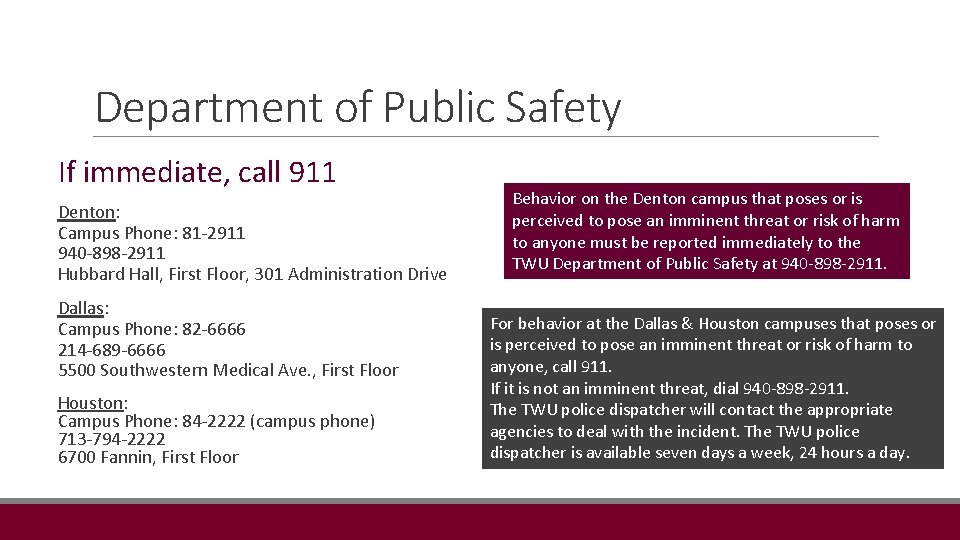
Department of Public Safety If immediate, call 911 Denton: Campus Phone: 81 -2911 940 -898 -2911 Hubbard Hall, First Floor, 301 Administration Drive Dallas: Campus Phone: 82 -6666 214 -689 -6666 5500 Southwestern Medical Ave. , First Floor Houston: Campus Phone: 84 -2222 (campus phone) 713 -794 -2222 6700 Fannin, First Floor Behavior on the Denton campus that poses or is perceived to pose an imminent threat or risk of harm to anyone must be reported immediately to the TWU Department of Public Safety at 940 -898 -2911. For behavior at the Dallas & Houston campuses that poses or is perceived to pose an imminent threat or risk of harm to anyone, call 911. If it is not an imminent threat, dial 940 -898 -2911. The TWU police dispatcher will contact the appropriate agencies to deal with the incident. The TWU police dispatcher is available seven days a week, 24 hours a day.
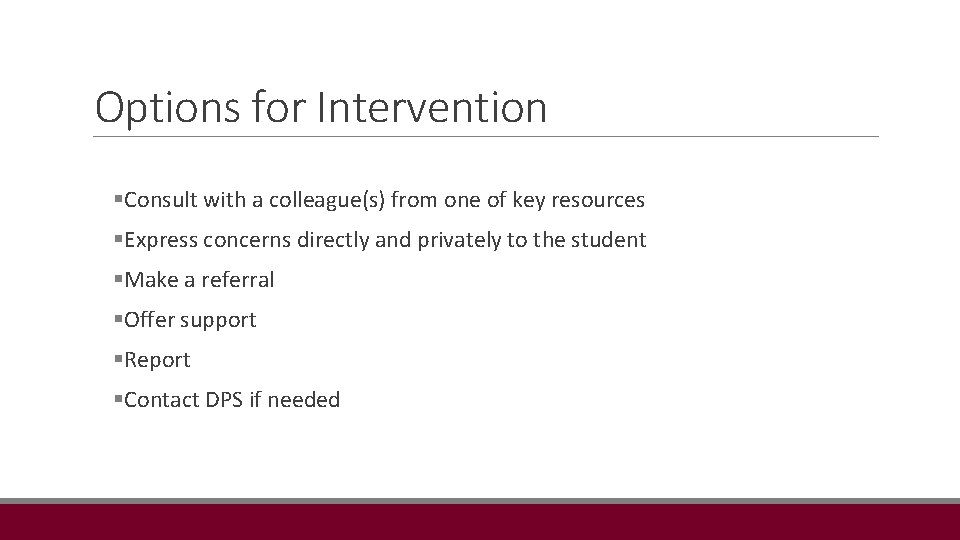
Options for Intervention §Consult with a colleague(s) from one of key resources §Express concerns directly and privately to the student §Make a referral §Offer support §Report §Contact DPS if needed
- Slides: 24