
Supporting Details Supporting details consist of the additional

- Slides: 13
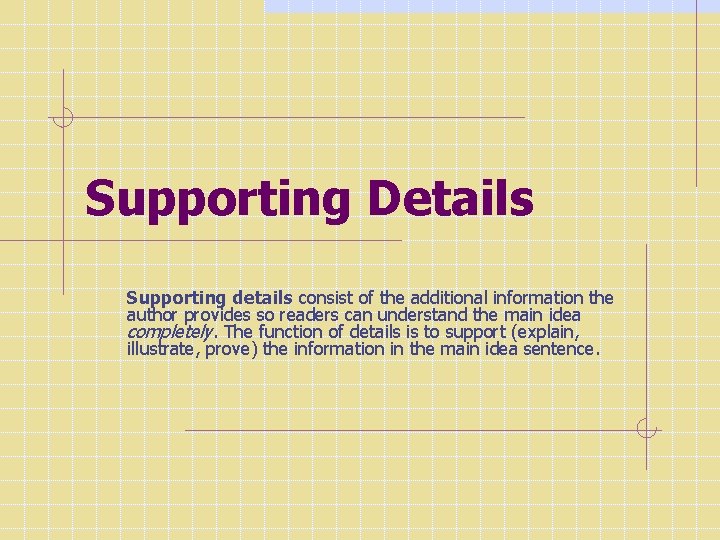
Supporting Details Supporting details consist of the additional information the author provides so readers can understand the main idea completely. The function of details is to support (explain, illustrate, prove) the information in the main idea sentence.
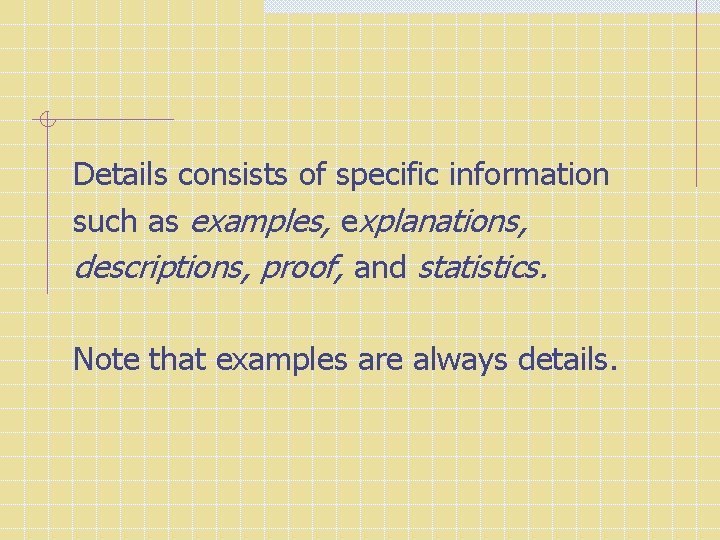
Details consists of specific information such as examples, explanations, descriptions, proof, and statistics. Note that examples are always details.
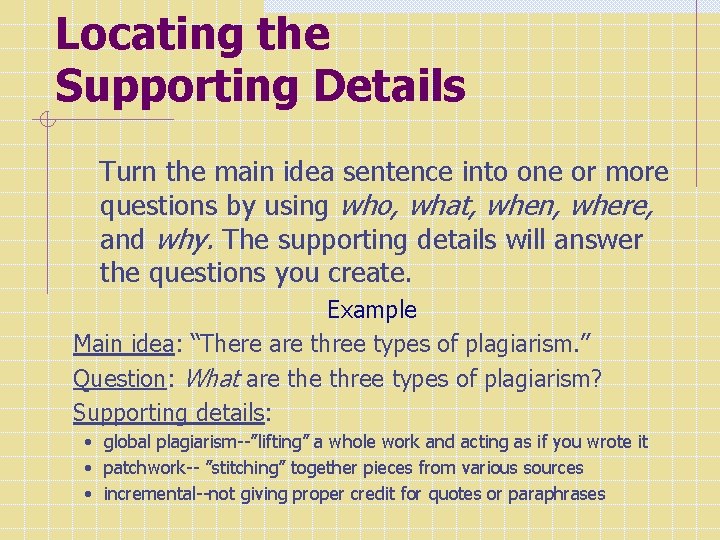
Locating the Supporting Details Turn the main idea sentence into one or more questions by using who, what, when, where, and why. The supporting details will answer the questions you create. Example Main idea: “There are three types of plagiarism. ” Question: What are three types of plagiarism? Supporting details: • global plagiarism--”lifting” a whole work and acting as if you wrote it • patchwork-- ”stitching” together pieces from various sources • incremental--not giving proper credit for quotes or paraphrases
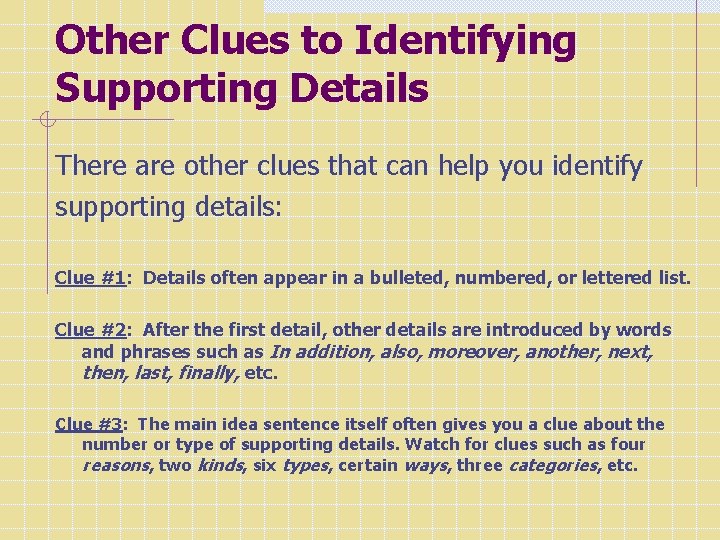
Other Clues to Identifying Supporting Details There are other clues that can help you identify supporting details: Clue #1: Details often appear in a bulleted, numbered, or lettered list. Clue #2: After the first detail, other details are introduced by words and phrases such as In addition, also, moreover, another, next, then, last, finally, etc. Clue #3: The main idea sentence itself often gives you a clue about the number or type of supporting details. Watch for clues such as four reasons, two kinds, six types, certain ways, three categories, etc.
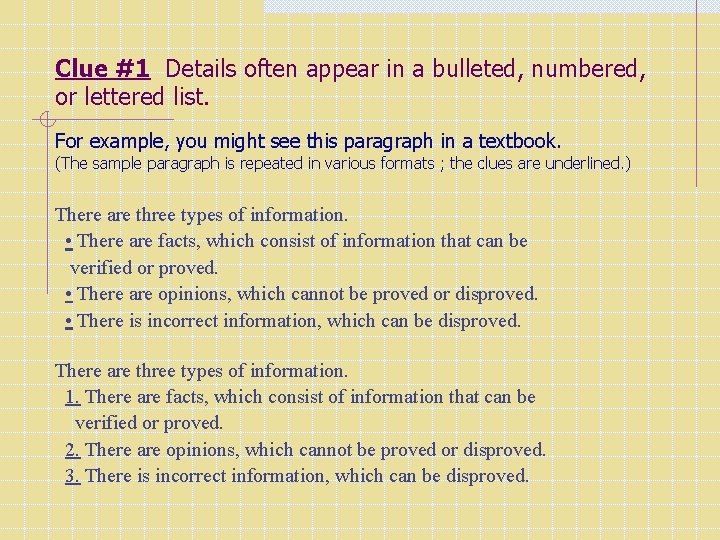
Clue #1 Details often appear in a bulleted, numbered, or lettered list. For example, you might see this paragraph in a textbook. (The sample paragraph is repeated in various formats ; the clues are underlined. ) There are three types of information. • There are facts, which consist of information that can be verified or proved. • There are opinions, which cannot be proved or disproved. • There is incorrect information, which can be disproved. There are three types of information. 1. There are facts, which consist of information that can be verified or proved. 2. There are opinions, which cannot be proved or disproved. 3. There is incorrect information, which can be disproved.
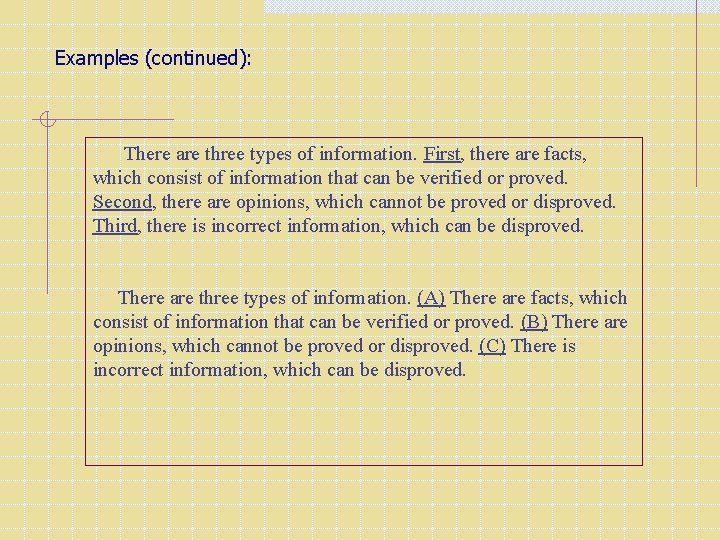
Examples (continued): There are three types of information. First, there are facts, which consist of information that can be verified or proved. Second, there are opinions, which cannot be proved or disproved. Third, there is incorrect information, which can be disproved. There are three types of information. (A) There are facts, which consist of information that can be verified or proved. (B) There are opinions, which cannot be proved or disproved. (C) There is incorrect information, which can be disproved.
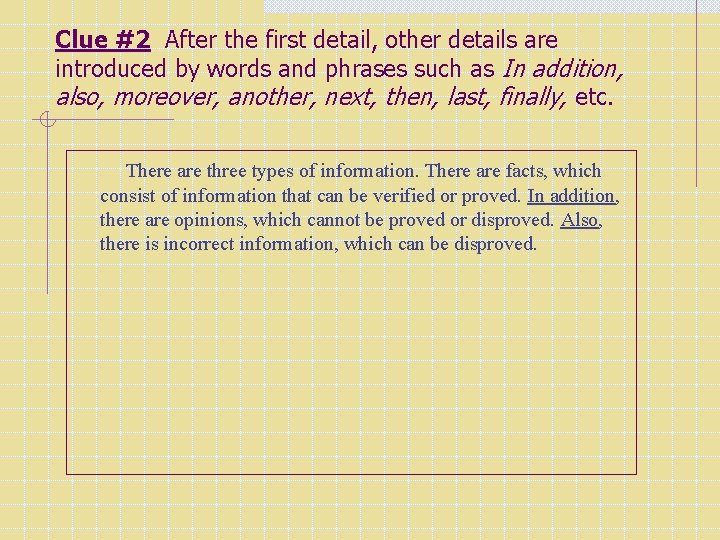
Clue #2 After the first detail, other details are introduced by words and phrases such as In addition, also, moreover, another, next, then, last, finally, etc. There are three types of information. There are facts, which consist of information that can be verified or proved. In addition, there are opinions, which cannot be proved or disproved. Also, there is incorrect information, which can be disproved.
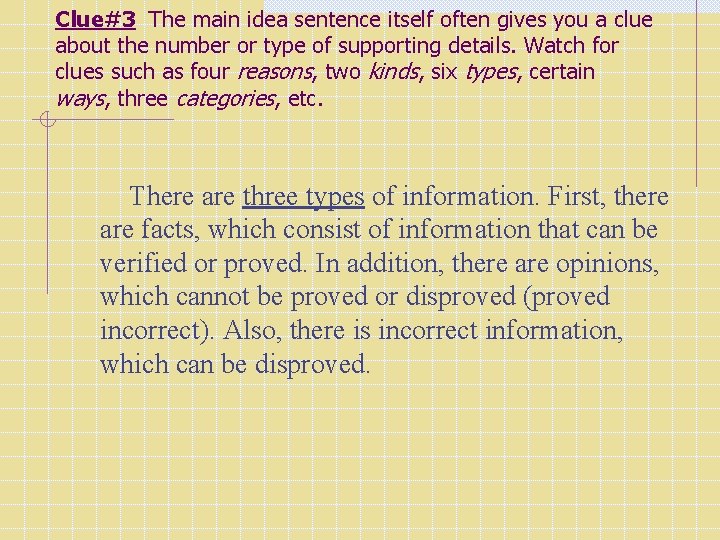
Clue#3 The main idea sentence itself often gives you a clue about the number or type of supporting details. Watch for clues such as four reasons, two kinds, six types, certain ways, three categories, etc. There are three types of information. First, there are facts, which consist of information that can be verified or proved. In addition, there are opinions, which cannot be proved or disproved (proved incorrect). Also, there is incorrect information, which can be disproved.
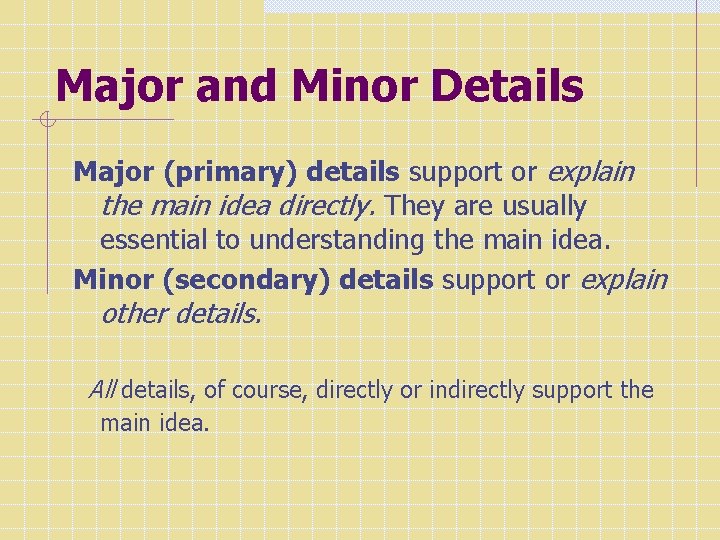
Major and Minor Details Major (primary) details support or explain the main idea directly. They are usually essential to understanding the main idea. Minor (secondary) details support or explain other details. All details, of course, directly or indirectly support the main idea.
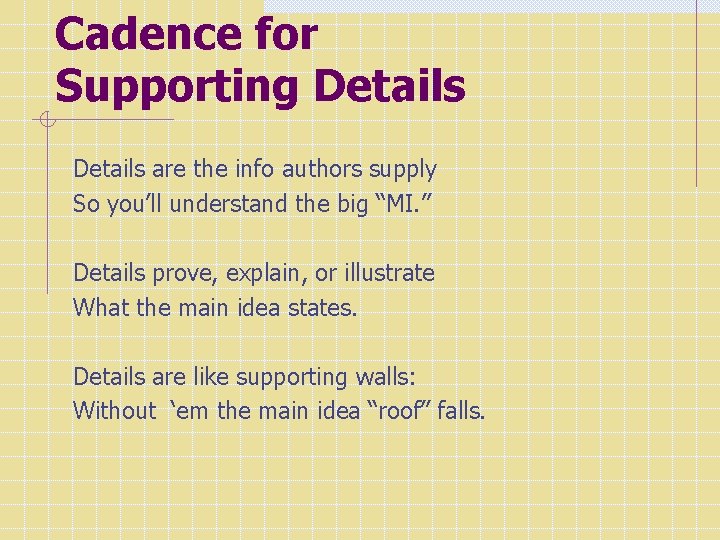
Cadence for Supporting Details are the info authors supply So you’ll understand the big “MI. ” Details prove, explain, or illustrate What the main idea states. Details are like supporting walls: Without ‘em the main idea “roof” falls.
Main Idea and Supporting Details “House” Main Idea Supporting Details
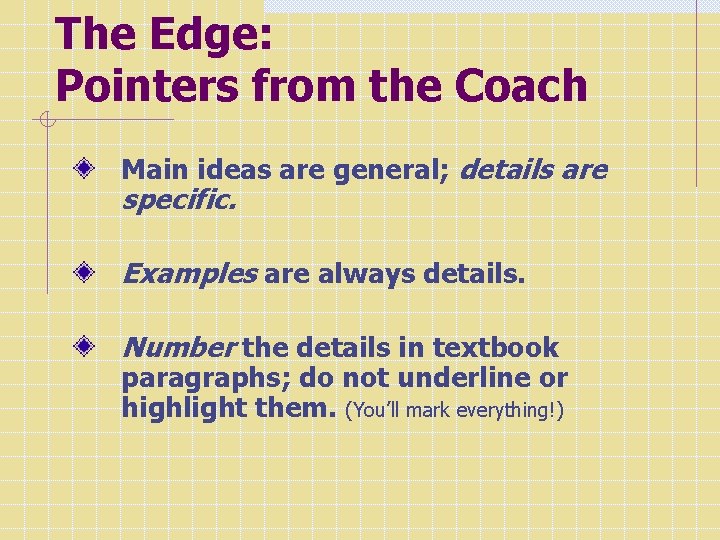
The Edge: Pointers from the Coach Main ideas are general; details are specific. Examples are always details. Number the details in textbook paragraphs; do not underline or highlight them. (You’ll mark everything!)
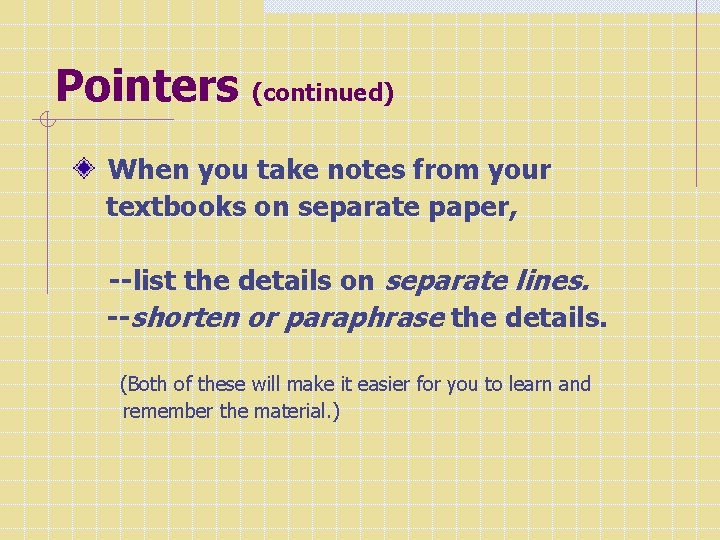
Pointers (continued) When you take notes from your textbooks on separate paper, --list the details on separate lines. --shorten or paraphrase the details. (Both of these will make it easier for you to learn and remember the material. )