
Support Vector Machine By Alexy Skoutnev Mentor Milad
Support Vector Machine By: Alexy Skoutnev Mentor: Milad Eghtedari Naeini
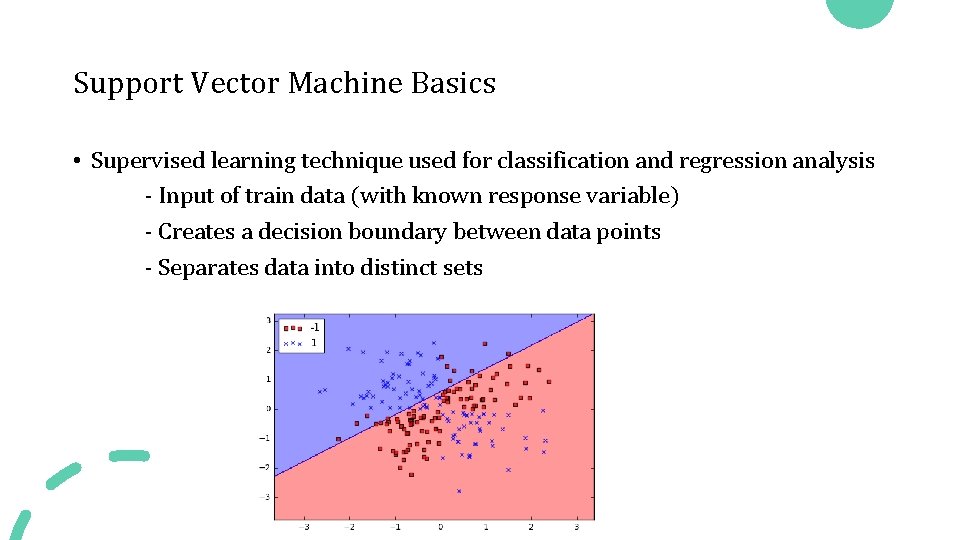
Support Vector Machine Basics • Supervised learning technique used for classification and regression analysis - Input of train data (with known response variable) - Creates a decision boundary between data points - Separates data into distinct sets
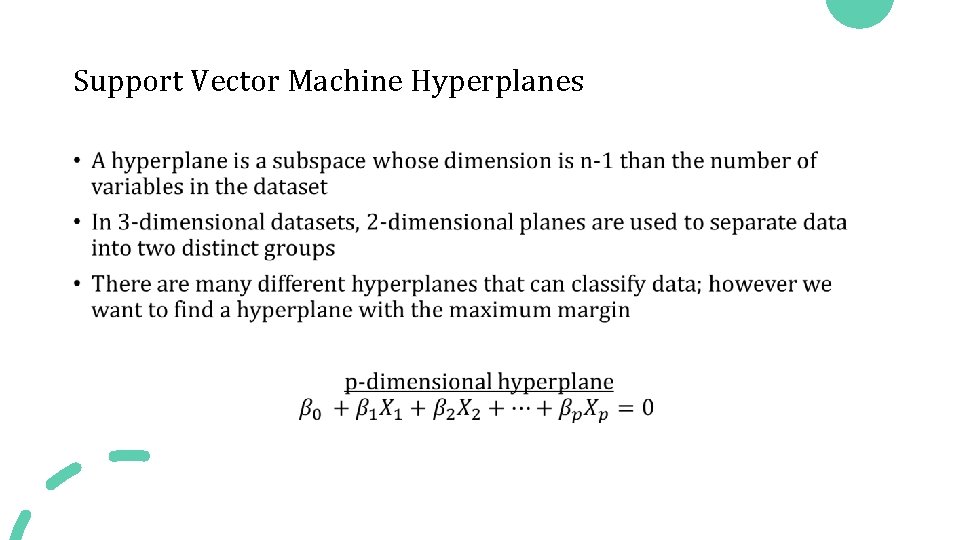
Support Vector Machine Hyperplanes •
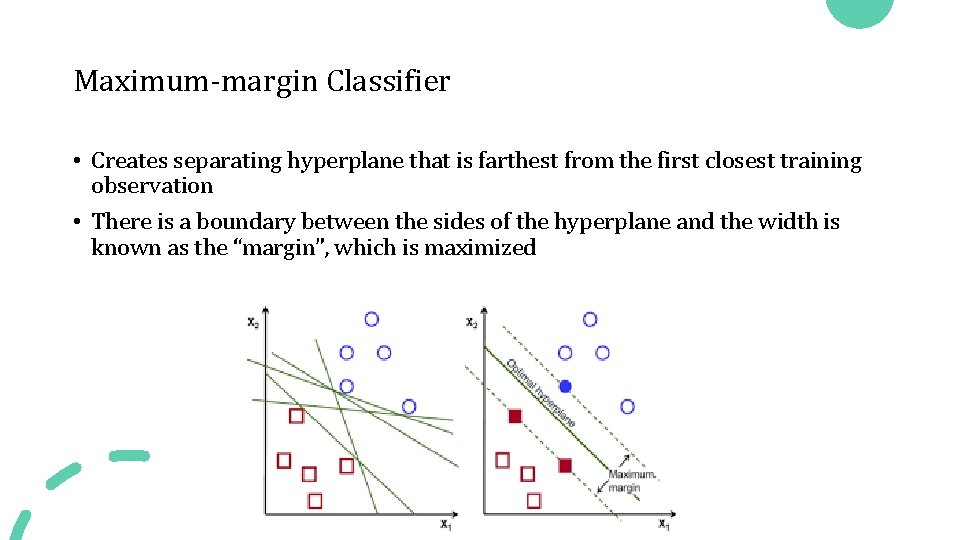
Maximum-margin Classifier • Creates separating hyperplane that is farthest from the first closest training observation • There is a boundary between the sides of the hyperplane and the width is known as the “margin”, which is maximized
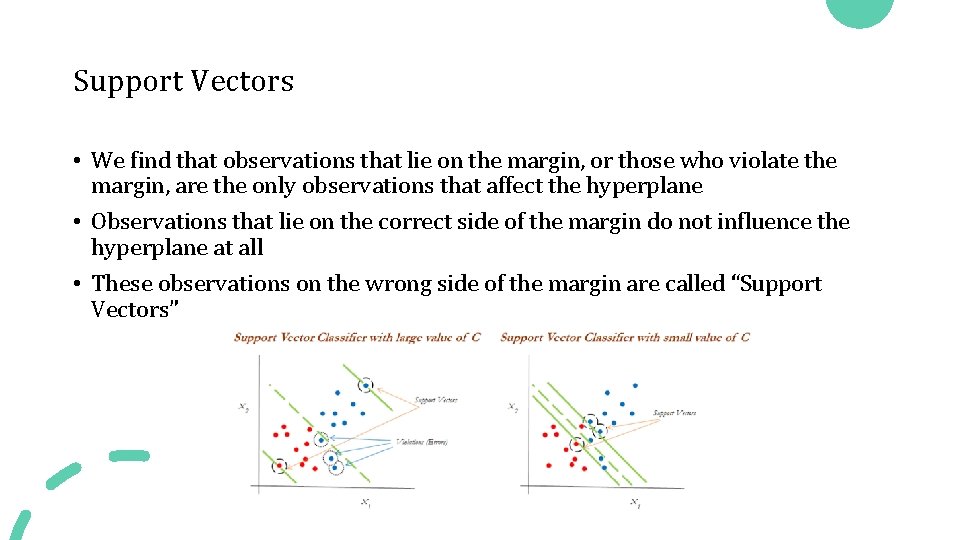
Support Vectors • We find that observations that lie on the margin, or those who violate the margin, are the only observations that affect the hyperplane • Observations that lie on the correct side of the margin do not influence the hyperplane at all • These observations on the wrong side of the margin are called “Support Vectors”
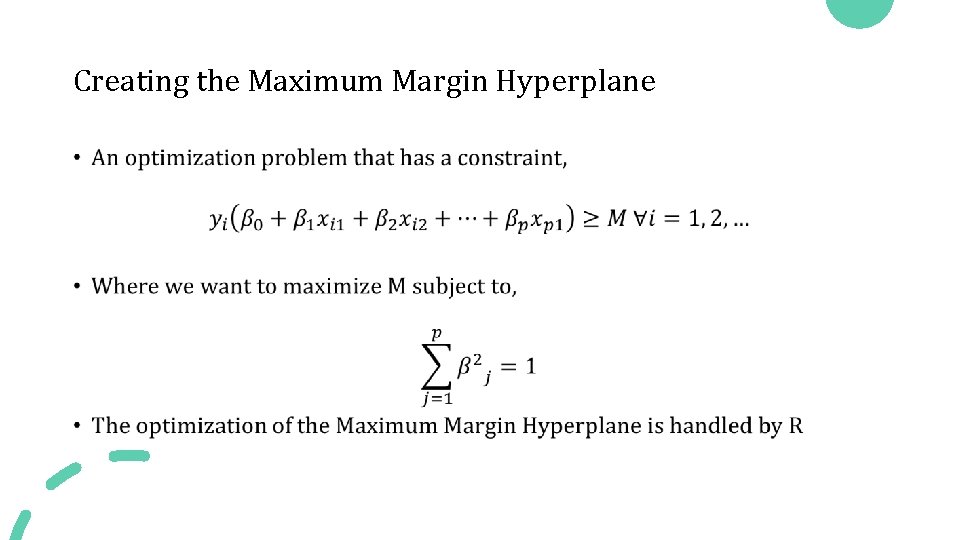
Creating the Maximum Margin Hyperplane •

Support Vector Classifiers •
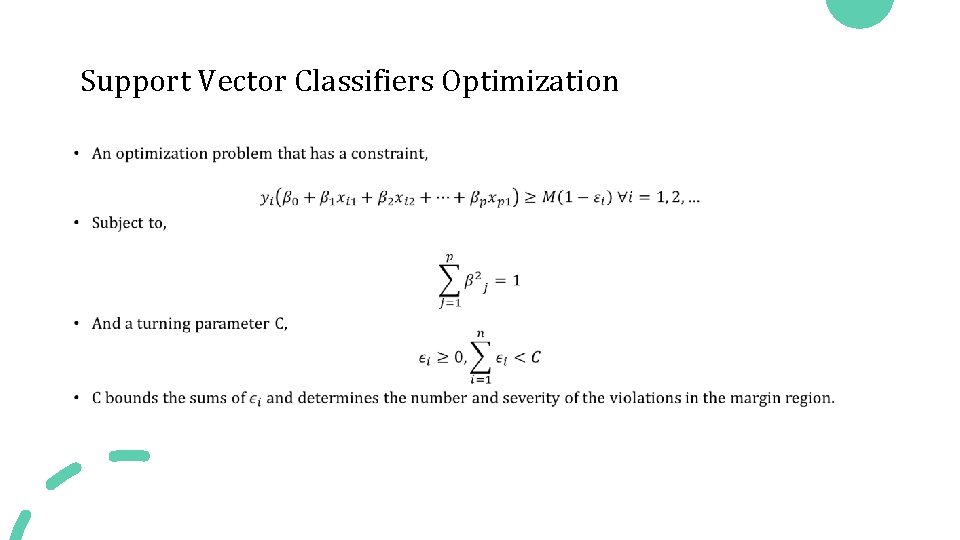
Support Vector Classifiers Optimization •
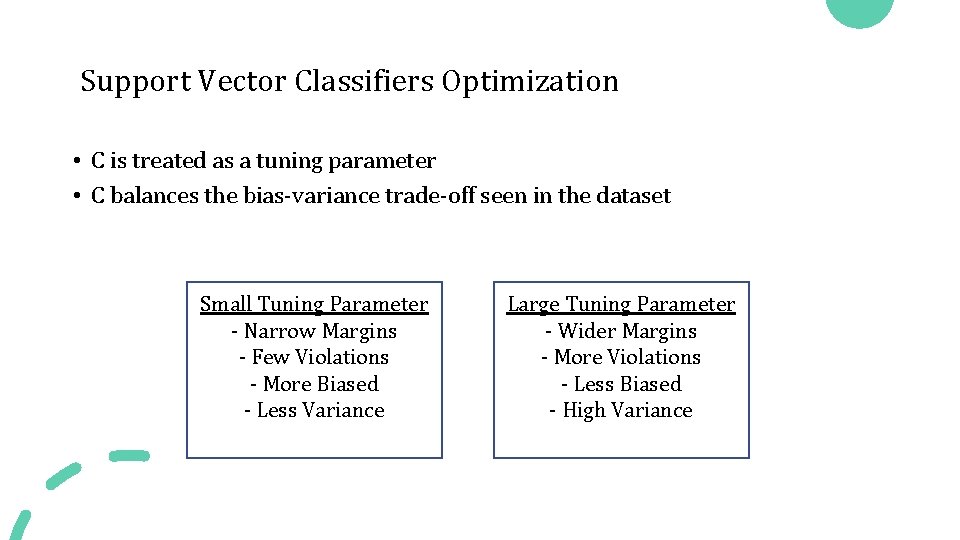
Support Vector Classifiers Optimization • C is treated as a tuning parameter • C balances the bias-variance trade-off seen in the dataset Small Tuning Parameter - Narrow Margins - Few Violations - More Biased - Less Variance Large Tuning Parameter - Wider Margins - More Violations - Less Biased - High Variance
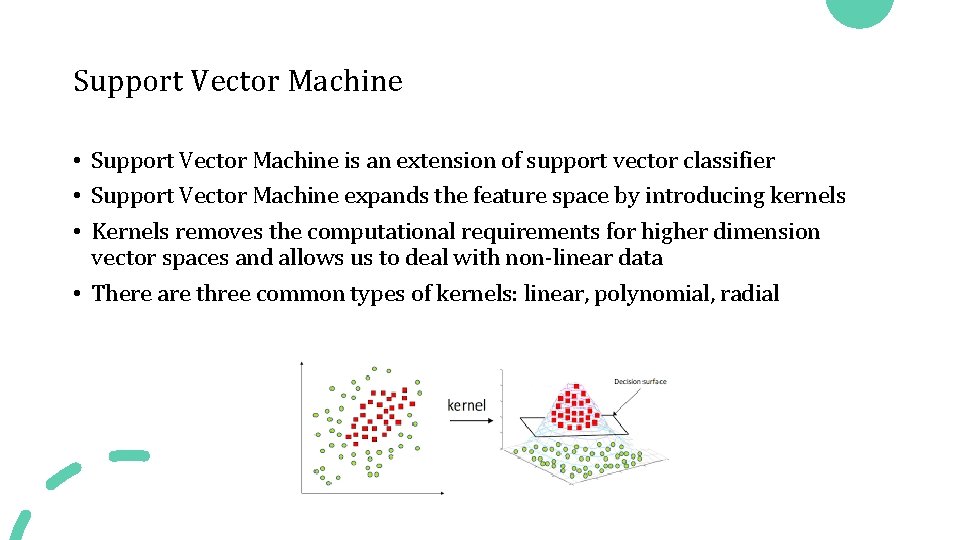
Support Vector Machine • Support Vector Machine is an extension of support vector classifier • Support Vector Machine expands the feature space by introducing kernels • Kernels removes the computational requirements for higher dimension vector spaces and allows us to deal with non-linear data • There are three common types of kernels: linear, polynomial, radial

Support Vector Machine Optimization •
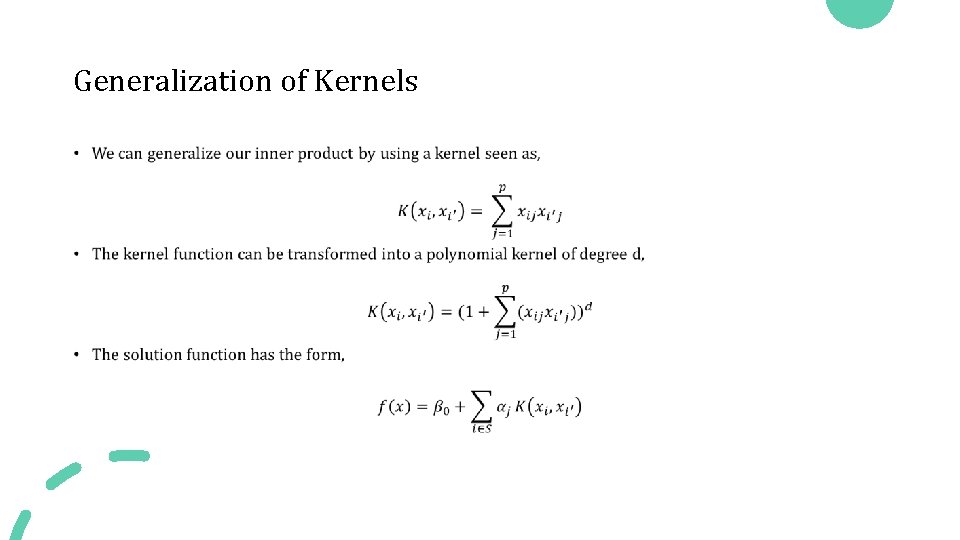
Generalization of Kernels •
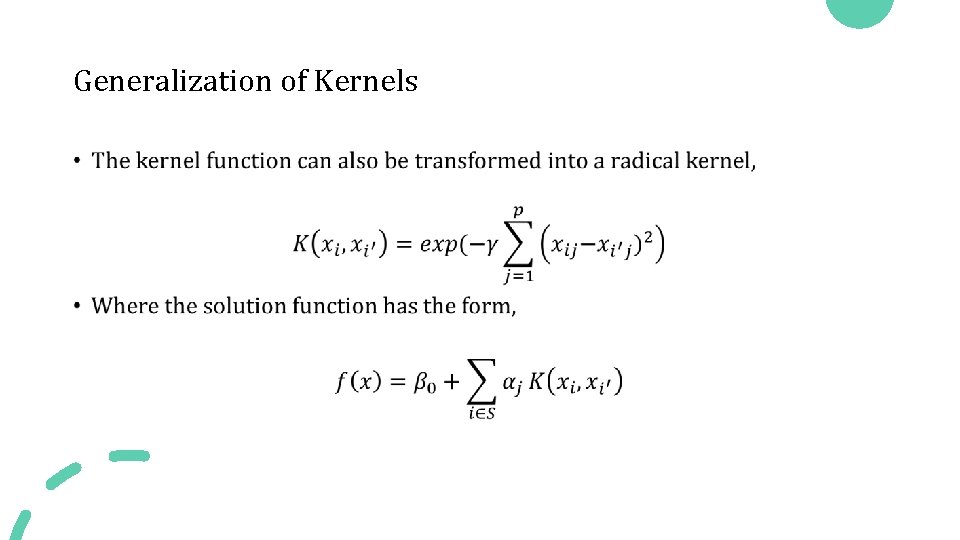
Generalization of Kernels •
Using Support Vector Machine in R • I used a dataset named spam 7 that contains data whether an email is spam or not • The 6 predictors of the dataset were - crl. tot: total length of words in capitals dollar: number of occurrences of the $ symbol bang: number of occurrences of the ! symbol money: number of occurrences of the word ‘money’ n 000: number of occurrences of the string ‘ 000’ make: number of occurrences of the word ‘make’ • The response variable “yesno” was the indication whether it is spam or not - yesno: outcome variable, a factor with levels n not spam, y spam
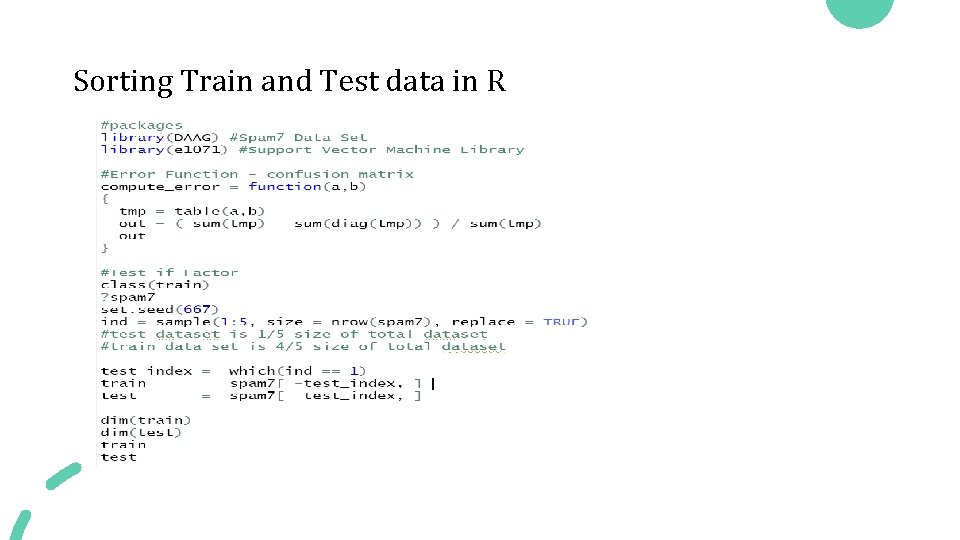
Sorting Train and Test data in R
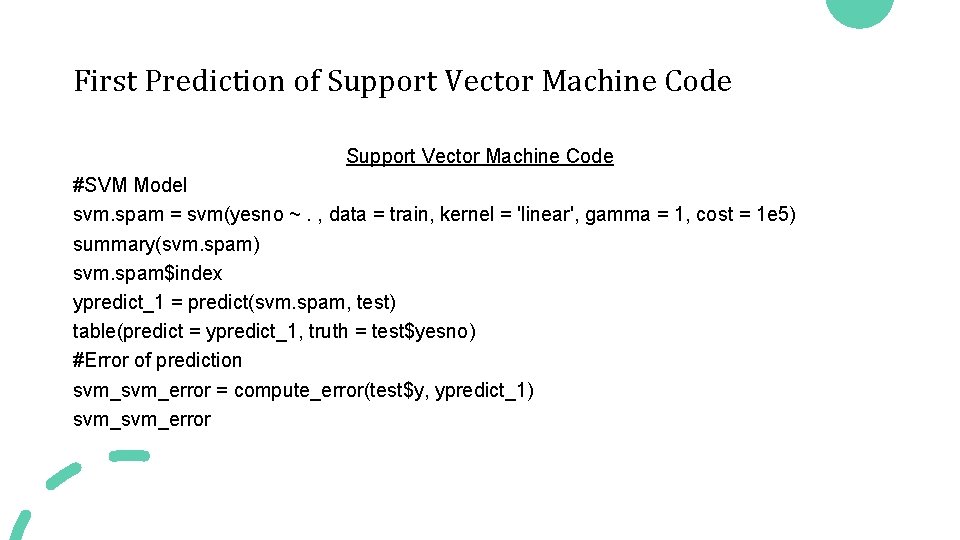
First Prediction of Support Vector Machine Code #SVM Model svm. spam = svm(yesno ~. , data = train, kernel = 'linear', gamma = 1, cost = 1 e 5) summary(svm. spam) svm. spam$index ypredict_1 = predict(svm. spam, test) table(predict = ypredict_1, truth = test$yesno) #Error of prediction svm_error = compute_error(test$y, ypredict_1) svm_error
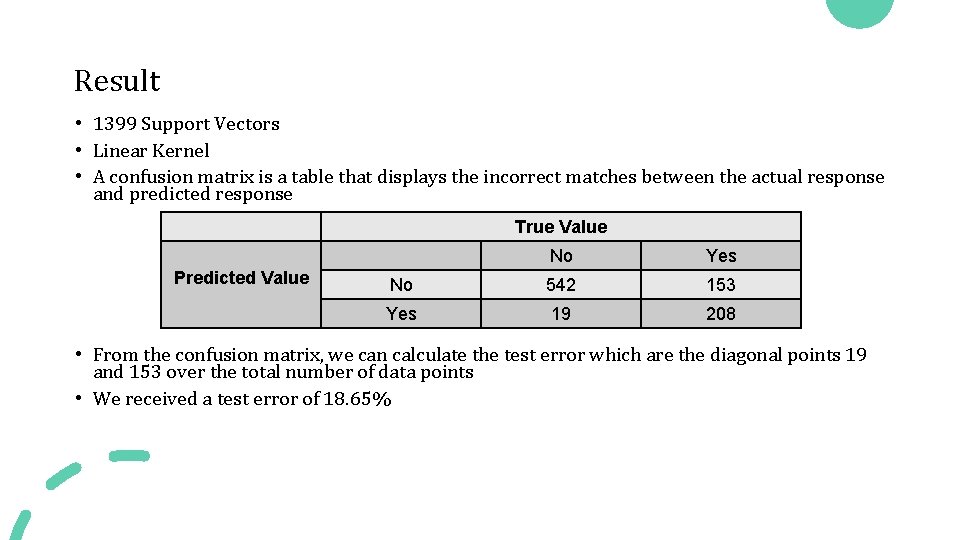
Result • 1399 Support Vectors • Linear Kernel • A confusion matrix is a table that displays the incorrect matches between the actual response and predicted response True Value Predicted Value No Yes No 542 153 Yes 19 208 • From the confusion matrix, we can calculate the test error which are the diagonal points 19 and 153 over the total number of data points • We received a test error of 18. 65%
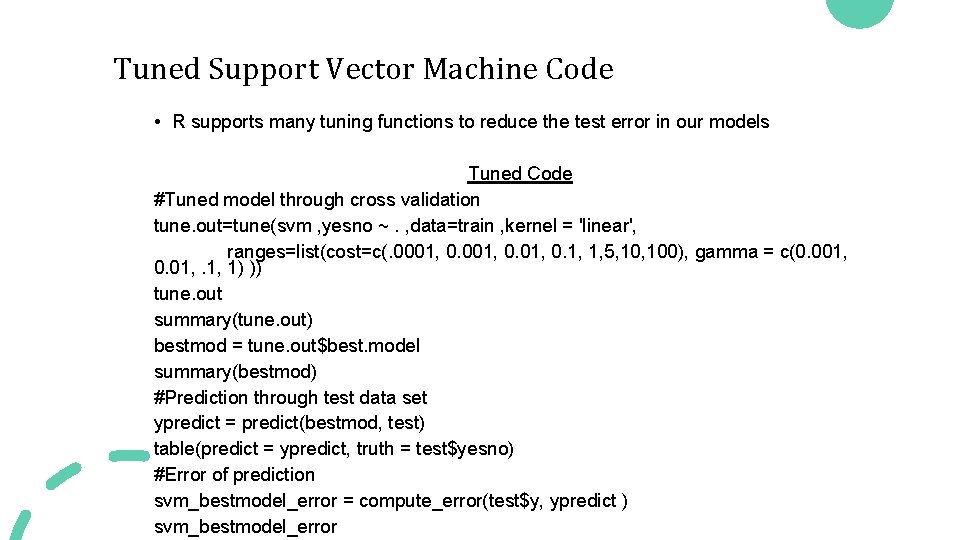
Tuned Support Vector Machine Code • R supports many tuning functions to reduce the test error in our models Tuned Code #Tuned model through cross validation tune. out=tune(svm , yesno ~. , data=train , kernel = 'linear', ranges=list(cost=c(. 0001, 0. 1, 1, 5, 100), gamma = c(0. 001, 0. 01, . 1, 1) )) tune. out summary(tune. out) bestmod = tune. out$best. model summary(bestmod) #Prediction through test data set ypredict = predict(bestmod, test) table(predict = ypredict, truth = test$yesno) #Error of prediction svm_bestmodel_error = compute_error(test$y, ypredict ) svm_bestmodel_error
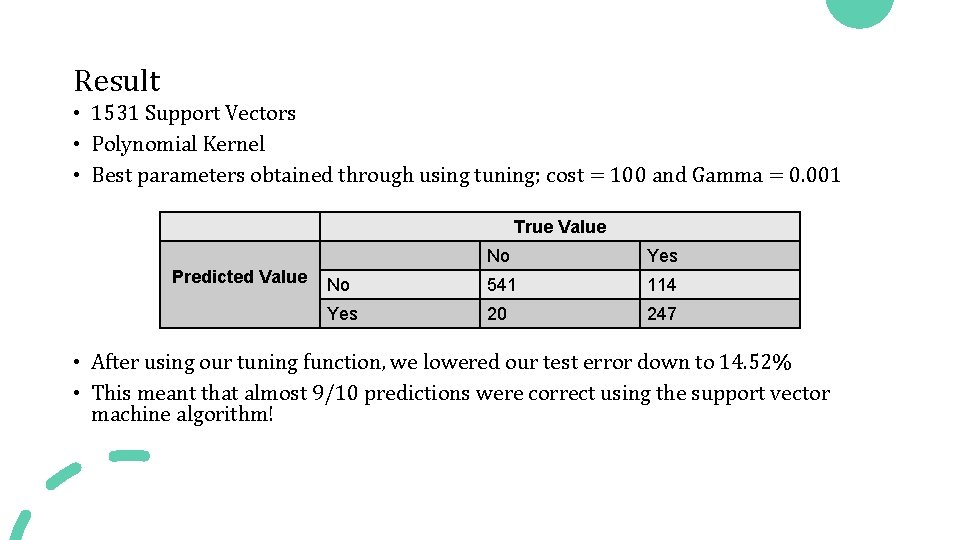
Result • 1531 Support Vectors • Polynomial Kernel • Best parameters obtained through using tuning; cost = 100 and Gamma = 0. 001 True Value Predicted Value No Yes No 541 114 Yes 20 247 • After using our tuning function, we lowered our test error down to 14. 52% • This meant that almost 9/10 predictions were correct using the support vector machine algorithm!
- Slides: 19