
Support Vector and Kernel Methods John ShaweTaylor University

- Slides: 42
Support Vector and Kernel Methods John Shawe-Taylor University of Southampton
Motivation • Linear learning typically has nice properties – Unique optimal solutions – Fast learning algorithms – Better statistical analysis • But one big problem – Insufficient capacity
Historical perspective • Minsky and Pappert highlighted the weakness in their book Perceptrons • Neural networks overcame the problem by glueing together many thresholded linear units – Solved problem of capacity but ran into training problems of speed and multiple local minima
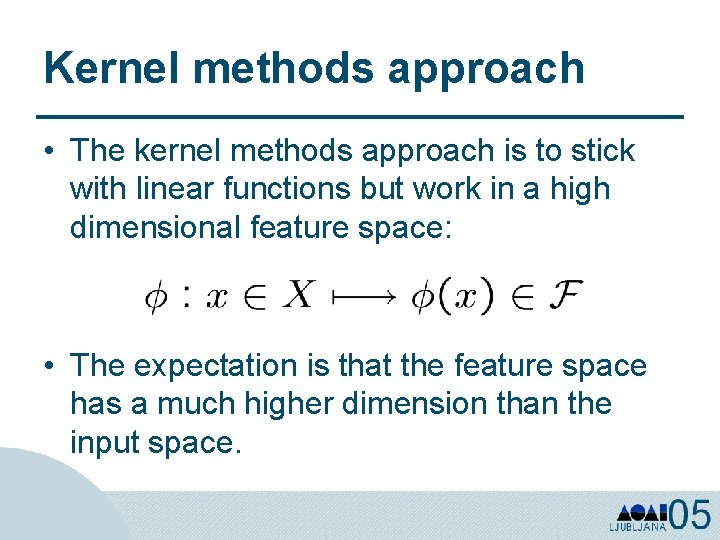
Kernel methods approach • The kernel methods approach is to stick with linear functions but work in a high dimensional feature space: • The expectation is that the feature space has a much higher dimension than the input space.
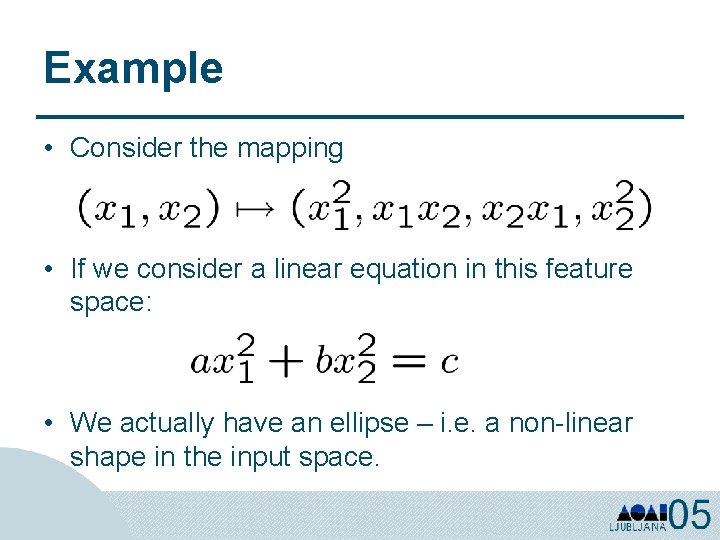
Example • Consider the mapping • If we consider a linear equation in this feature space: • We actually have an ellipse – i. e. a non-linear shape in the input space.
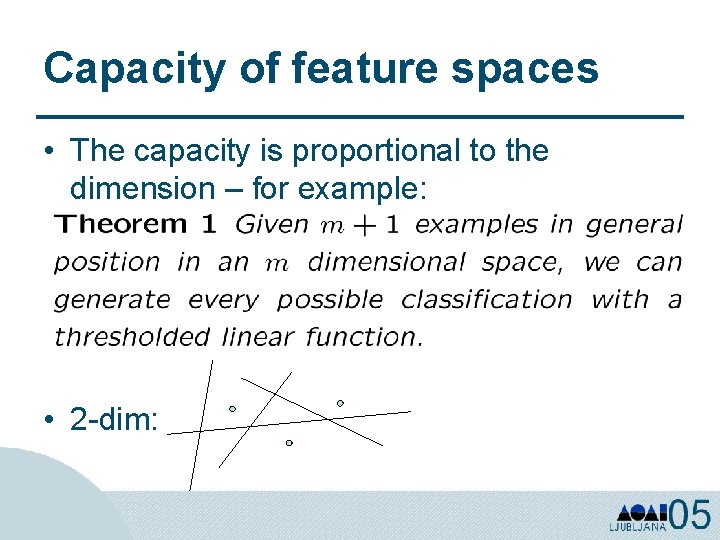
Capacity of feature spaces • The capacity is proportional to the dimension – for example: • 2 -dim:
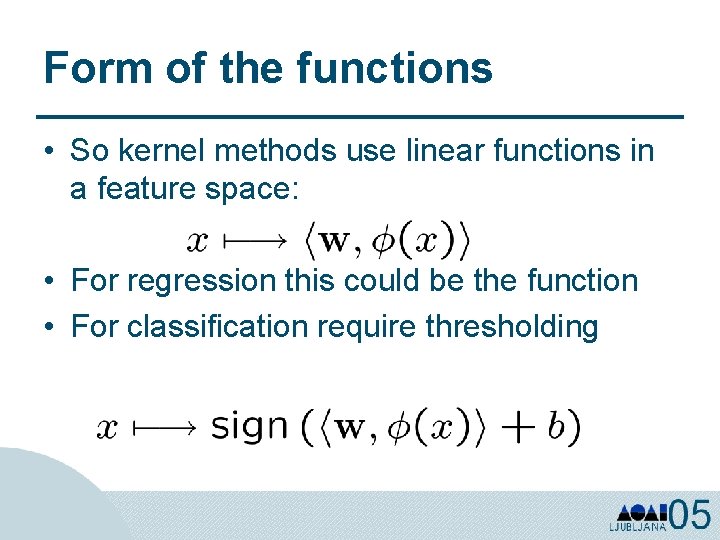
Form of the functions • So kernel methods use linear functions in a feature space: • For regression this could be the function • For classification require thresholding
Problems of high dimensions • Capacity may easily become too large and lead to overfitting: being able to realise every classifier means unlikely to generalise well • Computational costs involved in dealing with large vectors
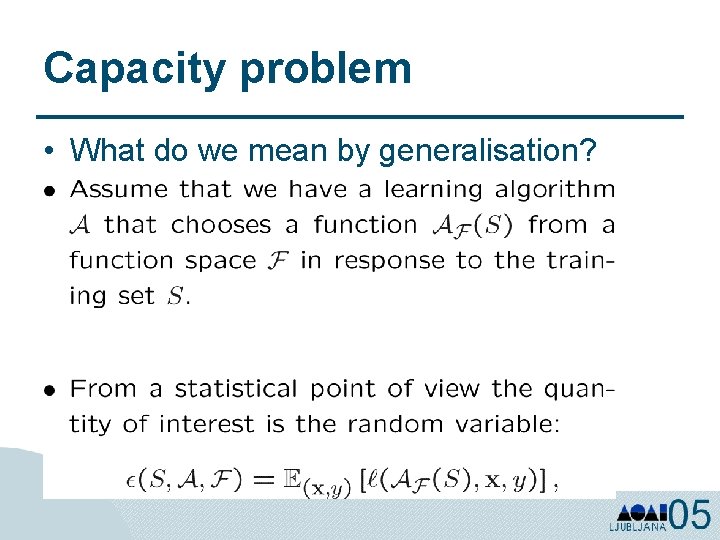
Capacity problem • What do we mean by generalisation?
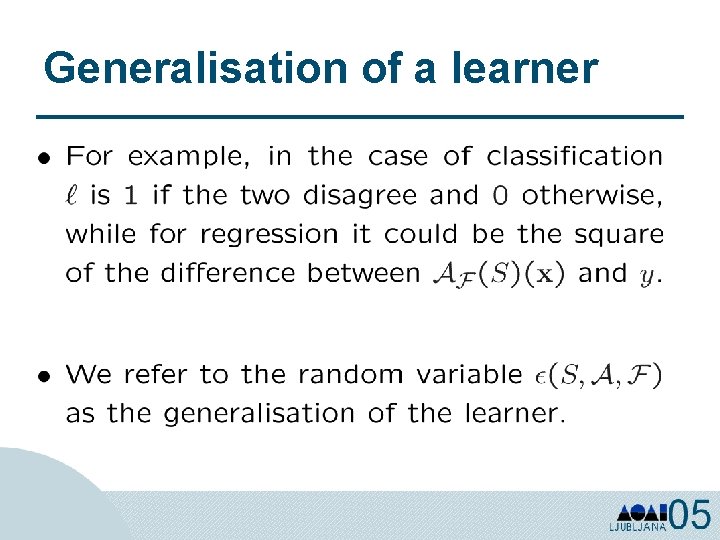
Generalisation of a learner
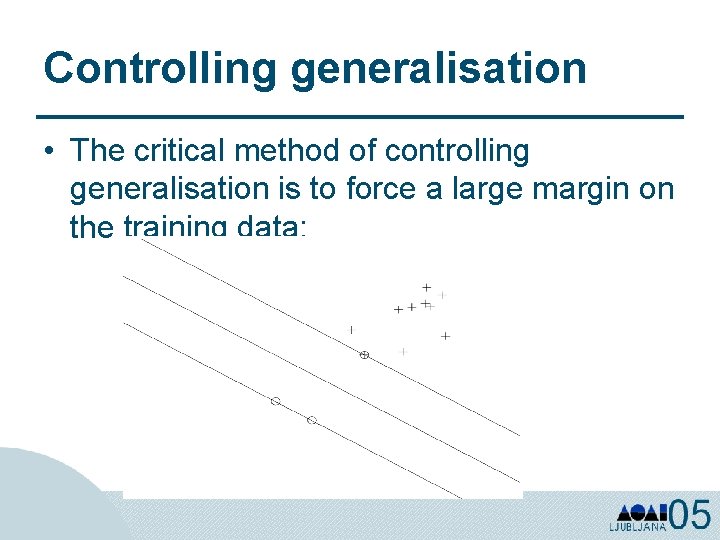
Controlling generalisation • The critical method of controlling generalisation is to force a large margin on the training data:
Regularisation • Keeping a large margin is equivalent to minimising the norm of the weight vector while keeping outputs above a fixed value • Controlling the norm of the weight vector is also referred to as regularisation, c. f. weight decay in neural network learning • This is not structural risk minimisation since hierarchy depends on the data: data-dependent structural risk minimisation see S-T, Bartlett, Williamson & Anthony, 1998
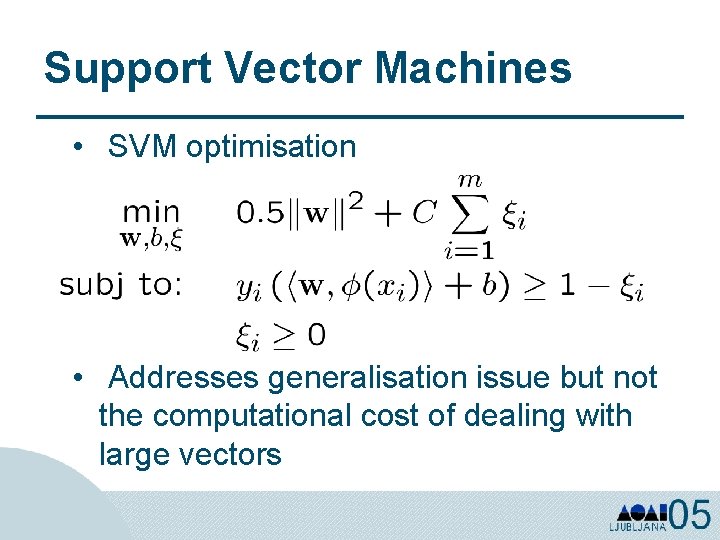
Support Vector Machines • SVM optimisation • Addresses generalisation issue but not the computational cost of dealing with large vectors
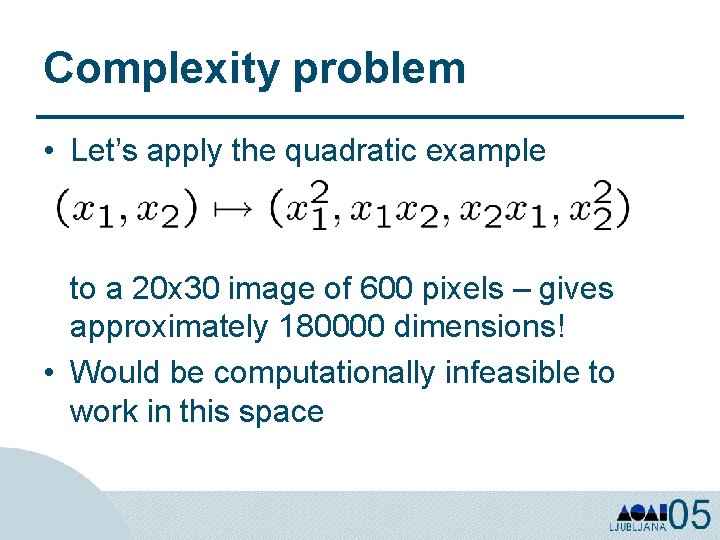
Complexity problem • Let’s apply the quadratic example to a 20 x 30 image of 600 pixels – gives approximately 180000 dimensions! • Would be computationally infeasible to work in this space
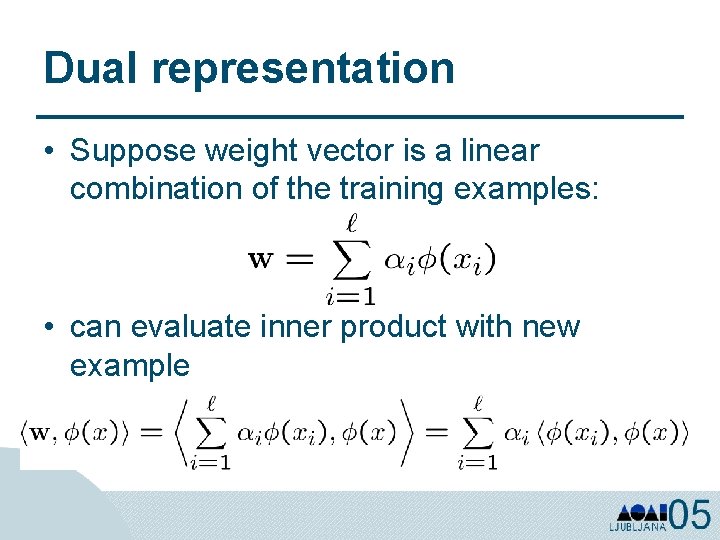
Dual representation • Suppose weight vector is a linear combination of the training examples: • can evaluate inner product with new example
Learning the dual variables • Since any component orthogonal to the space spanned by the training data has no effect, general result that weight vectors have dual representation: the representer theorem. • Hence, can reformulate algorithms to learn dual variables rather than weight vector directly
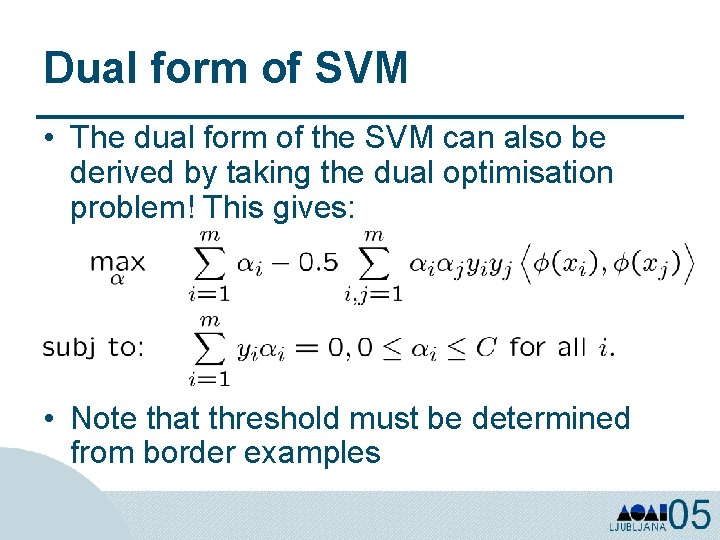
Dual form of SVM • The dual form of the SVM can also be derived by taking the dual optimisation problem! This gives: • Note that threshold must be determined from border examples
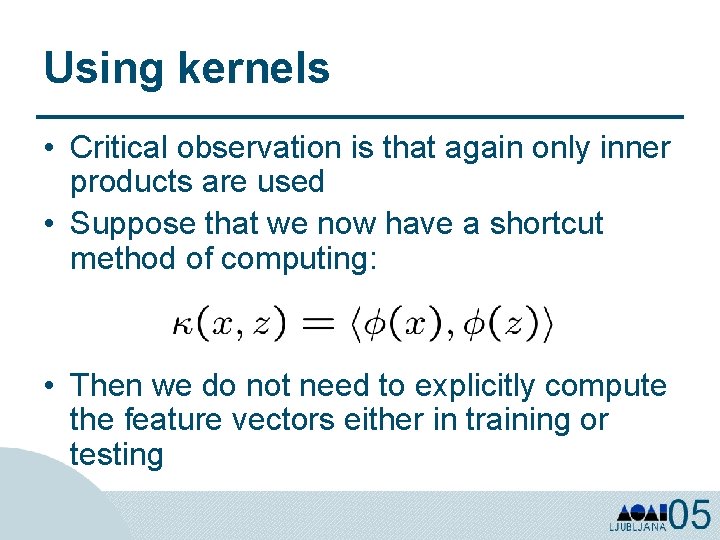
Using kernels • Critical observation is that again only inner products are used • Suppose that we now have a shortcut method of computing: • Then we do not need to explicitly compute the feature vectors either in training or testing
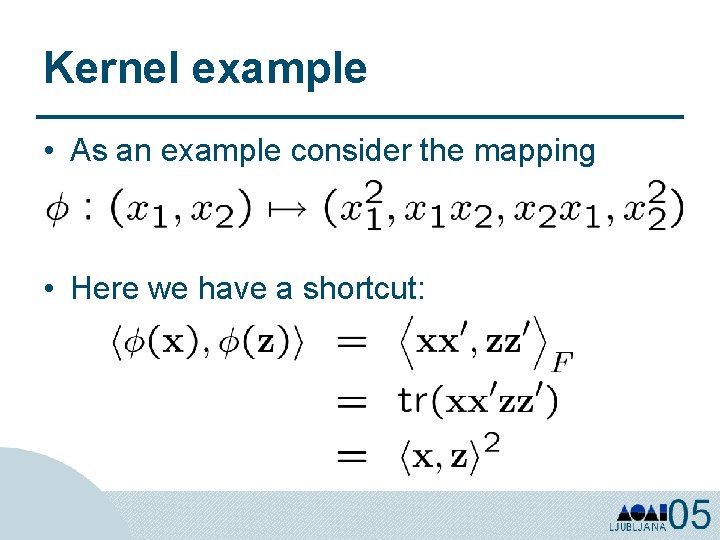
Kernel example • As an example consider the mapping • Here we have a shortcut:
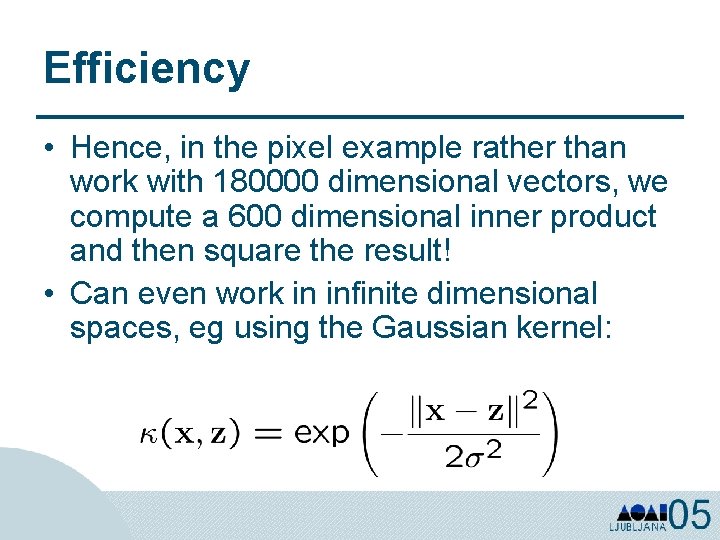
Efficiency • Hence, in the pixel example rather than work with 180000 dimensional vectors, we compute a 600 dimensional inner product and then square the result! • Can even work in infinite dimensional spaces, eg using the Gaussian kernel:
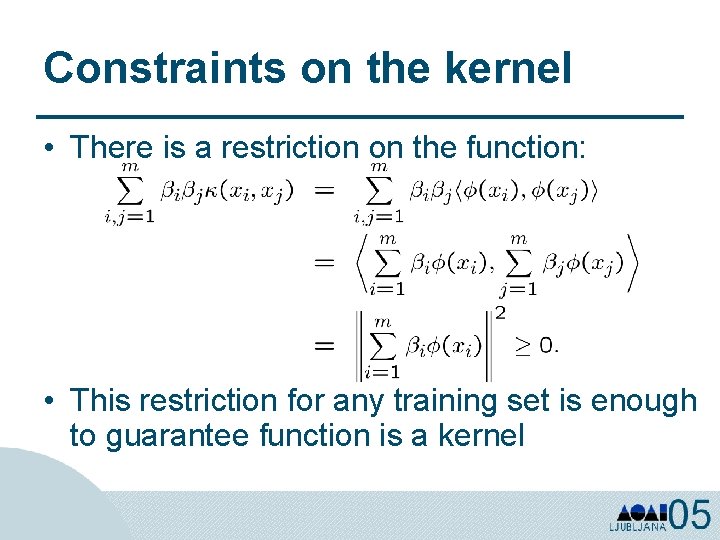
Constraints on the kernel • There is a restriction on the function: • This restriction for any training set is enough to guarantee function is a kernel
What have we achieved? • Replaced problem of neural network architecture by kernel definition – Arguably more natural to define but restriction is a bit unnatural – Not a silver bullet as fit with data is key – Can be applied to non- vectorial (or high dim) data • Gained more flexible regularisation/ generalisation control • Gained convex optimisation problem – i. e. NO local minima!
Brief look at algorithmics • Have convex quadratic program • Can apply standard optimisation packages – but don’t exploit specifics of problem and can be inefficient • Important to use chunking for large datasets • But can use very simple gradient ascent algorithms for individual chunks
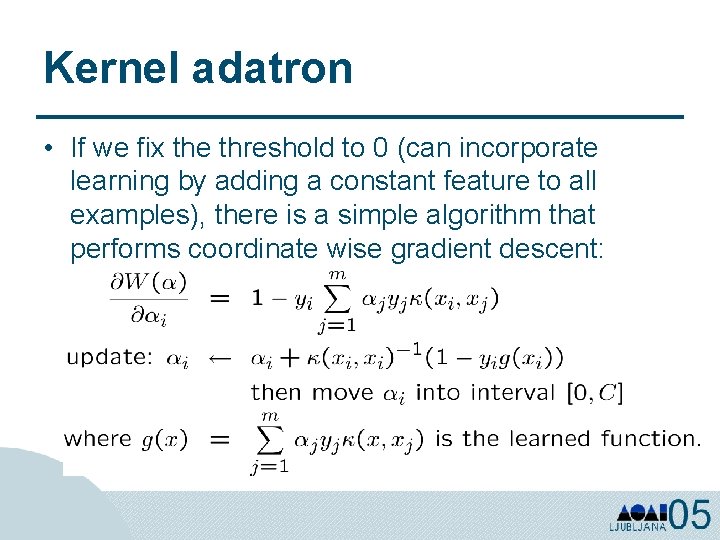
Kernel adatron • If we fix the threshold to 0 (can incorporate learning by adding a constant feature to all examples), there is a simple algorithm that performs coordinate wise gradient descent:
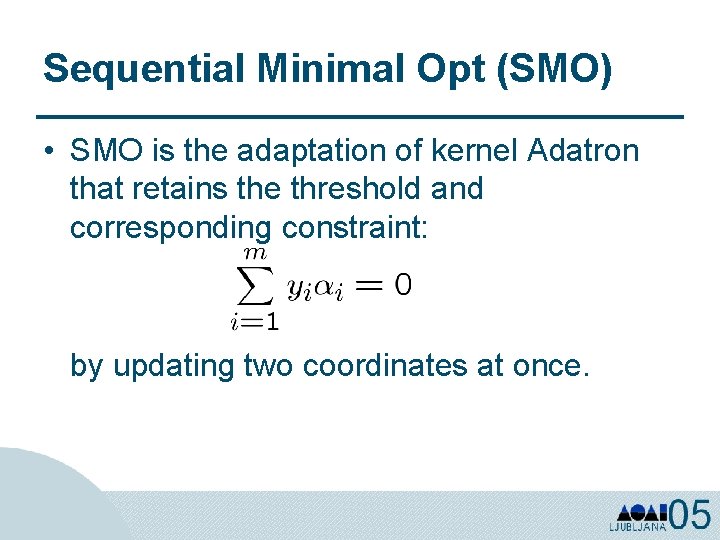
Sequential Minimal Opt (SMO) • SMO is the adaptation of kernel Adatron that retains the threshold and corresponding constraint: by updating two coordinates at once.
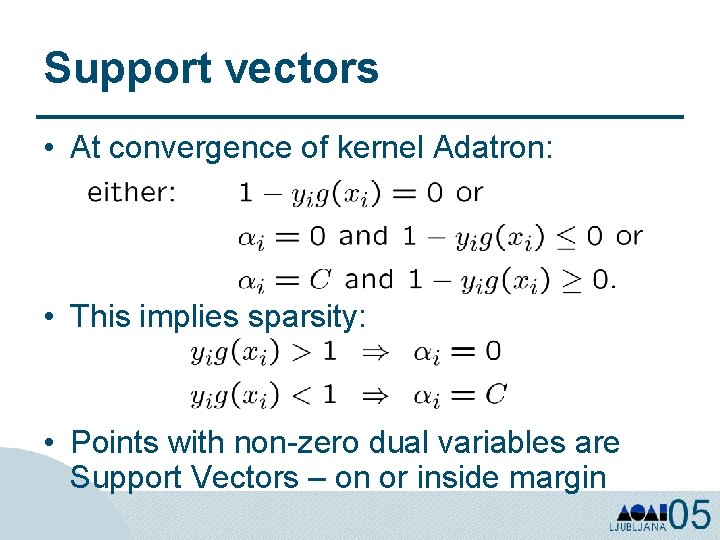
Support vectors • At convergence of kernel Adatron: • This implies sparsity: • Points with non-zero dual variables are Support Vectors – on or inside margin
Issues in applying SVMs • Need to choose a kernel: – Standard inner product – Polynomial kernel – how to choose degree – Gaussian kernel – but how to choose width – Specific kernel for different datatypes • Need to set parameter C: – Can use cross-validation – If data is normalised often standard value of 1 is fine
Kernel methods topics • Kernel methods are built on the idea of using kernel defined feature spaces for a variety of learning tasks: issues – Kernels for different data – Other learning tasks and algorithms – Subspace techniques such as PCA for refining kernel definitions
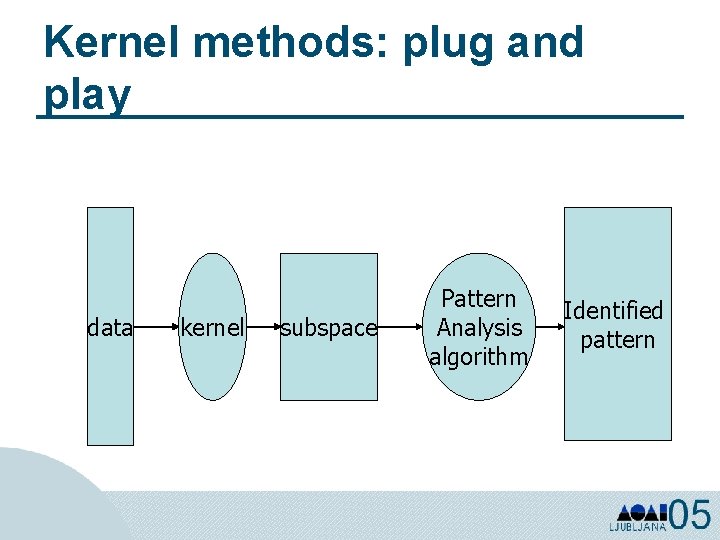
Kernel methods: plug and play data kernel subspace Pattern Analysis algorithm Identified pattern
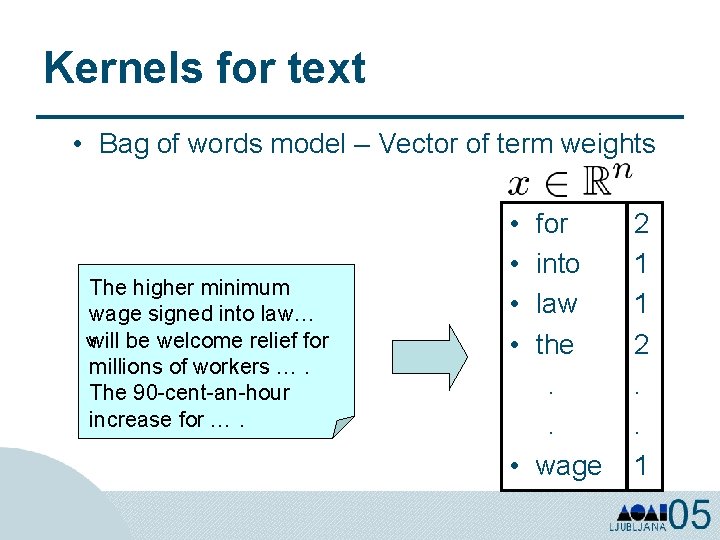
Kernels for text • Bag of words model – Vector of term weights The higher minimum wage signed into law… vwill be welcome relief for millions of workers …. The 90 -cent-an-hour increase for …. • • for into law the. . • wage 2 1 1 2. . 1
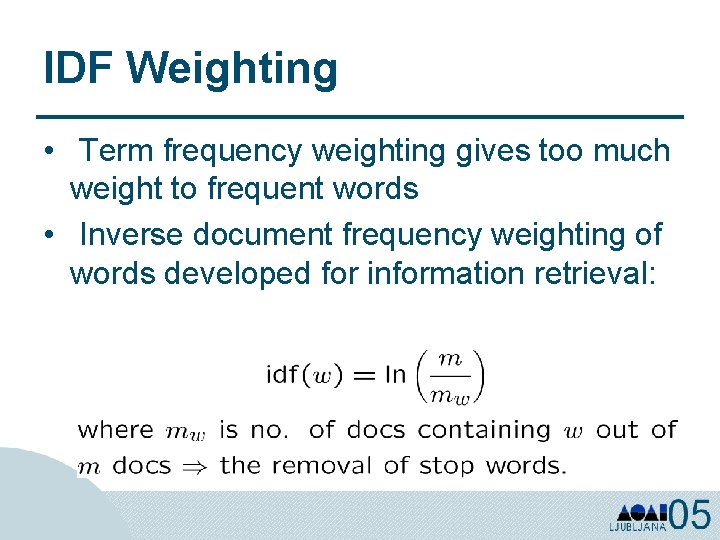
IDF Weighting • Term frequency weighting gives too much weight to frequent words • Inverse document frequency weighting of words developed for information retrieval:
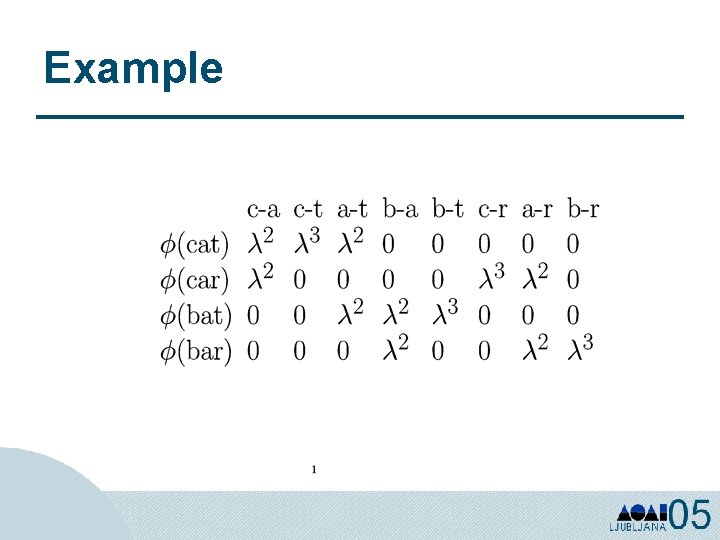
Alternative: string kernel • Features are indexed by k-tuples of characters • Feature weight is count of occurrences of k-tuple as a subsequence down weighted by its length • Can be computed efficiently by a dynamic programming method
Example
Other kernel topics • Kernels for structured data: eg trees, graphs, etc. – Can compute inner products efficiently using dynamic programming techniques even when an exponential number of features included • Kernels from probabilistic models: eg Fisher kernels, P-kernels – Fisher kernels used for smoothly parametrised models: computes gradients of log probability – P-kernels consider family of models with each model providing one feature
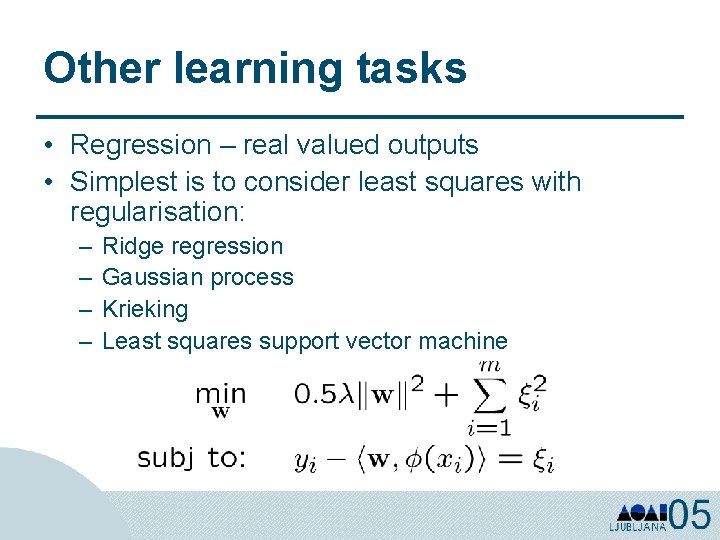
Other learning tasks • Regression – real valued outputs • Simplest is to consider least squares with regularisation: – – Ridge regression Gaussian process Krieking Least squares support vector machine
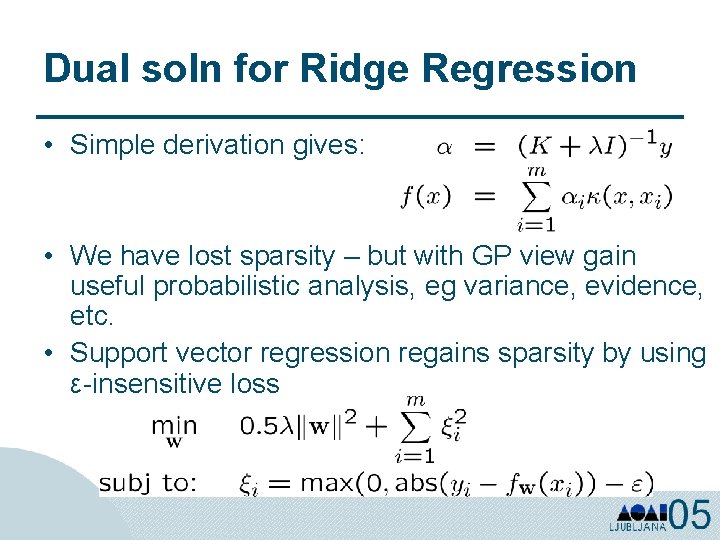
Dual soln for Ridge Regression • Simple derivation gives: • We have lost sparsity – but with GP view gain useful probabilistic analysis, eg variance, evidence, etc. • Support vector regression regains sparsity by using ε-insensitive loss
Other tasks • Novelty detection, eg condition monitoring, fraud detection: possible solution is so-called one class SVM, or minimal hypersphere containing the data • Ranking, eg recommender systems: can be made with similar margin conditions and generalisation bounds • Clustering, eg k-means, spectral clustering: can be performed in a kernel defined feature space
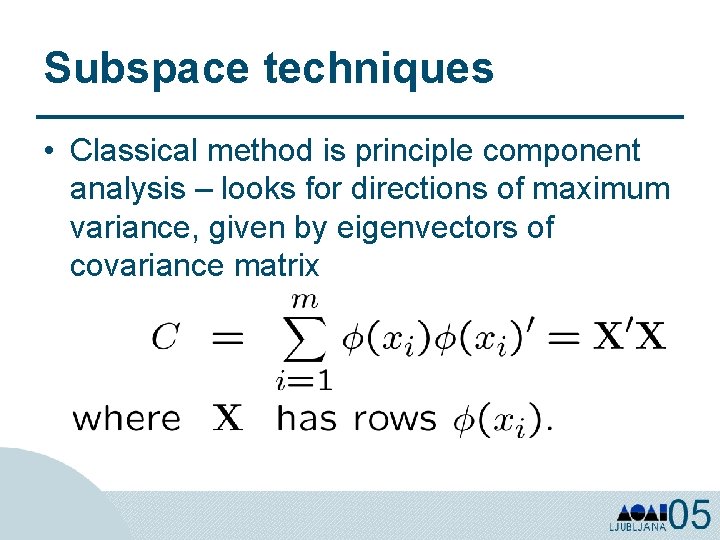
Subspace techniques • Classical method is principle component analysis – looks for directions of maximum variance, given by eigenvectors of covariance matrix
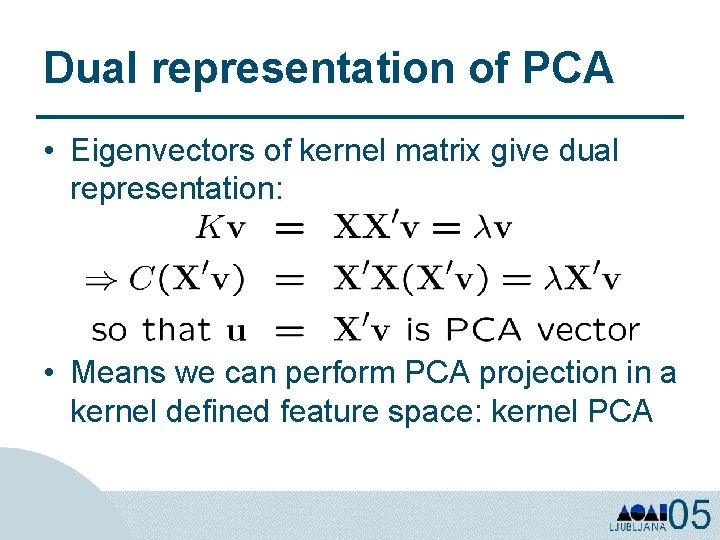
Dual representation of PCA • Eigenvectors of kernel matrix give dual representation: • Means we can perform PCA projection in a kernel defined feature space: kernel PCA
Other subspace methods • Latent Semantic kernels equivalent to k. PCA • Kernel partial Gram-Schmidt orthogonalisation is equivalent to incomplete Cholesky decomposition • Kernel Partial Least Squares implements a multidimensional regression algorithm popular in chemometrics • Kernel Canonical Correlation Analysis uses paired datasets to learn a semantic representation independent of the two views
Conclusions • SVMs are well-founded in statistics and lead to convex quadratic programs that can be solved with simple algorithms • Allow use of high dimensional feature spaces but control generalisation in a data dependent structural risk minimisation • Kernels enable efficient implementation through dual representations • Kernel design can be extended to nonvectorial data and complex models
Conclusions • Same approach can be used for other learning tasks: eg regression, ranking, etc. • Subspace methods can often be implemented in kernel defined feature spaces using dual representations • Overall gives a generic plug and play framework for analysing data, combining different data types, models, tasks, and preprocessing