
Support Department Cost Allocation Prepared by Douglas Cloud
Support Department Cost Allocation Prepared by Douglas Cloud Pepperdine University 6 -1
Objectives 1. Describe the. After difference between studying this support departmentschapter, and producing departments. you should 2. Explain five reasons whyto: support cost may be be able assigned to producing departments. 3. Calculate charging rates, and distinguish between single and dual charging rates. 4. Allocate support center costs to producing departments using the direct method, the sequential method, Continued and the reciprocal method. 6 -2
Objectives 5. Calculate departmental overhead rates. 6 -3
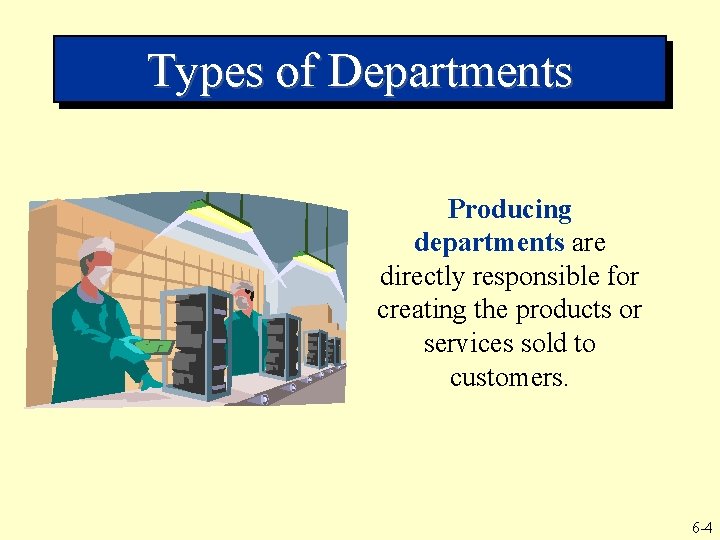
Types of Departments Producing departments are directly responsible for creating the products or services sold to customers. 6 -4
Types of Departments Supporting departments provide essential support services for producing departments. Maintenance, grounds, engineering, personnel, storage 6 -5
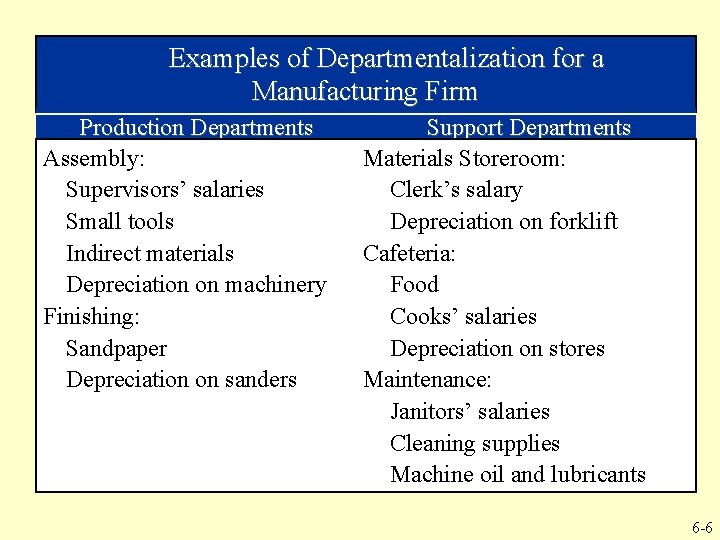
Examples of Departmentalization for a Manufacturing Firm Production Departments Assembly: Supervisors’ salaries Small tools Indirect materials Depreciation on machinery Finishing: Sandpaper Depreciation on sanders Support Departments Materials Storeroom: Clerk’s salary Depreciation on forklift Cafeteria: Food Cooks’ salaries Depreciation on stores Maintenance: Janitors’ salaries Cleaning supplies Machine oil and lubricants 6 -6
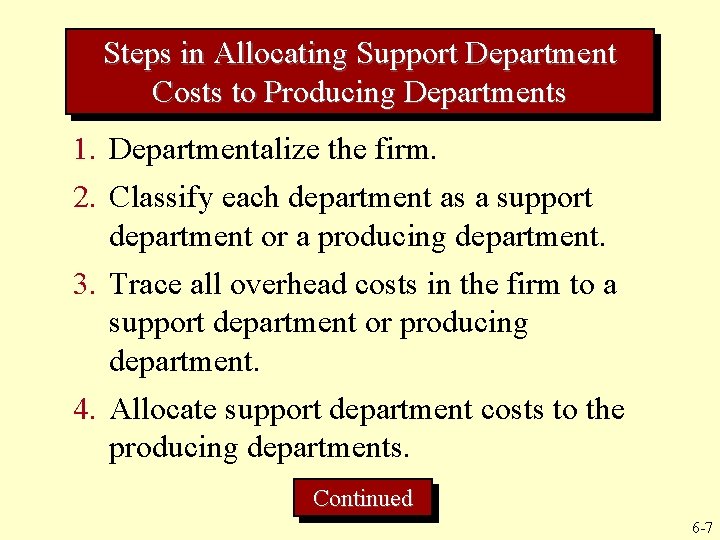
Steps in Allocating Support Department Costs to Producing Departments 1. Departmentalize the firm. 2. Classify each department as a support department or a producing department. 3. Trace all overhead costs in the firm to a support department or producing department. 4. Allocate support department costs to the producing departments. Continued 6 -7
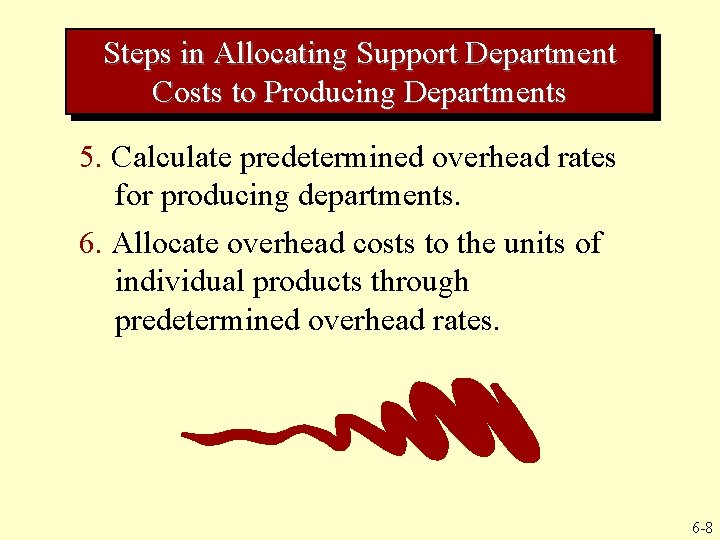
Steps in Allocating Support Department Costs to Producing Departments 5. Calculate predetermined overhead rates for producing departments. 6. Allocate overhead costs to the units of individual products through predetermined overhead rates. 6 -8
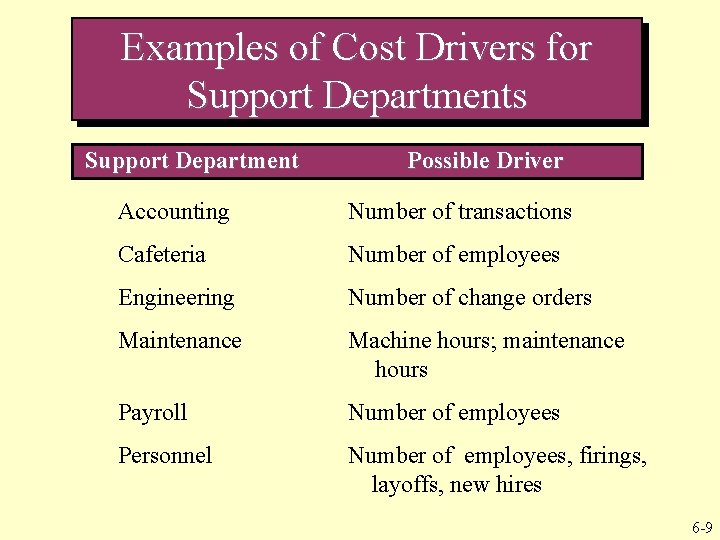
Examples of Cost Drivers for Support Departments Support Department Possible Driver Accounting Number of transactions Cafeteria Number of employees Engineering Number of change orders Maintenance Machine hours; maintenance hours Payroll Number of employees Personnel Number of employees, firings, layoffs, new hires 6 -9
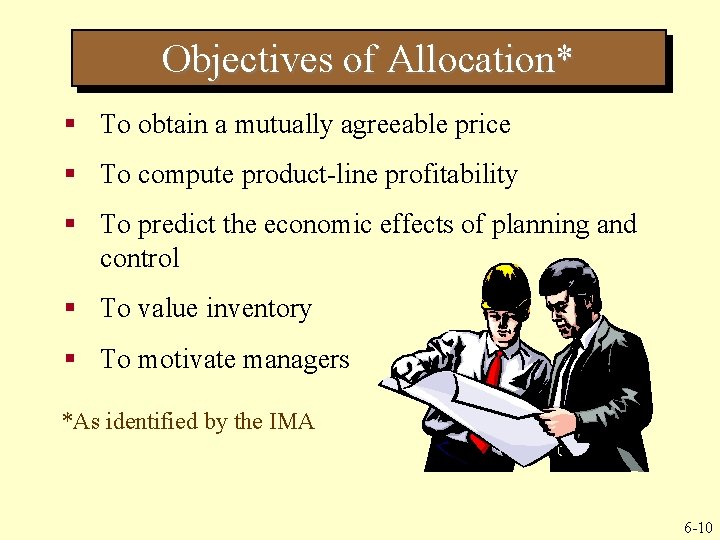
Objectives of Allocation* § To obtain a mutually agreeable price § To compute product-line profitability § To predict the economic effects of planning and control § To value inventory § To motivate managers *As identified by the IMA 6 -10
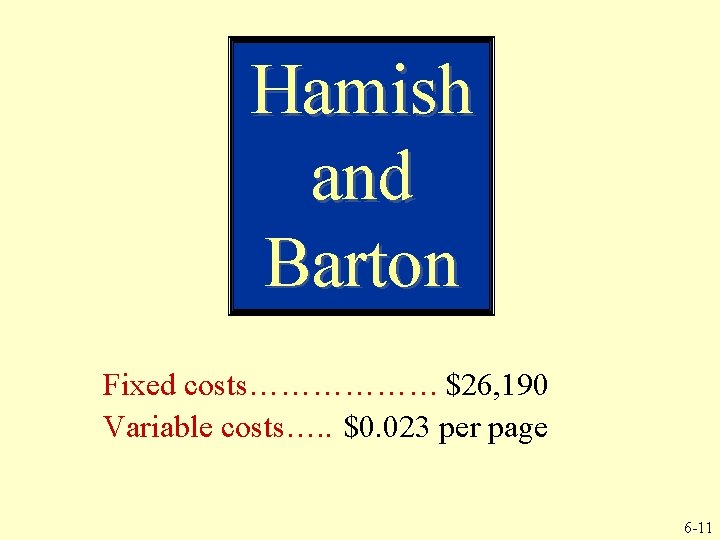
Hamish and Barton Fixed costs……………… $26, 190 Variable costs…. . $0. 023 per page 6 -11
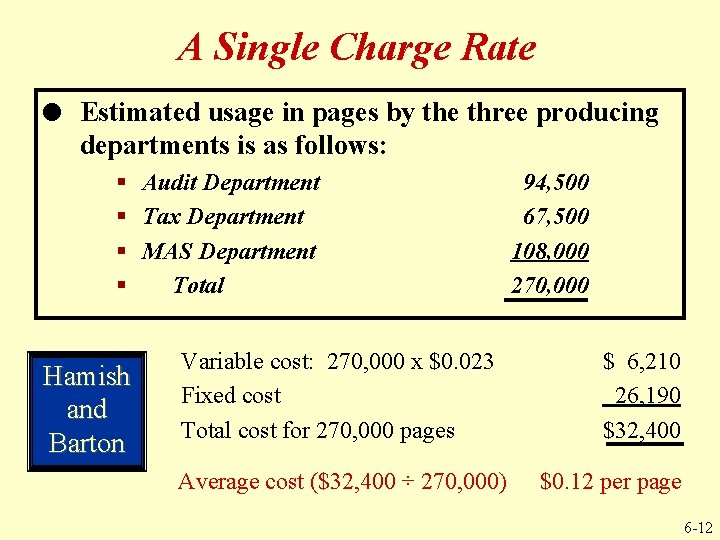
A Single Charge Rate l Estimated usage in pages by the three producing departments is as follows: § Audit Department § Tax Department § MAS Department § Total Hamish and Barton Variable cost: 270, 000 x $0. 023 Fixed cost Total cost for 270, 000 pages Average cost ($32, 400 ÷ 270, 000) 94, 500 67, 500 108, 000 270, 000 $ 6, 210 26, 190 $32, 400 $0. 12 per page 6 -12
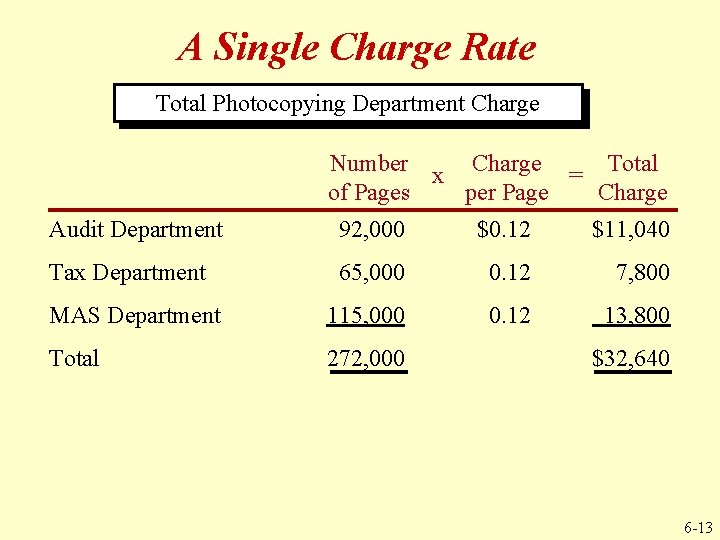
A Single Charge Rate Total Photocopying Department Charge Number x Charge = Total of Pages per Page Charge Audit Department 92, 000 $0. 12 $11, 040 Tax Department 65, 000 0. 12 7, 800 MAS Department 115, 000 0. 12 13, 800 Total 272, 000 $32, 640 6 -13
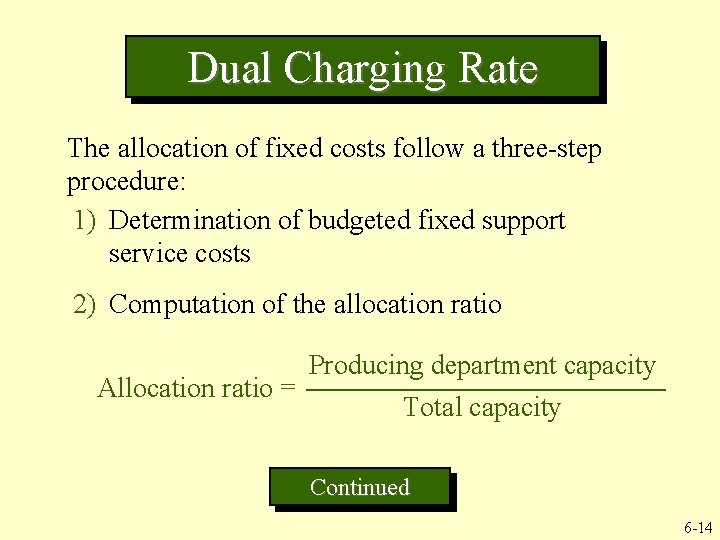
Dual Charging Rate The allocation of fixed costs follow a three-step procedure: 1) Determination of budgeted fixed support service costs 2) Computation of the allocation ratio Allocation ratio = Producing department capacity Total capacity Continued 6 -14
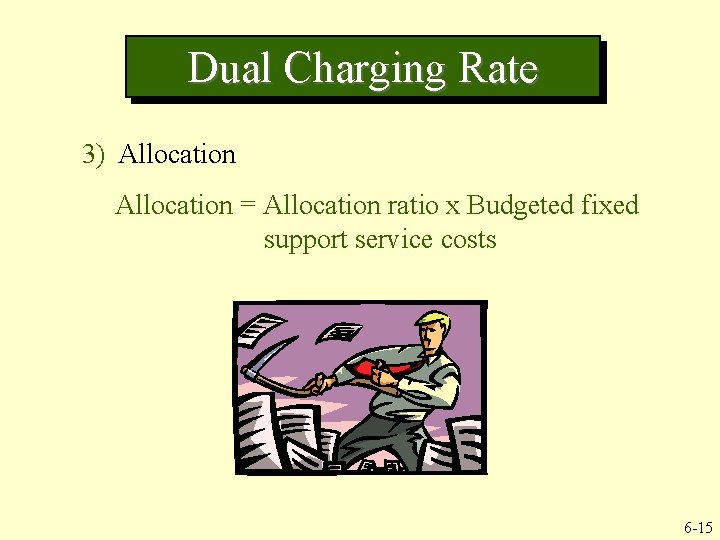
Dual Charging Rate 3) Allocation = Allocation ratio x Budgeted fixed support service costs 6 -15
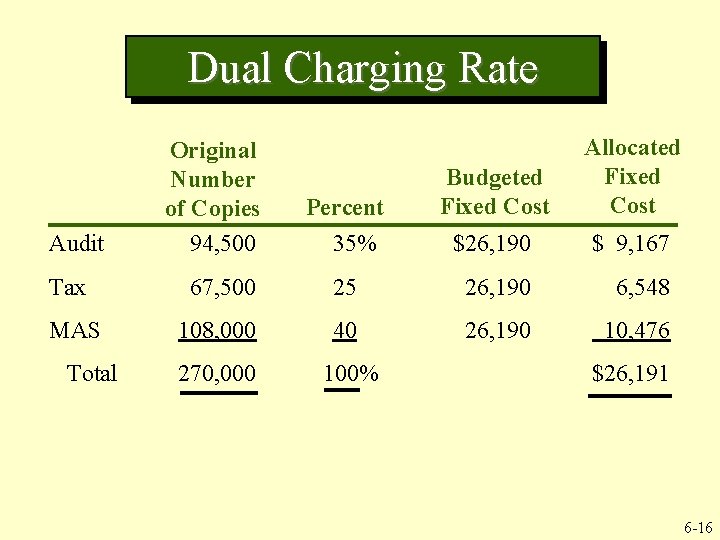
Dual Charging Rate Audit Tax MAS Total Original Number of Copies 94, 500 Percent 35% Budgeted Fixed Cost Allocated Fixed Cost $26, 190 $ 9, 167 67, 500 25 26, 190 6, 548 108, 000 40 26, 190 10, 476 270, 000 100% $26, 191 6 -16
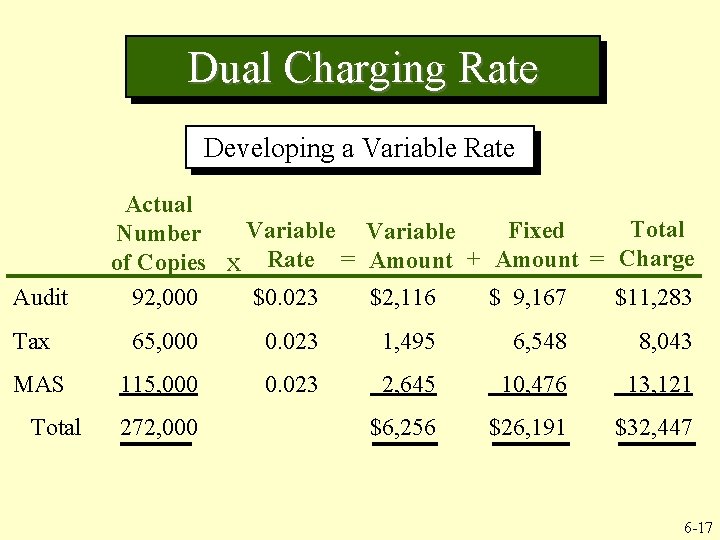
Dual Charging Rate Developing a Variable Rate Audit Tax MAS Total Actual Total Variable Fixed Number of Copies x Rate = Amount + Amount = Charge 92, 000 $0. 023 $2, 116 $ 9, 167 $11, 283 65, 000 0. 023 1, 495 6, 548 8, 043 115, 000 0. 023 2, 645 10, 476 13, 121 $6, 256 $26, 191 $32, 447 272, 000 6 -17
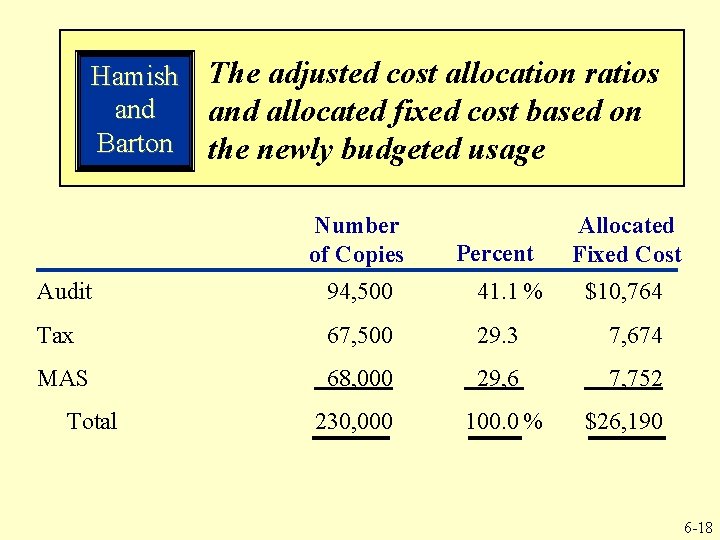
Hamish and Barton The adjusted cost allocation ratios and allocated fixed cost based on the newly budgeted usage Number of Copies Percent Allocated Fixed Cost Audit 94, 500 41. 1 % Tax 67, 500 29. 3 7, 674 MAS 68, 000 29, 6 7, 752 230, 000 100. 0 % Total $10, 764 $26, 190 6 -18
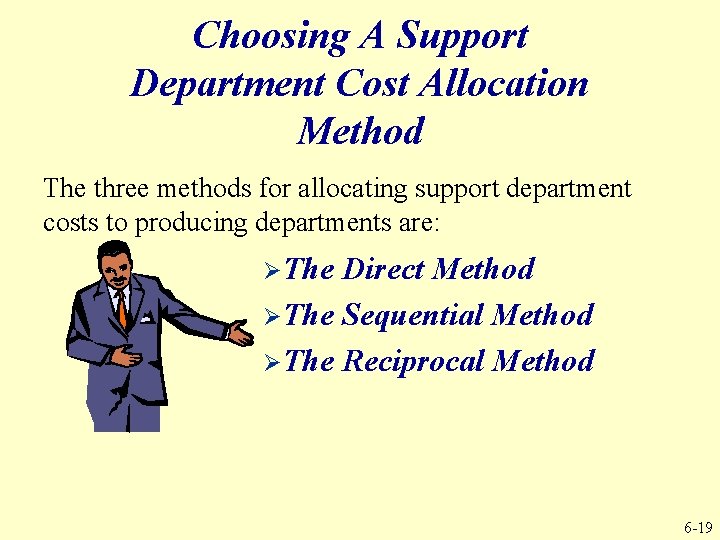
Choosing A Support Department Cost Allocation Method The three methods for allocating support department costs to producing departments are: ØThe Direct Method ØThe Sequential Method ØThe Reciprocal Method 6 -19
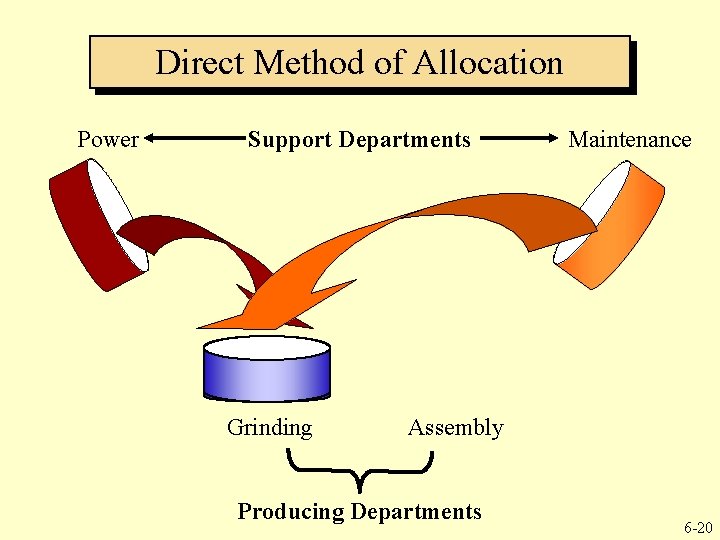
Direct Method of Allocation Power Support Departments Grinding Maintenance Assembly Producing Departments 6 -20
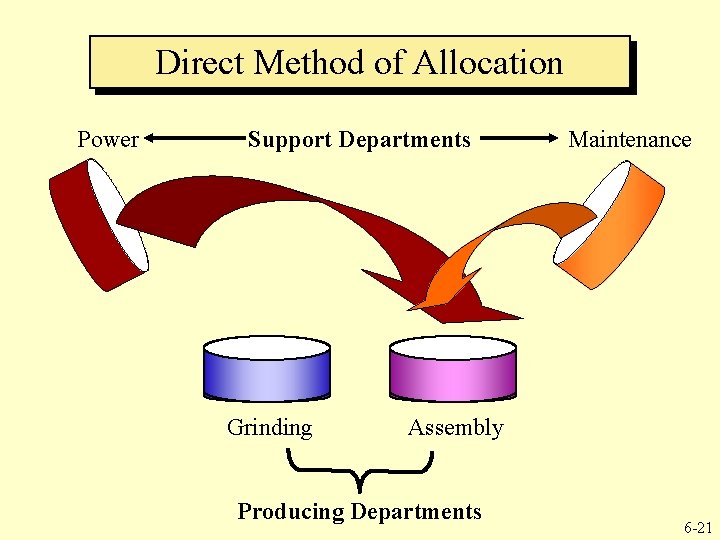
Direct Method of Allocation Power Support Departments Grinding Maintenance Assembly Producing Departments 6 -21
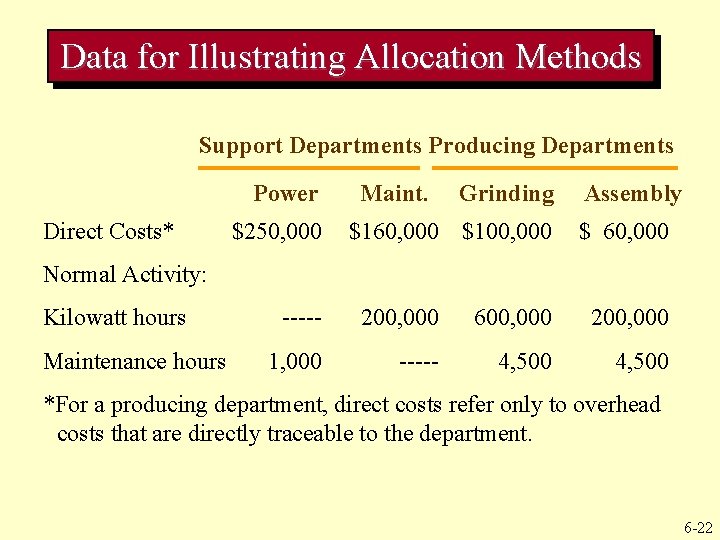
Data for Illustrating Allocation Methods Support Departments Producing Departments Power Direct Costs* $250, 000 Maint. Grinding $160, 000 $100, 000 Assembly $ 60, 000 Normal Activity: Kilowatt hours Maintenance hours ----- 200, 000 600, 000 200, 000 1, 000 ----- 4, 500 *For a producing department, direct costs refer only to overhead costs that are directly traceable to the department. 6 -22
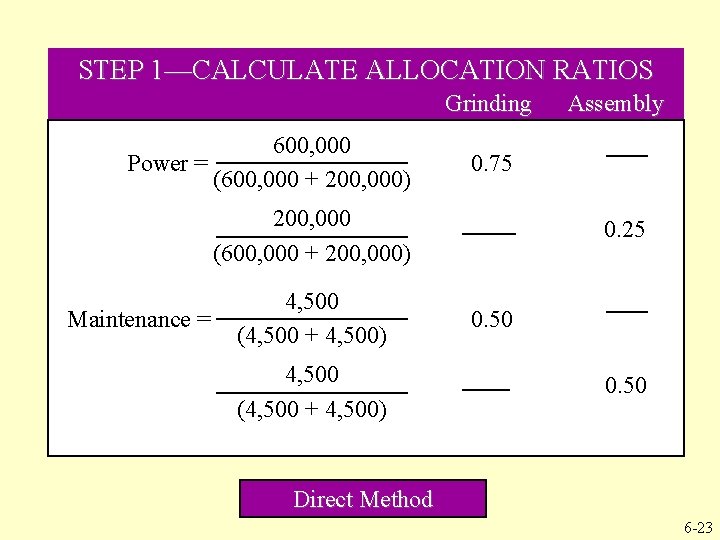
STEP 1—CALCULATE ALLOCATION RATIOS Grinding 600, 000 Power = (600, 000 + 200, 000) 0. 75 200, 000 (600, 000 + 200, 000) Maintenance = 4, 500 (4, 500 + 4, 500) Assembly 0. 25 0. 50 Direct Method 6 -23
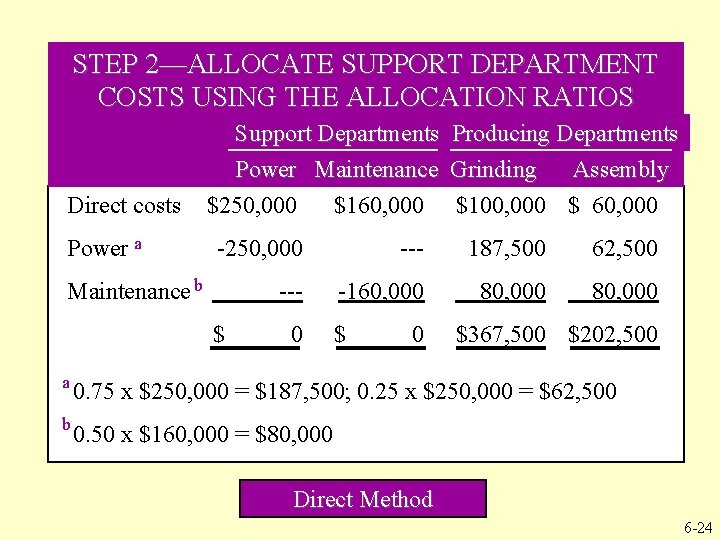
STEP 2—ALLOCATE SUPPORT DEPARTMENT COSTS USING THE ALLOCATION RATIOS Direct costs Power a Support Departments Producing Departments Power Maintenance Grinding Assembly $250, 000 $160, 000 $100, 000 $ 60, 000 -250, 000 --- 187, 500 62, 500 --- -160, 000 80, 000 Maintenance b $ 0 $367, 500 $202, 500 a 0. 75 x $250, 000 = $187, 500; 0. 25 x $250, 000 = $62, 500 b 0. 50 x $160, 000 = $80, 000 Direct Method 6 -24
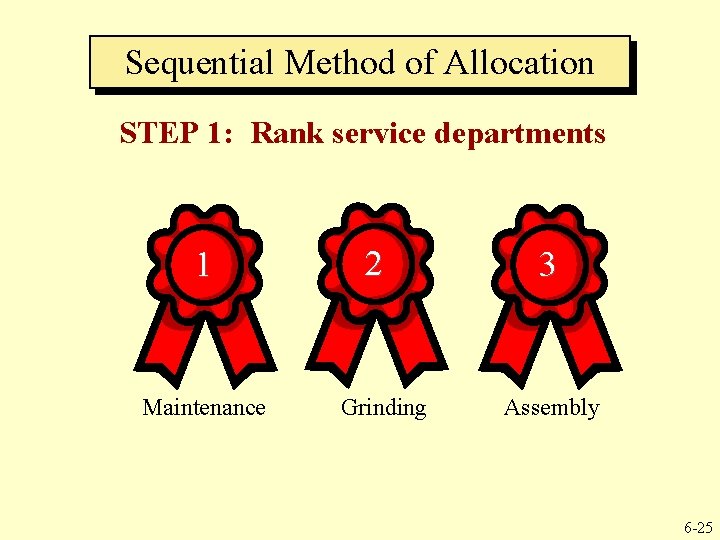
Sequential Method of Allocation STEP 1: Rank service departments 1 Maintenance 2 Grinding 3 Assembly 6 -25
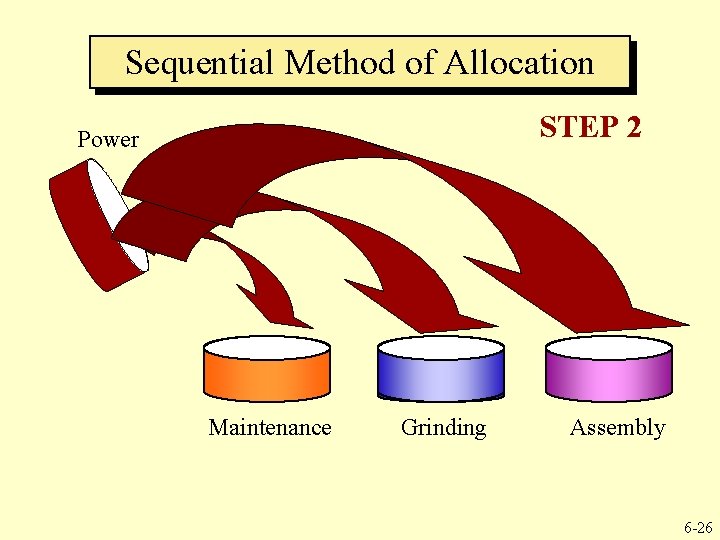
Sequential Method of Allocation STEP 2 Power Maintenance Grinding Assembly 6 -26
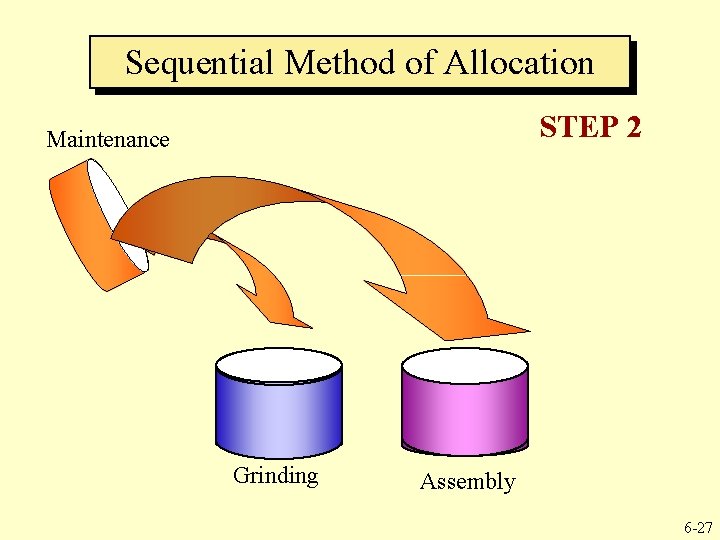
Sequential Method of Allocation STEP 2 Maintenance Grinding Assembly 6 -27
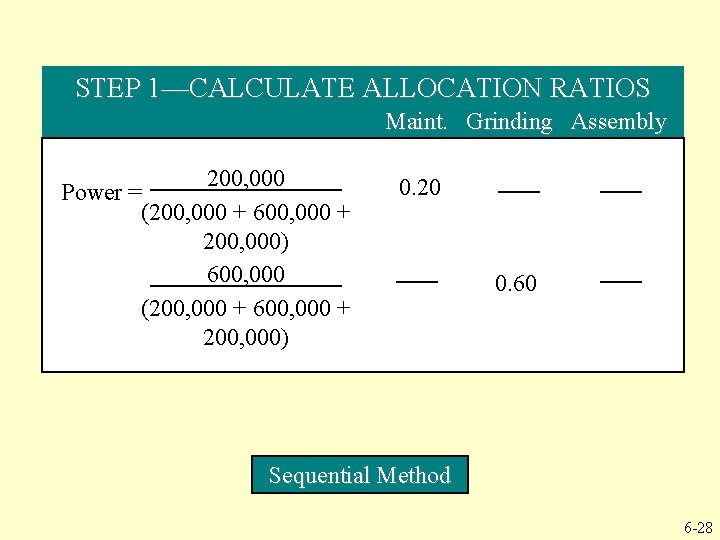
STEP 1—CALCULATE ALLOCATION RATIOS Maint. Grinding Assembly 200, 000 Power = (200, 000 + 600, 000 + 200, 000) 600, 000 (200, 000 + 600, 000 + 200, 000) 0. 20 0. 60 Sequential Method 6 -28
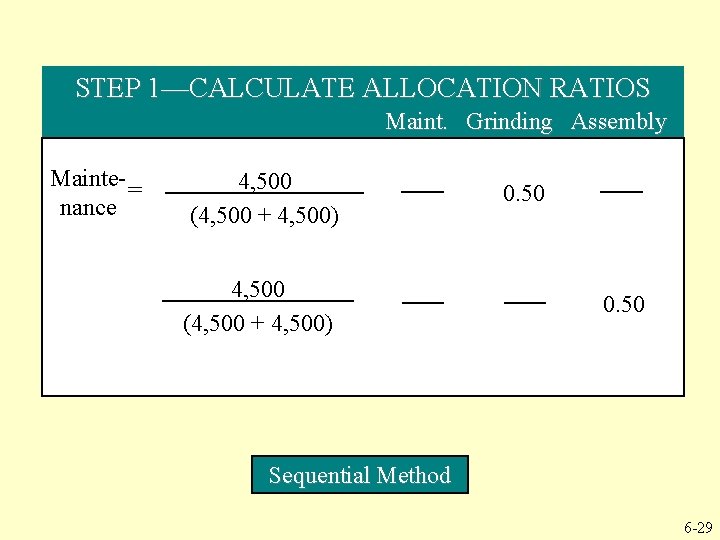
STEP 1—CALCULATE ALLOCATION RATIOS Maint. Grinding Assembly Mainte- = nance 4, 500 (4, 500 + 4, 500) 0. 50 Sequential Method 6 -29
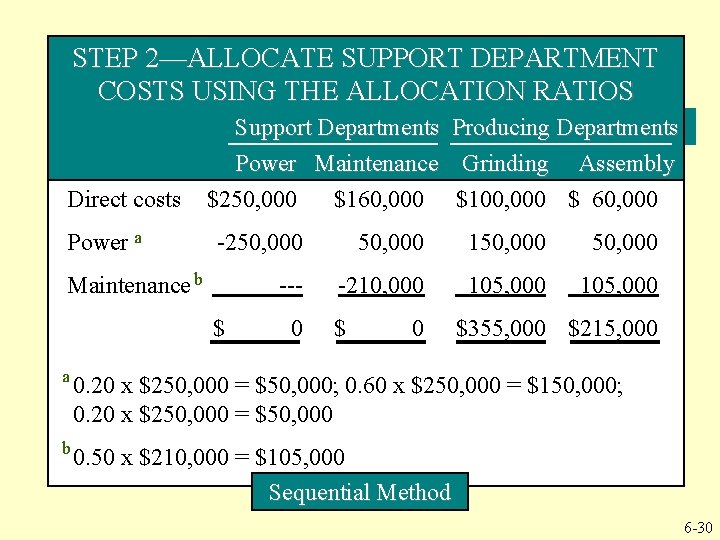
STEP 2—ALLOCATE SUPPORT DEPARTMENT COSTS USING THE ALLOCATION RATIOS Direct costs Power a Support Departments Producing Departments Power Maintenance Grinding Assembly $250, 000 $160, 000 $100, 000 $ 60, 000 -250, 000 150, 000 --- -210, 000 105, 000 Maintenance b $ 0 $355, 000 $215, 000 a 0. 20 x $250, 000 = $50, 000; 0. 60 x $250, 000 = $150, 000; 0. 20 x $250, 000 = $50, 000 b 0. 50 x $210, 000 = $105, 000 Sequential Method 6 -30

The reciprocal method of allocation recognizes all interactions among support departments. 6 -31
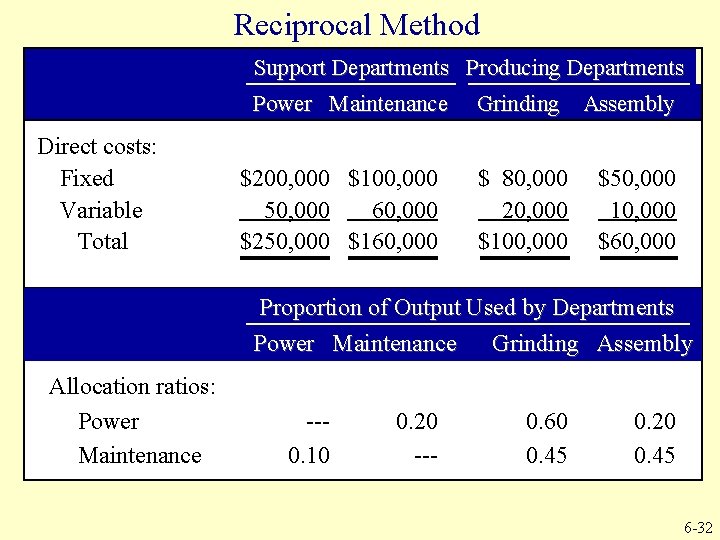
Reciprocal Method Support Departments Producing Departments Power Maintenance Direct costs: Fixed Variable Total $200, 000 $100, 000 50, 000 60, 000 $250, 000 $160, 000 Grinding Assembly $ 80, 000 20, 000 $100, 000 $50, 000 10, 000 $60, 000 Proportion of Output Used by Departments Power Maintenance Grinding Assembly Allocation ratios: Power Maintenance --0. 10 0. 20 --- 0. 60 0. 45 0. 20 0. 45 6 -32
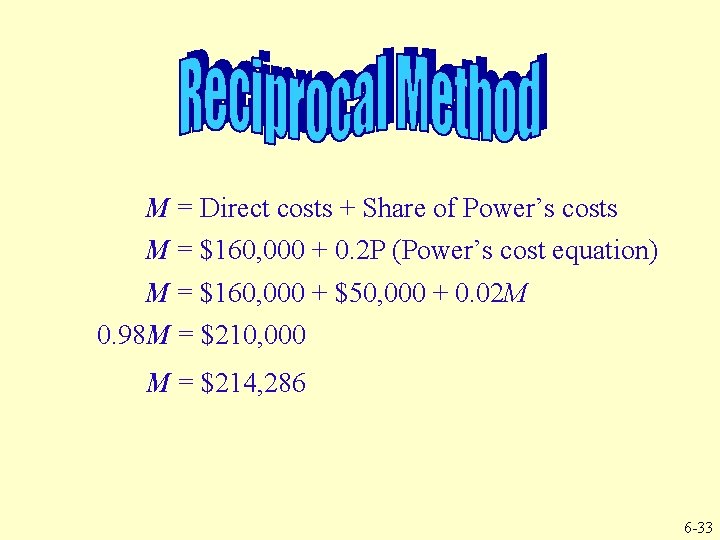
M = Direct costs + Share of Power’s costs M = $160, 000 + 0. 2 P (Power’s cost equation) M = $160, 000 + $50, 000 + 0. 02 M 0. 98 M = $210, 000 M = $214, 286 6 -33
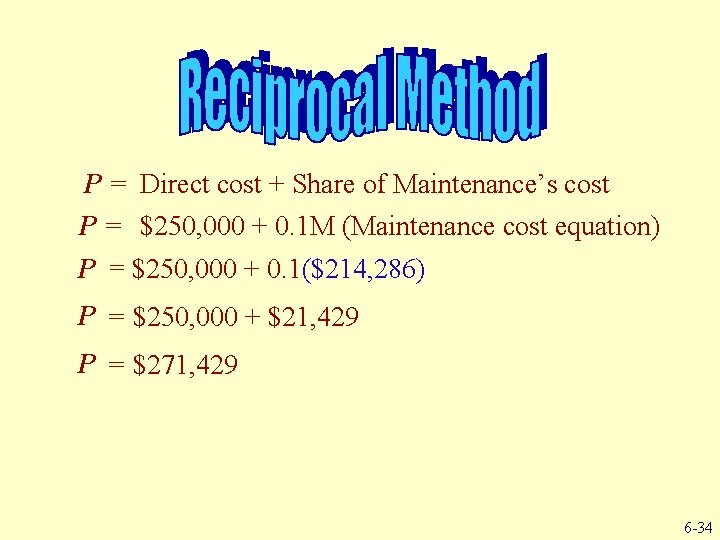
P = Direct cost + Share of Maintenance’s cost P = $250, 000 + 0. 1 M (Maintenance cost equation) P = $250, 000 + 0. 1($214, 286) P = $250, 000 + $21, 429 P = $271, 429 6 -34
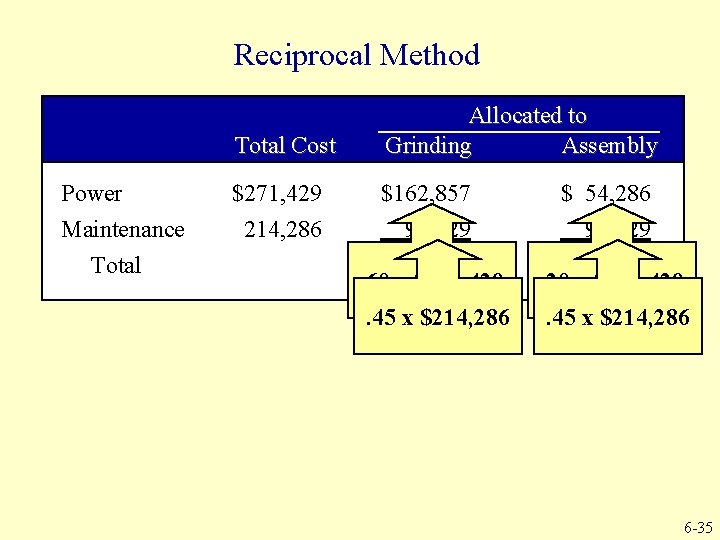
Reciprocal Method Power Maintenance Total Cost Allocated to Grinding Assembly $271, 429 $162, 857 $ 54, 286 214, 286 96, 429 $259, 286. 60 x $271, 429 96, 429 $150, 715. 20 x $271, 429 . 45 x $214, 286 6 -35
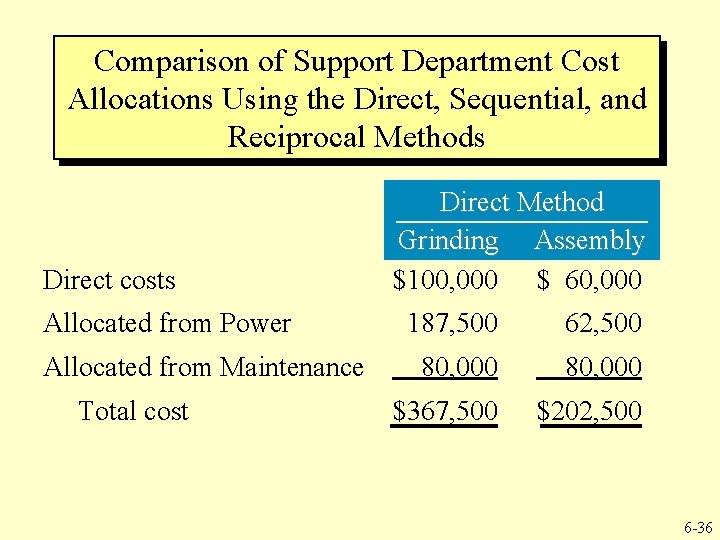
Comparison of Support Department Cost Allocations Using the Direct, Sequential, and Reciprocal Methods Direct costs Allocated from Power Allocated from Maintenance Total cost Direct Method Grinding Assembly $100, 000 $ 60, 000 187, 500 62, 500 80, 000 $367, 500 $202, 500 6 -36
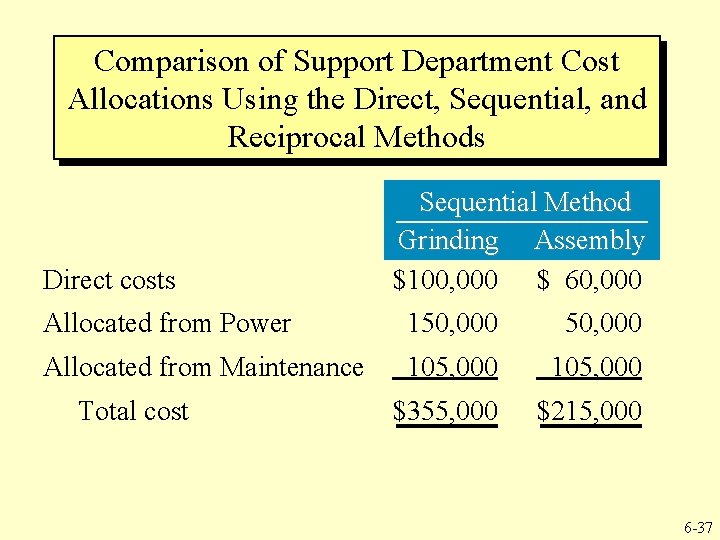
Comparison of Support Department Cost Allocations Using the Direct, Sequential, and Reciprocal Methods Direct costs Sequential Method Grinding Assembly $100, 000 $ 60, 000 Allocated from Power 150, 000 Allocated from Maintenance 105, 000 $355, 000 $215, 000 Total cost 6 -37
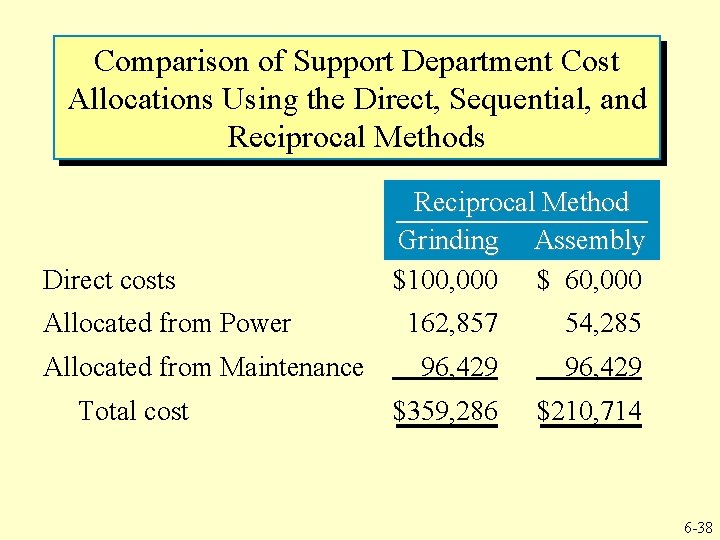
Comparison of Support Department Cost Allocations Using the Direct, Sequential, and Reciprocal Methods Direct costs Allocated from Power Allocated from Maintenance Total cost Reciprocal Method Grinding Assembly $100, 000 $ 60, 000 162, 857 54, 285 96, 429 $359, 286 $210, 714 6 -38
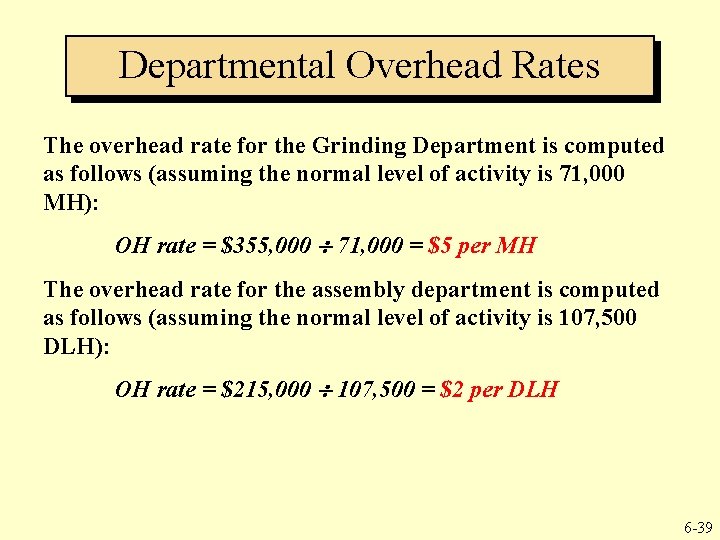
Departmental Overhead Rates The overhead rate for the Grinding Department is computed as follows (assuming the normal level of activity is 71, 000 MH): OH rate = $355, 000 71, 000 = $5 per MH The overhead rate for the assembly department is computed as follows (assuming the normal level of activity is 107, 500 DLH): OH rate = $215, 000 107, 500 = $2 per DLH 6 -39

End of Chapter 6 -40

6 -41
- Slides: 41