
Support CoordinationCase Management Training Understanding and assessing Change
- Slides: 54
Support Coordination/Case Management Training Understanding and assessing “Change in Status” and “ISP Implemented Appropriately”
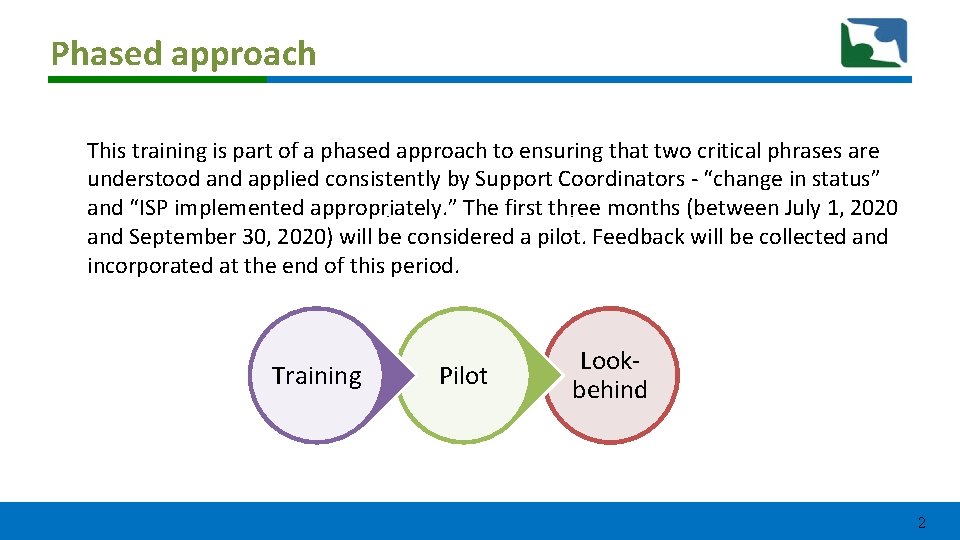
Phased approach This training is part of a phased approach to ensuring that two critical phrases are understood and applied consistently by Support Coordinators - “change in status” and “ISP implemented appropriately. ” The first three months (between July 1, 2020 and September 30, 2020) will be considered a pilot. Feedback will be collected and incorporated at the end of this period. Training Pilot Lookbehind 2
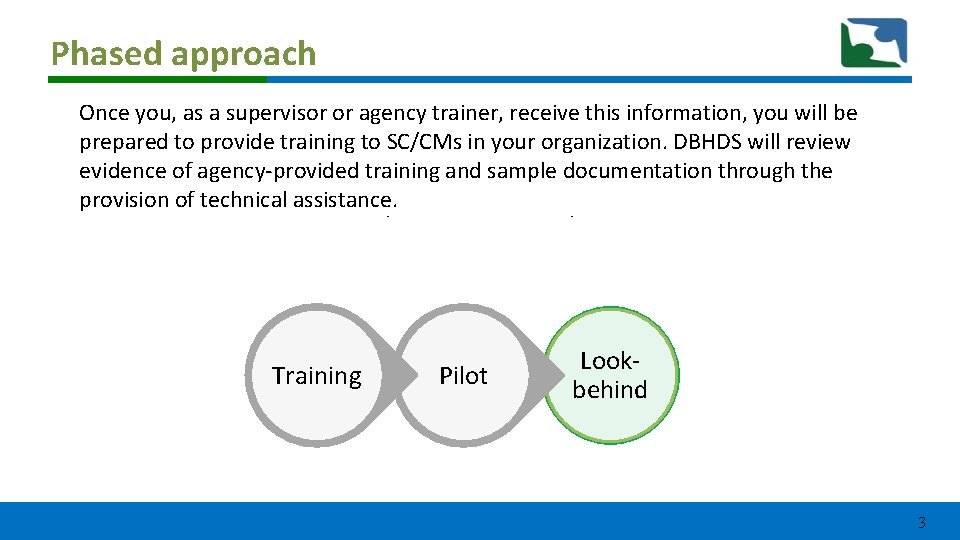
Phased approach Once you, as a supervisor or agency trainer, receive this information, you will be prepared to provide training to SC/CMs in your organization. DBHDS will review evidence of agency-provided training and sample documentation through the provision of technical assistance. Training Pilot Lookbehind 3
Objectives By the end of this training, you will be able to identify: • the definition of “change in status” • the definition of “ISP implemented appropriately” • how to assess for these two factors during face to face visits • how to document and report findings • how respond when concerns occur 4
About the Definitions The two phrases “change in status” and “ISP implemented appropriately” • are critical to ensuring the health and wellness of people supported • must be understood and applied consistently across Support Coordinators/Case Managers • require careful consideration with each encounter with a person who has services and supports under Virginia’s DD waivers and through discussions with people supporting the person 5
Background Virginia has been consistently found non-compliant with provision V. F. 2 of the Settlement Agreement… At these face-to-face meetings, the case manager shall: • observe the individual and the individual’s environment to assess for previously unidentified risks, injuries, needs, or other changes in status; assess the status of previously identified risks, injuries, needs, or other change in status; • assess whether the individual’s support plan is being implemented appropriately and remains appropriate for the individual; and • ascertain whether supports and services are being implemented consistent with the individual’s strengths and preferences and in the most integrated setting appropriate to the individual’s needs. Settlement Agreement Provision V. F. 2. 6
Background Per the Independent Reviewer for the Settlement Agreement “The Commonwealth has not provided sufficient data, analysis and documentation that aligns with compliance indicators and cannot demonstrate that the indicator requirements and the measures have been achieved. ” “The study of case management confirmed a high percent of discrepancies between the services individuals are receiving and those described in his/her ISP. All essential supports were not listed in the ISP. The behavioral supports study found that inadequacies in implementation of BSPs had not been identified, or corrective actions steps had not been taken. ” V. F. 2_CM_IR Report History 6. 9. 20 7
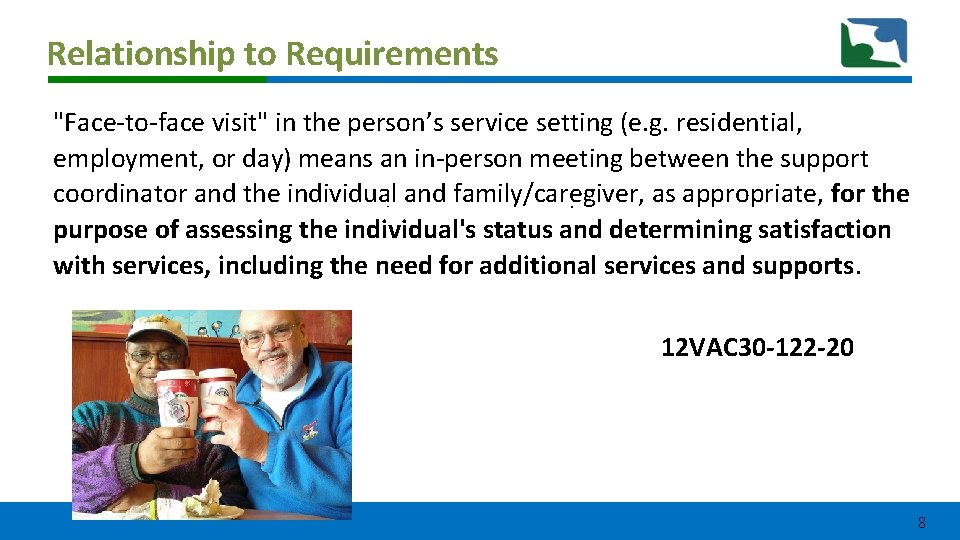
Relationship to Requirements "Face-to-face visit" in the person’s service setting (e. g. residential, employment, or day) means an in-person meeting between the support coordinator and the individual and family/caregiver, as appropriate, for the purpose of assessing the individual's status and determining satisfaction with services, including the need for additional services and supports. 12 VAC 30 -122 -20 8
Relationship to Requirements At face-to-face meetings, the case manager shall (i) observe and assess for any previously unidentified risks, injuries, needs, or other changes in status; (ii) assess the status of previously identified risks, injuries, or needs, or other changes in status; (iii) assess whether the individual's service plan is being implemented appropriately and remains appropriate for the individual; and (iv) assess whether supports and services are being implemented consistent with the individual's strengths and preferences and in the most integrated setting appropriate to the individual's needs. 12 VAC 35 -105 -1245 9
Relationship to Requirements Reassessments shall be completed at least annually and when any time there is a need based on changes in the medical, psychiatric, or behavioral, or other status of the individual Update the ISP at least annually and any time assessments identify risks, injuries, needs, or a change in status of the individual or following major life events or changes in circumstances 12 VAC 35 -105 -675 10
Relationship to Requirements The support coordinator shall be responsible for continuously monitoring the appropriateness of the individual's services and making timely revisions to the ISP as indicated by changing needs (or the inappropriate implementation of a service) 12 VAC 30 -122 -190 11
Relationship to Requirements The local department of social services adult protective services unit or child protective services unit, as appropriate, and the DBHDS Offices of Licensing and Human Rights and DMAS shall be notified immediately of the emergency discontinuation of services by the support coordinator and the provider when the individual's health, safety, or welfare may be in danger. 12 VAC 30 -122 -100 12
Support Coordinator Role includes… • Advocating for individuals in response to their changing needs; • Planning for transitions in the individual's life; • Knowing and monitoring the individual's health status, any medical conditions, and his medications and potential side effects, and assisting the individual in accessing primary care and other medical services, as needed; and • Understanding the capabilities of services to meet the individual's identified needs and preferences 12 VAC 35 -105 -1240 13
Support Coordinator Role includes… • Communicating with providers to share vital information • Communicating with Care Coordinators of the Managed Care Organizations (MCOs) to update them on an individual's needs and services and obtain results of their HRAs • Collaborating with care coordinators regarding medically related issues to develop coordinated plans to mitigate risks and risks of harm • Reporting alleged abuse, neglect or exploitation to Adult Protective Services (APS) and Child Protective Services https: //sccmtraining. partnership. vcu. edu/chapter 10. html 14
Change in Status Has the person’s standing changed? 15
Change in Status “Change in status” refers to changes related to a person’s mental, physical, or behavioral condition and/or changes in one’s circumstances to include representation, financial status, living arrangements, service providers, eligibility for services, services received, and type of services or waiver. 16
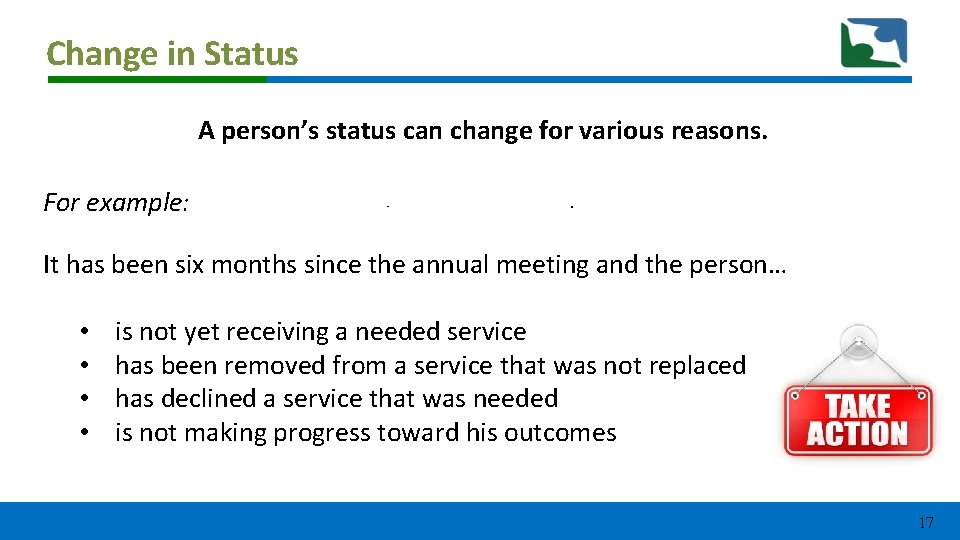
Change in Status A person’s status can change for various reasons. For example: It has been six months since the annual meeting and the person… • • is not yet receiving a needed service has been removed from a service that was not replaced has declined a service that was needed is not making progress toward his outcomes 17
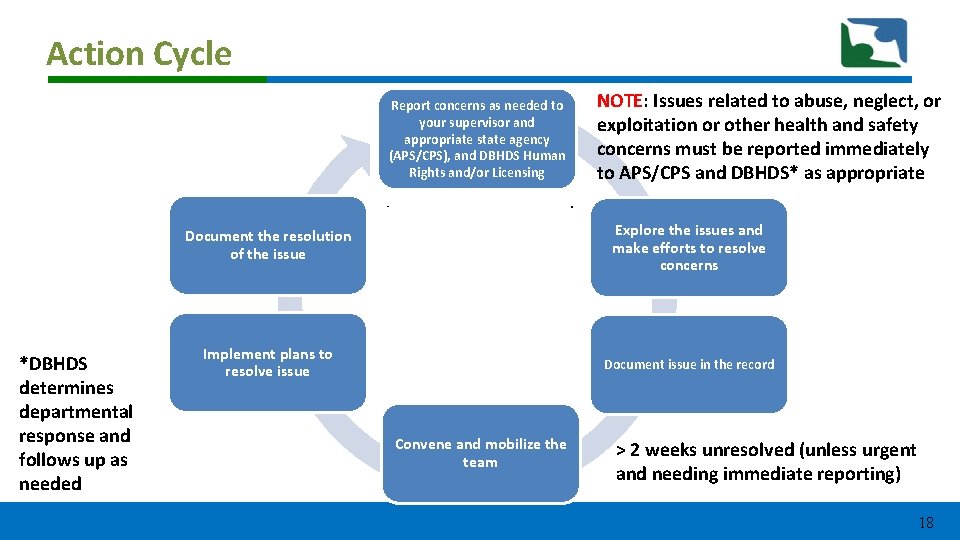
Action Cycle Report concerns as needed to your supervisor and appropriate state agency (APS/CPS), and DBHDS Human Rights and/or Licensing *DBHDS determines departmental response and follows up as needed NOTE: Issues related to abuse, neglect, or exploitation or other health and safety concerns must be reported immediately to APS/CPS and DBHDS* as appropriate Document the resolution of the issue Explore the issues and make efforts to resolve concerns Implement plans to resolve issue Document issue in the record Convene and mobilize the team > 2 weeks unresolved (unless urgent and needing immediate reporting) 18
Important Contacts Virginia Department of Social Services 24 -hour, toll-free Adult Protective Services (APS) hotline at (888) 832 -3858 Virginia Department of Social Services 24 -hour, toll-free Child Protective Services (CPS) Hotline at (800) 552 -7096 DBHDS Office of Human Rights http: //www. dbhds. virginia. gov/assets/doc/QMD/human-rights-contacts. pdf DBHDS Office of Licensing http: //www. dbhds. virginia. gov/assets/doc/QMD/OL/ol-complaintform_nov_18_19_distributed. pdf 19
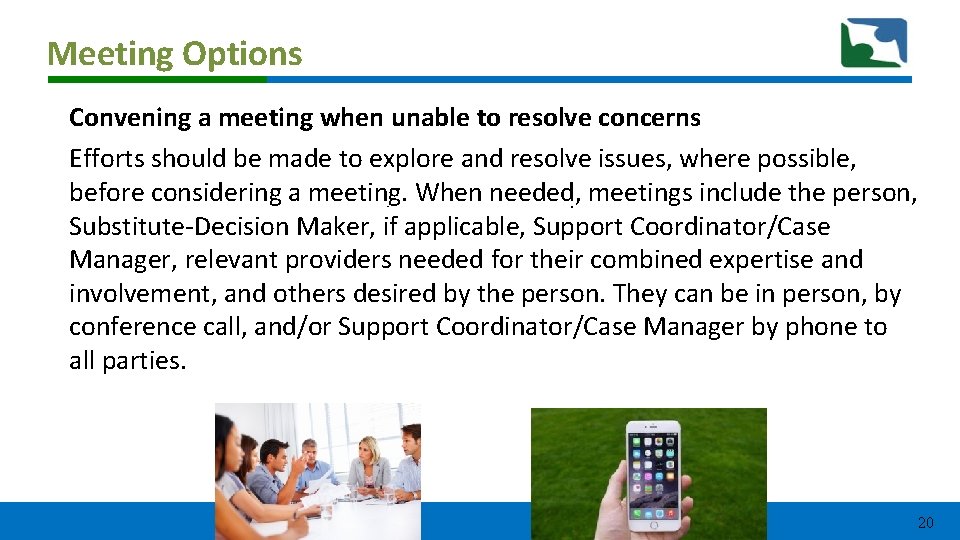
Meeting Options Convening a meeting when unable to resolve concerns Efforts should be made to explore and resolve issues, where possible, before considering a meeting. When needed, meetings include the person, Substitute-Decision Maker, if applicable, Support Coordinator/Case Manager, relevant providers needed for their combined expertise and involvement, and others desired by the person. They can be in person, by conference call, and/or Support Coordinator/Case Manager by phone to all parties. 20
ISP Implemented Appropriately “ISP implemented appropriately” means that services identified in the ISP are delivered consistent within generally accepted practices and have demonstrated progress toward expected outcomes, and if not, have been reviewed and modified. Consider all of the following: the assessment, the written plan, targets, data collection, reviews, and changes as needed 21
ISP Implemented Appropriately Generally accepted practice includes: ISPs that: • include activities that are allowable • include skill-building as required • address preferences and health-related needs • are overseen by qualified supervisors Services that: • are provided in accordance with the plan (which includes the assessment, the written plan, targets, data collection, reviews, and changes as needed) • are provided by qualified providers And documentation that: • matches desired outcomes and describes progress 22
ISP Implemented Appropriately A note about qualified providers… Part of the role of a Support Coordinator/Case Manager is to monitor services and support - be sure to ask, observe, and learn. • Are DSPs providing person-centered supports consistent with the ISP and behavior support plan, as applicable? Do the DSPs know the issues identified and their role in providing these services? 23
ISP Implemented Appropriately Generally accepted practice includes: • The Support Coordinator’s assessment of whether a service is being implemented, that is, consistent with generally accepted practices and if there are no records of expected progress or no progress is evident after six months of implementation then further review is required. Any progress or lack of progress should be included in an explanatory note on the Onsite-Visit Tool. 24
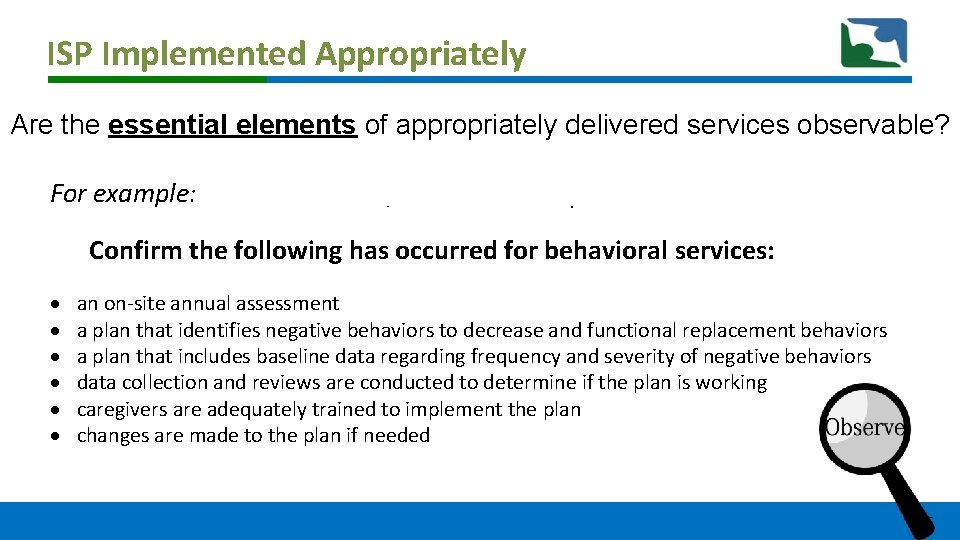
ISP Implemented Appropriately Are the essential elements of appropriately delivered services observable? For example: Confirm the following has occurred for behavioral services: an on-site annual assessment a plan that identifies negative behaviors to decrease and functional replacement behaviors a plan that includes baseline data regarding frequency and severity of negative behaviors data collection and reviews are conducted to determine if the plan is working caregivers are adequately trained to implement the plan changes are made to the plan if needed 25
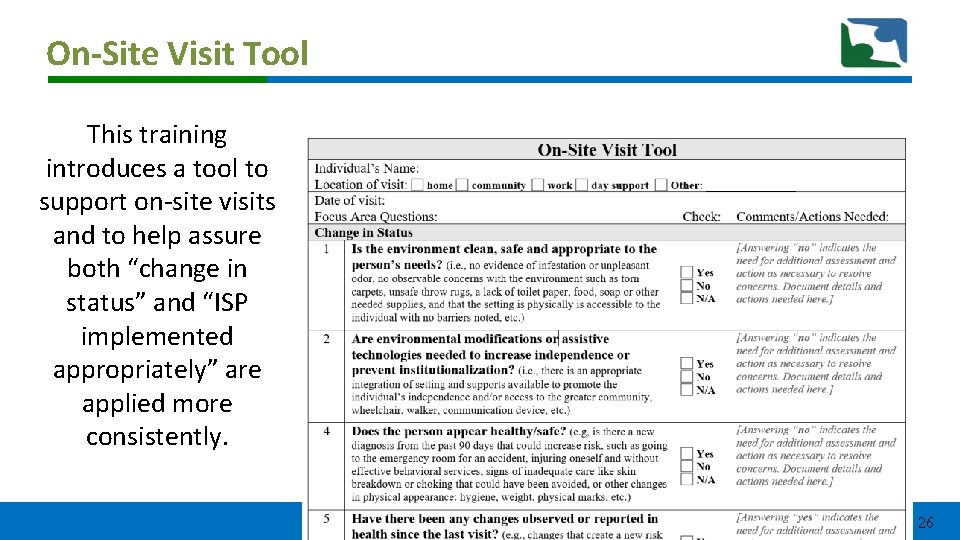
On-Site Visit Tool This training introduces a tool to support on-site visits and to help assure both “change in status” and “ISP implemented appropriately” are applied more consistently. 26
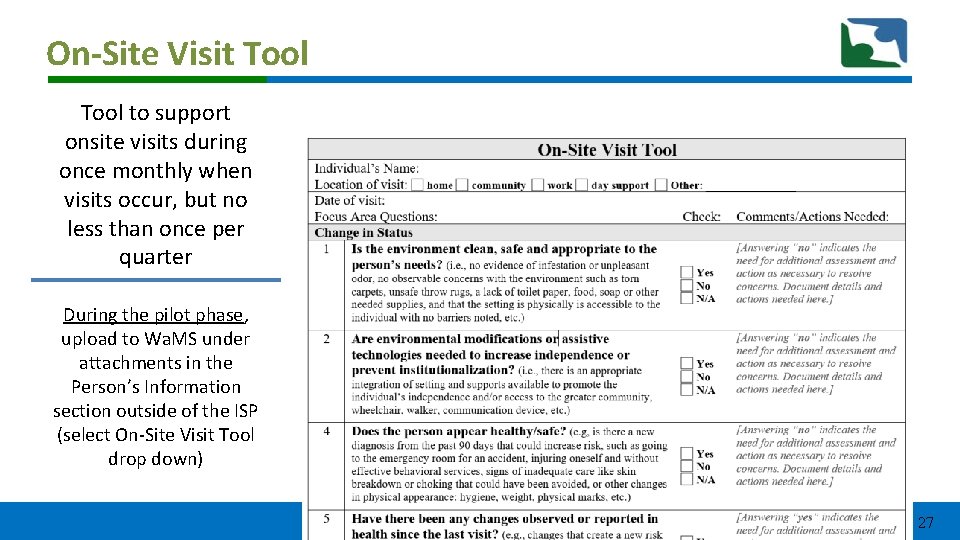
On-Site Visit Tool to support onsite visits during once monthly when visits occur, but no less than once per quarter During the pilot phase, upload to Wa. MS under attachments in the Person’s Information section outside of the ISP (select On-Site Visit Tool drop down) 27
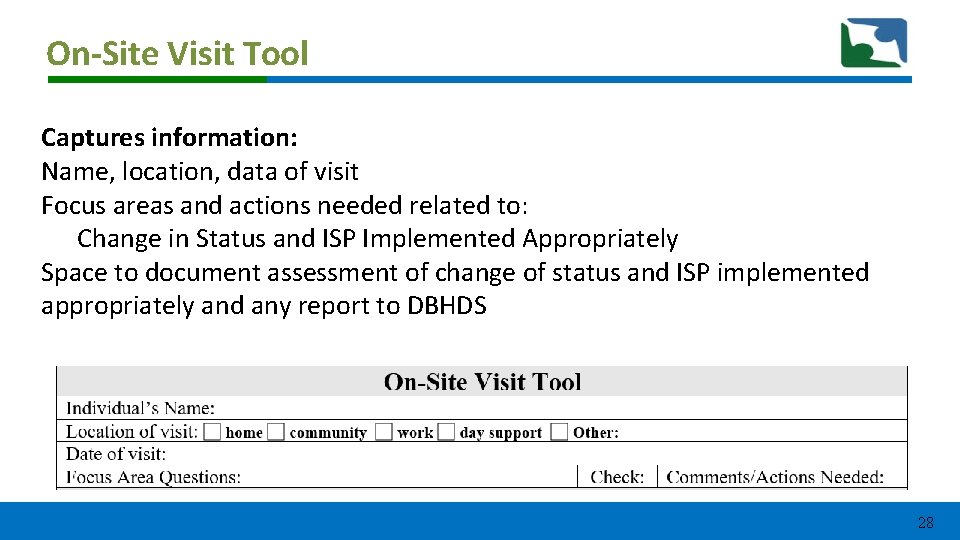
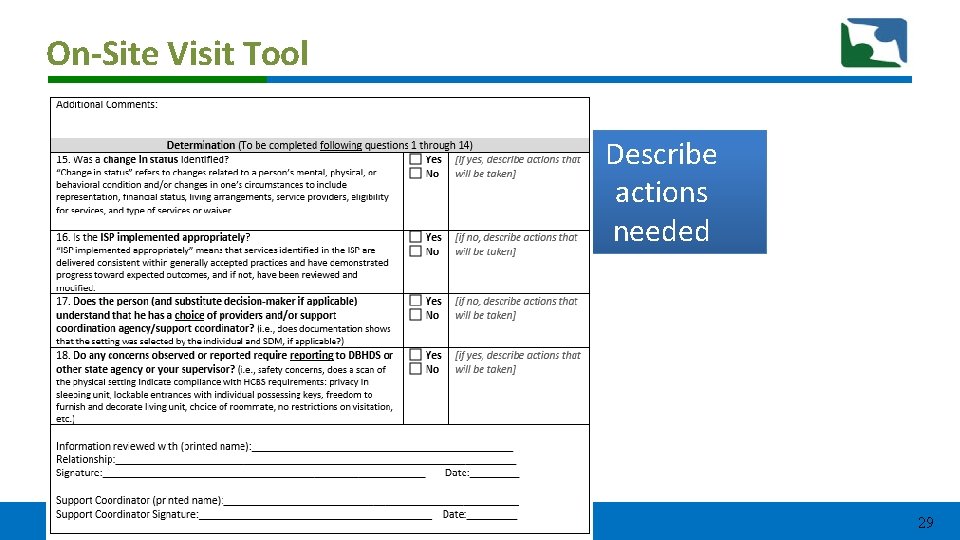
On-Site Visit Tool Captures information: Name, location, data of visit Focus areas and actions needed related to: Change in Status and ISP Implemented Appropriately Space to document assessment of change of status and ISP implemented appropriately and any report to DBHDS 28
On-Site Visit Tool Describe actions needed 29
On-Site Visit Tool About signatures during the pilot • A signature is not required for uploading, just type the name of the person providing information onto the form and upload into Wa. MS • Only one signature is needed Ø For providers, obtain a signature of a manager/supervisor after the visit (can be before or at the next visit); the provider can access the form in Wa. MS Ø For an individual/SDM/family member, the signature can be obtained at the next visit 30
On-Site Visit Tool DBHDS will collect results from the On-Site Visit Tool to: • Assure that Support Coordination services adequately meet the Settlement Agreement provision V. F. 2 in a consistent manner • Confirm that assessments occur in relation to change in status and ISP implemented appropriately • Assure reporting is occurring where concerns are noted • Formulate systemic responses to address areas of concern 31
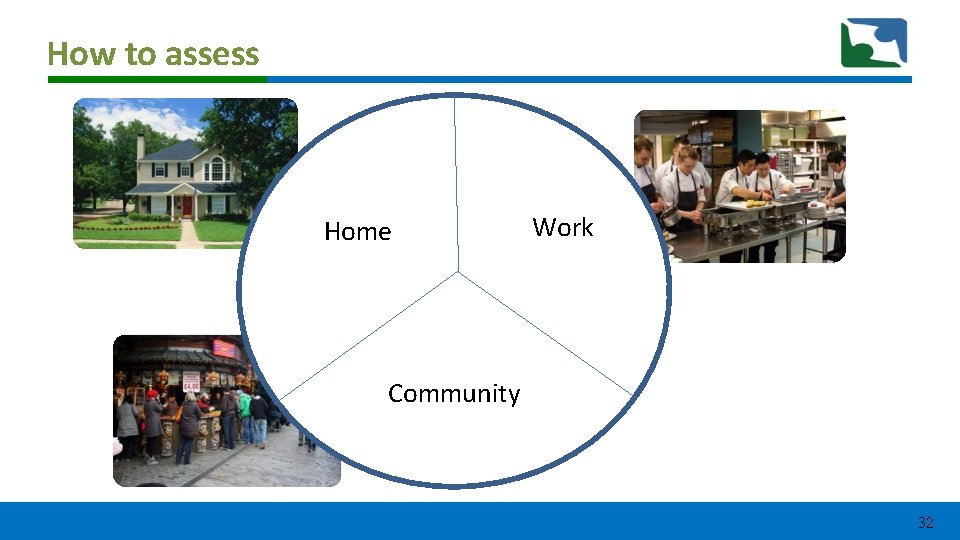
How to assess Home Work Community 32
How to Assessing for “change in status” and “ISP implemented appropriately” includes observing and asking questions through which Support Coordinators can assess for changes and monitor the services provided. The following questions are designed to guide the assessment. On-Site Visit Tool Examples 33
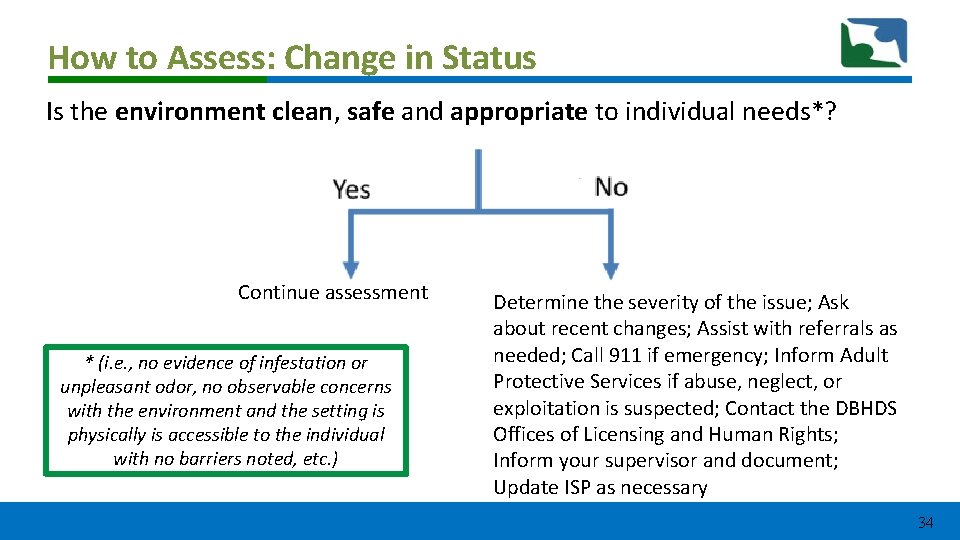
How to Assess: Change in Status Is the environment clean, safe and appropriate to individual needs*? Continue assessment * (i. e. , no evidence of infestation or unpleasant odor, no observable concerns with the environment and the setting is physically is accessible to the individual with no barriers noted, etc. ) Determine the severity of the issue; Ask about recent changes; Assist with referrals as needed; Call 911 if emergency; Inform Adult Protective Services if abuse, neglect, or exploitation is suspected; Contact the DBHDS Offices of Licensing and Human Rights; Inform your supervisor and document; Update ISP as necessary 34
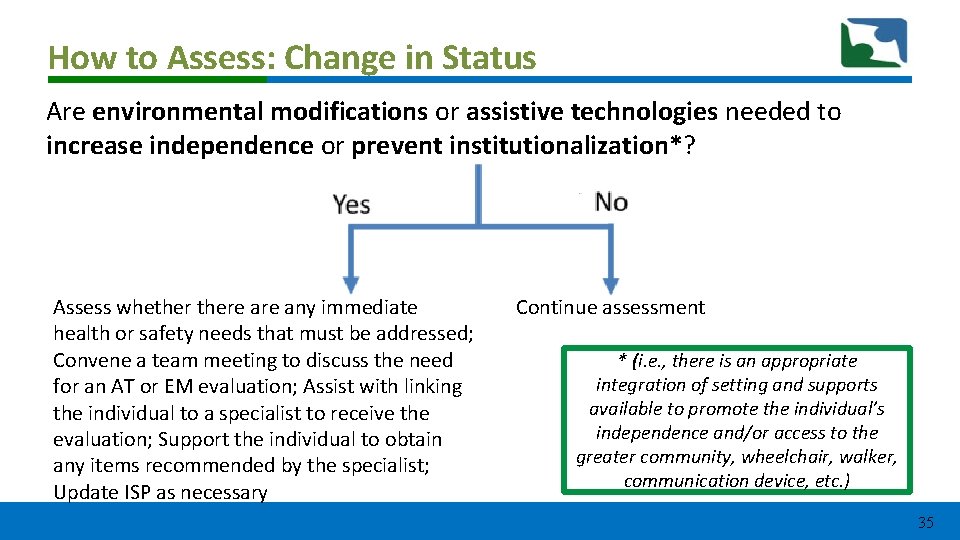
How to Assess: Change in Status Are environmental modifications or assistive technologies needed to increase independence or prevent institutionalization*? Assess whethere any immediate health or safety needs that must be addressed; Convene a team meeting to discuss the need for an AT or EM evaluation; Assist with linking the individual to a specialist to receive the evaluation; Support the individual to obtain any items recommended by the specialist; Update ISP as necessary Continue assessment * (i. e. , there is an appropriate integration of setting and supports available to promote the individual’s independence and/or access to the greater community, wheelchair, walker, communication device, etc. ) 35
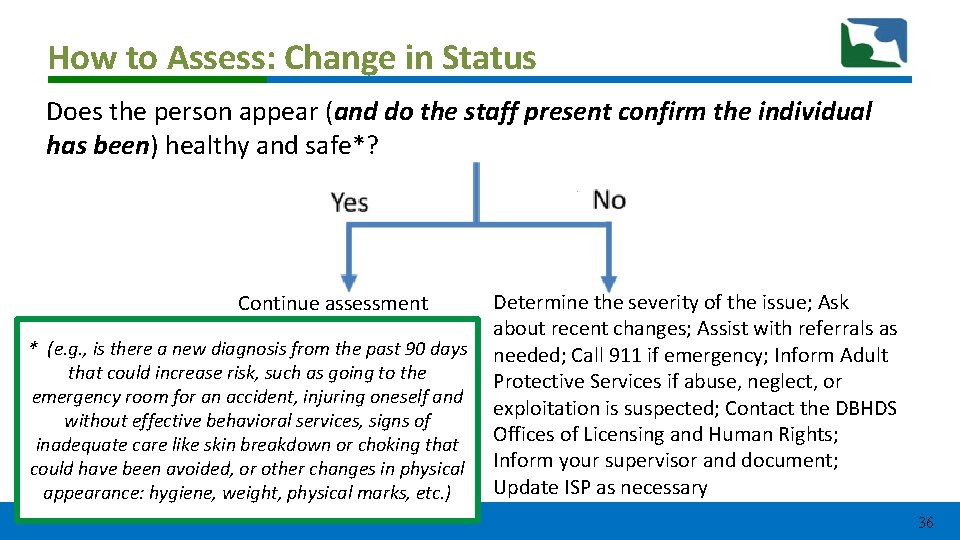
How to Assess: Change in Status Does the person appear (and do the staff present confirm the individual has been) healthy and safe*? Continue assessment * ((e. g. , is there a new diagnosis from the past 90 days that could increase risk, such as going to the emergency room for an accident, injuring oneself and without effective behavioral services, signs of inadequate care like skin breakdown or choking that could have been avoided, or other changes in physical appearance: hygiene, weight, physical marks, etc. ) Determine the severity of the issue; Ask about recent changes; Assist with referrals as needed; Call 911 if emergency; Inform Adult Protective Services if abuse, neglect, or exploitation is suspected; Contact the DBHDS Offices of Licensing and Human Rights; Inform your supervisor and document; Update ISP as necessary 36
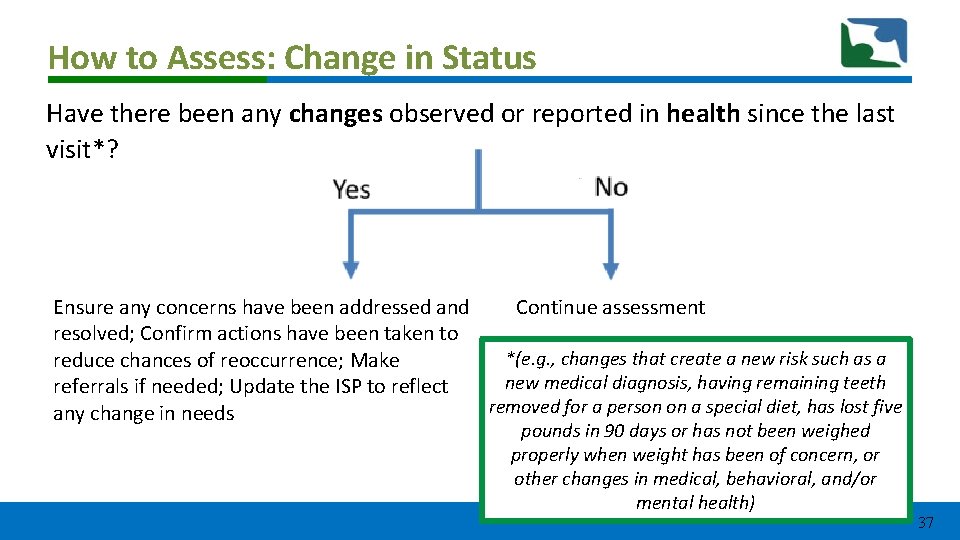
How to Assess: Change in Status Have there been any changes observed or reported in health since the last visit*? Ensure any concerns have been addressed and Continue assessment resolved; Confirm actions have been taken to *(e. g. , changes that create a new risk such as a reduce chances of reoccurrence; Make new medical diagnosis, having remaining teeth referrals if needed; Update the ISP to reflect removed for a person on a special diet, has lost five any change in needs pounds in 90 days or has not been weighed properly when weight has been of concern, or other changes in medical, behavioral, and/or mental health) 37
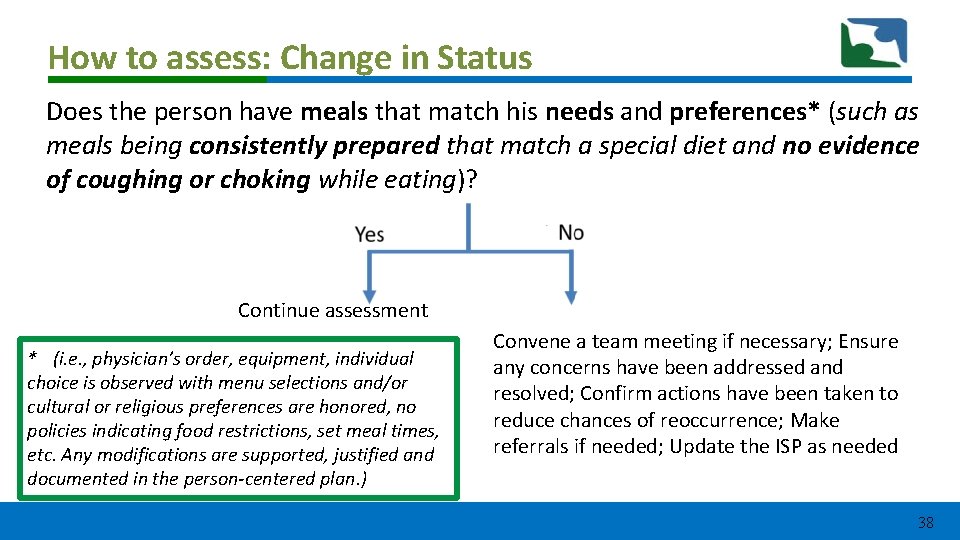
How to assess: Change in Status Does the person have meals that match his needs and preferences* (such as meals being consistently prepared that match a special diet and no evidence of coughing or choking while eating)? Continue assessment * (((i. e. , physician’s order, equipment, individual choice is observed with menu selections and/or cultural or religious preferences are honored, no policies indicating food restrictions, set meal times, etc. Any modifications are supported, justified and documented in the person-centered plan. ) Convene a team meeting if necessary; Ensure any concerns have been addressed and resolved; Confirm actions have been taken to reduce chances of reoccurrence; Make referrals if needed; Update the ISP as needed 38
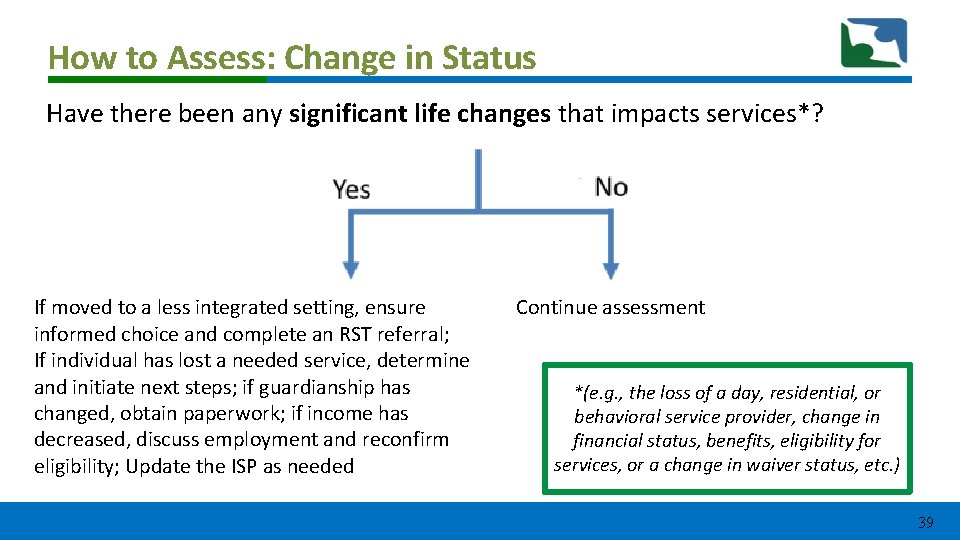
How to Assess: Change in Status Have there been any significant life changes that impacts services*? If moved to a less integrated setting, ensure informed choice and complete an RST referral; If individual has lost a needed service, determine and initiate next steps; if guardianship has changed, obtain paperwork; if income has decreased, discuss employment and reconfirm eligibility; Update the ISP as needed Continue assessment *(e. g. , the loss of a day, residential, or behavioral service provider, change in financial status, benefits, eligibility for services, or a change in waiver status, etc. ) 39
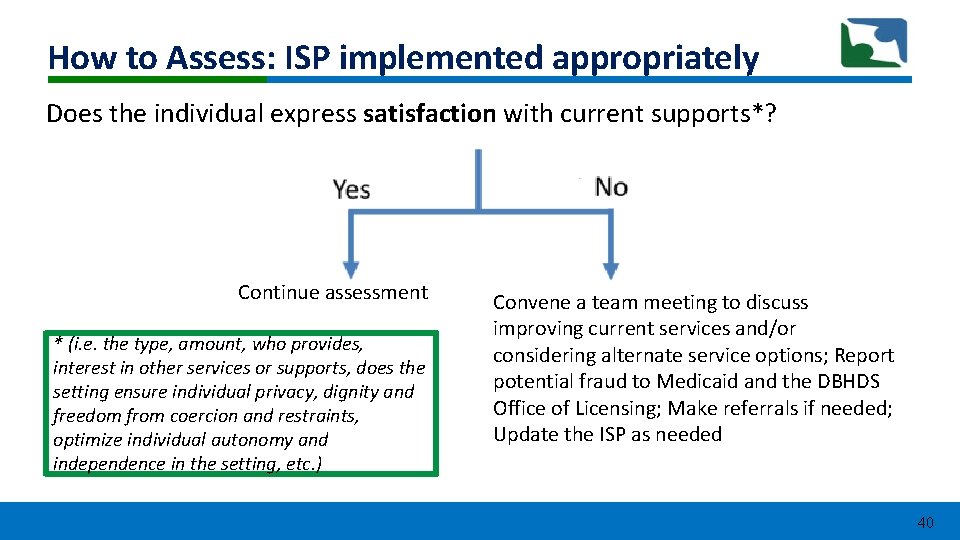
How to Assess: ISP implemented appropriately Does the individual express satisfaction with current supports*? Continue assessment * (i. e. the type, amount, who provides, interest in other services or supports, does the setting ensure individual privacy, dignity and freedom from coercion and restraints, optimize individual autonomy and independence in the setting, etc. ) Convene a team meeting to discuss improving current services and/or considering alternate service options; Report potential fraud to Medicaid and the DBHDS Office of Licensing; Make referrals if needed; Update the ISP as needed 40
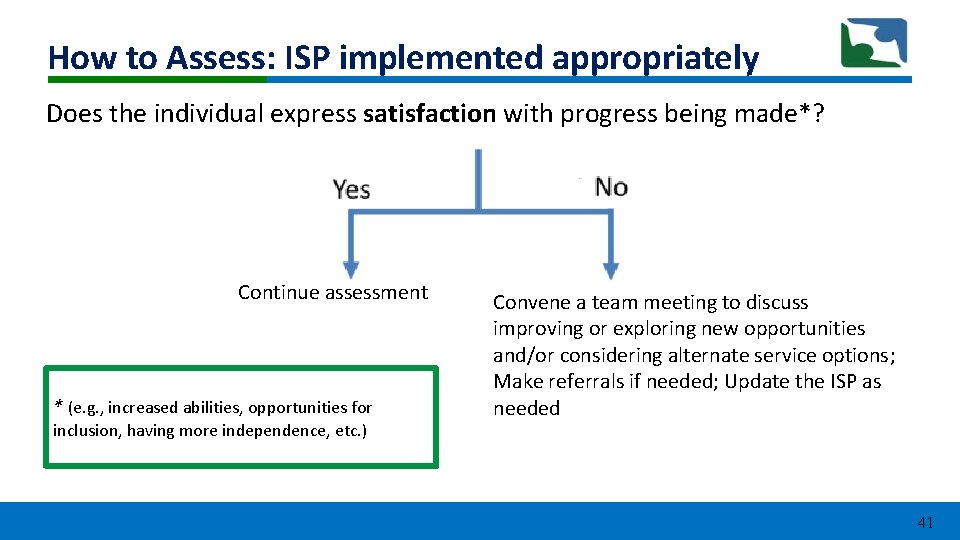
How to Assess: ISP implemented appropriately Does the individual express satisfaction with progress being made*? Continue assessment * (e. g. , increased abilities, opportunities for inclusion, having more independence, etc. ) Convene a team meeting to discuss improving or exploring new opportunities and/or considering alternate service options; Make referrals if needed; Update the ISP as needed 41
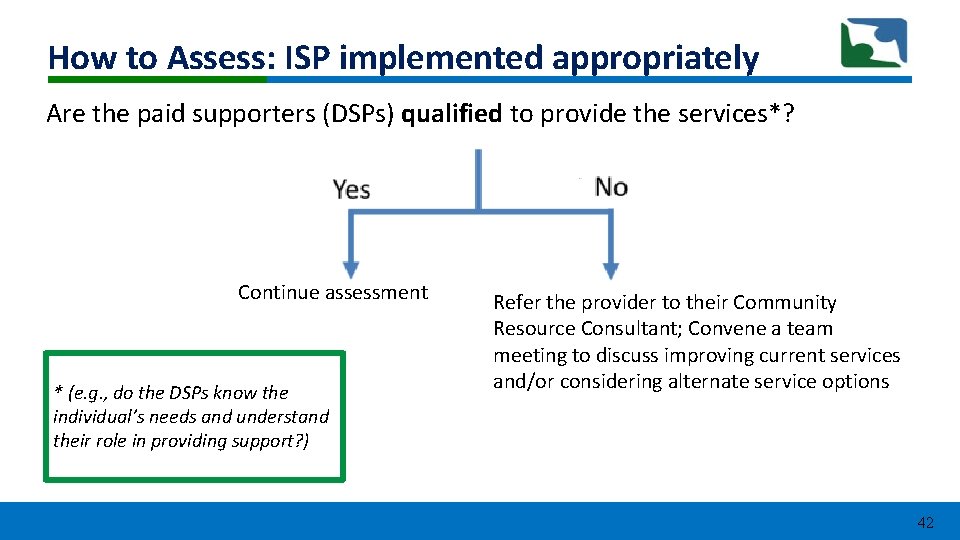
How to Assess: ISP implemented appropriately Are the paid supporters (DSPs) qualified to provide the services*? Continue assessment * (e. g. , do the DSPs know the individual’s needs and understand their role in providing support? ) Refer the provider to their Community Resource Consultant; Convene a team meeting to discuss improving current services and/or considering alternate service options 42
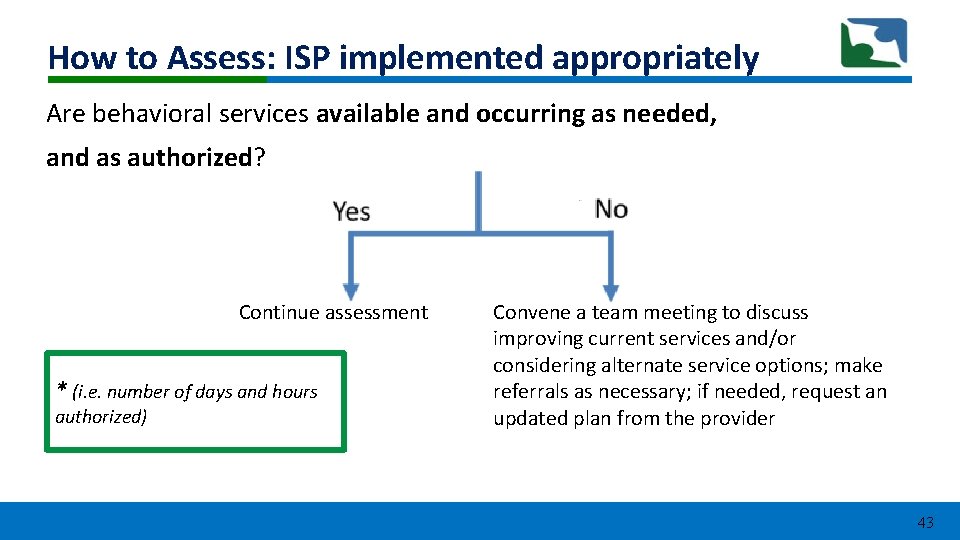
How to Assess: ISP implemented appropriately Are behavioral services available and occurring as needed, and as authorized? Continue assessment * (i. e. number of days and hours authorized) Convene a team meeting to discuss improving current services and/or considering alternate service options; make referrals as necessary; if needed, request an updated plan from the provider 43
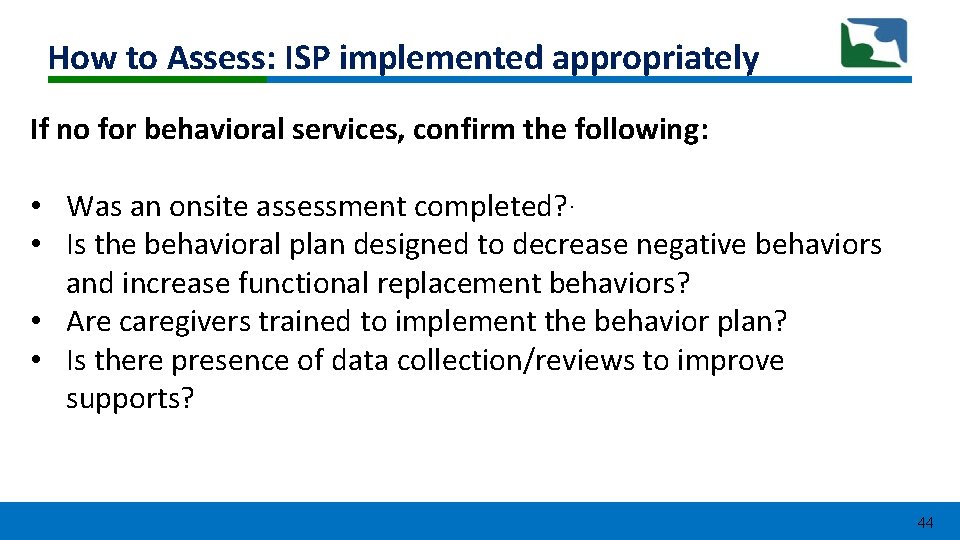
How to Assess: ISP implemented appropriately If no for behavioral services, confirm the following: • Was an onsite assessment completed? • Is the behavioral plan designed to decrease negative behaviors and increase functional replacement behaviors? • Are caregivers trained to implement the behavior plan? • Is there presence of data collection/reviews to improve supports? 44
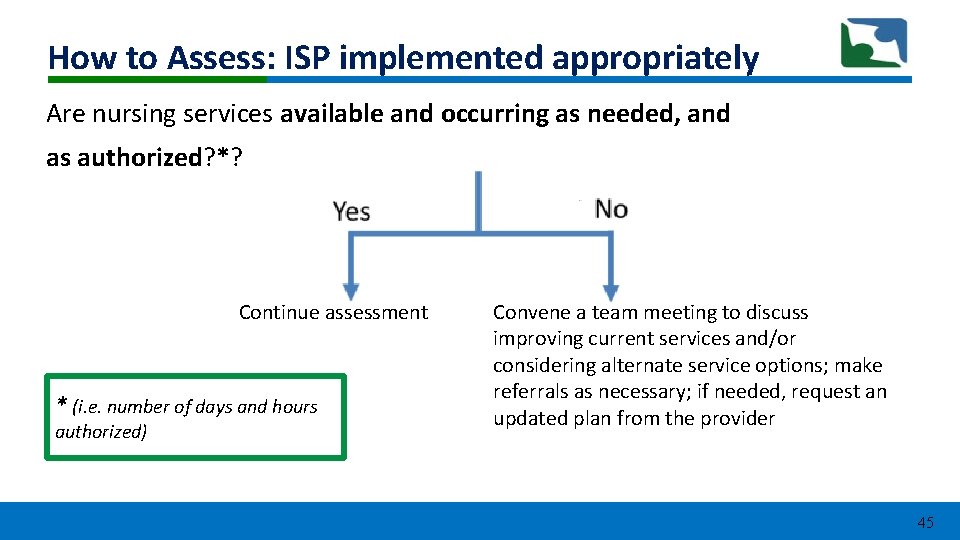
How to Assess: ISP implemented appropriately Are nursing services available and occurring as needed, and as authorized? *? Continue assessment * (i. e. number of days and hours authorized) Convene a team meeting to discuss improving current services and/or considering alternate service options; make referrals as necessary; if needed, request an updated plan from the provider 45
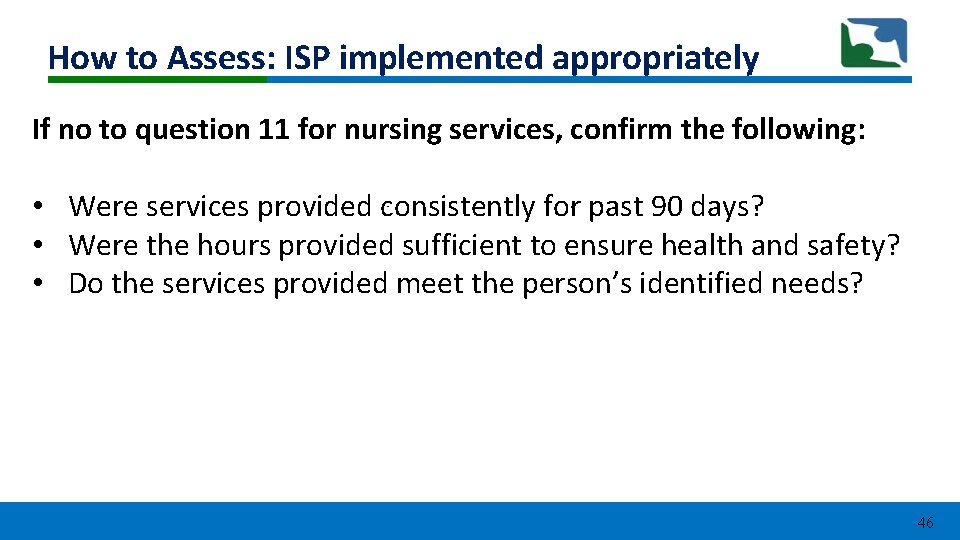
How to Assess: ISP implemented appropriately If no to question 11 for nursing services, confirm the following: • Were services provided consistently for past 90 days? • Were the hours provided sufficient to ensure health and safety? • Do the services provided meet the person’s identified needs? 46
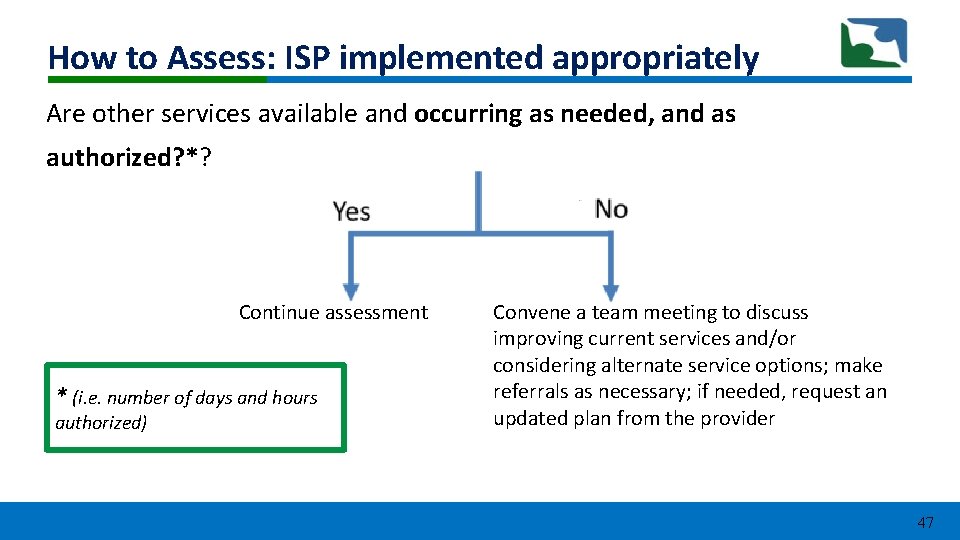
How to Assess: ISP implemented appropriately Are other services available and occurring as needed, and as authorized? *? Continue assessment * (i. e. number of days and hours authorized) Convene a team meeting to discuss improving current services and/or considering alternate service options; make referrals as necessary; if needed, request an updated plan from the provider 47
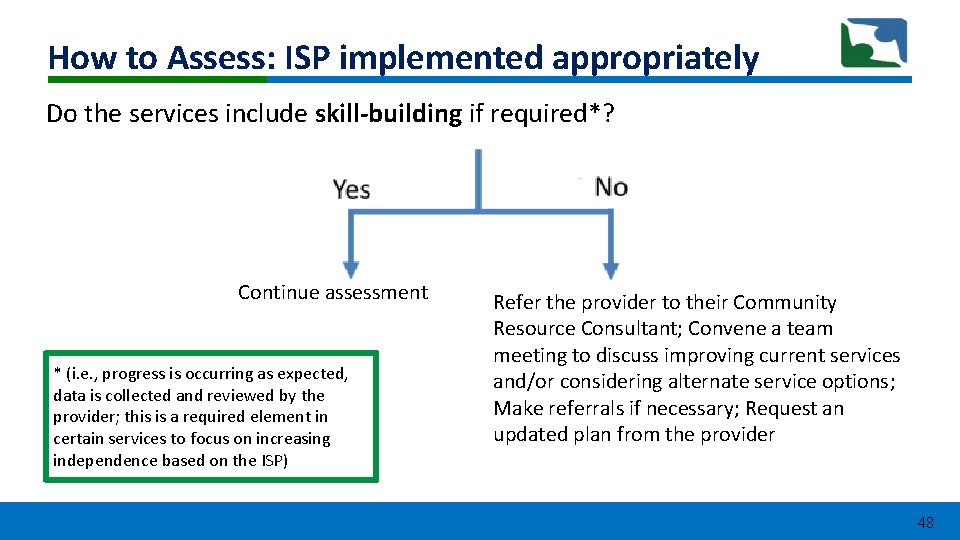
How to Assess: ISP implemented appropriately Do the services include skill-building if required*? Continue assessment * (i. e. , progress is occurring as expected, data is collected and reviewed by the provider; this is a required element in certain services to focus on increasing independence based on the ISP) Refer the provider to their Community Resource Consultant; Convene a team meeting to discuss improving current services and/or considering alternate service options; Make referrals if necessary; Request an updated plan from the provider 48
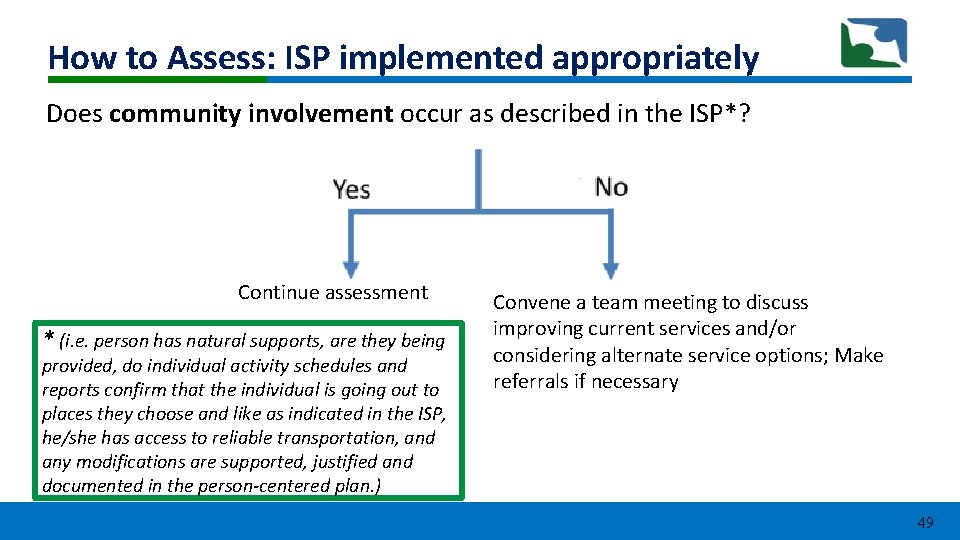
How to Assess: ISP implemented appropriately Does community involvement occur as described in the ISP*? Continue assessment * (i. e. person has natural supports, are they being provided, do individual activity schedules and reports confirm that the individual is going out to places they choose and like as indicated in the ISP, he/she has access to reliable transportation, and any modifications are supported, justified and documented in the person-centered plan. ) Convene a team meeting to discuss improving current services and/or considering alternate service options; Make referrals if necessary 49
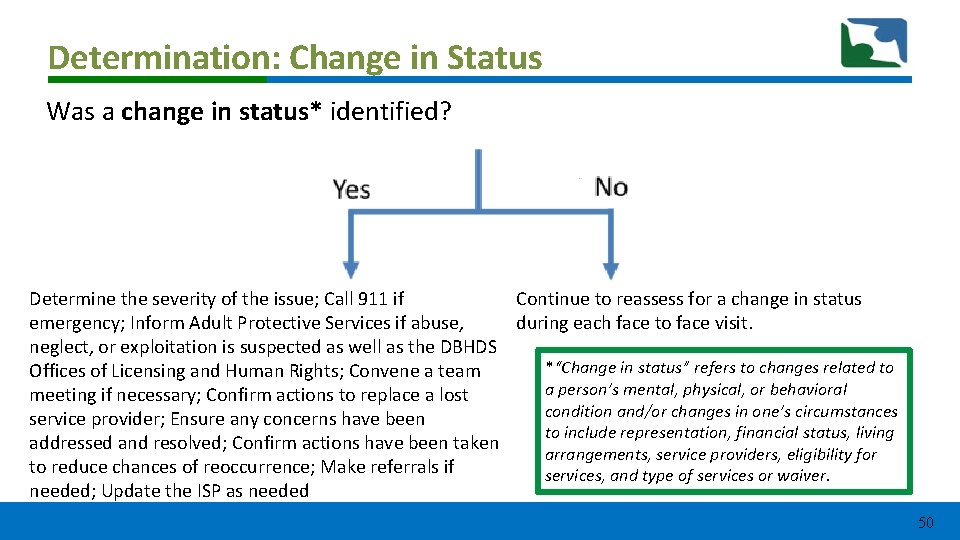
Determination: Change in Status Was a change in status* identified? Determine the severity of the issue; Call 911 if Continue to reassess for a change in status emergency; Inform Adult Protective Services if abuse, during each face to face visit. neglect, or exploitation is suspected as well as the DBHDS *“Change in status” refers to changes related to Offices of Licensing and Human Rights; Convene a team a person’s mental, physical, or behavioral meeting if necessary; Confirm actions to replace a lost condition and/or changes in one’s circumstances service provider; Ensure any concerns have been to include representation, financial status, living addressed and resolved; Confirm actions have been taken arrangements, service providers, eligibility for to reduce chances of reoccurrence; Make referrals if services, and type of services or waiver. needed; Update the ISP as needed 50
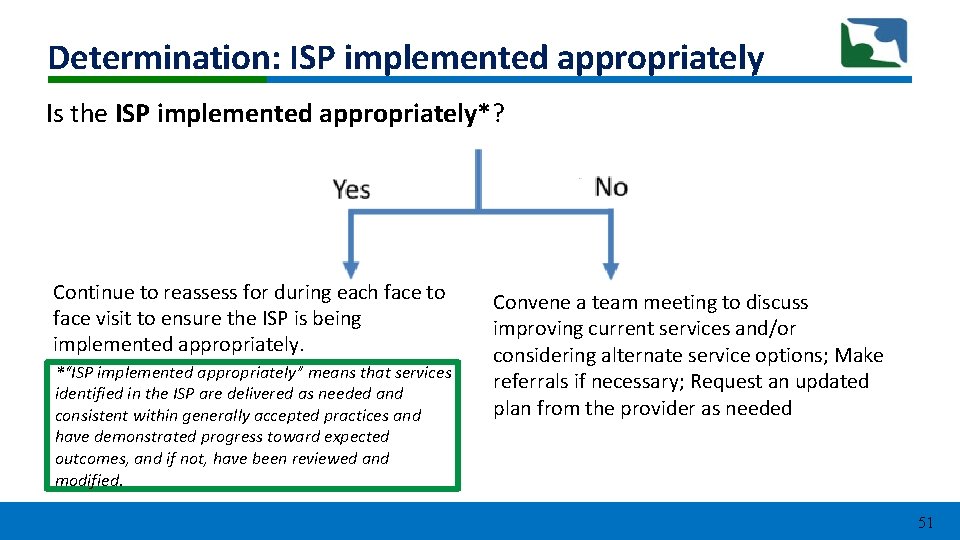
Determination: ISP implemented appropriately Is the ISP implemented appropriately*? Continue to reassess for during each face to face visit to ensure the ISP is being implemented appropriately. *“ISP implemented appropriately” means that services identified in the ISP are delivered as needed and consistent within generally accepted practices and have demonstrated progress toward expected outcomes, and if not, have been reviewed and modified. Convene a team meeting to discuss improving current services and/or considering alternate service options; Make referrals if necessary; Request an updated plan from the provider as needed 51
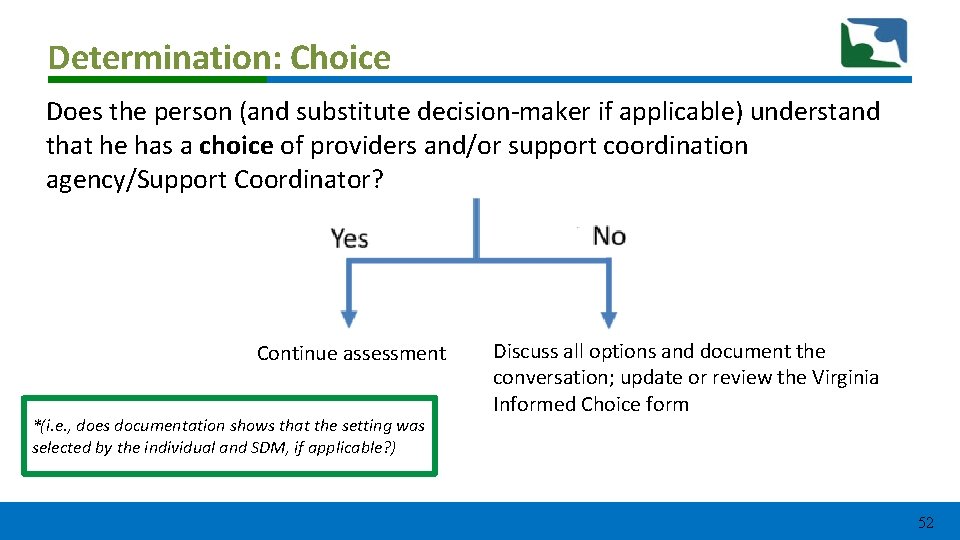
Determination: Choice Does the person (and substitute decision-maker if applicable) understand that he has a choice of providers and/or support coordination agency/Support Coordinator? Continue assessment *(i. e. , does documentation shows that the setting was selected by the individual and SDM, if applicable? ) Discuss all options and document the conversation; update or review the Virginia Informed Choice form 52
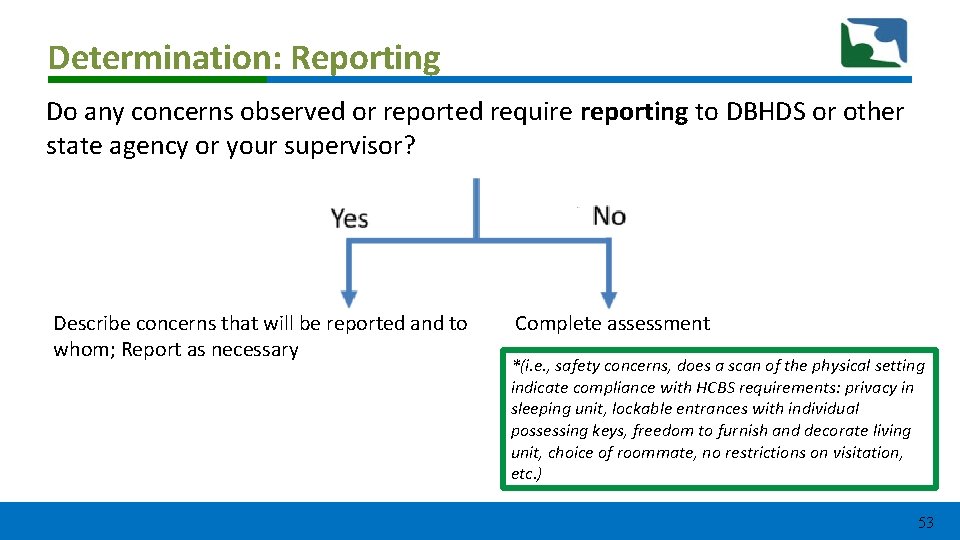
Determination: Reporting Do any concerns observed or reported require reporting to DBHDS or other state agency or your supervisor? Describe concerns that will be reported and to whom; Report as necessary Complete assessment *(i. e. , safety concerns, does a scan of the physical setting indicate compliance with HCBS requirements: privacy in sleeping unit, lockable entrances with individual possessing keys, freedom to furnish and decorate living unit, choice of roommate, no restrictions on visitation, etc. ) 53
Resources DBHDS Licensing Regulations http: //dbhds. virginia. gov/assets/QMD/licensing/ch. 105. full. wemergcompliance. 9. 01. 18 docx. pdf DMAS Proposed DD Waiver Regulations http: //register. dls. virginia. gov/details. aspx? id=7347 SC/CM Training Modules and DD SC Manual through DBHDS http: //www. dbhds. virginia. gov/case-management 54