
Support and oppose questions TODAY WE WILL To


- Slides: 9
Support and oppose questions
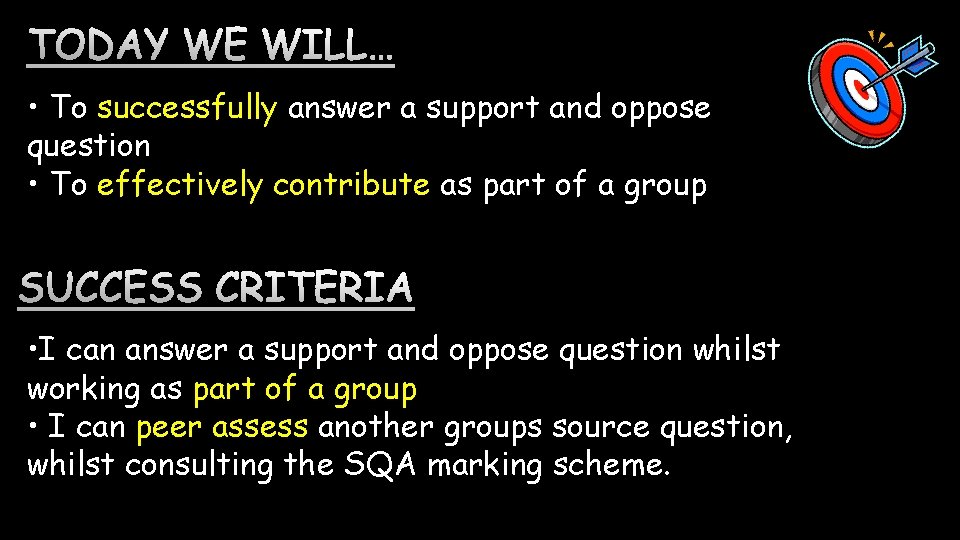
TODAY WE WILL… • To successfully answer a support and oppose question • To effectively contribute as part of a group SUCCESS CRITERIA • I can answer a support and oppose question whilst working as part of a group • I can peer assess another groups source question, whilst consulting the SQA marking scheme.
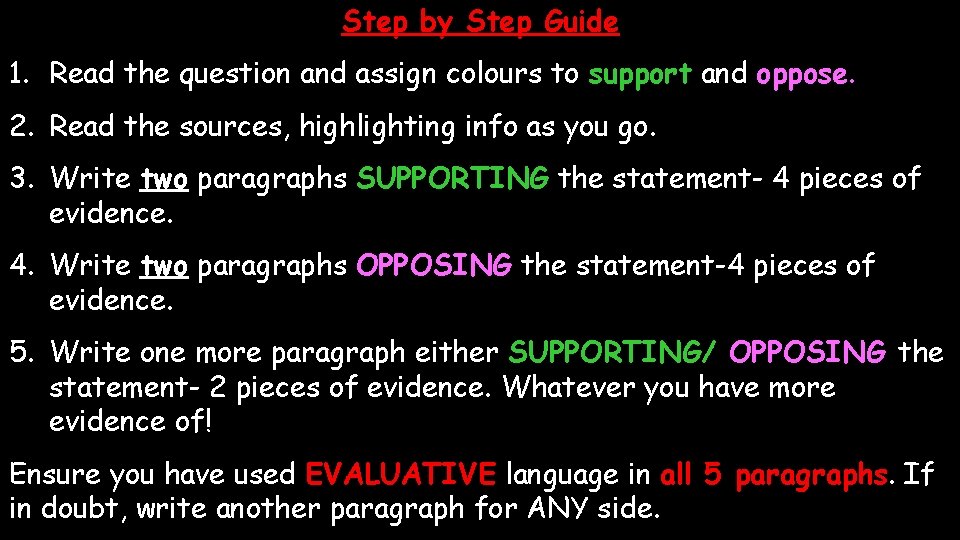
Step by Step Guide 1. Read the question and assign colours to support and oppose. 2. Read the sources, highlighting info as you go. 3. Write two paragraphs SUPPORTING the statement- 4 pieces of evidence. 4. Write two paragraphs OPPOSING the statement-4 pieces of evidence. 5. Write one more paragraph either SUPPORTING/ OPPOSING the statement- 2 pieces of evidence. Whatever you have more evidence of! Ensure you have used EVALUATIVE language in all 5 paragraphs. If in doubt, write another paragraph for ANY side.
Marking: • 2 support paragraphs- 4 pieces of evidence- try and synthesise and link evidence together from within the sources!! This will get you extra marks! (4 marks) • 2 oppose paragraphs= 4 pieces of evidence- try and synthesise and link evidence together from within the sources!! This will get you extra marks! (4 marks) • 1 oppose/supporting paragraph- 2 pieces of evidence- must be linked and synthesised. (2 marks)
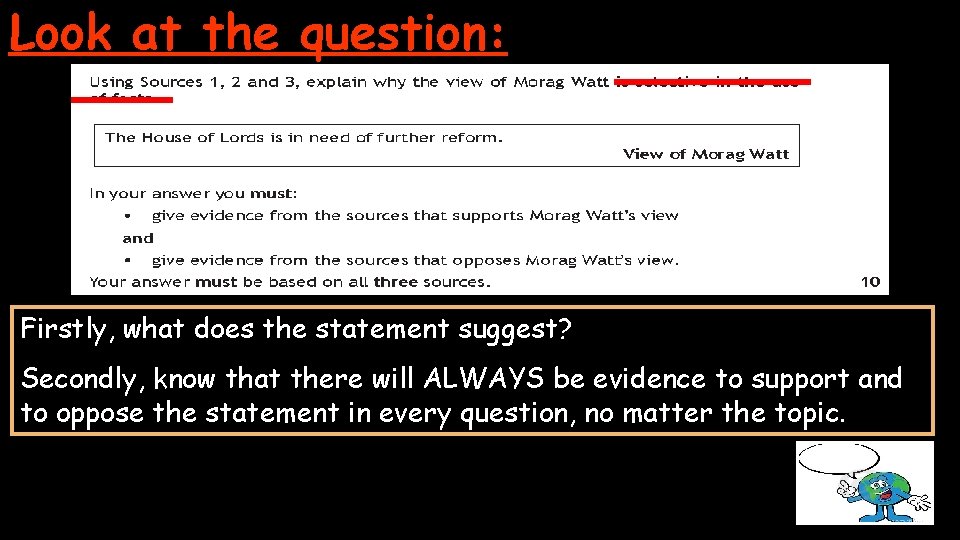
Look at the question: Firstly, what does the statement suggest? Secondly, know that there will ALWAYS be evidence to support and to oppose the statement in every question, no matter the topic.
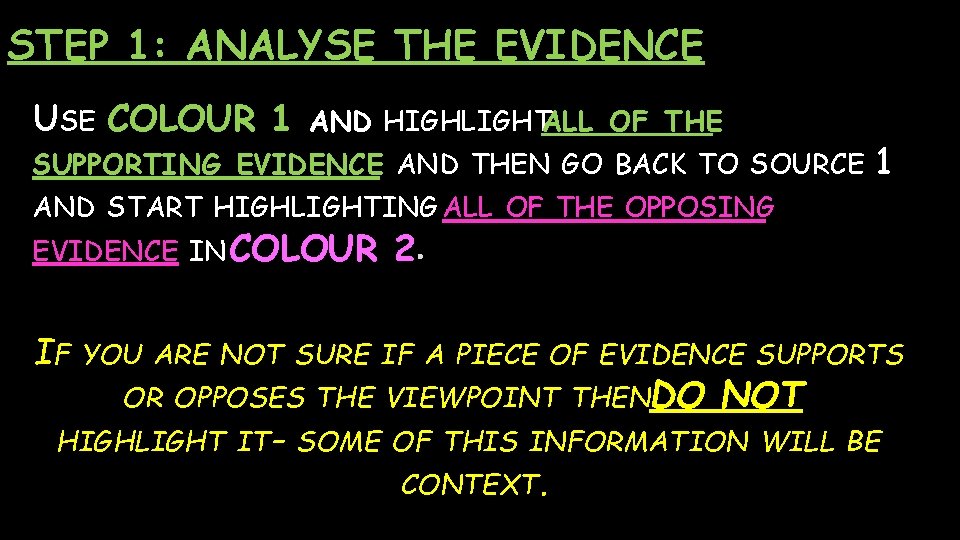
STEP 1: ANALYSE THE EVIDENCE USE COLOUR 1 AND HIGHLIGHTALL OF THE SUPPORTING EVIDENCE AND THEN GO BACK TO SOURCE AND START HIGHLIGHTING ALL OF THE OPPOSING EVIDENCE IN COLOUR 1 2. IF YOU ARE NOT SURE IF A PIECE OF EVIDENCE SUPPORTS OR OPPOSES THE VIEWPOINT THENDO NOT HIGHLIGHT IT- SOME OF THIS INFORMATION WILL BE CONTEXT.
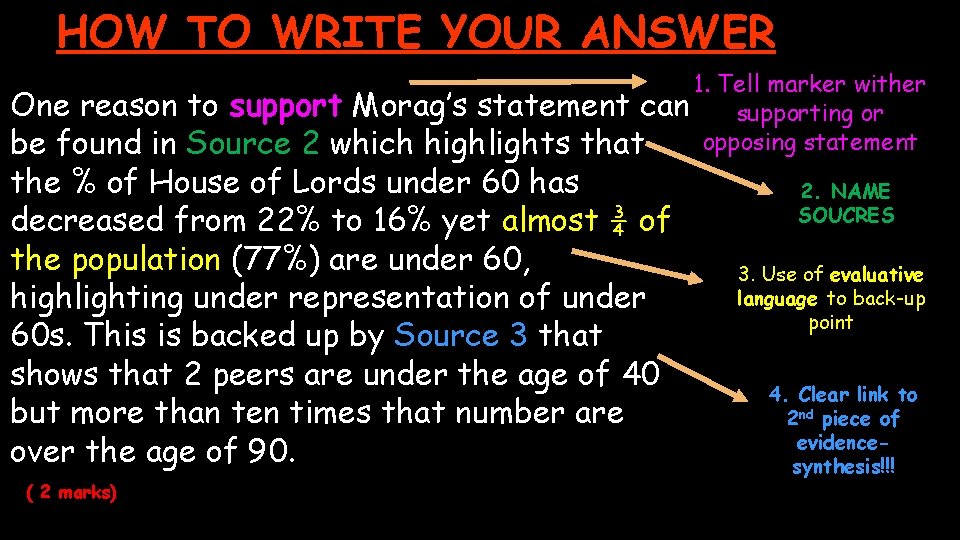
HOW TO WRITE YOUR ANSWER 1. Tell marker wither to support Morag’s statement can supporting or opposing statement Source 2 which highlights that One reason be found in the % of House of Lords under 60 has decreased from 22% to 16% yet almost ¾ of the population (77%) are under 60, highlighting under representation of under 60 s. This is backed up by Source 3 that shows that 2 peers are under the age of 40 but more than ten times that number are over the age of 90. ( 2 marks) 2. NAME SOUCRES 3. Use of evaluative language to back-up point 4. Clear link to 2 nd piece of evidencesynthesis!!!
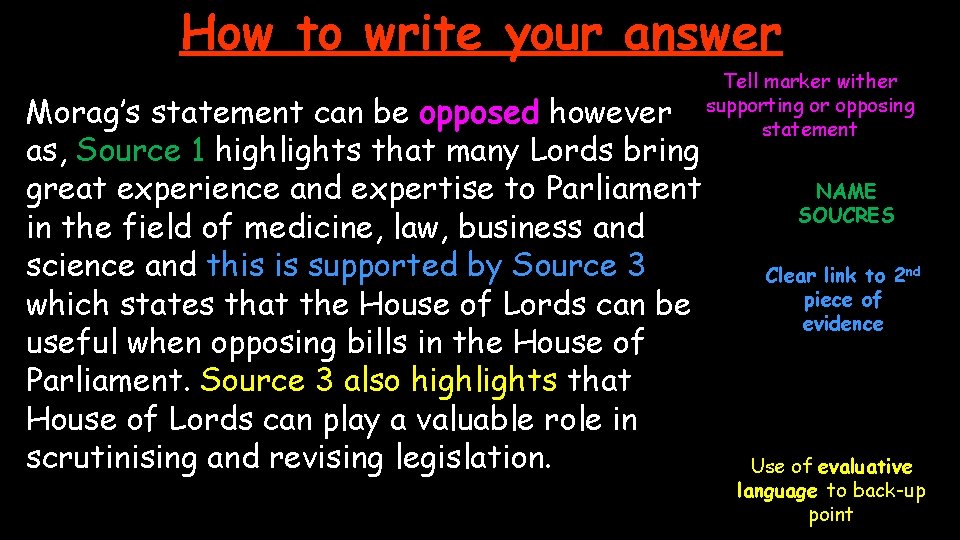
How to write your answer Morag’s statement can be opposed however as, Source 1 highlights that many Lords bring great experience and expertise to Parliament in the field of medicine, law, business and science and this is supported by Source 3 which states that the House of Lords can be useful when opposing bills in the House of Parliament. Source 3 also highlights that House of Lords can play a valuable role in scrutinising and revising legislation. Tell marker wither supporting or opposing statement NAME SOUCRES Clear link to 2 nd piece of evidence Use of evaluative language to back-up point
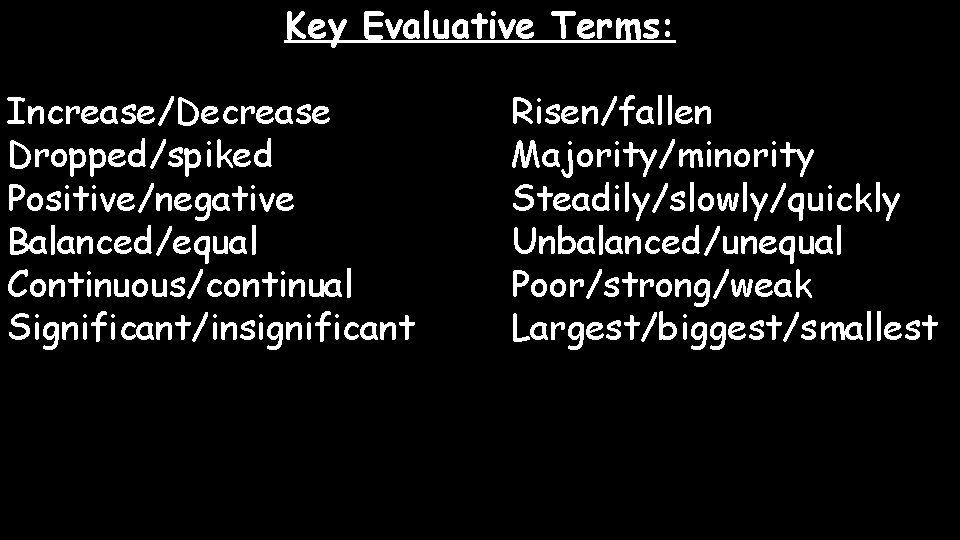
Key Evaluative Terms: Increase/Decrease Dropped/spiked Positive/negative Balanced/equal Continuous/continual Significant/insignificant Risen/fallen Majority/minority Steadily/slowly/quickly Unbalanced/unequal Poor/strong/weak Largest/biggest/smallest