
Support Analysis for Software A means to ensure


- Slides: 37
Support Analysis for Software A means to ensure software supportability R. Somoza ramon. somoza@software-supportability. org DLCSPM - Canadian Software Support Seminar - April 1998 - DAPSCT 1
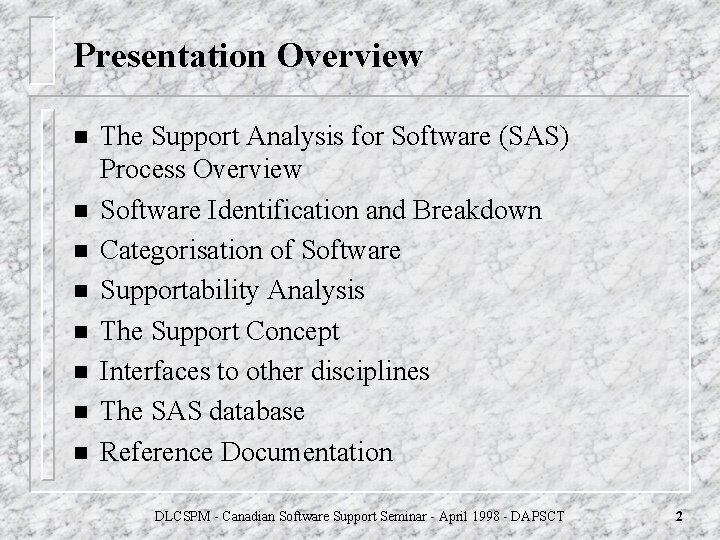
Presentation Overview n n n n The Support Analysis for Software (SAS) Process Overview Software Identification and Breakdown Categorisation of Software Supportability Analysis The Support Concept Interfaces to other disciplines The SAS database Reference Documentation DLCSPM - Canadian Software Support Seminar - April 1998 - DAPSCT 2
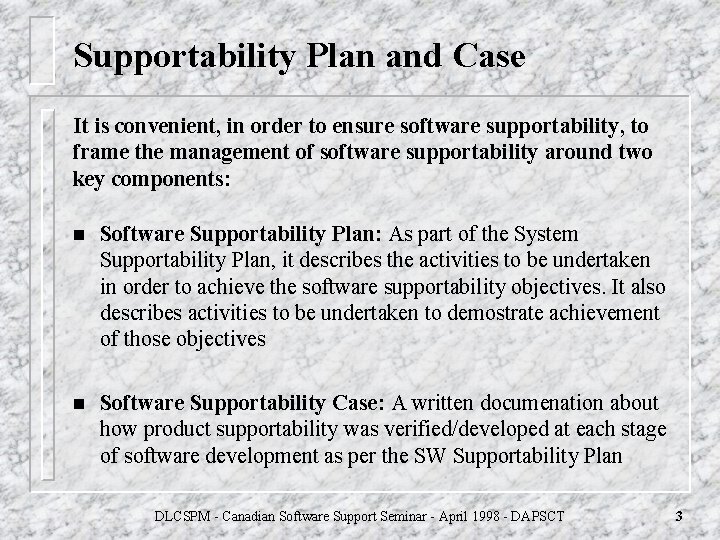
Supportability Plan and Case It is convenient, in order to ensure software supportability, to frame the management of software supportability around two key components: n Software Supportability Plan: As part of the System Supportability Plan, it describes the activities to be undertaken in order to achieve the software supportability objectives. It also describes activities to be undertaken to demostrate achievement of those objectives n Software Supportability Case: A written documenation about how product supportability was verified/developed at each stage of software development as per the SW Supportability Plan DLCSPM - Canadian Software Support Seminar - April 1998 - DAPSCT 3
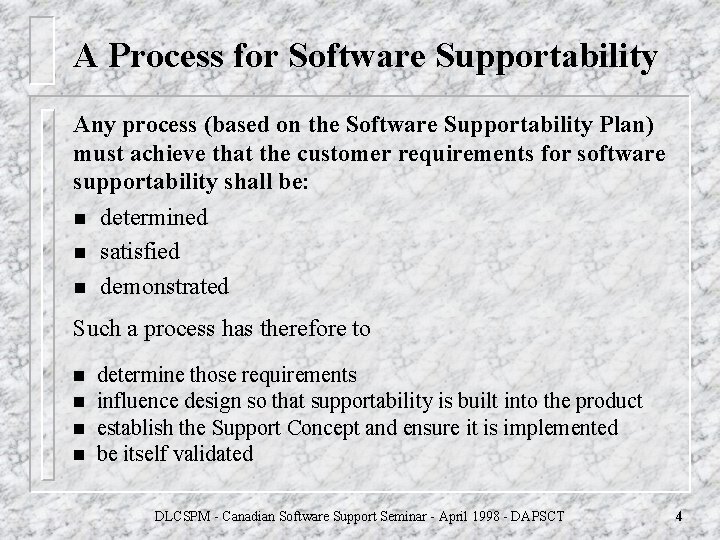
A Process for Software Supportability Any process (based on the Software Supportability Plan) must achieve that the customer requirements for software supportability shall be: n determined n satisfied n demonstrated Such a process has therefore to n n determine those requirements influence design so that supportability is built into the product establish the Support Concept and ensure it is implemented be itself validated DLCSPM - Canadian Software Support Seminar - April 1998 - DAPSCT 4
The response: n A methodological process that derives supportability requirements on the basis of the support functions to be carried out: Support Analysis for Software DLCSPM - Canadian Software Support Seminar - April 1998 - DAPSCT 5
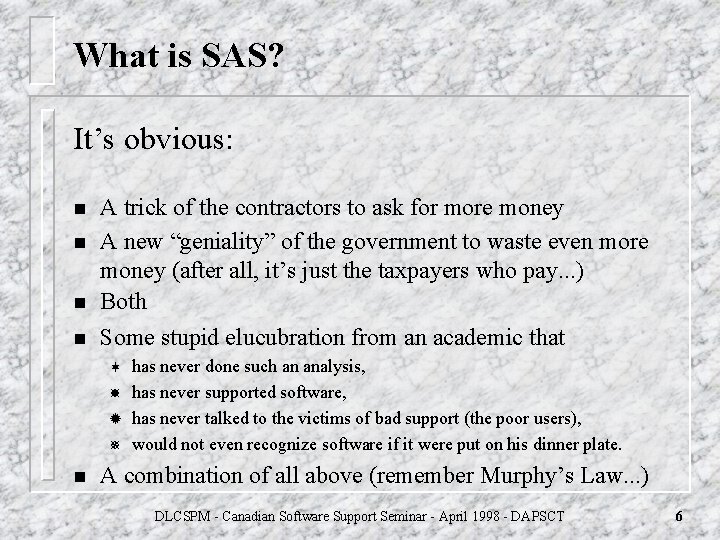
What is SAS? It’s obvious: n n A trick of the contractors to ask for more money A new “geniality” of the government to waste even more money (after all, it’s just the taxpayers who pay. . . ) Both Some stupid elucubration from an academic that ¬ ® ¯ n has never done such an analysis, has never supported software, has never talked to the victims of bad support (the poor users), would not even recognize software if it were put on his dinner plate. A combination of all above (remember Murphy’s Law. . . ) DLCSPM - Canadian Software Support Seminar - April 1998 - DAPSCT 6
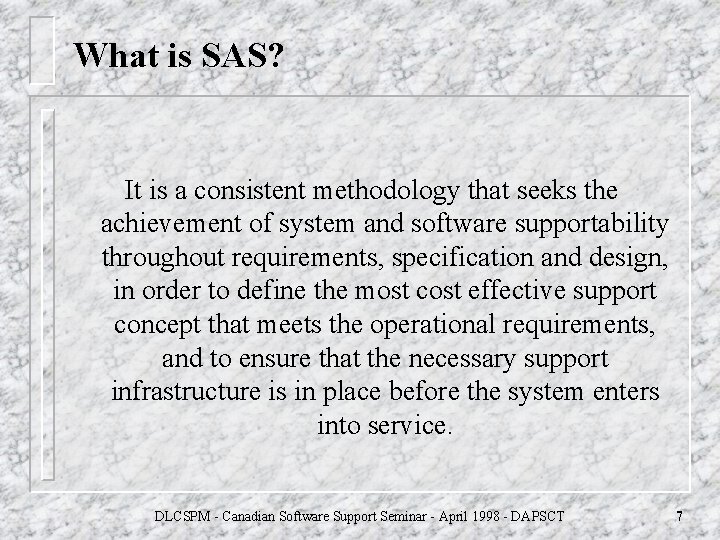
What is SAS? It is a consistent methodology that seeks the achievement of system and software supportability throughout requirements, specification and design, in order to define the most cost effective support concept that meets the operational requirements, and to ensure that the necessary support infrastructure is in place before the system enters into service. DLCSPM - Canadian Software Support Seminar - April 1998 - DAPSCT 7
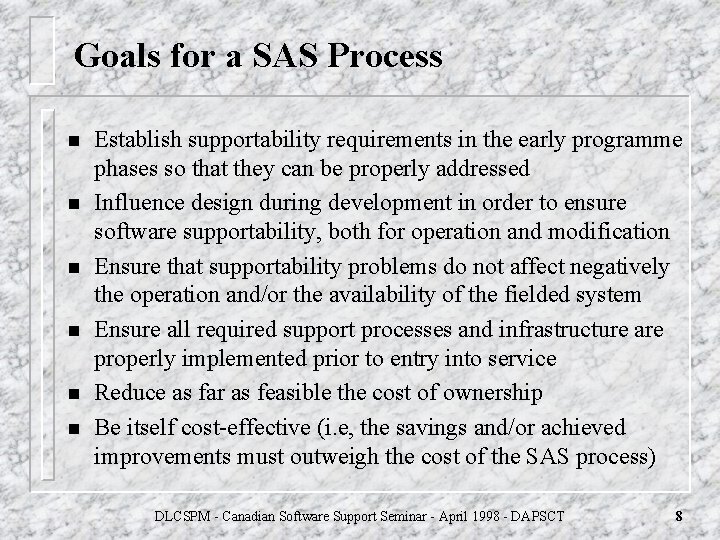
Goals for a SAS Process n n n Establish supportability requirements in the early programme phases so that they can be properly addressed Influence design during development in order to ensure software supportability, both for operation and modification Ensure that supportability problems do not affect negatively the operation and/or the availability of the fielded system Ensure all required support processes and infrastructure are properly implemented prior to entry into service Reduce as far as feasible the cost of ownership Be itself cost-effective (i. e, the savings and/or achieved improvements must outweigh the cost of the SAS process) DLCSPM - Canadian Software Support Seminar - April 1998 - DAPSCT 8
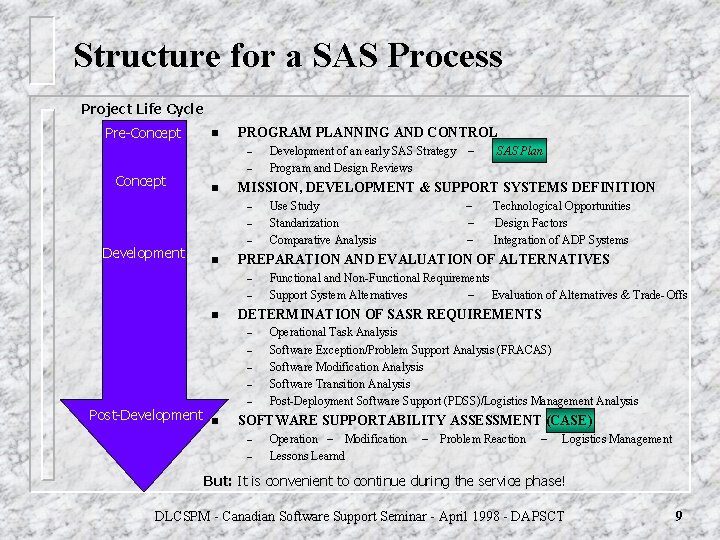
Structure for a SAS Process Project Life Cycle Pre-Concept n PROGRAM PLANNING AND CONTROL – Concept – n – – – n Use Study Standarization Comparative Analysis – – – Technological Opportunities Design Factors Integration of ADP Systems Functional and Non-Functional Requirements Support System Alternatives – Evaluation of Alternatives & Trade- Offs DETERMINATION OF SASR REQUIREMENTS – Post-Development SAS Plan PREPARATION AND EVALUATION OF ALTERNATIVES – n – MISSION, DEVELOPMENT & SUPPORT SYSTEMS DEFINITION – Development of an early SAS Strategy Program and Design Reviews Operational Task Analysis Software Exception/Problem Support Analysis (FRACAS) Software Modification Analysis Software Transition Analysis Post-Deployment Software Support (PDSS)/Logistics Management Analysis SOFTWARE SUPPORTABILITY ASSESSMENT (CASE) – – Operation – Modification Lessons Learnd – Problem Reaction – Logistics Management But: It is convenient to continue during the service phase! DLCSPM - Canadian Software Support Seminar - April 1998 - DAPSCT 9
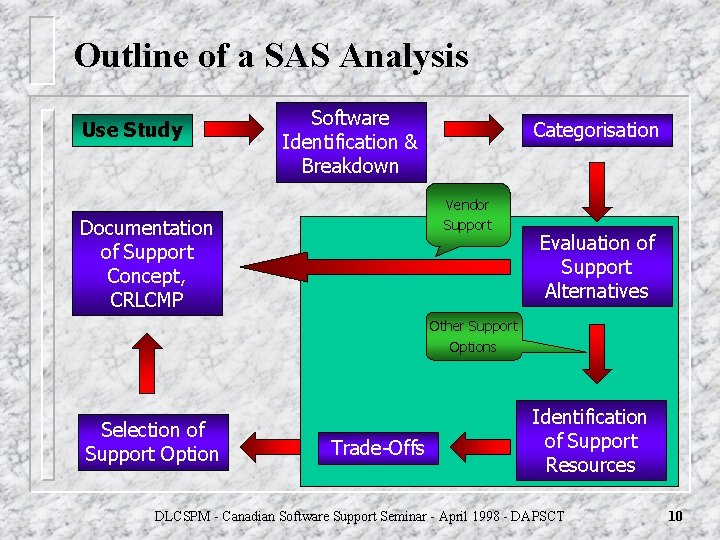
Outline of a SAS Analysis Use Study Software Identification & Breakdown Categorisation Vendor Support Documentation of Support Concept, CRLCMP Evaluation of Support Alternatives Other Support Options Selection of Support Option Trade-Offs Identification of Support Resources DLCSPM - Canadian Software Support Seminar - April 1998 - DAPSCT 10
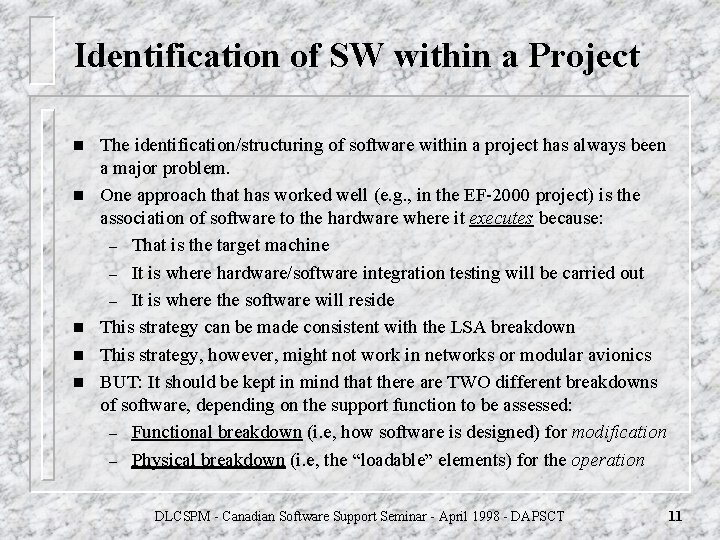
Identification of SW within a Project n n n The identification/structuring of software within a project has always been a major problem. One approach that has worked well (e. g. , in the EF-2000 project) is the association of software to the hardware where it executes because: – That is the target machine – It is where hardware/software integration testing will be carried out – It is where the software will reside This strategy can be made consistent with the LSA breakdown This strategy, however, might not work in networks or modular avionics BUT: It should be kept in mind that there are TWO different breakdowns of software, depending on the support function to be assessed: – Functional breakdown (i. e, how software is designed) for modification – Physical breakdown (i. e, the “loadable” elements) for the operation DLCSPM - Canadian Software Support Seminar - April 1998 - DAPSCT 11
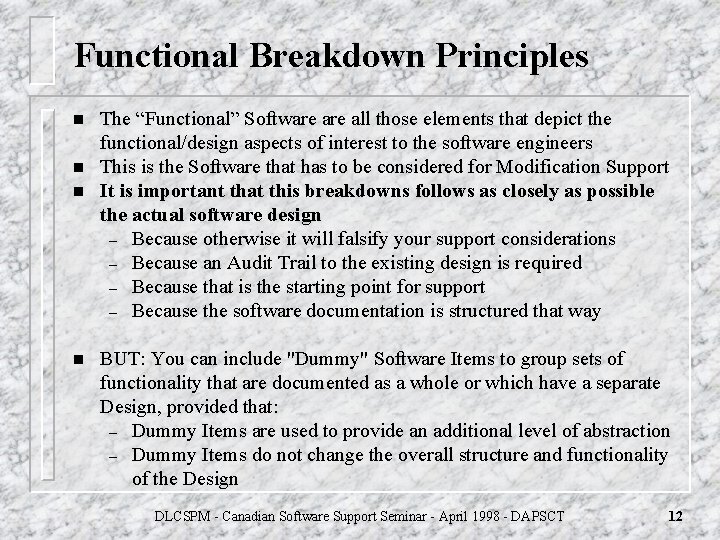
Functional Breakdown Principles n n The “Functional” Software all those elements that depict the functional/design aspects of interest to the software engineers This is the Software that has to be considered for Modification Support It is important that this breakdowns follows as closely as possible the actual software design – Because otherwise it will falsify your support considerations – Because an Audit Trail to the existing design is required – Because that is the starting point for support – Because the software documentation is structured that way BUT: You can include "Dummy" Software Items to group sets of functionality that are documented as a whole or which have a separate Design, provided that: – Dummy Items are used to provide an additional level of abstraction – Dummy Items do not change the overall structure and functionality of the Design DLCSPM - Canadian Software Support Seminar - April 1998 - DAPSCT 12
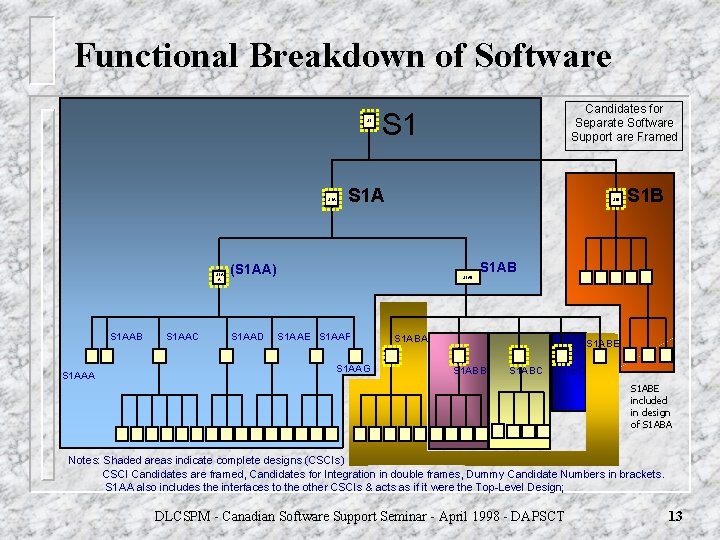
Functional Breakdown of Software S 1 A A S 1 AAB S 1 AAA S 1 AAC S 1 A S 1 B S 1 AB (S 1 AA) S 1 AAD Candidates for Separate Software Support are Framed S 1 AB S 1 AAE S 1 AAF S 1 AAG S 1 ABA S 1 ABE S 1 ABB S 1 ABC S 1 ABD S 1 ABE included in design of S 1 ABA Notes: Shaded areas indicate complete designs (CSCIs) CSCI Candidates are framed, Candidates for Integration in double frames, Dummy Candidate Numbers in brackets. S 1 AA also includes the interfaces to the other CSCIs & acts as if it were the Top-Level Design; DLCSPM - Canadian Software Support Seminar - April 1998 - DAPSCT 13
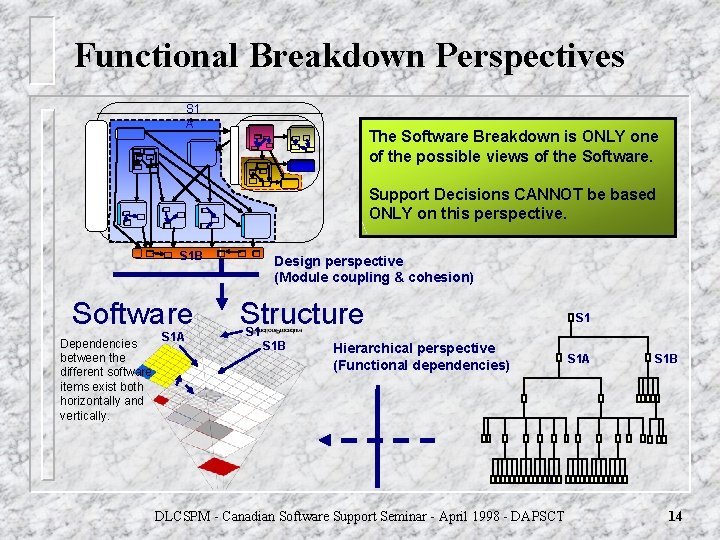
Functional Breakdown Perspectives S 1 A The Software Breakdown is ONLY one of the possible views of the Software. Support Decisions CANNOT be based ONLY on this perspective. S 1 B Software Dependencies between the different software items exist both horizontally and vertically. S 1 A Design perspective (Module coupling & cohesion) Structure S 1 S 1 B Hierarchical perspective (Functional dependencies) DLCSPM - Canadian Software Support Seminar - April 1998 - DAPSCT S 1 A S 1 B 14
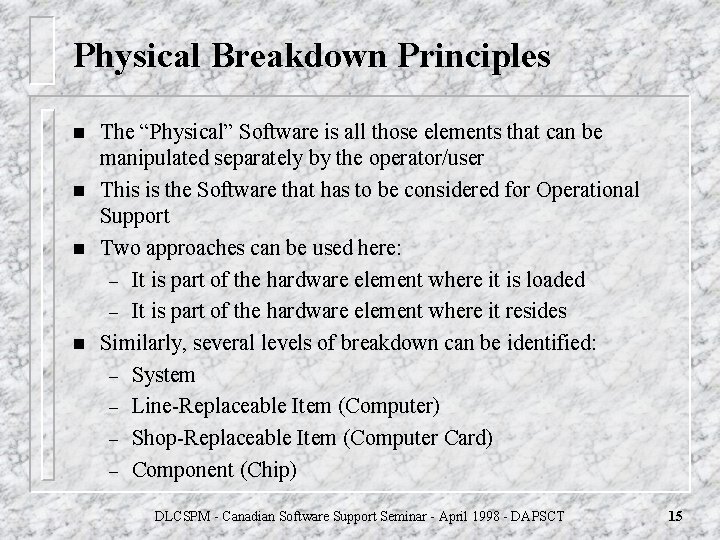
Physical Breakdown Principles n n The “Physical” Software is all those elements that can be manipulated separately by the operator/user This is the Software that has to be considered for Operational Support Two approaches can be used here: – It is part of the hardware element where it is loaded – It is part of the hardware element where it resides Similarly, several levels of breakdown can be identified: – System – Line-Replaceable Item (Computer) – Shop-Replaceable Item (Computer Card) – Component (Chip) DLCSPM - Canadian Software Support Seminar - April 1998 - DAPSCT 15
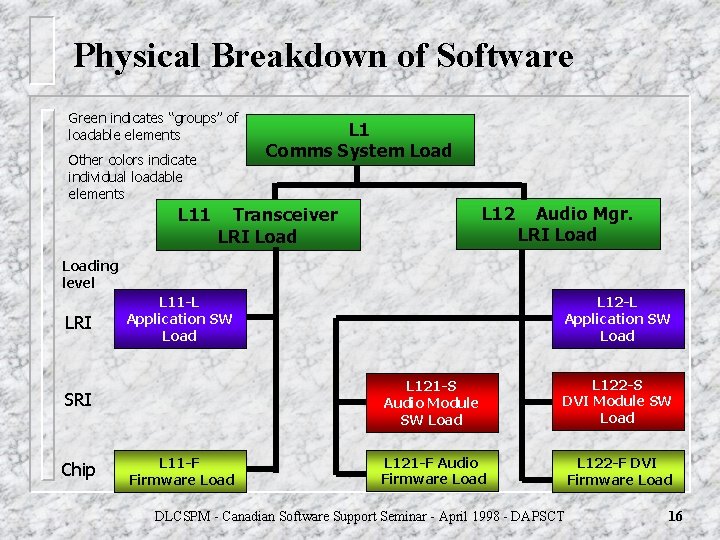
Physical Breakdown of Software Green indicates “groups” of loadable elements Other colors indicate individual loadable elements L 11 L 1 Comms System Load L 12 Transceiver LRI Load Audio Mgr. LRI Loading level LRI L 11 -L Application SW Load SRI Chip L 11 -F Firmware Load L 12 -L Application SW Load L 121 -S Audio Module SW Load L 122 -S DVI Module SW Load L 121 -F Audio Firmware Load L 122 -F DVI Firmware Load DLCSPM - Canadian Software Support Seminar - April 1998 - DAPSCT 16
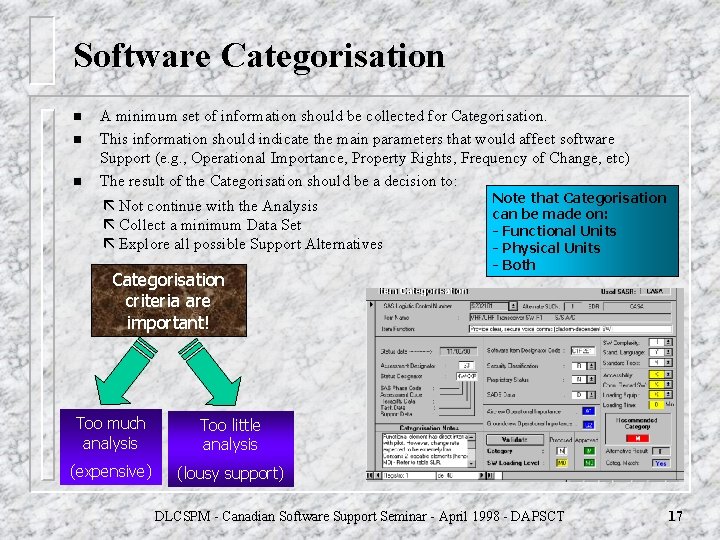
Software Categorisation n A minimum set of information should be collected for Categorisation. This information should indicate the main parameters that would affect software Support (e. g. , Operational Importance, Property Rights, Frequency of Change, etc) The result of the Categorisation should be a decision to: ã Not continue with the Analysis ã Collect a minimum Data Set ã Explore all possible Support Alternatives Categorisation criteria are important! Too much analysis Too little analysis (expensive) (lousy support) Note that Categorisation can be made on: - Functional Units - Physical Units - Both DLCSPM - Canadian Software Support Seminar - April 1998 - DAPSCT 17
Selection of SAS Candidates n n SAS Candidates are elements which are going to be subject to some kind of supportability analysis SAS Candidates should be selected on the basis of their operational or supportability significance Three types of distinct SAS Candidates should be selected: ý Functional Software Elements ý Physical Software Elements ý Data Each of these has its own characteristics and different supportability problems DLCSPM - Canadian Software Support Seminar - April 1998 - DAPSCT 18
Selection of Functional Candidates n n Inherent Candidates: – The Item that includes all Software in the System and/or LRI – All Items (CSCIs) that have a separate Design – All intermediate Items between the CSCIs and the Top-Level CSCI at which Integration is performed Potential Candidates: All Support Anomalies such as – Software Items requiring special hardware or software tools – Software Items of different risk classes than the software where they are embedded – Proprietary software, such as Run-Time Libraries or COTS Software – Software Items that have different versions for use of the parent software on different platforms (e. g. , different I/O handlers, so that the Software can run both on an A/C and on the Flight Simulator) – Different programming languages (specially weird ones) – Deviations to the Design Environment – Reused Software DLCSPM - Canadian Software Support Seminar - April 1998 - DAPSCT 19
Selection of Physical Candidates n n For Software: – All software executables that can be loaded and/or installed separately or that require different loading/installation tasks – All groups of the above that are loaded/installed together in one single operation For Data: – All databases – All data blocks (e. g. , mission data) that: n Are manipulated as a single entity n Require specific software for creation, manipulation or evaluation (e. g. , post-flight analysis) n Are installed, loaded or unloaded by means of a specific task DLCSPM - Canadian Software Support Seminar - April 1998 - DAPSCT 20
Function-oriented Supportability Analysis n n It is convenient to carry out the Supportability Analysis from the point of view of the support functions that have to be carried out, and not from the point view of the product When considering the functions (e. g. , modify software, operate software), it is much easier to determine the necessary tasks, as well as those aspects that will simplify those tasks (e. g. , software modularity helps modification, installation requires a loading device) A first assessment of those tasks early in the development cycle will be useful to determine the software supportability requirements and objectives But: software supportability in only one of the system supportability parameters, and should be always assessed in this context DLCSPM - Canadian Software Support Seminar - April 1998 - DAPSCT 21
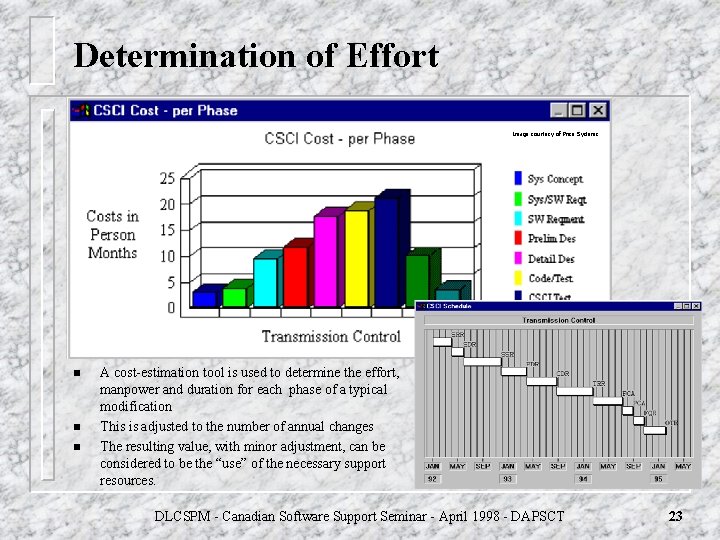
Analysis for Modification Support n n n The Analysis for Modification Support should be based both on the software to be modified and the tasks to be carried out to make that modification. The first step should use a set of standard tasks (say, from IEEE 1219, ISO 12207, MIL-STD-498 or equivalent). The standard tasks can be usually related to a specific hierarchical level within the software. A cost or effort estimation tool (e. g. , COCOMO) can provide the effort for the modification task. On the basis of existing metrics or software engineering studies, this effort can be statistically distributed over the different tasks. The next step consists of identifying the support elements required to carry out those tasks. The use of those elements usually can be derived from the effort and duration of the tasks. DLCSPM - Canadian Software Support Seminar - April 1998 - DAPSCT 22
Determination of Effort Image courtesy of Price Systems n n n A cost-estimation tool is used to determine the effort, manpower and duration for each phase of a typical modification This is adjusted to the number of annual changes The resulting value, with minor adjustment, can be considered to be the “use” of the necessary support resources. DLCSPM - Canadian Software Support Seminar - April 1998 - DAPSCT 23
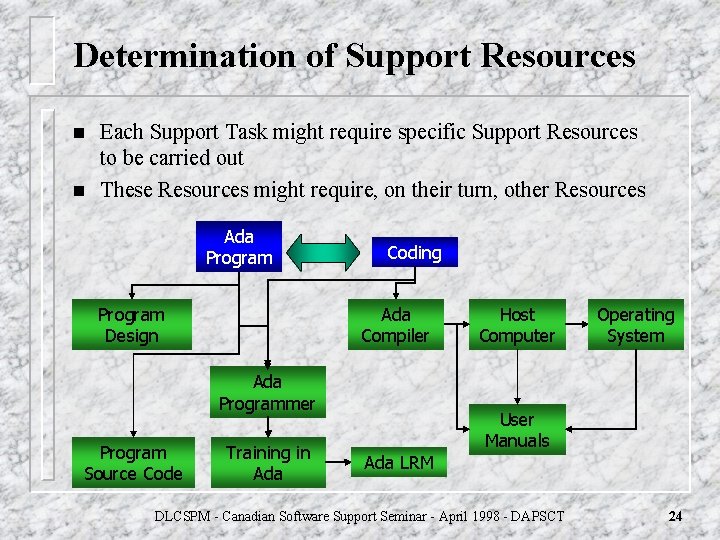
Determination of Support Resources n n Each Support Task might require specific Support Resources to be carried out These Resources might require, on their turn, other Resources Ada Program Design Coding Ada Compiler Ada Programmer Program Source Code Training in Ada Host Computer Operating System User Manuals Ada LRM DLCSPM - Canadian Software Support Seminar - April 1998 - DAPSCT 24
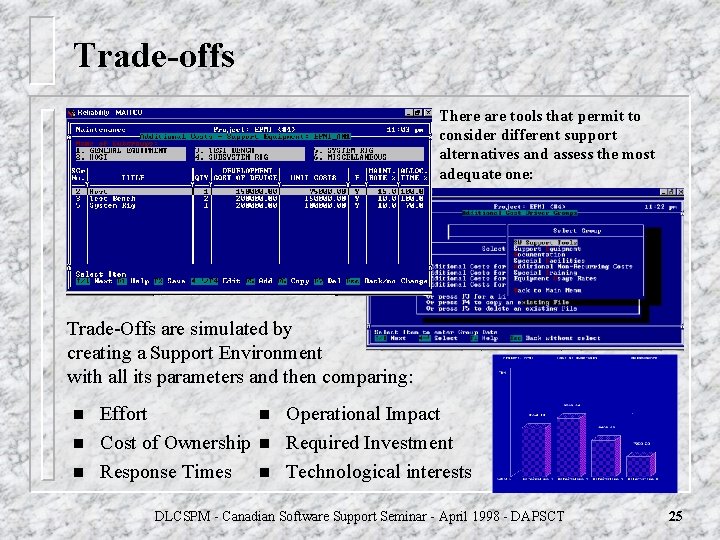
Trade-offs There are tools that permit to consider different support alternatives and assess the most adequate one: Trade-Offs are simulated by creating a Support Environment with all its parameters and then comparing: n n n Effort Cost of Ownership Response Times n n n Operational Impact Required Investment Technological interests DLCSPM - Canadian Software Support Seminar - April 1998 - DAPSCT 25
Analysis for Operational Support n n n Unfortunately, there are no standards for Operational Support from which a set of standard tasks could be derived One practical approach is to derive a set of Support Initiators, that is, a set of events that might affect software These Support Initiators result in a process to be modeled, from which resources can then be identified It is convenient that this is harmonised with the LSA Process, as many of the Support Initiators can be identified through FMECA. Tools used for LORA can often be also used for this purpose Typical Support Initiators include: – – – New software release / new firmware Repair of computing hardware Corruption of data or executable code (including virus infection) System/Software failure New system mission (with change of software and/or mission data) DLCSPM - Canadian Software Support Seminar - April 1998 - DAPSCT 26
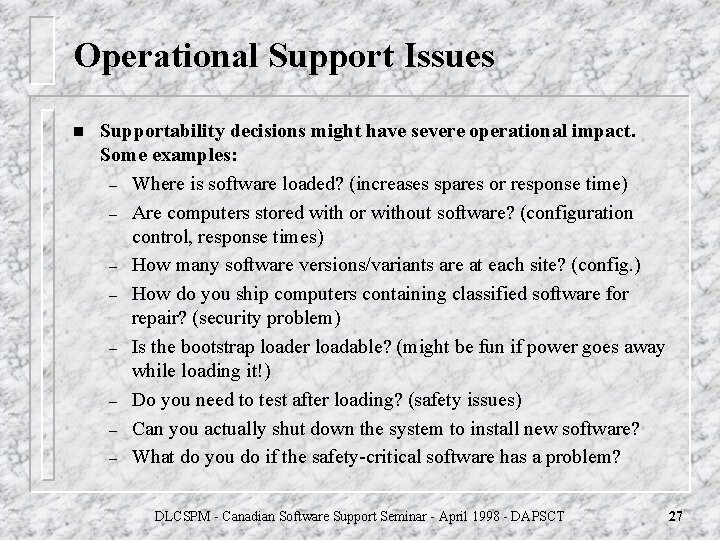
Operational Support Issues n Supportability decisions might have severe operational impact. Some examples: – Where is software loaded? (increases spares or response time) – Are computers stored with or without software? (configuration control, response times) – How many software versions/variants are at each site? (config. ) – How do you ship computers containing classified software for repair? (security problem) – Is the bootstrap loader loadable? (might be fun if power goes away while loading it!) – Do you need to test after loading? (safety issues) – Can you actually shut down the system to install new software? – What do you do if the safety-critical software has a problem? DLCSPM - Canadian Software Support Seminar - April 1998 - DAPSCT 27
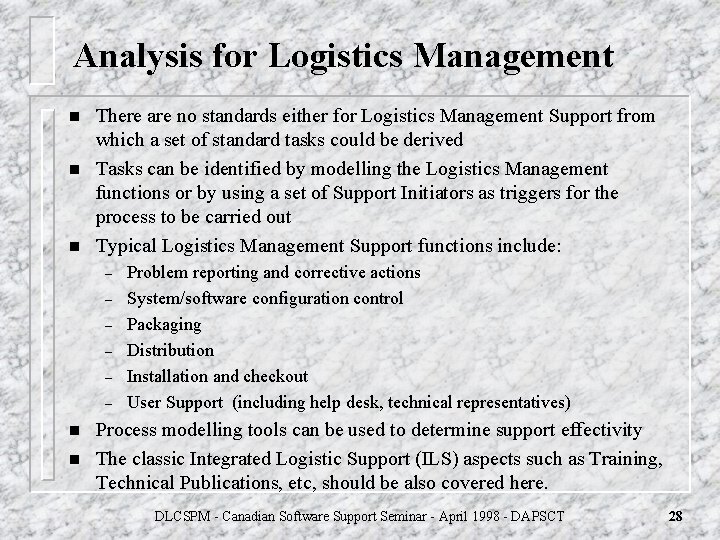
Analysis for Logistics Management n n n There are no standards either for Logistics Management Support from which a set of standard tasks could be derived Tasks can be identified by modelling the Logistics Management functions or by using a set of Support Initiators as triggers for the process to be carried out Typical Logistics Management Support functions include: – – – n n Problem reporting and corrective actions System/software configuration control Packaging Distribution Installation and checkout User Support (including help desk, technical representatives) Process modelling tools can be used to determine support effectivity The classic Integrated Logistic Support (ILS) aspects such as Training, Technical Publications, etc, should be also covered here. DLCSPM - Canadian Software Support Seminar - April 1998 - DAPSCT 28
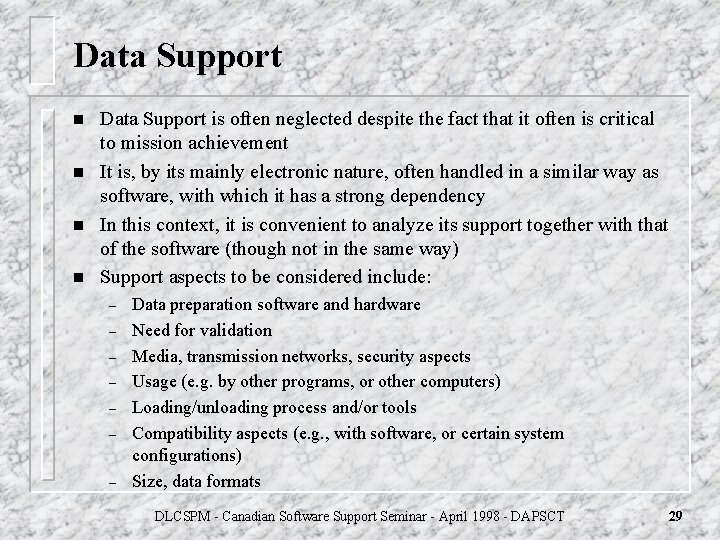
Data Support n n Data Support is often neglected despite the fact that it often is critical to mission achievement It is, by its mainly electronic nature, often handled in a similar way as software, with which it has a strong dependency In this context, it is convenient to analyze its support together with that of the software (though not in the same way) Support aspects to be considered include: – – – – Data preparation software and hardware Need for validation Media, transmission networks, security aspects Usage (e. g. by other programs, or other computers) Loading/unloading process and/or tools Compatibility aspects (e. g. , with software, or certain system configurations) Size, data formats DLCSPM - Canadian Software Support Seminar - April 1998 - DAPSCT 29
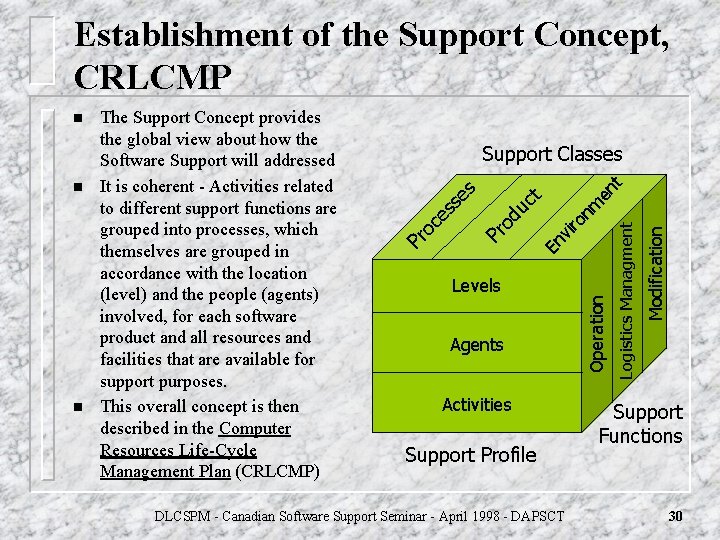
Establishment of the Support Concept, CRLCMP n Agents Activities Support Profile DLCSPM - Canadian Software Support Seminar - April 1998 - DAPSCT Modification Logistics Managment en t Levels Operation En vi ro nm uc t od Pr es s es Support Classes oc n The Support Concept provides the global view about how the Software Support will addressed It is coherent - Activities related to different support functions are grouped into processes, which themselves are grouped in accordance with the location (level) and the people (agents) involved, for each software product and all resources and facilities that are available for support purposes. This overall concept is then described in the Computer Resources Life-Cycle Management Plan (CRLCMP) Pr n Support Functions 30
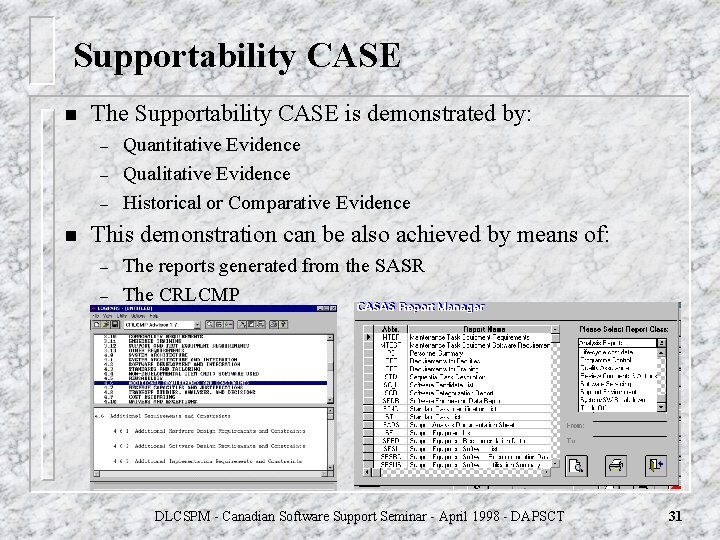
Supportability CASE n The Supportability CASE is demonstrated by: – – – n Quantitative Evidence Qualitative Evidence Historical or Comparative Evidence This demonstration can be also achieved by means of: – – The reports generated from the SASR The CRLCMP DLCSPM - Canadian Software Support Seminar - April 1998 - DAPSCT 31
Interfaces to other disciplines n n n SAS has also a link to the classic ILS disciplines, to which it issues requirements for Training, Support Equipment and Support Software, Technical Publications, Facilities, etc. , in a similar way as LSA The Link to LSA is established through the “Physical Software” breakdown and its relationship with the hardware It is convenient that LSA (if carried out) documents the SAS results for the Operational Support, so that all operational matters are stored together The link to RM&T is also only for operational purposes - RM&T for Software Modification is carried out as part of the SAS Analysis The link to Engineering is through the software design. It is convenient that SAS participates as part of an Integrated Project Team (IPT), or at least as a reviewer during the whole software design. DLCSPM - Canadian Software Support Seminar - April 1998 - DAPSCT 32
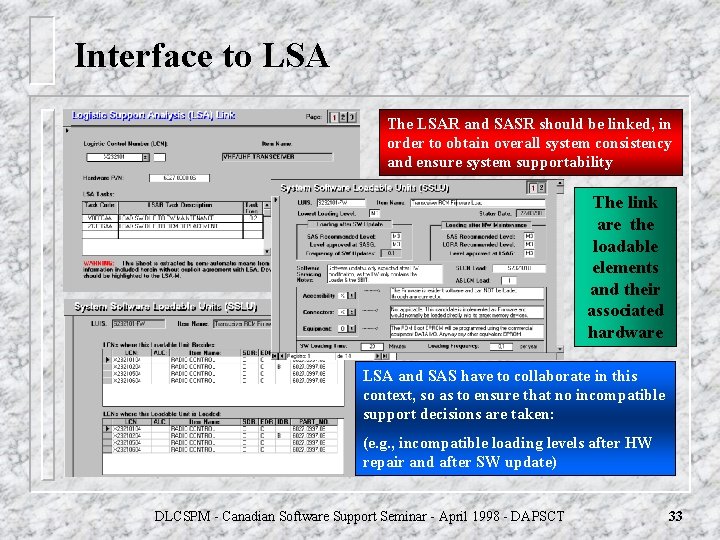
Interface to LSA The LSAR and SASR should be linked, in order to obtain overall system consistency and ensure system supportability The link are the loadable elements and their associated hardware LSA and SAS have to collaborate in this context, so as to ensure that no incompatible support decisions are taken: (e. g. , incompatible loading levels after HW repair and after SW update) DLCSPM - Canadian Software Support Seminar - April 1998 - DAPSCT 33
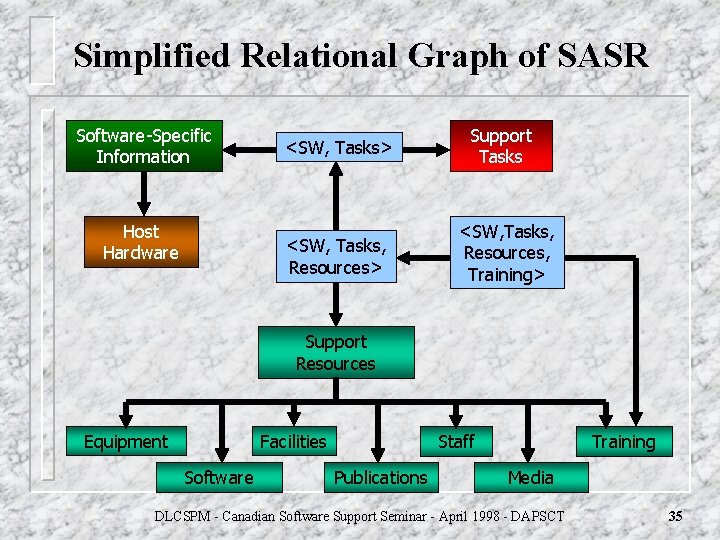
The SAS Database (SASR) Though often disconsidered in the Supportability Analysis, the use of a database for all software supportability information is of great importance since: n n n It provides a single master data repository for all software related information (everybody works on the basis of the same data) It integrates such information from multiples sources, for all software in one single system or across multiple related systems It provides an overview of all required support resources, thus making it easier to identify commonalities or consider combined support It can be queried to seek out specific information, such as software metrics, system load, deviations. . It can be linked to software engineering tools or information, as well as to logistics-related information (the LSAR) However: There is no standard for such a database and the LSAR cannot be used for this purpose DLCSPM - Canadian Software Support Seminar - April 1998 - DAPSCT 34
Simplified Relational Graph of SASR Software-Specific Information Host Hardware <SW, Tasks> <SW, Tasks, Resources> Support Tasks <SW, Tasks, Resources, Training> Support Resources Equipment Facilities Software Staff Publications Training Media DLCSPM - Canadian Software Support Seminar - April 1998 - DAPSCT 35
Conclusions A Supportability Analysis can be carried out in a similar way as the LSA Process (but don’t try to use MIL-STD-1388!) n It is not specially difficult, but it is convenient that it is done by a mix of software engineers and logisticians n Critical to this is the establishment of a software Supportability Plan in the early programme phases n Not only support can benefit from this approach, even the design process might be optimized because of it n The Supportability Case prevents that supportability is killed due to schedule or cost constraints - it is a contractual requirement! But it should be always kept in mind: n Supportability for its own sake is a waste of money! n DLCSPM - Canadian Software Support Seminar - April 1998 - DAPSCT 36
Some Reference Documentation n n n DEF STAN 00 -60, “Integrated Logistic Support”, Issue 2, October 1996, Part 3: “Logistic Support Analysis Application to Software Aspects of Systems” SAE Standard JA 1004 (Draft), “Software Supportability Program Standard”, in SAE Ballot MIL-HDBK-347, “Mission-Critical Computer Resources Support”, May 1990 SAE Aerospace Information Report AIR 5121, “Software Supportability - An Overview”, January 1997 SAE Report JA 1006 (Draft), “Software Support Concept”, in SAE Ballot SAE Recommended Practice JA 1005, “Software Supportability Implementation Guide” (Draft) Software Logistics Planning Handbook, US Army, CECOM, October 1995 ISO Standard 12207, “Information Technology - Software Life Cycle Processes”, August 1995 IEEE Standard 1219, “IEEE Standard for Software Maintenance”, June 1993 MIL-STD-498, “Software Development and Documentation”, December 1994 SAE G-11 Software Committtee Homepage (http: //www. sae. org/TECHCMTE/g 11 soft. htm) DEF STAN 00 -60 Homepage (http: //www. demon. co. uk/ilsuk. html) DLCSPM - Canadian Software Support Seminar - April 1998 - DAPSCT 37