
Supply Demand and Market Equilibrium Mr Clifford O
Supply, Demand, and Market Equilibrium
Mr. Clifford! O Mr. Clifford

What is a Market? O Definition = An interaction between buyers (demanders) and sellers (suppliers) for goods, services, or resources
Demand First O A “schedule” or “curve” that shows the amount of products that consumers are willing and able to buy at a series of possible prices at a specific period of time O Two things affect this: market demand individual demand

Law of Demand O Definition: As prices fall, the quantity demanded rises. As prices rise, the quantity demanded falls. O There is an inverse relationship between price and quantity demanded. Versus $549 $0. 45 1, 220 erasers!
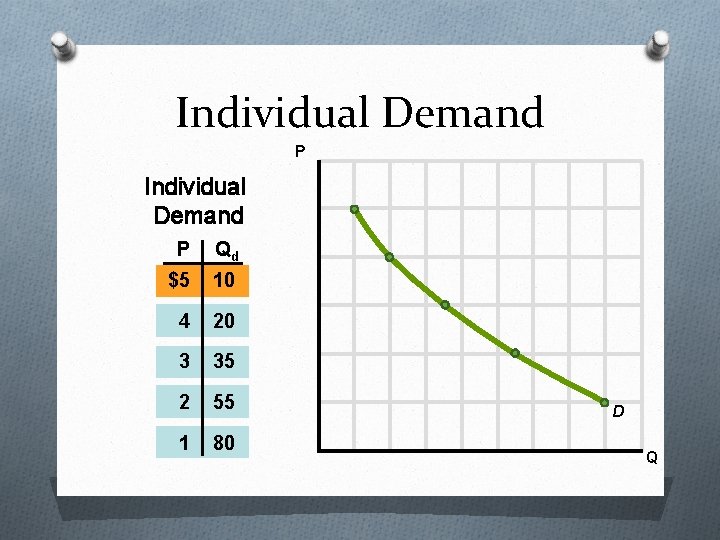
Individual Demand P Qd $5 10 4 20 3 35 2 55 1 80 D Q
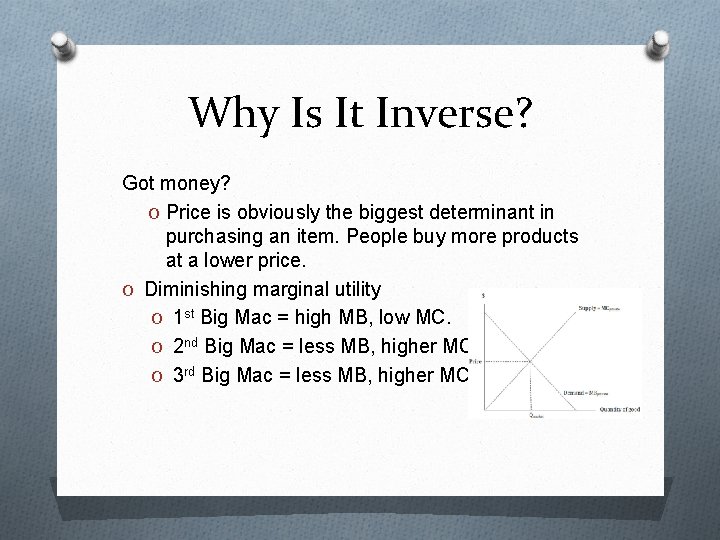
Why Is It Inverse? Got money? O Price is obviously the biggest determinant in purchasing an item. People buy more products at a lower price. O Diminishing marginal utility O 1 st Big Mac = high MB, low MC. O 2 nd Big Mac = less MB, higher MC O 3 rd Big Mac = less MB, higher MC
Part 2 O Income Effect O A lower price enables you to buy more of a product than you could when the price was higher O Higher price of a product has the opposite effect O Substitution Effect O At a lower price, you have the incentive to substitute the less expensive product for similar products that are more expensive O You’re getting a “better deal” with the lower price product O As price increases for a good, demand for its cheaper substitute goes up as well
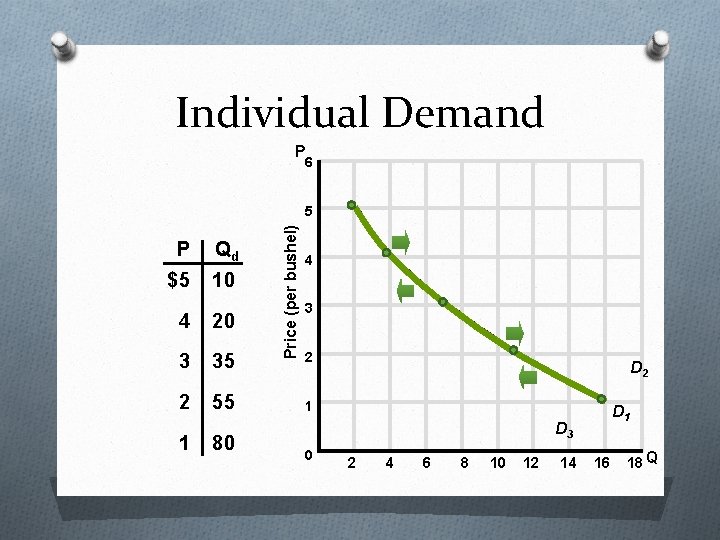
Individual Demand P 6 P Qd $5 10 4 20 3 35 2 55 1 80 5 Price (per bushel) Individual Demand Increase in Demand 4 3 2 1 0 D 2 Decrease in Demand 2 4 6 8 10 D 1 D 3 12 14 16 18 Q
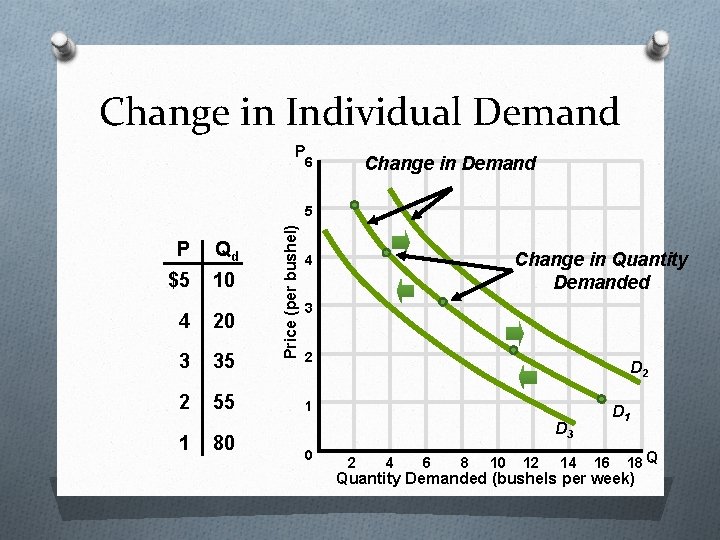
Change in Individual Demand P Change in Demand 6 P Qd $5 10 4 20 3 35 2 55 1 80 5 Price (per bushel) Individual Demand Change in Quantity Demanded 4 3 2 1 0 D 2 Decrease in Demand 2 4 6 8 10 D 1 D 3 12 14 16 18 Q Quantity Demanded (bushels per week)

Non-price Determinants O Preference: based on popularity or trends by consumers O Income effect O Population changes: how many consumers are in this market O Expectations of consumers: what consumers “think” will happen in the future that affects their actions now
Part 2 O Elasticity of demand: how much demand changes to respond to changes in price O More elastic: when goods are luxuries (cars, yachts, diamonds) O Less elastic: when goods are needed (medicine, soap) O We still need goods like medicine and soap but less need for diamonds and sports cars
P. I. P. E. E. R. O Preference of consumers O Income of consumers O Population of consumers O Expectations for the future (what to do NOW) O Elasticity (effect of price) O Related goods (is a substitute available? )
Supply O Supply is the amount of goods or services that producers are willing and able to sell O The major determinant of supply is price O Quantity: the amount of supply at each price O Supply schedule: the amount of supply at each price is shown in a schedule
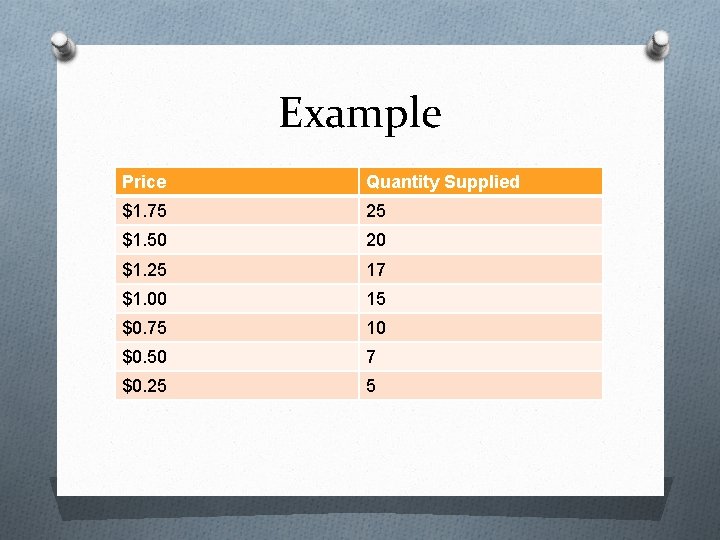
Example Price Quantity Supplied $1. 75 25 $1. 50 20 $1. 25 17 $1. 00 15 $0. 75 10 $0. 50 7 $0. 25 5
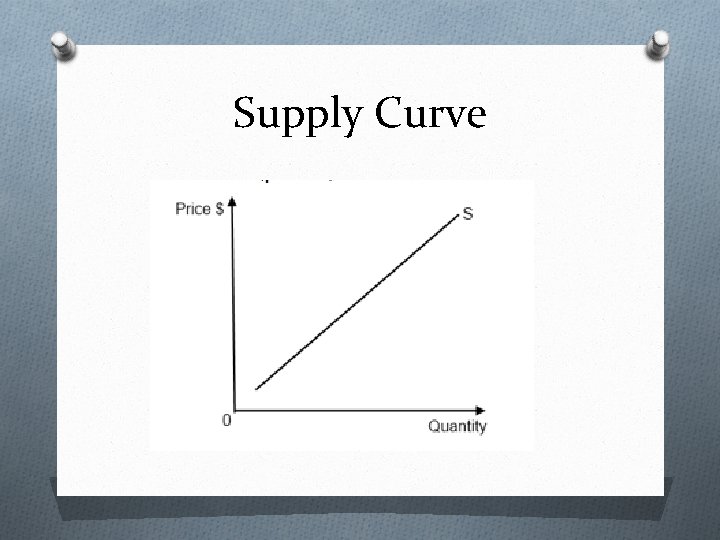
Supply Curve
Upwards Curve O Supply curve goes upwards because: O Price and quantity supplied have a direct relation O Price is an incentive to producers as they receive more revenue when more goods/services are sold
Law of Supply O Supply varies directly with price O If price goes up, quantity supplied goes up O If price goes down, quantity supplied goes down
Non-price Determinants O Cost of production: cost of producing goods and services O Minimum wage for labor goes up O Natural disasters make costs go up O Expectations of producers: predictions on how consumers will act O Resources can be used for different goods O Grow corn or grow soybeans?
Part 2 O Technology improvements increased production O Taxes/subsidies: Pay more taxes which increases the costs of production or the government pays producers to produce (subsidies) O # of suppliers in the market O Tesla entered the car market recently and increased the supply of cars
C. E. R. T. T/S. S O Cost of production O Expectations of producers O Resources O Technology O Taxes/Subsidies O Suppliers
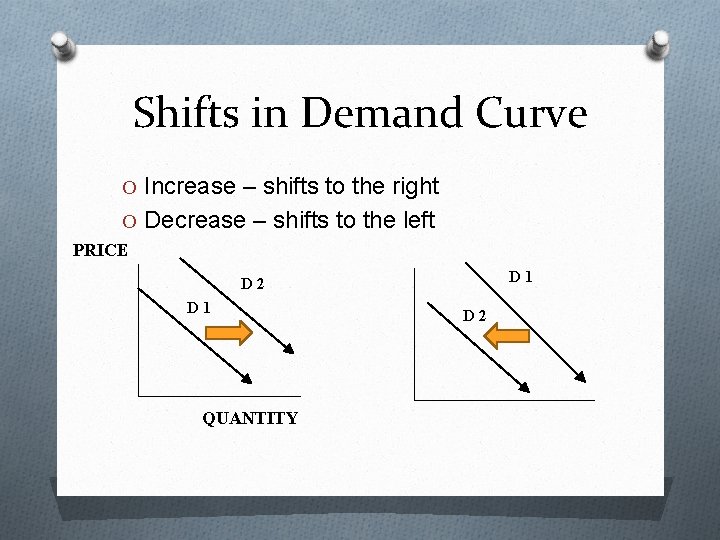
Shifts in Demand Curve O Increase – shifts to the right O Decrease – shifts to the left PRICE D 1 D 2 D 1 QUANTITY D 2

Shifts in Supply Curve
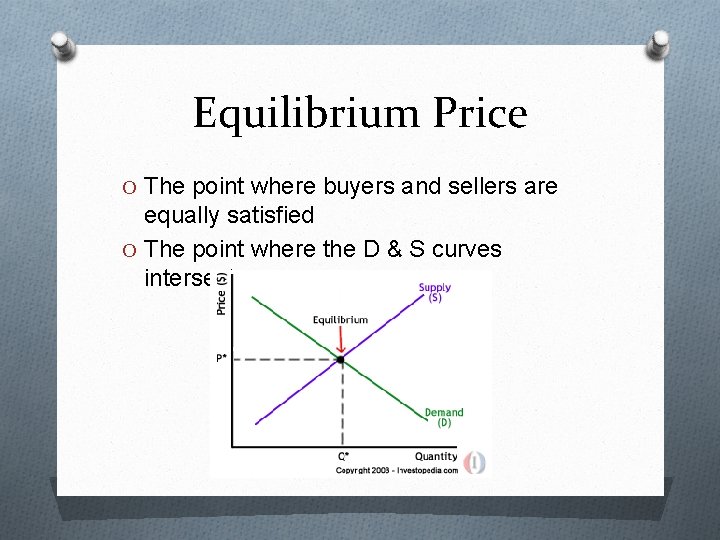
Equilibrium Price O The point where buyers and sellers are equally satisfied O The point where the D & S curves intersect
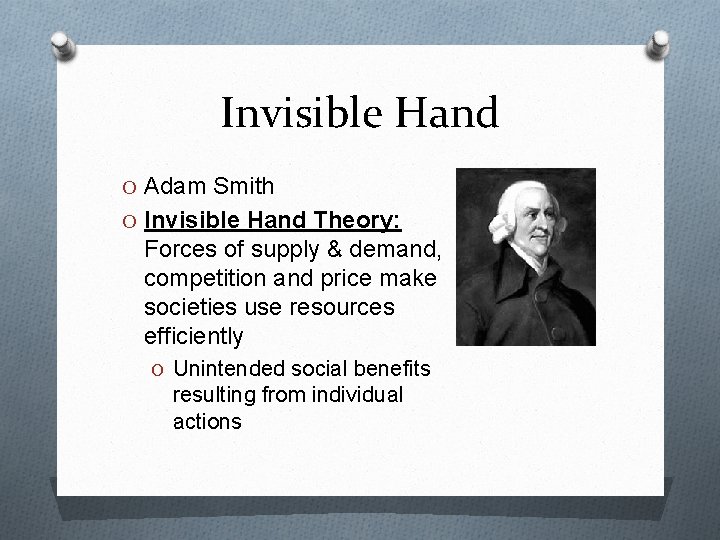
Invisible Hand O Adam Smith O Invisible Hand Theory: Forces of supply & demand, competition and price make societies use resources efficiently O Unintended social benefits resulting from individual actions
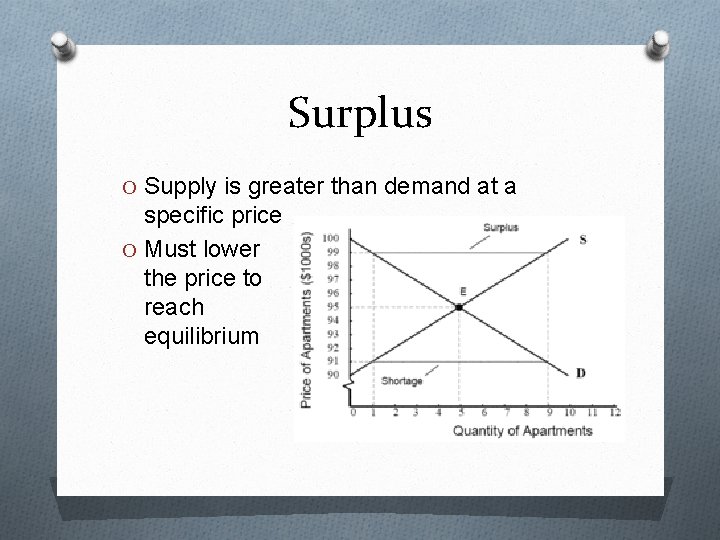
Surplus O Supply is greater than demand at a specific price O Must lower the price to reach equilibrium
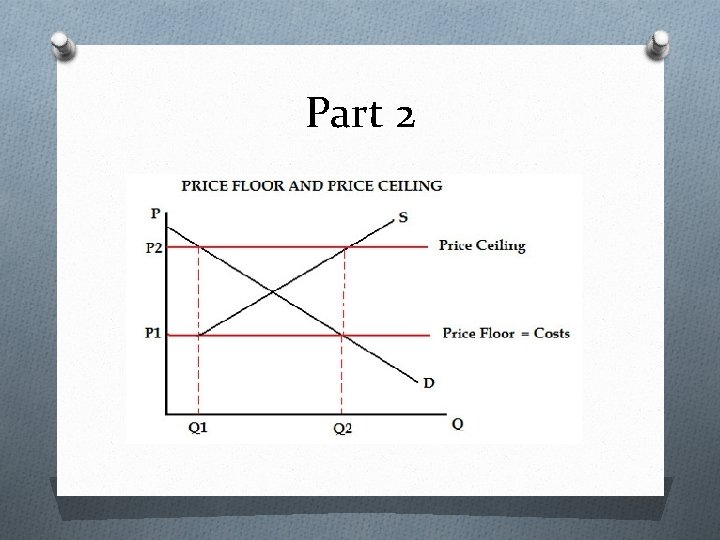
Price Floors vs. Price Ceiling O Price floors: O Price ceiling: O Government sets the O Government sets limit O Cannot go below a certain price O Causes a surplus O Example: minimum wage causes a surplus of workers at a set price maximum price O Cannot go above a certain price O Causes a shortage O Example: rent controls, price controls, utility rates set by the government
Part 2
- Slides: 28