
Supply Demand and Market Equilibrium Introduction to Demand
Supply, Demand, and Market Equilibrium
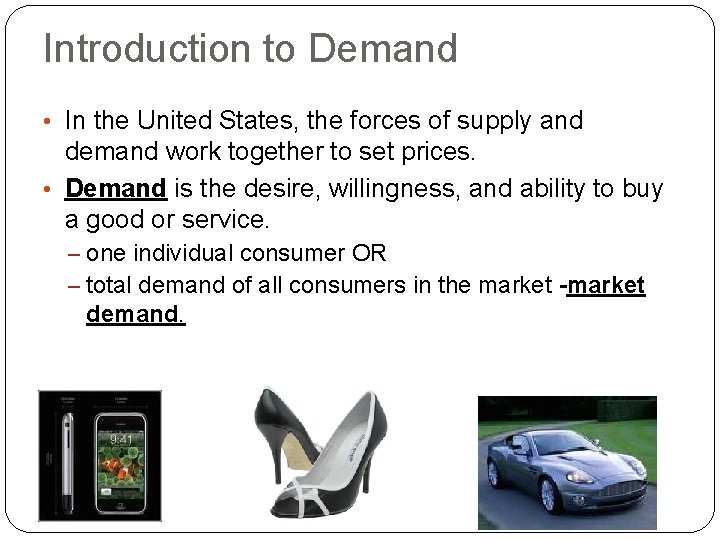
Introduction to Demand • In the United States, the forces of supply and demand work together to set prices. • Demand is the desire, willingness, and ability to buy a good or service. – one individual consumer OR – total demand of all consumers in the market -market demand.
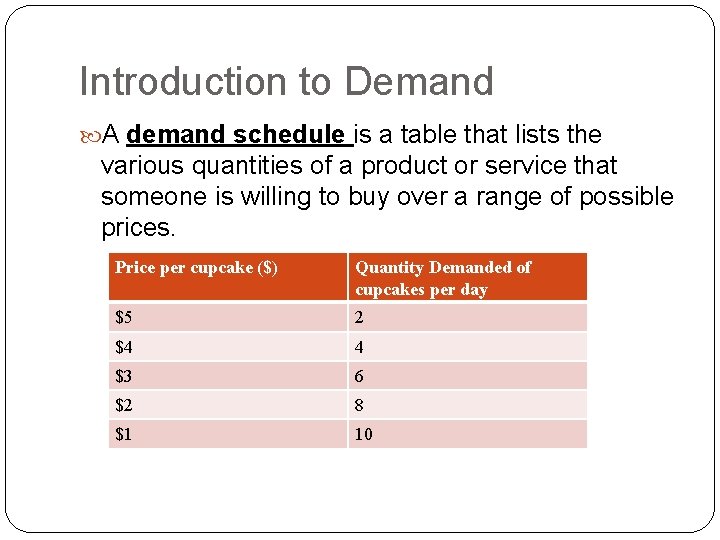
Introduction to Demand A demand schedule is a table that lists the various quantities of a product or service that someone is willing to buy over a range of possible prices. Price per cupcake ($) Quantity Demanded of cupcakes per day $5 2 $4 4 $3 6 $2 8 $1 10
Introduction to Demand A demand schedule can be shown as points on a graph. The graph lists prices on the vertical axis The graph lists quantities demanded on the horizontal axis. Each point on the graph shows how many units of the product or service an individual will buy at a particular price. Activity One: (Below curve these notes) The demand is the line that connects Using these the information points. in the previous slide…. Draw a demand curve using the information in the previous chart.
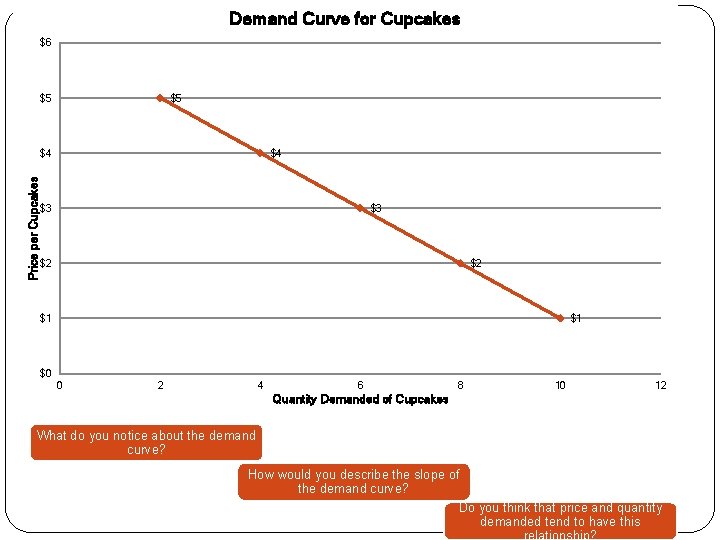
Demand Curve for Cupcakes $6 $5 $5 Price per Cupcakes $4 $4 $3 $3 $2 $2 $1 $1 $0 0 2 4 6 8 10 12 Quantity Demanded of Cupcakes What do you notice about the demand curve? How would you describe the slope of the demand curve? Do you think that price and quantity demanded tend to have this relationship?
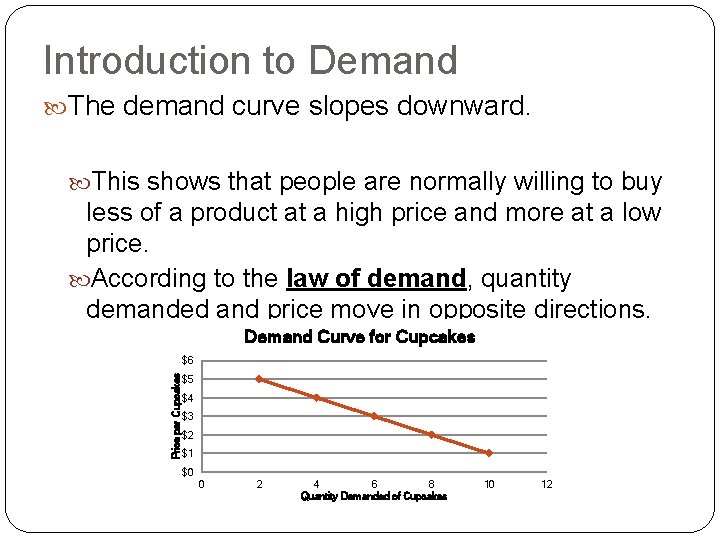
Introduction to Demand The demand curve slopes downward. This shows that people are normally willing to buy less of a product at a high price and more at a low price. According to the law of demand, quantity demanded and price move in opposite directions. Demand Curve for Cupcakes Price per Cupcakes $6 $5 $4 $3 $2 $1 $0 0 2 4 6 8 Quantity Demanded of Cupcakes 10 12
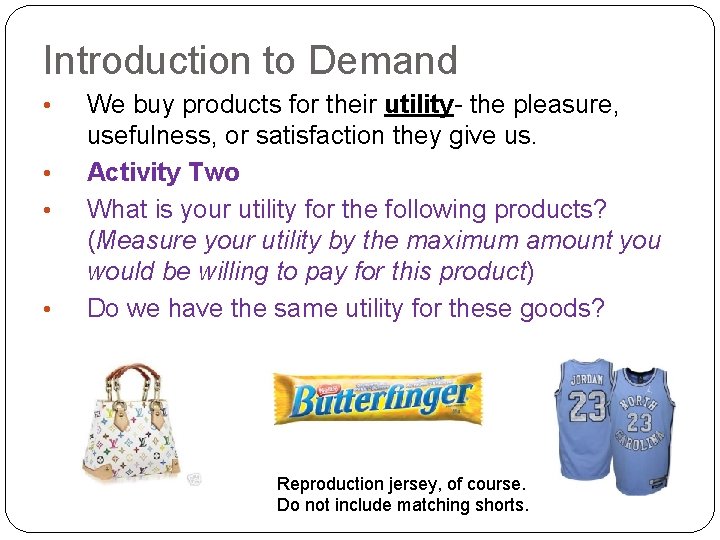
Introduction to Demand • • We buy products for their utility- the pleasure, usefulness, or satisfaction they give us. Activity Two What is your utility for the following products? (Measure your utility by the maximum amount you would be willing to pay for this product) Do we have the same utility for these goods? Reproduction jersey, of course. Do not include matching shorts.
Introduction to Demand One reason the demand curve slopes downward is due to diminished marginal utility • principle of diminishing marginal utility -our additional satisfaction tends to go down as we consume more and more units. Activity Three: (Below these notes) *Consider the Starbucks discussion from Unit 5…. Why don’t you buy three of your favorite Starbucks beverages at one time, but will purchase three t-shirts, if you can buy 2 and get the 3 rd one free? – • To make a buying decision, we consider whether the satisfaction we expect to gain is worth the money we must give up.
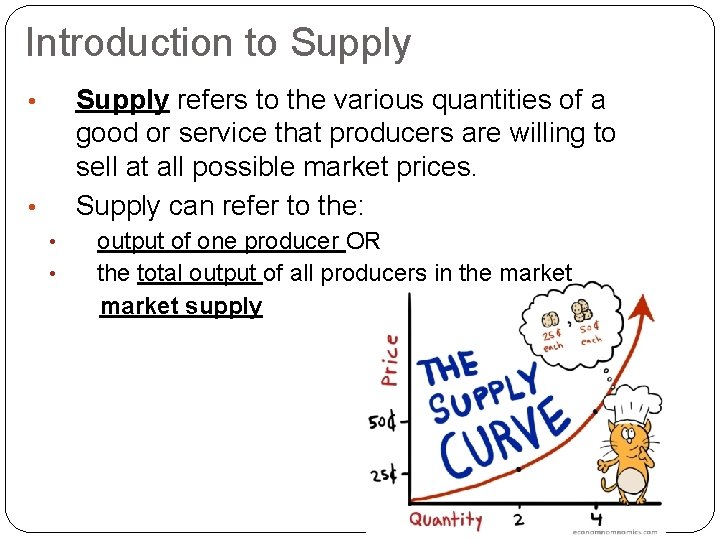
Introduction to Supply refers to the various quantities of a good or service that producers are willing to sell at all possible market prices. Supply can refer to the: • • output of one producer OR the total output of all producers in the market supply
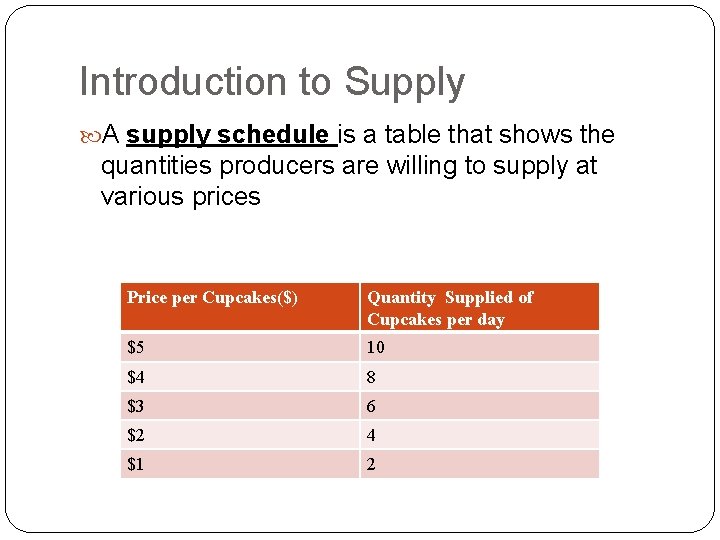
Introduction to Supply A supply schedule is a table that shows the quantities producers are willing to supply at various prices Price per Cupcakes($) Quantity Supplied of Cupcakes per day $5 10 $4 8 $3 6 $2 4 $1 2
Introduction to Supply A supply schedule can be shown as points on a graph. The graph lists prices on the vertical axis and quantities supplied on the horizontal axis. Each point on the graph shows how many units of the product or service a producer (or group of producers) would willing sell at a particular price. The supply curve is the line that connects these points. Activity Three: (Below these notes) Using the information in the previous slide…. Draw a supply curve using the information in the previous chart.
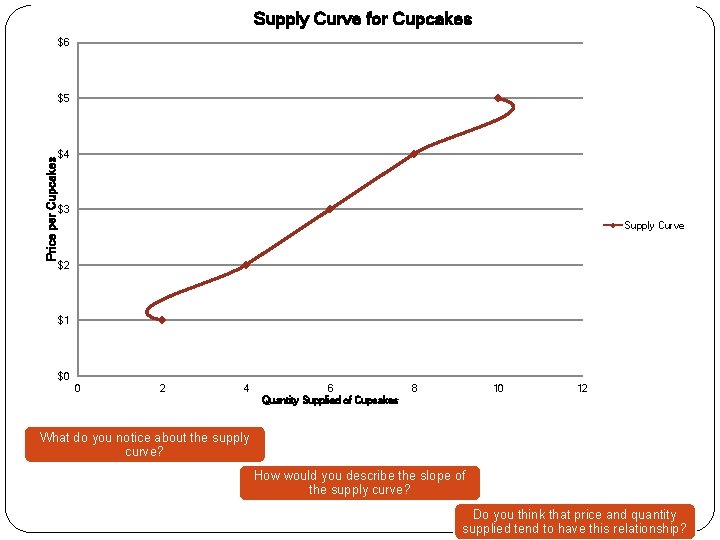
Supply Curve for Cupcakes $6 Price per Cupcakes $5 $4 $3 Supply Curve $2 $1 $0 0 2 4 6 Quantity Supplied of Cupcakes 8 10 12 What do you notice about the supply curve? How would you describe the slope of the supply curve? Do you think that price and quantity supplied tend to have this relationship?
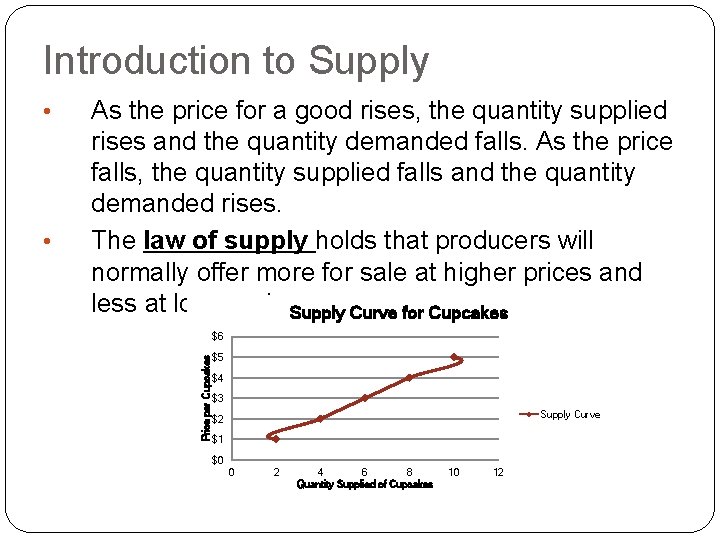
Introduction to Supply • As the price for a good rises, the quantity supplied rises and the quantity demanded falls. As the price falls, the quantity supplied falls and the quantity demanded rises. The law of supply holds that producers will normally offer more for sale at higher prices and less at lower prices. Supply Curve for Cupcakes $6 Price per Cupcakes • $5 $4 $3 Supply Curve $2 $1 $0 0 2 4 6 8 Quantity Supplied of Cupcakes 10 12
Introduction to Supply Businesses provide goods and services hoping to make a profit. Profit is the money a business has left over after it covers its costs. Businesses try to sell at prices high enough to cover their costs with some profit left over. The higher the price for a good =>the more profit a business will make after paying the cost for resources. Essential Question Why do businesses try to sell more goods at higher prices, than lower prices?
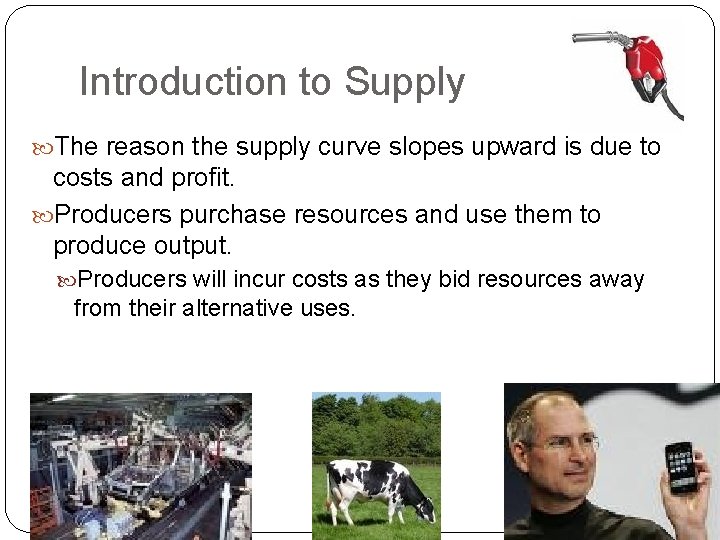
Introduction to Supply The reason the supply curve slopes upward is due to costs and profit. Producers purchase resources and use them to produce output. Producers will incur costs as they bid resources away from their alternative uses.
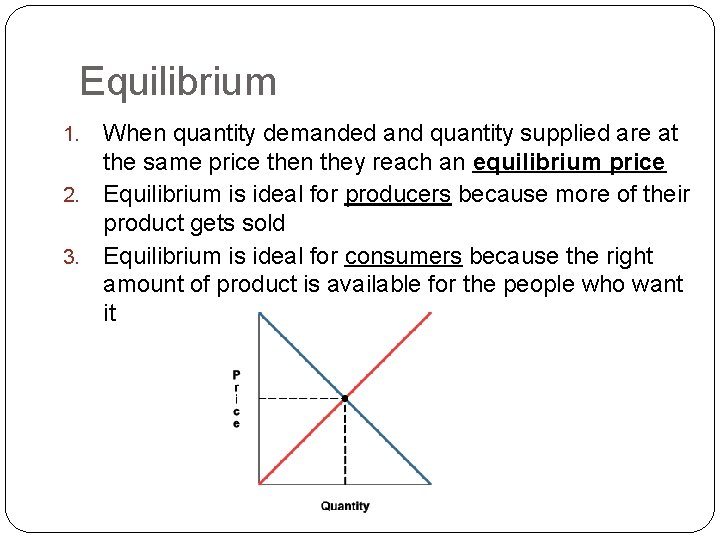
Equilibrium When quantity demanded and quantity supplied are at the same price then they reach an equilibrium price 2. Equilibrium is ideal for producers because more of their product gets sold 3. Equilibrium is ideal for consumers because the right amount of product is available for the people who want it 1.
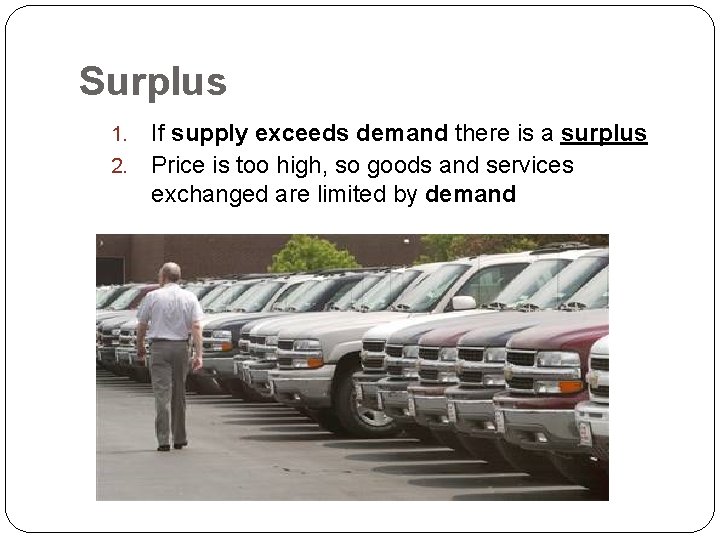
Surplus If supply exceeds demand there is a surplus 2. Price is too high, so goods and services exchanged are limited by demand 1.
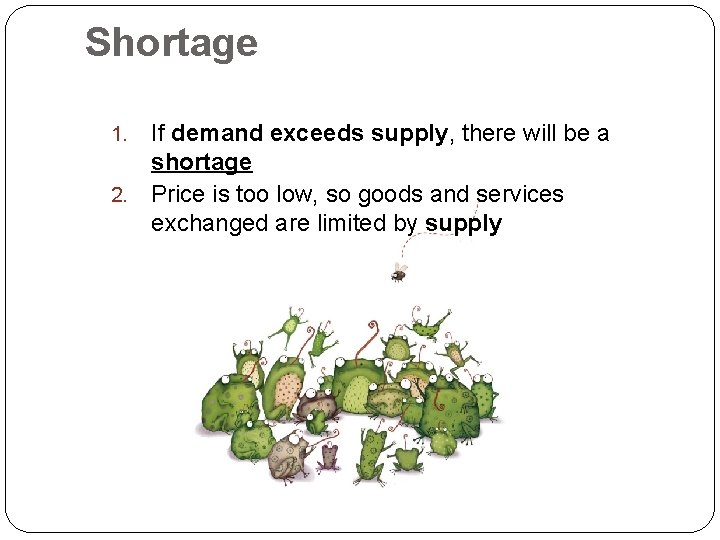
Shortage If demand exceeds supply, there will be a shortage 2. Price is too low, so goods and services exchanged are limited by supply 1.
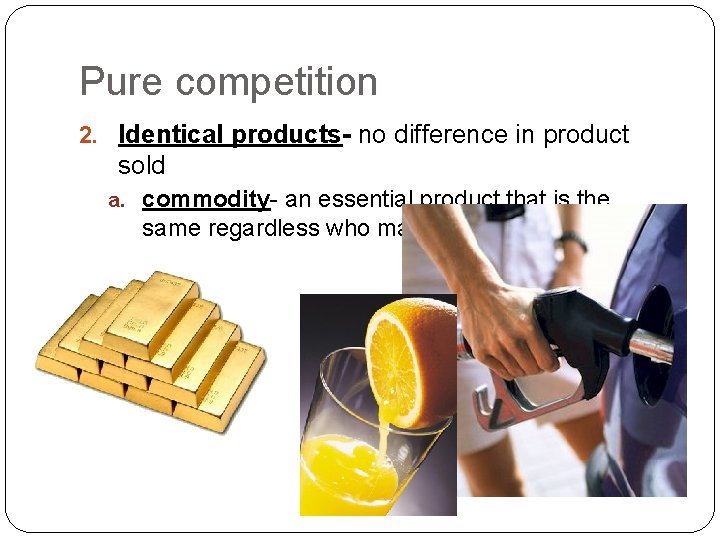
Pure competition 2. Identical products- no difference in product sold a. commodity- an essential product that is the same regardless who makes or sells it
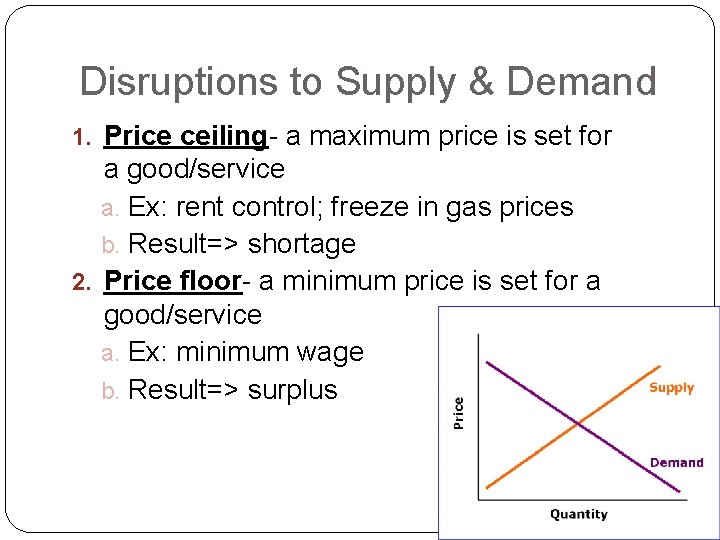
Disruptions to Supply & Demand 1. Price ceiling- a maximum price is set for a good/service a. Ex: rent control; freeze in gas prices b. Result=> shortage 2. Price floor- a minimum price is set for a good/service a. Ex: minimum wage b. Result=> surplus
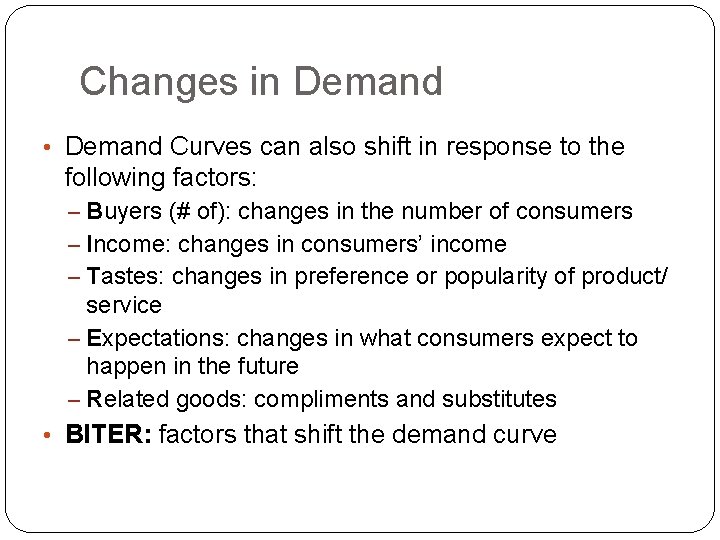
Changes in Demand • Demand Curves can also shift in response to the following factors: – Buyers (# of): changes in the number of consumers – Income: changes in consumers’ income – Tastes: changes in preference or popularity of product/ service – Expectations: changes in what consumers expect to happen in the future – Related goods: compliments and substitutes • BITER: factors that shift the demand curve
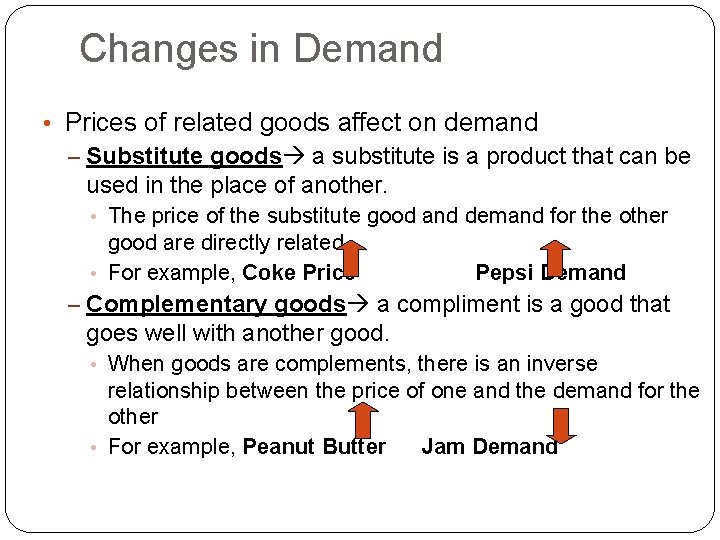
Changes in Demand • Prices of related goods affect on demand – Substitute goods a substitute is a product that can be used in the place of another. • The price of the substitute good and demand for the other good are directly related • For example, Coke Price Pepsi Demand – Complementary goods a compliment is a good that goes well with another good. • When goods are complements, there is an inverse relationship between the price of one and the demand for the other • For example, Peanut Butter Jam Demand
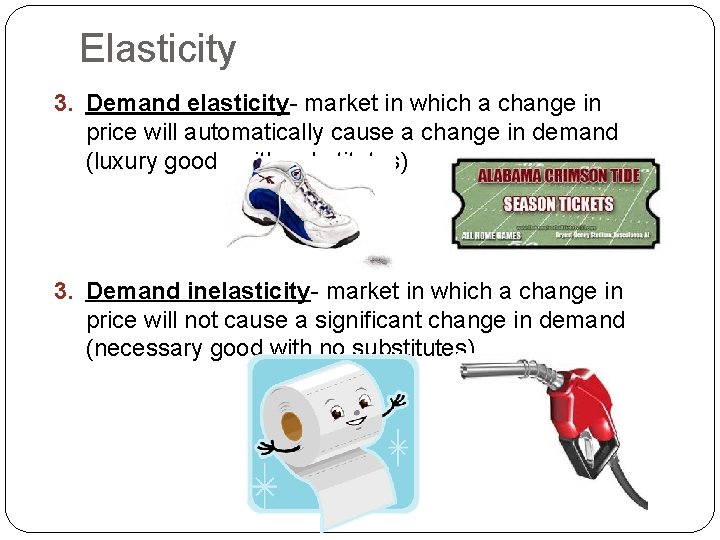
Elasticity 3. Demand elasticity- market in which a change in price will automatically cause a change in demand (luxury goods with substitutes) 3. Demand inelasticity- market in which a change in price will not cause a significant change in demand (necessary good with no substitutes)
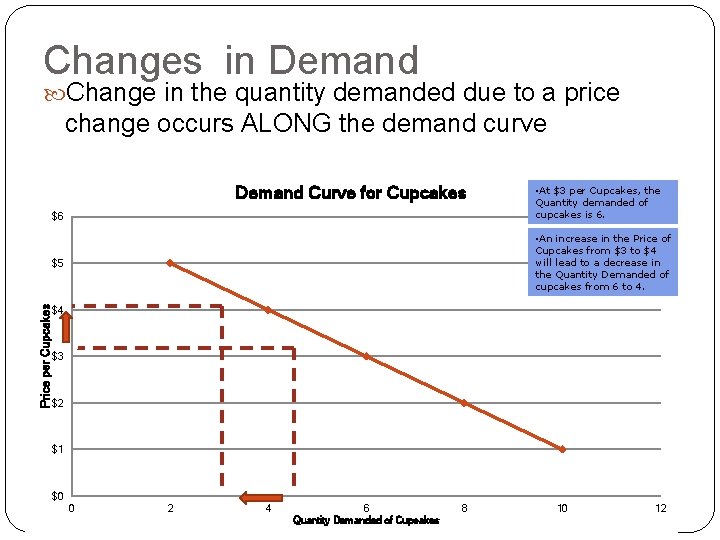
Changes in Demand Change in the quantity demanded due to a price change occurs ALONG the demand curve Demand Curve for Cupcakes $6 • An increase in the Price of Cupcakes from $3 to $4 will lead to a decrease in the Quantity Demanded of cupcakes from 6 to 4. $5 Price per Cupcakes • At $3 per Cupcakes, the Quantity demanded of cupcakes is 6. $4 $3 $2 $1 $0 0 2 4 6 Quantity Demanded of Cupcakes 8 10 12
Changes in Demand Changes in any of the factors other than price causes the demand curve to shift either: Decrease in Demand shifts to the Left (Less demanded at each price) OR Increase in Demand shifts to the Right (More demanded at each price)
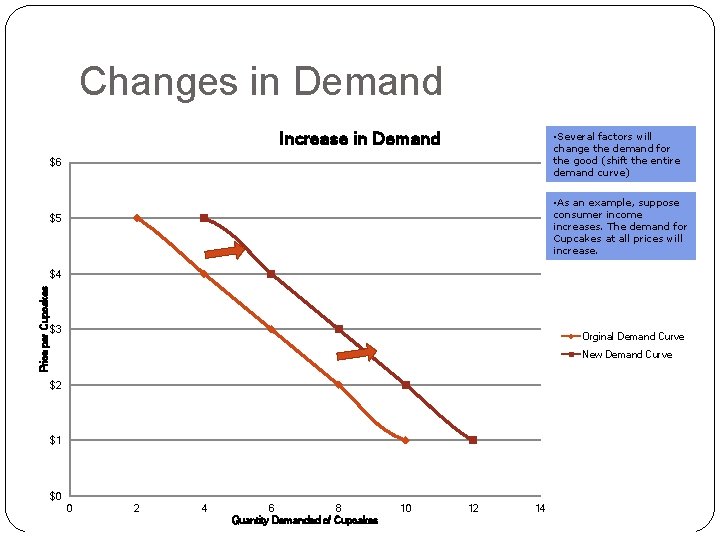
Changes in Demand Increase Curve in Demand for Widgets • Several factors will change the demand for the good (shift the entire demand curve) $6 $6 • As an example, suppose consumer income increases. The demand for Cupcakes at all prices will increase. $5 $5 Price per Cupcakes Price per Widget $4 $4 $3 $3 Orginal Demand Curve for Widgets New Demand Curve $2 $2 $1 $1 $0 $0 00 2 2 4 4 6 6 8 8 Quantity Demanded of of Widgets Cupcakes 10 10 12 12 14
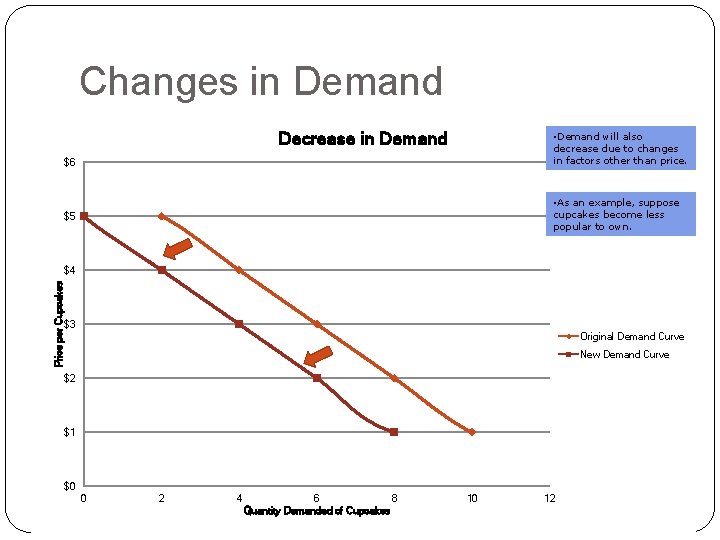
Changes in Demand Decrease Curve in Demand for Widgets • Demand will also decrease due to changes in factors other than price. $6$6 • As an example, suppose cupcakes become less popular to own. $5$5 Price per Widget Price per Cupcakes $4$4 $3 $3 Original Demand Curve for Widgets New Demand Curve $2 $2 $1 $1 $0 $0 0 0 2 2 4 4 6 8 Quantity Demanded of Cupcakes Quantity Demanded of Widgets 10 10 12 12
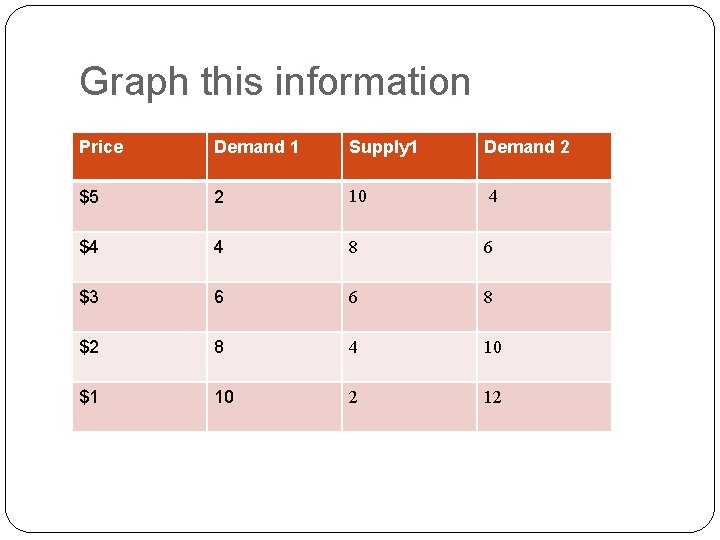
Graph this information Price Demand 1 Supply 1 Demand 2 $5 2 10 4 $4 4 8 6 $3 6 6 8 $2 8 4 10 $1 10 2 12
Changes in Supply • Supply Curves can also shift in response to the following factors: – Subsidies and taxes: government subsides encourage production, while taxes discourage production – Technology: improvements in production increase ability of firms to supply – Other goods: businesses consider the price of goods they could be producing – Number of sellers: how many firms are in the market – Expectations: businesses consider future prices and economic conditions – Resource costs: cost to purchase factors of production will influence business decisions • STONER: factors that shift the supply curve
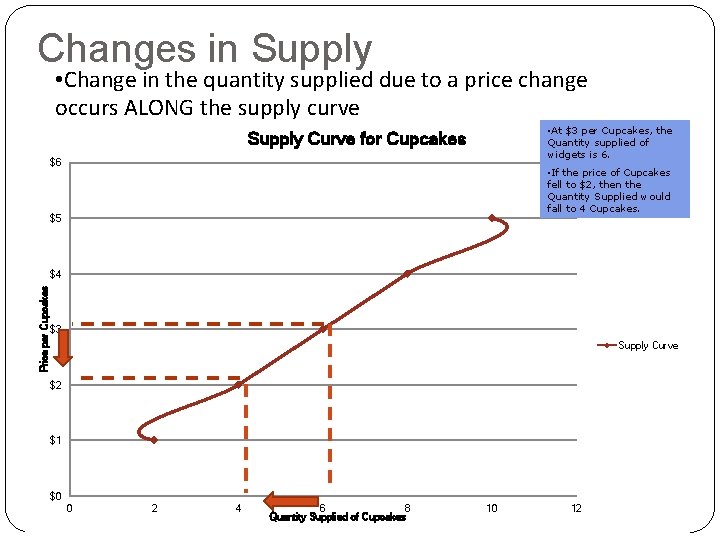
Changes in Supply • Change in the quantity supplied due to a price change occurs ALONG the supply curve • At $3 per Cupcakes, the Quantity supplied of widgets is 6. Supply Curve for Cupcakes $6 • If the price of Cupcakes fell to $2, then the Quantity Supplied would fall to 4 Cupcakes. $5 Price per Cupcakes $4 $3 Supply Curve $2 $1 $0 0 2 4 6 8 Quantity Supplied of Cupcakes 10 12
Changes in Supply Changes in any of the factors other than price causes the supply curve to shift either: Decrease in Supply shifts to the Left (Less supplied at each price) OR Increase in Supply shifts to the Right (More supplied at each price)
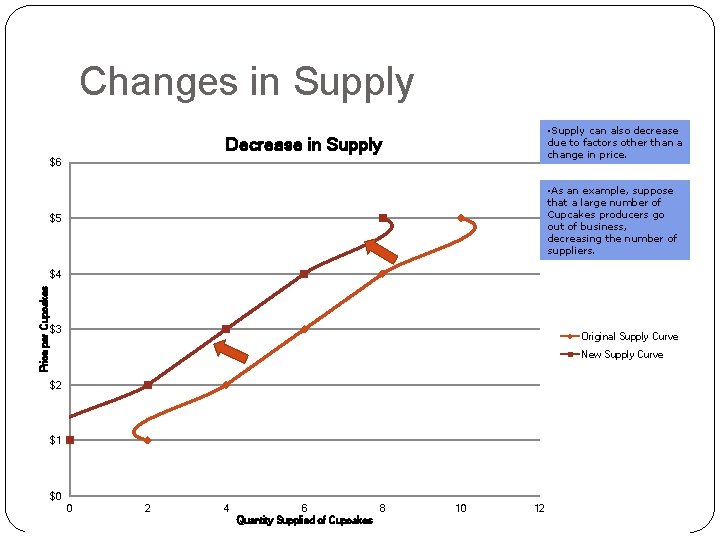
Changes in Supply • Supply can also decrease due to factors other than a change in price. Supplyin. Curve for Widgets Decrease Supply $6 • As an example, suppose that a large number of Cupcakes producers go out of business, decreasing the number of suppliers. $5 Priceper per. Cupcakes Widget $4 $3 Original Supply Curve New Supply Curve $2 $1 $0 0 22 4 4 6 6 8 Quantity Supplied of Cupcakes of Widgets 8 10 10 12 12
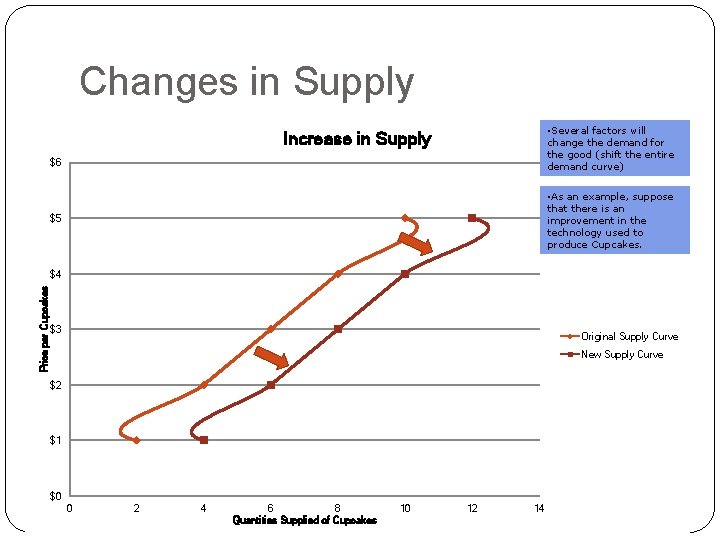
Changes in Supply • Several factors will change the demand for the good (shift the entire demand curve) Supply Increase Curveinfor Supply Widgets $6 • As an example, suppose that there is an improvement in the technology used to produce Cupcakes. $5 Priceper per. Cupcakes Widget $4 $3 Original Supply Curve New Supply Curve $2 $1 $0 0 2 2 4 4 6 6 8 Quantities Quantity Supplied of Cupcakes of Widgets 10 8 12 10 14 12
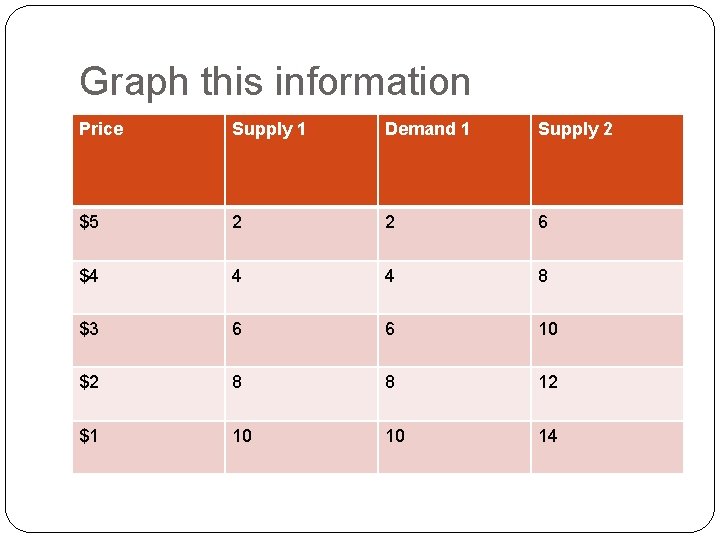
Graph this information Price Supply 1 Demand 1 Supply 2 $5 2 2 6 $4 4 4 8 $3 6 6 10 $2 8 8 12 $1 10 10 14
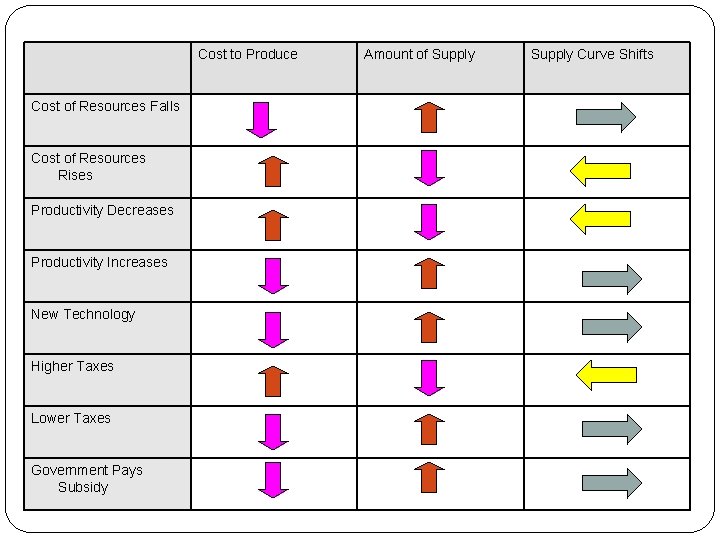
Cost to Produce Cost of Resources Falls Cost of Resources Rises Productivity Decreases Productivity Increases New Technology Higher Taxes Lower Taxes Government Pays Subsidy Amount of Supply Curve Shifts
Supply and Demand at Work Markets bring buyers and sellers together. The forces of supply and demand work together in markets to establish prices. In our economy, prices form the basis of economic decisions. Essential Question: Why are prices the basis of our economic decisions?
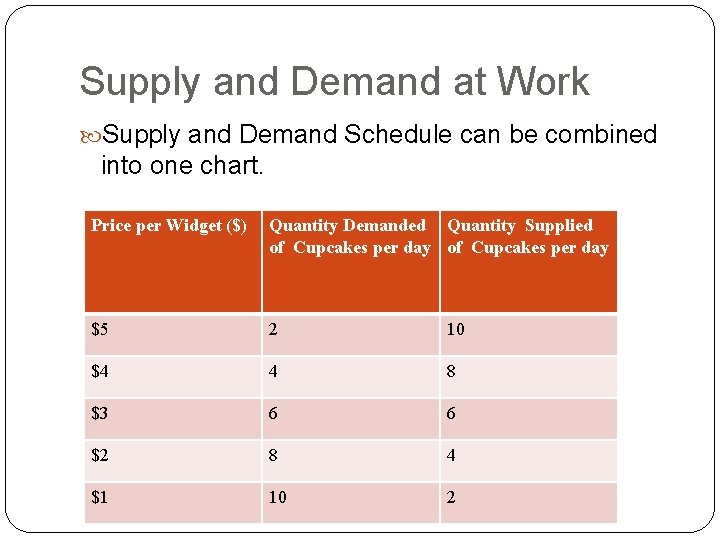
Supply and Demand at Work Supply and Demand Schedule can be combined into one chart. Price per Widget ($) Quantity Demanded Quantity Supplied of Cupcakes per day $5 2 10 $4 4 8 $3 6 6 $2 8 4 $1 10 2
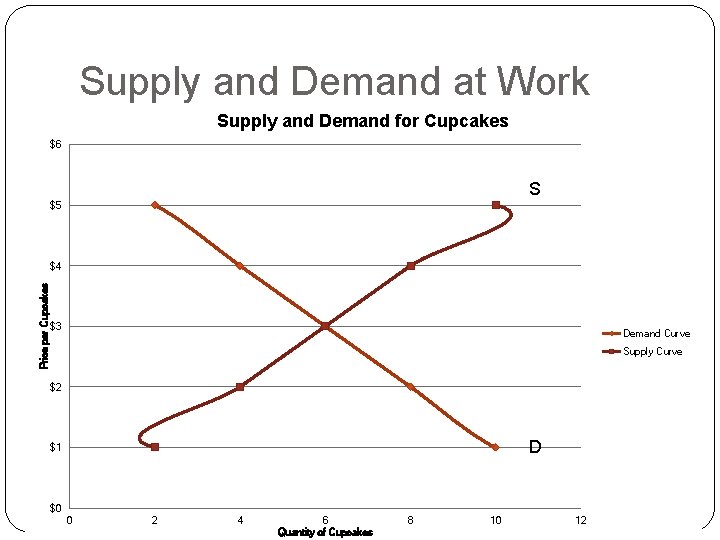
Supply and Demand at Work Supply and Demand for Cupcakes $6 S $5 Price per Cupcakes $4 $3 Demand Curve Supply Curve $2 D $1 $0 0 2 4 6 Quantity of Cupcakes 8 10 12
Supply and Demand at Work • A surplus is the amount by which the quantity supplied is higher than the quantity demanded. – – – A surplus signals that the price is too high. At that price, consumers will not buy all of the product that suppliers are willing to supply. In a competitive market, a surplus will not last. Sellers will lower their price to sell their goods.
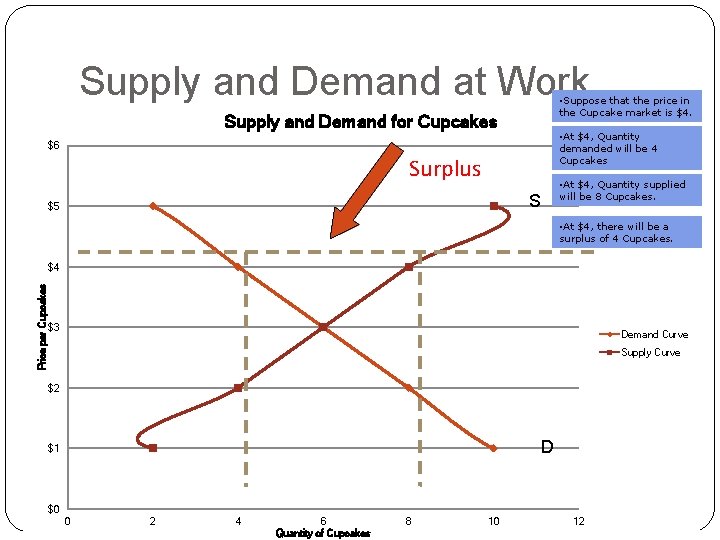
Supply and Demand at Work • Suppose that the price in the Cupcake market is $4. Supply and Demand for Cupcakes • At $4, Quantity demanded will be 4 Cupcakes $6 Surplus • At $4, Quantity supplied will be 8 Cupcakes. S $5 • At $4, there will be a surplus of 4 Cupcakes. Price per Cupcakes $4 $3 Demand Curve Supply Curve $2 D $1 $0 0 2 4 6 Quantity of Cupcakes 8 10 12
Supply and Demand at Work A shortage is the amount by which the quantity demanded is higher than the quantity supplied A shortage signals that the price is too low. At that price, suppliers will not supply all of the product that consumers are willing to buy. In a competitive market, a shortage will not last. Sellers will raise their price.
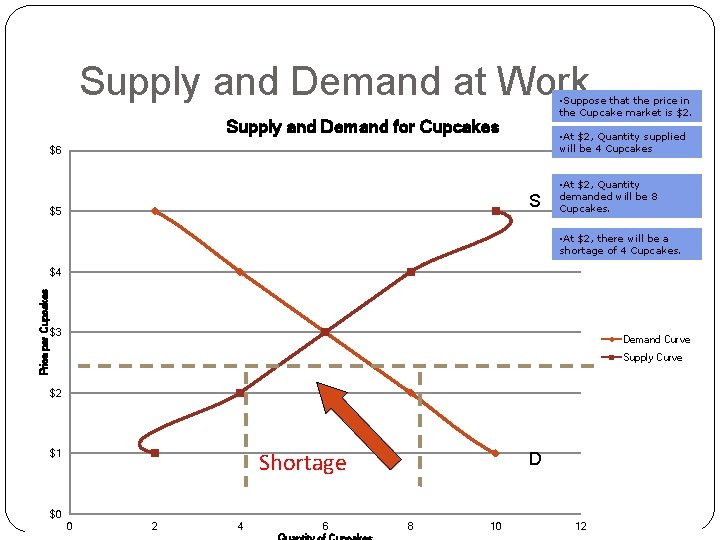
Supply and Demand at Work • Suppose that the price in the Cupcake market is $2. Supply and Demand for Cupcakes $6 • At $2, Quantity supplied will be 4 Cupcakes $5 • At $2, Quantity demanded will be 8 Cupcakes. S • At $2, there will be a shortage of 4 Cupcakes. Price per Cupcakes $4 $3 Demand Curve Supply Curve $2 Shortage $1 D $0 0 2 4 6 8 10 12
Supply and Demand at Work • When operating without restriction, our market economy eliminates shortages and surpluses. – – • Over time, a surplus forces the price down and a shortage forces the price up until supply and demand are balanced. The point where they achieve balance is the equilibrium price. At this price, neither a surplus nor a shortage exists. Once the market price reaches equilibrium, it tends to stay there until either supply or demand changes. – When that happens, a temporary surplus or shortage occurs until the price adjusts to reach a new equilibrium price.
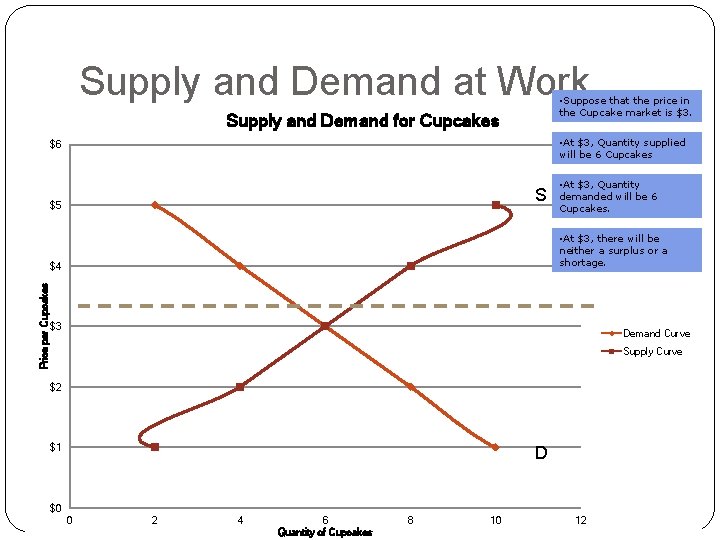
Supply and Demand at Work • Suppose that the price in the Cupcake market is $3. Supply and Demand for Cupcakes • At $3, Quantity supplied will be 6 Cupcakes $6 S $5 • At $3, there will be neither a surplus or a shortage. $4 Price per Cupcakes • At $3, Quantity demanded will be 6 Cupcakes. $3 Demand Curve Supply Curve $2 $1 D $0 0 2 4 6 Quantity of Cupcakes 8 10 12
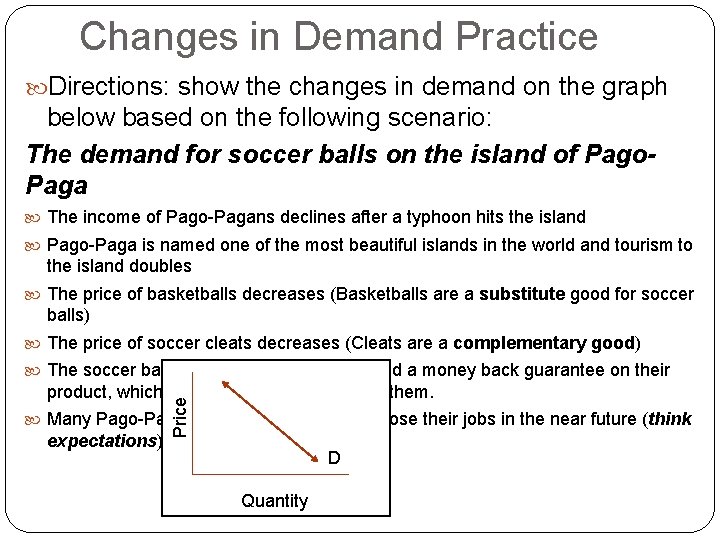
Changes in Demand Practice Directions: show the changes in demand on the graph below based on the following scenario: The demand for soccer balls on the island of Pago. Paga The income of Pago-Pagans declines after a typhoon hits the island Pago-Paga is named one of the most beautiful islands in the world and tourism to the island doubles The price of basketballs decreases (Basketballs are a substitute good for soccer balls) The price of soccer cleats decreases (Cleats are a complementary good) The soccer ball manufacturer decides to add a money back guarantee on their Price product, which increases the popularity for them. Many Pago-Pagans believe that they may lose their jobs in the near future (think expectations) D Quantity
Price 7. Come up with your own story about soccer balls and the Pago. Pagans. Write down the story, draw the change in demand based on the story, and explain why demand changed. D Quantity
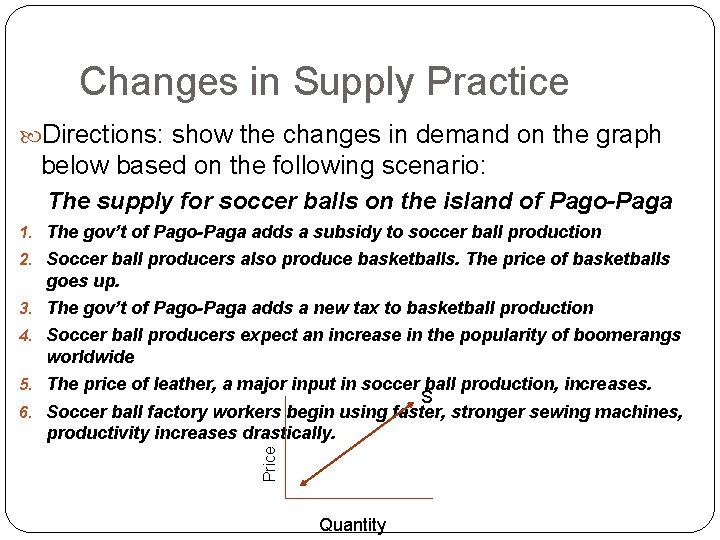
Changes in Supply Practice Directions: show the changes in demand on the graph below based on the following scenario: The supply for soccer balls on the island of Pago-Paga 1. The gov’t of Pago-Paga adds a subsidy to soccer ball production 2. Soccer ball producers also produce basketballs. The price of basketballs goes up. 3. The gov’t of Pago-Paga adds a new tax to basketball production 4. Soccer ball producers expect an increase in the popularity of boomerangs worldwide 5. The price of leather, a major input in soccer ball production, increases. Price S 6. Soccer ball factory workers begin using faster, stronger sewing machines, productivity increases drastically. Quantity
Price 7. Come up with your own story about soccer balls and the Pago. Pagans. Write down the story, draw the change in supply based on the story, and explain why supply changed. S Quantity
Demand Practice Answers
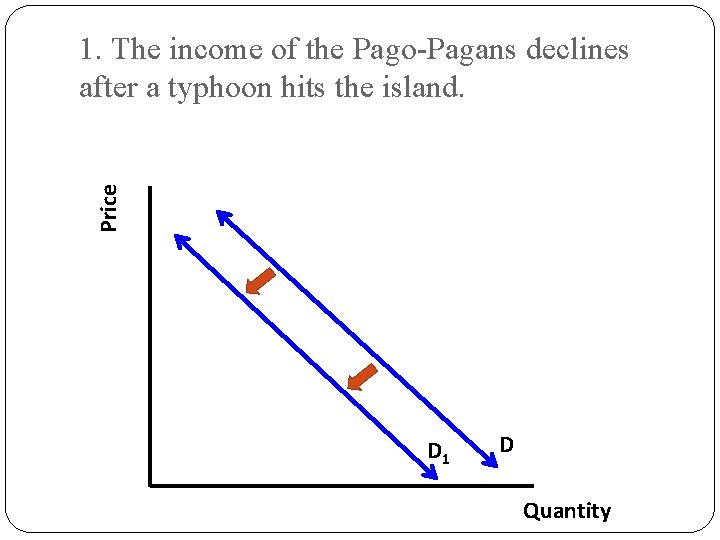
Price 1. The income of the Pago-Pagans declines after a typhoon hits the island. D 1 D Quantity
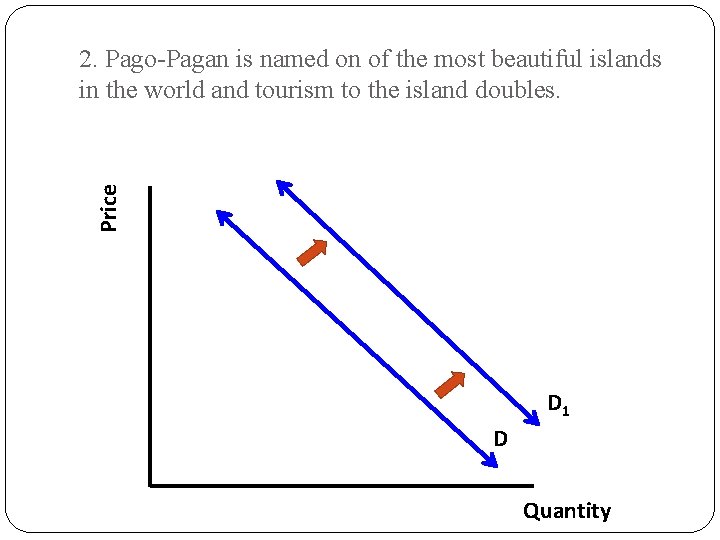
Price 2. Pago-Pagan is named on of the most beautiful islands in the world and tourism to the island doubles. D 1 D Quantity
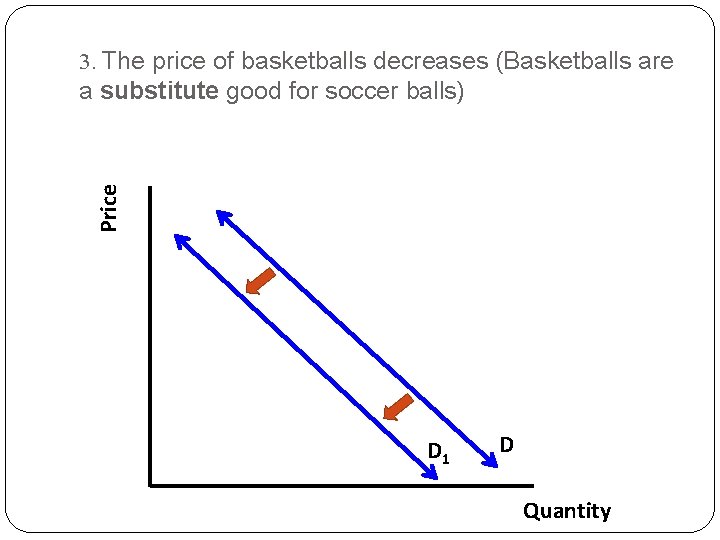
3. The price of basketballs decreases (Basketballs are Price a substitute good for soccer balls) D 1 D Quantity
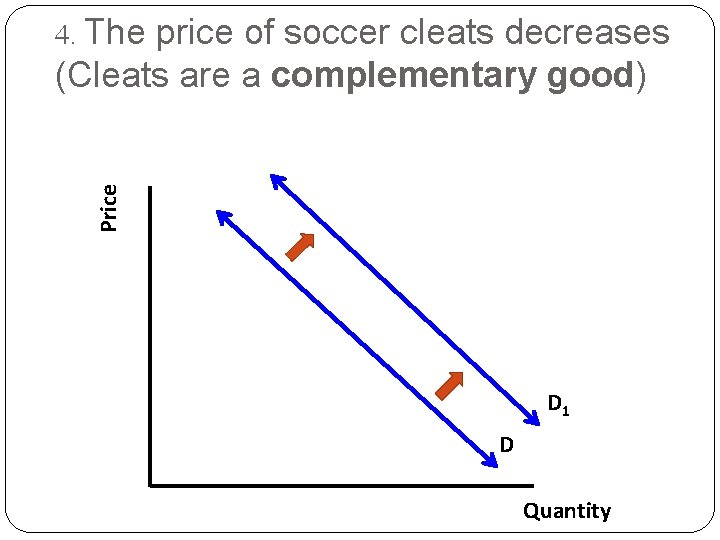
price of soccer cleats decreases (Cleats are a complementary good) Price 4. The D 1 D Quantity
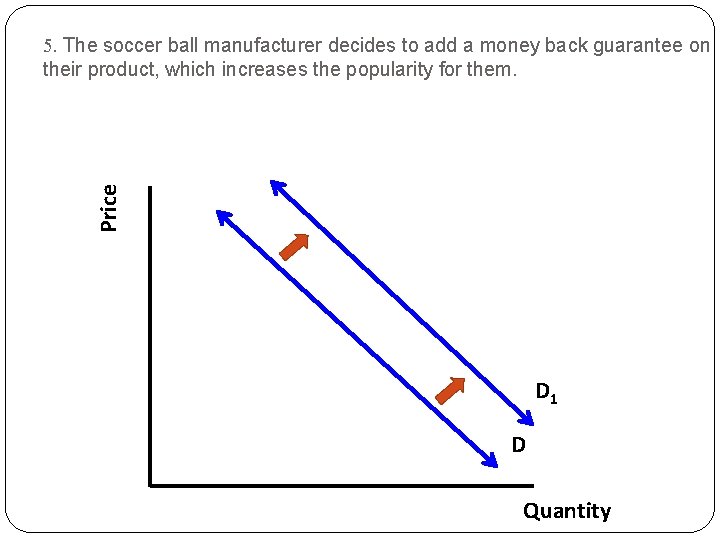
Price 5. The soccer ball manufacturer decides to add a money back guarantee on their product, which increases the popularity for them. D 1 D Quantity
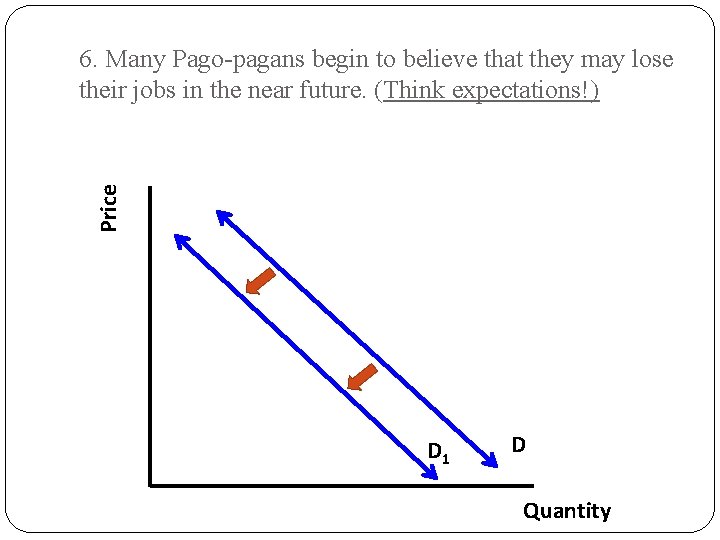
Price 6. Many Pago-pagans begin to believe that they may lose their jobs in the near future. (Think expectations!) D 1 D Quantity
Supply Practice Answers
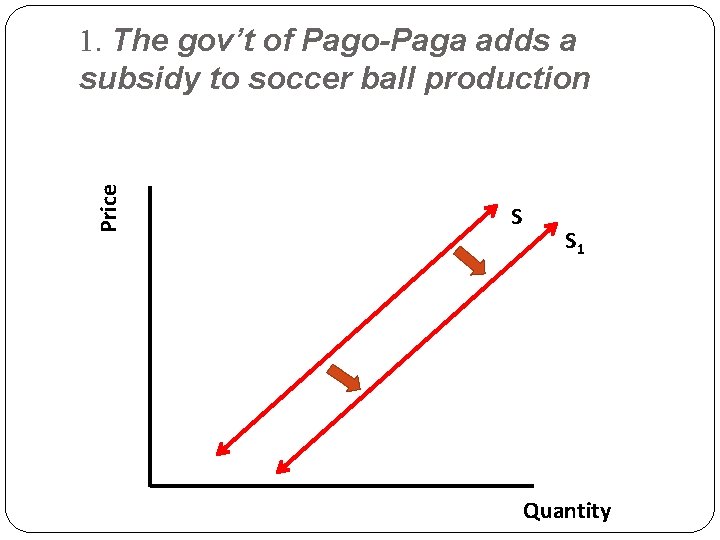
Price 1. The gov’t of Pago-Paga adds a subsidy to soccer ball production S S 1 Quantity
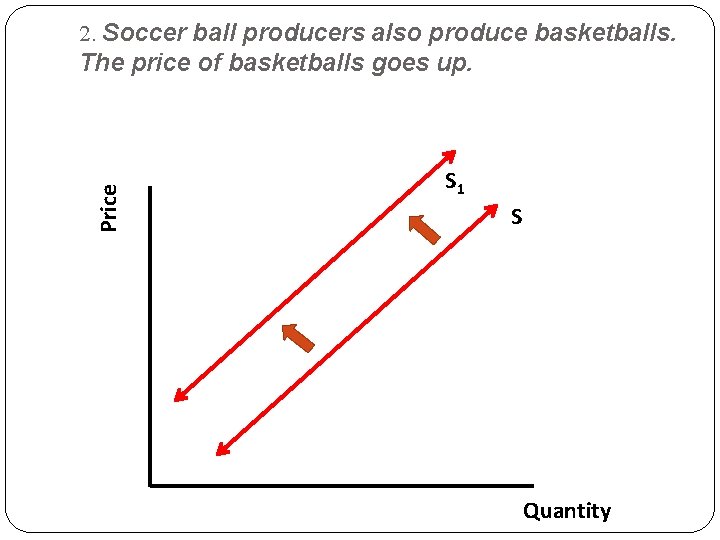
2. Soccer ball producers also produce basketballs. Price The price of basketballs goes up. S 1 S Quantity
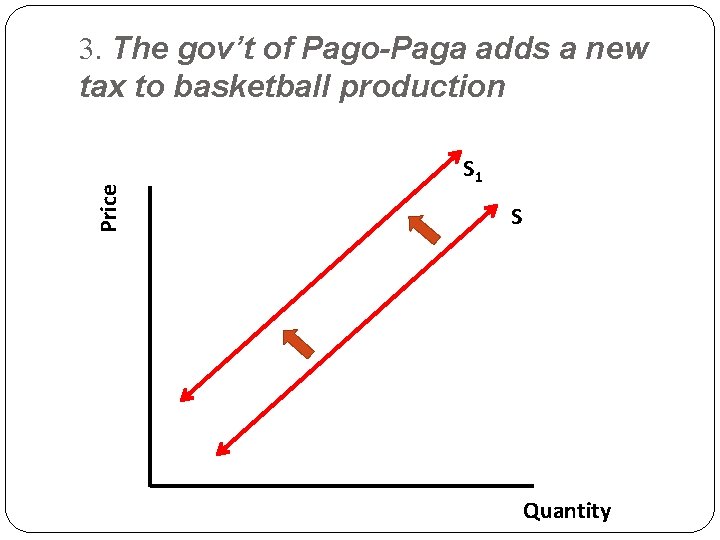
Price 3. The gov’t of Pago-Paga adds a new tax to basketball production S 1 S Quantity
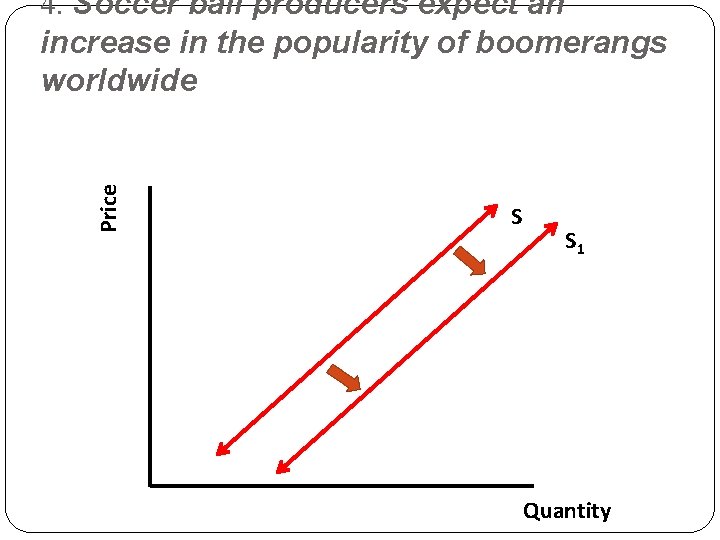
Price 4. Soccer ball producers expect an increase in the popularity of boomerangs worldwide S S 1 Quantity
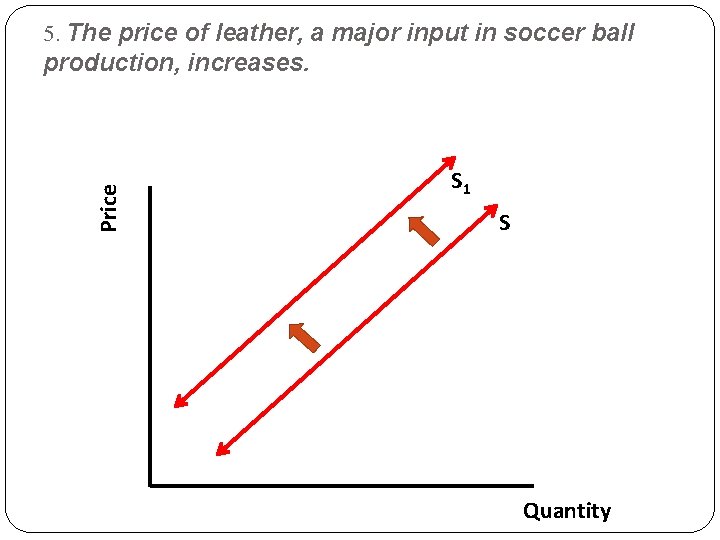
5. The price of leather, a major input in soccer ball Price production, increases. S 1 S Quantity
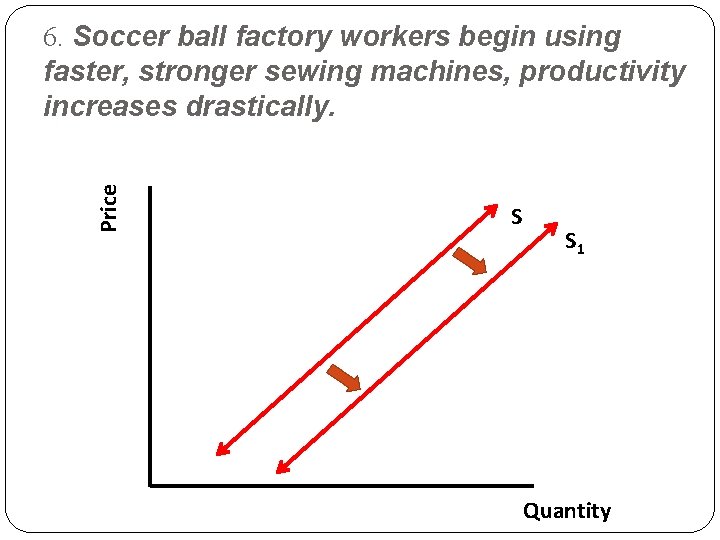
Price 6. Soccer ball factory workers begin using faster, stronger sewing machines, productivity increases drastically. S S 1 Quantity
- Slides: 62