
Supply Chain Planning and Design for Biodiesel Production
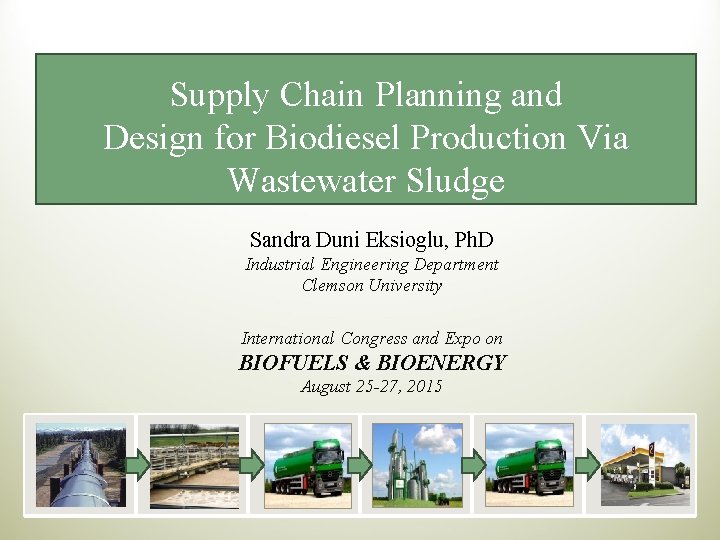
Supply Chain Planning and Design for Biodiesel Production Via Wastewater Sludge Sandra Duni Eksioglu, Ph. D Industrial Engineering Department Clemson University International Congress and Expo on BIOFUELS & BIOENERGY August 25 -27, 2015
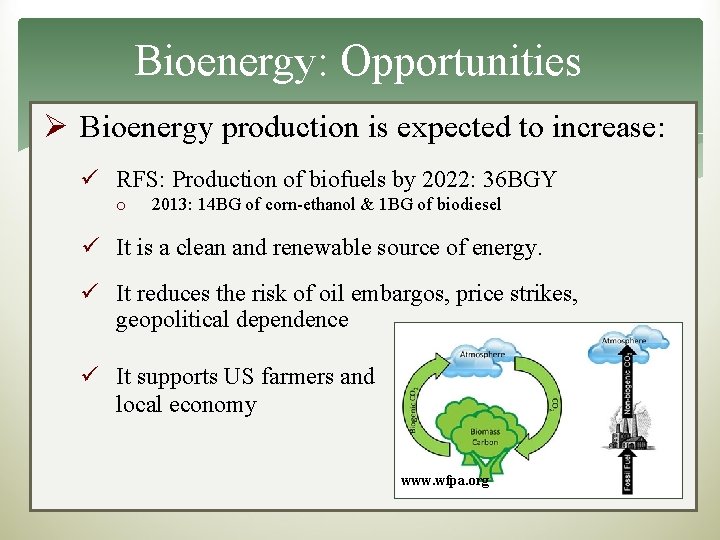
Bioenergy: Opportunities Ø Bioenergy production is expected to increase: ü RFS: Production of biofuels by 2022: 36 BGY o 2013: 14 BG of corn-ethanol & 1 BG of biodiesel ü It is a clean and renewable source of energy. ü It reduces the risk of oil embargos, price strikes, geopolitical dependence ü It supports US farmers and local economy www. wfpa. org
Bioenergy: Major Challenges Ø Technological challenges Ø Food versus fuel debate Ø Biomass logistical/transportation challenges: ü Biomass supply is constrained by land availability ü Biomass is seasonal ü Biomass looses dry matter with time ü Production yields are uncertain ü Bulky & difficult to transport ü Widely dispersed geographically ü Small & medium-sized farms
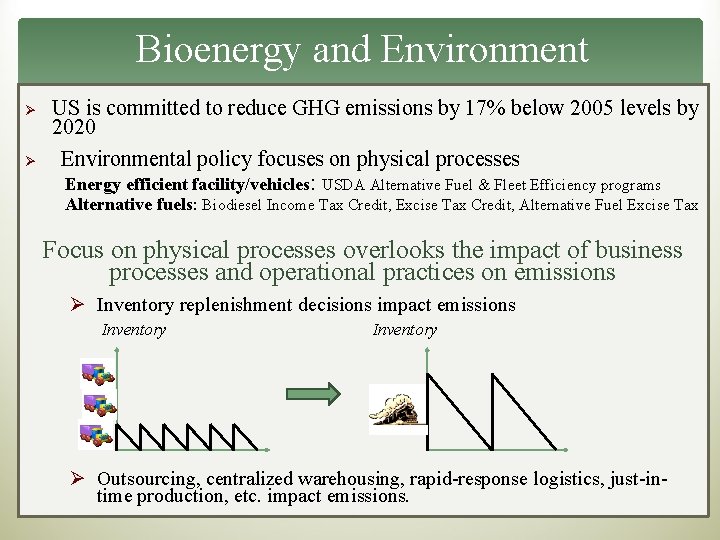
Bioenergy and Environment Ø Ø US is committed to reduce GHG emissions by 17% below 2005 levels by 2020 Environmental policy focuses on physical processes Energy efficient facility/vehicles: USDA Alternative Fuel & Fleet Efficiency programs Alternative fuels: Biodiesel Income Tax Credit, Excise Tax Credit, Alternative Fuel Excise Tax Focus on physical processes overlooks the impact of business processes and operational practices on emissions Ø Inventory replenishment decisions impact emissions Inventory Ø Outsourcing, centralized warehousing, rapid-response logistics, just-intime production, etc. impact emissions.
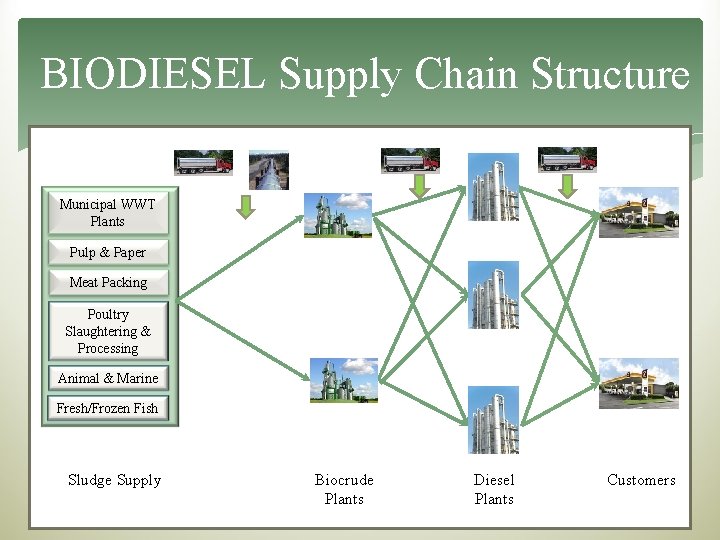
BIODIESEL Supply Chain Structure Municipal WWT Plants Pulp & Paper Meat Packing Poultry Slaughtering & Processing Animal & Marine Fresh/Frozen Fish Sludge Supply Biocrude Plants Diesel Plants Customers

BIODIESEL Supply Chain Ø Research Questions Estimate supply-chain related costs for production of biodiesel. Ø Biomass transportation (sludge): Ø What factors have a great impact to the transportation cost of sludge? Ø Under what conditions pipeline becomes a viable transportation mode? Ø Supply chain design and management: Ø Should a biocrude plant be co-located at a WWT facility? Ø What factors have a great impact on the supply chain costs? Provide insights about biodiesel supply chain related costs to potential investors.
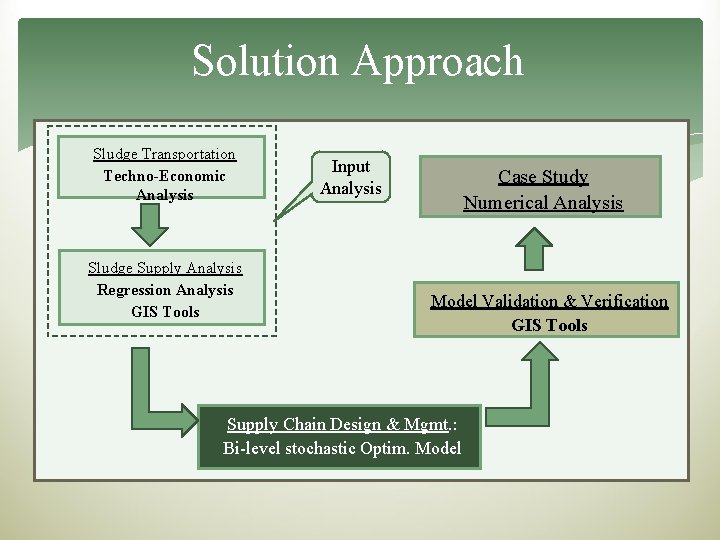
Solution Approach Sludge Transportation Techno-Economic Analysis Sludge Supply Analysis Regression Analysis GIS Tools Input Analysis Case Study Numerical Analysis Model Validation & Verification GIS Tools Supply Chain Design & Mgmt. : Bi-level stochastic Optim. Model
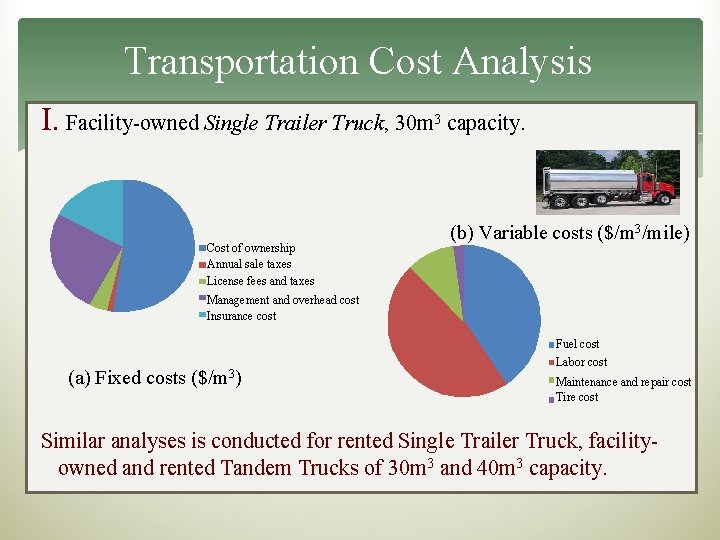
Transportation Cost Analysis I. Facility-owned Single Trailer Truck, 30 m 3 capacity. Cost of ownership Annual sale taxes License fees and taxes (b) Variable costs ($/m 3/mile) Management and overhead cost Insurance cost (a) Fixed costs ($/m 3) Fuel cost Labor cost Maintenance and repair cost Tire cost Similar analyses is conducted for rented Single Trailer Truck, facilityowned and rented Tandem Trucks of 30 m 3 and 40 m 3 capacity.

Transportation Cost Analysis II. Pipeline Transportation of Sludge Smaller the capacity, higher transp. costs.
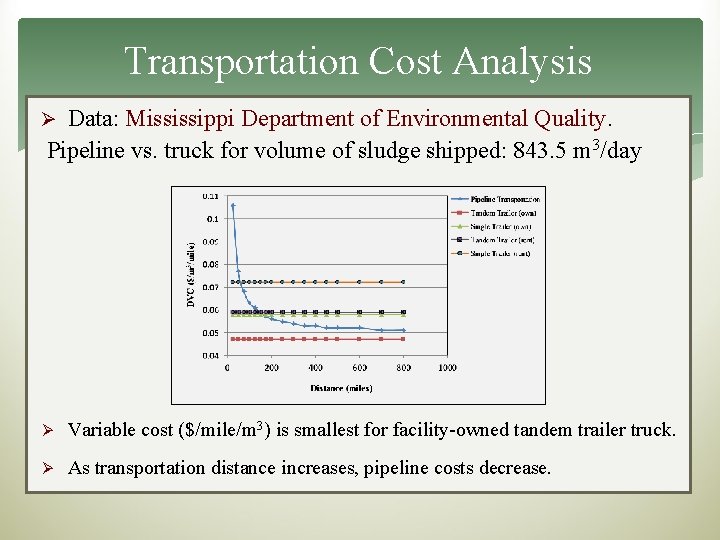
Transportation Cost Analysis Data: Mississippi Department of Environmental Quality. Pipeline vs. truck for volume of sludge shipped: 843. 5 m 3/day Ø Ø Variable cost ($/mile/m 3) is smallest for facility-owned tandem trailer truck. Ø As transportation distance increases, pipeline costs decrease.
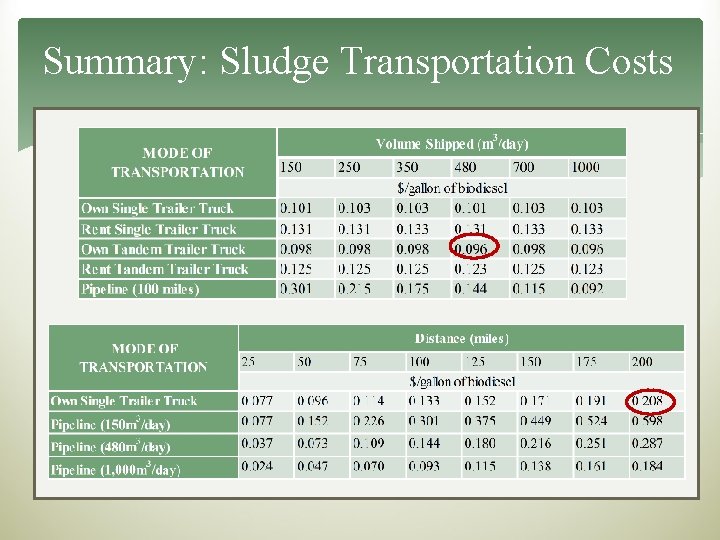
Summary: Sludge Transportation Costs
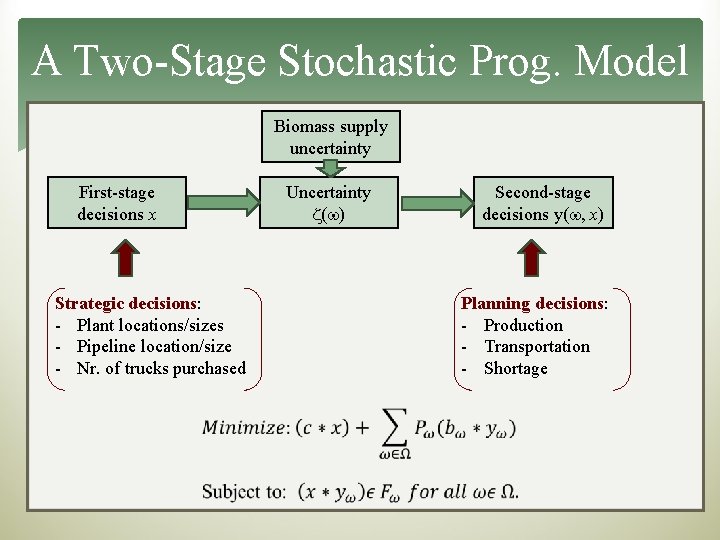
A Two-Stage Stochastic Prog. Model Biomass supply uncertainty First-stage decisions x Strategic decisions: - Plant locations/sizes - Pipeline location/size - Nr. of trucks purchased Uncertainty ( ) Second-stage decisions y( , x) Planning decisions: - Production - Transportation - Shortage
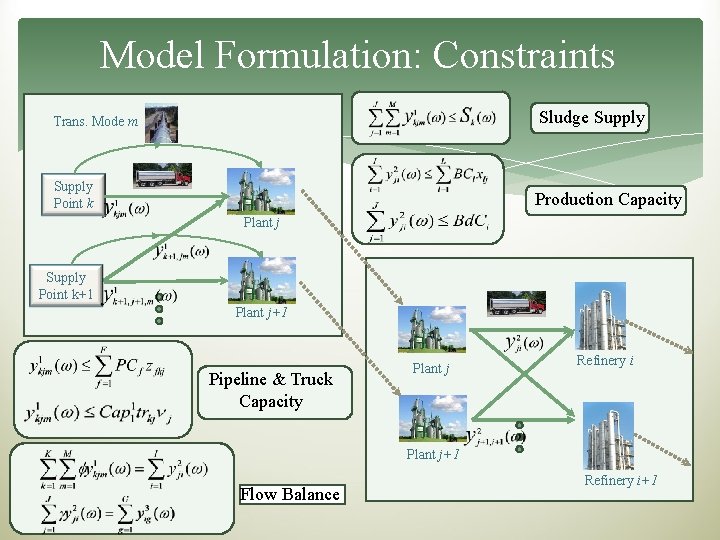
Model Formulation: Constraints Sludge Supply Trans. Mode m Supply Point k Production Capacity Plant j Supply Point k+1 Plant j+1 Pipeline & Truck Capacity Plant j Refinery i Plant j+1 Flow Balance Refinery i+1
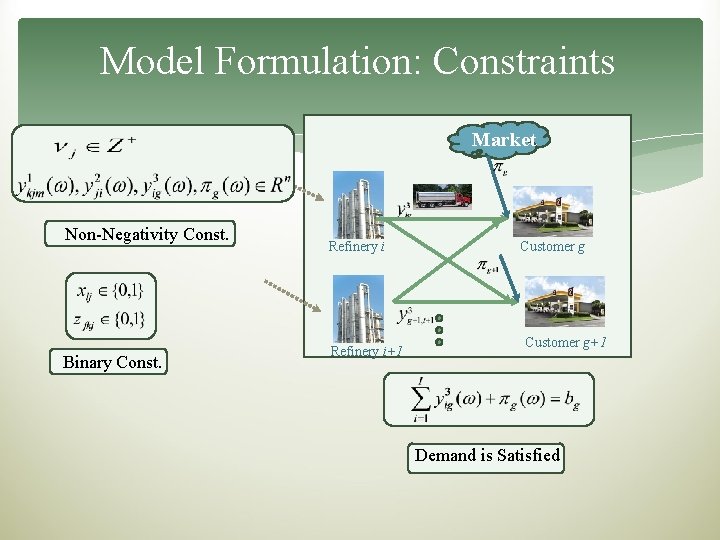
Model Formulation: Constraints Market Non-Negativity Const. Binary Const. Refinery i+1 Customer g+1 Demand is Satisfied
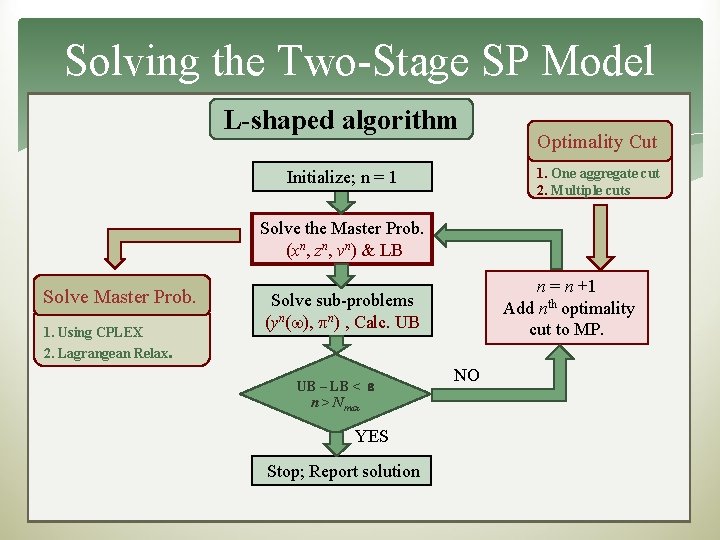
Solving the Two-Stage SP Model L-shaped algorithm Optimality Cut 1. One aggregate cut 2. Multiple cuts Initialize; n = 1 Solve the Master Prob. (xn, zn, vn) & LB Solve Master Prob. 1. Using CPLEX 2. Lagrangean Relax. n = n +1 Add nth optimality cut to MP. Solve sub-problems (yn( ), n) , Calc. UB UB – LB < n > Nmax YES Stop; Report solution NO
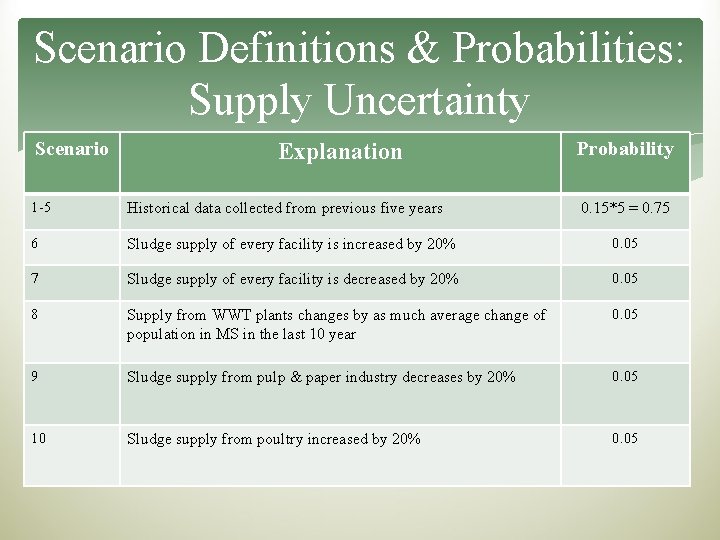
Scenario Definitions & Probabilities: Supply Uncertainty Scenario Explanation Probability 1 -5 Historical data collected from previous five years 6 Sludge supply of every facility is increased by 20% 0. 05 7 Sludge supply of every facility is decreased by 20% 0. 05 8 Supply from WWT plants changes by as much average change of population in MS in the last 10 year 0. 05 9 Sludge supply from pulp & paper industry decreases by 20% 0. 05 10 Sludge supply from poultry increased by 20% 0. 05 0. 15*5 = 0. 75
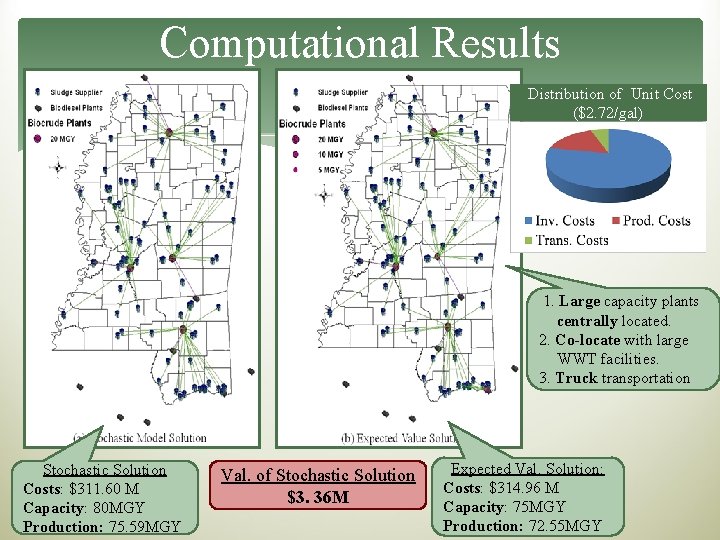
Computational Results Distribution of Unit Cost ($2. 72/gal) 1. Large capacity plants centrally located. 2. Co-locate with large WWT facilities. 3. Truck transportation Stochastic Solution Costs: $311. 60 M Capacity: 80 MGY Production: 75. 59 MGY Val. of Stochastic Solution $3. 36 M Expected Val. Solution: Costs: $314. 96 M Capacity: 75 MGY Production: 72. 55 MGY
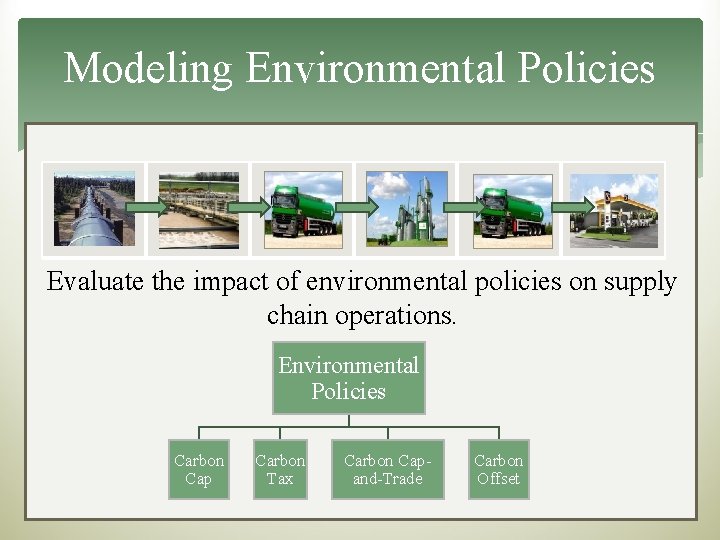
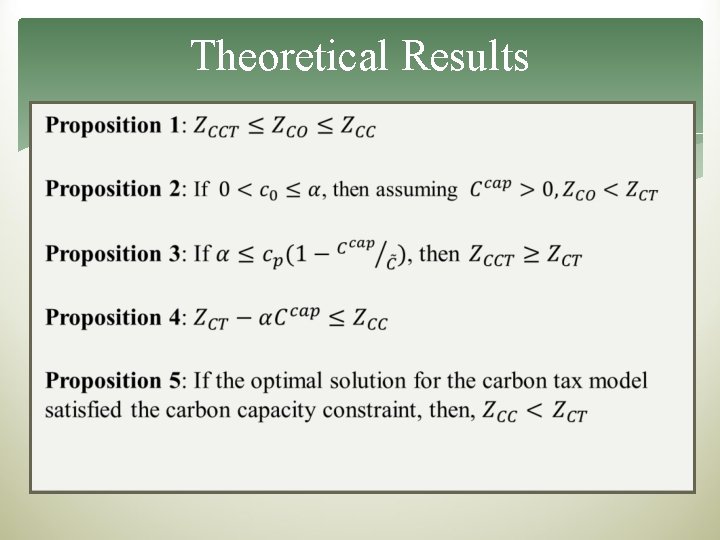
Modeling Environmental Policies Evaluate the impact of environmental policies on supply chain operations. Environmental Policies Carbon Cap Carbon Tax Carbon Capand-Trade Carbon Offset
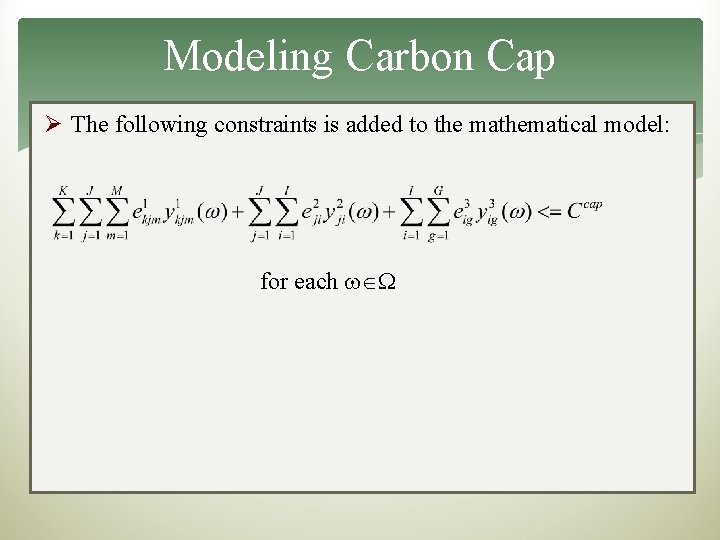
Modeling Carbon Cap Ø The following constraints is added to the mathematical model: for each
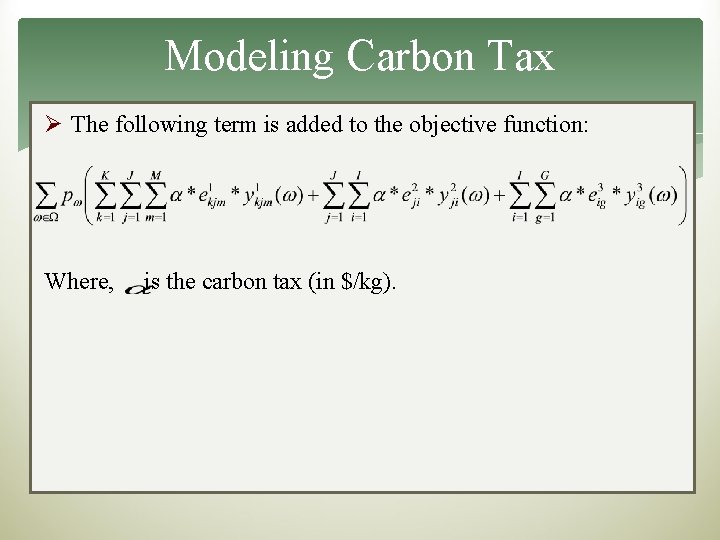
Modeling Carbon Tax Ø The following term is added to the objective function: Where, is the carbon tax (in $/kg).
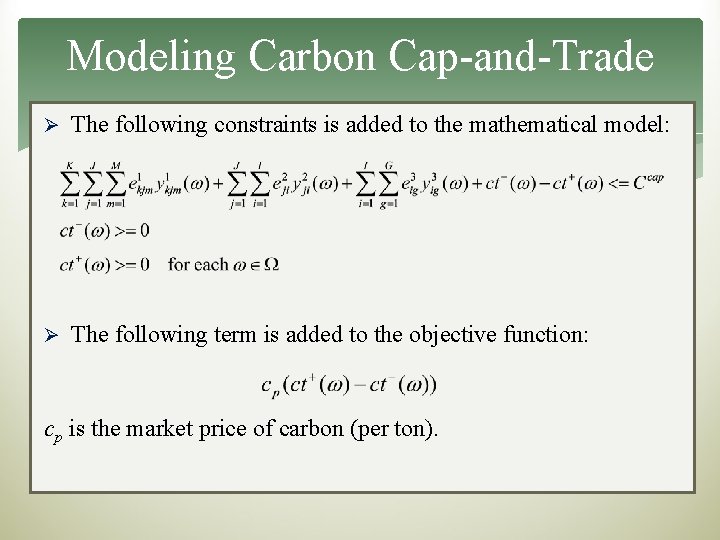
Modeling Carbon Cap-and-Trade Ø The following constraints is added to the mathematical model: Ø The following term is added to the objective function: cp is the market price of carbon (per ton).
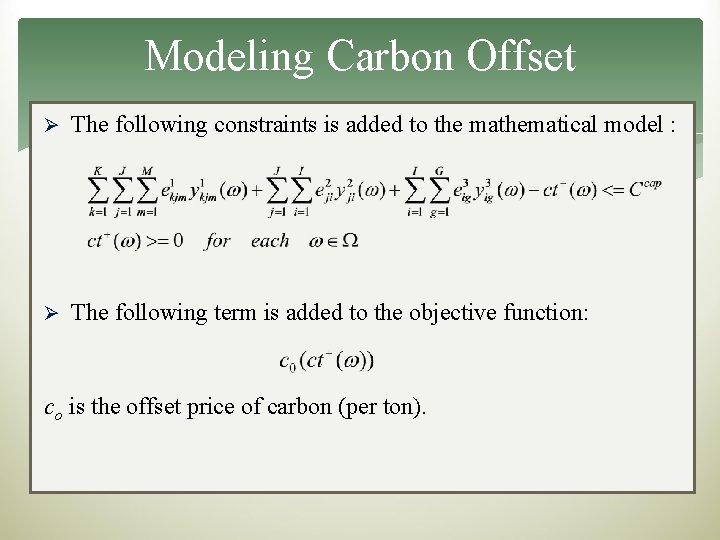
Modeling Carbon Offset Ø The following constraints is added to the mathematical model : Ø The following term is added to the objective function: co is the offset price of carbon (per ton).
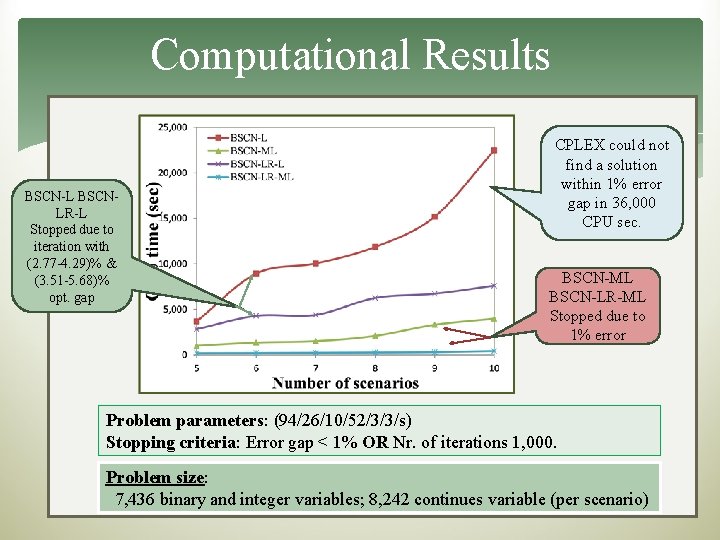
Computational Results BSCN-L BSCNLR-L Stopped due to iteration with (2. 77 -4. 29)% & (3. 51 -5. 68)% opt. gap CPLEX could not find a solution within 1% error gap in 36, 000 CPU sec. BSCN-ML BSCN-LR-ML Stopped due to 1% error Problem parameters: (94/26/10/52/3/3/s) Stopping criteria: Error gap < 1% OR Nr. of iterations 1, 000. Problem size: 7, 436 binary and integer variables; 8, 242 continues variable (per scenario)
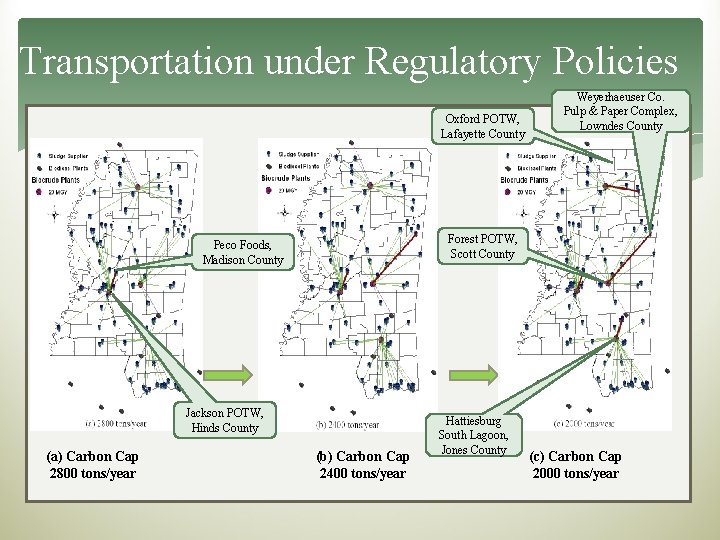
Transportation under Regulatory Policies Oxford POTW, Lafayette County Forest POTW, Scott County Peco Foods, Madison County Jackson POTW, Hinds County (a) Carbon Cap 2800 tons/year Weyerhaeuser Co. Pulp & Paper Complex, Lowndes County (b) Carbon Cap 2400 tons/year Hattiesburg South Lagoon, Jones County (c) Carbon Cap 2000 tons/year
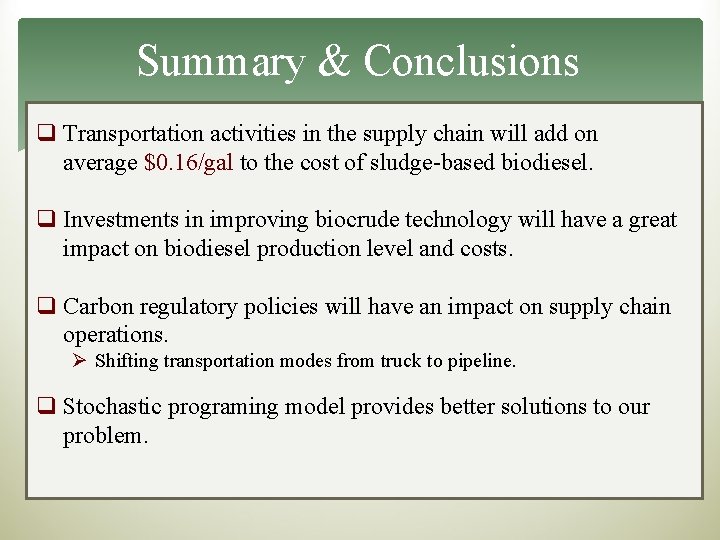
Summary & Conclusions q Transportation activities in the supply chain will add on average $0. 16/gal to the cost of sludge-based biodiesel. q Investments in improving biocrude technology will have a great impact on biodiesel production level and costs. q Carbon regulatory policies will have an impact on supply chain operations. Ø Shifting transportation modes from truck to pipeline. q Stochastic programing model provides better solutions to our problem.
Research Team Ø Department of Industrial Eng. , Clemson Univ. Sandra D. Eksioglu, Ph. D E-mail: seksiog@clemson. edu Mohammad Marufuzzaman E-mail: maruf 237@gmail. com Ø Department of Chemical Eng. Mississippi State Univ. Rafael Hernandez, Ph. D Todd French, Ph. D Andro Mondala, Ph. D Ø Department of Civil & Env. Eng. Mississippi State Univ. Dennis D. Traux, Ph. D

QUESTIONS Sandra D. Eksioglu, Ph. D Clemson University Department of Industrial Engineering seksiog@clemson. edu
Theoretical Results
- Slides: 28