
Supply Chain Operations Serial and Distribution Inventory system
Supply Chain Operations: Serial and Distribution Inventory system Inventory management 吳仲軒 陳薏如

Agenda ¡ Introduction ¡ Different ordering policies ¡ Serial System ¡ Order-up-to-S policies in distribution system ¡ Batch-ordering in distribution system
Introduction-Multi-echelon inventory system ¡ The management of multi-echelon inventory 在供應鏈操作上之目標 1. 降低訂貨成本 2. 供應鏈資金維持 3. 提高客戶服務
Introduction-Different system structures 本文主要介紹存貨系統之分配 ¡ 下圖為 單一Warehouse與 多零售商 (Retailers)的Two-level distribution system ¡

Introduction-Different system structures ¡ Fig 1 在此圖中,在多樣化產品 生產時Central warehouse可 為產品的最終組裝點。而 Retailers則視為產品倉庫 Central warehouse Retailers Fig. 1. Two-level distribution inventory system
Introduction-Different system structures ¡ 在分配系統中,每一installation將最多只有 一個Predecessor,反過來說也將最多只有 一個Successor。在此情況下我們將此系統 稱為Serial system
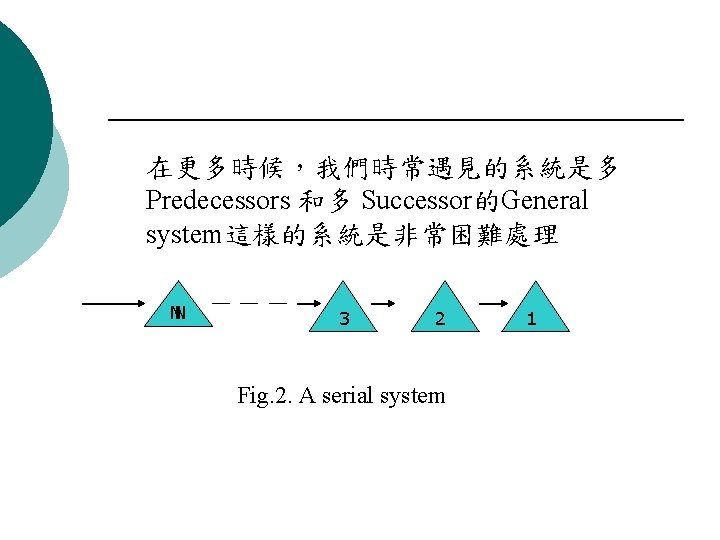
在更多時候,我們時常遇見的系統是多 Predecessors 和多 Successor的General system這樣的系統是非常困難處理 NN 3 2 Fig. 2. A serial system 1

Installation stock policies verse echelon stock policies 在Single-echelon inventory 下我們通常使用 (R, Q) 的存貨管理政策其中 ¡ R=再訂購點 Q=單次訂購之批量 ¡ (R, Q)政策也常和multi-echelon inventory作 鏈結,這代表當每一Installation皆使用此 Policy,在此狀況下每一Installation 之再訂 購點皆不同。 ¡
Installation stock policies verse echelon stock policies 以下我們用 installation stock (R, Q) policy 與echelon stock (R, Q) policy分別標記兩政策。 ¡ 存貨位置於The echelon inventory可為所有 旗下游installation存貨位置的總合。(見圖 一與圖二) ¡
Installation stock policies verse echelon stock policies ¡ ¡ The echelon stock (R, Q) policy 可以像 installation stock (R, Q) policy一樣精確 作,但我們必須考 慮到實際情況的Echelon stock policy下的Reorder point會大於Installation 因為在Echelon stock policy下每一intallation除了 考量自身之存貨外另外需要考慮當下游存貨不足 時,對其所下之訂單滿足。因此在此情況下每一 installation需考慮有更多存貨。
Installation stock policies verse echelon stock policies 當使用Multi-echelon reorder point policy時, 我們假設定單由以低於再定訂購點的 installation觸發。 ¡ 此類狀況下,即使Upstream Installation無 法供貨,我們也僅讓Upstream Installation 將此訂單列為back ordered,在此狀況下僅 影響存貨位置,而不影響到存貨控制 ¡
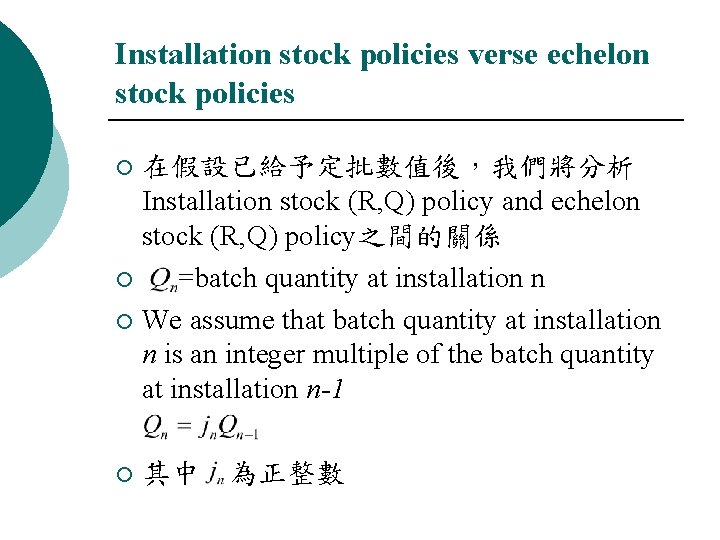
Installation stock policies verse echelon stock policies 在假設已給予定批數值後,我們將分析 Installation stock (R, Q) policy and echelon stock (R, Q) policy之間的關係 ¡ =batch quantity at installation n ¡ We assume that batch quantity at installation n is an integer multiple of the batch quantity at installation n-1 ¡ ¡ 其中 為正整數
Installation stock policies verse echelon stock policies 此類假設時常使用在討論rationing policy 於installation滿足或缺貨於該訂單 ¡ The installation stock在每一installation到下 游installation時必須為整數 ¡
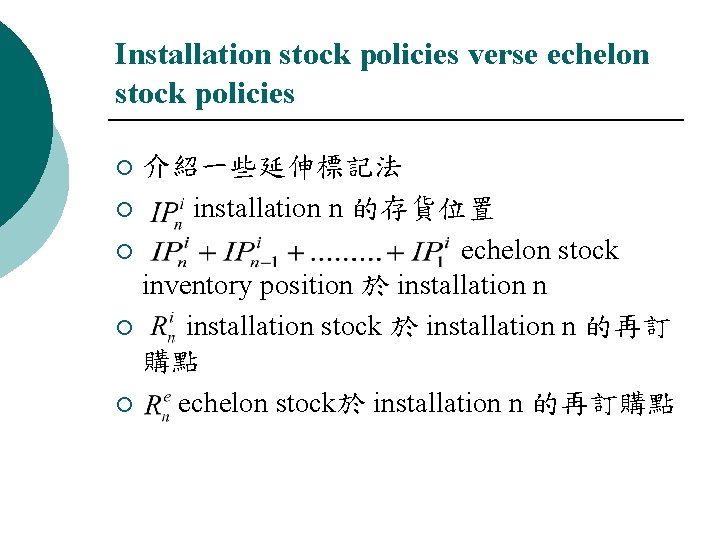
Installation stock policies verse echelon stock policies 介紹一些延伸標記法 ¡ installation n 的存貨位置 ¡ echelon stock inventory position 於 installation n ¡ installation stock 於 installation n 的再訂 購點 ¡ echelon stock於 installation n 的再訂購點 ¡
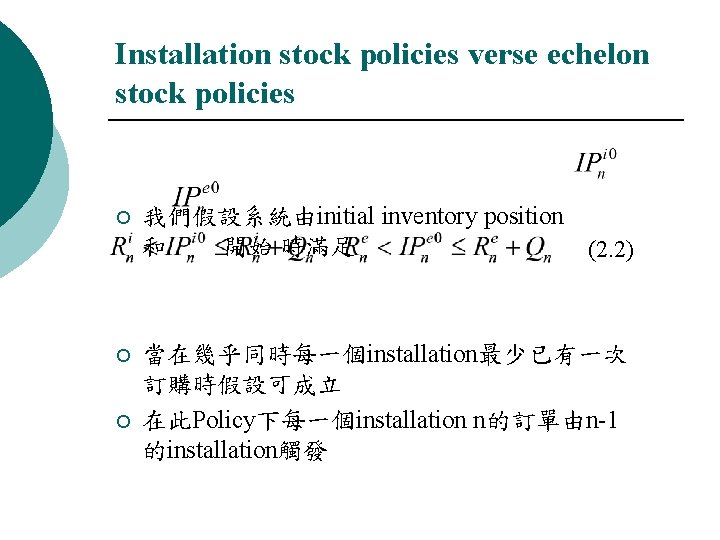
Installation stock policies verse echelon stock policies ¡ 我們假設系統由initial inventory position 和 開始 時滿足 (2. 2) ¡ 當在幾乎同時每一個installation最少已有一次 訂購時假設可成立 在此Policy下每一個installation n的訂單由n-1 的installation觸發 ¡
Installation stock policies verse echelon stock policies ¡ ¡ 因此當Installation n下訂單之時n-1 n-2, …. . , 1 皆須同時下訂單我們稱此policy is nested 再echelon stock policy下當n-1 installation 下 訂單時,其存貨位置將提高但對installation n來說存貨位置將減少,這對echelon inventory的整體存貨位置將不變。 Echelon inventory將只在最終需求於 installation 1 時變化時產生存貨位置之變化 由此推倒出nested策略在echelon inventory policy 下為非必要之選用
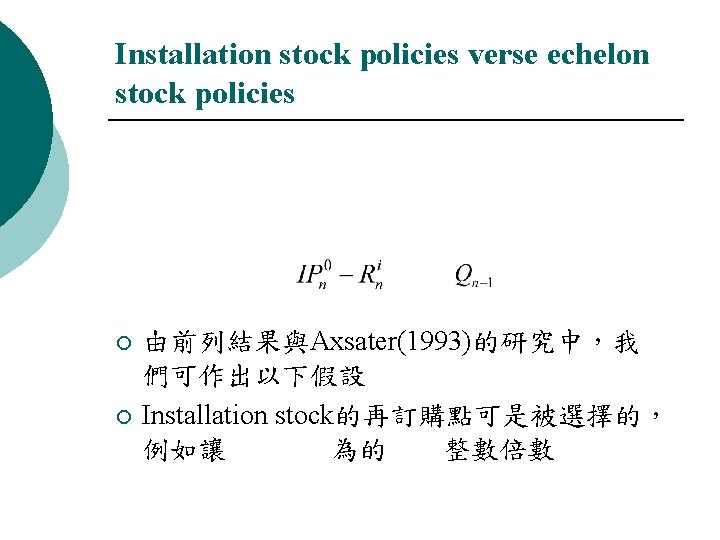
Installation stock policies verse echelon stock policies ¡ ¡ 由前列結果與Axsater(1993)的研究中,我 們可作出以下假設 Installation stock的再訂購點可是被選擇的, 例如讓 為的 整數倍數

Installation stock policies verse echelon stock policies 在已知installation stock reorder point 下我們 可以證實以下幾個議題 ¡ Proposition 1 -已知的installation reorder point policy可由相同的echelon stock reorder point 取代 ¡ Proof: 在installation n 當在訂購策略為nested 加上 為 的integer multiple ¡
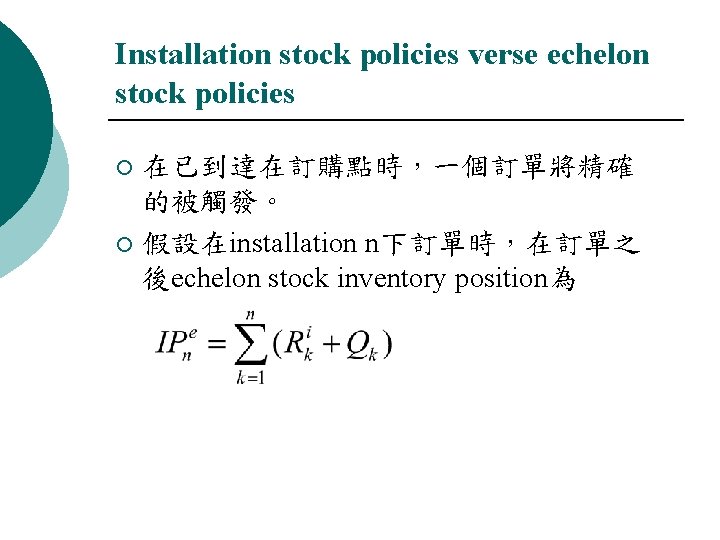
Installation stock policies verse echelon stock policies 在已到達在訂購點時,一個訂單將精確 的被觸發。 ¡ 假設在installation n下訂單時,在訂單之 後echelon stock inventory position為 ¡
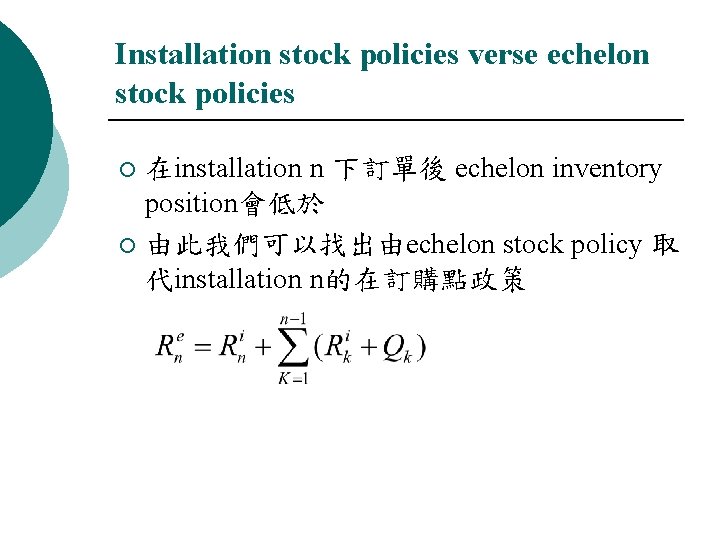
Installation stock policies verse echelon stock policies 在installation n 下訂單後 echelon inventory position會低於 ¡ 由此我們可以找出由echelon stock policy 取 代installation n的在訂購點政策 ¡
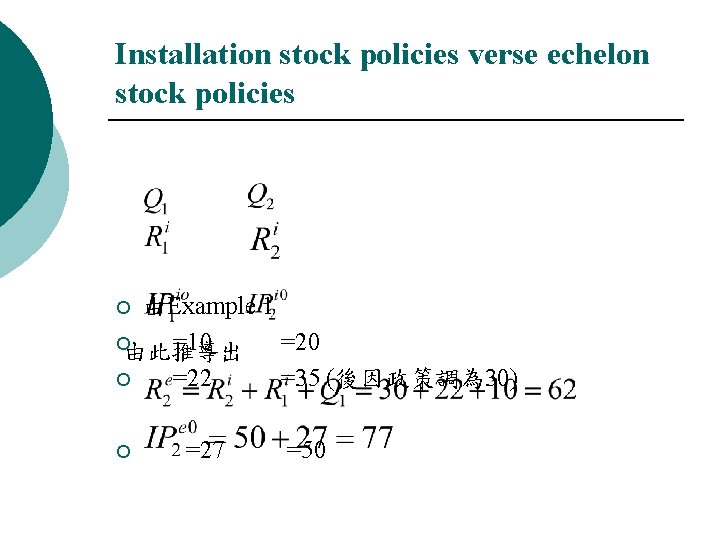
Installation stock policies verse echelon stock policies 由Example 1 ¡由此推導出 =10 =20 ¡ =22 =35 (後因政策調為 30) ¡ ¡ =27 =50

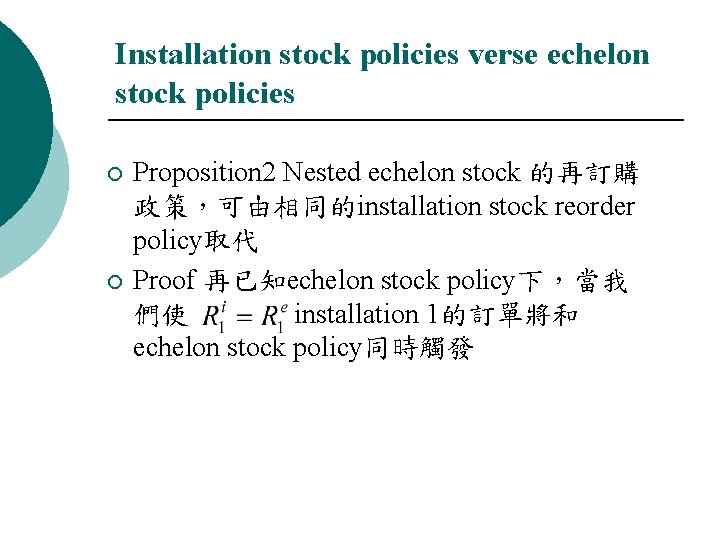
Installation stock policies verse echelon stock policies ¡ ¡ Proposition 2 Nested echelon stock 的再訂購 政策,可由相同的installation stock reorder policy取代 Proof 再已知echelon stock policy下,當我 們使 installation 1的訂單將和 echelon stock policy同時觸發
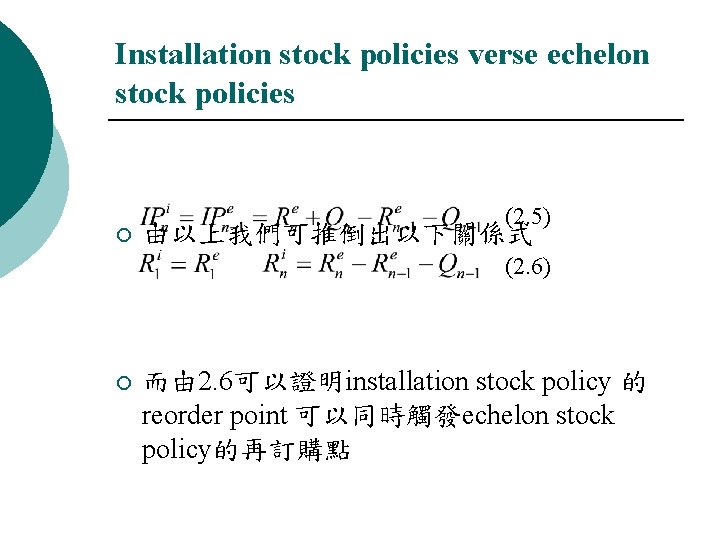
Installation stock policies verse echelon stock policies ¡ (2. 5) 由以上我們可推倒出以下關係式 (2. 6) ¡ 而由 2. 6可以證明installation stock policy 的 reorder point 可以同時觸發echelon stock policy的再訂購點
Installation stock policies verse echelon stock policies ¡ ¡ 由前兩個討論中,我們可以看出installation stock (R, Q) policies 可為 echelon stock (R, Q) policies的子集合 再評定準則已知的狀況下,最佳解於echelon stock reorder policy 也可提出作為Installation stock policy的最佳化由過去的範例(Axsater 2000)可看出此兩政策在此情況的差異性
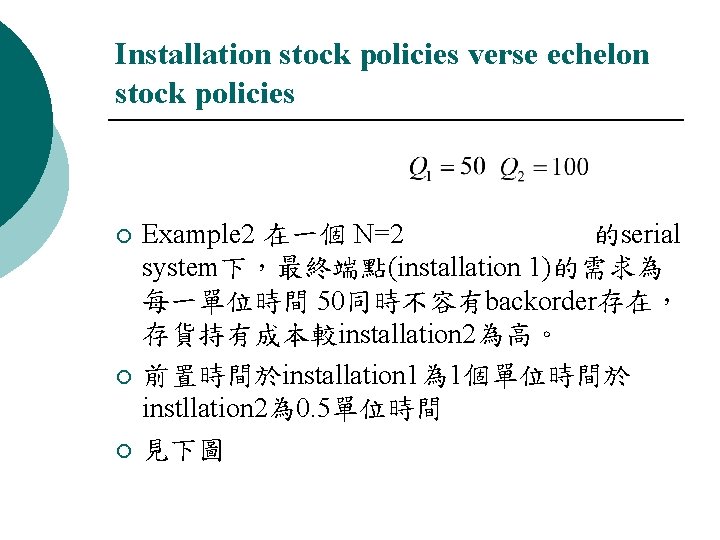
Installation stock policies verse echelon stock policies ¡ ¡ ¡ Example 2 在一個 N=2 的serial system下,最終端點(installation 1)的需求為 每一單位時間 50同時不容有backorder存在, 存貨持有成本較installation 2為高。 前置時間於installation 1為 1個單位時間於 instllation 2為 0. 5單位時間 見下圖

Installation stock policies verse echelon stock policies
Installation stock policies verse echelon stock policies ¡ 上圖可視為一組最佳化的控制方式,其中 installation 2用定批取代JIT ¡ 但在此圖中並不適用installation (R, Q) policy 因為此系統為nested Installation 2只在 installation 1下單時下單(例如在時間點 0, 1, 2…)但在理想上我們會希望可以讓 installation在時間點 0. 5 2. 5可以觸發訂單
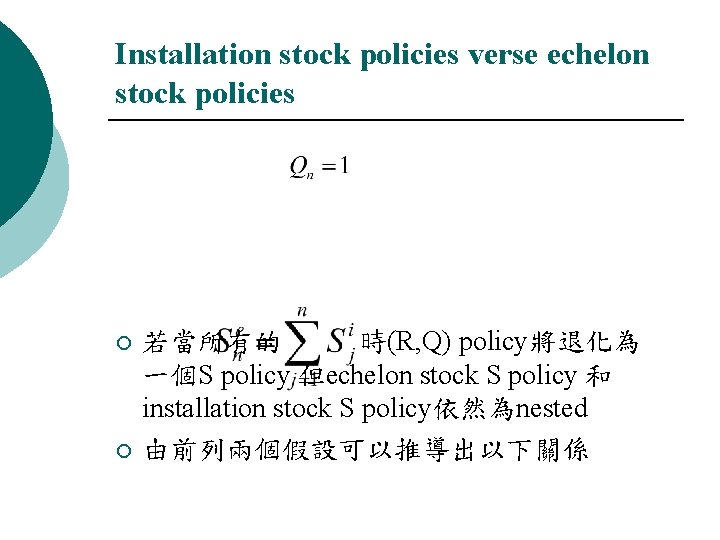
Installation stock policies verse echelon stock policies ¡ ¡ 若當所有的 時(R, Q) policy將退化為 一個S policy 但echelon stock S policy 和 installation stock S policy依然為nested 由前列兩個假設可以推導出以下關係
Installation stock policies verse echelon stock policies Propostion 1 and 2可以為裝配線系統上的實 際情況,但無法成為在配送系統上的實際 狀況 ¡ 在過去研究中,最佳的echelon stock reorder policy可能是精進(outperform)的 installation stock reorder policy但我們可能 還須考量其他狀況。 ¡
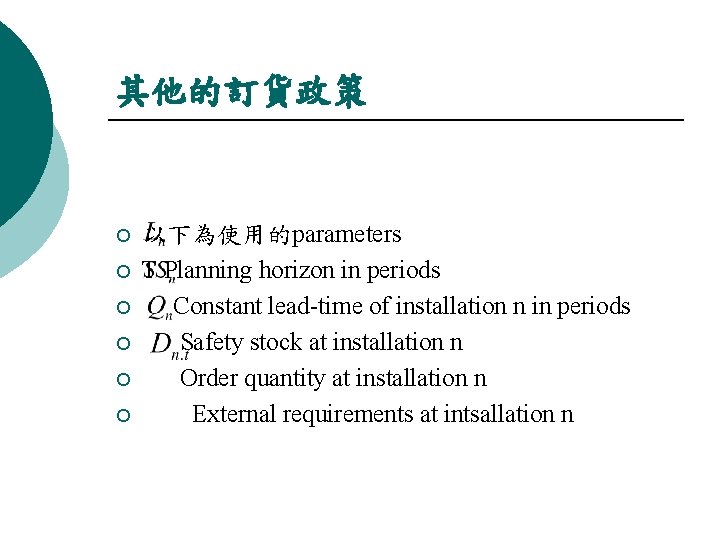
其他的訂貨政策 ¡ ¡ ¡ 以下為使用的parameters T Planning horizon in periods Constant lead-time of installation n in periods Safety stock at installation n Order quantity at installation n External requirements at intsallation n
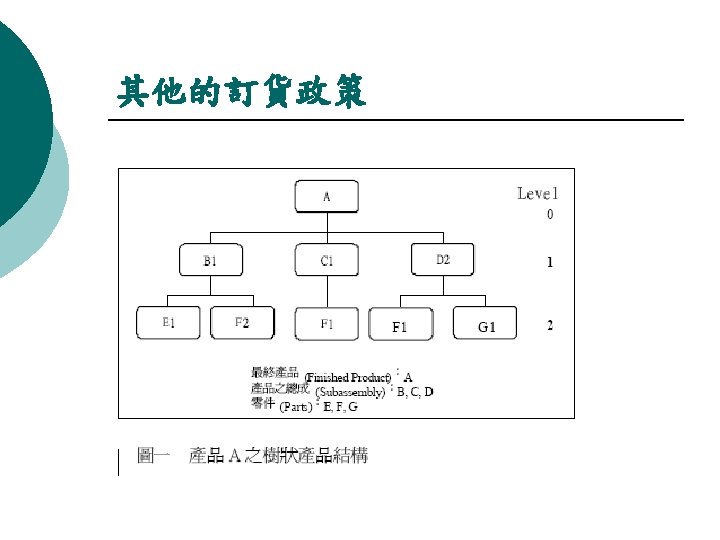
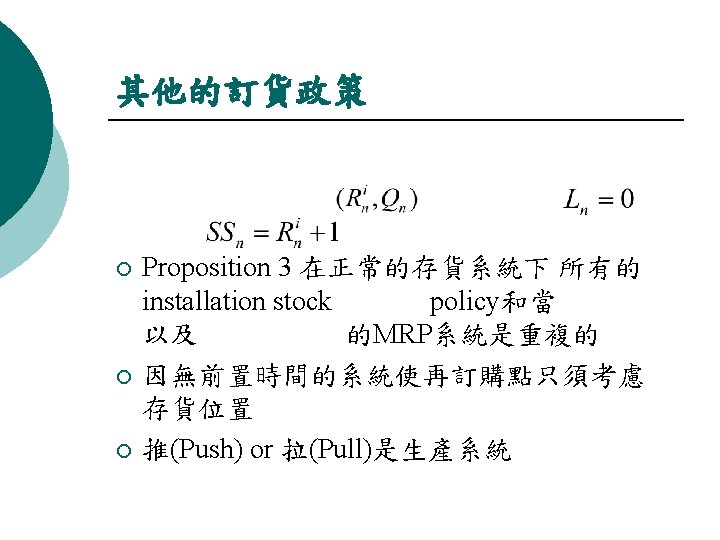
其他的訂貨政策 ¡ Proposition 4 for serial and assembly systems any echelon stock reorder point 可由相同的 MRP系統取代
Serial systems ¡ The Clark-Scarf model ¡ The batch-ordering
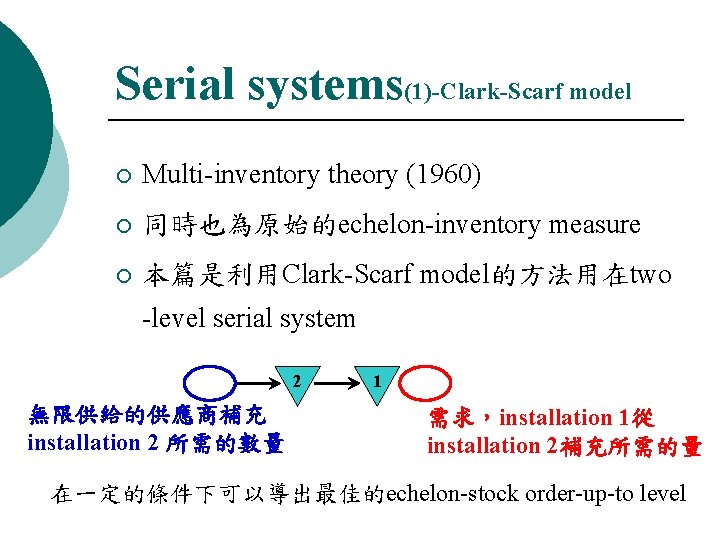
Serial systems(1)-Clark-Scarf model ¡ Multi-inventory theory (1960) ¡ 同時也為原始的echelon-inventory measure ¡ 本篇是利用Clark-Scarf model的方法用在two -level serial system 2 無限供給的供應商補充 installation 2 所需的數量 1 需求,installation 1從 installation 2補充所需的量 在一定的條件下可以導出最佳的echelon-stock order-up-to level
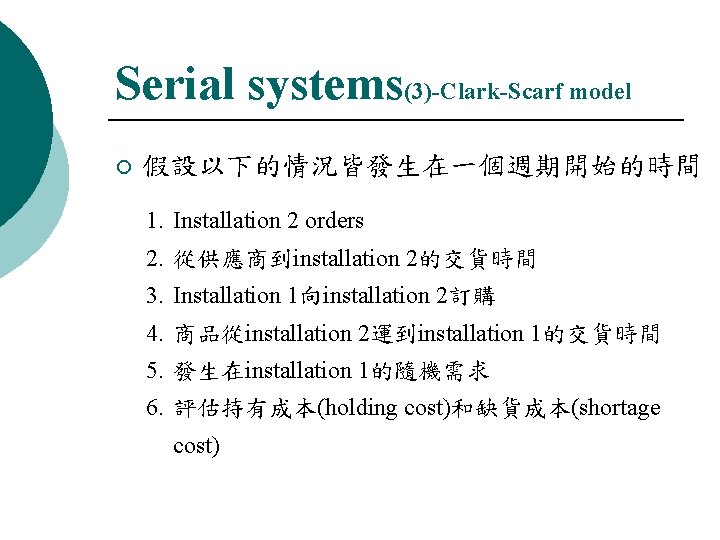
Serial systems(3)-Clark-Scarf model ¡ 假設以下的情況皆發生在一個週期開始的時間 1. Installation 2 orders 2. 從供應商到installation 2的交貨時間 3. Installation 1向installation 2訂購 4. 商品從installation 2運到installation 1的交貨時間 5. 發生在installation 1的隨機需求 6. 評估持有成本(holding cost)和缺貨成本(shortage cost)
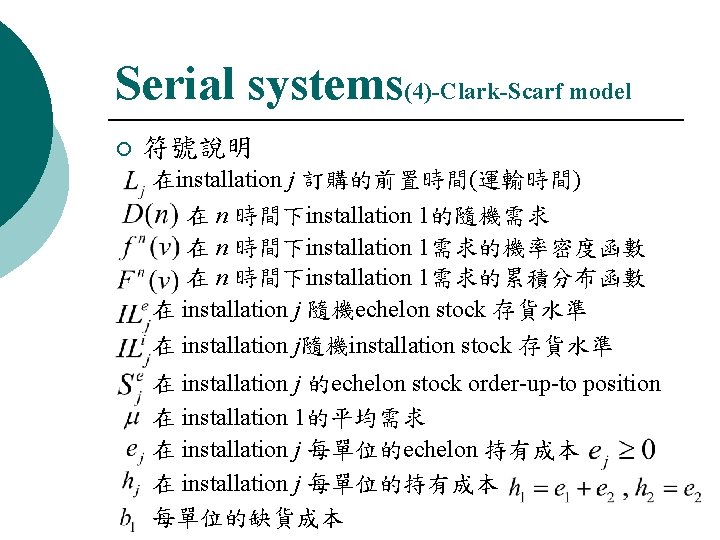
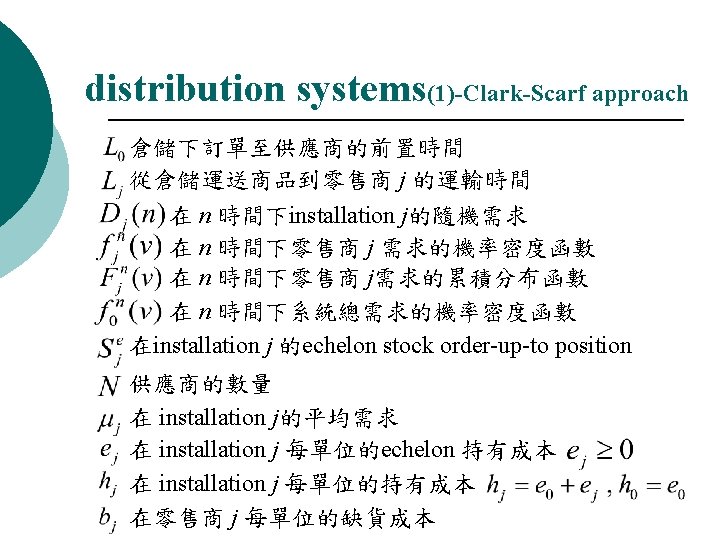
Serial systems(4)-Clark-Scarf model ¡ 符號說明 在installation j 訂購的前置時間(運輸時間) 在 n 時間下installation 1的隨機需求 在 n 時間下installation 1需求的機率密度函數 在 n 時間下installation 1需求的累積分布函數 在 installation j 隨機echelon stock 存貨水準 在 installation j隨機installation stock 存貨水準 在 installation j 的echelon stock order-up-to position 在 installation 1的平均需求 在 installation j 每單位的echelon 持有成本 在 installation j 每單位的持有成本 每單位的缺貨成本
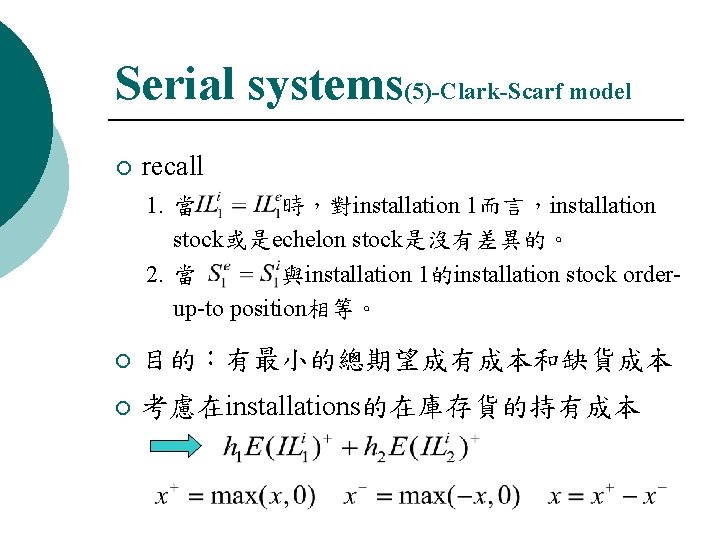
Serial systems(5)-Clark-Scarf model ¡ recall 1. 當 時,對installation 1而言,installation stock或是echelon stock是沒有差異的。 2. 當 與installation 1的installation stock orderup-to position相等。 ¡ 目的:有最小的總期望成有成本和缺貨成本 ¡ 考慮在installations的在庫存貨的持有成本
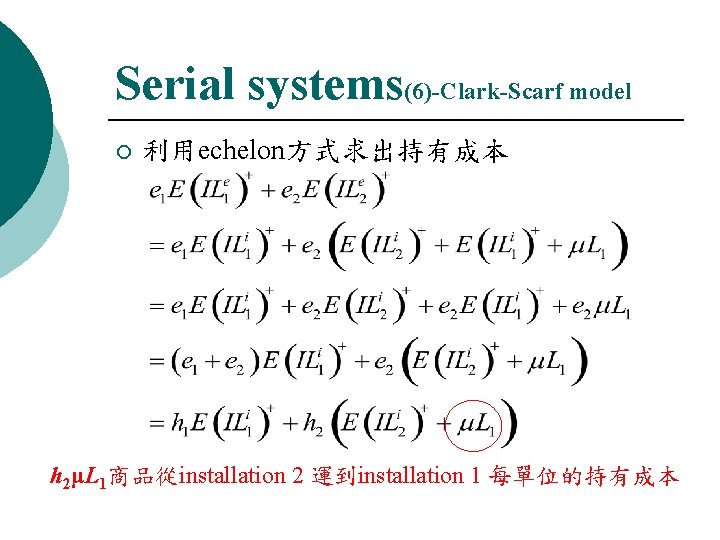
Serial systems(6)-Clark-Scarf model ¡ 利用echelon方式求出持有成本 h 2μL 1商品從installation 2 運到installation 1 每單位的持有成本
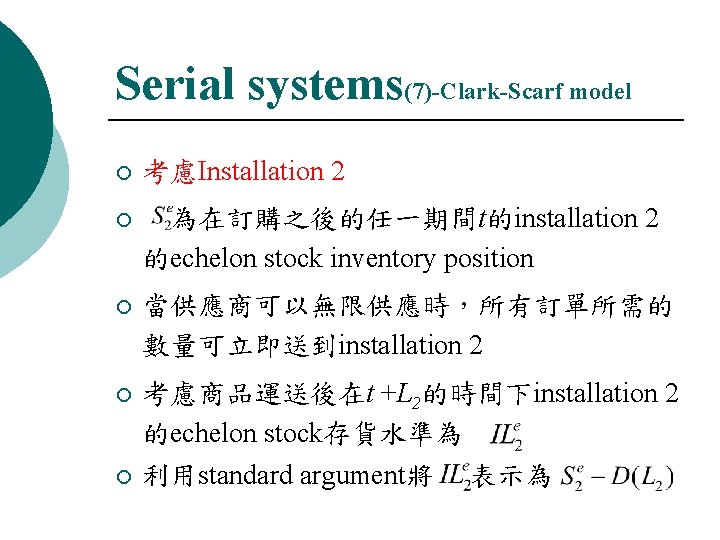
Serial systems(7)-Clark-Scarf model ¡ 考慮Installation 2 ¡ 為在訂購之後的任一期間t的installation 2 的echelon stock inventory position ¡ 當供應商可以無限供應時,所有訂單所需的 數量可立即送到installation 2 ¡ 考慮商品運送後在t +L 2的時間下installation 2 的echelon stock存貨水準為 利用standard argument將 表示為 ¡
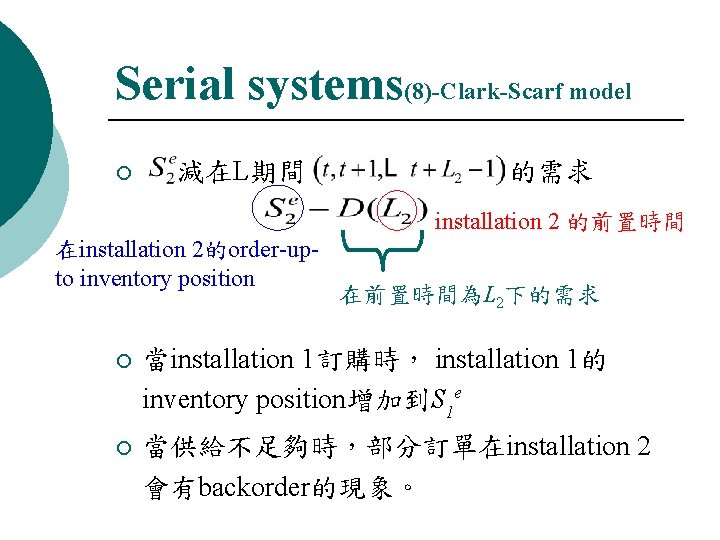
Serial systems(8)-Clark-Scarf model ¡ 減在L期間 的需求 installation 2 的前置時間 在installation 2的order-upto inventory position 在前置時間為L 2下的需求 ¡ 當installation 1訂購時, installation 1的 inventory position增加到S 1 e ¡ 當供給不足夠時,部分訂單在installation 2 會有backorder的現象。
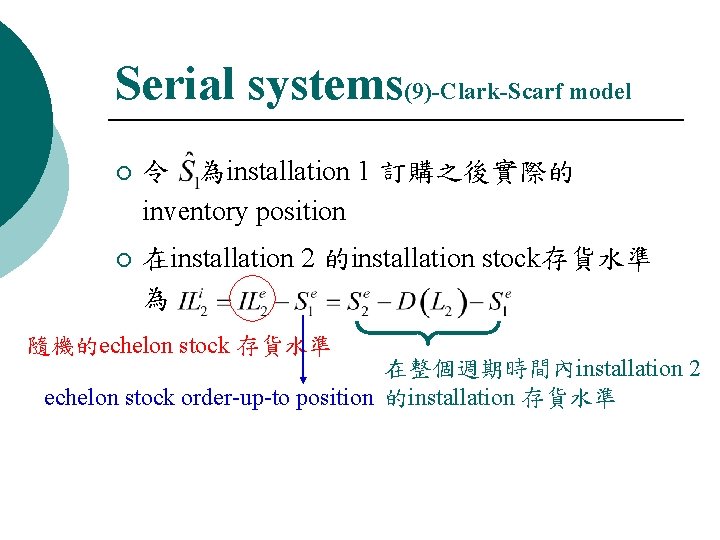
Serial systems(9)-Clark-Scarf model ¡ 令 為installation 1 訂購之後實際的 inventory position ¡ 在installation 2 的installation stock存貨水準 為 隨機的echelon stock 存貨水準 在整個週期時間內installation 2 echelon stock order-up-to position 的installation 存貨水準
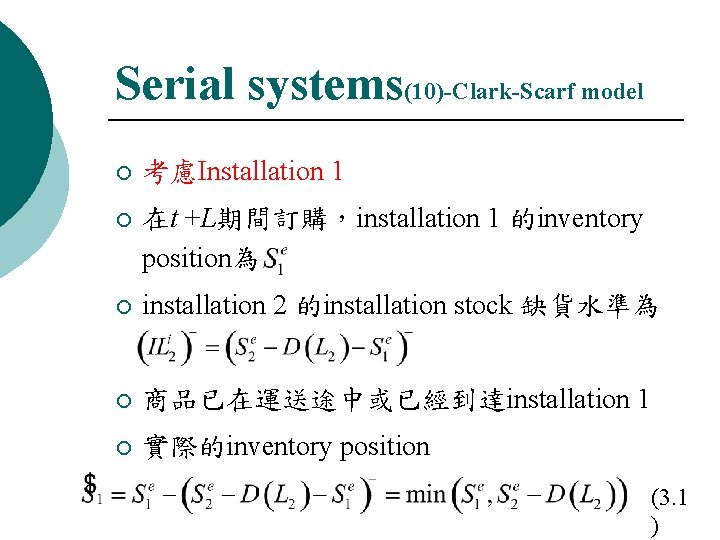
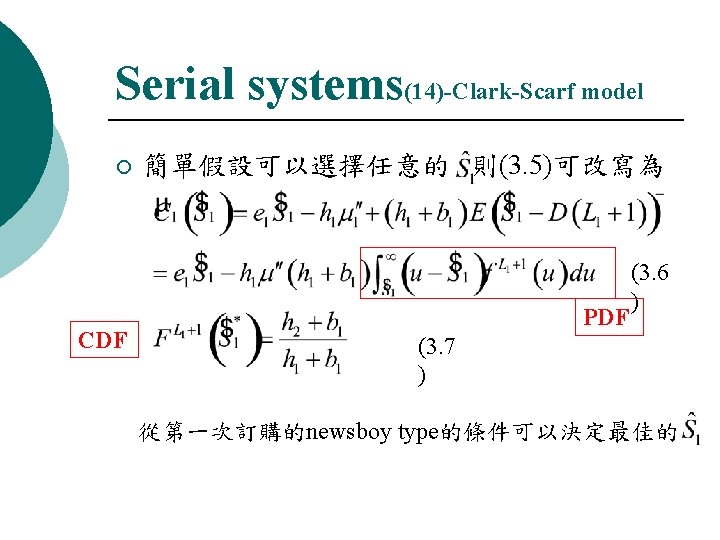
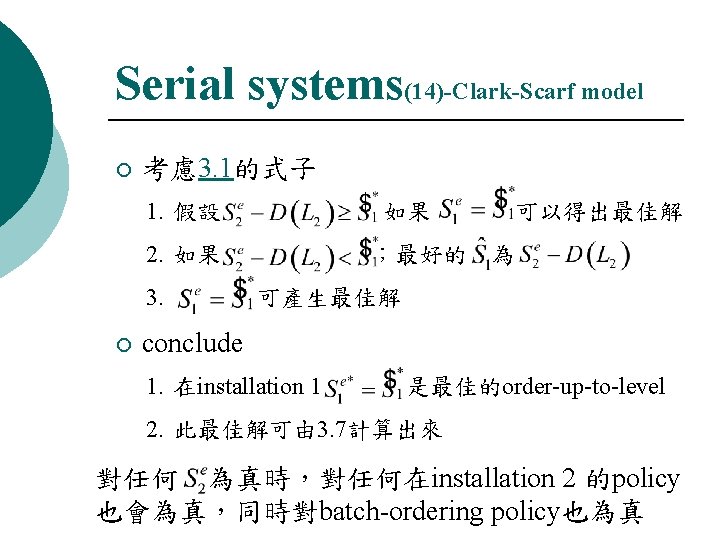
Serial systems(10)-Clark-Scarf model ¡ 考慮Installation 1 ¡ 在t +L期間訂購,installation 1 的inventory position為 ¡ installation 2 的installation stock 缺貨水準為 ¡ 商品已在運送途中或已經到達installation 1 ¡ 實際的inventory position (3. 1 )
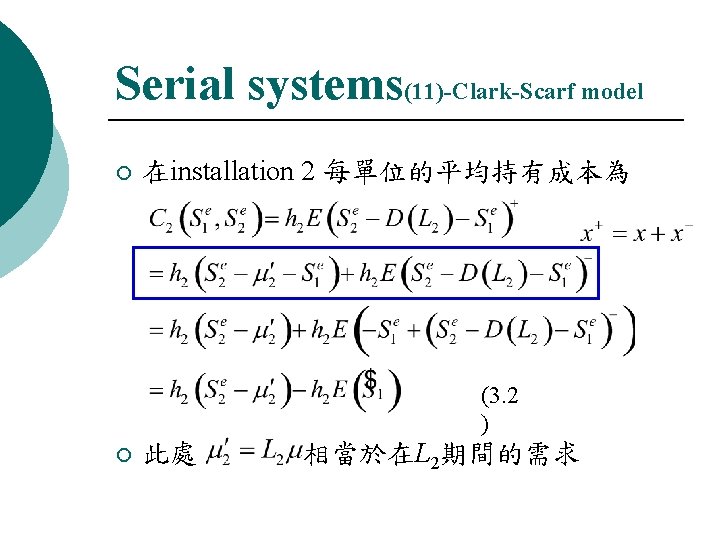
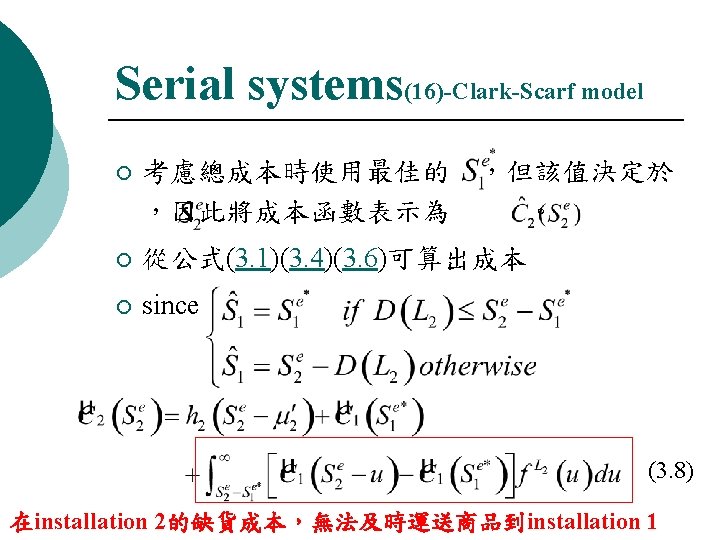
Serial systems(11)-Clark-Scarf model ¡ 在installation 2 每單位的平均持有成本為 (3. 2 ) ¡ 此處 相當於在L 2期間的需求
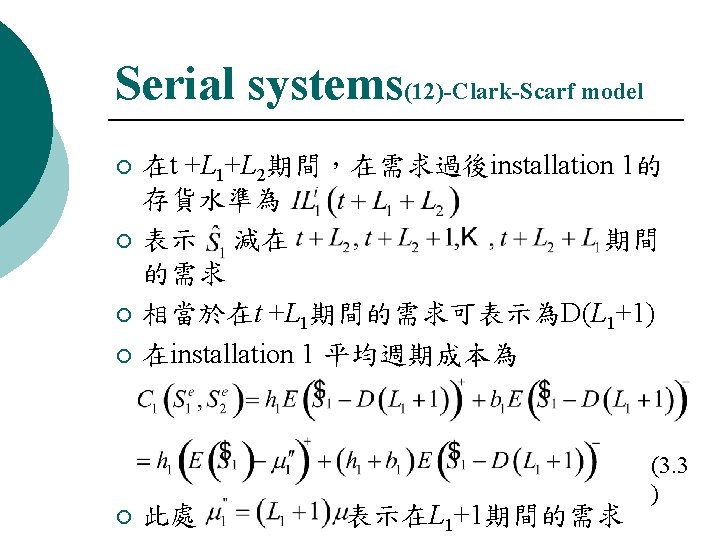
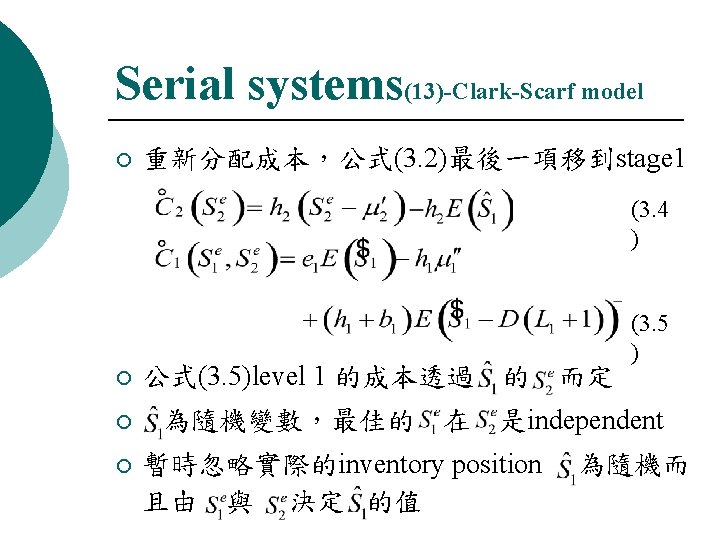
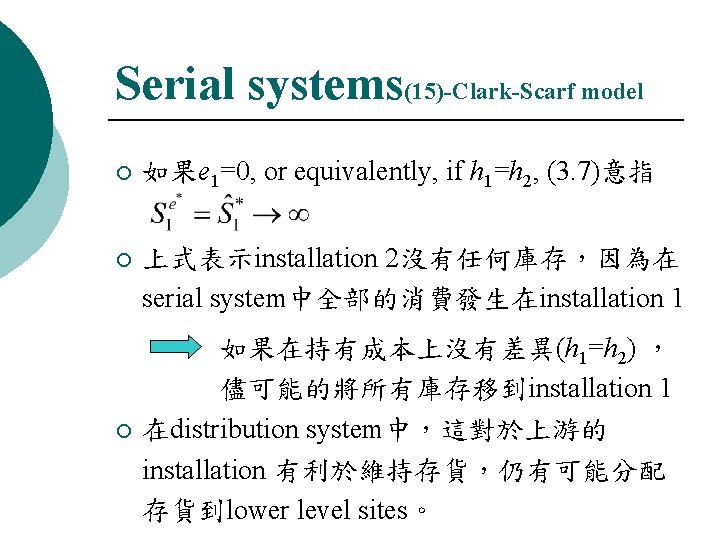
Serial systems(15)-Clark-Scarf model ¡ 如果e 1=0, or equivalently, if h 1=h 2, (3. 7)意指 ¡ 上式表示installation 2沒有任何庫存,因為在 serial system中全部的消費發生在installation 1 ¡ 如果在持有成本上沒有差異(h 1=h 2) , 儘可能的將所有庫存移到installation 1 在distribution system中,這對於上游的 installation 有利於維持存貨,仍有可能分配 存貨到lower level sites。

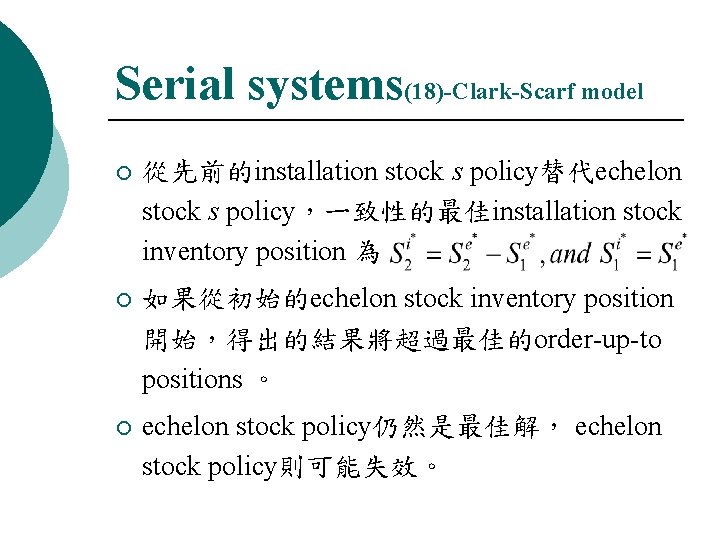
Serial systems(18)-Clark-Scarf model ¡ 從先前的installation stock s policy替代echelon stock s policy,ㄧ致性的最佳installation stock inventory position 為 ¡ 如果從初始的echelon stock inventory position 開始,得出的結果將超過最佳的order-up-to positions 。 ¡ echelon stock policy仍然是最佳解, echelon stock policy則可能失效。
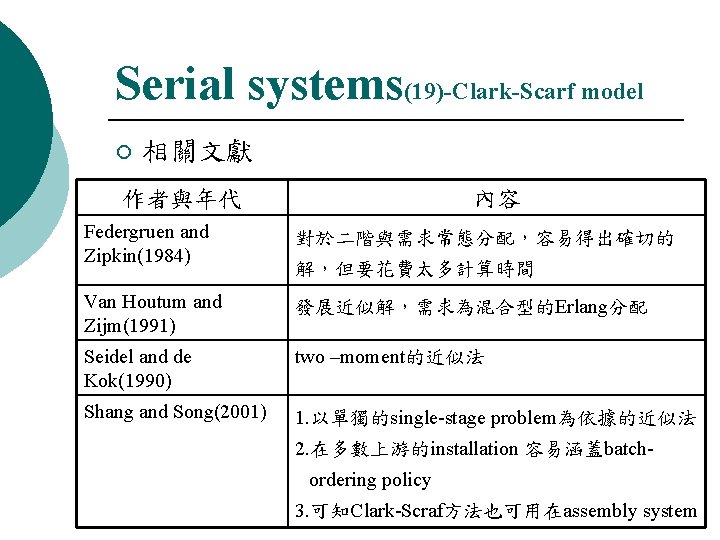
Serial systems(19)-Clark-Scarf model ¡ 相關文獻 作者與年代 內容 Federgruen and Zipkin(1984) 對於二階與需求常態分配,容易得出確切的 Van Houtum and Zijm(1991) 發展近似解,需求為混合型的Erlang分配 Seidel and de Kok(1990) two –moment的近似法 Shang and Song(2001) 1. 以單獨的single-stage problem為依據的近似法 解,但要花費太多計算時間 2. 在多數上游的installation 容易涵蓋batchordering policy 3. 可知Clark-Scraf方法也可用在assembly system
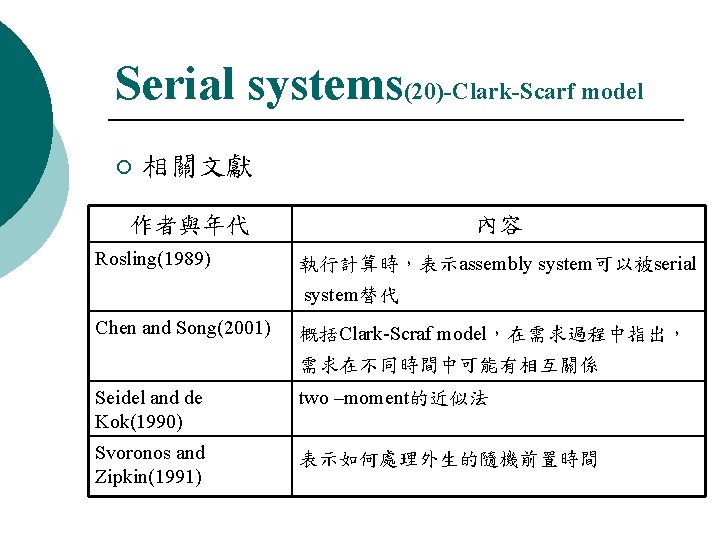
Serial systems(20)-Clark-Scarf model ¡ 相關文獻 作者與年代 Rosling(1989) 內容 執行計算時,表示assembly system可以被serial system替代 Chen and Song(2001) 概括Clark-Scraf model,在需求過程中指出, 需求在不同時間中可能有相互關係 Seidel and de Kok(1990) two –moment的近似法 Svoronos and Zipkin(1991) 表示如何處理外生的隨機前置時間
Serial systems(21)- Batch-ordering policies ¡ 如果所有installations 批量訂購,不單單只考 慮多數上游installation,此時model將變得更 複雜。 ¡ 對於serial system而言仍然可高效率處理 batch-ordering policy

Serial systems(23)- Batch-ordering policies ¡ 迴歸程序(recursive procedure)起始點在上游 的installation,出發到下游。 ¡ Clark-Scarf:起始點在下游(不同方向) ¡ Axsater(1993) :提出其他方法評估在serial system的batch-ordering policy確切的policy。 ¡ 對於給定批量大小,最佳的echelon stock reorder points可被繼續執行,類似前面提及 的最佳化的order-up-to level
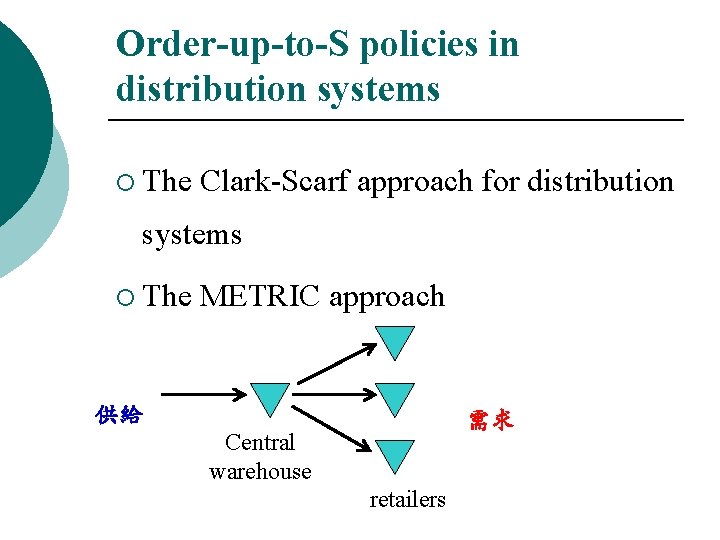
Order-up-to-S policies in distribution systems ¡ The Clark-Scarf approach for distribution systems ¡ The METRIC approach 供給 需求 Central warehouse retailers
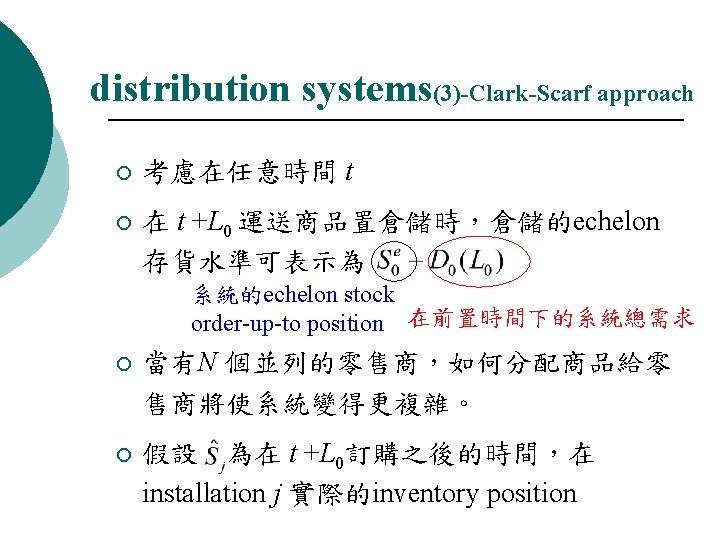
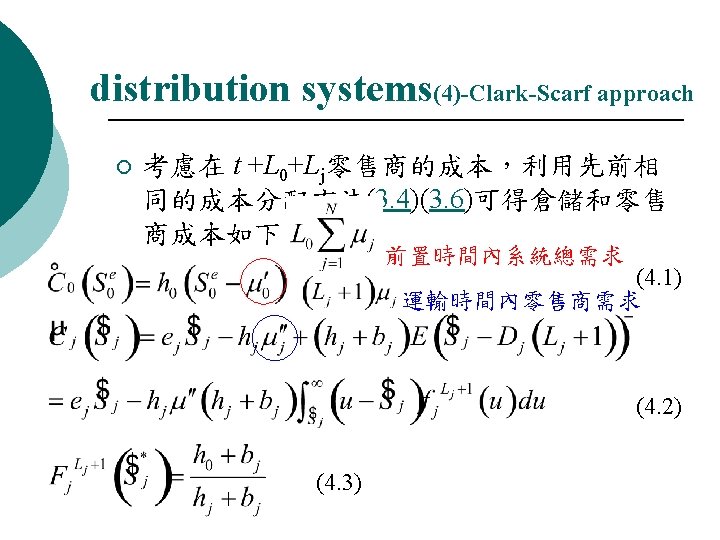
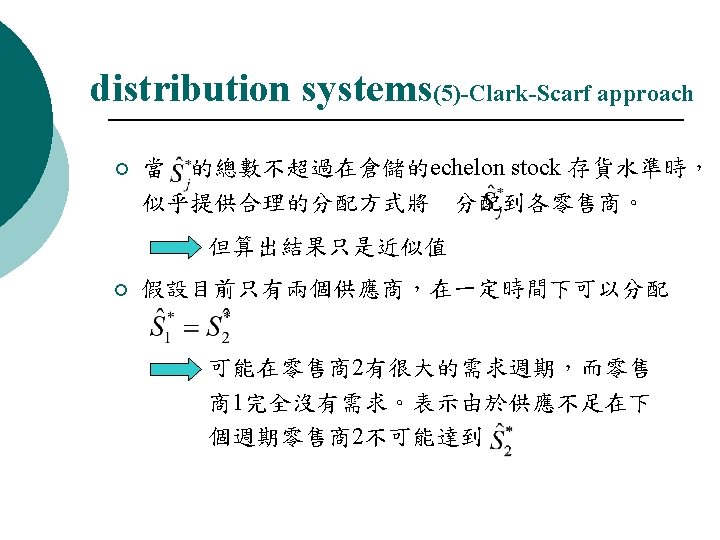
distribution systems-Clark-Scarf approach ¡ ¡ ¡ 目前所要考慮的為distribution system 利用‘balance’ assumption的近似法求解 原始的‘balance’ assumption 由Clark. Scraf(1960)發表 Eppen and Schrang使用‘balance’ assumption 在有相同零售商和需求常態分配下,中心倉 儲不允許任何存貨。 Federgruen and Zipkin(1984)延伸Eppen and Schrang,使用non-identical的零售商和倉儲 的存貨。
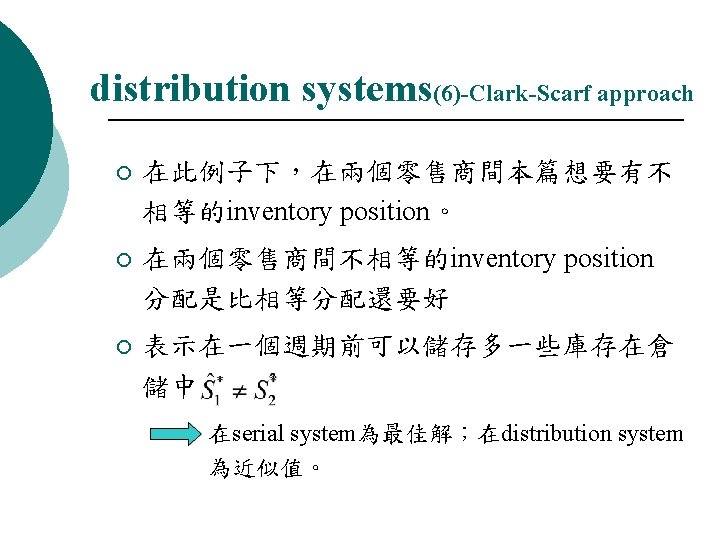
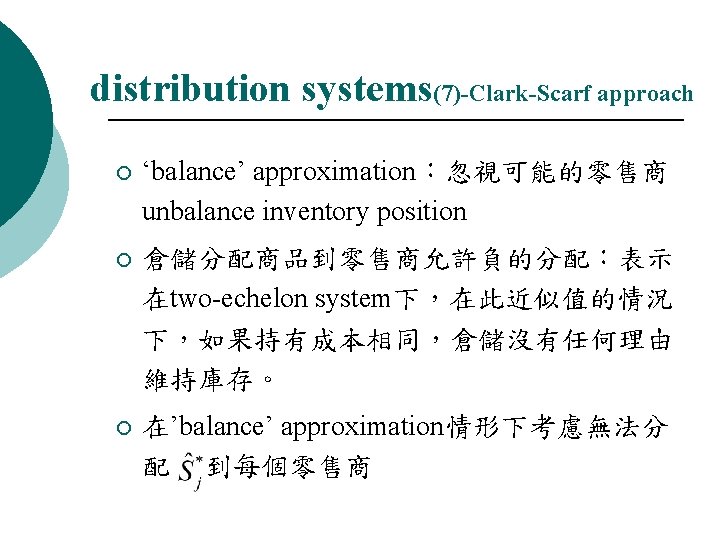
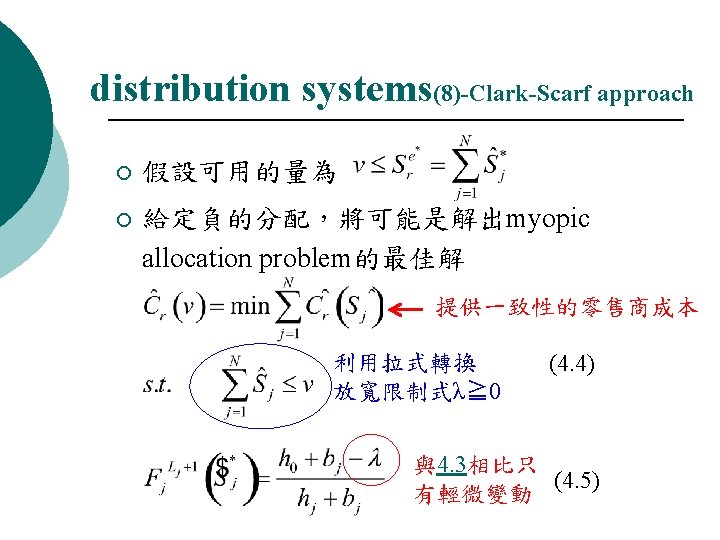
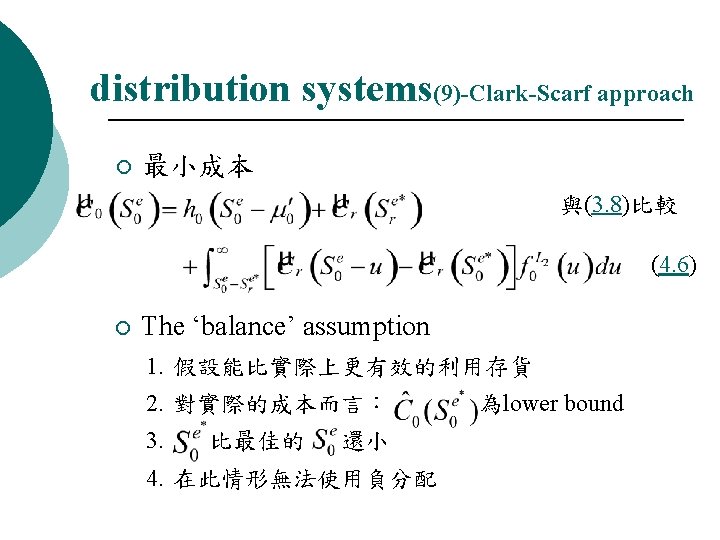
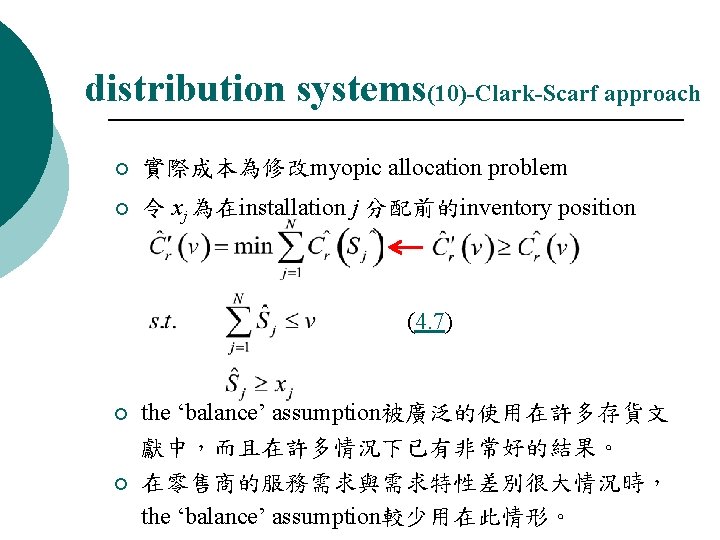
distribution systems(10)-Clark-Scarf approach ¡ 實際成本為修改myopic allocation problem ¡ 令 xj 為在installation j 分配前的inventory position (4. 7) ¡ ¡ the ‘balance’ assumption被廣泛的使用在許多存貨文 獻中,而且在許多情況下已有非常好的結果。 在零售商的服務需求與需求特性差別很大情況時, the ‘balance’ assumption較少用在此情形。

Batch-ordering in distribution systems-Basic facts
Batch-ordering in distribution systems. Basic facts ¡ 在第四章我們以解釋了分配系統不同技術 的演化和最佳化於 order-up-to-S polices
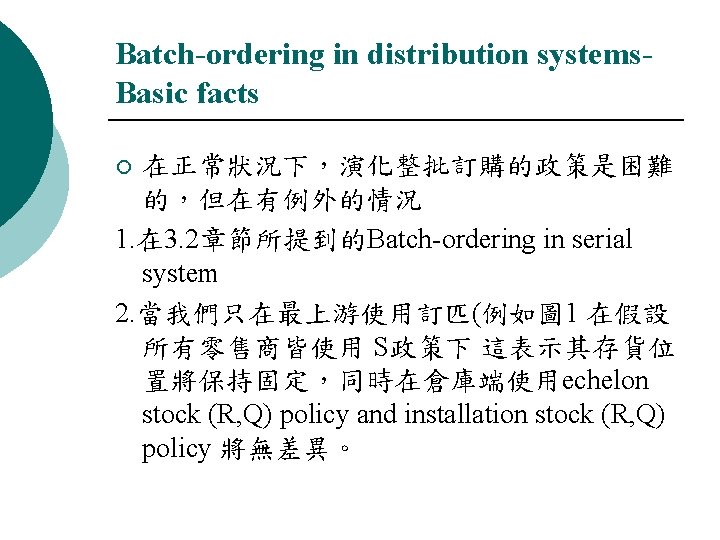
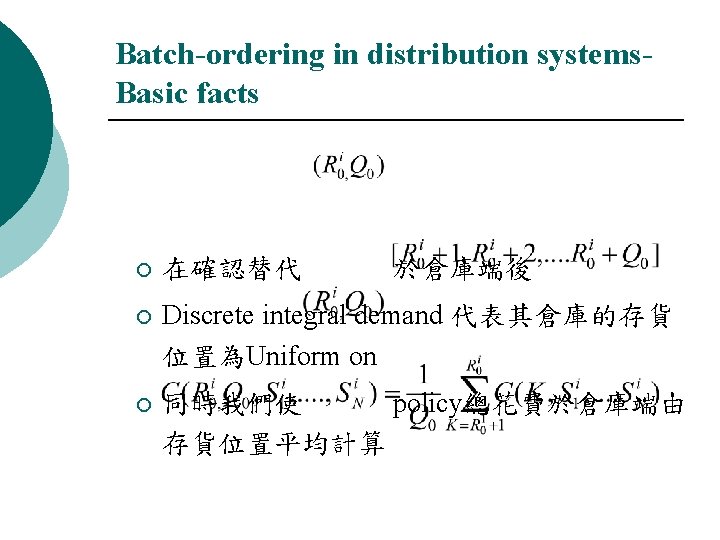
Batch-ordering in distribution systems. Basic facts ¡ 在確認替代 於倉庫端後 ¡ Discrete integral demand 代表其倉庫的存貨 位置為Uniform on ¡ 同時我們使 policy總花費於倉庫端由 存貨位置平均計算
Batch-ordering in distribution systems. Basic facts ¡ 雖然Multi-echelon inventory system with general batch-ordering policies很難被分析。 但在Single echelon system that carry out over the multi-echelon下依然有些重要特性

Batch-ordering in distribution systems. Basic facts ¡ ¡ ¡ 在確認為Uniform distribution of the inventory position使用(R, Q)存貨政策時,考慮一個使用 installation (R, Q)間斷需求的分配系統。 使q 為the largest factor於batch quantities It is the evident that all replenishment and all demands at the warehouse are multiples of q
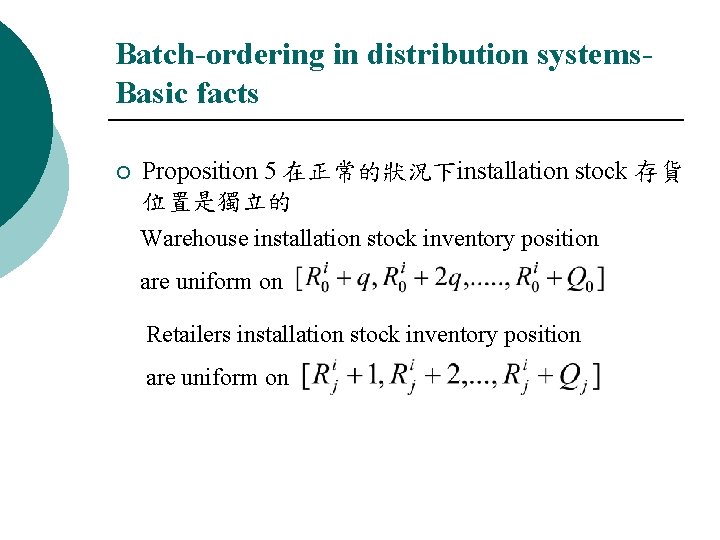
Batch-ordering in distribution systems. Basic facts ¡ Proposition 5 在正常的狀況下installation stock 存貨 位置是獨立的 Warehouse installation stock inventory position are uniform on Retailers installation stock inventory position are uniform on
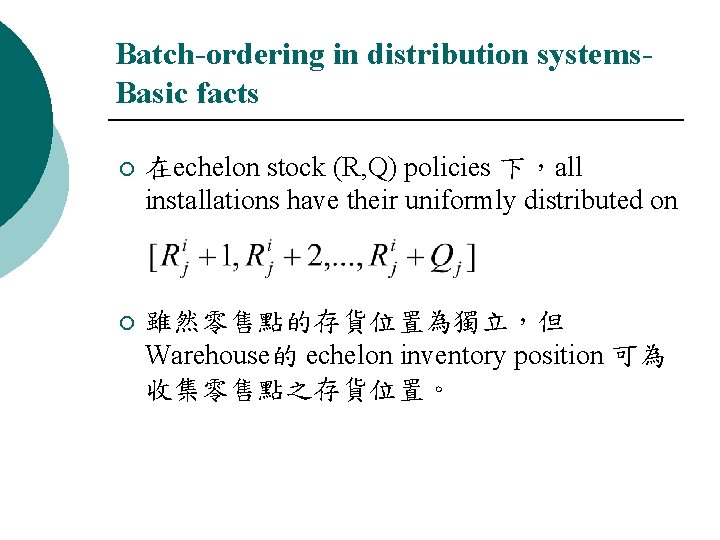
Batch-ordering in distribution systems. Basic facts ¡ 在echelon stock (R, Q) policies 下,all installations have their uniformly distributed on ¡ 雖然零售點的存貨位置為獨立,但 Warehouse的 echelon inventory position 可為 收集零售點之存貨位置。
- Slides: 91