
Supply Chain Management To Accompany Russell and Taylor


- Slides: 126
Supply Chain Management To Accompany Russell and Taylor, Operations Management, 4 th Edition, 2003 Prentice-Hall, Inc. All rights reserved.
Introduction to Supply Chains and Supply Chain Management To Accompany Russell and Taylor, Operations Management, 4 th Edition , 2003 Prentice-Hall, Inc. All rights reserved.
Supply Chain (Definition of) ü The sequence of organizations- their facilities, functions, processes and activities- that are involved in producing and delivering a product or service Sometimes referred to as value chain
Components of Supply (Value) Chains • Supply Component: Starts at the beginning of the SC and ends with the internal operations of the organization. • Demand Component: Starts at the point where the organization’s output is delivered to its immediate customer and ends with the final customer in the chain. Demand chain is the sales and distributon portion of the value chain The length of each component depends on where a particular organization is in the chain
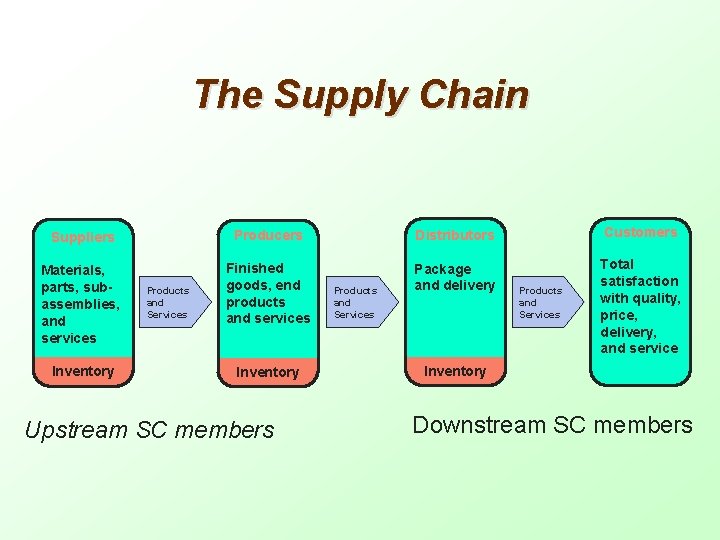
The Supply Chain Suppliers Producers Distributors Customers Materials, parts, subassemblies, and services Finished goods, end products and services Package and delivery Total satisfaction with quality, price, delivery, and service Inventory Products and Services Inventory Upstream SC members Products and Services Inventory Downstream SC members
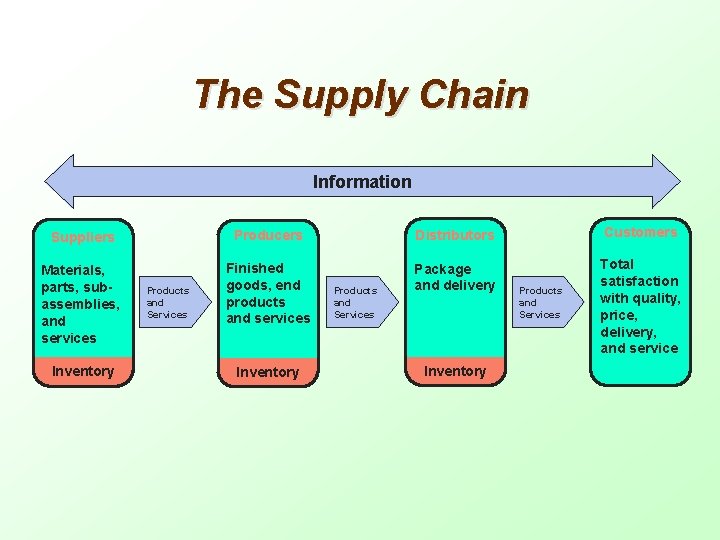
The Supply Chain Information Suppliers Producers Distributors Customers Materials, parts, subassemblies, and services Finished goods, end products and services Package and delivery Total satisfaction with quality, price, delivery, and service Inventory Products and Services
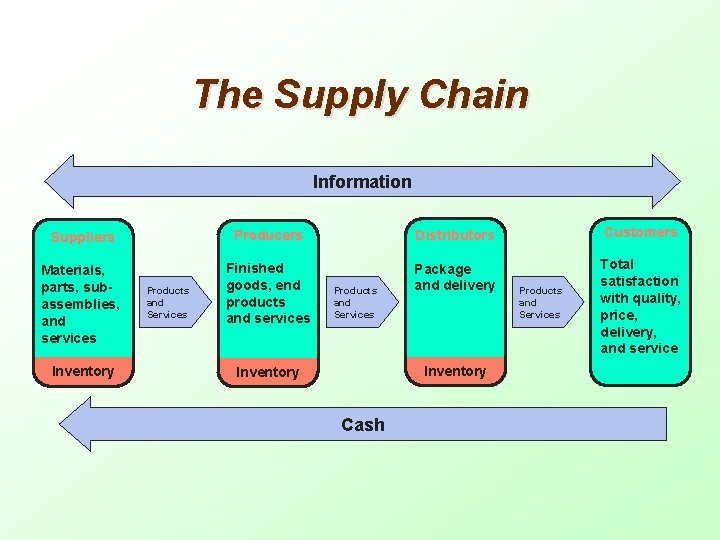
The Supply Chain Information Suppliers Producers Distributors Customers Materials, parts, subassemblies, and services Finished goods, end products and services Package and delivery Total satisfaction with quality, price, delivery, and service Inventory Products and Services Inventory Cash Products and Services
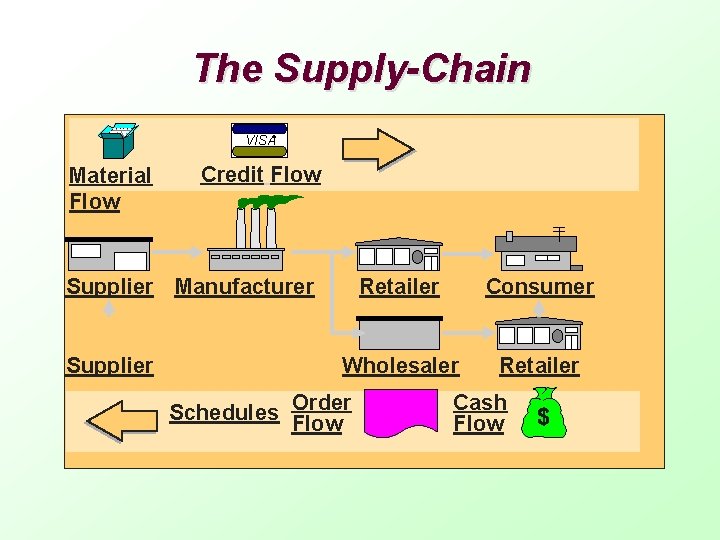
The Supply-Chain VISA ® Material Flow Credit Flow Supplier Manufacturer Supplier Retailer Consumer Wholesaler Retailer Schedules Order Flow Cash Flow
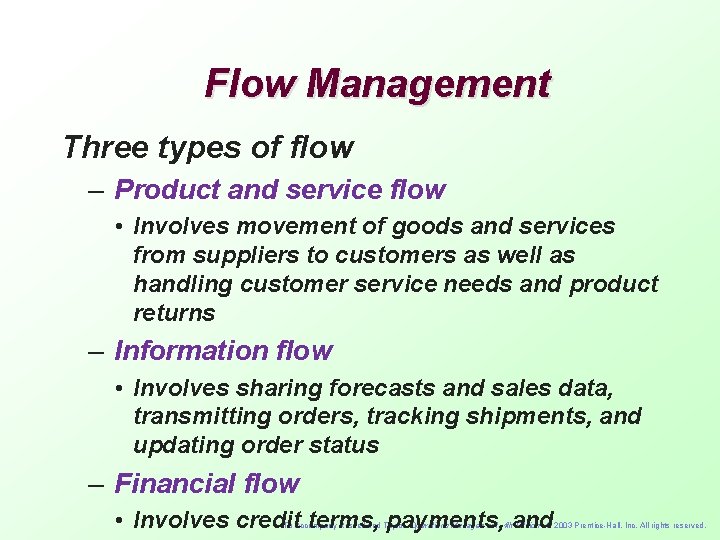
Flow Management Three types of flow – Product and service flow • Involves movement of goods and services from suppliers to customers as well as handling customer service needs and product returns – Information flow • Involves sharing forecasts and sales data, transmitting orders, tracking shipments, and updating order status – Financial flow • Involves credit terms, payments, and To Accompany Russell and Taylor, Operations Management, 4 th Edition , 2003 Prentice-Hall, Inc. All rights reserved.
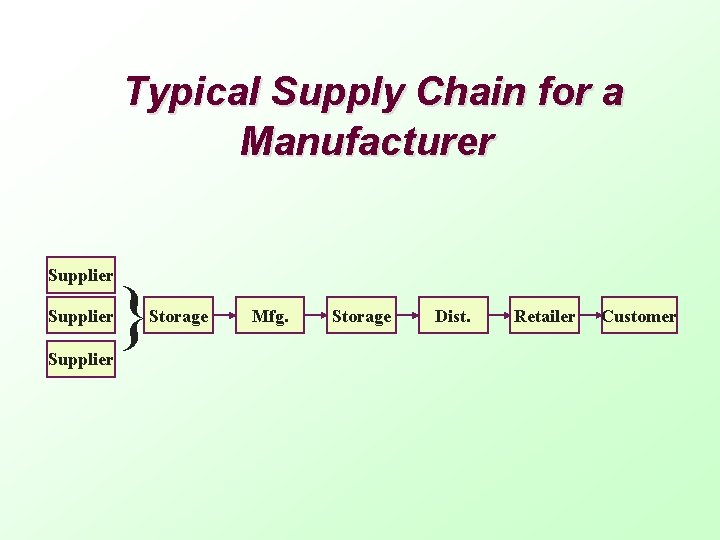
Typical Supply Chain for a Manufacturer Supplier } Storage Mfg. Storage Dist. Retailer Customer
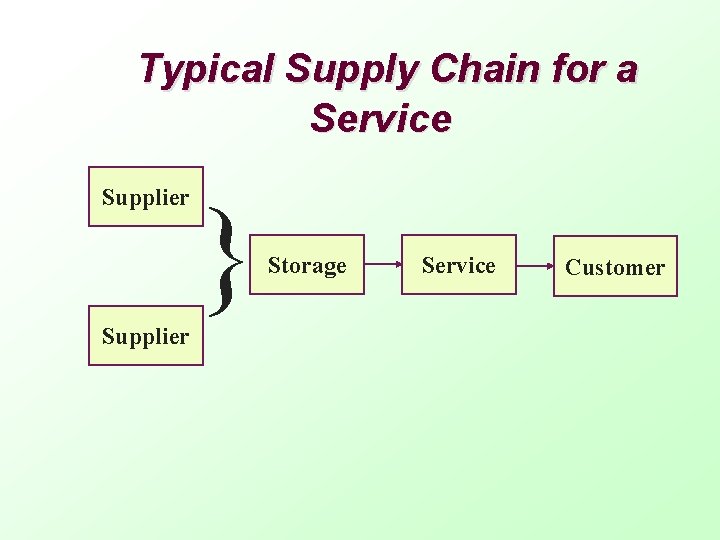
Typical Supply Chain for a Service Supplier } Storage Service Customer
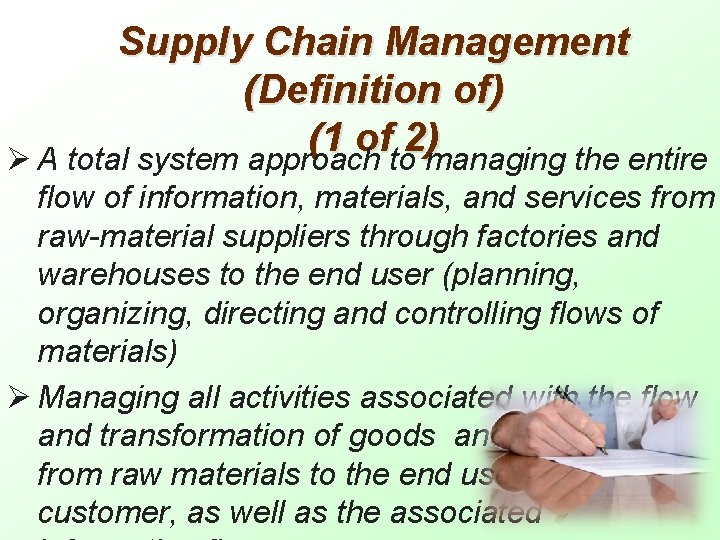
Supply Chain Management (Definition of) (1 of 2) Ø A total system approach to managing the entire flow of information, materials, and services from raw-material suppliers through factories and warehouses to the end user (planning, organizing, directing and controlling flows of materials) Ø Managing all activities associated with the flow and transformation of goods and services from raw materials to the end user, the customer, as well as the associated
Supply Chain Management(Definition of) (2 of 2) Ø The strategic coordination of business functions within a business organization and throughout its supply chain for the purpose of integrating supply and demand management Ø The process of planning, implementing and controlling supply chain operations. To Accompany Russell and Taylor, Operations Management, 4 th Edition , 2003 Prentice-Hall, Inc. All rights reserved.
Goals of Supply Chain Management (1 of 2) ü Synchronization of activities required to achieve maximum competitive benefits ü Coordination, cooperation, and communication and timing among SC members ü Ensuring rapid flow of information among members
Goals of Supply Chain Management (2 of 2) ü Linking the market, distribution channels, processes and suppliers so that market demand is met as efficiently as possible across the chain ü Matching supply and demand at each stage of the chain as effectively and efficiently as possible Ultimate goal: Achieving customer satisfaction
Facilities Involved in SCM The sequence of the supply chain begins with basic suppliers and extends all the way to the final customer Ø Warehouses Ø Factories Ø Processing centers Ø Distribution centers Ø Retail outlets Ø Offices
Elements of Supply Chain Management Element Typical Issues Customers Determining what customers want Forecasting Predicting quantity and timing of demand Design Incorporating customer wants, mfg. , and time Processing Controlling quality, scheduling work Inventory Meeting demand while managing inventory costs Purchasing Evaluating suppliers and supporting operations Suppliers Monitoring supplier quality, delivery, and relations Location Determining location of facilities Logistics Deciding how to best move and store materials To Accompany Russell and Taylor, Operations Management, 4 th Edition , 2003 Prentice-Hall, Inc. All rights reserved.
Supply Chain Management Issues (1 of 3) Ø Determining what customers want Ø Predicting (forecasting) quantity and timing of demand Ø Incorporating customer wants to product design Ø Determining appropriate levels of outsourcing Ø Managing procurement (purchasing) Ø Managing and evaluating suppliers (monitoring supplier quality, delivery and relations) To Accompany Russell and Taylor, Operations Management, 4 th Edition , 2003 Prentice-Hall, Inc. All rights reserved.
Supply Chain Management Issues (2 of 3) ØDetermining the location of facilities ØManaging customer relationships ØInformation management Ø Managing supporting operations ØManaging risk ØManaging flows Ø Quality assurance and control To Accompany Russell and Taylor, Operations Management, 4 th Edition , 2003 Prentice-Hall, Inc. All rights reserved.
Supply Chain Management Issues (3 of 3) ØProduction planning, scheduling and control ØInventory management (meeting demand while managing inventory costs) ØLogistics Ø Deciding how best to move and store materials (distribution and delivery) ØCstomer service Ø Identifying problems and responding to them To Accompany Russell and Taylor, Operations Management, 4 th Edition , 2003 Prentice-Hall, Inc. All rights reserved.
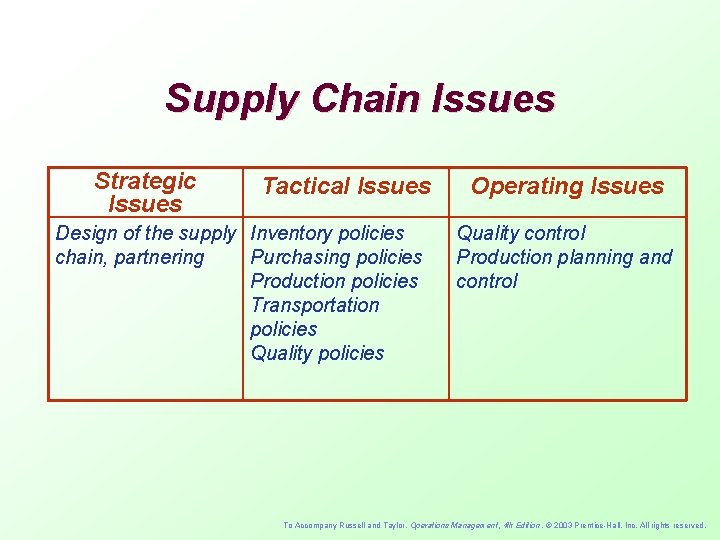
Strategic &Operational Decisions in Supply Chains Three types of decisions in supply chain management – Strategic – design and policy – Tactical – Operational – day-today activities
Supply Chain Issues Strategic Issues Tactical Issues Design of the supply Inventory policies chain, partnering Purchasing policies Production policies Transportation policies Quality policies Operating Issues Quality control Production planning and control To Accompany Russell and Taylor, Operations Management, 4 th Edition , 2003 Prentice-Hall, Inc. All rights reserved.
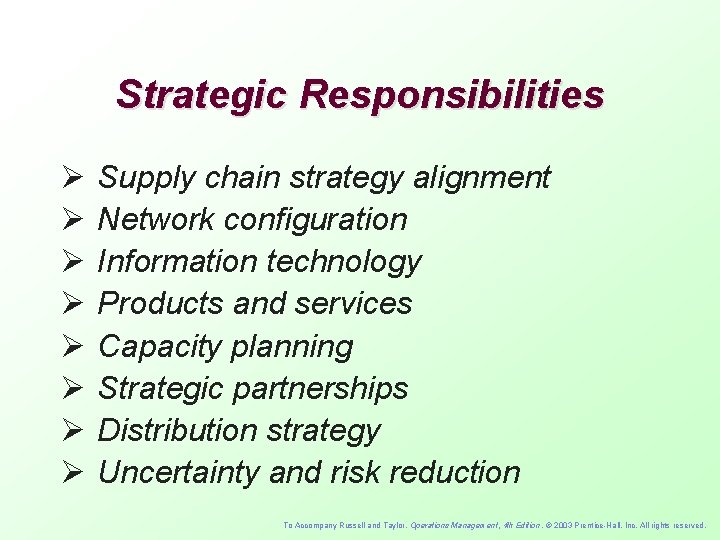
Strategic Responsibilities Ø Ø Ø Ø Supply chain strategy alignment Network configuration Information technology Products and services Capacity planning Strategic partnerships Distribution strategy Uncertainty and risk reduction To Accompany Russell and Taylor, Operations Management, 4 th Edition , 2003 Prentice-Hall, Inc. All rights reserved.
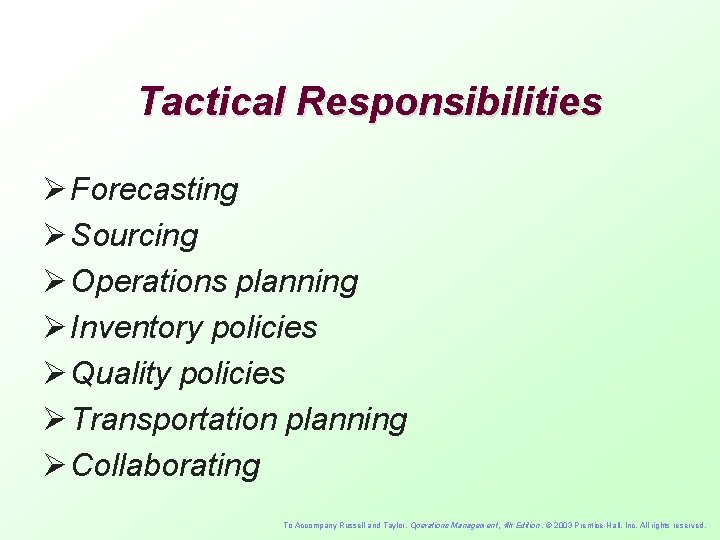
Tactical Responsibilities Ø Forecasting Ø Sourcing Ø Operations planning Ø Inventory policies Ø Quality policies Ø Transportation planning Ø Collaborating To Accompany Russell and Taylor, Operations Management, 4 th Edition , 2003 Prentice-Hall, Inc. All rights reserved.
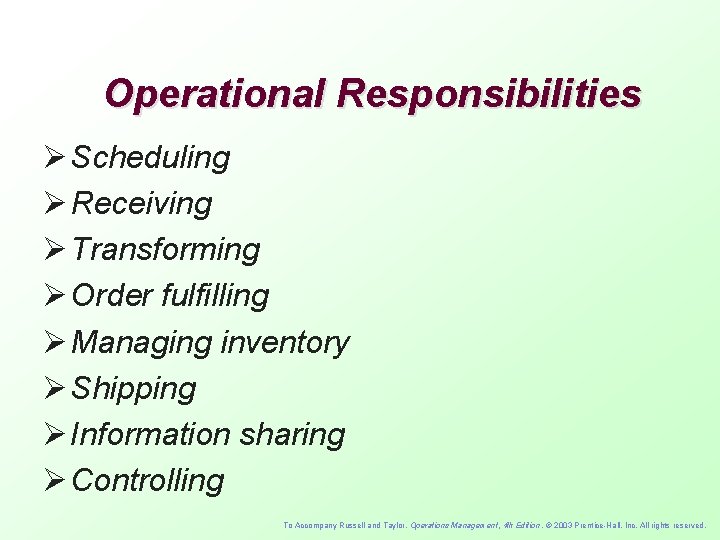
Operational Responsibilities Ø Scheduling Ø Receiving Ø Transforming Ø Order fulfilling Ø Managing inventory Ø Shipping Ø Information sharing Ø Controlling To Accompany Russell and Taylor, Operations Management, 4 th Edition , 2003 Prentice-Hall, Inc. All rights reserved.
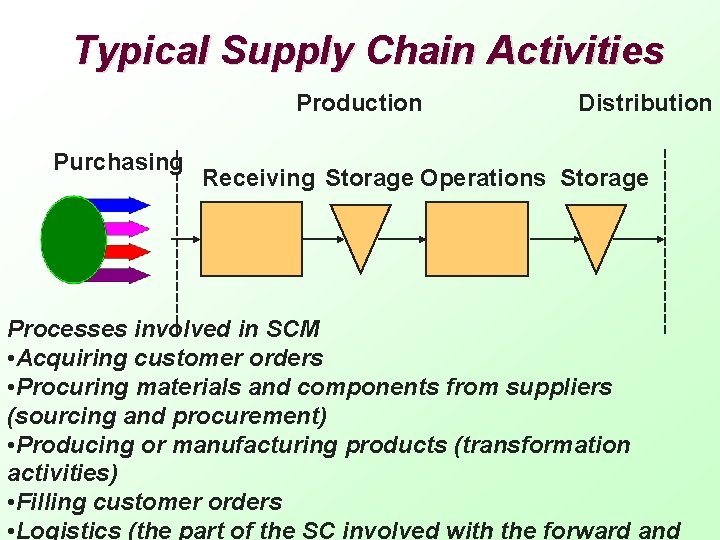
Typical Supply Chain Activities Production Purchasing Distribution Receiving Storage Operations Storage Processes involved in SCM • Acquiring customer orders • Procuring materials and components from suppliers (sourcing and procurement) • Producing or manufacturing products (transformation activities) • Filling customer orders • Logistics (the part of the SC involved with the forward and
Trends in SCM • • • Reevaluation of outsourcing Risk management Inventory management Lean supply chains Sustainability As a result of these trends, organizations are likely to give serious thought to reconfiguring their supply chains to • reduce risks, • improve flow, • increase profits and • increase customer satisfaction
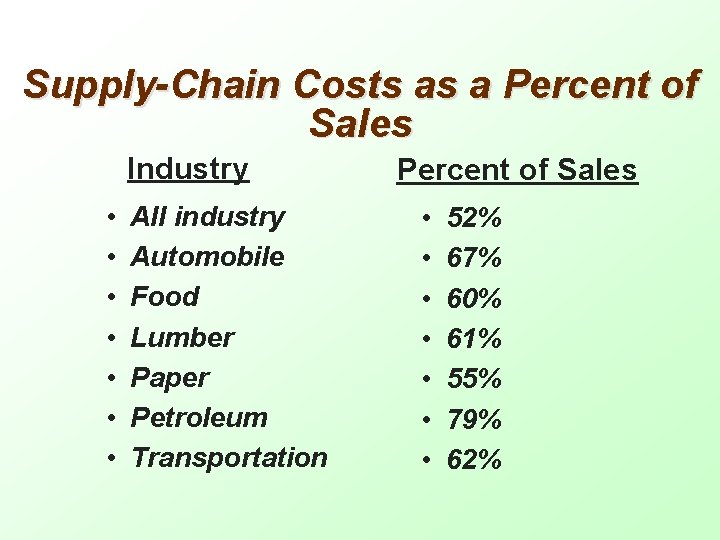
Supply-Chain Costs as a Percent of Sales Industry • • All industry Automobile Food Lumber Paper Petroleum Transportation Percent of Sales • • 52% 67% 60% 61% 55% 79% 62%
Factors That Contribute to the Increased Need for Effective Supply Chain Management Ø need to improve operations Ø increased levels of outsourcing Ø increasing transportation costs Ø competitive pressures Ø increasing globalization Ø increasing importance of e-commerce Ø increasing complexity of supply chains Ø increasing pressure to decrease
Benefits of Supply Chain Management ØLower inventories ØLower costs ØHigher productivity ØGreater agility ØShorter lead times ØHigher profits ØGreater customer loyalty ØIntegration of seperate organizations into a cohesive operating system
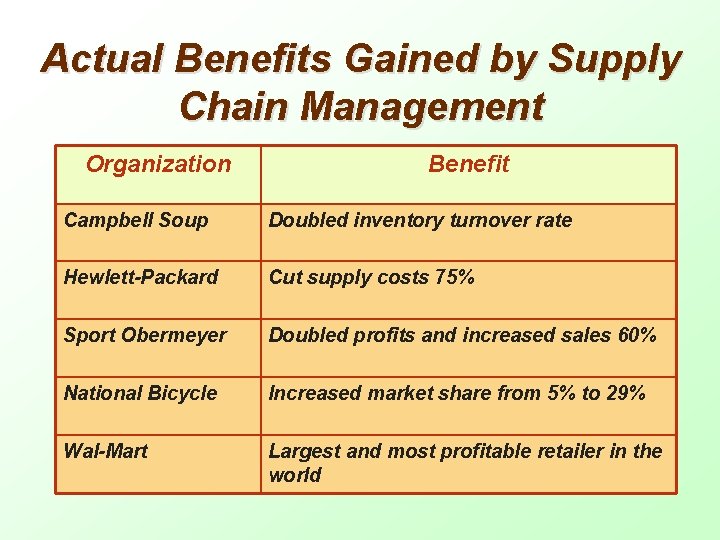
Actual Benefits Gained by Supply Chain Management Organization Benefit Campbell Soup Doubled inventory turnover rate Hewlett-Packard Cut supply costs 75% Sport Obermeyer Doubled profits and increased sales 60% National Bicycle Increased market share from 5% to 29% Wal-Mart Largest and most profitable retailer in the world
Requirements of a Successful Supply Chain ØIt begins with strategic sourcing ØAnalyzing the procurement process to lower costs by reducing waste and non-value-added activities, increasing profits, reducing risks and improving supplier performance ØTrust among trading partners ØEffective cooperation and communications Supply chain should enable members to 1) share forecasts, 2) determine the status of orders in real time, 3) access inventory data of partners ØSupply chain visibility ØInventory velocity ØEvent-management capability
Creating an Effective Supply Chain An Effective Supply Chain requires linking the market, distribution channels processes, and suppliers 1. Develop strategic objectives and tactics 2. Integrate and coordinate activities in the internal supply chain 3. Coordinate activities with suppliers and with distributors 4. Coordinate planning and execution across the
SC Performance Measures To Accompany Russell and Taylor, Operations Management, 4 th Edition , 2003 Prentice-Hall, Inc. All rights reserved.
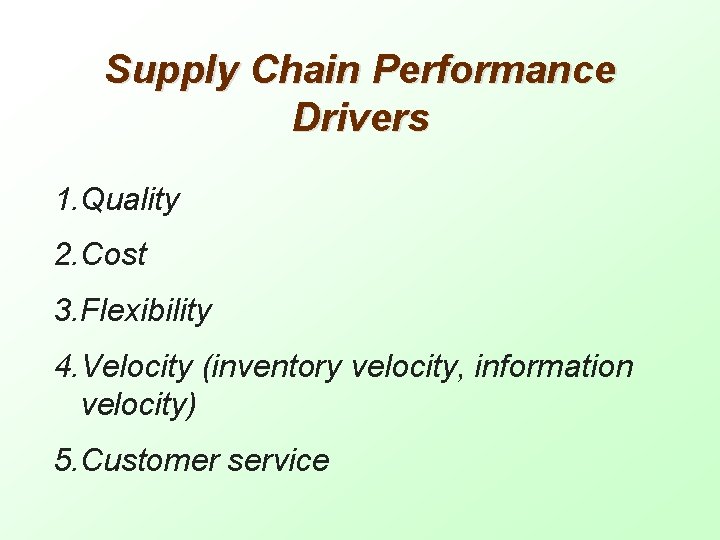
Supply Chain Performance Drivers 1. Quality 2. Cost 3. Flexibility 4. Velocity (inventory velocity, information velocity) 5. Customer service
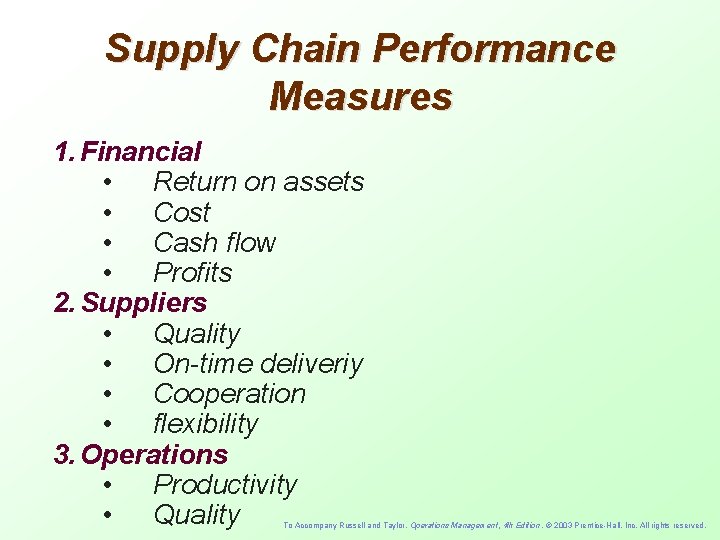
Supply Chain Performance Measures 1. Financial • Return on assets • Cost • Cash flow • Profits 2. Suppliers • Quality • On-time deliveriy • Cooperation • flexibility 3. Operations • Productivity • Quality To Accompany Russell and Taylor, Operations Management, 4 th Edition , 2003 Prentice-Hall, Inc. All rights reserved.
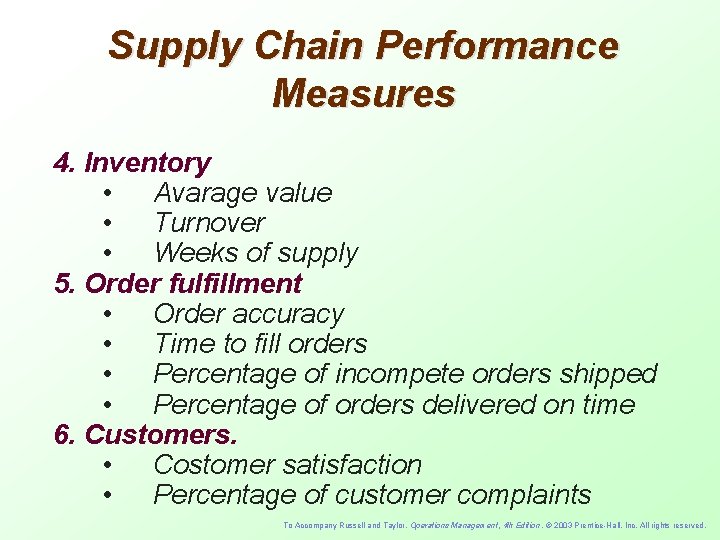
Supply Chain Performance Measures 4. Inventory • Avarage value • Turnover • Weeks of supply 5. Order fulfillment • Order accuracy • Time to fill orders • Percentage of incompete orders shipped • Percentage of orders delivered on time 6. Customers. • Costomer satisfaction • Percentage of customer complaints To Accompany Russell and Taylor, Operations Management, 4 th Edition , 2003 Prentice-Hall, Inc. All rights reserved.
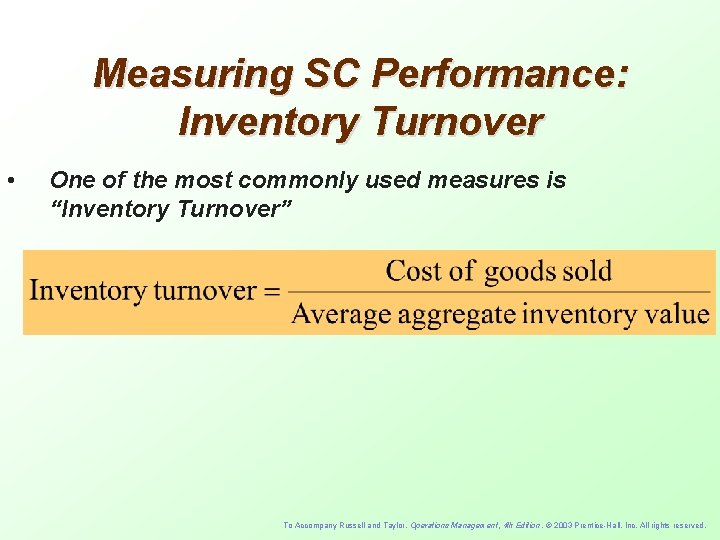
Measuring SC Performance: Inventory Turnover • One of the most commonly used measures is “Inventory Turnover” To Accompany Russell and Taylor, Operations Management, 4 th Edition , 2003 Prentice-Hall, Inc. All rights reserved.
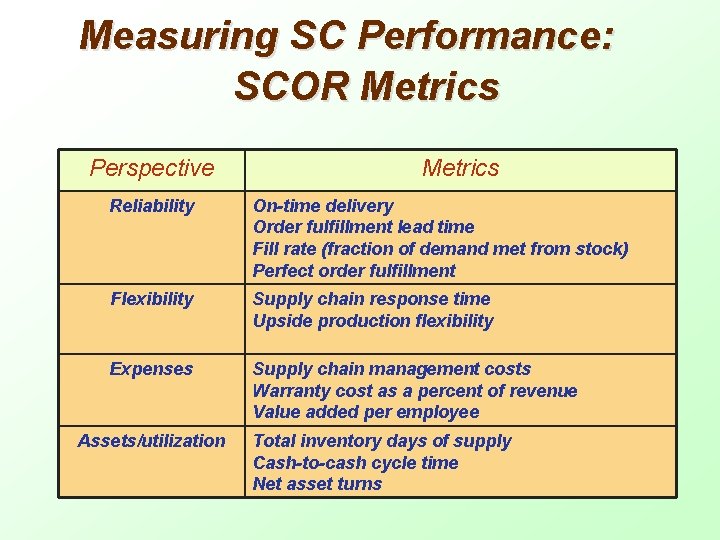
Measuring SC Performance: SCOR Metrics Perspective Metrics Reliability On-time delivery Order fulfillment lead time Fill rate (fraction of demand met from stock) Perfect order fulfillment Flexibility Supply chain response time Upside production flexibility Expenses Supply chain management costs Warranty cost as a percent of revenue Value added per employee Assets/utilization Total inventory days of supply Cash-to-cash cycle time Net asset turns
Inventory Management To Accompany Russell and Taylor, Operations Management, 4 th Edition , 2003 Prentice-Hall, Inc. All rights reserved.
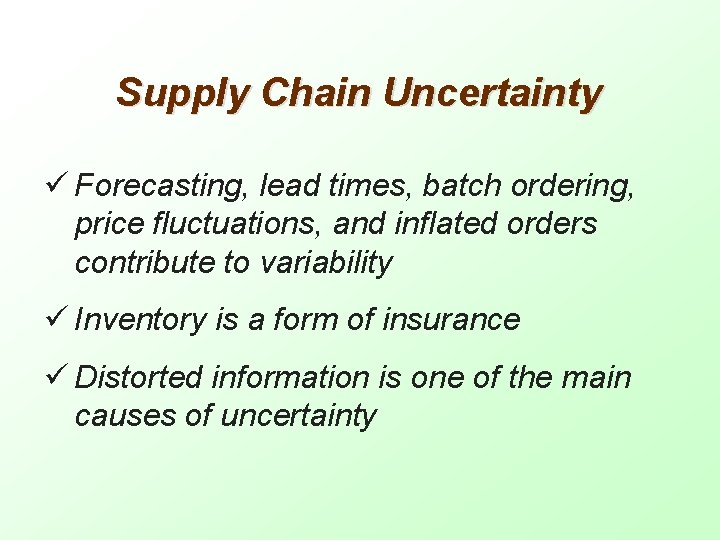
Supply Chain Uncertainty ü Forecasting, lead times, batch ordering, price fluctuations, and inflated orders contribute to variability ü Inventory is a form of insurance ü Distorted information is one of the main causes of uncertainty
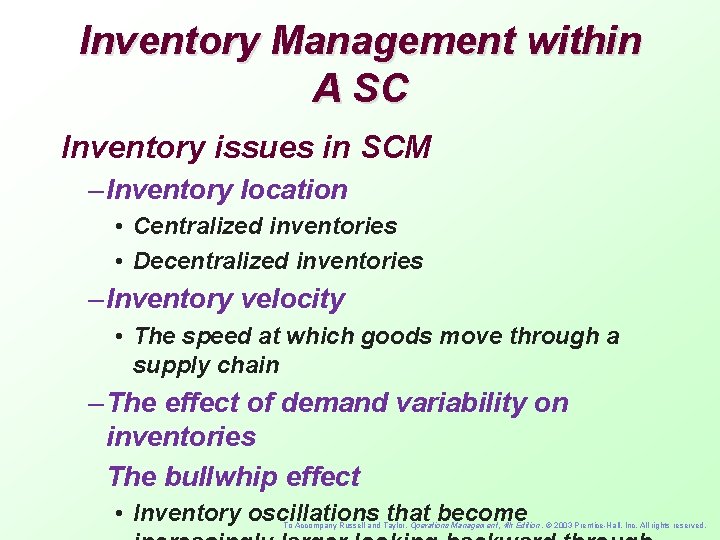
Inventory Management within A SC Inventory issues in SCM – Inventory location • Centralized inventories • Decentralized inventories – Inventory velocity • The speed at which goods move through a supply chain – The effect of demand variability on inventories The bullwhip effect • Inventory oscillations that become To Accompany Russell and Taylor, Operations Management, 4 th Edition , 2003 Prentice-Hall, Inc. All rights reserved.
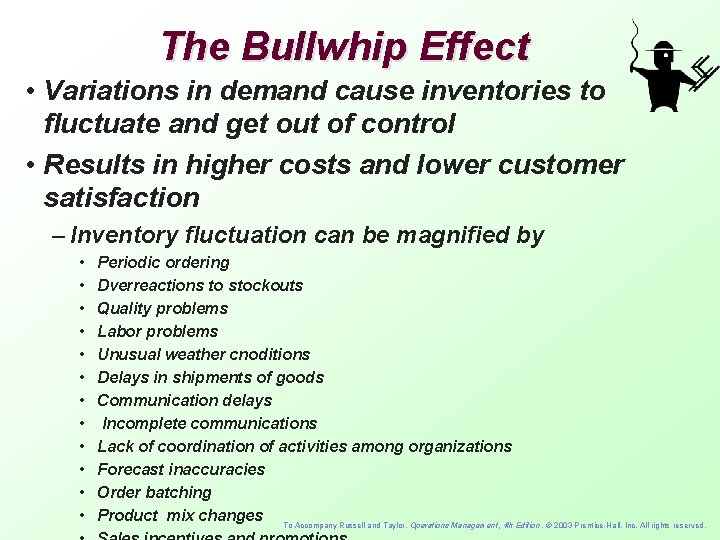
The Bullwhip Effect • Variations in demand cause inventories to fluctuate and get out of control • Results in higher costs and lower customer satisfaction – Inventory fluctuation can be magnified by • • • Periodic ordering Dverreactions to stockouts Quality problems Labor problems Unusual weather cnoditions Delays in shipments of goods Communication delays Incomplete communications Lack of coordination of activities among organizations Forecast inaccuracies Order batching Product mix changes To Accompany Russell and Taylor, Operations Management, 4 th Edition , 2003 Prentice-Hall, Inc. All rights reserved.
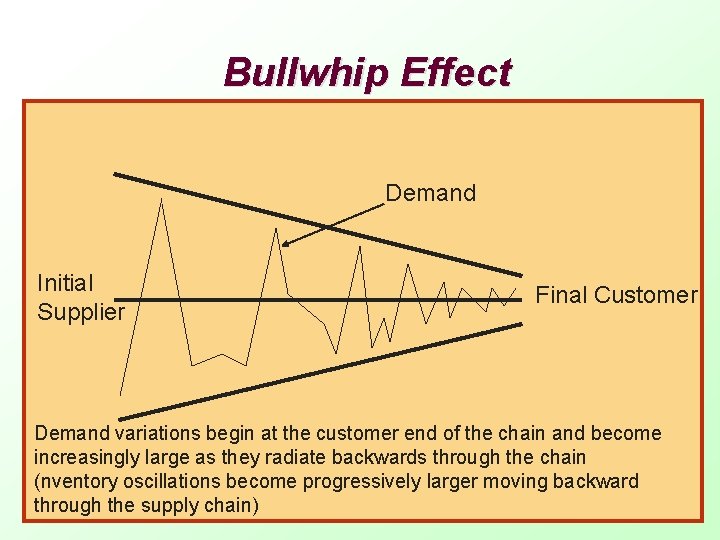
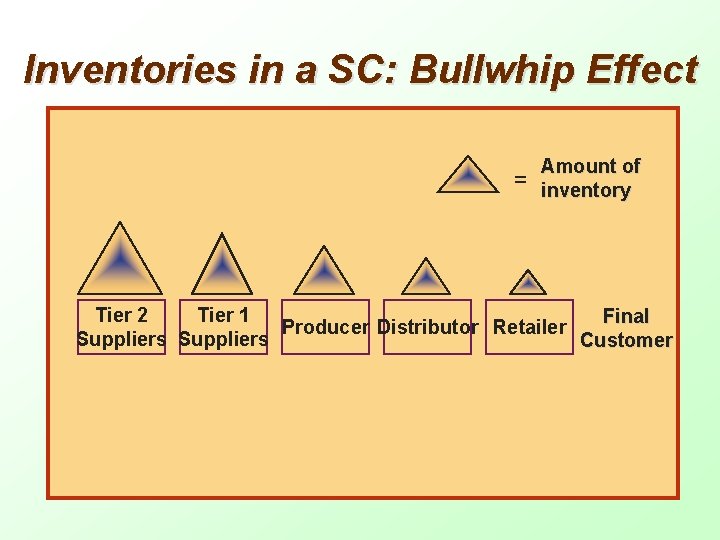
Bullwhip Effect Demand Initial Supplier Final Customer Demand variations begin at the customer end of the chain and become increasingly large as they radiate backwards through the chain (nventory oscillations become progressively larger moving backward through the supply chain)
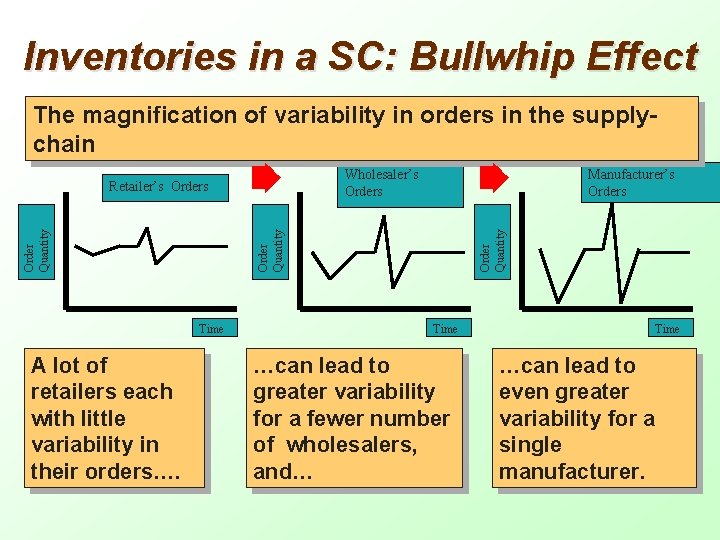
Inventories in a SC: Bullwhip Effect The magnification of variability in orders in the supplychain Order Quantity Time A lot of retailers each with little variability in their orders…. Manufacturer’s Order Quantity Wholesaler’s Orders Retailer’s Orders Time …can lead to greater variability for a fewer number of wholesalers, and… Time …can lead to even greater variability for a single manufacturer.
Inventories in a SC: Bullwhip Effect = Amount of inventory Tier 2 Tier 1 Final Producer Distributor Retailer Suppliers Customer
Mitigating the Bullwhip Effect • Good supply chain management can overcome the bullwhip effect – Strategic buffering • Holding inventory at a distribution center rather than at retail outlets – Replenishment based on need • Vendor-managed inventory – Vendors monitor goods and replenish retail inventories when supplies are low To Accompany Russell and Taylor, Operations Management, 4 th Edition , 2003 Prentice-Hall, Inc. All rights reserved.
Vendor-Managed Inventories The use of a local supplier to maintain inventory for the manufacturer ü Stocking information is accessed using EDI ü A first step towards supply chain collaboration ü Increased speed, reduced errors, and improved service
Supply Chains and Information Technology To Accompany Russell and Taylor, Operations Management, 4 th Edition , 2003 Prentice-Hall, Inc. All rights reserved.
Role of Information in the Supply Chain (1 of 2) ü Centralized coordination of information flows ü Integration of transportation, distribution, ordering, and production ü Direct access to domestic and global transportation and distribution channels ü Locating and tracking the movement of every item in the supply chain
Role of Information in the Supply Chain (2 of 2) ü Data interchange ü Data acquisition at the point of origin and point of sale ü Intercompany and intracompany information access ü Instantaneous updating of inventory levels ü Increasing the rate at which information is communicated in a SC.
Some IT Applications for SCM (1 of 3) ØElectronic Business (replacement of physical processes with electronic ones) ØElectronic Data Interchange (a computer-to-computer exchange of business documentsincluding purchase orders, shipping notices, and debit or credit memos) in a standard format) ØBar Coding (computer readable codes attached to items flowing through the SC). Generates point-of-sale data which is useful for determining sales trends, ordering, production scheduling, and delivery plans 1234 5678
Some IT Applications for SCM (2 of 3) ØRFID (Radio Frequency Identification) Technology Ø A technology that uses radio waves to identify objects, such as goods in supply chains) ØSimilar to bar codes but Øuses radio frequency to transmit product information to receiver ØAre able to convey much more information ØDo not require line-of-sight for reading ØDo not need to be read one at a time ØUsed to track goods in supply chain ØRFID tags attached to objects ØRFID eliminates need for manual counting and bar code scanning To Accompany Russell and Taylor, Operations Management, 4 th Edition , 2003 Prentice-Hall, Inc. All rights reserved.
Some IT Applications for SCM (3 of 3) ØInternet (provides instant access to organizations, individuals and information sources; fundamentaly changes the way organizations do business; add speed and accessibility to the SC) ØIntranets (internet-like networks that operate within a single organization) ØExtranets (intranets that can be connected to the global internet & that include a company’s
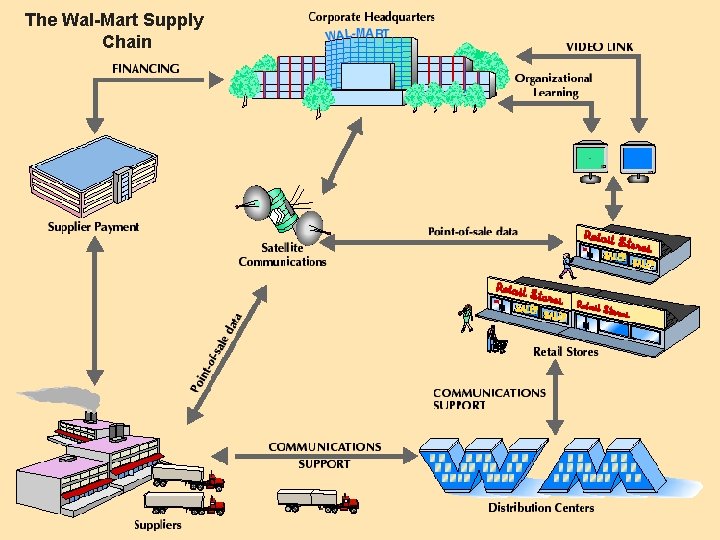
The Wal-Mart Supply Chain To Accompany Russell and Taylor, Operations Management, 4 th Edition , 2003 Prentice-Hall, Inc. All rights reserved.
Wall-Mart Case · Wal-Mart has a satellite network for electronic data interchange that allows vendors to directly access point-of-sale data in real time, enabling them to improve their forecasting and inventory management. · Wal-Mart also uses the system for issuing purchase orders and receiving invoices from its vendors. To Accompany Russell and Taylor, Operations Management, 4 th Edition , 2003 Prentice-Hall, Inc. All rights reserved.
Benefits of Electronic Data Interchange • • Increased productivity Reduction of paperwork Lead time and inventory reduction Facilitation of just-in-time systems Electronic transfer of funds Improved control of operations Reduction in clerical labor Increased accuracy To Accompany Russell and Taylor, Operations Management, 4 th Edition , 2003 Prentice-Hall, Inc. All rights reserved.
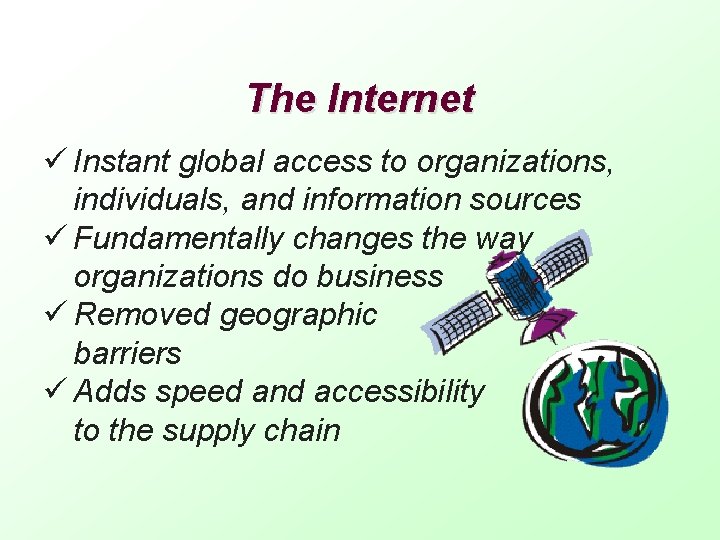
The Internet ü Instant global access to organizations, individuals, and information sources ü Fundamentally changes the way organizations do business ü Removed geographic barriers ü Adds speed and accessibility to the supply chain
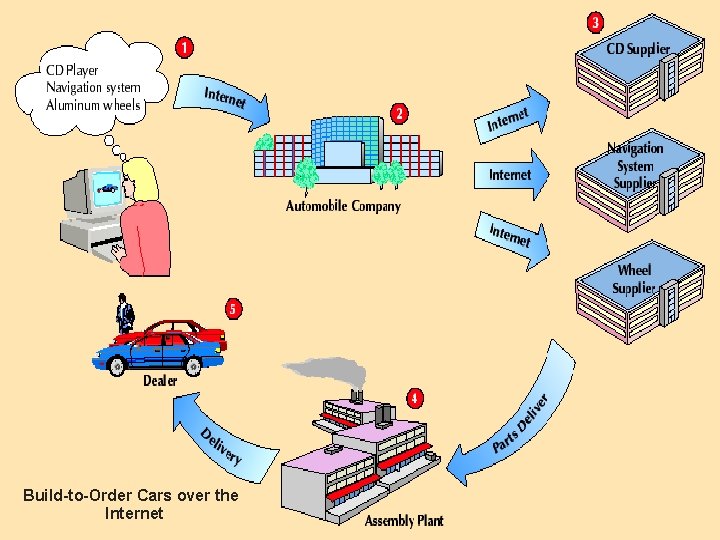
Build-to-Order Cars over the Internet
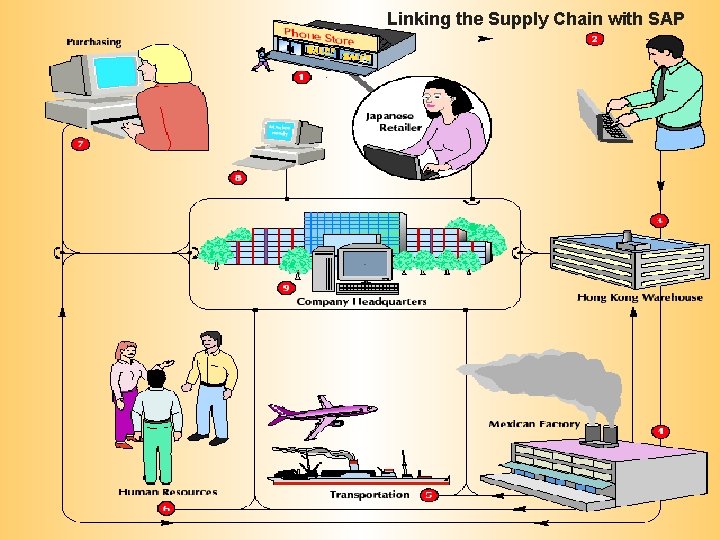
Linking the Supply Chain with SAP To Accompany Russell and Taylor, Operations Management, 4 th Edition , 2003 Prentice-Hall, Inc. All rights reserved.
Electronic Business • E-Business: the use of electronic technology to facilitate business transactions Involves the interaction of different business organizations as well as the interaction of individuals with business organizations. Replacement of physical processes with electronic ones • Applications include: – Internet buying and selling – E-mail
Essential Features of EBusiness Ø The Web site (front-end design) Ø Order fulfillment (back end) ØOrder processsing ØBilling Øİnventory management ØWarehousing ØPacking ØShiping ØDelivery To Accompany Russell and Taylor, Operations Management, 4 th Edition , 2003 Prentice-Hall, Inc. All rights reserved.
Advantages of E-Business (1 of 2) ØGlobal presence and increased visibility ØGlobal access to markets and customers ØImproved competitiveness, quality and service ØGreater choices and more and easy access to information for customers ØCollection and analysis of detailed customer data, interests and preferences ØShortened supply chain response times
Advantages of E-Business (2 of 2) ØShortened transaction times for ordering and delivery ØCost savings and price reductions ØVirtual companies with lower prices ØLeveling the playing field for small companies ØReducing or eliminating intermediaries (disintermetiation) ØImproved service
E-Business Order Fulfillment Problems • Efficient web sites do not necessarily mean the rest of the supply chain will be as efficient Customer expectations – Order quickly Quick delivery • Demand variability creates order fulfillment problems • Sometimes Internet demand exceeds an organization’s ability to fulfill orders • Inventory – Outsourcing order fulfillment • Loss of control – Build large warehouses To Accompany Russell and Taylor, Operations Management, 4 th Edition , 2003 Prentice-Hall, Inc. All rights reserved.
IT Issues ü Increased benefits and sophistication come with increased costs ü Efficient web sites do not necessarily mean the rest of the supply chain will be as efficient ü Security problems are very real ü Partnership and trust are important elements that may be new to business relationships
Procurement To Accompany Russell and Taylor, Operations Management, 4 th Edition , 2003 Prentice-Hall, Inc. All rights reserved.
Procurement Development and implementation of purchasing plans for products and services that support operations strategies
E-Procurement ü Business-to-business commerce conducted on the Internet ü Benefits include lower transaction costs, lower prices, reduce clerical labor costs, and faster ordering and delivery times ü Currently used more for indirect goods ü E-Marketplaces service industry-specific companies and suppliers To Accompany Russell and Taylor, Operations Management, 4 th Edition , 2003 Prentice-Hall, Inc. All rights reserved.
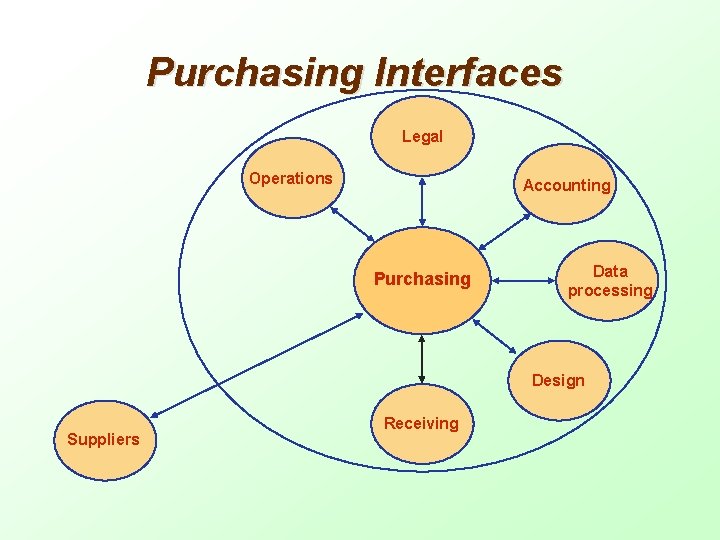
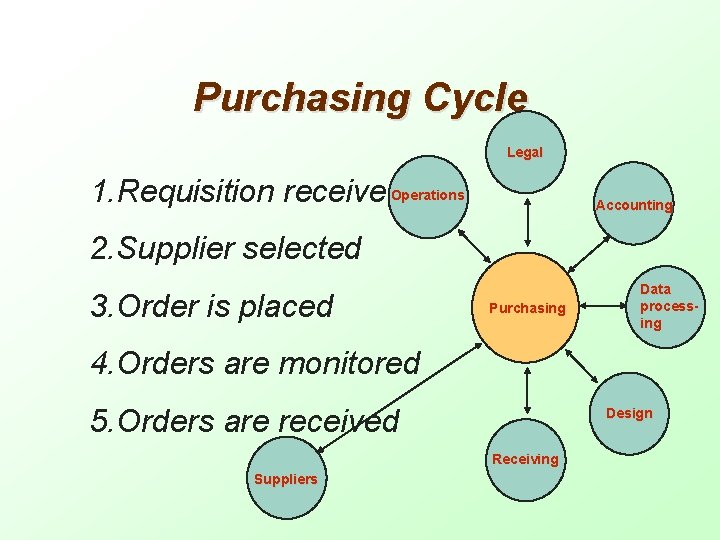
Purchasing • Purchasing is responsible for obtaining the materials, parts, and supplies and services needed to produce a product or provide a service. • Purchasing cycle: Series of steps that begin with a request for purchase and end with notification of shipment received in satisfactory condition.
Importance of Purchasing is important because: - it is a major cost center - affect quality of final product - aids strategy of low cost, response and differentiation
Goals of Purchasing • Develop and implement purchasing plans for products and services that support operations strategies. • Develop, evaluate, and determine the best supplier, price, and delivery for the products and services that can be best obtained externally
Duties of Purchasing • Identifying sources of supply • Negotiating contracts • Maintaining a database of suppliers • Obtaining goods and services • Managing supplies
Purchasing Interfaces Legal Operations Accounting Purchasing Data processing Design Suppliers Receiving
Purchasing Cycle Legal 1. Requisition received. Operations Accounting 2. Supplier selected 3. Order is placed Purchasing Data processing 4. Orders are monitored 5. Orders are received Design Receiving Suppliers
Centralized vs Decentralized Purchasing • Centralized purchasing – Purchasing is handled by one special department • Decentralized purchasing –Individual departments or separate locations handle their own purchasing requirements
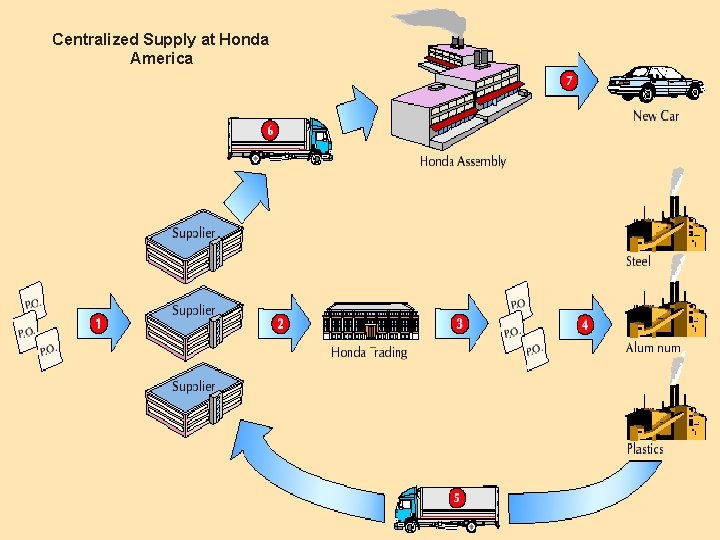
Centralized Supply at Honda America To Accompany Russell and Taylor, Operations Management, 4 th Edition , 2003 Prentice-Hall, Inc. All rights reserved.
Supplier Management To Accompany Russell and Taylor, Operations Management, 4 th Edition , 2003 Prentice-Hall, Inc. All rights reserved.
Suppliers ü Purchased materials account for about half of manufacturing costs ü Materials, parts, and service must be delivered on time, of high quality, and low cost ü Suppliers should be integrated into their customers’ supply chains ü Partnerships should be established ü On-demand delivery (JIT) is a frequent requirement To Accompany Russell and Taylor, Operations Management, 4 th Edition , 2003 Prentice-Hall, Inc. All rights reserved.
Supplier Related Issues • Sourcing (choosing suppliers) – Vendor analysis (evaluating sources of supply) – Supplier audits – Supplier certification • Supplier relationship management • Supplier partnerships – CPFR To Accompany Russell and Taylor, Operations Management, 4 th Edition , 2003 Prentice-Hall, Inc. All rights reserved.
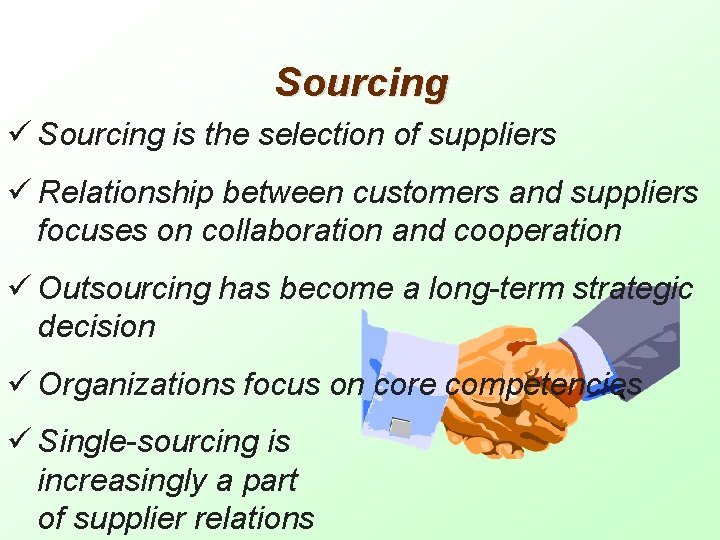
Sourcing ü Sourcing is the selection of suppliers ü Relationship between customers and suppliers focuses on collaboration and cooperation ü Outsourcing has become a long-term strategic decision ü Organizations focus on core competencies ü Single-sourcing is increasingly a part of supplier relations
Vendor Analysis Evaluating the sources of supply in terms of: • Price • Quality and quality pratices • Flexibility • Location • Past experience • Product or service changes • Reputation and financial stability • Lead times and on-time delivery • Inventory policy • Services (such as technical support and training) provided The above criteria can be classified as 1) those related to the
Supplier Audits and Certification • Supplier audit – A means of keeping current on suppliers’ production (or service) capabilities, quality and delivery problems and resolutions, and performance on other criteria • Supplier certification – Involves a detailed examination of a supplier’s policies and capabilities – The process verifies the supplier meets or exceeds the requirements of a buyer To Accompany Russell and Taylor, Operations Management, 4 th Edition , 2003 Prentice-Hall, Inc. All rights reserved.
Supplier Relationship Management • Type of relationship is often governed by the duration of the trading relationship – Short-term • Oftentimes involves competitive bidding • Minimal interaction – Medium-term • Often involves an ongoing relationship – Long-term • Often involves greater cooperation that evolves into a partnership To Accompany Russell and Taylor, Operations Management, 4 th Edition , 2003 Prentice-Hall, Inc. All rights reserved.
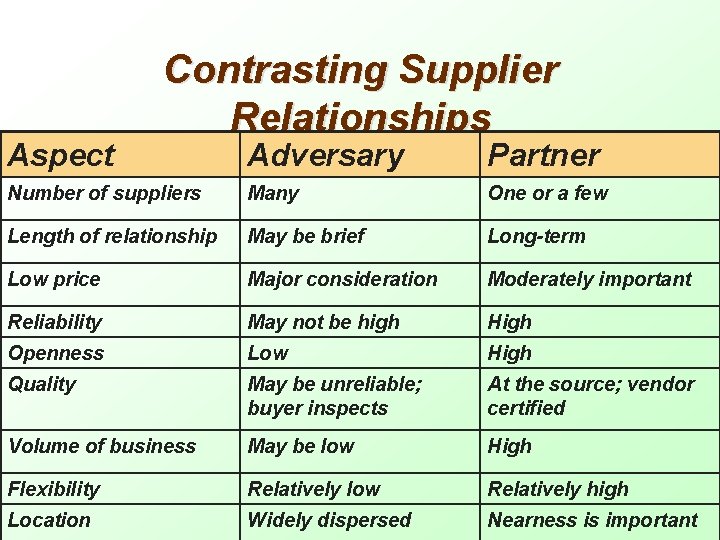
Aspect Contrasting Supplier Relationships Adversary Partner Number of suppliers Many One or a few Length of relationship May be brief Long-term Low price Major consideration Moderately important Reliability May not be high High Openness Low High Quality May be unreliable; buyer inspects At the source; vendor certified Volume of business May be low High Flexibility Relatively low Relatively high Location Widely dispersed Nearness is important
Supplier Partnerships Ideas from suppliers could lead to improved competitiveness 1. Reduce cost of making the purchase 2. Reduce transportation costs 3. Reduce production costs 4. Improve product quality 5. Improve product design 6. Reduce time to market 7. Improve customer satisfaction 8. Reduce inventory costs 9. Introduce new products or services
Collaborative Planning, Forecasting, and Replenishment ØA system based on the notion that there should be Øinformation sharing among supply chain trading partners in planning, forecasting and inventory replenishment Øcooperation among supply chain trading partners in planning Øcoordination of activities To Accompany Russell and Taylor, Operations Management, 4 th Edition , 2003 Prentice-Hall, Inc. All rights reserved.
CPFR Process • Internet-based exchange of data and information • Significant decrease in inventory levels and more efficient logistics • Companies focus on core competencies • Eliminates typical order processig To Accompany Russell and Taylor, Operations Management, 4 th Edition , 2003 Prentice-Hall, Inc. All rights reserved.
CPFR Results • Nabisco and Wegmans – 50% increase in category sales • Wal-mart and Sara Lee – 14% reduction in store-level inventory – 32% increase in sales • Kimberly-Clark and Kmart – Increased category sales that exceeded market growth To Accompany Russell and Taylor, Operations Management, 4 th Edition , 2003 Prentice-Hall, Inc. All rights reserved.
Strategic Partnering Two or more business organizations that have complementary products or services join so that each may realize a strategic benefit To Accompany Russell and Taylor, Operations Management, 4 th Edition , 2003 Prentice-Hall, Inc. All rights reserved.
Order Fulfillment To Accompany Russell and Taylor, Operations Management, 4 th Edition , 2003 Prentice-Hall, Inc. All rights reserved.
Order Fulfillment Order fulfillment – The process involved in responding to customer orders – Often a function of the degree of customization required • Common approaches – – Engineer-to-order (ETO) Make-to-order (MTO) Assemble-to-order (ATO) Make-to-stock (MTS) To Accompany Russell and Taylor, Operations Management, 4 th Edition , 2003 Prentice-Hall, Inc. All rights reserved.
Figure 7. 5 Order Fulfillment at Amazon. com To Accompany Russell and Taylor, Operations Management, 4 th Edition , 2003 Prentice-Hall, Inc. All rights reserved.
Distribution System Design To Accompany Russell and Taylor, Operations Management, 4 th Edition , 2003 Prentice-Hall, Inc. All rights reserved.
Distribution System Encompasses all of the distribution channels, processes and functions, including warehousing and transportation, that a product passes through on its way to the final customer. To Accompany Russell and Taylor, Operations Management, 4 th Edition , 2003 Prentice-Hall, Inc. All rights reserved.
Logistics To Accompany Russell and Taylor, Operations Management, 4 th Edition , 2003 Prentice-Hall, Inc. All rights reserved.
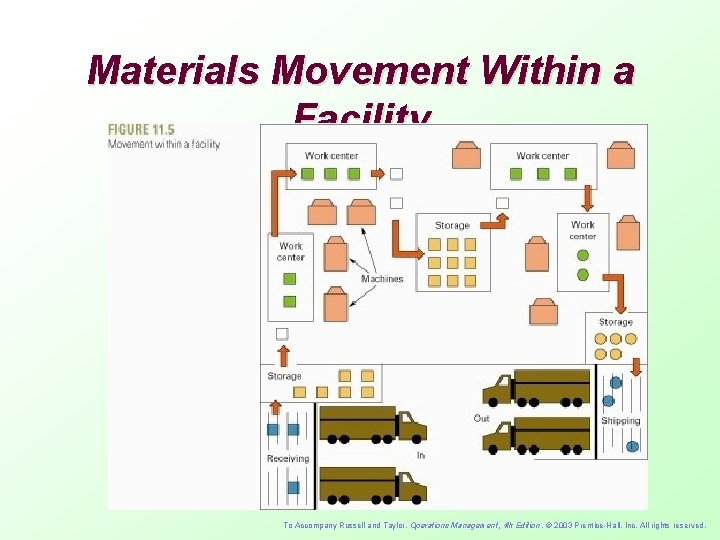
Logistics Refers to the movement of materials, services, cash and information in a supply chain. Includes: • movement within a facility, • incoming and outgoing shipments of goods and materials (traffic management) • decisions on shipping methods and time • information flow throughout the supply chain (RFID to track goods) To Accompany Russell and Taylor, Operations Management, 4 th Edition , 2003 Prentice-Hall, Inc. All rights reserved.
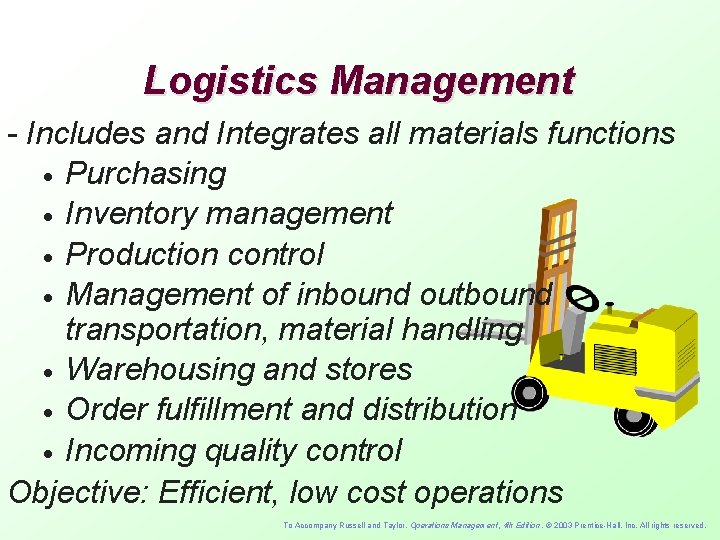
Logistics Management - Includes and Integrates all materials functions · Purchasing · Inventory management · Production control · Management of inbound outbound transportation, material handling · Warehousing and stores · Order fulfillment and distribution · Incoming quality control Objective: Efficient, low cost operations To Accompany Russell and Taylor, Operations Management, 4 th Edition , 2003 Prentice-Hall, Inc. All rights reserved.
Materials Movement Within a Facility To Accompany Russell and Taylor, Operations Management, 4 th Edition , 2003 Prentice-Hall, Inc. All rights reserved.
Incoming and Outgoing Shipments Traffic management – Overseeing the shipment of incoming and outgoing goods • Handles schedules and decisions on shipping method and times, taking into account: – – Costs of shipping alternatives Government regulations Needs of the organization Shipping delays or disruptions To Accompany Russell and Taylor, Operations Management, 4 th Edition , 2003 Prentice-Hall, Inc. All rights reserved.
Distribution ü The actual movement of products and materials between locations ü Handling of materials and products at receiving docks, storing products, packaging, and shipping ü Often called logistics ü Driving force today is speed ü Particularly important for Internet dot-coms To Accompany Russell and Taylor, Operations Management, 4 th Edition , 2003 Prentice-Hall, Inc. All rights reserved.
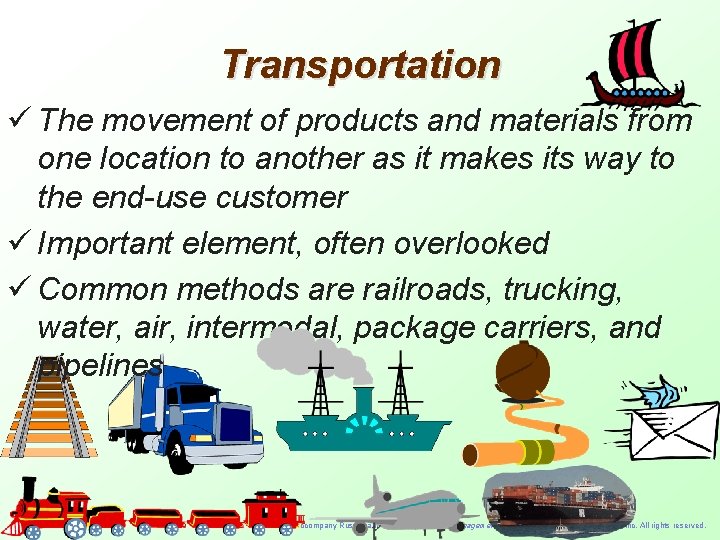
Transportation ü The movement of products and materials from one location to another as it makes its way to the end-use customer ü Important element, often overlooked ü Common methods are railroads, trucking, water, air, intermodal, package carriers, and pipelines To Accompany Russell and Taylor, Operations Management, 4 th Edition , 2003 Prentice-Hall, Inc. All rights reserved.
Evaluating Shipping Alternatives Considerations include: • Shipping costs • Availabilitiy • Materials being shipped • Coordination of shipments with other SC activities • Flexibility • Speed • Environmental considerations To Accompany Russell and Taylor, Operations Management, 4 th Edition , 2003 Prentice-Hall, Inc. All rights reserved.
Distribution Centers and Warehousing ü Trend is for more frequent orders in smaller quantities ü Flow-through facilities and automated material handling ü Final assembly and product configuration may be done at the DC To Accompany Russell and Taylor, Operations Management, 4 th Edition , 2003 Prentice-Hall, Inc. All rights reserved.
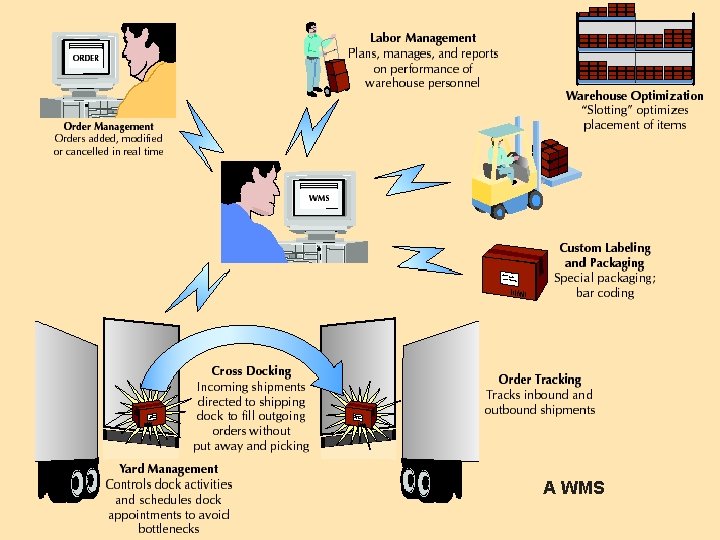
Warehouse Management Systems ü Highly automated systems ü Controls item putaway, picking, packing, and shipping ü Cross-docking: Goods arriving at a warehouse from a supplier are unloaded from the supplier’s truck and loaded onto outbound trucks Avoids warehouse storage To Accompany Russell and Taylor, Operations Management, 4 th Edition , 2003 Prentice-Hall, Inc. All rights reserved.
A WMS To Accompany Russell and Taylor, Operations Management, 4 th Edition , 2003 Prentice-Hall, Inc. All rights reserved.
Third-Party Logistics The term used to describe the outsourcing of logistics management. Includes warehousing and distribution To Accompany Russell and Taylor, Operations Management, 4 th Edition , 2003 Prentice-Hall, Inc. All rights reserved.
Reverse Logistics Reverse logistics – the backward flow of goods returned to the supply chain (the process of transporting returned items) Products are returned to companies or third party handlers for a variety of reasons (Defective products, recalled products, obsolete products, unsold products, parts replaced in the field, items for recycling, waste) and in a variety of conditions Processing returned goods • Sorting, examining/testing, restocking, repairing • Reconditioning, recycling, disposing Elements of return management • Gatekeeping – screening returned goods to prevent incorrect acceptance of goods To Accompany Russell and Taylor, Operations Management, 4 th Edition , 2003 Prentice-Hall, Inc. All rights reserved.
Global Supply Chain Management To Accompany Russell and Taylor, Operations Management, 4 th Edition , 2003 Prentice-Hall, Inc. All rights reserved.
Global Supply Chains üProduct design often uses inputs from around the world üSome manufacturing and service activities are outsourced to countries where labor and/or materials costs are lower üProducts are sold globally To Accompany Russell and Taylor, Operations Management, 4 th Edition , 2003 Prentice-Hall, Inc. All rights reserved.
Complexities of Global Supply Chains ü National and regional differences ü Language and cultural differences ü Currency fluctuations ü Political instability ü Quality issues ü Customs, business practices, ü Nonhomogeneoity of foreign markets ü Financial and economic considerations ü Governmental, environmental and regulatory considerations. ü Increased transportation costs and lead time ü Increased need for trust amongst supply chain partners To Accompany Russell and Taylor, Operations Management, 4 th Edition , 2003 Prentice-Hall, Inc. All rights reserved.
Infrastructure Obstacles to Global Trade ü Some emerging markets lack suitable distribution systems, i. e. roads, rail systems ü Existing roads and ports may be inadequate ü Market instability, political instability ü Vertical integration is a common solution
Global Supply-Chain Issues Supply chains in a global environment must be: – Flexible enough to react to sudden changes in parts availability, distribution, or shipping channels, import duties, and currency rates – Able to use the latest computer and transmission technologies to schedule and manage the shipment of parts in and finished products out – Staffed with local specialists to handle duties, trade, freight, customs and political issues
Challanges within a Supply Chain To Accompany Russell and Taylor, Operations Management, 4 th Edition , 2003 Prentice-Hall, Inc. All rights reserved.
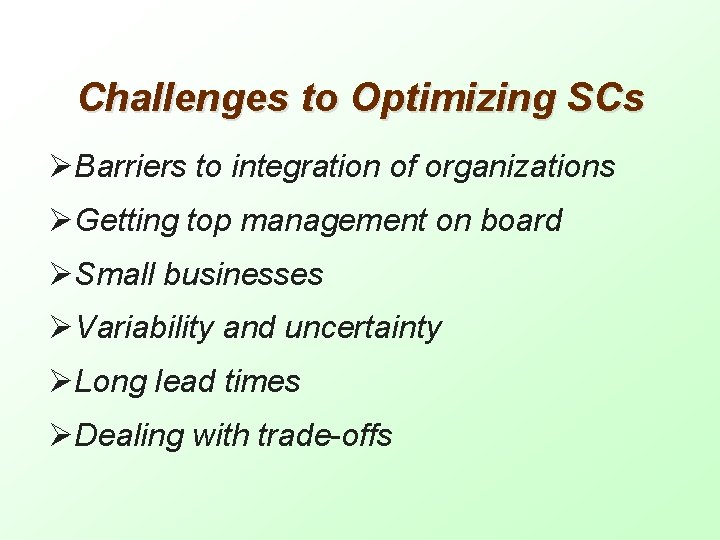
Challenges to Optimizing SCs ØBarriers to integration of organizations ØGetting top management on board ØSmall businesses ØVariability and uncertainty ØLong lead times ØDealing with trade-offs
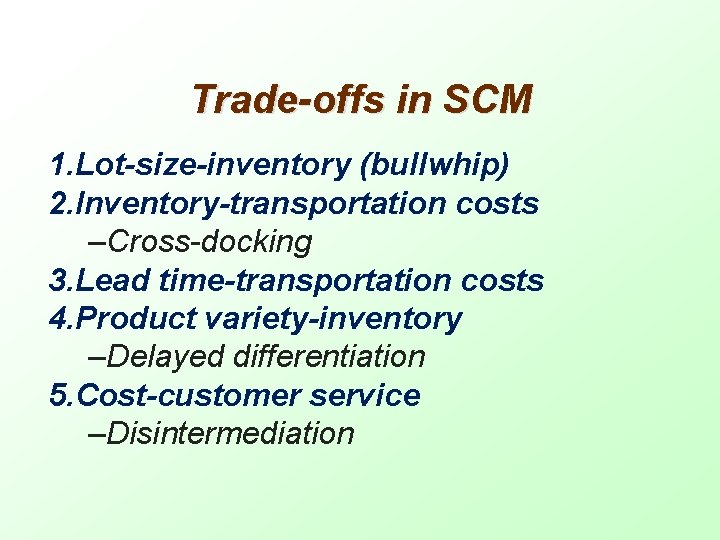
Trade-offs in SCM 1. Lot-size-inventory (bullwhip) 2. Inventory-transportation costs –Cross-docking 3. Lead time-transportation costs 4. Product variety-inventory –Delayed differentiation 5. Cost-customer service –Disintermediation
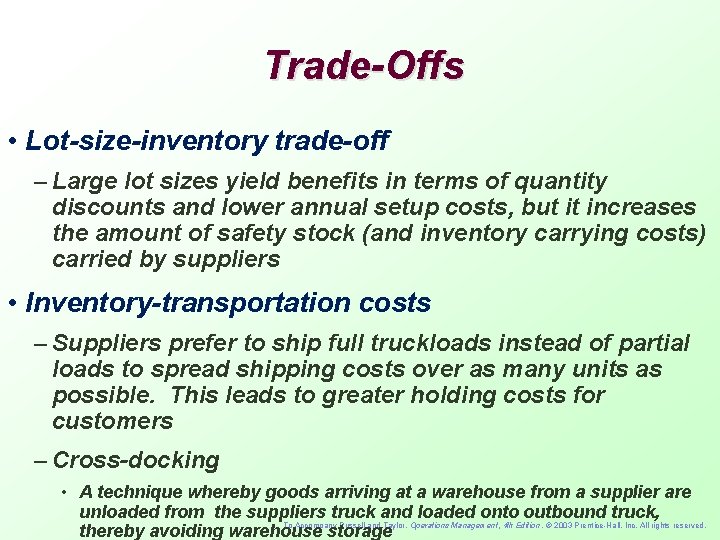
Trade-Offs • Lot-size-inventory trade-off – Large lot sizes yield benefits in terms of quantity discounts and lower annual setup costs, but it increases the amount of safety stock (and inventory carrying costs) carried by suppliers • Inventory-transportation costs – Suppliers prefer to ship full truckloads instead of partial loads to spread shipping costs over as many units as possible. This leads to greater holding costs for customers – Cross-docking • A technique whereby goods arriving at a warehouse from a supplier are unloaded from the suppliers truck and loaded onto outbound truck, To Accompany Russell and Taylor, Operations Management, 4 th Edition , 2003 Prentice-Hall, Inc. All rights reserved. thereby avoiding warehouse storage
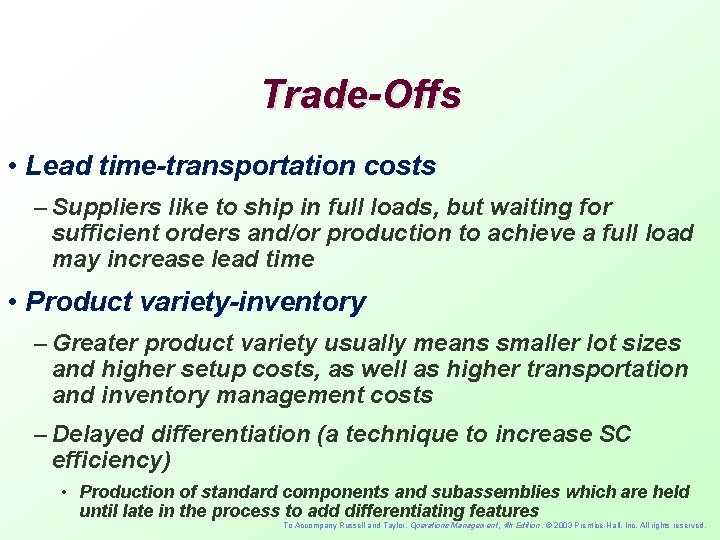
Trade-Offs • Lead time-transportation costs – Suppliers like to ship in full loads, but waiting for sufficient orders and/or production to achieve a full load may increase lead time • Product variety-inventory – Greater product variety usually means smaller lot sizes and higher setup costs, as well as higher transportation and inventory management costs – Delayed differentiation (a technique to increase SC efficiency) • Production of standard components and subassemblies which are held until late in the process to add differentiating features To Accompany Russell and Taylor, Operations Management, 4 th Edition , 2003 Prentice-Hall, Inc. All rights reserved.
Trade-Offs • Cost-customer service – Producing and shipping in large lots reduces costs, but increases lead time – Disintermediation (a technique to increase SC efficiency) • Reducing one or more steps in a supply chain by cutting out one or more intermediaries – Drop Shipping • Shipping directly from the supplier to the end consumer, rather than from the seller, saving both time and reshipping costs To Accompany Russell and Taylor, Operations Management, 4 th Edition , 2003 Prentice-Hall, Inc. All rights reserved.
Techniques to Increase SC Efficiency To Accompany Russell and Taylor, Operations Management, 4 th Edition , 2003 Prentice-Hall, Inc. All rights reserved.
Techniques to Increase SC Efficiency • Delayed differentiation Postponing the tasks of differentiating a product for a specific customer until the latest possible point in the supply-chain network. Production of standard components and subassemblies, which are held until late in the process to add differentiating features – Channel assembly (sending distributors the individual components and modules rather than finished goods) • Disintermediation – Reducing one or more steps in a supply chain by cutting out one or more intermediaries + Cross Docking + Drop Shipping
Other Techniques to Increase SC Efficiency Outsourcing • • Blanket orders (a long-term purchase commitment to a supplier for items that are to be delivered against short-term releases to ship · Drop Shipping and Special Packaging – supplier will ship to end consumer rather than to seller • Vendor managed inventory systems The use of a local supplier to maintain inventory for the manufacturer. • Electronic ordering and funds transfer (paperless ordering, payment by wire)
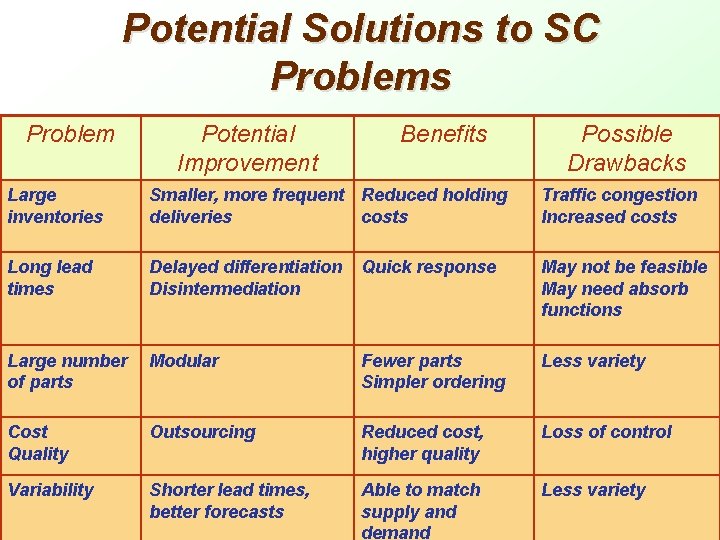
Potential Solutions to SC Problems Problem Potential Improvement Benefits Possible Drawbacks Large inventories Smaller, more frequent Reduced holding deliveries costs Traffic congestion Increased costs Long lead times Delayed differentiation Disintermediation Quick response May not be feasible May need absorb functions Large number of parts Modular Fewer parts Simpler ordering Less variety Cost Quality Outsourcing Reduced cost, higher quality Loss of control Variability Shorter lead times, better forecasts Able to match supply and demand Less variety
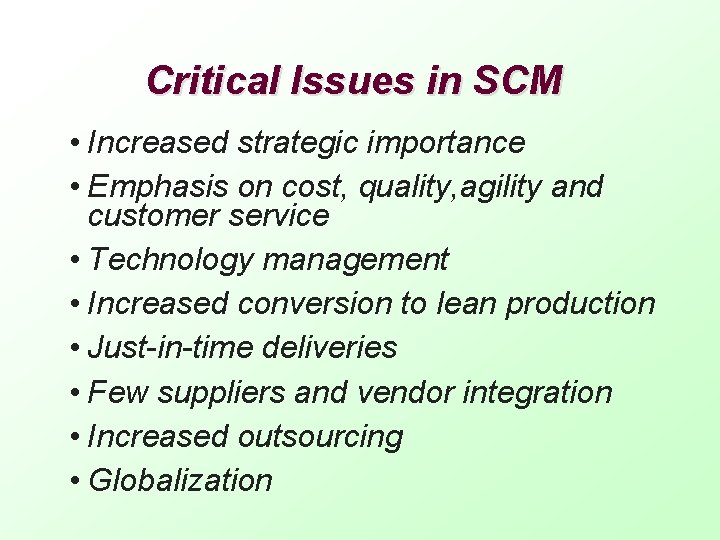
Critical Issues in SCM • Increased strategic importance • Emphasis on cost, quality, agility and customer service • Technology management • Increased conversion to lean production • Just-in-time deliveries • Few suppliers and vendor integration • Increased outsourcing • Globalization
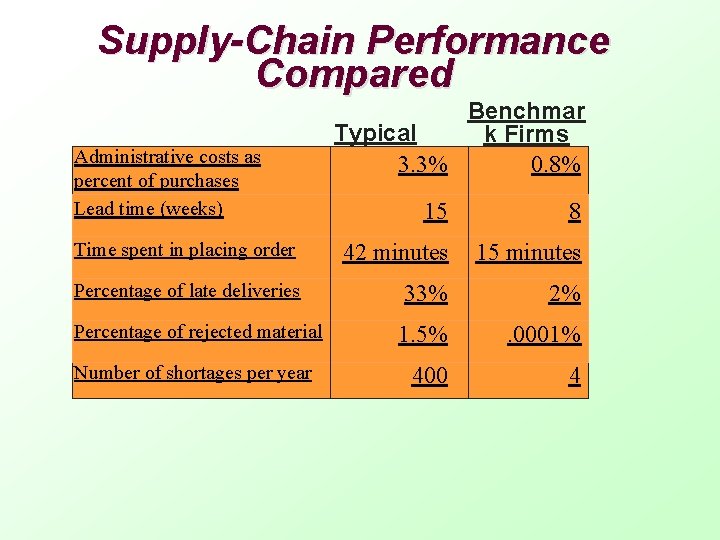
Supply-Chain Performance Compared Administrative costs as percent of purchases Lead time (weeks) Benchmar Typical k Firms 3. 3% 0. 8% 15 8 Time spent in placing order 42 minutes 15 minutes Percentage of late deliveries 33% 2% Percentage of rejected material 1. 5% . 0001% 400 4 Number of shortages per year
To Accompany Russell and Taylor, Operations Management, 4 th Edition , 2003 Prentice-Hall, Inc. All rights reserved.