
Supply Chain Management Principles LB I Demand Planning
Supply Chain Management Principles LB I: Demand Planning

LB Objectives • Explain Integrated Business Management • Explain how demand shaping is used to manage • • LO 1 demand Distinguish between qualitative and quantitative methods of forecasting Categorize the different types of demand patterns Identify causes of the bullwhip effect upon the supply chain Discuss MRP, CRP, DRP, ERP, CPFR 10 -2
Supply Chain Focus • Products • Information • Funds – all of which move from: • Suppliers Distribution • Retailers Customers • Reverse Logistics LO 2 10 -3

Integrated Business Plan • Based on strategies, mission and vision • Business plan drives the demand & supply plan LO 1 10 -4
Demand Management • Demand management is the process through which manufacturers recognize demand through forecasting and customer orders • It can also shape demand through marketing & sales strategies • Supply plan adheres to the agreed-upon demand plan and delivers the targeted revenue, profitability, and cash flow objectives LO 1 10 -5
Balancing Supply with Demand • When demand is greater than supply, business is lost and may never be recaptured • When supply is greater than demand, prices decrease, companies might have funds tied up in inventory, and risk products becoming obsolete LO 2 10 -6
Improving balance between supply and demand • Internal balance – Varying how much is produced and how much is stored in inventory (flexible production processes) • External balance – use of price and lead time – aka Demand Shaping LO 2 10 -7
Collaborative Planning Process • Demand planning is a collaborative process that strives to achieve consensus • It is personnel working together to achieve agreed-upon outcome • CPFR – Collaborative Planning Forecasting & Replenishment LO 3 10 -8
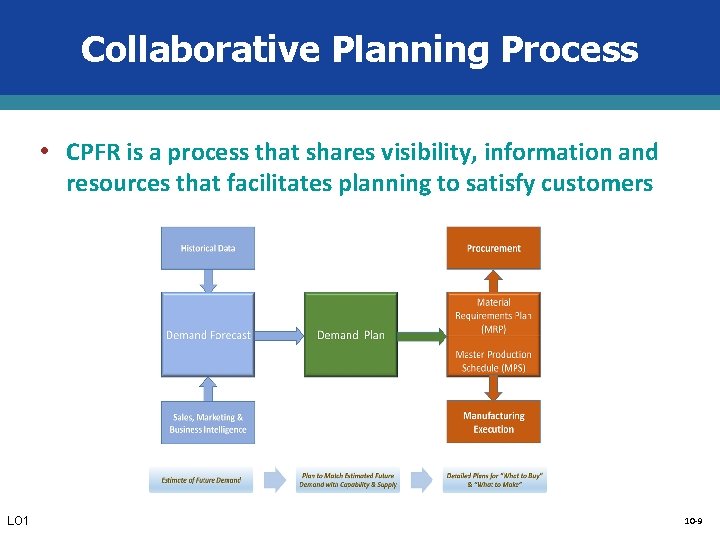
Collaborative Planning Process • CPFR is a process that shares visibility, information and resources that facilitates planning to satisfy customers LO 1 10 -9
Collaborative Planning • Process is driven by demand forecast based on data from business intelligence provided by sales, marketing, and management • S&OP – Sales and Operations Planning helps develop input for the forecast • MRP – Materials Requirements Planning – What should be procured from suppliers • MPS – Master Production Schedule – Which products to make and when to make them LO 5 10 -10
Demand Forecast • A high-level comprehensive plan by senior management with marketing and sales input and is shaped by anticipated customer demand. • It incorporates vision and expectations for shareholder value, revenues, market share and profitability LO 5 10 -11
Demand Plan • Demand forecast enables the creation of the demand plan which more accurately defines resource requirements such as: • • Facilities Equipment Materials Employees • MRP & MPS define specific raw materials and semi- finished goods that are necessary for manufacturing and distribution to achieve targeted revenue, profitability and cash flow objectives 10 -12

Demand Forecasting Methods • Quantitative Forecasting – Use of historical data • Qualitative Forecasting – Use of intuition or expert judgement such as for new products or products that change frequently 10 -13
Demand Forecasting Methods • External inputs – Current and new customers, competition and industryspecific outlook • Internal inputs – Pricing and special promotions planned and the existence of any new product launches 10 -14
Types of Demand Patterns • Stationary patterns – Steady, even demand with • • little fluctuation Random patterns – Exhibit changes and variances that are not predictable Trend – Predictable Seasonal – Increase and decline that repeat cycle after cycle Cyclical – Influenced by external factors such as broader economy or changes in customer preferences 10 -15
Challenges of Demand Planning • • Receiving customer data on a timely basis Determining demand for new products Note that forecasting is almost NEVER perfect Forecast errors calculated should be shared with all stakeholders • Long range forecasts – Greater degree of error • Short term forecasts – Less uncertainty and more accurate because of known market conditions 10 -16
Independent and Dependent Demand • Independent Demand – Finished goods sold by a company which are derived outside the company and created by customers • Dependent – Created by sale of finished goods such as demand for components required to complete a product e. g. demand for tires, seats… • MRP – Materials Requirement Planning software e. g. Oracle, SAP and i-2. • MRP is driven by the demand plan and MPS 10 -17
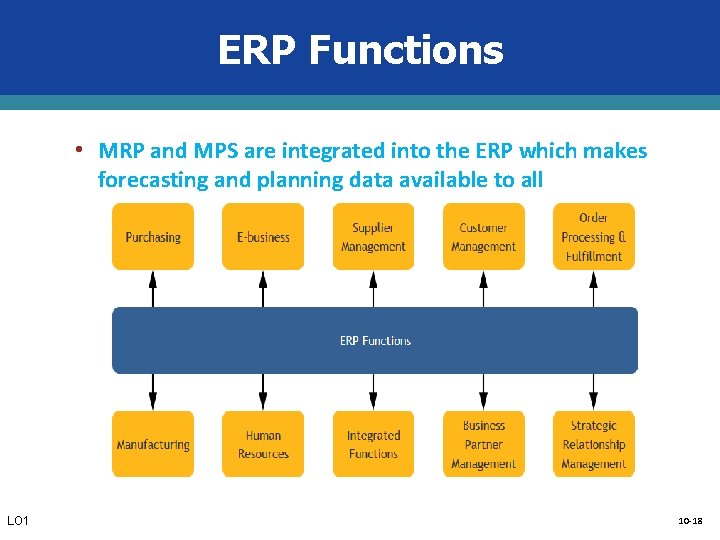
ERP Functions • MRP and MPS are integrated into the ERP which makes forecasting and planning data available to all LO 1 10 -18
- Slides: 18